Customer Pain Points: Complete Guide [Turn Problems into Profit]
Updated on 2 Dec 2025

Jump to
Standing in line at a coffee shop, watching someone struggle with a complicated mobile payment app – that's a customer pain point in action. You've seen it, felt it, and maybe even lost customers because of it.
Tackling these pain points takes more than a friendly customer service rep; it demands a smart approach that lifts the entire customer experience.
Here, we’ll analyze pain points, why pinpointing them matters, and how to take solid steps to fix and even prevent them.
Whether you’re in marketing, sales, or product development, understanding these pain points is key to creating solutions that resonate with customers' true wants and expectations.
What Are Customer Pain Points?
Customer pain points are customers' everyday frustrations when dealing with a service business.
Whether it's the pricing that feels just out of reach, the hassle of inconvenient processes, or a less-than-stellar customer service experience, these issues matter. They impact satisfaction, loyalty, and every buying decision a customer makes.
Spotting these pain points and tackling them head-on? That's how a business builds trust, creates smoother experiences, and forms lasting customer connections.
4 Types of Pain Points
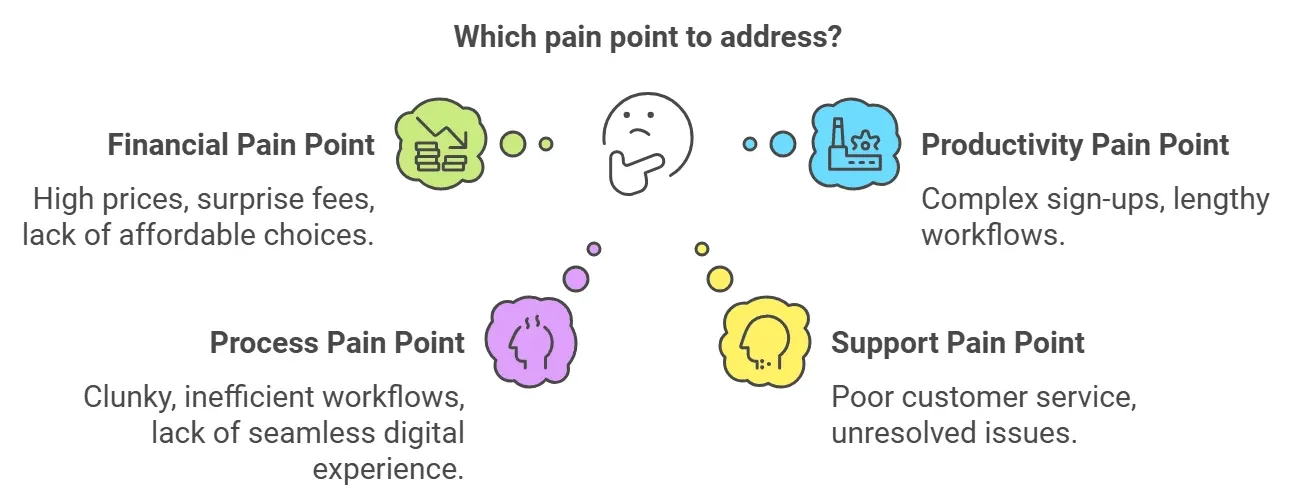
Financial Pain Points
When money feels wasted or value doesn’t add up, that’s a financial pain point. High prices, surprise fees, or a lack of affordable choices can drive customers away. In fact, Saleslion has found that 60% of shoppers abandon purchases over hidden charges.
Productivity Pain Points
Technician productivity suffers when anything that wastes time or demands too much effort creates productivity pain. Complex sign-ups and lengthy workflows are the frustrations that push people toward easier options.
This same friction impacts internal operations; if your technicians are wasting billable hours searching for scattered job site photos or equipment manuals, you can calculate your DAM ROI to measure exactly how much revenue is being lost to disorganized digital files. Similarly, a mobile-first system that lets teams maintain a running inventory of their tools can help cut the same kind of wasted time by making critical information instantly accessible in the field.
Using knowledge management software can help service teams organize job site photos, equipment manuals, troubleshooting guides, and customer records so technicians can find the information they need faster.
Process Pain Points
Process pain is all about clunky, inefficient workflows. If a customer can’t achieve their goals smoothly, they’re gone. A recent study from Salesforce Research says 57% of people will leave a brand that lacks a seamless digital experience.
Businesses can address these issues by simplifying workflows, improving usability, and investing in application modernization services to replace outdated systems that create friction.
Support Pain Points
Poor customer service? Big problem. When issues go unresolved, customers walk. In fact, according to Microsoft’s Global Customer Service Report 56% of customers say bad service is why they switch brands.
Advanced Tip
Use real-time feedback tools like Qualtrics to catch and categorize these pain points early, so you’re always one step ahead in addressing customer concerns.
Importance of Identifying Pain Points
Tackling customer pain points isn’t just a nice-to-have—it’s a must for keeping customers happy, loyal, and talking positively about your brand.
When you smooth out these rough spots, you’re creating an experience that feels right, that meets what customers expect, and that keeps them coming back.
A seamless experience doesn’t just please; it keeps people loyal.
Forbes found that 73% of consumers say a good experience is what locks in their brand loyalty.
Quick Tip
Regularly review customer feedback and key metrics. Stay tuned into what your customers want and be ready to shift your strategies to match.
Why Identifying Customer Pain Points Matters
Value Proposition Improvement
Spotting your customers' pain points is the key to sharpening your value proposition. Learning how to start a service business with customer needs in mind helps shape your offerings to the exact solution they need.
When you understand what they’re struggling with, you can shape your product or service to be the exact solution they need. It’s all about crafting offerings that truly resonate.
Quick Tip
Check in with your customers regularly—simple surveys work wonders. This keeps your product in sync with what they actually need, refining your value proposition to stay relevant.
Enhanced Customer Satisfaction
Solving those pain points is the fast track to happy, loyal customers. When you show them you’re listening and care about their experience, you’re building trust that keeps them coming back.
| Satisfaction Driver | Impact on Customer Loyalty |
|---|---|
Pain Point Resolution | Builds trust, strengthens loyalty |
Responsive Support | Cuts frustration, elevates experience |
User-Friendly Processes | Simplifies and boosts satisfaction |
Increased Retention and Loyalty
Addressing what frustrates your customers is key to keeping them around. When pain points go unaddressed, they can quickly turn into reasons for customers to walk away.
In fact, PWC found that 32% of customers would leave a brand they loved after just one bad experience.
That’s why tackling these issues head-on isn’t just important—it’s essential for keeping your customers happy and loyal.
Pro Tip
Tap into predictive analytics to spot potential issues before they become problems. Get ahead of the game, cut down on churn, and make sure your customers stick around.
Competitive Advantage
To stand out, address what your customers struggle with. When you fix the gaps others leave behind, you’re no longer just a choice—you’re the choice. And that makes a difference.
McKinsey found that 70% of buying decisions hinge on how customers feel treated. This isn’t just nice to have; it’s essential.
In today’s crowded market, putting customers first isn’t just wise—it’s the game-changer that builds loyalty and keeps you ahead.
How to Identify Customer Pain Points
Methods for Identifying Pain Points
Customer Feedback Surveys
Customer surveys are a goldmine for spotting pain points. These open-ended questions give customers a chance to voice their unique challenges. Multiple-choice options make it easy to sort and analyze.
Microsoft found that 77% of people view brands more positively when they actively seek and act on feedback.
Quick Tip
Add questions like, “What was the biggest challenge in using our service?” so customers can highlight what really needs fixing.
Market Research and Competitive Analysis
Market research and competitor analysis shine a light on industry trends and unmet needs. An AI in marketing automation can help businesses process large volumes of market data and customer feedback. This method not only reveals customer pain points but also shows where competitors are falling short.
Social Listening
Social media is where people vent and share raw experiences. Platforms like Twitter and Facebook are filled with real opinions and frustrations. Perfect for tapping into unfiltered customer feedback. Analyzing privacy and security concerns can also reveal customer pain points. Many users get calls from unknown numbers and worry if they are safe. A reverse phone lookup service can help identify callers and reduce uncertainty.
Customer Support Interactions
Customer service logs and FAQs are a treasure trove of recurring issues. A skilled field service manager can spot patterns here that help identify common pain points that just keep coming up.
NLP Tools and Techniques
Sentiment Analysis
Sentiment analysis reveals how customers feel about specific pain points by examining text feedback. It uncovers insights into customer emotions, improving customer engagement before issues escalate.
Topic Modeling
Topic modeling groups feedback into common themes, making customer needs and complaints clearer. This technique clusters related concerns, so teams can focus on solving the most frequent issues.
Tools like LDA (Latent Dirichlet Allocation) often help organize feedback based on common topics.
Keyword Extraction
Keyword extraction tools zero in on the exact words customers use to describe their challenges. This way, companies can align their messaging to better match customer language, enhancing clarity and connection.
Advanced Tip
Use NLP tools like MonkeyLearn or Lexalytics for keyword extraction. These tools quickly identify common terms across feedback, making it easier to spot recurring issues and address them faster.
Common Customer Pain Points Across Industries
Financial and Cost-Related Pain Points
High costs, hidden fees, and surprise charges. These are the common headaches that stop customers in their tracks. It’s frustrating when the final price suddenly jumps because of unexpected add-ons. Hidden costs like these make people suspicious of billing fraud, breaking trust instantly.
Quick Tip
Be upfront with all costs to build trust and keep those carts from being abandoned.
Productivity-Related Pain Points
Time-wasting processes. Clunky operations. These are the hurdles slowing us down. People want quick, easy experiences—from a fast checkout to a customer service chat that doesn’t drag.
Salesforce Research shows that 66% of customers expect businesses to understand and meet their time-saving demands. They’re ready for things to move faster—are you?
| Issue | Examples |
|---|---|
Manual, Repetitive Tasks | Endless forms, typing the same info over and over |
Slow Processes | Long waits, delayed replies |
Inefficient Navigation | Complicated menus, too many clicks to get things done |
User Experience and Accessibility Pain Points
User experience (UX) and accessibility issues can be a real deal-breaker for customers. When interfaces are tricky or don’t support people with disabilities, users get frustrated—and fast.
The stats don’t lie: 98% of websites have accessibility problems, according to InfoStride. This highlights a massive need for inclusive design.
Common UX Issues
- Confusing navigation.
- Poor mobile optimization.
- Inconsistent design elements.
Accessibility Barriers
- No screen-reader compatibility.
- Missing alt text for images.
Quick Tip
Test your website’s accessibility regularly. Stay compliant with WCAG standards to make things smoother and easier for everyone.
Support and Service Gaps
Long wait times, unhelpful replies, and a lack of personal touch—these are support issues that drive people away fast.
In fact, 56% of customers say goodbye to a brand after poor service, according to Microsoft. Reducing wait times and adding a personal touch can change the game.
Implementing efficient field service dispatching can significantly reduce response times and improve customer satisfaction.
| Support Issue | Impact |
|---|---|
Long Wait Times | Increases frustration, reduces satisfaction |
Unhelpful Responses | Trust drops, brand reputation takes a hit |
Lack of Personalization | Customers feel unseen and start to drift away |
How to Address and Solve Customer Pain Points
Following field service management best practices is crucial when addressing customer pain points. Start by refining what you offer. When you address real customer needs head-on, everything changes.
Product or Service Improvements
Start by refining what you offer. When you address real customer needs head-on, everything changes.
Tweaks that make your product easier to use and remove frustrations are game-changers. From smoother onboarding to simpler navigation, even the smallest adjustments can make a big difference.
Ways to Improve Usability
- Add guided tutorials for new users.
- Cut down steps in any service process.
- Regularly gather and act on feedback to polish features.
Customer-Centric Marketing and Messaging
Customer-centric marketing goes straight to the heart of what matters to people—showing them you “get it.” Address their struggles directly.
When they see you understand, they’ll trust that you’re here to help.
Targeted campaigns that cut through the noise and offer real solutions let customers know their needs are your top priority.
Effective Messaging Tactics
- Spotlight solutions for common challenges in your ads.
- Share testimonials from customers who’ve faced similar issues.
- Personalize messages for groups with shared needs.
Further Read: Electrician Marketing: Increase Your Customers with Effective Strategies
Quick Tip
Use email to spotlight new product features designed to tackle specific issues. Keep them in the loop and feel valued.
Updating Processes and Customer Support
Implementing field service automation can boost efficiency in customer support, leading to faster responses and more personalized help.
Automated tools like AI customer service solutions, AI-powered chatbots and predictive analytics allow companies to jump in right when customers need it most, while stronger caller authentication practices can also help businesses improve customer trust and reduce fraud-related support issues. For field service businesses that receive high volumes of inbound calls, pairing these tools with a dedicated answering service ensures phone inquiries are handled automatically — so no customer call goes unanswered while technicians are out in the field.
| Simplifying Strategies | Benefits |
|---|---|
Automated Chatbots | Instant support, less waiting |
Predictive Analytics | Anticipates needs, personalizes answers |
Self-Service Portals | Empowers customers to solve issues on their own |
A Zendesk study shows businesses using AI for support see major cuts in response times, giving customer satisfaction a real boost.
Advanced Tip
Use AI insights to zero in on the most urgent issues so customers with complex concerns get swift, tailored solutions.
Case Study: Resolving Customer Pain Points
Grasping what customers struggle with—and actually fixing it—matters. It’s the key to happier customers, stronger loyalty, and, ultimately, a thriving business.
Some brands have cracked the code on this, zeroing in on those pain points and turning them around. This leads to better experiences for customers and real growth for the business.
Here’s a look at a few real-world wins:
PayPal's Cultural Adaptation in Customer Support
PayPal saw something big: customer satisfaction looked different depending on where you were in the world. To dig deeper, PayPal teamed up with Medallia to uncover just how culture shaped customer service scores.
They found that people across regions had unique expectations and ways of seeing things.
So, PayPal got smart—they tailored their training to match these cultural differences. This led to a global boost in customer support that truly connects no matter where you are.
Amazon's Focus on Customer Convenience
Amazon knows what we all want: quick, easy, no-hassle shopping. With one-click buys, same-day delivery, and a simple return policy, they've taken the stress out of the process.
It’s all designed to make life easier and faster, so you can get what you need, when you need it, without a second thought.
These features keep customers happy and coming back for more, setting a high bar for e-commerce.
Hilton Hotels' Technological Enhancements
Hilton Hotels and Resorts knew one thing: long check-in lines were driving guests crazy. So, they took action.
Now, with their mobile app, you can skip the front desk hassle, check in, and even pick your room—all from your phone. Faster, smoother, and totally in your hands.
A few taps, and you're in control, ready to enjoy your stay without the wait. Guests love it. Satisfaction up, stress down.
Tools and Technologies to Help Identify and Address Pain Points
Customer Feedback Platforms
Platforms like SurveyMonkey, Typeform, and Google Forms help businesses gather real, structured feedback straight from customers.
With targeted surveys, you’ll capture insights on satisfaction, pain points, and areas to improve. Many businesses use customer engagement tools to streamline these insights and act faster on critical feedback.
These tools make it easy to switch up question types—from multiple choice to open-ended—so responses are simple to sort and analyze.
Benefits of Feedback Platforms
- Gather and review data fast.
- Export and organize results easily.
- Tailor survey formats for any audience.
Sentiment Analysis Tools
Sentiment analysis tools like MonkeyLearn and Lexalytics give companies a clear view of what customers really feel.
Using Natural Language Processing (NLP), these tools pick up on whether feedback is positive, neutral, or negative—whether it’s a review, a tweet, or a support message.
Pro Tip
Pair sentiment analysis with topic modeling to uncover specific issues that spark strong reactions.
Social Listening Tools
Hootsuite and Sprout Social are go-to tools for keeping tabs on what people are saying about your brand on social media. They let businesses track brand mentions, hashtags, and key phrases, capturing real-time reactions to products or services.
Spotting feedback quickly means catching potential issues before they snowball.
A Sprout Social report even highlights that 78% of consumers are more likely to buy after a positive social media interaction.
Social Listening Advantages
- Monitors customer feedback across platforms.
- Enables fast responses to issues.
- Offers insights into brand reputation and loyalty.
Customer Service Software
Customer service software—like Tidio, Zendesk and Freshdesk—brings order to the chaos of customer support. They gather all those support requests in one place, letting you spot common issues quickly.
With features to track and tag those recurring pain points, these tools make it easier to stay on top of what customers need most.
Plus, their CRM tools make it simple for your team to deliver that extra personal touch, which customers love.
In fact, Salesforce reports that 88% of people stick with companies that show they care through personalized support.
Conclusion
Customer pain points reveal what your audience really needs but isn’t getting. By spotting these gaps and taking action, you’re not just easing their experience—you’re building loyalty and showing you’re a brand that truly cares.
But remember, these needs don’t stand still. They shift, they grow. Stay on it, be ready to adapt, and meet them where they are. Start today.
Listen. Understand. Act. Your customers will respond with the loyalty and trust that every brand craves.
Frequently Asked Questions
What are common customer pain points?
Common pain points include high costs, wasted time, clunky experiences, and weak support. Hidden fees and endless wait times wear down customers, leading to lost sales and slipping loyalty.
How can I identify pain points in my business?
Spot the pain points with customer surveys, market research, social listening, and digging into support requests. These methods expose what frustrates your customers, pointing the way to real improvements.
How do customer pain points affect retention?
Unresolved issues drive dissatisfaction and churn. Research shows just one bad experience can push 32% of customers away from a brand—proof that quick fixes aren’t optional.
What is the role of NLP in identifying pain points?
NLP tools like sentiment analysis and keyword extraction dive into feedback, showing customer emotions and frequent problems. With this, businesses can swiftly spot and tackle pain points, keeping customers happier, and longer.
Try FieldServicely #1 Field Service Management Software
Try for free - No credit card required!