- GPS Tracking for Field Service
How to Avoid Client Disputes with GPS Time Logs [Causes & Best Practices]
Updated on 27 Mar 2026

Jump to
Summary

Client disputes start when the time, location, and work proof don’t clearly match the invoice.
Manual logs create gaps, while GPS time logs connect time, location, and activity into one verifiable record.
Most disputes come from missing proof, delayed entries, unclear work breakdowns, and a lack of transparency.
GPS systems remove doubt using real-time tracking, geofencing, and proof-backed logs for every task.
Clear, data-backed records turn invoices into facts, which speeds approvals and reduces disputes.
A client questions your invoice because they cannot verify the work. You say the team worked 5 hours. They believe it was 2. That gap creates friction.
GPS-verified time logs fix this problem at the root. They show exact time, exact location, and real activity. Still, most businesses rely on manual logs. That leads to vague entries, delayed tracking, and missing proof.
As a result, invoices turn into arguments instead of approvals. And once disputes begin, they don’t just slow payments. They damage trust, relationships, and future deals.
In this blog, we will break down why disputes happen and how GPS time logs eliminate them.
What is a GPS Time-Based Client Invoice Dispute?
A GPS time-based client invoice dispute happens when a client questions your invoice because time and location proof are missing or unclear. This happens often.
You send a bill, and the client asks, “Were your team really there that long?”
Traditional disputes usually come from memory-based logs. Teams fill timesheets later, and errors creep in. Now, GPS-based disputes are different. They happen when data exists, but doesn’t fully prove the work.
For example, a worker logs 3 hours, but the GPS shows only 1.5 hours on-site. This creates a direct mismatch.
Manual logs are subjective because people estimate. GPS logs are objective because they automatically record exact time and location.
However, GPS only works when properly configured. Without proper tracking, even data can be questioned.
Why Do Client Disputes Take Place?
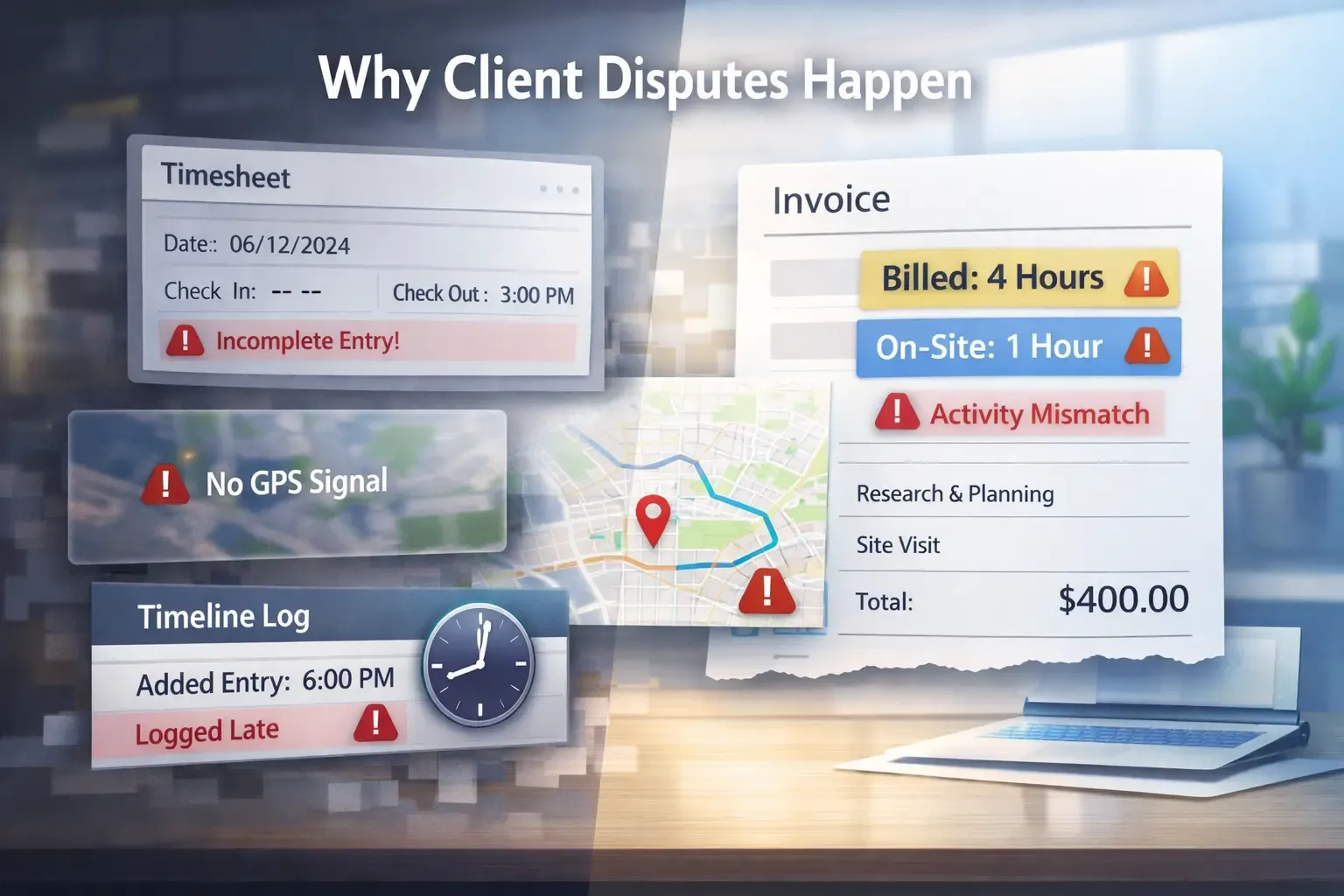
Client disputes don’t appear out of nowhere. I’ve seen this happen repeatedly. A project goes well, work gets delivered, but the moment the invoice arrives, questions start to arise.
Let’s break down the real reasons behind it.
Lack of Verifiable Proof
Most disputes start when you cannot clearly prove the work. You may know your team did the job, but the client cannot see that proof. That’s where things begin to break.
I’ve worked with teams that relied on manual logs. Everything looked fine internally, but when the client asked for exact timelines or proof of location, there was nothing solid to show.
A 2024 Deloitte audit study shows companies without strong tracking systems face over 30% billing disputes due to missing verification data.
So even when the work is correct, the lack of proof creates doubt. And once doubt enters the conversation, the dispute begins.
No Location Validation or Real-Time Logs
Now, let’s go deeper. Even if time is tracked, without location validation, it still feels incomplete.
For example, a technician logs 3 hours on-site. The client remembers seeing them for much less time. Without GPS or real-time logs, there is no way to confirm what actually happened.
This is where real-time tracking changes everything. Research shows that inefficient or delayed time tracking leads to inaccuracies and payroll disputes. That’s because they stop explaining and start showing.
Without that data, every discussion becomes a back-and-forth argument.
Delayed or Reconstructed Time Entries
Another major reason is delayed time tracking. Teams don’t always log time when the work happens. They log it later.
Many employees fill out timesheets at the end of the day or even the end of the week. At that point, they are relying on memory rather than actual data. And memory is never perfect.
According to a study, 80% of medical billing contains at least one error. Even small errors can make invoices look inconsistent.
Once clients notice that inconsistency, they start questioning everything.
Mismatch Between Work and Invoice
Here’s where perception plays a big role. Clients don’t see your full process. They only see the invoice.
You might spend hours researching, planning, and preparing. But the client only remembers a short call or a quick visit. So when they see a 4-hour charge, it feels high to them.
This creates a mismatch between effort and visibility. The work is real, but the value is not clearly shown. That gap is what triggers disputes.
Clients don’t reject the work itself. They question what they cannot see.
Trust Gap Between Client and Business
All of this leads to one thing. A trust gap.
Once clients start doubting one invoice, they begin to question others. I’ve seen this escalate quickly. One unclear bill leads to multiple follow-ups, delayed payments, and increased scrutiny.
According to a report, lack of transparency drives payment delays and disputes. When clients cannot verify the data, they assume risk. And when trust drops, even accurate invoices get challenged.
Uncertainty
Disputes are not really about money. I’ve seen clients approve large invoices instantly when everything is clear. At the same time, small invoices get questioned when details are missing.
So the real issue is not pricing. It is uncertainty.
When clients feel unsure about what they are paying for, they push back. When they see clear, verifiable proof, they move forward without hesitation.
That’s why disputes happen. Not because clients don’t want to pay, but because there is no strong evidence to remove doubt.
Stop relying on memory-based timesheets
Track work in real time with GPS logs so every billed hour matches actual activity.
Hidden Cost of Invoice Disputes
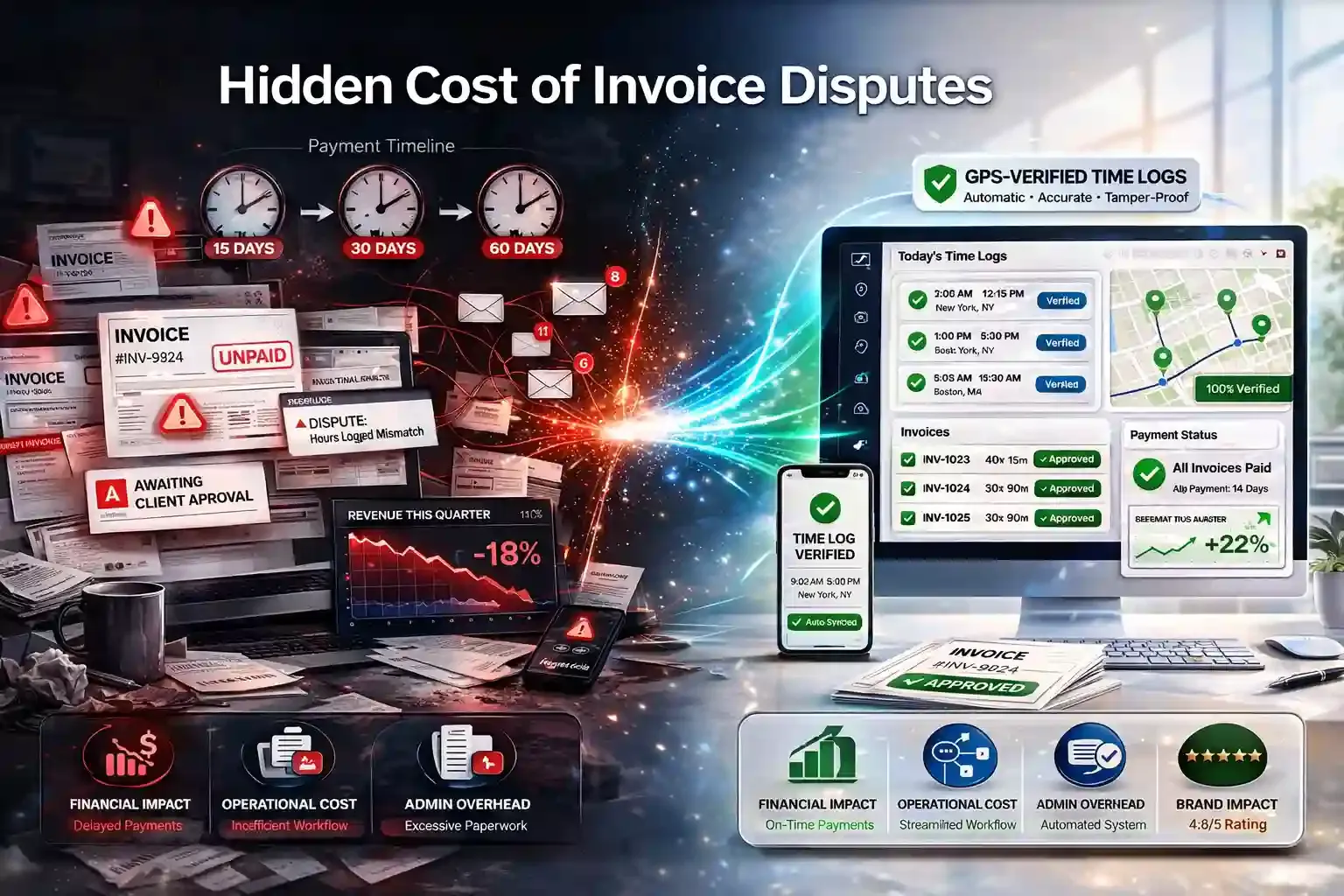
Financial Impact: Delayed Payments and Revenue Leakage
Invoice disputes immediately slow down payments because clients pause approvals the moment confusion appears. What should close in 15 days often stretches to 30, 45, or even 60 days while both sides go back and forth.
According to a 2025 Atradius survey, 55% of B2B payments face delays due to disputes or approval issues. It directly disrupts cash flow planning.
This delay creates a second problem. Businesses start adjusting invoices just to close the issue faster, which leads to revenue leakage. Instead of collecting full value, teams accept partial payments, discounts, or write-offs to avoid prolonged conflict.
Over time, these small losses add up and quietly reduce profitability.
Operational Cost: Time Spent Resolving Disputes
Invoice disputes consume operational time because every detail needs validation before responding. Teams review logs, check timelines, revisit communications, and sometimes even reconstruct the work history to justify a single invoice. This process takes hours.
Did you know invoice exceptions ranked as the top AP challenge in 2024? That too affecting 53% of teams, and these bottlenecks cause organizations to miss early-payment discounts and lose efficiency.
It means half of your team’s effort goes into fixing issues instead of building systems or improving efficiency. As disputes increase, this becomes a recurring operational burden that slows down the entire organization.
Admin Overhead: Extra Work That Slows Everything Down
Invoice disputes increase administrative overhead because each issue creates multiple layers of follow-up work. Teams don’t just send an invoice anymore. They track conversations, resend documents, revise entries, and manage long email threads to clarify details.
This repeated effort increases processing cost per invoice. Only 17% of firms had fully automated their payment processes. It leaves most companies exposed to manual bottlenecks like errors, late payments, and cash-flow volatility.
As disputes grow, billing workflows become heavier, slower, and more complex. Instead of a smooth system, the process turns into constant correction and coordination.
Relationship Damage: Loss of Trust and Churn Risk
Invoice disputes damage relationships because clients begin to question reliability. When billing lacks clarity, clients begin to doubt the entire process. This shift changes the dynamic from trust to verification.
According to a report, 29% of consumers stopped buying because of poor customer experience online or in person. Billing confusion often triggers that experience because it directly affects money and transparency.
Once trust drops, every future invoice faces more scrutiny, increasing friction and slowing collaboration. Over time, this leads to churn risk.
Clients prefer working with businesses that provide clarity and confidence. If your process creates repeated doubt, they start looking for alternatives.
Brand Impact: Negative Reviews and Reputation Loss
Invoice disputes affect brand perception because dissatisfied clients often share their experience publicly. A billing issue feels more serious than a minor service delay because it involves money and fairness. When clients feel overcharged or confused, they are more likely to leave negative feedback.
According to a report, only 4% of consumers never read online reviews. That means a huge portion of consumers rely on online reviews before taking a service.
So one negative review shapes how new prospects perceive your credibility before they even engage.
This creates a long-term impact. Reputation loss reduces conversion rates, affects referrals, and weakens your position in competitive markets.
Reduce payment delays and cash flow gaps
Use GPS-backed time logs to remove confusion
How GPS-Verified Time Logs Eliminate Disputes
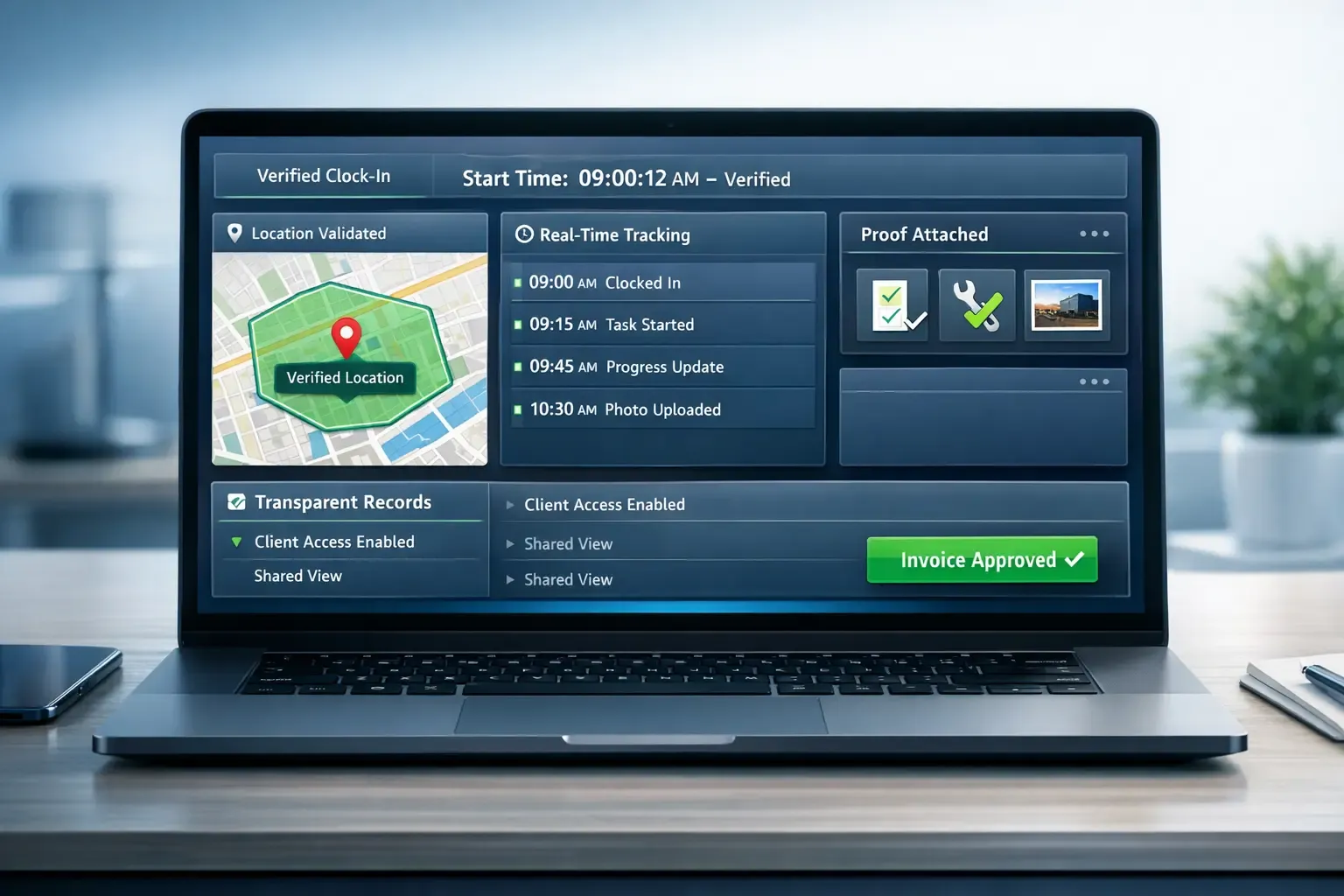
Once I switched to GPS-verified time logs, it removed doubt completely. Now, let me walk you through how that system actually works in real life.
Verified Clock-Ins
Disputes often begin with one simple question. When did the work actually start?
Manual systems depend on entries filled later. Someone writes 9:00 AM, but there is no way to verify it. That small gap creates suspicion immediately.
GPS clock-ins remove that gap. The system captures the exact second someone starts work, along with their real location. That record stays locked.
Now the invoice does not “claim” a start time. It shows it. That single change removes the first layer of argument.
Location Validation
After a time, the next question shows up fast. Was the work done at the right place?
This problem appears more often than expected. Someone clocks in near a job site, not at the actual site. On paper, it looks correct. In reality, it is not.
Geofencing fixes this directly. The system allows clock-ins only inside a defined job boundary. Anything outside gets blocked or flagged instantly.
That means every recorded hour connects to the correct location, not just a nearby point.
According to a paper, the manual workload is associated with attendance tracking. It introduces errors, while automated systems minimize errors and enhance accuracy. Once you validate the location at the source, those errors drop sharply.
Real-Time Tracking
Now comes the biggest issue. Time gets filled after the work ends.
At the end of the day, details blur. Tasks merge. Hours get rounded. Small errors slip in, and those errors add up.
Real-time tracking removes that problem completely. The system records work as it happens, not hours later.
So instead of guessing how long something took, the system builds a clean timeline automatically. Each entry connects to actual activity, not memory. That keeps the data sharp and consistent from the start.
Proof-Based Logs
Even with accurate time, one problem remains. Time alone does not explain value.
A client sees “3 hours billed” and immediately asks, what happened during those 3 hours?
Proof-based logs answer that question without delay. Each time entry connects to supporting evidence like photos, task updates, or job notes.
So instead of seeing just hours, the client sees completed work tied to those hours. That changes how invoices get reviewed. Questions drop because the work becomes visible.
Data Transparency
Another hidden issue lies in how information flows.
In most cases, one side holds all the data. The other side sees only the invoice. That imbalance creates friction.
GPS-based systems remove that imbalance. Both sides access the same records, including timestamps, locations, and proof logs.
No filtering. No interpretation gaps. Just shared visibility.
That shift matters because disputes don’t grow when both sides look at the same data. They grow when information feels incomplete.
Faster Approvals
All of this leads to one clear outcome.
Invoices stop triggering questions. They start making decisions.
When records show exact time, exact location, and clear proof, the review process becomes simple. There is nothing left to verify manually.
This is not just a theory. Clear data speeds up approvals because it removes hesitation.
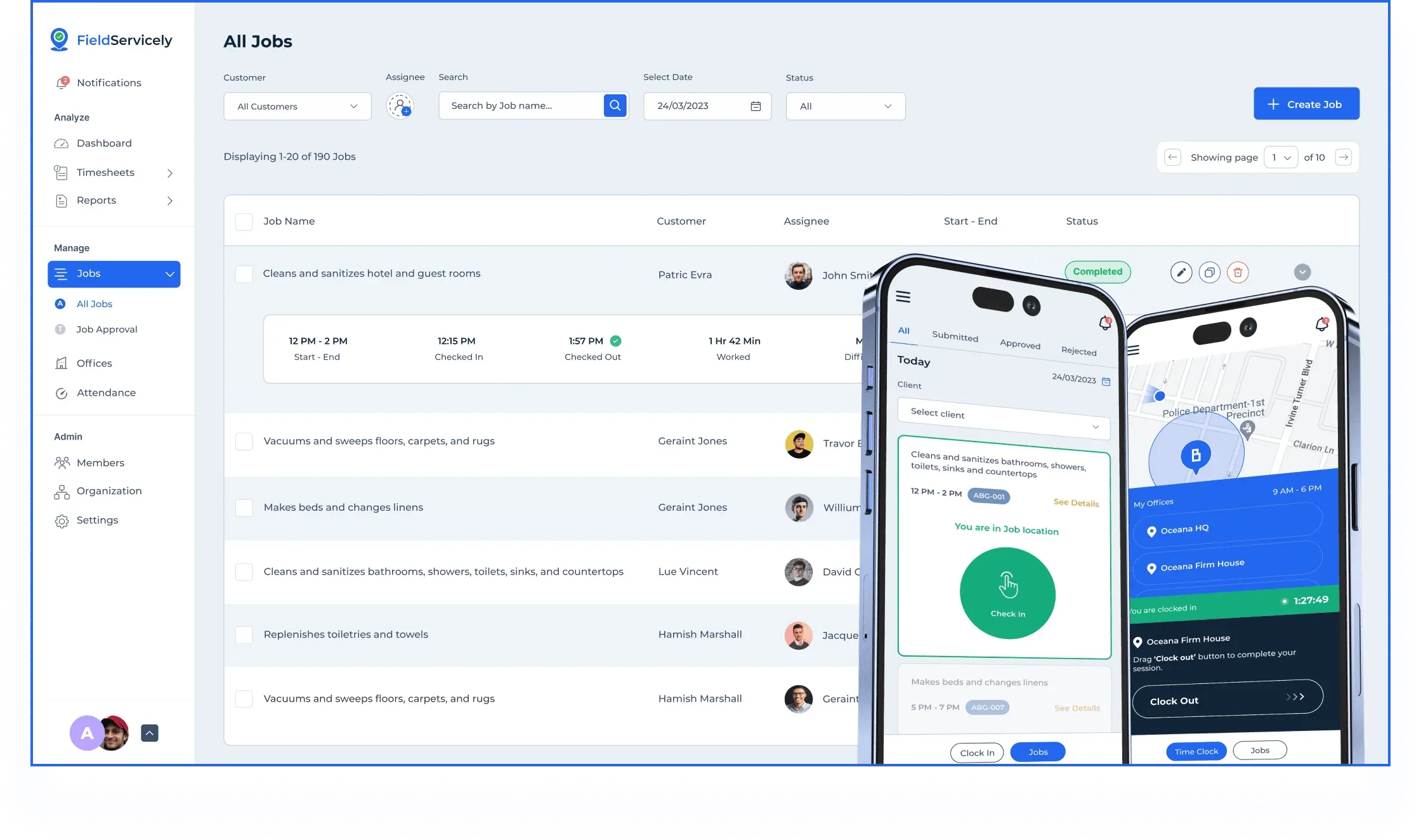
At this point, the system matters more than the tool. That said, platforms like Fieldservicely bring this entire setup into one place with GPS tracking, geofencing, and proof-based logs already built in.
So instead of managing separate tools, everything connects automatically, which makes dispute prevention part of your daily workflow, not an extra step.
Replace manual logs with Fieldservicely GPS tracking
Capture exact time, exact location, and real activity without relying on memory.
How to Avoid Client Invoice Disputes: Best Practices
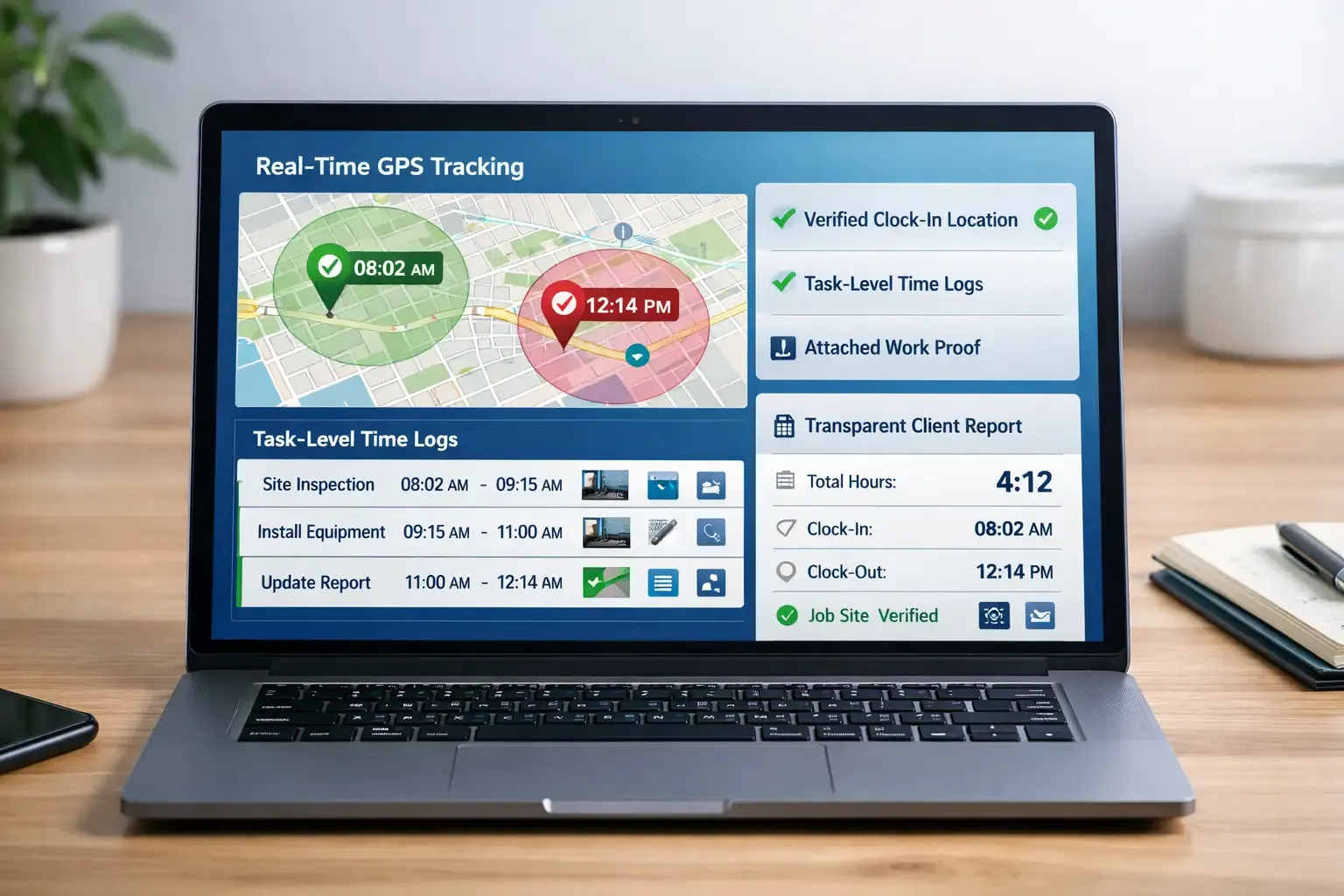
Track Time in Real Time with GPS
Manual time tracking creates inconsistencies, even when the team tries to stay accurate. People don’t log work instantly. They wait until later, then try to reconstruct what happened during the day.
That leads to rounded numbers, missing tasks, and entries that don’t fully reflect actual work.
Real-time GPS tracking removes that entire layer of guesswork. The system records time as the work happens, so every entry reflects real activity instead of memory. This keeps the data consistent from the beginning and removes the need to adjust or “clean up” timesheets before sending invoices.
Validate Location at Clock-In and Clock-Out
Even accurate time tracking doesn’t fully solve disputes if the location remains unclear.
GPS-based geofencing closes that gap. The system allows clock-ins only within defined job locations and flags anything outside that boundary. This creates a direct link between recorded time and the actual job site.
This step becomes critical for mobile teams. According to research, real-time location monitoring significantly improved attendance tracking by eliminating manual errors.
Break Work into Task-Level Logs
Large time blocks often create confusion, even when they are accurate. A single entry covering several hours doesn’t explain how that time was used, which makes clients feel uncertain about the value behind it.
Breaking work into task-level logs improves clarity immediately. Instead of grouping hours, each activity gets its own entry with its own duration. This creates a clear sequence of work that clients can follow without additional explanation.
Attach Proof to Time Logs
Time tracking shows duration, but it doesn’t always show output. Clients don’t just evaluate how long something took. They evaluate what actually got done during that time.
Attaching proof to time logs fills that gap. Photos, notes, and task updates connect directly to each time entry, giving context to every recorded hour. This turns time logs into complete work records instead of simple numbers.
Share Transparent Reports with Clients
Sharing transparent reports changes how invoices get reviewed. These reports combine time, location, and supporting proof into one structured view. Clients can see exactly how the work progressed without needing to request clarification.
This approach reduces friction during approval. Instead of asking for breakdowns or explanations, clients can review everything up front. That shortens the feedback loop and keeps payments moving.
This aligns with broader payment behavior trends. According to research, businesses using structured, data-driven billing processes experience fewer disputes and faster approvals.
Validate every clock-in with location proof
Ensure time entries match the exact job site with geofencing and live tracking.
Conclusion
Most invoice disputes start when something doesn’t clearly match.
A client checks the invoice and struggles to connect the hours with actual work. That confusion leads to questions, and those questions slow everything down.
This usually happens because time tracking lacks clear proof. Hours exist, but supporting details don’t.
GPS-verified time logs solve this by linking time, location, and work together. When clients see that connection clearly, approvals become faster, and disputes rarely come up.
Frequently Asked Questions
Is GPS time tracking legal for employees?
Yes, GPS time tracking is legal in most countries when you inform employees clearly. Laws usually require consent, especially if tracking uses personal devices. You must also limit tracking to work hours to avoid privacy issues.
How accurate are GPS time logs for billing?
GPS time logs are usually accurate within 5 to 20 meters, depending on the environment. Outdoor job sites provide higher accuracy than indoor spaces. That level of precision is enough to verify attendance and time-on-site for billing.
Can GPS tracking replace manual timesheets completely?
Yes, many businesses replace manual timesheets with GPS-based tracking. Automated logs reduce human error and save time on payroll processing. However, adding notes or task details still improves clarity for clients.
Do GPS time logs work without an internet connection?
Yes, most GPS apps store data offline and sync later. This helps teams working in remote areas or low-signal zones. Once the device reconnects, the system uploads all time and location data automatically.
What industries benefit the most from GPS time tracking?
Industries with field work benefit the most. This includes construction, cleaning services, HVAC, logistics, and field service teams. Any business that bills based on time and location can reduce disputes using GPS logs.