- Fundamentals
Field Service Technician: Role, Training, Salary & Jobs
Updated on 12 May 2026
Jump to
Summary

A field service technician installs, repairs, maintains, and troubleshoots equipment at customer locations.
The job needs technical skills, problem-solving, customer service, time management, and clear record-keeping.
Training can include trade school, job training, and certifications like CompTIA A+ or OSHA.
Field service technician pay depends on experience, skills, overtime, and the type of work.
Businesses can manage field teams better with scheduling tools and field service software.
A field service technician travels to customer sites to install, repair, inspect, and maintain equipment. These professionals handle equipment installation, diagnostics, and testing in the field.
And honestly, demand for skilled field service technicians keeps growing. Modern businesses depend more on connected systems, industrial equipment, and fast customer service.
In this blog, I will discuss what a field service technician does, the skills and certifications needed. I will also share the salary expectations, industries hiring technicians, and the steps to enter this career.
What is a Field Service Technician?
A field service technician fixes, installs, checks, and maintains equipment at the customer’s location.
Instead of working only at a help desk or giving phone support, this worker travels to the job site to fix problems. They may work in homes, offices, or hospitals. They may also work in factories, telecom sites, HVAC systems, or construction sites.
Simply, a field service technician is the hands-on person behind on-site service.
They handle service calls, field visits, customer callouts, and equipment setup. Not to mention system configuration, parts replacement, testing, inspection, and job documentation.
Now, here’s where this role becomes more important.
A field technician is often the only person the customer meets face-to-face. 74% of mobile workers say customer expectations are higher than before. This means the technician is not just fixing equipment. They are also protecting customer trust.
You may also see this role labeled as:
- Service technician
- Field service worker
- Mobile technician
- On-site technician
- Maintenance technician
- Repair technician
- Installation technician
- Equipment technician
- Customer service technician
That said, it is not the same as office-based technical support.
A technical support technician may guide customers from a desk. But a field service technician shows up and completes preventive maintenance. And makes sure the system works before leaving the site.
What Does a Field Service Technician Do?
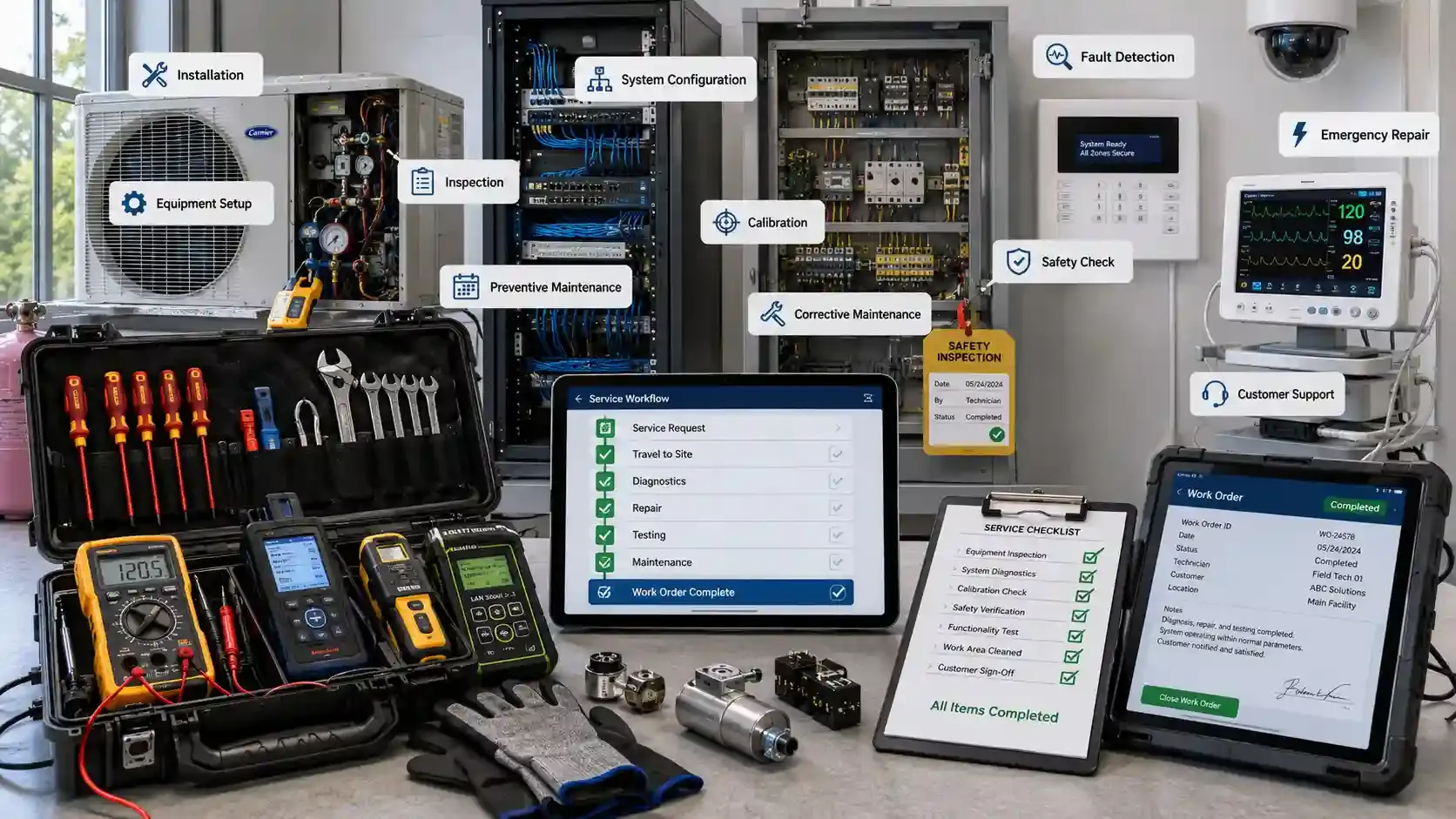
A field service technician fixes and maintains equipment at the customer’s site. So, the job starts when a service request comes in.
The technician checks the issue, travels to the site, and runs diagnostics. Then he finds out what failed. From there, the work becomes hands-on.
In HVAC, telecom, medical equipment, security systems, and industrial machinery. This role often sits inside the wider installation, maintenance, and repair job.
But, a field technician does not only “fix broken things.” They help keep equipment working and repair it when it stops working.
The job can include replacing parts, checking wires, and testing safety features.
As said earlier, customer support is part of the job too.
A good service technician explains problems, showing customers how to use the equipment. He even provides simple training when needed. And the demand behind this work is real.
And the demand behind this work is real.
U.S. employment in installation, maintenance, and repair occupations reached 4.859 million people in April 2026! Safety also stays close to the job.
Field service workers use tools, machines, and electrical systems in different work areas. So safety checks are very important.
Make service calls easier.
Assign jobs, track progress, and complete work orders faster.
What Skills Do Field Service Technicians Need?
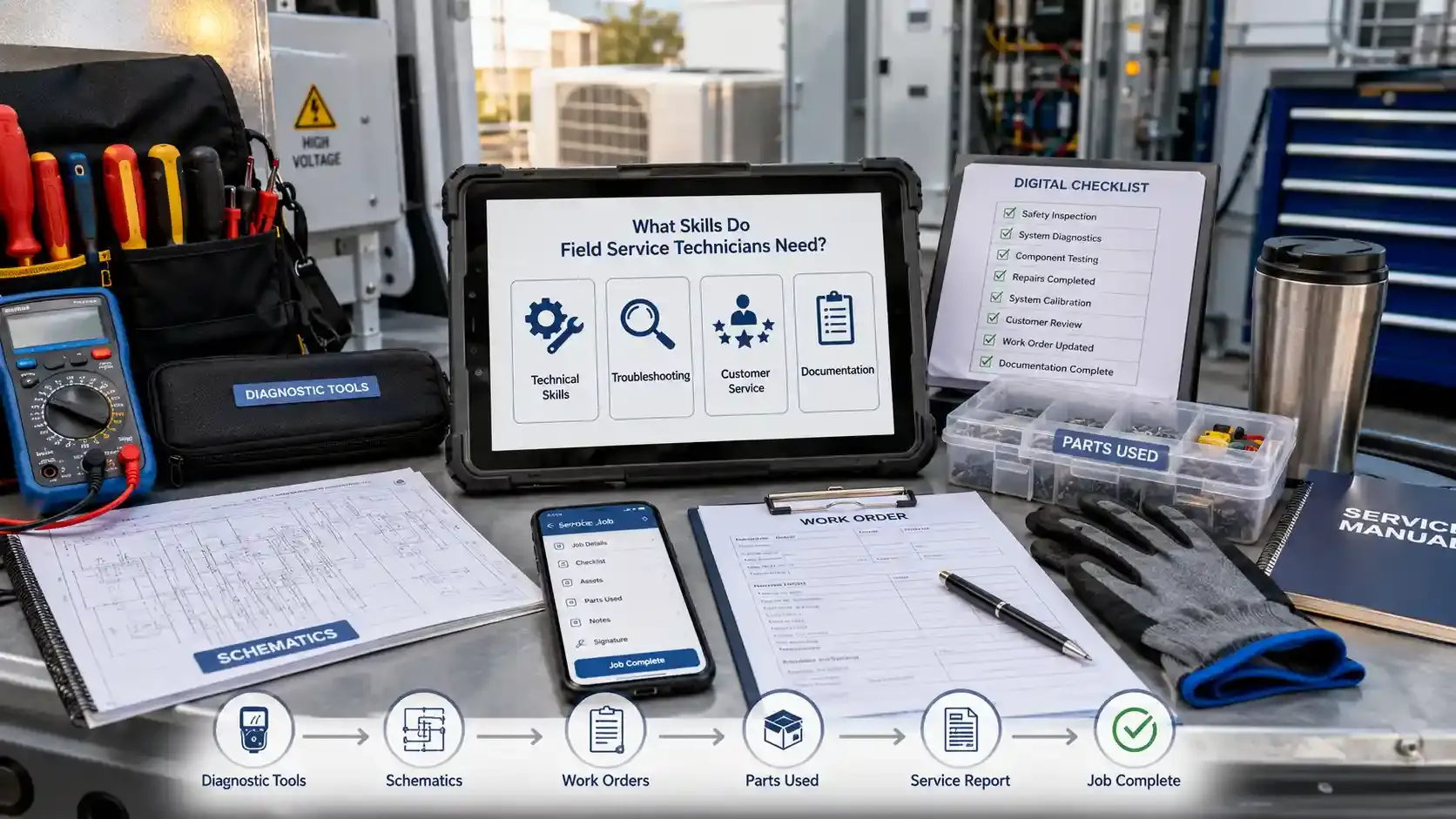
A field service technician needs technical, troubleshooting, customer service, and documentation skills.
And yes, all four matter.
Technical Skills
Technical knowledge is the first thing a field service technician needs. They must know the equipment and how it works. They also need basic repair and electrical skills.
Diagnostic skills come next because the real issue is not always obvious.
A good equipment technician knows how to use field service technician software. He also test tools, meters, service manuals, and mobile apps to find the real fault. According to Microsoft, technicians need reliable digital tools and offline mobile access to work well in the field.
The ability to read schematics also matters a lot.
Schematics, wiring diagrams, blueprints, and service manuals help a repair technician avoid guesswork. This becomes even more important in electrical services and telecom services. It also matters in utilities, security systems, manufacturing, and equipment repair.
Problem-Solving and Troubleshooting Skills
Troubleshooting skills separate an average service technician from a great one.
The job is not only about replacing parts. A field maintenance technician spots the fault, tests the system, and compares symptoms. Then he decides if the job needs corrective, preventive, or emergency repair.
Now, here’s where it gets serious.
A failed first visit results in an average of 2.7 visits and adds about 13 days to resolution time. So yes, better fault detection and diagnostics can save days, not just minutes.
Problem-solving skills also help when the technician works alone.
A mobile technician may reach a customer site and find missing parts, poor access, or incorrect job notes. The worst is finding a different issue than expected.
In that moment, the technician must think clearly. Then he follows procedures, calls support while protecting the customer experience.
Customer Service and Communication Skills
Customer service skills matter. Because the technician often becomes the face of the company.
The customer may never meet the dispatcher, manager, or engineer. They meet the on-site technician. He is the one who explains, answers questions, and provides basic customer training.
Communication skills also reduce confusion.
A customer service technician must explain technical support in simple words. Instead of saying “the control board failed,” they might say, “This part sends signals to the unit, and it is no longer responding.”
The World Economic Forum says workers need technology skills and customer service skills. It also highlights empathy and active listening as important skills.
Time Management and Documentation Skills
Time management matters because field service workers move from one service call to another.
They deal with travel time, customer appointments, and urgent field dispatches. So, a technician who cannot manage time will slow down the whole field service operation.
Documentation skills matter just as much. This keeps the customer history, asset history, and service history clean for the next visit.
Help technicians work smarter.
Support field teams with checklists, updates, and job notes.
What Training and Certification do Field Service Technicians Require?
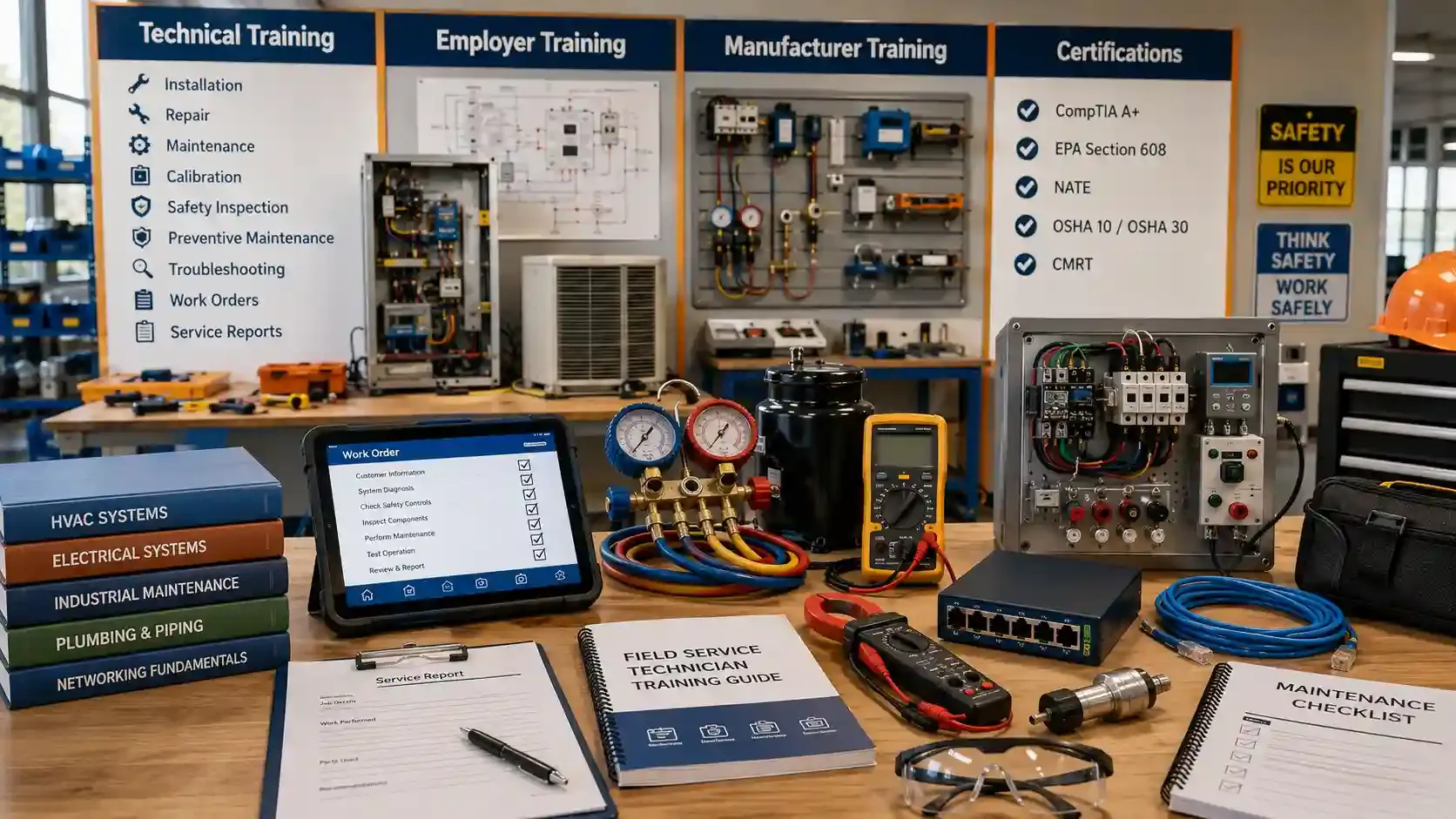
Field service technician training depends on the industry you choose. And that’s the part many people miss.
An HVAC technician, an IT service technician, and a field maintenance technician may all work on customer sites. But they need to have completely different training.
Technical Training
A new field service technician can start with a trade school. He can also get vocational training, go to community college, or do an apprenticeship.
This path works well because the job is hands-on from day one. You learn equipment installation, repair, maintenance, calibration, and safety inspection. You also learn the basic troubleshooting before you handle real service calls alone.
A maintenance technician in manufacturing may need mechanical skills and electrical knowledge.
A telecom or IT technician may need basic computer skills and diagnostic software knowledge. They may also need to understand system setup and configuration.
Employer and Manufacturer Training
Employer training is important as well because every machine, tool, and service process is different.
A company may train a mobile technician to use service reports, work orders, and safety rules. They may also learn customer support skills and brand-specific repair training.
Certifications That Help
CompTIA A+ is suitable for IT services, hardware, and mobile devices. It also matters in software, networking, troubleshooting, and security. The current CompTIA A+ V15 covers two exams and focuses on today’s support roles.
EPA Section 608 certification is important for HVAC technicians. Because they maintain, service, repair, or dispose of equipment that may release refrigerants. EPA updated its Section 608 certification requirements page in March 2026. So this is still a current compliance point.
NATE certification helps HVACR technicians prove their skills. NATE also offers the Certified HVAC Professional pathway. They use five 30-question exams tied to on-the-job learning.
OSHA 10 and OSHA 30 are safety training programs, not job licenses.
Still, they help. Even students receive a 10/ 30-hour course completion card after finishing Outreach Training.
CMRT can also help a field maintenance technician.
Turn training into better service.
Give new technicians clear steps and job history.
How Much Does a Field Service Technician Make?
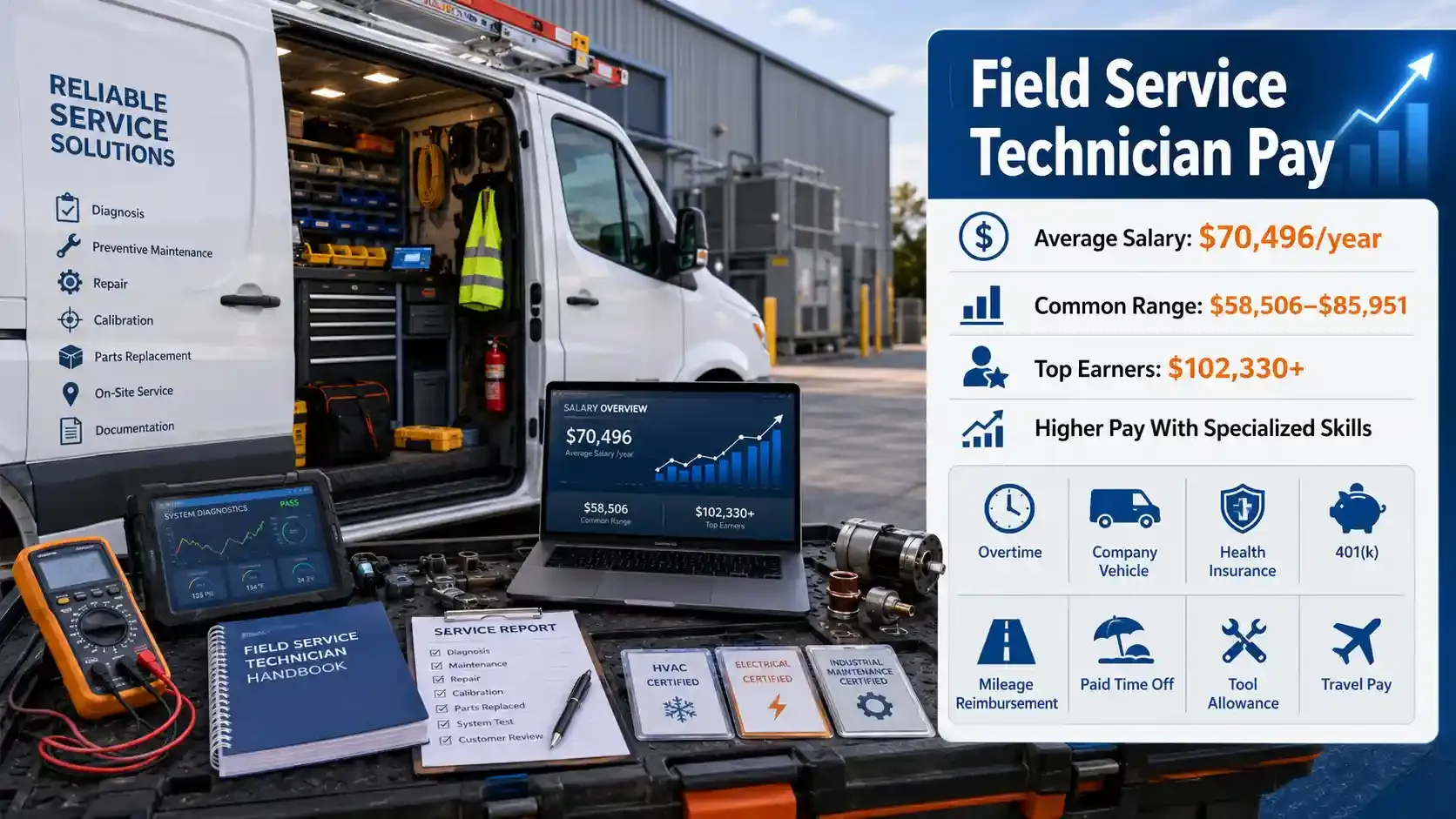
A field service technician's salary depends on the industry, skill level, location, and the complexity of the equipment.
So, there is no single pay number that fits every field technician. A new repair technician doing basic appliance repair will not earn the same as a senior equipment technician.
That said, the pay is solid.
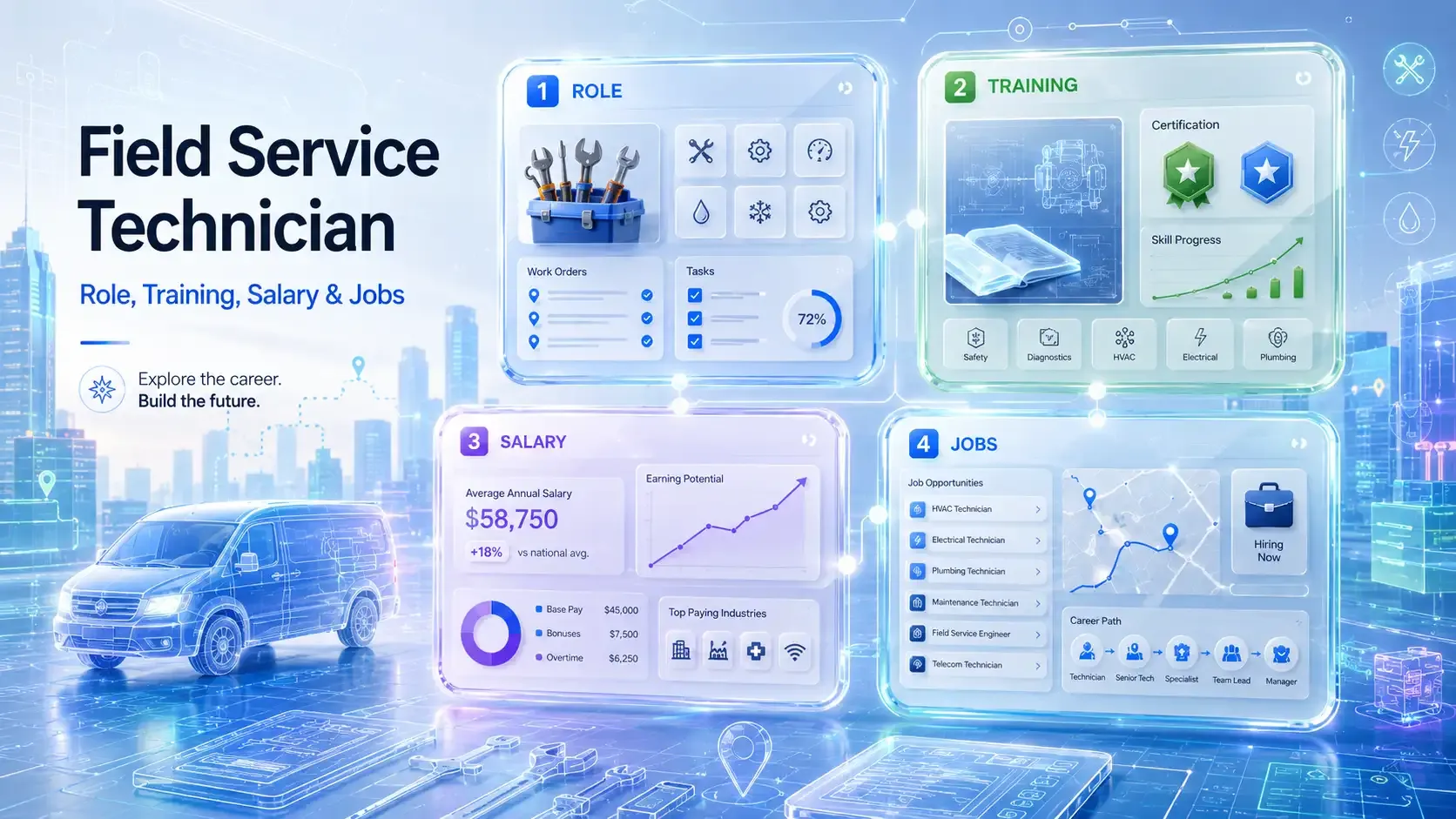
The average field service technician in the U.S. earns about $70,496 per year, with a common range between $58,506 and $85,951. Top earners reach around $102,330.
But this usually comes with experience, certifications, overtime, and specialized equipment knowledge. Now, here’s where it gets interesting.
A field service technician can earn more when the work needs deeper technical skill. For example, the BLS says medical equipment repairers made a median annual wage of $62,630. While industrial machinery mechanics, machinery maintenance workers, and millwrights made $63,510.
Elevator maintenance pays even higher.
BLS reports that elevator and escalator installers and repairers earned a median annual wage of $106,580. That shows how much specialized field service work can change the income ceiling.
But salary is only one part of the package.
Many field service technician jobs offer overtime pay and a company vehicle. Some jobs also include mileage pay, health insurance, and a 401(k) plan. They also enjoy paid time off, tools, phone allowance, and travel pay.
Track hours without guesswork.
Manage timesheets, overtime, and payroll more easily.
What Industries Use Field Service Technicians?
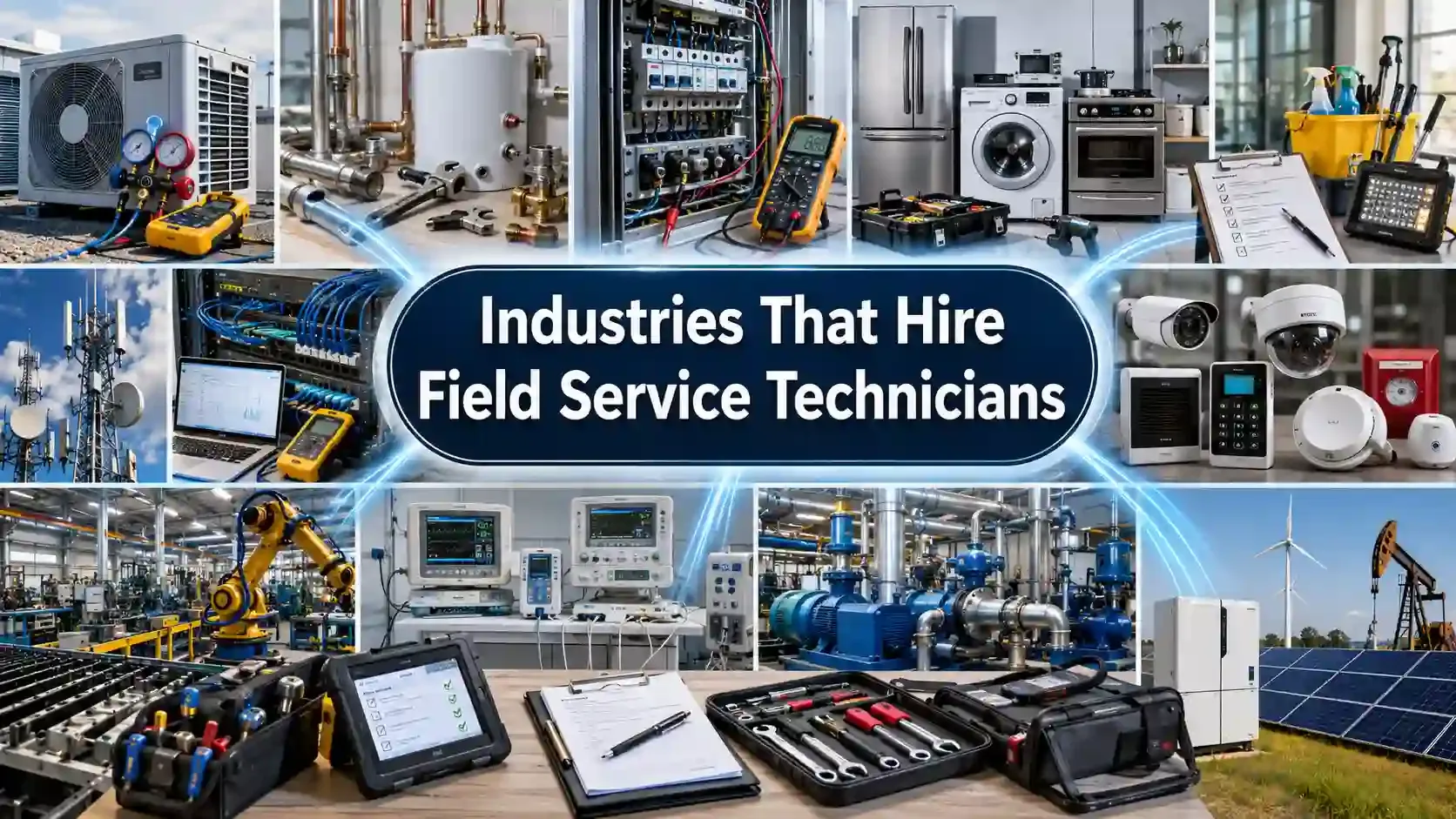
HVAC, Plumbing, and Electrical Services
HVAC companies hire field service technicians. They install, repair, and maintain heating and cooling systems. This work also includes emergency repair, preventive maintenance, inspection, and service appointments.
Plumbing and electrical services also depend on field service workers.
A plumbing technician may fix leaks, blocked drains, and water heater failures. An electrical service technician may inspect panels, repair wiring, and complete safety inspections.
Appliance Repair and Property Maintenance
Appliance repair companies hire repair technicians to fix household and commercial equipment.
This can include refrigerators, ovens, dishwashers, dryers, washing machines, and commercial kitchen systems. The job usually starts with fault detection and diagnostics. Then it moves into equipment repair, testing, parts replacement, and service reporting.
Property maintenance companies also rely on mobile technicians.
A property maintenance technician may handle HVAC checks, facility maintenance, tenant service requests, and lighting issues. They may also handle cleaning services, coordination, and pest control follow-ups.
That means the technician must have time management, multitasking, and job documentation skills.
Telecom, IT Services, and Security Systems
Telecom companies hire field technicians to maintain communication systems and customer-site hardware.
This includes fiber connections, routers, switches, wireless systems, and cabling infrastructure. Because businesses now depend on a stable internet and network access. So the telecom field service remains a strong career path.
IT services companies also hire technical support technicians who work outside the office.
These technicians handle system configuration and equipment setup. They also replace hardware, diagnose it, and perform software troubleshooting at customer locations.
In many cases, the role overlaps with that of a field support specialist. The technician manages both technical support and customer communication during field visits.
Security systems companies also need installation technicians. These technicians install cameras, alarms, access control systems, sensors, and fire safety equipment.
Manufacturing, Healthcare, and Industrial Equipment
Manufacturing companies hire field maintenance technicians to keep industrial equipment running.
This can include conveyors, robotics, motors, automated systems, packaging equipment, and heavy machines. When production systems fail, businesses lose time and money quickly. So companies value technicians who can troubleshoot problems fast and complete corrective maintenance.
Healthcare organizations also hire field service technicians for medical device service. These technicians inspect, calibrate, and test. Then they repair patient monitors, imaging systems, pumps, and laboratory equipment.
Utilities, oil and gas, and renewable energy companies hire field engineers and service engineers, too. These technicians maintain power systems, pumps, valves, and compressors.
Built for mobile service teams.
Keep jobs, routes, and technicians organized across locations.
Steps to Become a Field Service Technician
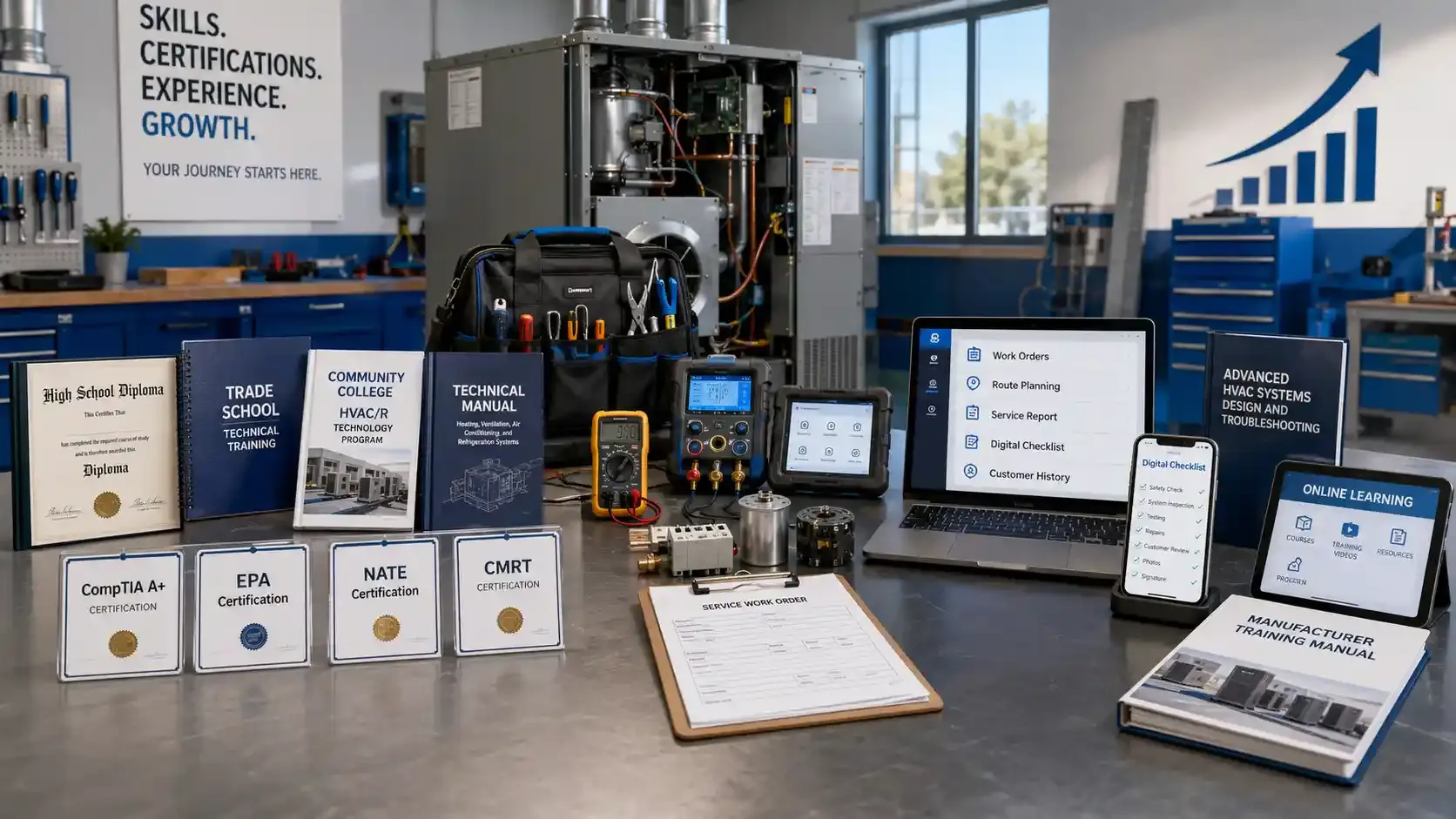
Becoming a field service technician does not always require a four-year degree.
But it requires technical skills and hands-on experience. It also requires the ability to solve problems in real-world situations.
Finish High School or Get Technical Training
Most field service technician jobs start with a high school diploma or GED.
After that, many people move into trade school, vocational training, or community college programs. Community colleges also help students. They build equipment knowledge, troubleshooting skills, and preventive maintenance experience.
Military technical training can also help a lot.
Veterans with experience in communications, mechanics, and electrical systems often transition well. Because they already understand diagnostics, safety inspection, and repair procedures.
Earn Certifications That Match Your Industry
Certifications help employers trust your technical skills faster.
An IT field technician may benefit from CompTIA A+ or Network+ certification. An HVAC technician may need EPA certification or NATE certification. A manufacturing field maintenance technician may also pursue CMRT training. It improves maintenance and reliability knowledge.
And yes, certifications can improve job opportunities.
Gain Hands-On Experience
Hands-on experience matters more than theory in field service work. That’s why apprenticeships, internships, and entry-level service jobs help so much.
A new field technician learns faster during real customer callouts and service appointments. This also builds confidence.
Handling diagnostics, setup, and testing is more helpful than only studying the theory.
Learn Field Service Software and Mobile Tools
Modern field service jobs now depend heavily on field service technician management software.
Technicians use mobile apps to track jobs and complete service reports. The apps can also show customer history, routes, checklists, and proof of service.
So, learning field service management tools early can make a new technician more productive from day one.
Keep Learning After You Get the Job
The best field service technicians never stop learning.
New systems, automation tools, diagnostic software, and equipment models appear every year. Strong technicians keep learning through workshops, safety programs, online groups, and advanced training.
Technicians who learn new skills and adapt to new technology can move into senior roles faster.
Learn modern field tools.
Get familiar with mobile updates, reports, and job tracking.
How Businesses Can Manage Field Service Technicians More Efficiently
Centralize Service Requests
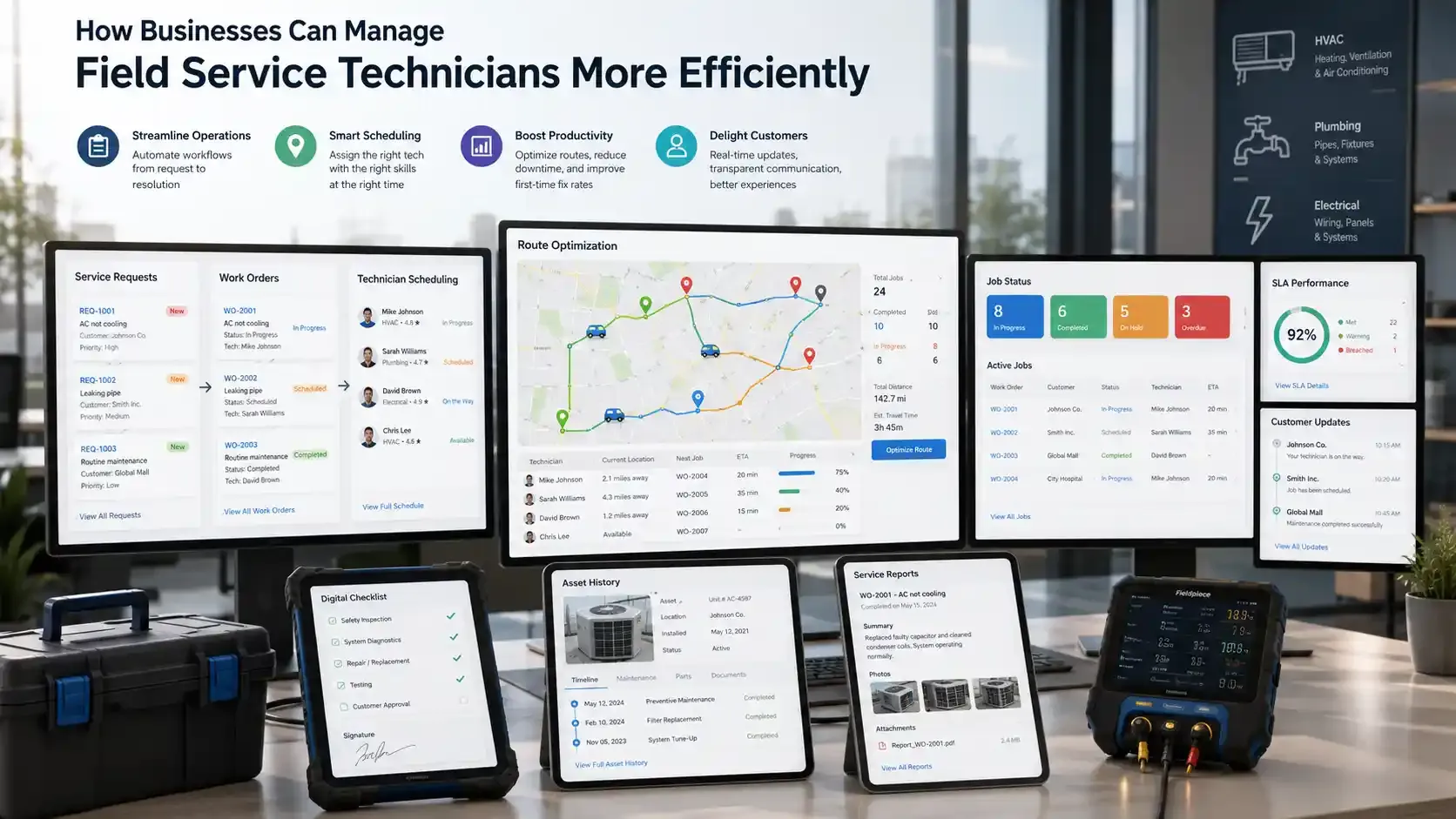
The first step is to centralize all service requests in a single system. A good field service system keeps job details and schedules in one place. This helps dispatchers work faster and avoid paper notes or long email chains.
Assign the Right Technician
The best field service teams match jobs based on skill, location, and urgency.
For example, an HVAC repair job should go to a technician who knows HVAC systems and works near the customer. This saves travel time and helps fix the problem faster.
And yes, first-time fix rate directly affects profitability.
Every repeat visit increases fuel costs, labor time, scheduling pressure, and customer frustration. So, smarter job assignment becomes one of the biggest drivers of efficient field service operations.
Use Job Scheduling and Route Optimization
Job scheduling keeps workloads balanced across the team.
Without scheduling tools, one field technician may become overloaded. On the other side, another sits idle between service appointments. Good scheduling prevents missed jobs, reduces overtime pressure, and improves job completion rates.
Route optimization makes the process even smoother.
A mobile workforce management system can suggest faster routes. Thus, it reduces travel time and helps technicians reach customer callouts more quickly. This becomes critical for businesses managing large territories or high daily service volume.
Track Technician Location and Job Status
Technician tracking improves operational visibility in real time.
Dispatchers can see where technicians are and which jobs are active. They can also see if delays affect SLA targets or service level agreements. This helps managers adjust schedules before small delays become larger operational problems.
Job status updates also improve customer trust.
Customers want to know when the technician is coming, whether the job has started, and when the work is complete. Real-time updates reduce frustration because customers no longer feel ignored during service appointments.
Keep Customer History and Asset History Organized
Customer history helps technicians solve problems faster.
A field technician should check past repairs and maintenance records before arriving. They should also know the warranty details and report problems. This reduces guesswork and improves troubleshooting during service visits.
Asset history matters for long-term maintenance, too.
When businesses track repairs, inspections, and parts history, technicians can make better repair decisions. This also helps reduce downtime. Field teams work better when technicians, dispatchers, and managers use the same system.
Platforms like FieldServicely help teams manage jobs, schedules, and technician tracking in one place.
Dispatchers can see technician locations in real time. Managers can track response times and service performance. Technicians can also complete checklists, upload reports, and update work orders from the field.
Field service teams work better when technicians, dispatchers, and managers stay connected in one system.
Keep your field team organized.
FieldServicely helps reduce manual work and improve job visibility.
Conclusion
A field service technician helps keep equipment and systems working at customer locations. The job includes repair work, problem-solving, customer service, and travel to different job sites.
Field technicians can work in HVAC, telecom, IT, healthcare, manufacturing, utilities, and many other industries. Because technicians work in many locations, businesses must manage schedules, routes, work orders, and customer updates carefully.
Good training, smart scheduling, and the right field service software help teams work faster and stay organized.
Frequently Asked Questions
Is being a field service technician hard?
Yes, being a field service technician can be hard. Because the job mixes travel, technical repair, customer pressure, and tight schedules.
Do field service technicians work alone?
Yes, field service technicians often work alone during field visits. But that does not mean they work without support. A good field service team gives technicians the tools and support they need before each job.
Do field service technicians work nights or weekends?
Yes, some field service technician jobs include nights, weekends, holidays, or on-call shifts. It depends on the industry.
Do field service technicians need their own tools?
Sometimes, but not always. Many companies give technicians tools, safety gear, mobile devices, and company vehicles for daily work. Some employers may also ask technicians to carry basic hand tools and keep spare parts in the service vehicle.
Is a field service technician the same as a service technician?
Not always. A service technician is a broader term. While a field service technician usually travels to customer locations for on-site service. A service technician may work in a shop, office, facility, or customer site. But a field service technician travels to customer locations. Then they handle repairs, maintenance, troubleshooting, and service calls.
What are common field service technician goals?
Common field service technician goals include finishing jobs on time and improving the first-time fix rate. They also focus on reducing response time and following safety rules. Customer satisfaction is another key goal. Technicians also write service reports, manage parts, and provide proof of service. Good work also helps reduce repeat visits.