Field Workers: Definition, Key Skills, Challenges, Considerations, and Trends
Updated on 2 Dec 2025

Jump to
The term “Field Workers” is not the same anymore as we used to define it. The most common characterization is an individual or group of individuals who work in the field.
Well, the depiction has evolved into something like– anyone who works in a field but that field could be an office, a retail store, a construction site, a service location, or anywhere.
In this blog, you’ll learn about the definition of field service workers– further exploring their roles, skills, the impact they have on the success of field operations, and challenges.
Whether you’re a business owner, manager, or someone interested in the field service industry, this is for you!
FieldServicely Pro Tip
Unlock 100+ service business ideas and discover new opportunities tailored to your skills and expertise. Find the perfect fit to grow your business.
Definition of Field Workers
In general words, field workers are someone who work outdoors– mostly in a remote location. You are to offer your service outside traditional office settings.
Typical field service workers are those who investigate and take care of environmental issues, quality checks, and conduct research, and surveys by collecting data in multiple regions.
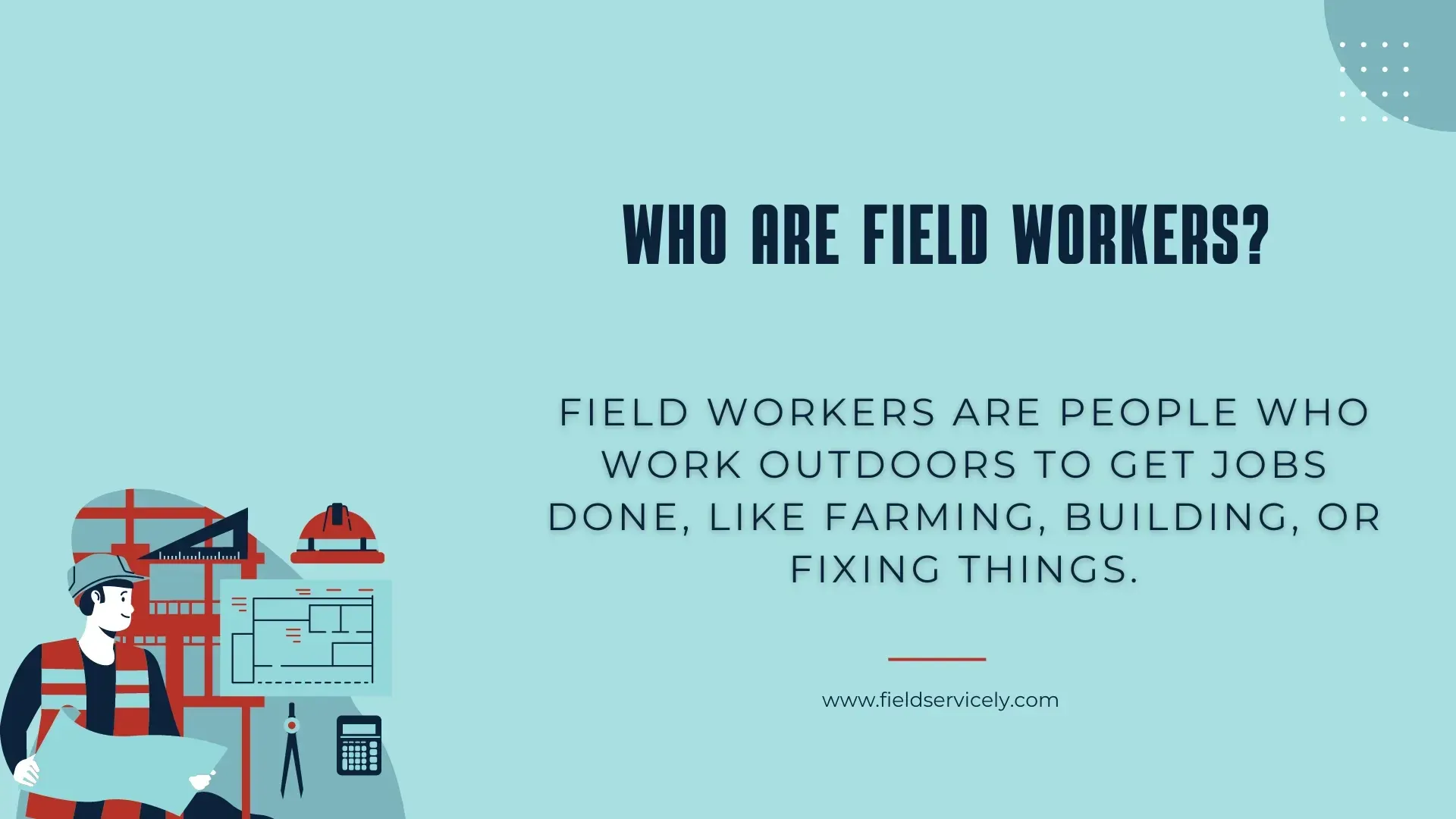
From a farmer, technicians, laborers, electricians, and more to an office worker, marketers, managers, receptionists, software developers, and every other professional working in various environments are field service workers.
All of them play a pivotal role in bridging the gap between the company and its clients. Additionally, the expectations and responsibilities of a field worker are also transforming.
These people are some of the finest and most skilled problem-solvers who often need to think creatively to overcome unique challenges. They usually require specialized training for their roles. A strong understanding of the local setting, culture, and language is essential for their effectiveness.
Additionally, they must handle physical and mental demands. That includes long hours, harsh weather, and tough terrain.
Interesting statistics about field service workers
- 64% of field workers in the US are male while 36% are female.
- The average age of field service workers globally is 38.9 years (till 2019) which is expected to grow to 39.6+ by 2025. Moreover, in the US the median age is 40.3.
FieldServicely Pro Tip
Boost your field workers' performance with FieldServicely’s scheduling, tracking, and management, ensuring efficient service and long-term success.
Key Roles and Responsibilities of Field Service Workers
Following field service management best practices, successful field workers handle multiple responsibilities:
On-site Installation & Maintenance: Field workers install, repair, and maintain equipment, machinery, or systems at customer sites.
This may include anything from HVAC Business Software to telecommunications equipment, depending on the industry.
Customer Interaction: A crucial part of the field workers’ job involves communicating with clients. They need to diagnose issues, and explaining solutions in a way that customers can understand.
Technical Troubleshooting: Field workers often need to troubleshoot technical problems on-site.
Reporting & Documentation: Field workers accurately record details of each job, such as the issues encountered and the actions taken.
This helps maintain a service history and ensures future service efficiency.
Safety Compliance: Working in diverse environments, field workers need to follow safety protocols to protect themselves, the equipment, and the client’s property.
This includes wearing safety gear, following industry standards, and ensuring a safe work environment.
Overall, successful field workers combine technical expertise with excellent customer service skills.
Skills to be a Successful Field Worker
The skills of field workers mostly depend on the role they are playing. Also, the responsibilities and tasks they perform designate the skillset they should have.
Surely the skillset of a field woker in a garden, and a field worker in a corporate office wouldn’t match except for a few. Also, a field worker in town and a worker in the seaside will have different kinds of skills.
Traditionally their skills are within the scope of communication, organizational skills, team management, problem-solving capability, and technical expertise. Furthermore, they are an expert in handling people of diverse backgrounds.
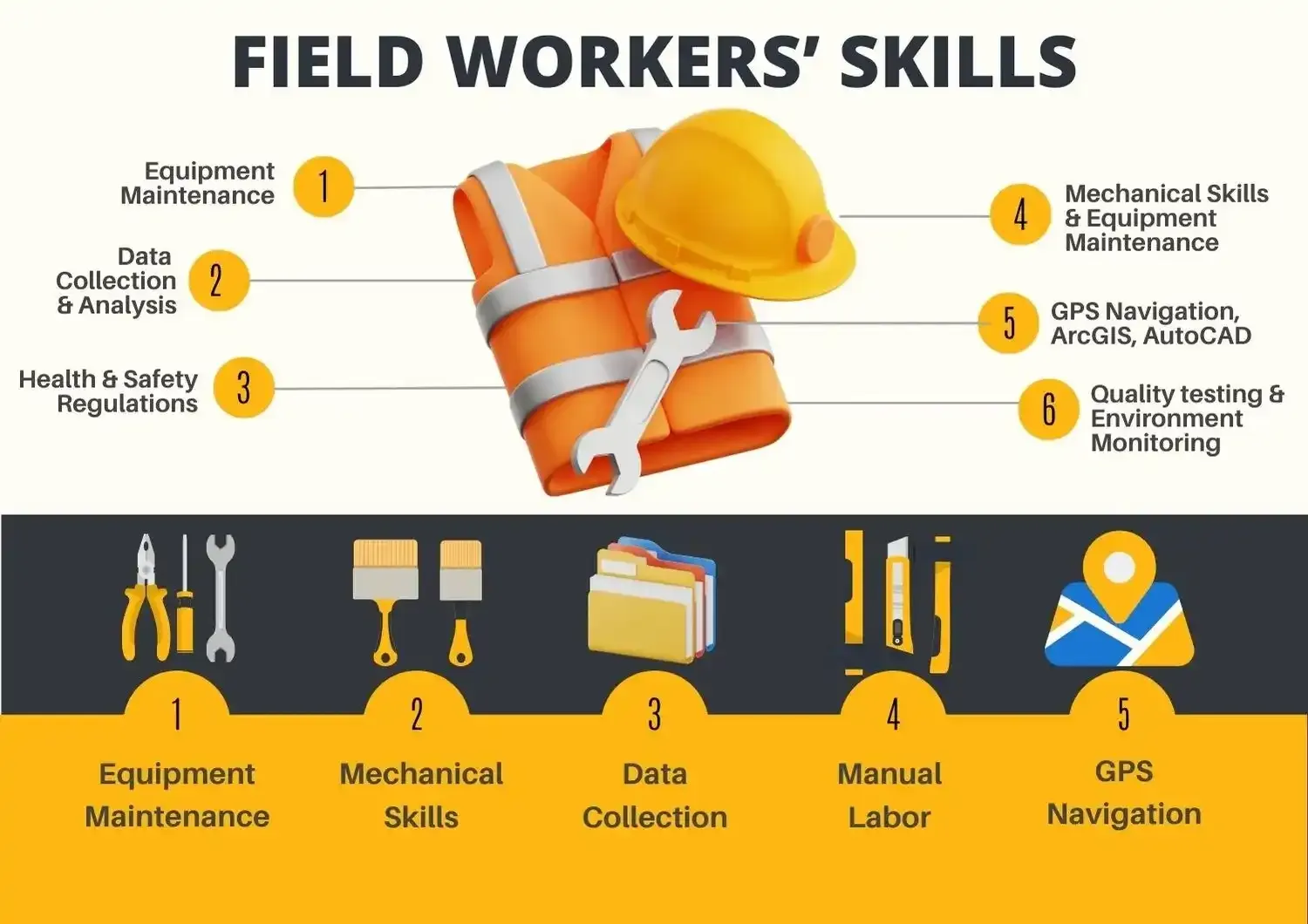
In 2025, Home health is the most used technical skill of field worker resume. 54% of US field workers use this skill in their resume. Besides, these are the top technical skills that field service workers should have:
- Data collection and analysis.
- Safety procedures and management.
- Safety Regulations.
- Mechanical skills.
- Equipment maintenance.
- Manual labor.
- ArcGIS.
- GPS navigation.
- Survey123
- AutoCAD.
- Quality testing (of their subsequent domain).
- Environmental monitoring.
- Trimble Technology.
- Customer services.
Field workers must also possess a strong understanding of the local context and culture.They also need to understand customers' pain points. It helps them to navigate and address community needs effectively. In these environments, they need to be adaptable and quick-thinking. Having a keen eye for detail ensures quality and safety standards are met.
FieldServicely Pro Tip
Stay with the industry trends to manage your service business. Manage your services with automation.
Health and Safety Considerations
Fieldwork demands loads of physicality. Their work might incline lots of stress and further long hours. About two-thirds of the fieldwork requires lifting heavy objects and maintaining edgy tools. These are the most primary safety and health considerations for any field worker.
Also, there are a few other safety hazards in the environment they work in. To avoid such incidents field workers are inclined to take necessary steps and are heavily instructed to maintain safety precautions.
Some of the precautions include wearing necessary equipment like PPE (Personal Protective Equipment), glasses, helmets, fire-resistant suits, steel-toe boots, gloves, and others. Some fieldwork roles require specific dress codes to ensure safety.
These dress codes help protect workers from potential hazards and maintain a safe working environment.
Challenges Faced by Field Workers
These workers often face a range of challenges that can impact their work and well-being. These challenges vary depending on a lot of factors. However, the most common challenges include:
- Health and safety risks.
- Adverse weather conditions.
- Physical demands (stressing).
- Communication barriers.
- Equipment reliability (malfunctions).
- Cultural and language differences.
- Logistical coordination and issues.
- Work-Life balancing challenge.
No wonder why most field workers ask for individual health and safety insurance. The team manager plays a vital role in addressing these challenges. Furthermore, addressing these challenges requires a combination of proper planning, training, and support.
To mitigate such challenges access to resources that enable them to perform their duties is inevitable. More than that they have to be self-conscious to deal with these challenges.
FieldServicely Pro Tip
Track your service professional's location and time accurately to ensure precise payroll with no missed or overstated hours.
Trending Technology Used in Fieldwork
As the term field worker evolved with it the technology used by them. In the current market climate, field workers are dealing with drones, IoT, automated tools, and virtual/augmented reality gadgets for the completion of work.
Some of the trending technologies used nowadays:
- Automation for inventory management, assigning tasks, scheduling appointments, invoicing, managing customers, and others.
- Barcode scanners are also an automation tool that helps save time by record-keeping, managing recalls, and improving connectivity at the same time.
- AR (Augmented Reality) and VR (Virtual Reality) to create work simulations, deliver job training, and enhance the customer experience. Also to diagnose and troubleshoot issues through simulation, and others.
- Drones for aerial surveys, monitoring, inspections, and further data collection.
- The use of Big Data for optimizing labor, cost, and time. This technology has played a significant role in improving decision-making in every sector of fieldwork.
- Field service dispatching software helps automate task assignments and scheduling.
- AI gadgets like smart sensors, predictive analytics tools, machine learning algorithms, computer vision systems, and others.
- AutoCADs for detailed design and drafting, facilitating accurate planning and construction in various field applications.
- Moreover, 3D Printers for rapid prototyping and producing custom parts on-site.
- Also, the use of GPS gadgets for precise location tracking and navigation.
- Various IoT devices for real-time update– data collection and remote monitoring.
- Plus, managers can implement time and attendance software to manage field service employees' time logs.
Fieldwork technologies are getting more innovative. This makes it easier to handle the tasks. Field workers are welcoming these techs and gadgets warm-heartedly. Seems like companies or organizations that are leveraging these tools are ahead in the competition.
Plus, managers can use a time tracking software to manage your field service employees’ time logs.
It is also the duty and responsibility of field workers to stay attuned with these techs and how to use them.
In the end
Field workers are the eyes and ears of the field. When your equipment fails– they’re the ones who’ll notice it first and report it.
Starting from potential problems to even new revenue opportunities, they’ll notify you.Moreover, to fully harness their observations and insights, businesses need to view their field workers as valuable sources of information.
Also, if you can leverage them in the right way– might even explore some new revenue insights.
Frequently Asked Questions about Field Workers
What are the types of field workers?
Field workers come in various roles depending on the industry. Some common types include:
- Field Technicians: Individuals who perform repairs, maintenance, and installations on-site.
- Sales Representatives: Professionals who use sales representative tracking apps to manage client visits and promote products or services.
Also Read: Best apps for sales reps in 2026 (Top 12 tools) - Construction Workers: Laborers who work on-site for building, repairs, or construction projects.
- Surveyors and Inspectors: People who assess and evaluate sites or conditions for various purposes.
- Healthcare Workers: Nurses, home care aides, or healthcare professionals providing services outside of medical facilities.
There are many other types, including delivery drivers, agricultural workers, and utility workers, all performing their roles away from a fixed office location.
What is considered field work?
Field work refers to any work that is performed outside of the traditional office or workplace.
It typically involves visiting different locations or traveling to customer sites.
Examples include conducting inspections, providing repairs or maintenance services, performing sales or promotional activities, and any hands-on work performed directly in a particular environment, like construction sites, farms, or outdoor locations.
What is a field employee?
A field employee is someone whose primary job responsibilities require them to work off-site, outside the standard office environment.
Their work often involves traveling to different locations to perform specific duties, such as service calls, client visits, or site-based tasks.
These employees typically work independently or with minimal supervision while representing their company or organization in the field.
Try FieldServicely #1 Field Service Management Software
Try for free - No credit card required!