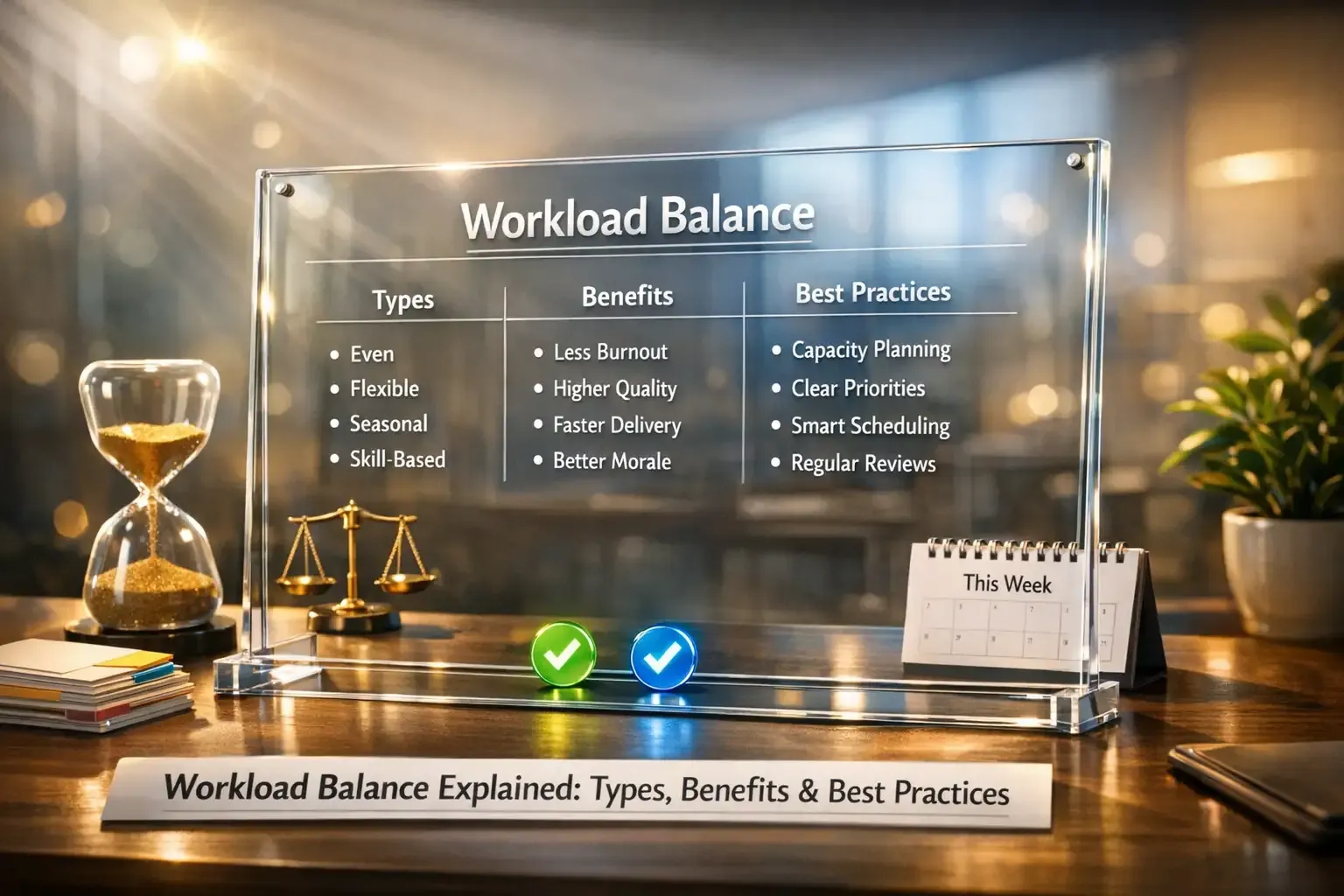
Workload Balance Explained: Types, Benefits & Best Practices
Updated on 4 Mar 2026
Jump to
Summary

Workload balance means distributing tasks based on capacity, skill, and real availability.
Balanced workloads prevent bottlenecks, missed deadlines, burnout, and hidden financial loss.
Static, dynamic, and hybrid models manage work differently depending on demand stability.
Measurable metrics like utilization, capacity ratio, and overtime reveal imbalance early.
Clear scope, smart prioritization, skill alignment, and flexible adjustment keep teams steady.
Workload balance means distributing tasks based on real capacity, skills, and available time. It increases productivity and protects energy. Plus, workload balance also reduces overtime, prevents burnout, and improves deadline accuracy.
Teams that operate within healthy limits produce stronger results with fewer errors.
In this blog, we will discuss how workload balance works and why it matters for operational and financial stability.
What Is Workload Balance?
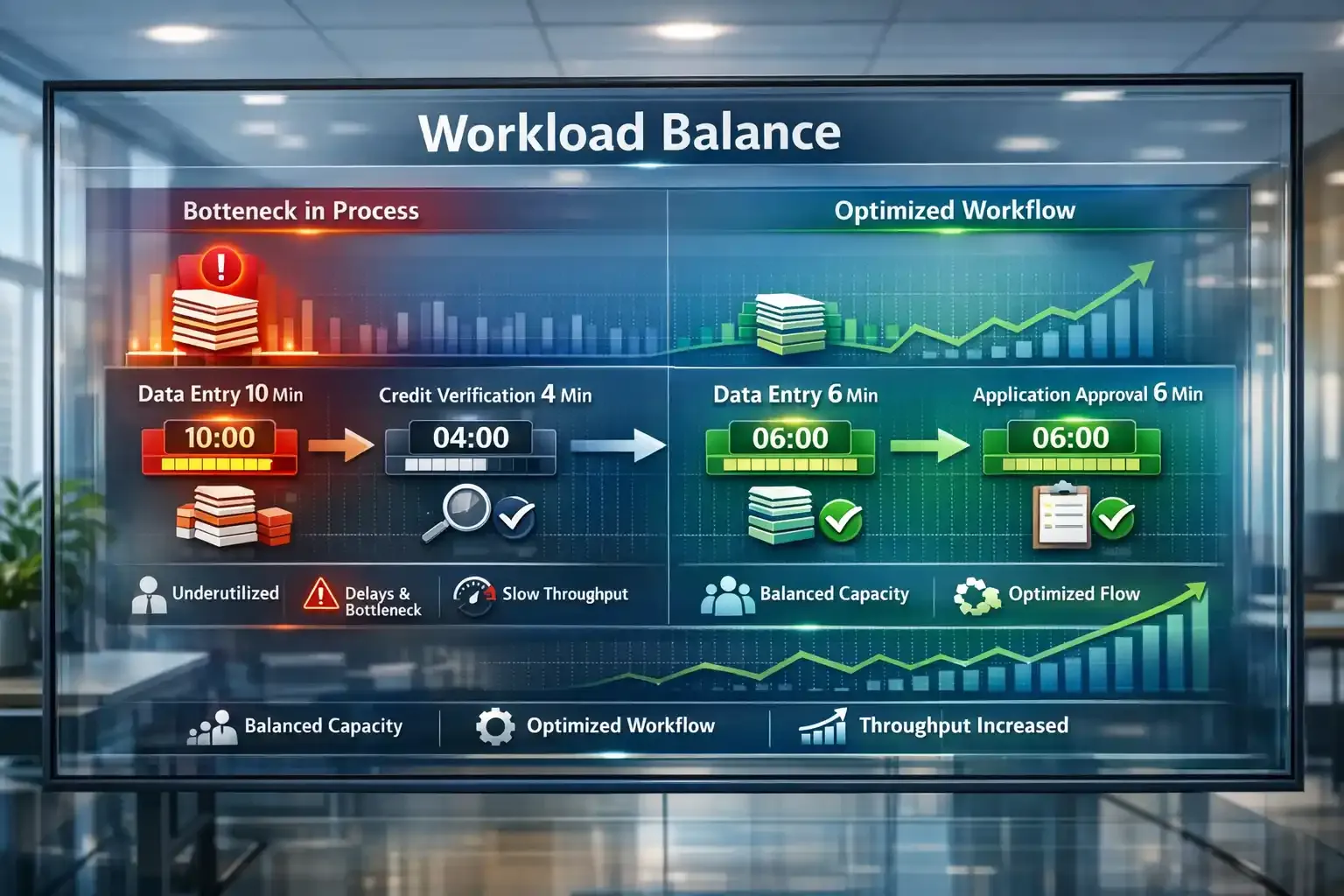
Workload balance is the strategic allocation of tasks and responsibilities according to each person’s ability, expertise, and available time. It ensures that no employee is overloaded while others remain underutilized.
In practical terms, workload balance means assigning work that people can realistically complete without constant overtime or idle gaps.
It looks at utilization levels, task complexity, deadlines, and resource availability before decisions are made. Instead of simply dividing tasks equally, it aligns effort with capability to protect both productivity and employee well-being.
This balance directly affects small business performance. Overloading and underloading both reduce output, just in different ways. Let me give an example.
Imagine a three-step loan approval process. One employee takes 10 minutes to enter customer data, another takes 4 minutes to verify credit. And the third takes 6 minutes to approve the application.
Even though three people are involved, the entire process moves at the pace of the 10-minute step. That slowest step becomes the bottleneck and limits total throughput.
If part of that 10-minute task is redistributed to the others, total processing time drops and output increases without hiring anyone new. That is workload balance in action.
Bottlenecks slow everything down
Identify capacity gaps before they limit output
Why Is Balancing Workload Important?
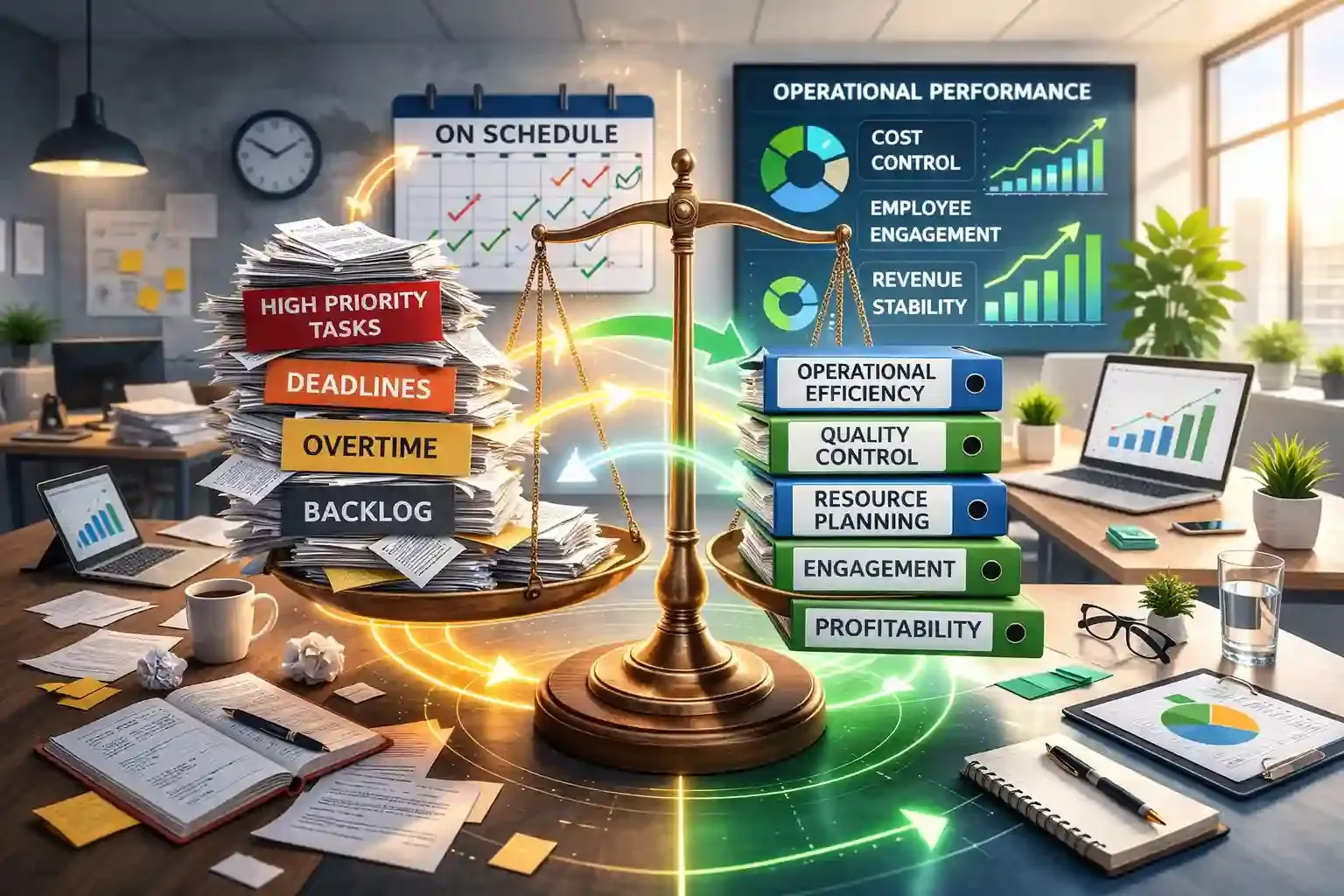
Operational Impact
Workload balance keeps work moving smoothly. When too many key tasks sit with one person, he/she becomes the bottleneck. Then the whole team slows down. As a result, deadlines start to slip. Next in line is the quality of work.
That’s because when people rush to catch up, they make more mistakes.
Financial Impact
Operational strain turns into financial loss. When teams rely on overtime to catch up, payroll costs rise fast. The U.S. Bureau of Labor Statistics confirms overtime requires at least 1.5 times regular pay.
That said, turnover also adds more cost. That includes hiring, training, and lost output. Not to mention idle capacity, which also hurts revenue as skilled employees sit underused.
Human Impact
Research shows that exposure to stress impairs working memory performance. And long working hours raise the risk of stroke and heart disease.
Meanwhile, underload causes disengagement. When employees feel underused, motivation drops and effort declines. According to a report, highly engaged teams see 23% higher profitability.
Imbalance also increases retention risk. People stay where work feels fair and manageable.
Know where your team is at all times
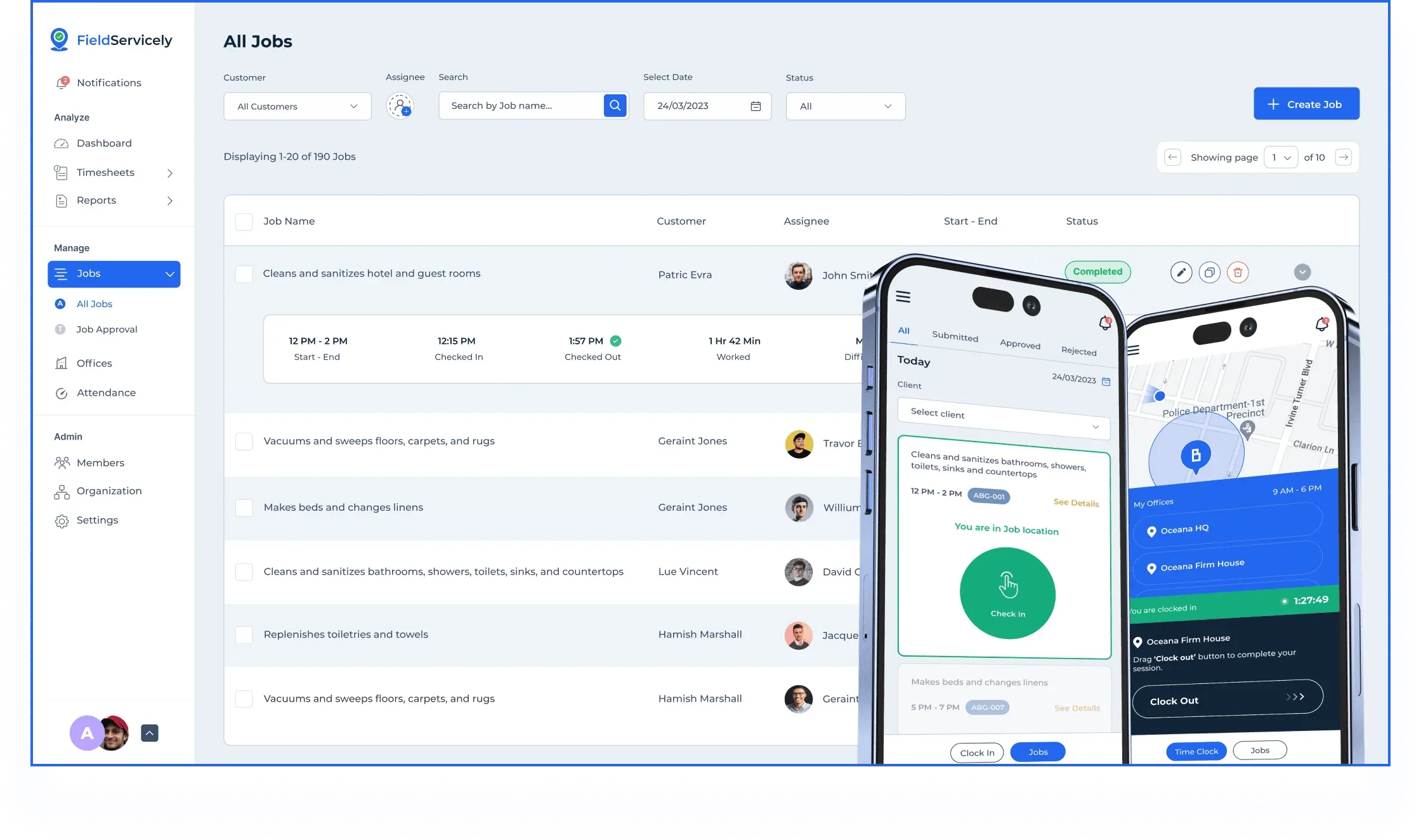
Live GPS tracking, geofencing, and automated timesheets
Types of Workload Balancing
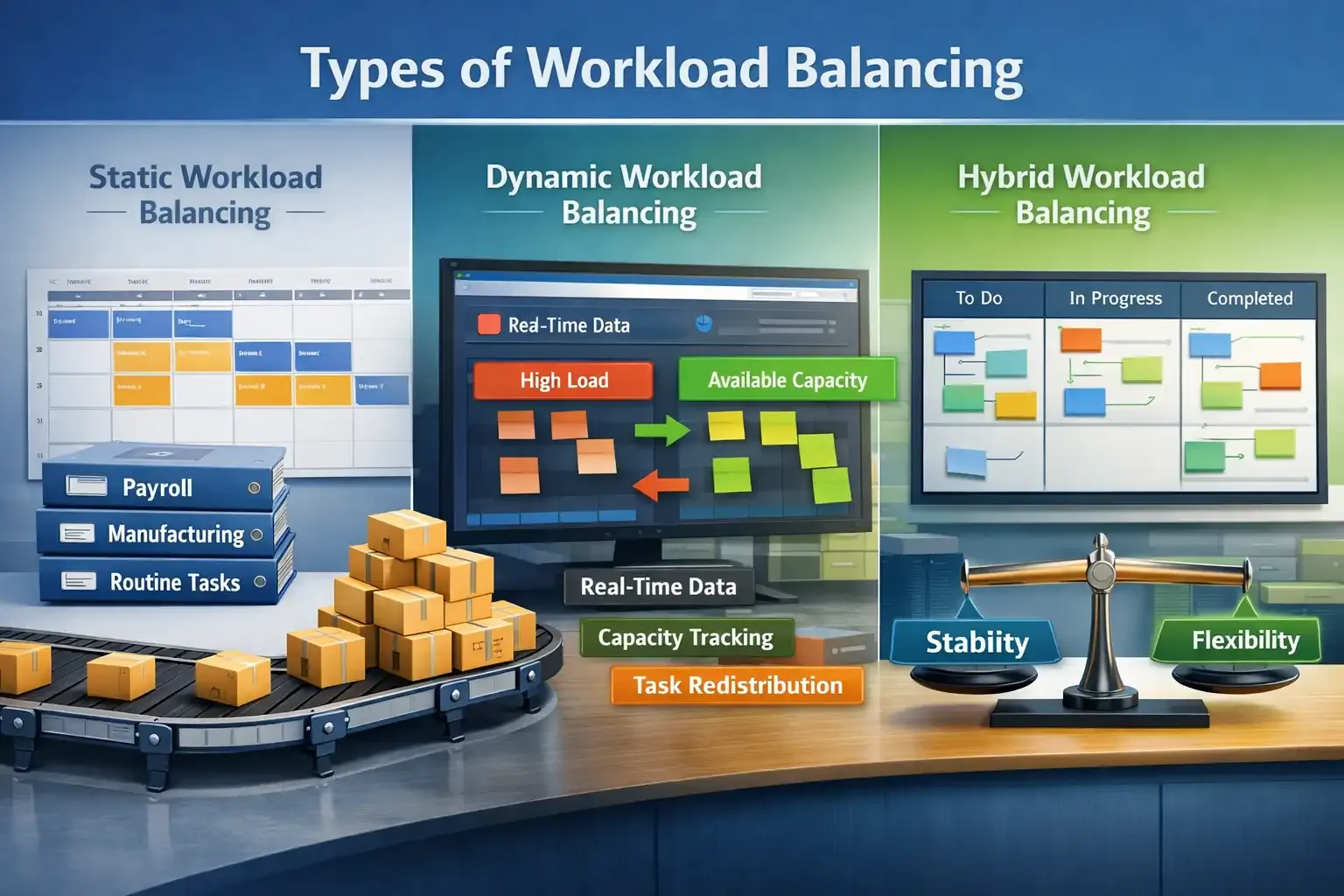
Workload balancing does not follow one single method. Broadly, workload balancing falls into three types: static, dynamic, and hybrid.
Each one solves a different operational problem:
Static Workload Balancing
Static workload balancing means pre-planned distribution of tasks. Managers assign work based on expected demand, known capacity, and defined roles. Once assigned, those responsibilities stay fixed for a period.
This approach works best in predictable environments. Manufacturing lines, payroll teams, and routine processing units often use it. When workload volume stays stable, fixed allocation keeps execution smooth.
Because tasks are defined early, employees know what they own. This clarity reduces confusion and saves coordination time. Teams focus on output instead of constant reshuffling.
However, static systems assume demand will not change. It creates risk as unexpected spikes appear; the system cannot adjust quickly.
For example, imagine a customer support team with fixed case assignments. If one agent receives several complex issues, others may still follow lighter queues. The overloaded agent becomes the bottleneck.
Dynamic Workload Balancing
Dynamic workload balancing relies on real-time redistribution. Instead of fixing assignments at the start, managers shift tasks based on current workload data.
This model fits fast-moving teams, such as software development, digital marketing, and technical support, which often face daily demand swings. Fixed allocation fails in such environments.
Just so you know, this model is data-driven. Many modern platforms track capacity, task completion time, and productivity trends. Research shows that data-driven decision-making in project management enables better resource optimization and proactive risk handling.
Dynamic systems also reduce overtime. When managers reassign work early, they avoid last-minute pressure. That protects payroll costs and employee energy.
However, dynamic balancing requires strong tools. Without dashboards or utilization tracking, decisions become guesswork. Too many changes without communication can also create confusion.
Hybrid Workload Balancing
Hybrid workload balancing combines planning with live adjustment. Teams begin with a structured distribution. Then they modify assignments when real conditions shift.
This approach blends stability and flexibility. While initial planning creates ownership and clarity, mid-cycle adjustment prevents overload and delays.
Many agile teams follow a hybrid workload balancing model. They plan sprint capacity at the start. During execution, they reassign tasks if blockers or urgent work appear.
FYI, hybrid systems scale better than static or fully dynamic models alone. As teams grow, managers need a predictable structure. At the same time, they need the ability to respond to volatility.
According to McKinsey, organizations using structured yet adaptive planning improve responsiveness. The good news is they maintain productivity, meanwhile. And hybrid workload balancing applies the same principle at the task level.
Compared to static balancing, hybrid systems adapt faster. And in contrast to the dynamic-only systems, they reduce chaos and role confusion. For most modern knowledge teams, this model proves to be the most scalable.
Real-time visibility changes everything
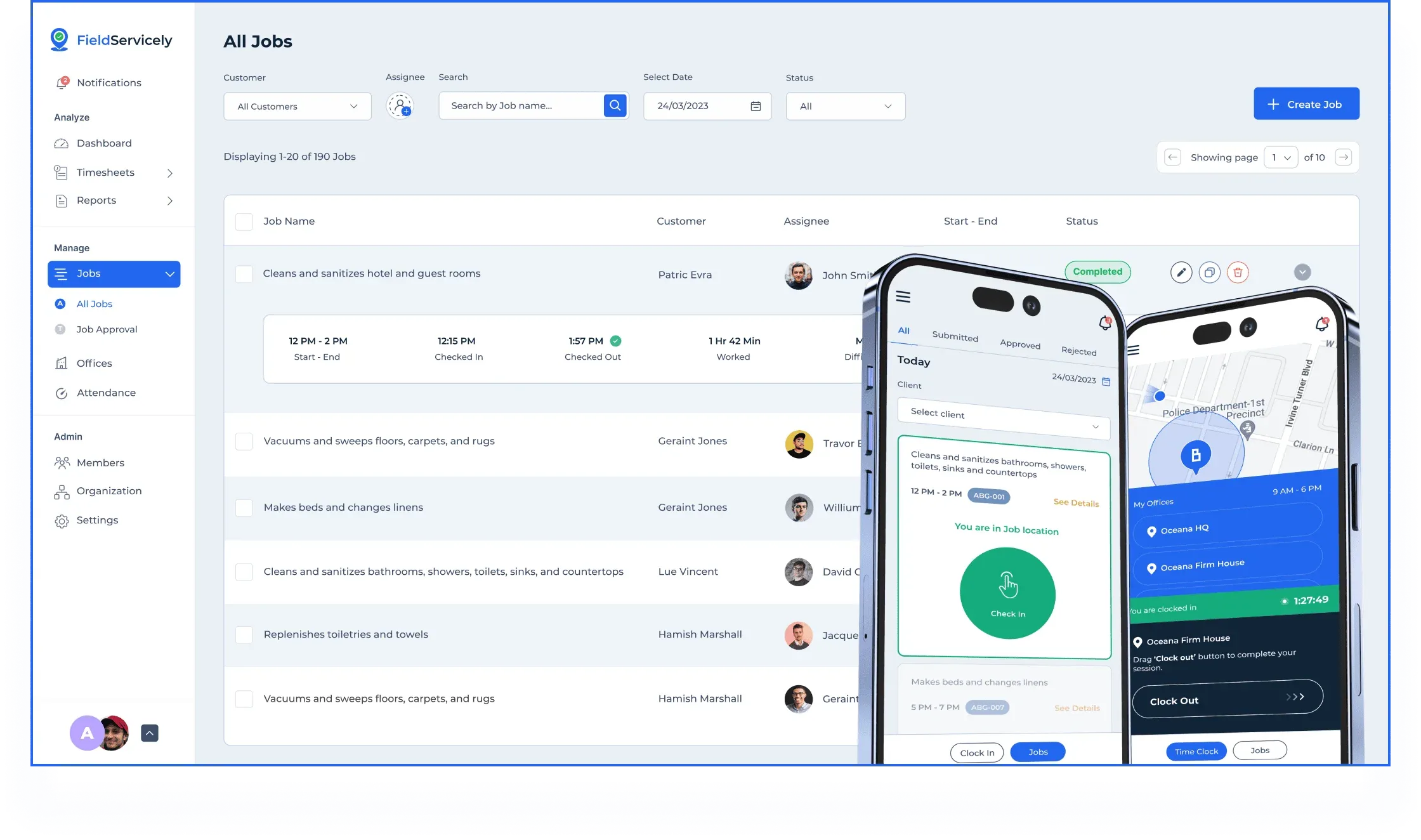
Track capacity, backlog, and utilization in one dashboard
Benefits of Balanced Workloads
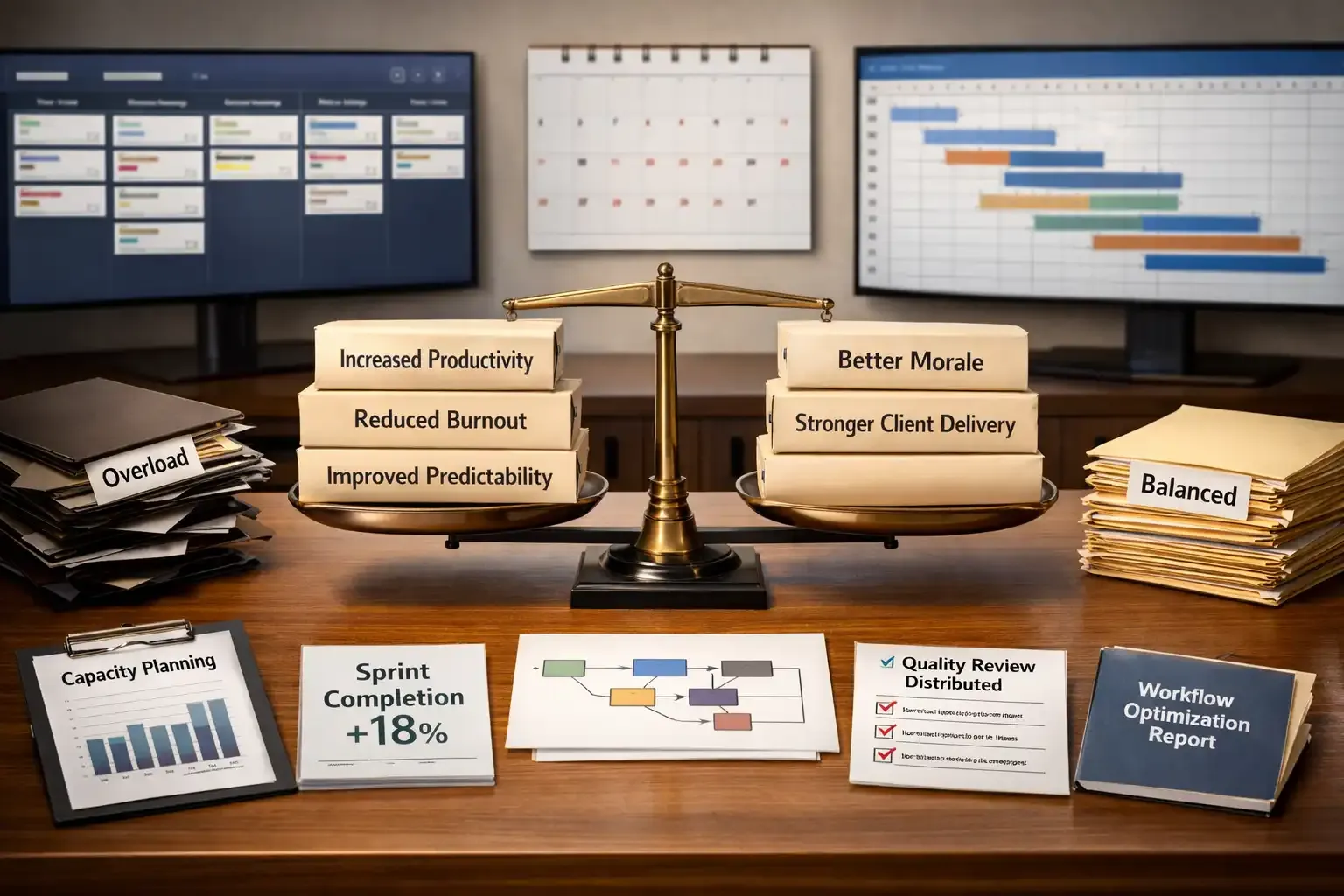
I used to think productivity problems meant we needed better talent. But once I started balancing workloads based on real capacity instead of assumptions, performance changed in measurable ways.
The improvement showed up in five clear areas.
Increased Productivity
I once ran a delivery team where two high performers handled the most urgent client work. They worked fast, but the team’s total output stayed limited because every critical task waited for them.
After mapping actual workload hours and redistributing complex work, we improved sprint completion by nearly 18% in two quarters.
According to McKinsey, companies that simplify and optimize workflows reduce duplicated decision-making and manual reporting. Thanks to balanced workloads, it removes friction from the workflow.
Reduced Burnout
When burnout happens slowly in strong employees, they rarely complain. But their energy drops, and small mistakes increase. The root cause was not difficulty, but sustained overload.
According to the American Psychological Association, 77% of employees experience work-related stress, and a heavy workload remains one of the top drivers.
After we introduced task caps and rotated high-pressure ownership roles, stress levels stabilized. Sick days declined over the next two quarters, and voluntary overtime dropped significantly.
Improved Predictability
Predictability was the benefit that surprised me most. Once we started assigning work based on workload visibility and dependency mapping, timeline accuracy improved.
According to PMI, ineffective resource allocation and planning continue to be major drivers of project underperformance and wasted investment. Balanced workloads remove such hidden risks. And it makes forecasting honest instead of hopeful.
Better Morale
When the same employees handle repeated pressure, resentment builds. At the same time, underused employees lose motivation because they feel disconnected. But engagement improves as you rebalance responsibility.
According to Gallup, engaged employees are significantly less likely to leave and more likely to contribute discretionary effort. Hence, fair workload distribution strengthens engagement and improves employee morale.
Stronger Client Delivery
Reliability and consistency drive long-term client retention more than speed alone. Balanced workloads protect consistency because people have space to think and validate.
Productivity problems aren’t always talent problems
Productivity problems aren’t always talent problems
What Are the Signs of Poor Workload Balance?
The signs usually appear in two layers. Some are visible and loud. Others stay hidden until output drops.
Visible Signs
Visible signs are easier to detect because they show up in schedules, reports, and conversations.
Frequent Overtime
Frequent overtime is one of the clearest warning signs. When the same employees work late every week, the system is overloaded. BLS-co-sponsored work-hours data reports that extended work hours correlate with higher fatigue and lower productivity over time.
Missed Deadlines
Missed deadlines signal uneven distribution more than poor planning. When a few people carry high-dependency tasks, delays multiply quickly. The Project Management Institute’s reports show that poor resource management remains a top driver of project failure.
Uneven task Distribution
Uneven task distribution appears in workload dashboards and meeting dynamics. Some employees stay constantly busy while others wait for direction. That imbalance slows total output.
Complaints
Complaints are direct signals, but leaders often dismiss them as temporary stress. Repeated comments about overload rarely come without reason. When complaints repeat, an imbalance likely exists.
Hidden Signs
Hidden signs are more dangerous because they look like productivity at first glance.
High utilization but low output
High utilization with low output signals results in inefficiency. When people log long hours but deliver little progress, overload may block focus.
Context switching overload
When employees jump between meetings, chat threads, and urgent tasks, cognitive fatigue builds. Research confirms that frequent task switching reduces productivity and increases error rates.
Too many small interruptions can feel like progress. In reality, they fragment attention.
Declining work quality
Declining work quality often appears before people admit stress. But the most common telltale signs are repeated small mistakes and longer review cycles.
Silent disengagement
Silent disengagement is the hardest sign to detect. Employees stop offering ideas. As a result, participation declines quietly.
Did you know engagement levels globally are only 23%? It means a large portion of the workforce is actively disengaged.
Busy doesn’t always mean productive
Track utilization and output side by side
How to Measure Workloads?
.webp?2026-03-04T04%3A53%3A19.334Z=&w=3840&q=100)
I learned to measure workloads after nearly costing me a project. Here’s how to measure workloads:
Utilization Rate
The utilization rate shows how much of someone’s working time goes to productive work. You calculate it by dividing productive hours by total available hours, then multiplying by 100.
For example, 32 productive hours out of 40 total hours equals 80% utilization. In practice, 75% to 85% feels sustainable. When utilization hits 95% or more for weeks, quality begins to slip.
Utilization helps you see hidden overload. If someone logs high hours but produces little progress, their workload may be fragmented. That leads directly to the next metric.
Capacity Ratio
The capacity ratio compares assigned work to available time. You calculate it by dividing the total assigned hours by the actual available hours. If someone has 45 hours of assigned tasks in a 40-hour week, the ratio becomes 112%.
Just so you know, a ratio above 100% signals over-allocation. And below 70% may signal underuse.
Task Completion Variance
Task completion variance shows the gap between planned time and actual time. You calculate it by subtracting planned hours from actual hours, or by measuring the percentage difference.
For example, if a task planned for 10 hours takes 14 hours, the variance equals 40%.
Variance tells you whether planning reflects reality. If overruns repeat, workload pressure likely interferes with focus.
Throughput Rate
Throughput rate measures how many tasks or deliverables a team completes in a set period. You count finished items per week or per sprint.
For instance, if a team closes 25 tickets per week consistently, that becomes their baseline throughput.
Overtime Frequency
Overtime frequency tracks how often employees exceed scheduled hours. You calculate it by dividing overtime hours by total work hours per week. For example, 6 overtime hours in a 40-hour week equals 15%.
The U.S. Bureau of Labor Statistics reports that extended overtime correlates with lower productivity per hour over time. Overtime frequency acts as an early burnout indicator. When it rises, capacity no longer matches demand.
Overtime is not always a crisis. However, when it becomes routine, an imbalance exists.
You can’t balance what you don’t measure
Track utilization, capacity, and overtime in one place
How to Balance Workloads
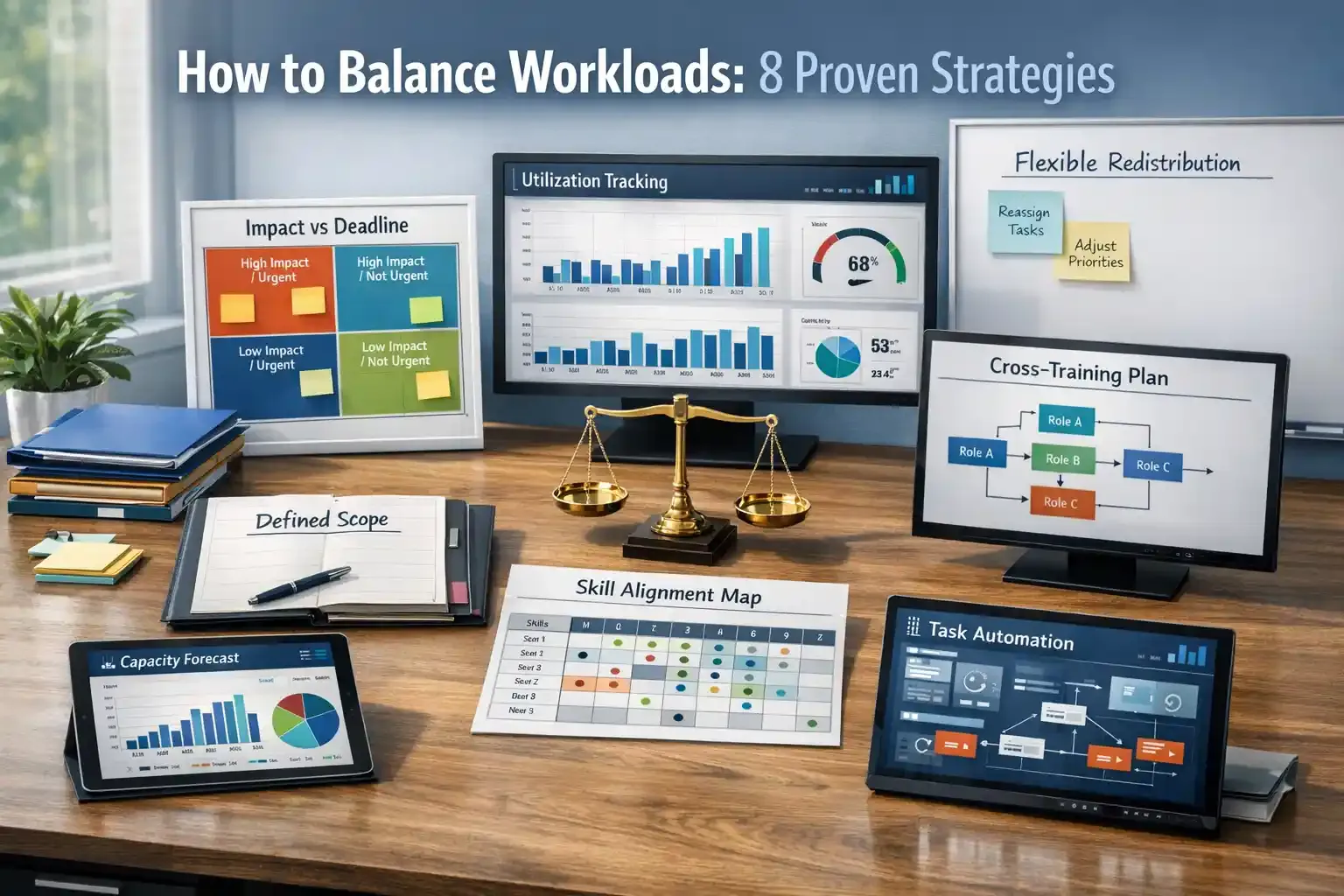
The following eight strategies work because I have used them in real teams.
1. Define Scope Clearly
Clear scope protects your team from hidden overload. When deliverables feel vague, work expands without warning. That expansion eats time and energy.
Projects with higher levels of performance also demonstrate lower rates of scope creep. While clear boundaries prevent silent workload growth, defined scope creates predictability.
2. Use Prioritization Frameworks
Prioritization protects focus when demand rises. Without ranking rules, teams treat every task as urgent. However, urgency without structure creates stress.
McKinsey confirms that structured prioritization reduces wasted effort in knowledge teams.
Also, a clear ranking improves execution speed. So, choose one ranking method and apply it consistently. And finally, protect your team from constant switching.
3. Assign by Skill, Not Availability
Availability alone does not ensure fast delivery. Skill alignment determines speed and quality. If you don’t know, mismatched assignments create rework.
Gallup Research finds that people who use their strengths at work tend to show higher engagement, productivity, and performance outcomes.
So, before assigning tasks, ask who can complete it best. Then confirm who has time.
4. Forecast Capacity Before Committing
Capacity forecasting prevents unrealistic promises. Many leaders commit based on revenue goals instead of available hours. Gaps like this cause overload. So before you guarantee any delivery, evaluate the capacity.
5. Monitor Utilization in Real Time
Utilization tracking reveals rising pressure early. This is why weekly visibility works better than monthly reviews. Because at the end of the month, it becomes too late.
That said, the better way is to keep an eye on real-time dashboards, which provide utilization clarity. And this leads to immediate action.
6. Cross-Train to Reduce Bottlenecks
Bottlenecks create imbalance quickly. When only one person holds key knowledge, demand stacks around them. And over time, it puts that person under stress.
That is why cross-training sessions are essential. Assign additional team members and train them up with a similar skill set.
7. Automate Repetitive Tasks
Repetitive work drains energy slowly. Manual reports, status updates, and data transfers waste focus. Those hours reduce strategic output.
A McKinsey study shows automation now handles many routine knowledge tasks. It also increases effective capacity without hiring.
8. Create Flexible Redistribution Mechanisms
Plans are dynamic by nature. As demand shifts and priorities change over time, plans get overwritten. Hence, corresponding teams must adjust quickly to stay balanced.
In my experience, once, a developer faced sudden client revisions that doubled his effort. What I did then was take out two lower-priority tasks immediately. And this sudden plan change helped the project stay on track. Harvard Business Research shows companies must integrate prediction, adaptability, and resilience to navigate volatile environments.
Bottlenecks form around one person
Bottlenecks form around one person
Conclusion
Workload balance shapes how your team performs every day. When you align tasks with real capacity and skill, work flows without constant pressure. That alignment protects productivity, morale, and delivery quality at the same time.
Ignoring an imbalance creates slow damage. Bottlenecks grow, overtime rises, and engagement drops before leaders notice. However, clear metrics and structured adjustments prevent those risks.
When the workload fits the capability, performance becomes steady. And steady performance builds sustainable growth without burning people out.
Frequently Asked Questions
How often should teams review workload balance?
Teams should review workload weekly in fast-moving environments and biweekly in stable ones. Regular reviews help leaders spot overload before it turns into burnout. Short check-ins work better than long monthly audits.
Can workload imbalance affect innovation?
Yes, imbalance reduces creative thinking. When employees operate under constant pressure, they focus on task survival instead of new ideas. Balanced workloads create mental space for innovation and problem-solving.
Is workload balance only a management responsibility?
No, employees also play a role. Team members should communicate capacity limits and flag unrealistic deadlines early. Transparent communication supports healthier distribution decisions.
How does remote work impact workload balance?
Remote work can hide overload because managers cannot see subtle stress signals. Clear tracking systems and regular check-ins become more important in distributed teams. Visibility prevents silent imbalance.
What tools help maintain workload balance long term?
Project dashboards, time-tracking systems, and capacity planning tools help maintain visibility. These tools provide real-time insight into utilization and task distribution. Data-driven decisions keep workloads sustainable.