- Route optimization and planning
15 Strategic Benefits of Route Optimization
Updated on 12 Jan 2026
Jump to
Key Summary

The primary economic benefits include fewer miles, low fuel consumption, and high vehicle capacity and lifespan.
For operations, it enables dynamic re-routing to handle last-minute changes.
Proper route planning improves on-time performance for better customer satisfaction.
Route optimization software reduces driver burnout by creating realistic, balanced workloads.
Route optimization software helps you grow your business without spending more. How? Well, you can fit more jobs into each day by taking shorter routes.
Basic GPS just gets you from A to B. But a route planner handles the hard part, such as managing hundreds of stops, delivery windows, and vehicle limits all at once. It turns your chaotic delivery process into something you can actually predict.
When it costs over $2.26 per mile to run a vehicle, manual planning or basic GPS apps are bleeding your money. But you know what? Route planning goes beyond just cost saving. And in this article, I'll explain to you how. So let's get started.
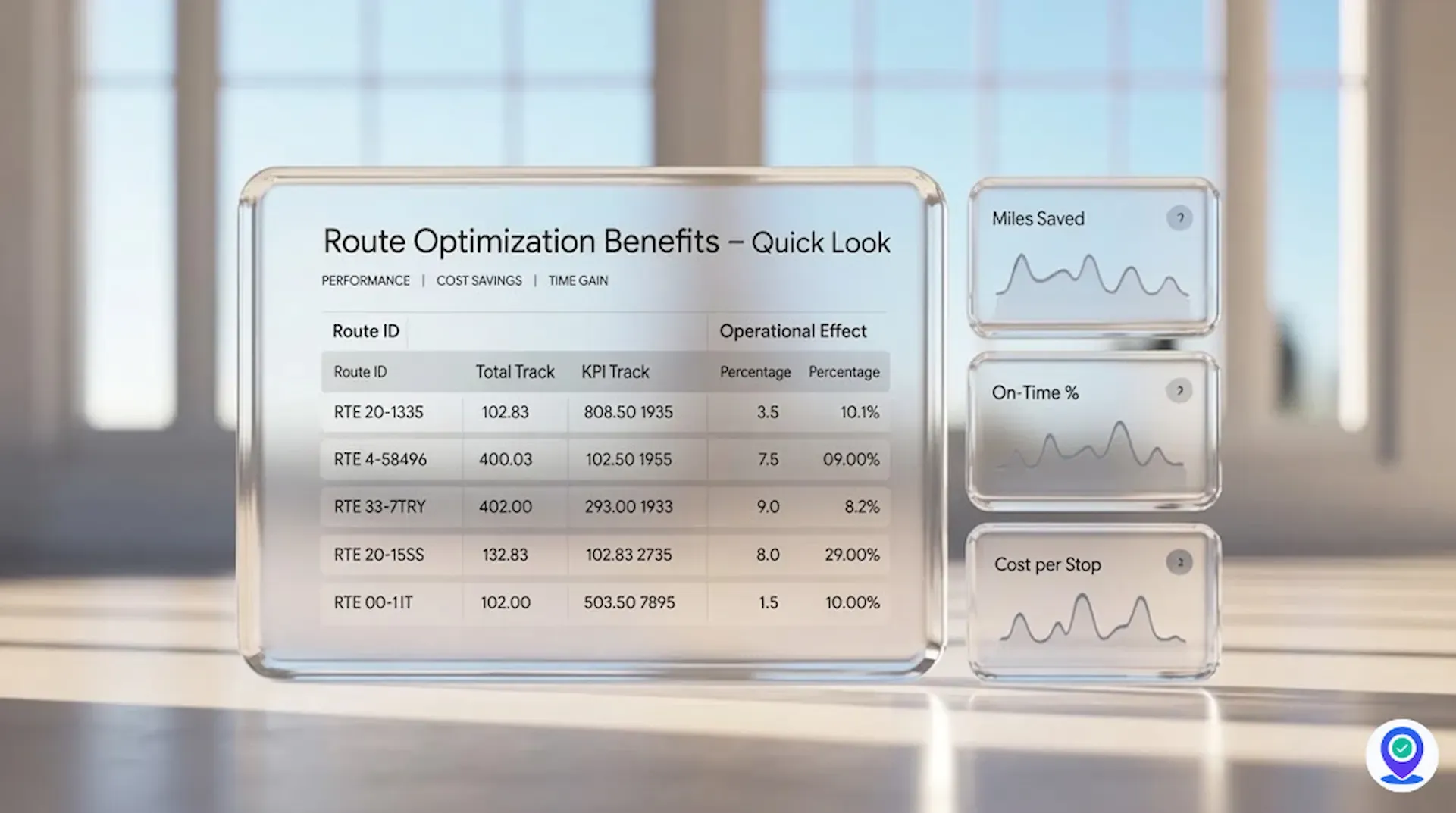
Quick Look at the Route Planning and Optimization Benefits
| Benefits | KPI to Track | Effect on Operation |
|---|---|---|
Drive fewer miles | Miles per route/miles per stop | You cut miles without cutting stops/jobs |
Reduce fuel usage | Gallons used / fuel cost per route | You see fuel drop as miles and idle drop |
Lower transportation cost | Cost per stop/cost per route | Your cost per stop trends down week over week |
Lower emissions (CO₂e) | CO₂e per route / per mile | Emissions drop as miles and fuel drop |
Maintain service targets while cutting waste | On-time % / service target hit rate | You save costs without hurting SLA |
Higher vehicle utilization | Utilization% / loads per run | Fewer empty miles, fewer “extra runs.” |
Bigger profit leverage in the last-mile | Cost per delivery / failed delivery rate | Small routing gains matter because the last mile is expensive |
Top Benefits of Route Optimization
Cost Savings: Reduce Miles, Fuel Spend, Overtime, and Cost per Stop
Reduce Miles & Fuel Consumption
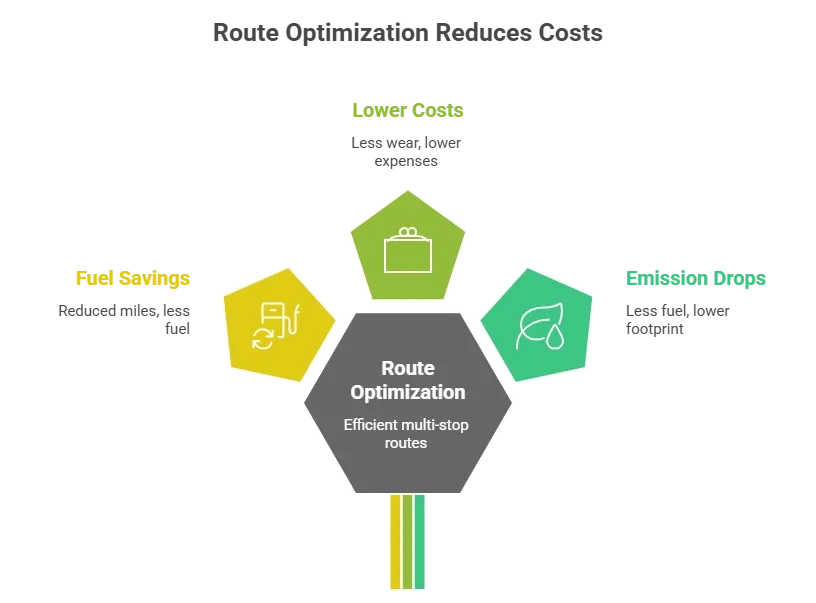
Route optimization cuts miles by building tighter multi-stop routes. Also, by removing backtracking between stops. So you spend less as you need to drive less.
This happens because every mile has a real cost, even when fuel prices dip. For example, in ATRI’s 2025 trucking cost report, fuel averaged 48¢ per mile in 2024. So if you can reduce 100 miles/day across your routes, and you remove about $48/day in fuel cost. At the end of the year, you save $12,000.
On that note, route optimization can save real miles at scale. For instance, UPS reports 10–14 fewer miles driven per driver per day using its proprietary ORION routing system. But you can always use tools like FieldServicely for your route planning needs.
Lower Operating Costs
Cost reduction is another major benefit of route optimization. FYI, every mile costs more than just fuel. For example, factors like less wear on tires, brakes, and engines directly save a lot of money.
So you need a real per-mile number to track savings. The IRS sets the 2026 business standard mileage rate at 72.5 cents per mile. That’s why many teams use it as a practical cost-per-mile proxy for cars, vans, and pickups.
To understand it better, here’s an example:
If 10 vans save 12 miles per day each, you save about $87 per day (120 miles × $0.725). That’s roughly $21,750 per year over 250 workdays. And this number is before you count overtime and dispatch time savings.
Lower CO₂ Emissions
Carbon emission drops significantly when you use a route planning and optimization tool. That’s because fewer miles mean less fuel burn. As a result, your carbon footprint drops the same day.
Just so you know, the U.S. EPA puts tailpipe CO₂ at about 8.887 kg per gallon of gasoline and 10.180 kg per gallon of diesel. So every gallon you don’t buy is also carbon you don’t emit.
That means, if optimized routing saves 40 gallons of gasoline in a week, you avoid about 355 kg of CO₂ (40 × 8.887). That’s roughly 8% of a typical passenger vehicle’s yearly emissions (about 4.6 metric tons), in just one week!
Operational Efficiency: Dynamic Routing, Better Utilization, Fewer Fire Drills
Increase Stops Per Route & Technician/Driver Productivity
Better routes help you make more stops by cutting down on drive time between jobs. You find the quickest order to visit each stop. Teams also cut empty miles, so workers can spend more time on actual paid work.
McKinsey found a company that used AI for daily route planning. Drivers spent 15% less time traveling, and it directly boosted productivity.
In another report, McKinsey states drivers waste 1-1.5 hours daily waiting at handovers. Businesses can reduce this with tighter scheduling and clearer dispatch thanks to efficient route management.
Boost productivity without adding trucks
Try for free - No credit card required!
Dynamic Routing & Real-Time Re-Optimization
Dynamic routing updates your plan when traffic gets bad, a customer cancels, or an urgent job pops up. The real-time routing system finds the best route, so your team still hits their time windows and priorities.
You see, traffic changes make morning routes outdated by lunch. The INRIX found that the average U.S. driver loses 49 hours to traffic jams. And about $894 in wasted time, so fixed routes quickly fall behind schedule.
To solve this, the route planning system rearranges stops when a worker runs late or finishes early. Dispatch can also add an emergency call or reorder the route. Also keeps work balanced across your team by updating ETAs.
Research on smart routing backs this up as well. Modern routing algorithms use current travel times to fix routes. They consider the situations, instead of sticking to an old plan. [Source: Sciencedirect ]
Improve Fleet Utilization and Workload Balancing
Fleet utilization improves when your routes keep each truck and tech busy for a full shift. And guess what? Route optimization uses capacity, time windows, and service times to efficiently allocate jobs to the appropriate vehicles. As a result, fewer trucks sit idle.
When a driver has 25 stops, and another has 14, the route planning system spreads stops and drive time across the team. Eventually, it cuts overtime and keeps ETAs realistic.
ATRI says the average cost to run a truck in 2024 was about $2.26 per mile. So if you cut empty miles and extra loops, you increase efficiency without buying more vehicles.
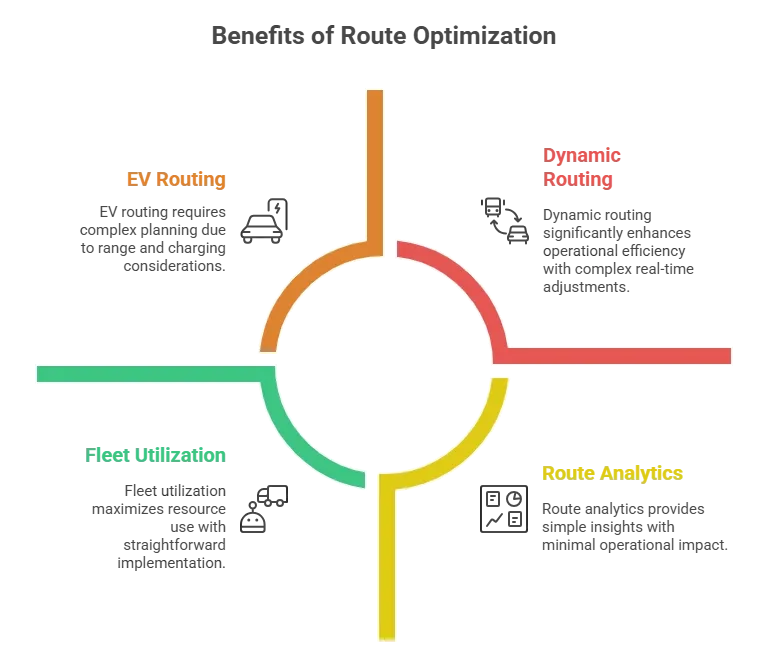
EV Routing: Range and Charging-Aware Planning
EV routing works when you plan the route and charging stops as one plan. The U.S. DOE says the median 2024 EV range is 283 miles per charge. However, real routes include detours, traffic, and extra stops.
Also, note that cold days shrink your buffer fast. AAA says using the heater on a 20°F day can cut EV range by about 41%, so a “safe” plan can turn risky in the afternoon.
Charging speed also shapes your schedule. DOE’s AFDC says charging can take less than 20 minutes on DC fast chargers but 20 hours or more on a basic wall outlet (Level 1).
So plan short fast-charge top-ups with route scheduling tools like FieldServicely to keep routes flexible. The U.S. Department of Transportation says charging slows near full, and the last 10% can take about as long as the first 90%. Therefore, many teams plan to charge around 80% and keep moving.
Growth & Planning: Capacity Forecasting, Better Bids, Smarter Territories
Route Analytics & KPI Reporting
Thanks to route optimization, route analytics shows the wins in numbers. The KPI reporting tells you whether miles, drive time, cost per stop, and on-time rate actually improved. And it does that route by route.
KPI dashboards also expose the waste you can fix. ATRI's 2025 update shows empty miles were 16.7% in 2024. Route optimization solves this by tightening miles and ordering stops smartly.
That said, service-time and travel-time reports also sharpen your bids. Real data helps you quote jobs better, plan capacity faster, and build routes your team can do daily.
Accurate Job Timing for Quotes, SLAs, and Contract Bids
Route optimization helps you estimate job times better. As a result, you can quote faster and price with confidence. It uses actual drive times and planned service time to predict how long each job will really take.
Traffic, however, makes guessing risky. This is where route optimization helps you plan around it with time windows and buffers. ATRI's 2024 report shows 1.2 billion hours of truck delays in 2022. And on average, it costs $108.8 billion every year. It's clear proof that route schedules fall apart when you ignore traffic.
Route scheduling also keeps you from overbooking, making SLA promises safer. Aquant's 2024 report found that one missed visit leads to 2.7 visits total and adds 13 days to fix the problem. So, good timing protects your bids from extra work you didn't plan for.
Reduce Driver/Tech Burnout with Predictable Routes
Route optimization lowers burnout by making routes simple and manageable. Dispatch can limit a route to, say, 18 stops instead of 26 and add extra time for traffic. And this makes it easy for field workers to finish on time. Besides, less burnout means company growth, as it leads to low turnover rates
Dispatch optimization also helps drivers earn more because they cover more miles and reduce empty runs. A 2024 driver market study from Conversion Interactive Agency and PDA found 81.9% of job-seeking drivers want steady pay. And 60% of pay complaints blamed a "lack of miles."
Customer Experience Benefits
Improved On-time Performance
Route optimization helps your field team arrive on time. It builds routes based on time windows, drive time, and how long each stop takes. When traffic gets bad, or a job runs longer, it shuffles stops around so one delay doesn't mess up your whole day.
Besides, customers care more about on-time service than many teams realize. Narvar’s 2025 U.S. shopper survey found 74% experienced late deliveries. And 60% of shoppers ages 18–29 won’t buy again after a late delivery.
That said, even if you miss on scheduled delivery, clear updates can protect trust. For example, the same survey shows 45% buyers want real-time updates. And 38% say frequent tracking updates reduce anxiety.
Improve CSAT with Proactive ETAs and Fewer Missed Visits
Route optimization improves CSAT because it sends customers a clear ETA and a specific arrival window. It also pushes regular SMS or email updates when traffic, job overruns, or a re-route change the plan.
Real-time visibility is also important. For example, the FedEx 2025 report says 68% of shoppers expect real-time tracking. This is because people love certainty over unclear promises.
Route Optimization Benefits by Industry
Last Mile Delivery and Logistics
Route optimization lowers cost per stop by minimizing travel road and repeat attempts in last-mile delivery. This matters because last-mile delivery is expensive, as Maersk says it is 53% of the total shipping costs.
That said, costs keep rising, too. DS Smith’s 2025 survey found 84% of companies saw last-mile costs increase, with 39% seeing jumps over 10%.
Last-mile route optimization helps deliveries arrive on time as well. It plans routes around delivery windows and updates arrival times when there's traffic.
The stats prove it works in real life. Like in December 2024, UPS hit 96.5% on-time delivery, FedEx hit 91.8%, and USPS hit 90.4%.
Also, you can now handle more deliveries by resequencing stops in seconds when orders spike. This comes in handy in peak seasons. For instance, the parcel industry delivered over 2.2 billion packages in December 2024. Dynamic routing and tracking help you handle these surges without hiring more drivers.
Field Service and Transportation
Field service dispatchers use route planning to create technician routes that fit appointment times and job lengths. This reduces drive time and helps you schedule more jobs without buying more trucks.
Take the Forrester study on Microsoft Dynamics 365 Field Service as proof. They found $2.1M in savings from less travel time over three years. It also shows that technician productivity went up 14% after full setup. As a result, 12% fewer return visits were needed. Return visits mean more miles, more gas, and frustrated customers.
Transportation fleets also get the same benefits at scale. Like fewer miles, steadier ETAs, and better fleet utilization.
Supply Chain Management
Route optimization helps supply chain teams move inventory from warehouses to job sites. It suggests shorter routes with fewer mistakes. This matters because U.S. logistics costs hit $2.6 trillion yearly. That's 8.7% of the total GDP of the country. So even small route improvements can save big money.
Lower your cost per delivery starting now
Try for free - No credit card required!
How to Measure Route Optimization Benefits
Here’s how you can measure route optimization benefits:
- Start with a benchmark week before you change anything. Track the same routes, same techs/drivers, and the same service area. This way, your numbers stay precise.
- Measure miles per route and drive time per stop from your GPS tracking or driver app.
- Track capacity with stops per day (delivery) or jobs per day (field service). A win looks like more completed stops without adding trucks, techs, or overtime.
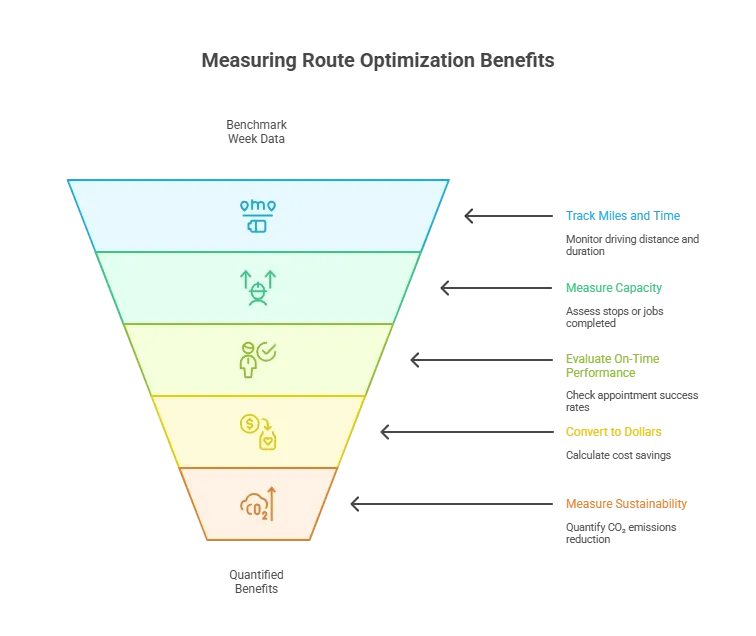
- Check on-time performance with one clear number: “% of arrivals inside the time window.” Also track “missed appointments / failed deliveries”. Because one failed stop often triggers a costly re-route and a second visit.
- Convert improvements into dollars with cost per stop. A quick proxy many US teams use is the IRS 2026 standard mileage rate. It's 72.5¢ per mile. So if you save 200 miles per week, that’s about $145/week before you even count labor and overtime.
- Measure sustainability in plain math using fuel. EPA estimates 8,887 grams CO₂ per gallon of gasoline and 10,180 grams CO₂ per gallon of diesel. So you can turn “gallons saved” into “CO₂ saved” for reports or customer bids. [Source: EPA]
Route Planning and Optimization Benefits in Real Life
Case Study of Cáritas Diocesana de Setúbal
Route optimization expands the capacity for field teams that run on appointments. In a “field service” case study for Cáritas Diocesana de Setúbal, optimized routing cut total travel time by 16% on Monday. More specifically, from 207 to 175 minutes. And 18% on Tuesday, from 219 to 180 minutes. When your techs spend less time driving, you can fit more jobs into the same day without adding headcount.
ArcGIS Pro Waste Collection (Saitama, Japan)
Route optimization reduces mileage and shift time in city fleets, too. A 2023 ArcGIS Pro waste-collection study in Saitama, Japan, used real operational data. They reported 7%–13% mileage reduction, along with lower operating time across the evaluated areas. That translates directly into lower fuel cost, less overtime pressure, and less vehicle wear.
Last Mile Delivery in Lisbon
A Lisbon case study found use of real-time route adjustments caused 15–20% faster delivery times. It also reported 30% higher fleet utilization. The same before-and-after study showed about 20% higher customer satisfaction.
On top of that, it found 25–40% lower CO₂ emissions, which is a big win for modern transportation teams. This proves route optimization speeds up last-mile delivery and helps fleets do more with the same vehicles.
The 2026 Buyer’s Checklist for Routing Software
Routing software should do more than draw a line on a map. It should help you plan multi-stop routes, dispatch, and hit time windows without chaos. Here is the checklist for an ideal route planning software:
Solve your real constraint: Pick a tool that handles time windows, service duration, capacity, and territories.
Support dispatch in real time: Look for live GPS tracking, quick reassignment, and a clear dispatch board for field teams and fleets.
Make the route usable on the road: An ideal route optimization tool should have a driver/technician mobile app with simple navigation, job details, and status updates.
Prove the work: Look for proof of service or proof of delivery, plus notes and photos per stop.
Track route adherence: Demand route history, stop sequence visibility, and basic exceptions (late, skipped, off-route).
Automate customer updates: Choose ETA and notification flows that reduce “Where are you?” calls.
Measure outcomes: Require reporting for miles driven, cost per stop, on-time rate, and productivity (stops per day).
Check what’s live today: Ask what’s available now vs. “coming soon,” and validate it in a demo and trial.
Why FieldServicely is the Complete Operations Solution
FieldServicely focuses on the daily operations you actually run. For example, dispatching, tracking, and route visibility in one place. It also offers route maps, scheduling, real-time notifications, and web + mobile access. Not to mention the offline access.
This tool also goes beyond routing with full-fledged field-service features. Basic functions like job management and performance tracking are baked into the tool by default. You can think of FieldServicely as field service management's Swiss Army Knife. It's a platform that combines scheduling, GPS tracking, timesheets/payroll, and more in one system. So it's safe to say, for your route planning and optimization needs, it passes with flying colors.
Try FieldServicely #1 Field Service Management Software
Try for free - No credit card required!
What to read next