- GPS Tracking for Field Service
What Is Buddy Punching? Causes, Risks & Prevention Guide
Updated on 24 Feb 2026
Jump to
Summary

Buddy punching is when one employee clocks in or out for another who is not actually present, creating fake time records.
It increases payroll costs, inflates overtime, distorts productivity data, and weakens workplace trust over time.
Employees often do it to cover lateness, avoid pay loss, exploit weak systems, or respond to rigid policies and low morale.
Businesses can detect it through unusual time patterns, repeated edits, device or location irregularities, and mismatched output.
Clear policies, secure time tracking, identity verification, audits, and fair communication help prevent buddy punching effectively.
Buddy punching is basically time fraud where an employee clocks in or out for another who is absent, late at work, or leaves early. While workers see this as a gesture of goodwill and co-operation, it creates inaccurate payroll and reduces productivity.
Over time, it increases labor costs, distorts overtime calculations, and weakens workplace trust.
In this blog, we will discuss how buddy punching works, why employees do it, its legal and financial impact, and how organizations can prevent it effectively.
What is Buddy Punching?
Buddy punching is when one employee clocks in or clocks out for another employee who is not actually at work. It almost always starts as a quick favor.
Here’s what it looks like:
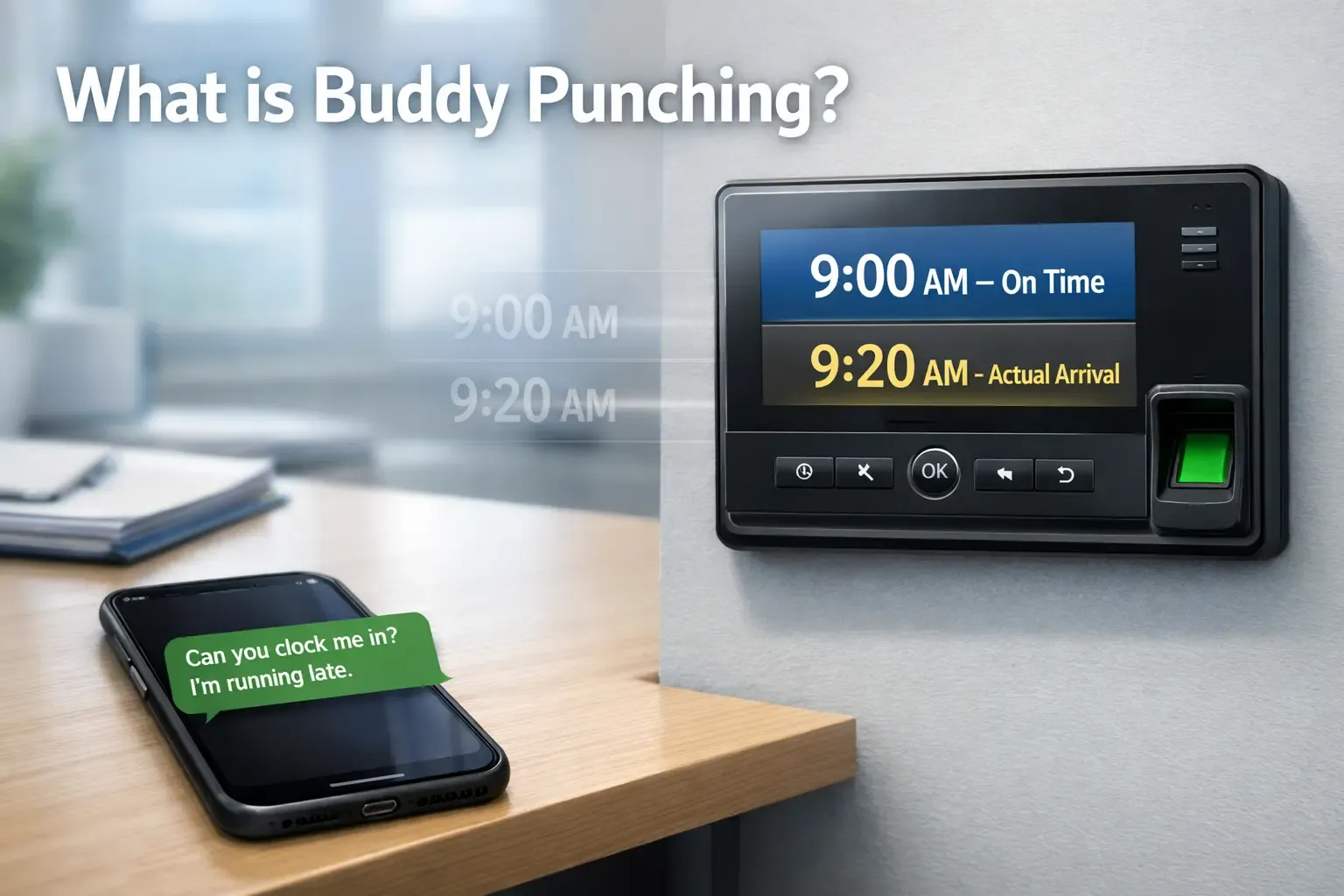
An employee is running late for a 9:00 AM shift. Instead of accepting the late mark, they text a coworker and ask them to punch in on time. The system records a full shift, even though the employee arrived 20 minutes later.
It also happens the other way around.
Someone wants to leave early but does not want fewer hours on record. They ask a colleague to clock them out at the scheduled time. Payroll shows a complete shift, but the work hours were shorter.
That is buddy punching.
Companies treat this as time theft because it creates false timecard records. The research shows employer losses due to buddy punching, estimating an average cost of about $1,560 per employee per year from excess paid hours.
Why Employees Perform Buddy Punching?

Buddy punching usually starts with a bad morning, a tight paycheck, or a system that makes shortcuts easy. When I look at real workplaces, the reasons feel very human. And that’s exactly why it spreads.
Concealing Tardiness
Most buddy punching begins with someone running late. Traffic backs up, a child gets sick, the alarm doesn’t go off. Instead of calling the manager and admitting it, they text a coworker.
“Can you clock me in?”
That coworker taps the time clock. The system says 9:00 AM sharp, even though the employee walks in at 9:18. In that moment, it feels harmless.
But here’s the problem. When attendance policies are strict and even small delays trigger warnings, people stop being honest. They start protecting themselves instead.
Preventing Wage Loss
Money pressure makes small decisions feel bigger. For hourly workers, every minute counts. Losing even 30 minutes a week means less take-home pay at the end of the month.
Cost pressure is still real. The U.S. Bureau of Labor Statistics continues to report that many workers are adjusting to higher living costs despite wage growth.
So when someone asks for a quick punch-in favor, the thought process basically is “I can’t afford to lose that time.”
Exploiting System Vulnerabilities
Now let’s talk about systems. Some workplaces practically make buddy punching easy. With shared PINs, card swiping, paper time sheets, and basic clock-in apps, anyone can register their attendance on time.
This happens a lot in retail, warehouses, construction, and healthcare. Large shift teams, limited supervision, and busy managers create space for shortcuts. And when no one checks closely, people notice.
The moment biometric time clocks or facial recognition systems enter the picture, the behavior drops. Once the loophole closes, the temptation weakens.
Avoiding Disciplinary Consequences
Fear pushes people into quiet decisions. Some companies use strict attendance scoring systems. Three late arrivals might trigger a formal warning.
Instead of risking that record, employees ask a friend for help. It feels safer than explaining personal struggles. It feels less risky than sitting in HR.
Rigid systems without flexibility often backfire. When employees believe management won’t listen, they stop communicating honestly. They look for ways around the system instead.
Responding to Workplace Culture
Culture quietly decides what is acceptable. If one person buddy punches and nothing happens, others notice. After a while, it stops feeling wrong.
Then peer pressure kicks in.
Saying no to a coworker feels awkward. Especially in tight teams. Helping someone once turns into helping them regularly.
Engagement plays a role here, too. Lower engagement often means lower emotional commitment to company rules.
When people feel disconnected from leadership, protecting company policy stops feeling personal.
Experiencing Burnout and Low Morale
Burnout changes behavior. Long shifts, short staffing, and constant pressure wear people down. In that state, leaving early or stretching time feels justified.
According to a study, 49.9 % of employees reported at least one burnout symptom. Burnout links to reduced engagement and increased counterproductive work behavior.
When someone feels exhausted and undervalued, the line between right and wrong blurs. They start thinking, “I deserve this break.”
Operating Without Clear Enforcement
Behavior spreads when consequences disappear. If managers never audit timecards or address attendance fraud, employees assume the risk is low.
I’ve seen how fast this grows. One favor becomes routine. Routine becomes culture.
On the other hand, clear monitoring changes behavior quickly. When companies review attendance records and apply consistent rules, buddy punching drops almost immediately.
Stop time fraud before it inflates your payroll
Get location-verified attendance built for field operations
What Are the Impacts of Buddy Punching?

At first, buddy punching feels minor. It looks like a small favor between coworkers. Someone runs late. Someone else taps the clock.
But when you track it across months, teams, and payroll cycles, the impact spreads further than most managers expect. Here’s what actually happens.
Increased Payroll Costs and Overtime Inflation
The most obvious impact is payroll loss.
When employees get paid for time they did not work, the company absorbs that cost. Ten or fifteen minutes may not sound serious, but multiply that across weeks and multiple employees, and the numbers grow quickly.
Now add overtime.
Inflated time entries can push employees past 40 hours per week. Once that threshold is crossed, overtime pay activates automatically. The company may end up paying time-and-a-half for hours that were never worked.
BLS reports that average weekly overtime hours for production and nonsupervisory workers were about 3.8 hours in January 2026
When time records are inaccurate, labor budgets stop reflecting reality. Managers begin questioning why labor costs increase without a matching increase in output.
Distorted Productivity and Misleading Business Data
Most organizations calculate productivity using hours worked. When time records are inflated, productivity per hour appears lower than it actually is.
For example, if an employee produces 100 units in a shift but the system shows 10 hours instead of 9.5, output per hour drops on paper. That small distortion affects performance reviews and departmental targets.
Over time, these inaccuracies compound. Leaders make decisions about staffing, hiring, or workflow adjustments based on flawed attendance data.
Instead of addressing time fraud, companies may incorrectly assume operational inefficiency. Once the underlying data becomes unreliable, decision-making quality declines.
Lower Morale, Fairness Concerns, and Engagement Decline
Buddy punching hurts team morale. Employees who show up on time can see when others don’t—and it’s frustrating when those same coworkers still have perfect attendance records in the end.
At first, most employees ignore it. Then resentment builds.
Did you know that only 23% of employees are engaged globally?
When employees perceive unfair treatment, motivation declines further. Some disengage quietly. Others begin rationalizing similar behavior. A single tolerated violation sends a signal that attendance rules are flexible.
Once fairness feels inconsistent, trust between management and staff weakens. And when trust weakens, retention becomes harder.
Legal, Compliance, and Financial Risk
Time records are not just internal documents. They carry legal weight.
Under the Fair Labor Standards Act, employers must maintain accurate records of hours worked for non-exempt employees.
If an audit occurs and timecards do not reflect actual work hours, the company faces exposure. Even if employees initiated the falsification, regulators expect employers to implement reasonable timekeeping controls.
Inaccurate records also affect overtime calculations, payroll taxes, and benefits reporting. A timekeeping discrepancy can create tax errors or disputes over unpaid wages.
Cultural Damage and Long-Term Organizational Impact
If minor time fraud goes unnoticed, other forms of rule-bending may follow. Expense reports become less precise. Performance reporting becomes less accurate, and accountability declines.
Customer experience can also suffer.
When employees are “clocked in” but not physically present, teams operate understaffed. In retail, healthcare, hospitality, or logistics, fewer people on the floor means slower service and increased errors.
Meanwhile, honest employees absorb the extra workload. Over time, that pressure contributes to burnout.
According to a study, burnout contributes to productivity loss, missed workdays, and adverse health outcomes among employees
Burnout lowers engagement. Lower engagement increases turnover risk.
Protect your margins with verified field time tracking
See how accurate attendance improves profitability
How to Detect Buddy Punching

Unusual Timecard Patterns
Buddy punching usually leaves a pattern. The first red flag is a timecard that looks unreal, like clock-ins at 9:00 on the dot every day for weeks.
Real life rarely runs that clean. Commutes change with traffic, weather, and childcare, so normal attendance data shows variation, even for great employees.
So perfect timestamps should make you pause.
Now, here’s the simple rule I use in audits. Start by sorting clock-ins by minute and second, then look for repeated “exact time” streaks. If two friends always clock in within the same 10 to 20 seconds, you may have your pair.
Next, compare that pattern to role and shift type.
A factory line with a physical time clock will show different behavior than a mobile crew with staggered arrival. So you are not accusing anyone yet, you are just spotting data that does not behave like real life.
Attendance vs. Physical Presence
Buddy punching becomes obvious when “clocked in” does not match “seen at work.” The cleanest signal is a person who shows as present in the system but appears late on the floor, at the front desk, or at the job site.
So ask a direct question. If your schedule says you had six people on shift at 9:00, did you actually see six people ready to work at 9:00?
You can do simple spot checks for two weeks, rotating days and shifts, then compare notes to time punches. If the same names keep showing gaps, your system probably has a loophole.
This also protects your good employees. Honest staff hate carrying the load while someone else “earns” time they did not work.
Excessive Timecard Edits
Buddy punching often hides behind “small corrections.” The biggest clue is not the punch itself, but the number of manual edits tied to the same employees.
Start with a basic audit question. Who edits timecards, how often, and for whom?
If one supervisor keeps approving “forgot to punch” fixes for the same two employees, you likely have a routine. If the edits always move time in one direction, like earlier clock-ins or later clock-outs, that pattern matters.
This connects to compliance risk, too.
Payroll mistakes do not just cost money; they can create penalties and legal exposure when records look unreliable. Over half of the surveyed companies reported payroll penalties in the last five years tied to non-compliance, which shows how quickly time and pay issues turn expensive.
So tighten your edit controls. Limit who can change time, require a reason code, and make managers approve changes in writing inside the system. Then review “top edited employees” monthly, like you would review overtime.
Device and Location Irregularities
Buddy punching increases when identity checks are weak.
If your system uses badges, PINs, or shared kiosks, confirm one simple thing: the person who punched is the person who worked.
Start with device and location logs. If five employees clock in from the same phone, the same browser, or the same IP, you need a clear explanation, especially outside a kiosk setup.
Then bring in location verification when the job needs it. GPS and geofencing help for field teams, because the system can confirm the punch happened at the site, not in a parking lot across town.
For field teams, tools like FieldServicely help close common gaps without adding complexity. It combines GPS tracking, geofenced check-ins, and photo verification so managers can confirm that clock-ins happen at the actual job site. Time entries connect directly to work orders and timesheets, which makes payroll reviews clearer and more accurate.
Mismatch Between Hours and Output
Buddy punching often shows up in performance before it shows up in data. The classic sign is hours that rise while output stays flat. Or a shift that looks fully staffed on paper but feels understaffed in reality.
So compare staffing coverage to what your customers experience.
If a store “has full coverage” but lines keep growing at opening, the clock data might be lying. If a warehouse “has full coverage” but pick rates drop at the start of every shift, the punches might not match the floor.
Also, listen to supervisors and peers, but filter it through facts. People complain for many reasons, so you should not treat every report as the truth.
Detect time irregularities before they turn costly
Review clock-ins, GPS, and job data in one place
How to Stop Buddy Punching
I didn’t think buddy punching was a serious problem at first. It felt like one of those small workplace habits that didn’t really move the needle. Then I ran payroll numbers for one quarter and saw costs climbing without any increase in output.
That’s when it hit me. So I started quick action.
Here’s how I stopped buddy punching in my company:
Clarify the Attendance Policy
The first thing I changed wasn’t technology. It was clarity.
Most employees don’t view clocking in for a friend as fraud. They see it as helping someone who got stuck in traffic or had a rough morning.
So we rewrote our attendance policy in simple language. We added one direct sentence: clocking in or out for another employee is falsifying company records. Then we explained the consequences plainly.
Organizations with formal anti-fraud policies detect issues faster and reduce losses significantly. [Source: Association of Certified Fraud Examiners]. That matched what I saw internally.
The “harmless favor” mindset started to disappear. People behave differently when ambiguity is gone.
Upgrade the System
If your time tracking system is easy to manipulate, someone will eventually manipulate it.
We used shared PIN access at one point. That alone created a loophole. Anyone who knew the code could punch for someone else.
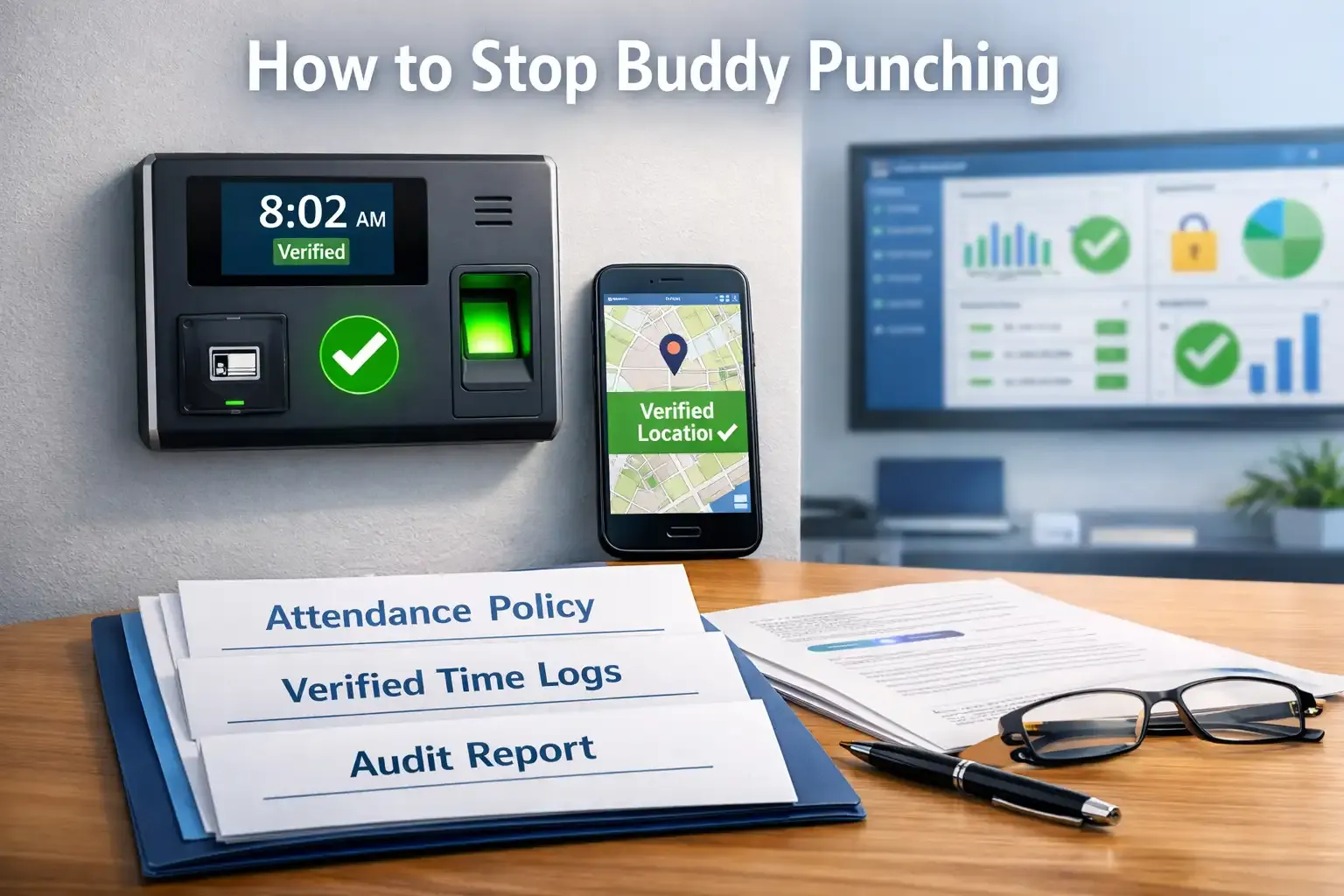
Once we switched to individual credentials with automatic edit logs, behavior shifted. Suddenly, every timecard change left a footprint tied to a specific person.
Time theft affects around 75% of U.S. businesses in some form. That tells me this isn’t rare. It’s common wherever systems allow shortcuts.
If your system makes cheating easy, you’re not protecting payroll. You’re testing temptation.
Strengthen Identity Verification
The biggest turning point for us came when we introduced biometric verification.
Badge swapping stopped immediately because it simply couldn’t happen anymore. You can hand someone your ID card, but you can’t hand them your fingerprint.
I was careful about privacy concerns. Modern biometric systems store encrypted templates, not raw fingerprint images, as we clearly explained to the team.
Once people understood that this was about fairness, resistance dropped. The shortcut disappeared, and with it, the behavior.
When the system makes impersonation impossible, buddy punching becomes impractical.
Verify Location for Mobile and Field Teams
Office time clocks are one thing. Field crews are another.
We realized mobile clock-ins created a different vulnerability. Someone could technically clock in before arriving on site unless we controlled the location.
So we added GPS verification and geofencing. If the device wasn’t physically within the job boundary, the system didn’t allow the punch.
Time variability is naturally higher in travel-based industries. That’s normal. But variability isn’t the same as fraud. Geofencing simply aligned recorded time with physical presence.
Once that went live, questionable early punches stopped without a single heated conversation.
Audit Consistently
At first, I resisted audits because I didn’t want the culture to feel suspicious. But I learned something important.
Audits feel intrusive only when they are reactive and personal. When they are routine and system-wide, they feel procedural.
We started running monthly time reports. We looked at repeated edits, unusually perfect start times, and overtime that didn’t match the workload.
Patterns surfaced quickly.
Proactive monitoring dramatically shortens fraud detection timelines and reduces total losses. That aligned exactly with our experience.
What surprised me most was this. Once employees knew audits were regular and consistent for everyone, anxiety actually decreased.
Address the Root Cause
Sometimes, buddy punching is about fear of rigid lateness policies. Fear of getting written up for five minutes. Fear of looking unreliable.
We introduced a small grace window for minor delays and created a clear correction process for honest mistakes. That alone reduced the perceived need to “help” someone by clocking them in.
Research shows that disengaged employees are significantly more likely to engage in counterproductive work behaviors. That includes time manipulation.
When we improved transparency and treated minor issues proportionally, morale improved. And with better morale, the justification for dishonest shortcuts faded.
When people feel treated fairly, they don’t feel the need to bend rules.
Communicate the Why Behind Every Change
The final piece was communication.
We explained the financial impact openly. We showed how inflated payroll affects raises, hiring capacity, and team bonuses.
Once employees saw that buddy punching didn’t hurt “the company” in the abstract but directly impacted their own team’s growth, the conversation shifted.
Stopping buddy punching stopped being about enforcement. It became about fairness. That’s the real formula.
Protect payroll accuracy without micromanaging your team
See verified attendance in one unified platform
Legal Considerations of Buddy Punching

Most business owners think buddy punching is only an internal discipline issue. Rather, it touches wage law, fraud definitions, overtime compliance, and even data privacy.
Here are the legal considerations of buddy punching:
Time Theft
Buddy punching is legally treated as time theft because wages are paid for hours not worked. The moment false hours enter payroll, you are dealing with inaccurate wage records. That distinction matters because labor laws are built around accurate timekeeping.
Under the Fair Labor Standards Act (FLSA), employers must maintain precise records of hours worked and wages paid. If recorded time does not reflect actual work performed, the company’s compliance position weakens immediately.
Even DOL reported more than $273 million in back wages due to wage and hour violations and recordkeeping failures. That tells you how seriously regulators treat time accuracy. If buddy punching distorts records, it places the company inside that same risk zone.
Occupational Fraud
Buddy punching falls under occupational fraud because compensation is issued based on false information.
Organizations lose about 5% oftheir annual revenue globally to occupational fraud, which includes payroll manipulation schemes. That category covers falsified time entries.
Intent does not change the classification. Even if an employee claims they were “helping a coworker,” the act still involves receiving pay under inaccurate reporting.
In repeated or organized cases, state theft statutes may apply if financial thresholds are crossed. Most incidents remain internal matters, but legally, the possibility of escalation exists when misconduct becomes systematic.
Legal Responsibility
Employers are not legally protected simply because an employee initiated the timecard fraud.
If management knows buddy punching occurs and fails to act, liability increases during audits or wage disputes. Courts rely heavily on employer time records as primary evidence.
When those records are inaccurate, the employer’s credibility weakens. That becomes especially important in overtime claims, where employees may later argue that records were unreliable or inconsistently enforced.
Labor enforcement trends through 2025 continue to emphasize employer responsibility for accurate systems. Regulators expect controls that prevent manipulation, not systems that invite it.
Overtime and Wage Calculations Violation
Buddy punching frequently affects overtime calculations. If an employee is clocked in early or clocked out late repeatedly, weekly totals increase and may trigger overtime pay that was not actually earned.
Overtime compliance under the FLSA remains a major enforcement focus. Inaccurate overtime calculations can lead to back pay orders and penalties if discovered during an audit.
The Department of Labor continues to prioritize overtime enforcement as part of its wage and hour initiatives. Even small discrepancies, when repeated across employees, can compound into significant exposure.
So the legal issue is not just false hours. It is the miscalculated wages flowing from those false hours.
Criminal Risk
Most buddy punching cases are handled internally through disciplinary action. However, when falsified punches become widespread and intentional, prosecutors may view the conduct as theft or conspiracy, depending on the financial impact.
Criminal thresholds vary by state, but repeated payroll fraud that crosses monetary limits can escalate beyond workplace discipline. That risk increases when multiple employees coordinate falsified entries over time.
While criminal charges are not common for isolated incidents, the legal framework allows escalation when misconduct becomes organized. That alone makes prevention a legal priority, not just a policy decision.
Data Compliance
Preventing buddy punching often involves biometric verification, tracking employees in real time via GPS, or facial recognition. Those tools reduce fraud risk but introduce privacy obligations.
For example, states like Illinois enforce strict biometric data laws requiring informed consent, secure storage, and defined destruction timelines. Non-compliance has led to costly lawsuits in recent years.
So while identity verification strengthens timekeeping integrity, it also requires careful legal compliance. Prevention systems must align with data protection regulations, not just payroll goals.
Reduce legal risk with accurate, verified attendance data
Align payroll records with GPS-backed time tracking
How to Set Up a Buddy Punching Policy
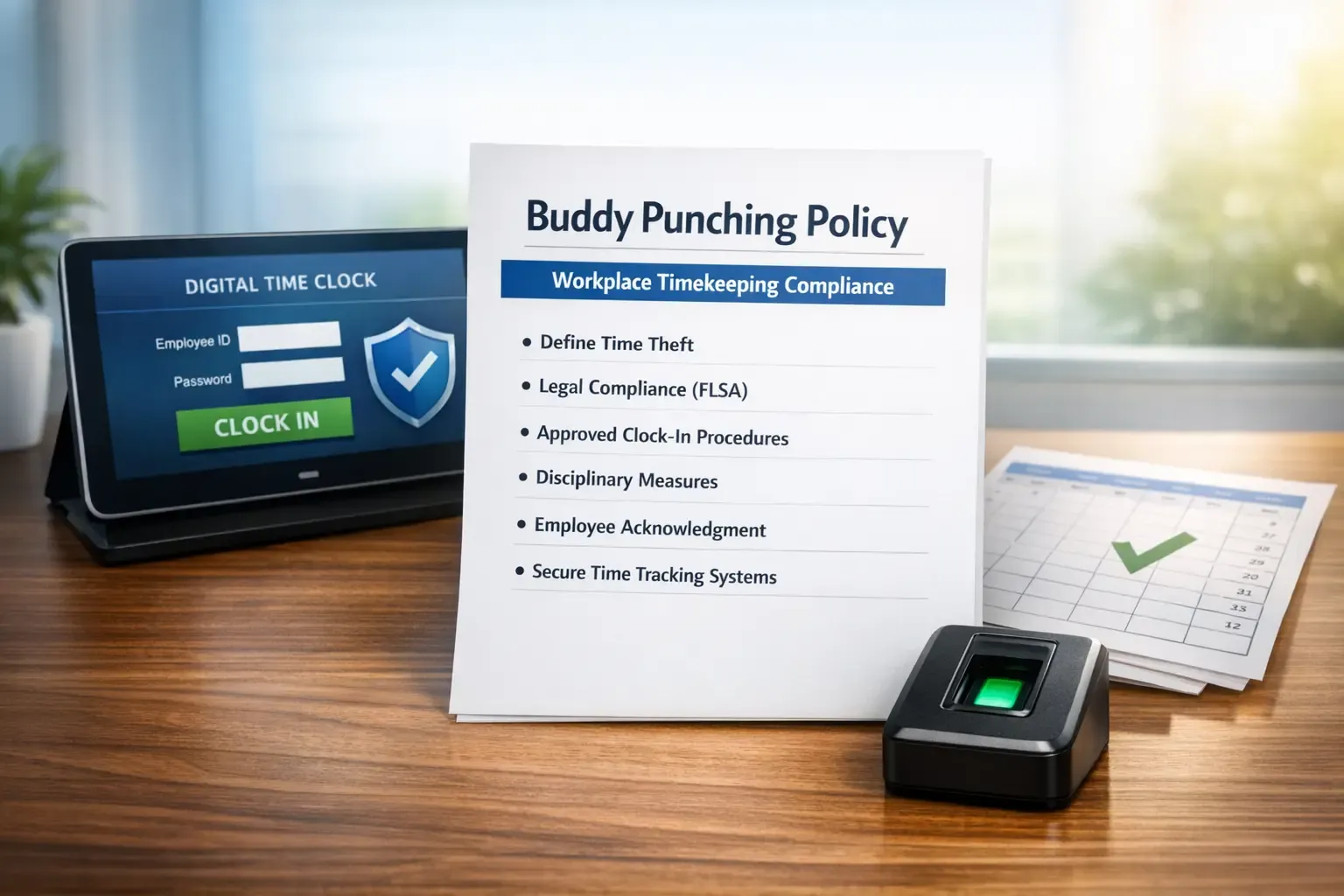
Define the Misconduct Clearly
A buddy punching policy must begin with a clear definition of prohibited behavior. The policy should state that clocking in or out for another employee, or requesting someone to do so, constitutes falsification of time records and payroll misrepresentation.
The definition should classify buddy punching as time theft and a violation of attendance procedures. Under the Fair Labor Standards Act (FLSA), employers must maintain accurate records of hours worked and wages paid.
Explain Legal and Financial Exposure
The policy must explain why buddy punching creates legal and financial risk. When false time entries distort wages or overtime, employers may face penalties, audits, or back-pay claims.
By clearly outlining these risks, the policy reinforces that timekeeping accuracy is not discretionary but legally required. Employees are more likely to comply when the implications are clearly stated.
Establish Clear Timekeeping Procedures
The policy must outline how employees are required to record time. It should specify approved devices, clock-in locations, authentication methods, and any identity verification requirements. Clearly documented procedures prevent loopholes and support consistent enforcement.
If biometric systems, GPS tracking, or unique login credentials are used, those expectations must be stated in advance. When employees understand exactly how time must be recorded, accountability improves.
Set Consistent Disciplinary Measures
The policy must define the consequences of violations. Progressive discipline may include written warnings, suspension, or termination depending on the severity and recurrence of misconduct. Clear disciplinary language strengthens enforceability.
Consistency in enforcement is essential. Courts and regulators evaluate whether employers apply policies uniformly across employees. Defined consequences reduce claims of unequal treatment and support legal defensibility.
Require Acknowledgment and Training
The policy should require employees to provide written acknowledgment confirming they understand the rule and its consequences. Signed acknowledgment strengthens the employer’s position in the event of disputes. Documentation demonstrates that expectations were communicated clearly.
The policy must also be integrated into onboarding and periodic training. Presenting the rule during orientation and reinforcing it through training sessions improves awareness.
Align Technology, Monitoring, and Review
The policy must align with the organization’s time tracking systems. If shared credentials or unsecured edits are permitted, enforcement becomes ineffective. Secure systems such as unique logins, audit logs, biometric verification, or GPS controls should support the written rule.
The policy should also state that time records are subject to routine review. Finally, the policy should allow for legitimate correction procedures. Clear methods for reporting honest timekeeping errors reduce the temptation to falsify records.
Plus, regular policy review ensures alignment with evolving labor regulations and technology updates.
Protect payroll integrity with structured attendance controls
Upgrade your timekeeping system to support your policy
Conclusion
Buddy punching may seem minor at first, but its impact grows quickly. When employees get paid for time they did not work, payroll accuracy suffers, trust declines, and compliance risks increase.
Understanding what is buddy punching helps organizations recognize that it is not just a policy violation but a structural risk. Clear rules, secure systems, consistent monitoring, and fair workplace practices reduce the opportunity for misuse. When expectations are transparent and enforcement is consistent, time records stay accurate, and workplace integrity remains protected.
Frequently Asked Questions
Is buddy punching illegal?
Buddy punching can be illegal depending on the circumstances. It qualifies as time theft because wages are paid for hours not worked, and falsifying time records may violate labor and fraud laws. While many cases result in termination rather than criminal charges, repeated or organized payroll fraud can escalate under state theft statutes.
Can an employee be fired for buddy punching?
Yes, an employee can be terminated for buddy punching. Most company handbooks classify falsifying time records as a serious violation of workplace policy. Employers have the legal right to discipline or terminate employees for dishonest payroll reporting.
How can managers prove buddy punching?
Managers can identify buddy punching by reviewing time logs, edit histories, and location data. Patterns such as identical clock-in times, repeated time edits, or mismatched location records often indicate manipulation. Secure systems with biometric verification or audit trails make proof easier and more defensible.
Does buddy punching affect employee morale?
Yes, buddy punching can negatively affect morale. When some employees receive pay for unworked hours, others may feel the system is unfair. Over time, this erodes trust, reduces engagement, and encourages similar misconduct if not addressed consistently.
What industries face the highest risk of buddy punching?
Industries with hourly workers and shift-based scheduling face higher exposure. Construction, retail, field service industry, hospitality, healthcare, and manufacturing environments often rely on clock-in systems that can be manipulated without proper controls. Field-based roles with mobile clock-ins also carry added risk if location verification is weak.