- GPS Tracking for Field Service
Timecard Fraud in Field Operations: Hidden Costs Explained
Jump to
Summary

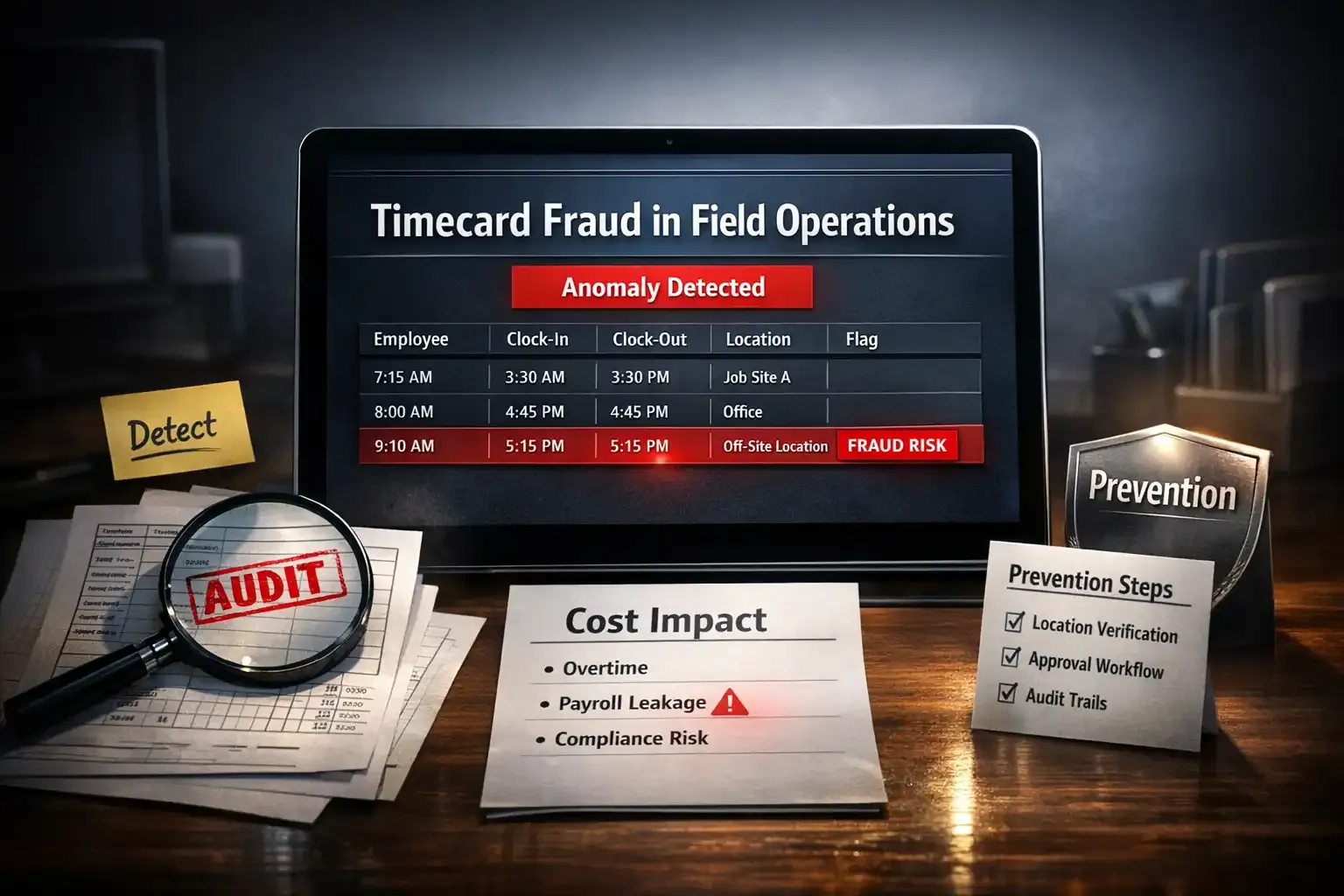
Timecard fraud is the intentional manipulation of time records to show more work than actually happened, often through edited mobile entries or inflated travel logs.
In field service, it hides inside normal reporting like buddy punching, extended breaks, unapproved overtime, and mis-coded service tickets.
It usually surfaces first as data inconsistencies, such as GPS mismatches, perfectly rounded hours, overtime spikes, or customer billing disputes.
The impact goes beyond payroll loss, distorting job costing, productivity metrics, morale, SLA compliance, and legal exposure.
Prevention requires verified time tracking, clear written policies, workforce analytics, and consistent supervision to protect operational integrity without damaging trust.
The time card fraud problem rarely starts big. You might not notice it immediately because it hides inside normal daily reporting. The most common giveaway is when you question why labor costs rise even though service ticket volume stays low.
In this blog, we will show you how timecard fraud shows up in field service operations. We will also explain how you can detect it early and prevent it without damaging team trust.
What Is Timecard Fraud?
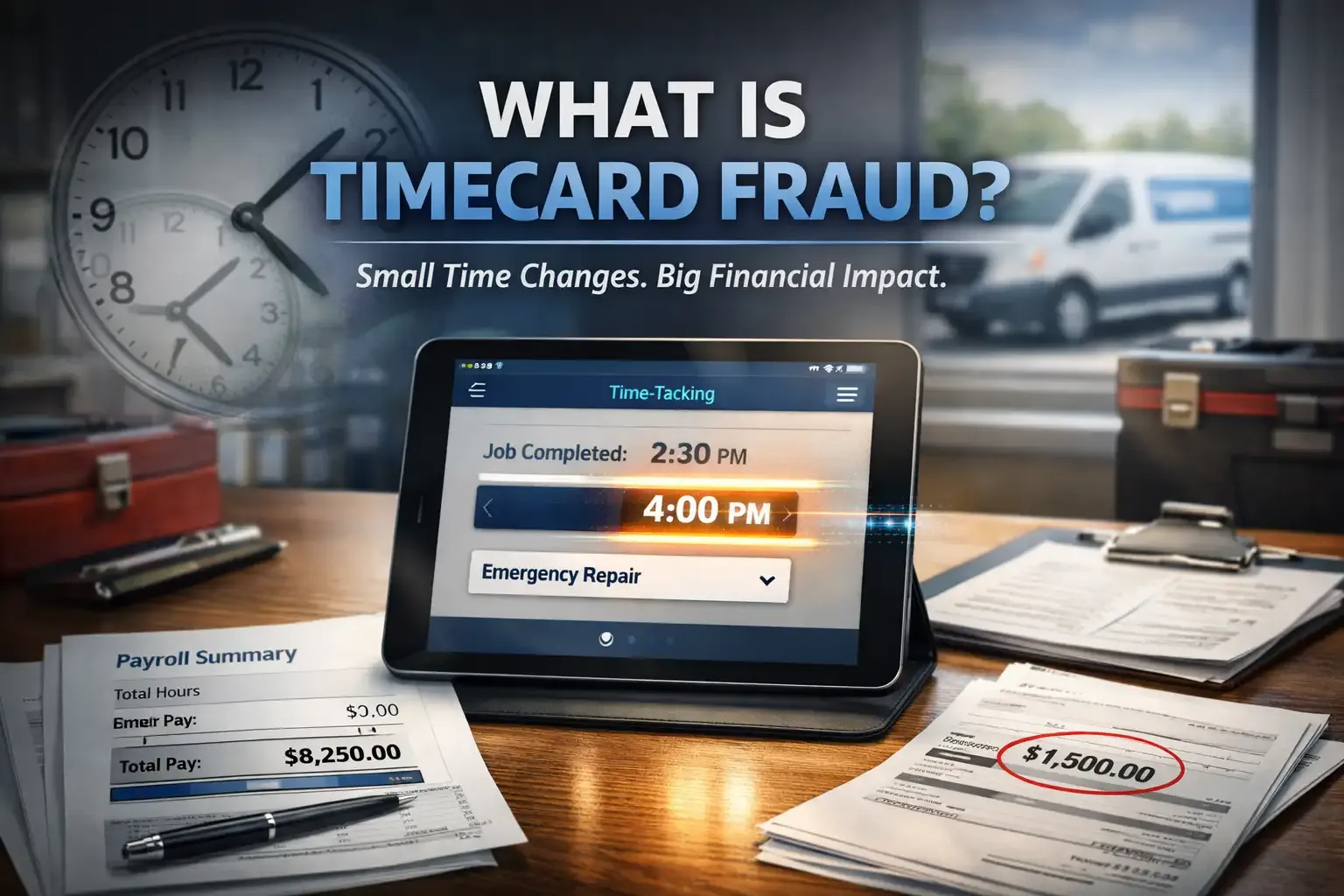
Timecard fraud is the intentional manipulation of time records to show more work than actually happened. It means someone edits time entries, job codes, or service logs to increase pay or reduce accountability.
In simple terms, the record says one thing, but reality says another. Now, you might ask, how does this actually happen in field service?
Unlike office teams, field technicians log their hours through mobile time-tracking apps and service management systems. Those digital entries become the official proof of work. When the system trusts what the technician enters, small changes can go unnoticed.
So what does that look like in real life?
A technician finishes a job at 2:30 PM but later edits the mobile timesheet to show 4:00 PM. Another logs hours under a higher-paying emergency ticket instead of a routine service call. On paper, it looks clean, but in practice, it inflates payroll and billing.
But why does this matter beyond payroll?
That’s because more than 75% of companies lose money due to buddy punching. For a field service company with a $2 million payroll, that could mean up to $100,000 lost every year. That number alone should raise concern. [Source: Forbes]
Now speaking of the compliance risk, the U.S. Department of Labor recovered over $274 million in back wages in fiscal year 2023 due to wage-and-hour violations. And this includes inaccurate recordkeeping.
Know that manipulated time records do not just affect margins but trigger legal scrutiny.
Stop timecard fraud before it inflates your payroll
Get GPS-validated time tracking built for field teams
Common Forms of Time Theft in Field Service
When I first started reviewing field time logs, I assumed the problems would be obvious. For example, someone might be missing shifts. But that’s not what I found.
Let me show you what it really looks like:
Buddy Punching on Mobile Apps
Yes, buddy punching still exists, but it just looks different now. Instead of swiping a physical time clock, one technician logs into the mobile time tracking app for another. Sometimes credentials are shared, or maybe the system has loose controls.
Here’s a real scenario:
Two technicians are assigned to the same job. One arrives on time. The other is 25 minutes late. The one who arrived first clocks in for both through the app. Now your system shows that both techs started at 8:00 AM.
According to Nucleus Research, such an event of buddy punching cost 2.2% more for payroll.
Inflated Travel Time
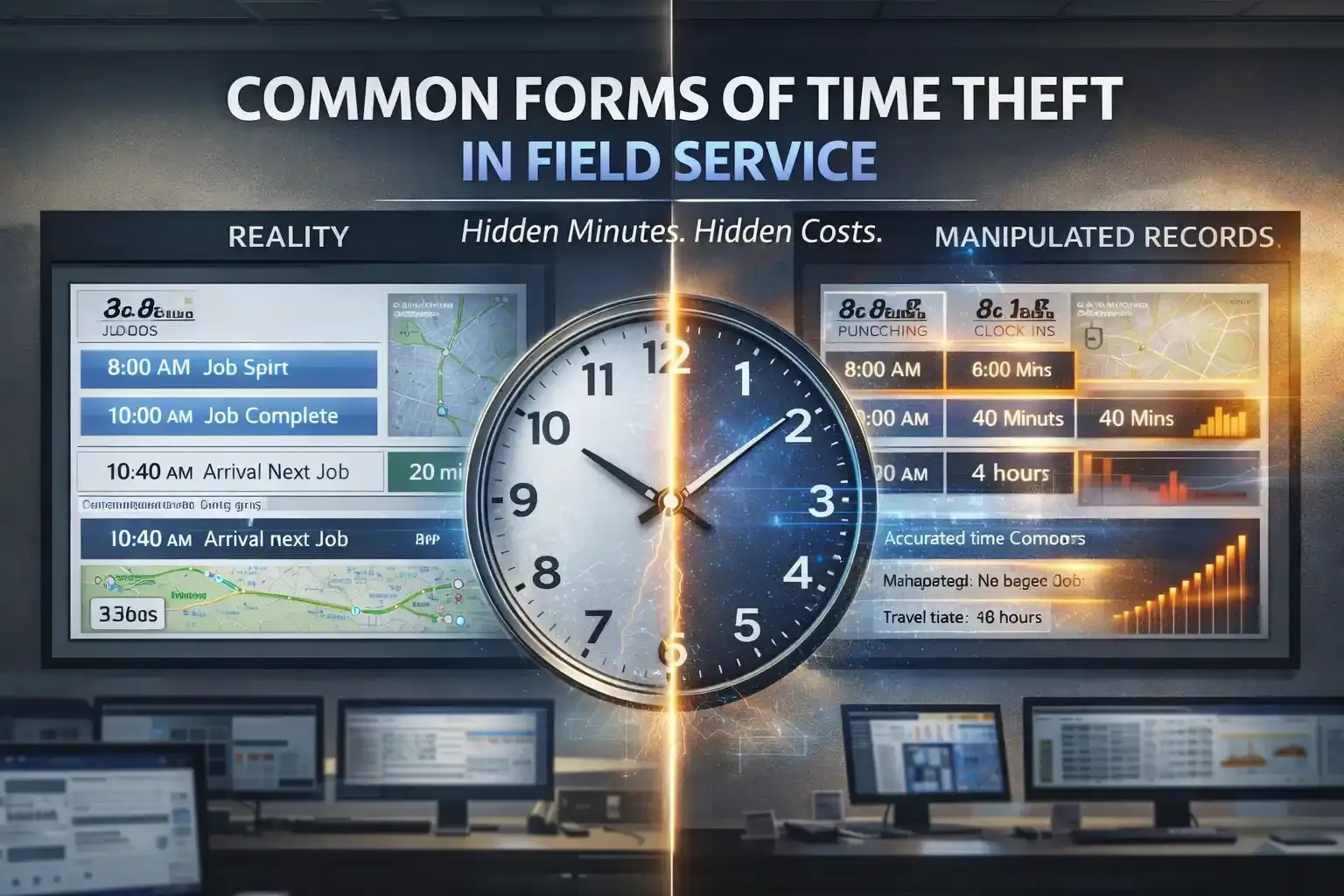
This is the one I see most often. For instance, a 20-minute drive becomes 40. Such an instance is hard to challenge because traffic changes are unpredictable. But when you compare GPS logs against travel entries over time, patterns start forming.
Let’s do simple math.
If one technician adds just 15 extra minutes of travel time per day, that equals more than 60 extra paid hours per year. Multiply that across 12 technicians, and you’re suddenly paying for 700+ hours that were never driven.
And here’s the kicker. More travel time often feeds into billing and job costing. As a result, it misrepresents margins along with the payroll increase.
See the gap between logged travel and actual routes
Extended Breaks Between Jobs
Breaks between jobs are almost invisible.
Think about this: technicians finish a job, and the next call is 40 minutes away. They stop for coffee or personal errands but remain clocked in as “traveling.”
The system shows movement between calls. But the vehicle sat parked for 18 minutes. No one questions it because the timeline looks reasonable.
Interestingly, research shows that the average employee steals about 4.5 hours per week in time theft. This includes extended breaks, late starts, and early departures. That compounds quickly over a year. [Source: Business.com]
Comparing this to an office setting, someone would notice a long absence. But in field service, it’s easy to sneak away.
Falsifying Service Duration
A job that typically takes two hours suddenly gets logged as four. The extra time gets labeled as paperwork, diagnostics, or customer explanation.
It might seem justified at first. But when you compare similar jobs across technicians, the numbers don’t align.
Now think long term. If your historical job data shows four hours instead of two, future quotes will reflect excessive labor assumptions. Over time, your pricing model shifts to lose you money.
Unauthorized Overtime
Overtime is expensive by default. In field service, it’s easy to stretch. For example, a technician logs after-hours emergency billing without dispatch approval. Another extends a job into overtime even though ticket volume stayed the same that week.
When I reviewed one payroll cycle, I noticed overtime hours rising while total service calls remained flat.
According to the U.S. Department of Labor, more than $274 million in back wages were recovered in fiscal year 2023 due to wage and hour violations.
Guess what? It includes recordkeeping issues.
Excessive Personal Activity While Marked Active
A technician sits in the van handling personal calls or scrolling through their phone. The time tracking app still shows an active status. The GPS shows the location near the job site, but no service work is happening. This is a common phenomenon.
According to a survey, about 43% of employees admit to exaggerating how many hours they work. Plus, a large share do this through inaccurate clock-ins or ongoing logged time without actual work.
Arriving Late or Leaving Early
A technician clocks in from home at 7:45 AM but doesn’t reach the first job until 8:20. Another leaves the final job at 3:30 PM but logs in until 5:00 PM. Each instance feels small.
And the worst part? Most of these forms don’t look like theft at first glance. They look like rounding, traffic, paperwork, and minor delays. That’s why reviewing timecards alone isn’t enough.
You have to compare travel logs, GPS records, dispatch assignments, and job duration benchmarks together.
Compare GPS, tickets, and logged hours in one view
The Impact of Time Theft on Field Service Businesses
Financial Loss
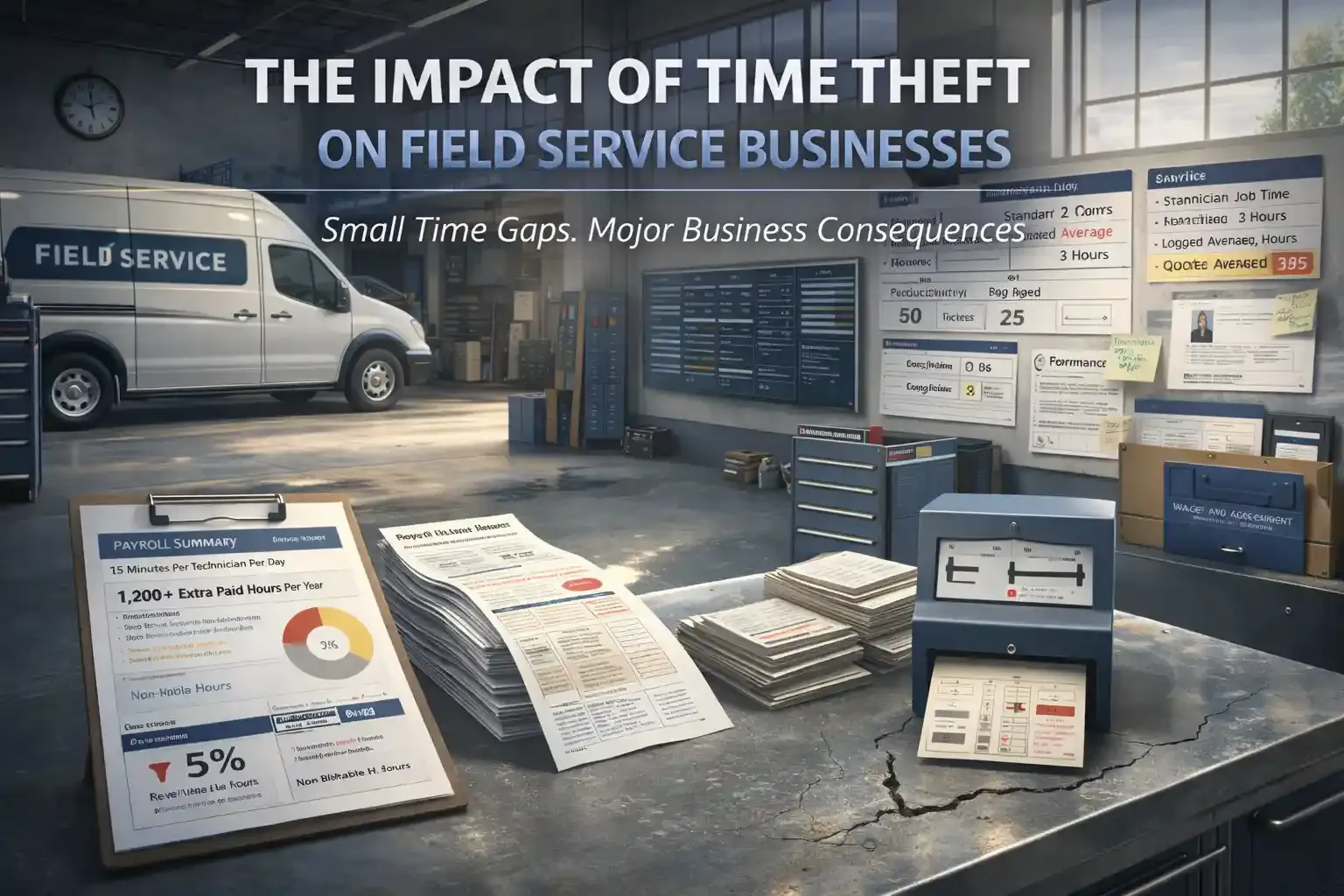
Financial loss is the most visible impact. Even 15 extra minutes per technician per day turns into serious money over time.
If you run a team of 20 technicians, 15 minutes per day equals 5 extra paid hours daily. Over a year, that becomes more than 1,200 paid hours that produced no revenue.
According to a report, organizations lose about 5% of annual revenue to fraud, and payroll schemes remain one of the most common types.
Distorted Job Costing
Distorted job costing is the second wave of damage. In field service, labor hours feed directly into quoting and contract pricing.
If a two-hour service call consistently gets logged as three hours, your system learns the wrong benchmark. Future quotes inflate, and long-term maintenance contracts are priced higher than necessary.
Meanwhile, competitors operating on clean labor data undercut you. Bad time data today becomes bad pricing tomorrow. And that pricing mistake can follow you for years.
Reduced Productivity
Reduced productivity hides behind misleading metrics. When logged hours rise but completed tickets stay the same, utilization numbers look healthy on paper. But the reality is completely opposite.
The U.S. Bureau of Labor Statistics tracks labor productivity by comparing output to hours worked. When hours increase without output growth, productivity declines. The same logic applies in field service as well.
Low Morale
Low morale builds quietly inside the team due to time theft. Honest technicians notice patterns long before management does.
When some team members stretch travel time or exaggerate overtime, while others follow policy, resentment grows. High performers begin to feel penalized for integrity, hence engagement drops.
Now, most occupational fraud is detected through internal tips. That means coworkers often see the suspicious behavior first. So when leadership ignores it, trust erodes and productivity follows.
SLA and Contract Risk
SLA risk hits when time records conflict with service obligations. In field service, timestamps prove compliance with response time guarantees and contractual commitments.
If a contract requires a four-hour response window and your logged arrival time shows compliance, but GPS or customer records tell a different story, disputes appear. This can trigger penalties, chargebacks, or lost renewals.
And in regulated industries, inaccurate time logs can even jeopardize certification status.
Protect your SLAs with verified time records
Align GPS data with logged arrival times automatically
Legal Exposure
Legal exposure increases when inaccurate timekeeping violates wage laws. Under the Fair Labor Standards Act (FLSA), employers must maintain accurate records of hours worked for non-exempt employees.
If manipulated timecards become systemic, regulators may interpret that as recordkeeping failure. In government contracts, certified payroll documentation must reflect real hours worked.
Even if manipulation starts at the employee level, the employer remains responsible for record accuracy.
How To Know When Time Theft Happens in Field Service
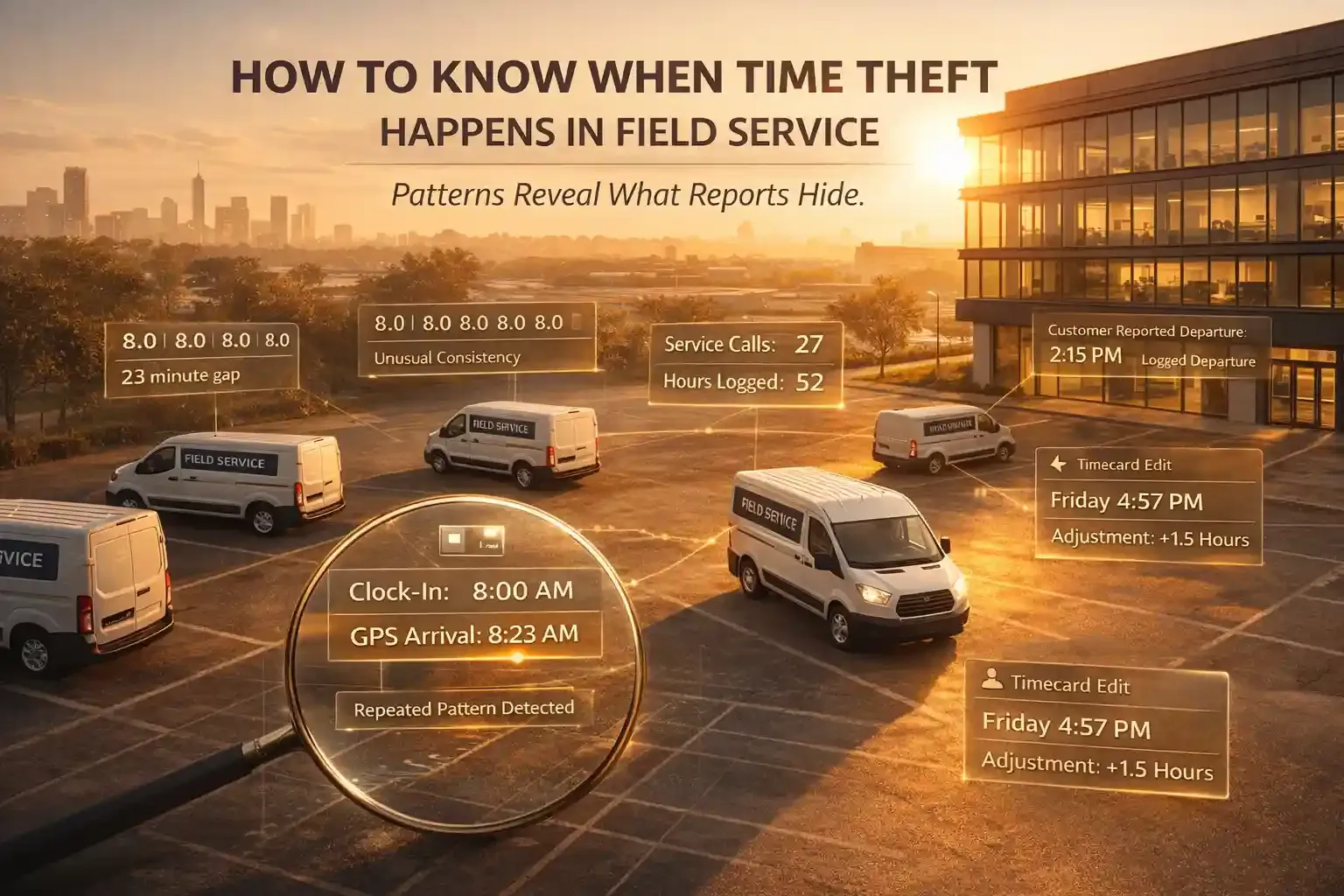
The truth is, time theft hides inside small data inconsistencies that most managers overlook.
Let’s break down what that actually looks like in real operations:
GPS and Timecard Don’t Match
The clearest red flag in field service is when clock-in time doesn’t match location data.
You might see a technician clock in at 8:00 AM. But the vehicle GPS shows arrival at the job site at 8:23 AM. That 23-minute gap isn’t always traffic. When it repeats multiple times per week, it becomes a pattern.
Field service companies now use GPS tracking for fleet management, so this mismatch becomes visible. According to Verizon, 69% of fleet operators use GPS tracking to monitor vehicle movement and workforce activity.
Perfectly Rounded Hours Every Day
When you see technicians logging exactly 8 hours every single day, or exactly 10 hours including overtime, it deserves a second look.
Real field schedules fluctuate. Consistent perfect numbers often mean manual rounding.
The U.S. Department of Labor emphasizes accurate time recordkeeping under the Fair Labor Standards Act (FLSA), especially for hourly workers. Clean, repetitive rounding patterns may not prove fraud on their own, but they contradict how field operations actually behave.
Overtime Increases Without More Service Calls
Another operational fingerprint shows up in productivity ratios.
If overtime hours increase but ticket volume stays flat, something doesn’t align. Either jobs are taking longer than usual, or logged hours don’t reflect the real workload.
For example, a technician handled 28 service calls last week with 40 hours logged. But if this week he handled 27 calls and logged 52 hours, you need to ask why.
According to the U.S. Bureau of Labor Statistics, average productivity per labor hour is measurable across industries. While field service has natural variation, workload and labor hours usually correlate. When they separate sharply, it signals inefficiency.
Travel Time Outliers
Travel time data tells a story most managers ignore. If five technicians average 18–22 minutes per trip, but one technician averages 38 minutes consistently on similar routes, that’s not random.
Modern field service management platforms track route history, timestamps, and job sequencing. When travel duration consistently exceeds route norms without geographic justification, you likely have tampered with drive-time logging.
Even small inflation adds up. Ten extra minutes per job across four daily jobs equals 40 minutes per day.
Idle Engine Time During “On-Site Work”
Vehicle telematics provide another strong signal. If labor logs show active service work for two hours, but vehicle engine data shows the van idling outside the site for extended periods, that needs to be investigated.
Fleet management systems increasingly capture engine idle data. Verizon's 2024 fleet report highlights idle tracking as a cost control measure because fuel waste and unproductive idle time drive expenses.
When idle engine time overlaps with “active service” time logs, it suggests either intentional padding.
Repeated Manual Edits Before Payroll
Timecard edits are not inherently suspicious. But repeated edits, especially right before payroll processing, deserve attention.
If field crews frequently adjust their own time entries late Friday afternoon, especially increasing hours, that’s a telltale sign. According to a report, payroll fraud consistently ranks among the top occupational fraud types.
Customer Billing Disputes
If clients question arrival times, departure times, or billed service duration, don’t dismiss it as confusion.
Field service operates on trust. When a customer says, “Your technician left at 2:15, not 3:00,” that’s valuable operational feedback.
According to the ACFE, external tips remain the most common way fraud is detected, with tips reported in 43% of cases. This is significantly more than any other detection method. Customers, vendors, and coworkers often surface irregularities before internal controls do.
Is overtime rising without more service calls?
Spot suspicious patterns automatically
How to Prevent Time Theft in Field Service
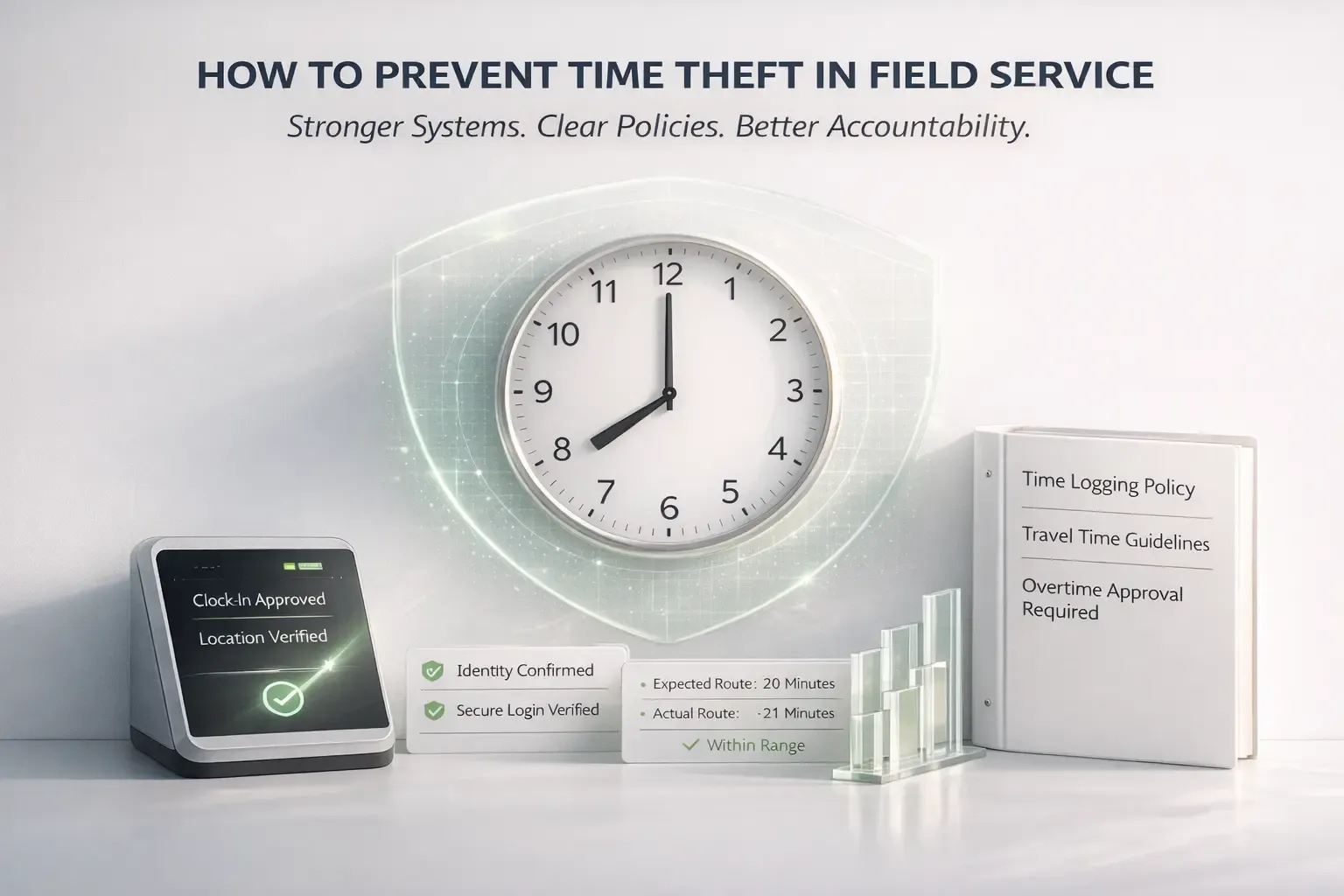
In field service, prevention is not about distrust but about structure. If your system allows for small manipulation, time fraud will eventually happen. So we stopped trying to watch people better and started fixing the gaps.
Here’s what actually worked:
Automated Time-Tracking Systems
The biggest mistake we made early on was trusting manual time entries too much. Workers could adjust their own hours before payroll closed. Most of them were honest. But the system itself made small adjustments easy.
So we implemented GPS-validated clock-ins and geofencing around job sites. If someone tried to clock in before arriving at the service location, the system blocked it. If they edited the time later, it left an audit trail.
See, GPS tracking systems enable real-time visibility and effective decision-making. It also supports efficient route planning, timely dispatching, and better resource allocation, all of which boost operational efficiency. [Source: Springer]
We saw that too, not just in routing, but in labor accuracy. Field service automation removed the opportunity. And when opportunity shrinks, temptation shrinks with it.
Biometric or Photo Verification
Next, we addressed identity verification. Shared logins were not widespread within our team, but they did occur occasionally. Someone running late would ask a coworker to clock them in. It felt harmless. It wasn’t.
We introduced simple photo verification at clock-in. Not invasive, just enough to confirm the right person was logging time.
The NIST continues to publish research on biometric verification performance, showing strong accuracy in modern facial systems. We didn’t need high-level biometrics. But we needed accountability tied to the individual.
Once clock-ins became personal, buddy punching stopped almost immediately.
GPS with Route Matching
GPS tracking is useless if you don’t analyze it. We began comparing logged travel time against realistic route expectations. When one technician consistently logged 35–40 minutes between jobs that normally required 20 minutes, we reviewed.
Research highlights how route optimization reduces unnecessary drive time and idle waste. That same logic helps detect inflated travel logs.
When technicians knew travel time was visible and compared to route data, time inflation dropped.
Bring clarity to technician travel time
Track routes and logged hours in one system
Clear Written Policies
We realized some of our time theft came from ambiguity.
Four rules that keep things transparent:
- What counts as travel time?
- Does drive-home time count? Who approves overtime?
- How do you log emergency tickets?
The U.S. Department of Labor requires accurate time records under the Fair Labor Standards Act. It’s the employers who carry that responsibility.
So we documented everything, such as travel rules, break logging, overtime approvals, and work order coding.
Workforce Analytics
Instead of relying on complaints, we built simple analytics dashboards to flag anomalies automatically.
Organizations that implement proactive data monitoring or analysis see much lower fraud losses and faster detection compared to those that do not. [Source: ScienceDirect]
Active Supervision
Our field managers started reviewing daily logs consistently. They compared service tickets to labor hours. They conducted occasional spot checks without being aggressive or suspicious.
Just so you know, internal review controls, including management oversight of accounts and compliance, are widely recognized as essential for early fraud detection and stronger internal controls. [Source: Grant Thornton]
Explain Why It Matters
Most technicians don’t think in terms of margins and job costing. They think in terms of finishing the day.
So we showed them the math. We demonstrated how 15 extra minutes per day per technician compounds into thousands annually. We explained how inflated hours distort quoting and hurt competitiveness.
PwC’s 2024 Global Economic Crime Survey highlights that a strong ethical culture reduces fraud risk.
Once the team understood that inaccurate time affects everyone, the resistance faded. Over time, we realized prevention only works when systems support it.
That’s where FieldServicely became part of our process. Instead of adding more supervision, we centralized GPS tracking, time logs, and job data in one platform.
Try FieldServicely #1 Field Service Management Software
Try for free - No credit card required!
Conclusion
Timecard fraud does not explode overnight. It grows quietly through small edits and unchecked habits. When your time data becomes unreliable, your margins tighten, and your forecasts lose accuracy. You start questioning reports instead of trusting them.
The real cost of time theft is distorted job costing, billing disputes, and weaker customer confidence. You cannot scale a field service business on inaccurate labor data.
The fix is verified systems, clear rules, and consistent review. When you protect time accuracy, you protect profitability, planning stability, and long-term operational integrity.
Frequently Asked Questions
What is the difference between time theft and timecard fraud?
Time theft is the behavior of getting paid for time not actually worked. Timecard fraud is the act of manipulating records to hide that behavior. In field service, time theft may involve extended breaks or inflated travel, while timecard fraud shows up as edited mobile entries or altered job codes.
Is timecard fraud illegal?
Yes, timecard fraud can violate wage and hour laws, especially if it leads to inaccurate payroll records. Under the Fair Labor Standards Act (FLSA), employers must maintain accurate time records. Manipulated time entries can trigger audits, penalties, or legal disputes.
Does time rounding count as timecard fraud?
Occasional rounding is not automatically fraud. However, consistent rounding that always favors the employee may indicate manipulation. Patterns matter more than single entries.
Can inaccurate time records affect insurance or bonding?
Yes. In regulated or contract-based industries, inaccurate labor documentation can affect compliance status, audits, and even bonding requirements. Reliable time records support financial and legal credibility.
What industries face the highest risk of timecard fraud?
Industries with mobile or hourly workforces face a higher risk. This includes construction, HVAC, plumbing, utilities, telecommunications, and maintenance services.
Can AI help detect timecard fraud?
Yes. AI-driven analytics can flag anomalies such as abnormal travel patterns, overtime spikes, or repeated time edits. However, human review remains critical for context and fairness
What to read next
No articles found at the moment.
