How to Create a Contractor Business Plan: A Complete Guide
Updated on 17 Feb 2026
Jump to
Running a contractor business without a plan is like building without a blueprint. A simple business plan helps you set goals, price your work, control costs, and win more jobs. It also shows clients and lenders you’re serious. In this guide, you’ll learn how to create a practical plan that fits your trade and your budget.
What is a Contractor Business Plan?
A contractor business plan is a written document that clearly shows how your contracting business will run in the future. It describes company goals, operational policies, market research, and 5 to 10 year economic forecasts. It also includes your pricing plan that includes labor, materials, tools, transport, permits, and profit margin. It is crucial if you want to secure funding, bring in more investors, and minimize risks.
How to Create a Contractor Business Plan
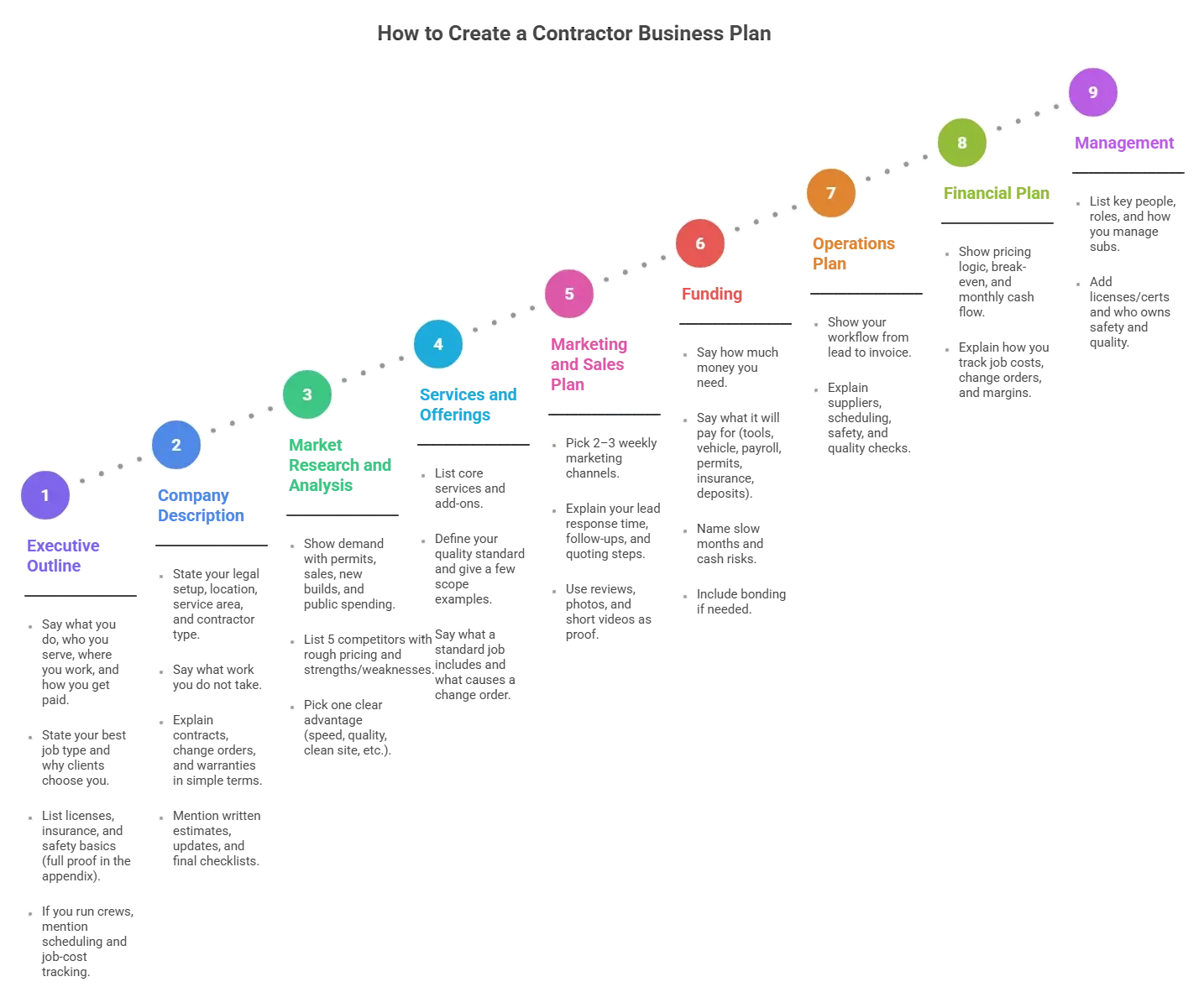
1. Executive Outline
Start by defining what you do, who you serve, where you work, and how you get paid. State your best job type and why clients choose you. Then, list licenses, insurance, and safety basics. And if you run crews, mention scheduling and job-cost tracking.
2. Company Description
In this section, first state your legal setup. Then work your way down in this order: location, service area, and contractor type. Don’t forget to mention what work you do not take.
Expand a bit further by explaining your contracts, change orders, and warranties in simple terms. Lastly, mention written estimates, updates, and final checklists.
3. Market Research and Analysis
Show demand with permits, sales, new builds, and public spending. Then list 5 competitors with rough pricing and strengths/weaknesses. After that, pick one clear advantage, such as speed, quality, clean site, etc.
4. Services and Offerings
List core services and add-ons. Define your quality standard and give a few scope examples. Say what a standard job includes and what causes a change order.
5. Marketing and Sales Plan
Pick 2–3 weekly marketing channels. Explain your lead response time, follow-ups, and quoting steps. And to earn trust, use reviews, photos, and short videos as proof.
6. Funding
Clearly show how much money you need. Say what it will pay for. For example, tools, vehicles, payroll, permits, insurance, and deposits.
Give confidence to investors by including a bond if needed. And don’t forget to name slow months and cash risks.
7. Operations Plan
Demonstrate your workflow from lead to invoice. Explain suppliers, scheduling, safety, and quality checks.
8. Financial Plan
Show pricing logic, break-even, and monthly cash flow. Explain how you track job costs, change orders, and margins.
9. Management
List key people, roles, and how you manage subs. Add licenses/certs and who owns safety and quality. Include a simple org chart (now vs. 12 months).
10. Appendix
Attach proof: licenses, insurance, sample estimate/contract, photos. Add SOPs, safety checklists, and supplier quotes for larger bids.
Automate job tracking & scheduling
Contractor Business Plan Template
Copy this contractor business plan template into Google Docs or Word. Then edit each section to fit your business.
1) Executive Outline: This is your short pitch. Say who you are, what you do, and why clients choose you. Keep it under 30 seconds to read.
Business Name: [ ]
Owner: [ ]
Location: [ ]
Business Type: [ ]
Contractor Type: [ ]
Summary (3–4 sentences): [ ]
Goals (next 12 months):
- [Goal 1]
- [Goal 2]
- [Goal 3]
2) Company Description: Show you are real and ready. List your focus, service area, and compliance.
Address: [ ]
Service Area: [ ]
Licenses: [ ]
Insurance: [ ]
Business Hours: [ ]
3) Market Research: Show you know your market. Use simple facts.
Target Customers: [ ]
Demand Proof (2–3 points): [ ]
Competitors (3):
- [Name], Strength: [ ] Weakness: [ ]
- [Name], Strength: [ ] Weakness: [ ]
- [Name], Strength: [ ] Weakness: [ ]
Your Advantage over the competitors: [ ]
4) Services List what you sell and how you price it. A clear scope avoids problems.
Main Services: [ ]
Add-ons: [ ]
Pricing Model: [ ]
What’s Included: [ ]
5) Marketing & Sales: Explain how you get leads each week. Explain how you close jobs.
Message: [ ]
Lead Sources (2–3): [ ]
Sales Steps (short):
- Contact
- Site visit
- Written quote
- Follow-up
- Contract + deposit
- Job updates
- Final payment Proof: [Photos, reviews, videos, licenses]
6) Funding: Show what you need and why. Show how you cover slow weeks.
Startup Costs:
- Tools: [ ],
- Vehicles [ ],
- Permits [ ],
- Insurance [ ],
- Marketing [ ],
- Materials [ ],
- Other [ ],
Total Needed: [ ]
Sources:
- Savings [ ],
- Loan [ ],
- Credit Line [ ],
- Investor [ ]
7) Operations Plan: Show how you run each job. Use the same steps every time.
Suppliers:
- [Supplier 1]
- [Supplier 2]
- [Supplier 3]
Process: Visit → Quote → Permits/Materials → Setup/Safety → Work/Inspect → Clean
Invoice Quality Checks: [ ]
Safety Basics: [ ]
8) Financial Plan: Show you can make a profit. Track job costs and monthly cash.
Income:
- Labor: [ ]
- Materials markup: [ ]
- Service calls: [ ]
- Contracts: [ ]
Fixed Costs: [ ]
Variable Costs: [ ]
Pricing Rules: [labor rate + overhead + profit]
12-Month Plan: [revenue, costs, profit]
9) Management: Show who does what. Show how you hire and manage subs.
Owner Role: [ ]
Hiring Plan: [ ]
Subcontractors: [how you vet licenses/insurance]
10) Appendix: Put proof here. Add anything that builds trust.
Licenses, insurance, bonds, certifications, sample contract, sample estimate, photos, supplier quotes, and financials.
Benefits of Making a Contractor Business Plan
A strong plan helps you explain your business to clients, lenders, and partners. It reduces mistakes because it forces you to define scope, process, and pricing up front.
Here are the key benefits of generating a contractor business plan:
You get more funding: It shows investors and lenders your plan for growth and profit. Most importantly, a clear future goal that they can rely on.
Gives a clear idea of your needs: You can list the tools, supplies, and staff required to start and run jobs.
Improves daily operations: It shows your exact steps to run jobs smoothly. As a result your your team stays aligned and becomes more efficient.
Reduces risk: A great plan helps you spot problems early and plan how to handle delays, cost changes, and other issues.
Gives you a competitive edge: Competitor research helps you stand out with a clear offer.
Keeps finances on track: Forecasts help you plan revenue, expenses, and growth steps.
Boost daily efficiency with a smart service tool
How to Launch Your Contractor Business
Get started with your contractor business in a simple order: pick your customer and services first. Then set up legal and safety basics. Marketing comes right after this. But avoid unnecessary expenses like spending on tools or running ads before you know what you sell.
Here are the exact steps you should follow to launch your contractor business:
Define your target market and services
Decide who you want to serve, what jobs you will take, and what makes you different. Add one ideal job example with a price range, timeline, and scope so your team stays well-informed.
Create a strong brand identity
Build a clear brand with a logo, tagline, and a professional website that matches your values. Add 10–20 job photos with short captions because proof beats promises.
Market your business
Promote your services using SEO, social media, and networking so people can find you fast. Pick two channels you can run weekly, like “Google + referrals,” before you add more.
Get licensed and insured
Follow local licensing and insurance rules to protect your business and build trust. Show your license and insurance on quotes, invoices, and your website footer. This reduces customer worry.
Build a Reliable Subcontractor Team
Hire reliable subcontractors. Check their references and licenses first. Use a simple agreement. Include scope, timeline, pay, and safety rules.
Close more leads with automated scheduling
How to Market Your Contractor Business
Marketing works when people can trust you and reach you fast. Show proof, explain your process, and answer calls quickly. Use a simple website and post your work on social media.
- Use local SEO so you show up in local searches.
- Run paid ads to get leads faster.
- Network with local groups and events.
- Offer simple promos like referrals or seasonal deals.
- Join community events to build trust.
- Say clearly what makes you different.
- Use good photos and short videos.
- Make it easy to contact you (phone, email, quote form).
- Give great service with updates and fast fixes.
Send job updates & invoices in real time
Is Contractor Business Profitable?
A contractor business can be profitable if you control costs and keep work booked. Track job costs on every job. Use clear scope and change orders to avoid rework. Skip “bad fit” jobs that waste time and cash.
Profit margin can be confusing. People mix up markup, gross margin, and net margin.
What usually increases profit:
- Specialize so you can charge more.
- Gain experience so jobs finish faster.
- Build a strong reputation for repeat work and referrals.
- The market often keeps coming in.
How to Prepare a Business Plan for Government Contracting
A government contracting plan works when you follow the rules, can do the work, and have enough cash.
- Pick your government focus: Choose the agencies you want. Choose the exact services you will sell. Start with one niche so you can build on past results faster.
- Explain your company and eligibility: State your legal type, location, licenses, and certifications. Only claim set-aside status if you can prove it.
- List services and NAICS codes: List your main services. Match each service to the right NAICS code. Keep the list short and specific.
- Make a capability statement: This is a one-page summary for buyers. Include services, past work, what makes you different, and company details (UEI, NAICS).
- Complete registrations: Do your SAM.gov setup before chasing bids. It says registration is free, and you must renew every 365 days to stay active.
- Research buyers and competitors: Find what agencies buy and what they pay. Use public award data to see who wins now.
- Cost control: Explain how you price labor, materials, overhead, and profit. Show how you track costs by job.
- Build a weekly pipeline plan: List where you will search for bids each week. Add weekly outreach and follow-ups.
- Explain your proposal process: Write your bid steps. Use a checklist so you don’t miss rules and get disqualified.
- Plan operations and compliance: Explain safety, reporting, documentation, and inspections. If the contract involves sensitive data, mention cybersecurity controls.
- Add a cash flow plan: Plan for slow payments so you never miss payroll. Keep cash reserves or a credit line.
Scale Your Contractor Business
Scaling means doing more jobs without lowering quality or running out of cash. You need faster scheduling, better job tracking, faster invoicing, and overall better contractor software. A scalable business uses simple systems, not daily firefighting.
- Get more local leads: Show up where local customers talk. Post job updates, answer questions, and ask for reviews and referrals.
- Book jobs faster: Reply quickly. Offer clear time slots. Use one calendar for calls, visits, and jobs.
- Cut travel time: Assign the closest worker. Group jobs in the same area. This saves time and fuel.
- Standardize work orders: Use the same steps for every job. Save photos and notes as proof. This reduces disputes.
- Improve time tracking and payroll: Track hours clearly. This controls labor cost. It also helps you price future jobs.
- Invoice faster: Send invoices right after the job. This improves cash flow and reduces errors.
- Track key numbers weekly: Watch a few metrics. Track booked jobs, gross margin, on-time jobs, and days to get paid.
Scale faster with automated time & billing
Try FieldServicely for free
Frequently Asked Questions
How do I start my own business as a contractor?
Pick one service, one customer type, and one area. Register the business, open a bank account, and get licensed and insured.
Do general contractors make 10% or 30% of jobs?
It depends on what you mean by “profit” (markup, gross profit, or net profit). A 30% net profit is rare for general contractors, and 10% net profit is already strong.
What are the 7 main points in a business plan?
The 7 main points are executive summary, company description, market research, services, marketing, operations, and financial plan.
What do most contractors charge per hour?
There is no single hourly rate. It depends on your trade, skill, and city.