
Field Service Industry in 2026: Trends, Challenges & KPIs
Updated on 16 Feb 2026

Jump to
Summary

Field service work happens on-site, where technician speed and service quality directly affect uptime, safety, and customer trust.
Field service includes more than repairs, such as installation, preventive maintenance, emergency fixes, inspections, upgrades, and customer training.
The industry is growing fast, and is projected to rise from $4.43B (2022) to $11.78B (2030).
Field service in 2026 is driven by smarter operations, including AI scheduling, IoT-based predictive maintenance, mobile-first apps, real-time ETAs, and connected FSM, ERP, and CRM systems.
A successful field service operation is measurable, using KPIs like response time, first-time fix rate, repeat calls, job completion time, and technician workload balance.
The Field service industry refers to work that happens on-site at a customer location, not inside your office. For example, HVAC repair in an office or a telecom router installation in a new building.
In other words, it’s the kind of work where your technician’s arrival time and performance directly impact uptime, safety, and customer trust.
But here’s the problem.
Field service looks simple from the outside, yet it gets messy fast when jobs pile up. One delayed visit can break your entire schedule, frustrate customers, and trigger repeat calls that waste hours and fuel. And as expectations rise, customers no longer accept vague service windows or poor communication.
In this blog, we will discuss what the field service industry is and the most common types of field service activities. We will also discuss the biggest trends shaping field service in 2026, and how to measure whether your operation is actually successful.
What is the Field Service Industry?
The field service industry refers to work that is done on-site at a customer location by a field service technician. This work happens “in the field,” not inside a company office or facility. It usually involves installing, maintaining, or repairing equipment.
Field service is common in industries like manufacturing, telecom, utilities, and healthcare technology. Most of the time, companies dispatch technicians or contractors to specific locations to complete the work.
These workers can be full-time employees or third-party contractors. Their work directly impacts uptime, safety, and customer satisfaction.
When most people think of field service, they picture a technician setting up cable TV or fixing Wi-Fi at home. They also think of utility workers restoring power after an outage. But it now includes many more deskless roles across industries like healthcare services, hospitality, and education.
For example, consider the HVAC field service. If an office AC stops working during peak summer, the company sends a technician to the site. He/She/They then diagnoses the issue, replaces parts if needed, and restores cooling fast. This prevents downtime and protects employee productivity.
Types of Field Service Activities
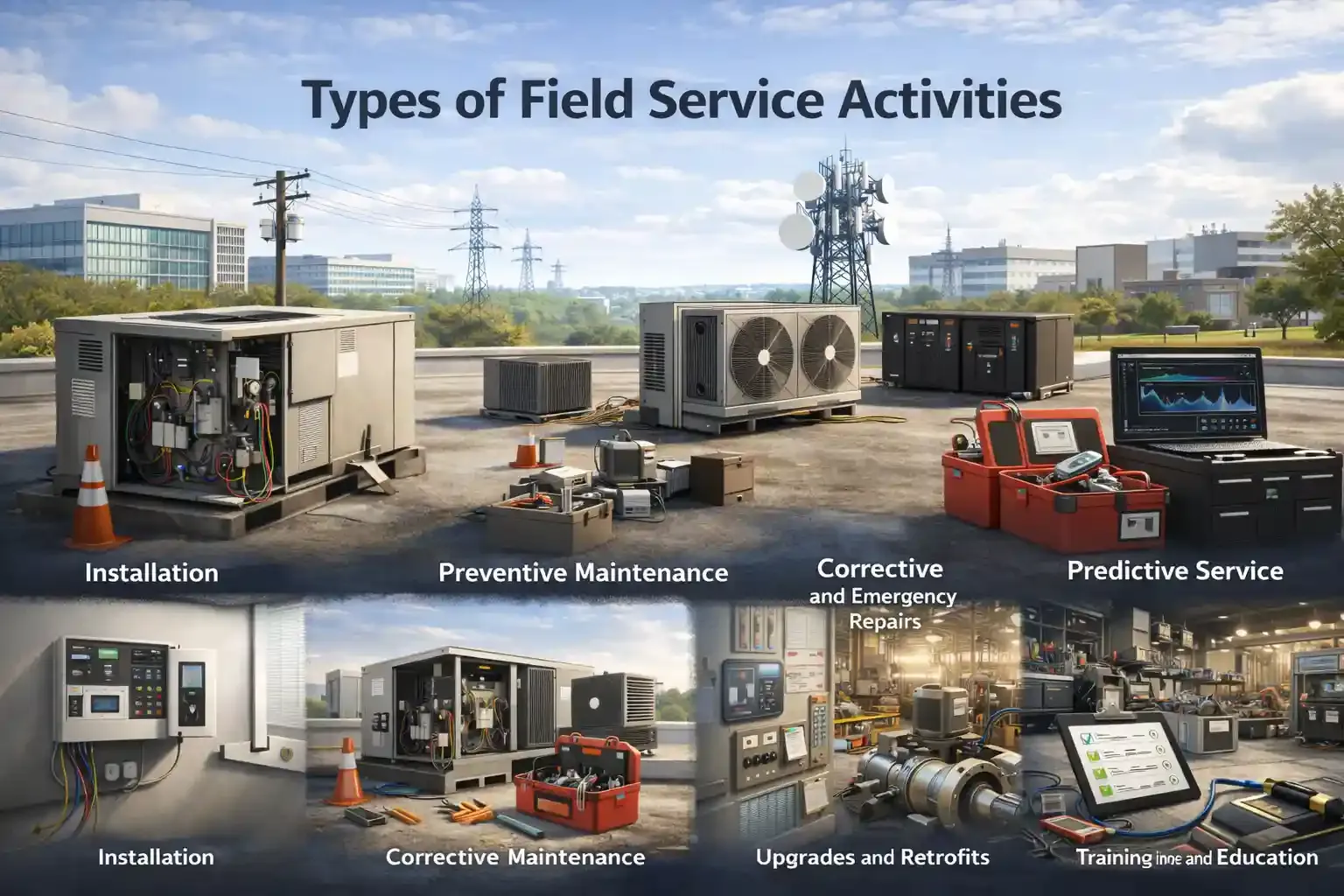
The global field service management market keeps growing because businesses rely on fast, reliable on-site service. According to research, the market will grow from USD 4.43B to USD 11.78B by 2030!
So, what does field service actually include in real operations?
Here are the most common field service activities you’ll see across industries:
Installation
Installation means setting up new equipment at the customer site. A technician connects, configures, and tests the system to make sure it works. For example, telecom teams install Wi-Fi routers and 5G equipment in homes and offices.
Preventive Maintenance
Preventive maintenance means regular service visits to avoid breakdowns. Technicians inspect parts, clean components, and replace worn items before failure. This helps reduce unplanned downtime that can harm operations.
Corrective and Emergency Repairs
Corrective repair is fixing equipment after it breaks. Emergency repair means doing the same work but with an urgent response because operations stop. For example, HVAC teams restore cooling fast when units fail during peak summer.
Predictive or Proactive Service
Predictive service uses data and sensors to spot issues before they become failures. Technicians act on alerts from connected machines so they can fix problems early. Many companies now use this because it boosts first-time fix rates and lowers costs.
Upgrades and Retrofits
Upgrades add new functions or improve existing systems without full replacement. Retrofitting updates older machines to meet new standards. For example, factories upgrade control systems or install IoT modules for better performance.
On-Site Inspections and Compliance Checks
Inspections confirm that systems meet safety and performance standards. Compliance checks matter in regulated fields like energy, healthcare, and telecom. Technicians record results using digital reports to prove safety and quality.
Training and Customer Education
Training means teaching customers how to use equipment the right way. Technicians explain best practices and basic troubleshooting steps. This lowers repeat calls and improves customer satisfaction.
Diagnostics and Troubleshooting
Diagnostics means finding the root cause of a problem on-site. Technicians use tools, logs, and error codes to isolate faults quickly. Quick diagnostics help improve first-time fix rates and reduce service costs.
Want smoother field operations without daily chaos?
Try for free - No credit card required!
What Are the Field Service Trends in 2026?
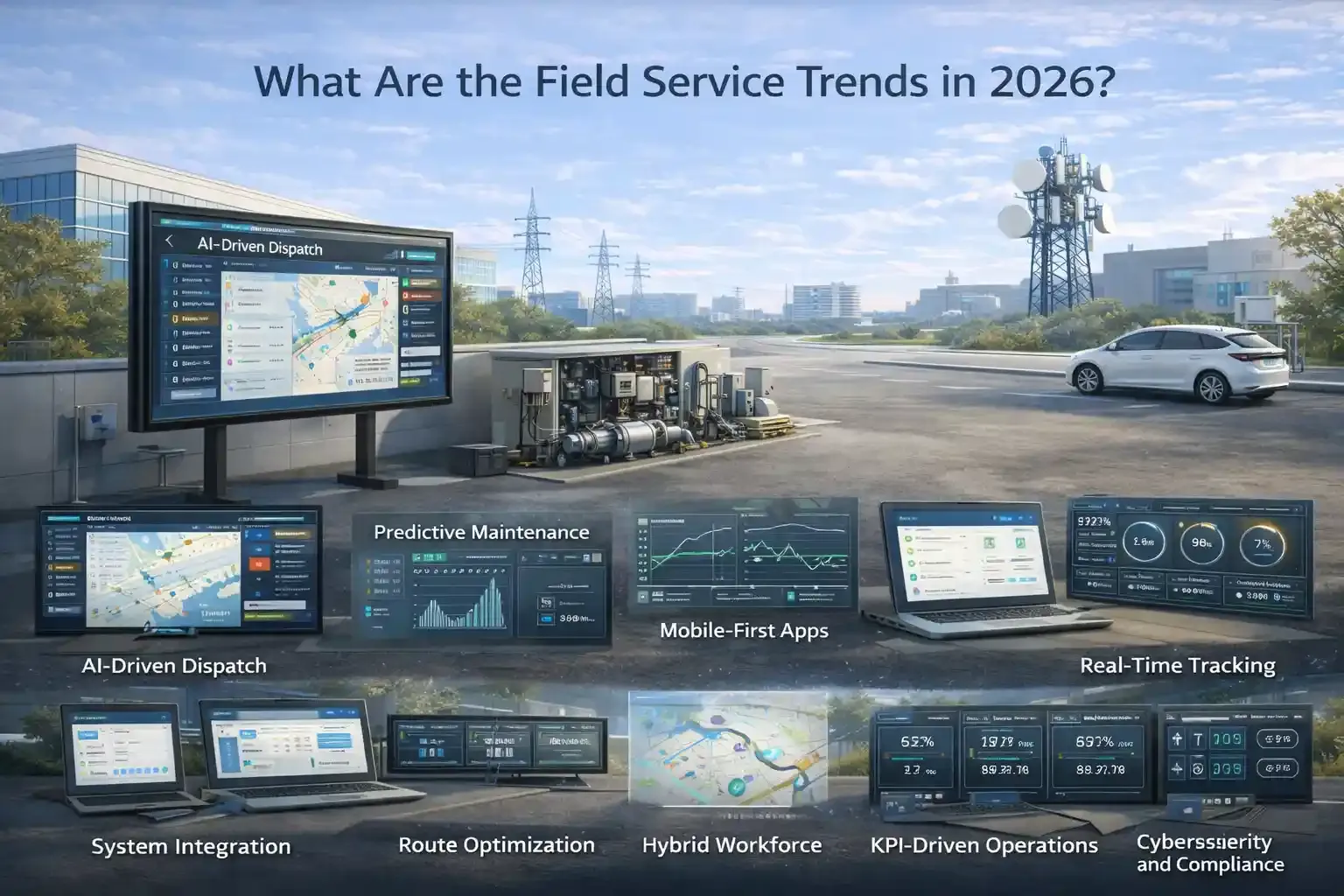
Field service in 2026 looks very different from what it did even a few years ago. You may have noticed that more companies are replacing manual dispatching and paperwork with AI, mobile tools, and real-time data.
If you want faster response times and better customer experience, these are the trends you need to pay attention to:
AI-driven dispatch and scheduling
AI now supports job assignment and scheduling at scale. I see teams using it to match technician skills, location, and job urgency faster than manual planning. If you manage heavy daily volume, AI helps reduce delays and rescheduling.
Predictive maintenance powered by IoT
IoT sensors track equipment condition like vibration, temperature, and pressure. You can spot early failure signals and schedule repairs before breakdowns happen. It reduces downtime and avoids expensive emergency calls.
Mobile-first field service apps
Technicians increasingly rely on mobile apps instead of paper or back-office calls. You can update work orders, follow checklists, attach photos, and collect signatures on-site. That makes the job closeout faster and the records more reliable.
Real-time tracking and accurate ETAs
Customers now expect clear arrival times and live updates. Real-time tracking helps you deliver accurate ETAs and reduce missed appointments. It also cuts support calls asking for technician status.
Customer self-service portals
Customers want control over scheduling and service info. Portals let them book visits, reschedule, view service history, and pay invoices online. This reduces admin pressure while improving customer experience.
Connected systems (FSM + CRM + ERP integration)
Disconnected tools create mistakes and slow billing. Integration connects customer data, asset history, parts inventory, and invoicing in one workflow. You get fewer data gaps and smoother service delivery.
Route optimization and fleet visibility
Route optimization reduces wasted driving and improves job sequencing. Dispatchers also get better visibility into technician location and progress. Over time, the savings show up in fuel cost and completed jobs per day.
Hybrid workforce models (W2 + contractors)
Field service companies are mixing full-time technicians with contractors more often. I see this trend grow because demand changes quickly and hiring stays difficult. You gain coverage flexibility without committing to permanent headcount.
Data dashboards and KPI-driven operations
Service leaders now run operations based on live KPIs. Metrics like first-time fix rate, MTTR, SLA compliance, and repeat visits highlight performance gaps early. You can fix bottlenecks before they turn into customer complaints.
Spot performance gaps before customers feel them
Try FieldServicely Fr
Cybersecurity and compliance focus
More connected tools also increase security exposure. Field employees need secure access, device controls, and protected customer data. This becomes critical in utilities, healthcare, and telecom, where compliance matters.
What Industries Does Field Service Software Serve?
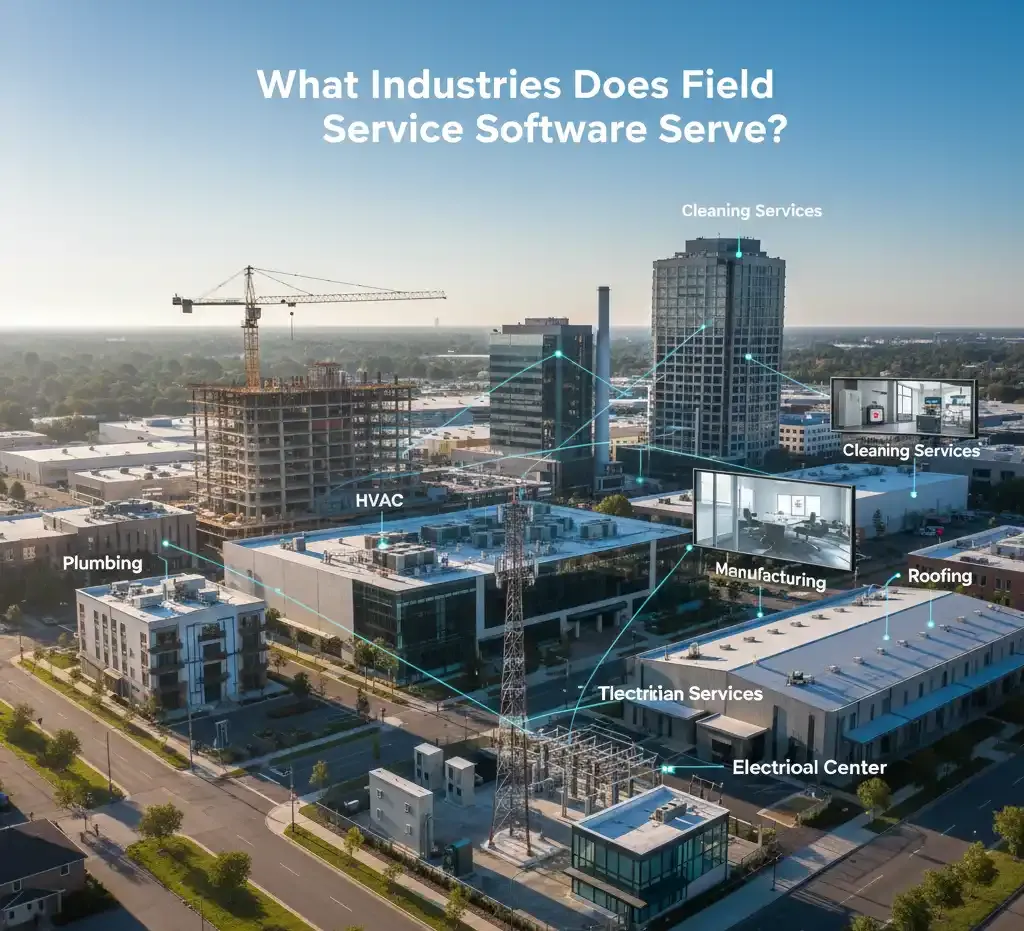
Field service software serves one simple purpose. It helps you manage work that happens outside your office. But what industries rely on field service software the most?
Let’s talk about it:
Plumbing
Plumbing is one of the clearest examples of why field service software exists. The work is unpredictable, and the urgency is real. A clogged drain can wait, but a burst pipe or sewer backup can turn into property damage within hours.
In plumbing, speed matters, and so does accuracy. You need to know which technician is closest, who has the right tools, and whether the job requires special parts. Field service management software helps you dispatch smarter, update schedules quickly, and keep job notes organized.
However, plumbing isn’t only about emergency calls. Many plumbing businesses make steady revenue from maintenance contracts and inspections, and software helps you schedule those recurring jobs without forgetting anyone.
HVAC
HVAC businesses run on timing. When it’s summer and an AC fails, the customer doesn’t want a visit next week; They want it today. The same thing happens in winter when heating stops, especially for families with kids or older adults.
This industry deals with heavy seasonal demand. That means your schedule can go from manageable to overloaded in a few days.
Field service software helps you handle the chaos by keeping jobs organized, sending reminders, and making dispatch decisions based on technician location and skill.
It also helps technicians perform better on-site. HVAC service often requires unit history, warranty details, and past repair notes. When your tech can see all of that in one place, you reduce repeat visits and improve the first-time fix rate.
Construction
Construction looks organized from the outside, but inside, it’s constant coordination. You’re managing crews, subcontractors, site tasks, inspections, and equipment.
And when one piece gets delayed, the whole timeline can slip.
Field service tools support construction teams by tracking tasks and field progress in real time. Instead of waiting for updates at the end of the day, supervisors can log progress, upload photos, and report issues instantly. This keeps office teams informed without nonstop phone calls.
Cleaning Services
Cleaning businesses grow through repeat clients. That means scheduling reliability becomes the product. If you miss appointments or arrive late too often, customers stop trusting you, even if the cleaning quality is great.
Field service software helps cleaning companies manage recurring jobs, assign teams, and track completion. It also reduces admin pressure because confirmations, reminders, and schedule updates can happen automatically. This is especially useful when you handle dozens of weekly contracts.
A real example is commercial office cleaning. If you clean 10 offices every night, you need a system that ensures crews follow the right checklist and don’t miss key areas. A cleaning business scheduling app helps standardize the process and reduce customer complaints.
Manufacturing
Heavy machinery service is a different kind of field service. When equipment breaks in manufacturing, downtime can stop production. That creates real financial loss, and it often puts pressure on service teams to respond fast.
Field service software helps manufacturing service teams in two ways.
First, it supports preventive maintenance scheduling, so equipment gets serviced before failure. Second, it tracks asset history, so technicians don’t waste time guessing what was replaced last time.
In industrial service, documentation matters as much as repairs. You need clear records for compliance, warranty claims, and lifecycle planning. Software makes that possible because it stores job notes, parts used, inspection results, and service dates in one place.
Telecommunications
Telecom is one of the most demanding field service industries today. Customers expect stable internet and mobile service at all times. And when service drops, the pressure is immediate.
Telecom field teams handle installs, repairs, line checks, fiber rollouts, and network troubleshooting. That means high job volume and tight scheduling windows. Field service industry software helps dispatch jobs faster, track technician routes, and reduce missed appointments.
It also improves customer communication. When customers can receive accurate ETAs and job updates, frustration drops. And in telecom, customer frustration directly turns into churn.
Electrician Services
Electricians deal with safety-first work. Many jobs require compliance checks, inspections, and careful documentation. And in commercial environments, mistakes can become expensive fast.
Field service software helps electricians manage work orders, job notes, and material tracking. It also helps assign jobs based on skill level. But why is it so important?
Because not every technician should handle high-voltage or complex panel work. That improves quality and reduces risk.
It also supports billing accuracy. Electric jobs often include labor, parts, travel, and sometimes permits. A strong job tracking system helps you capture everything cleanly, so revenue doesn’t leak.
Roofing
Roofing businesses face unpredictable demand spikes. After storms, calls flood in, and customers want quick inspections. At the same time, roofing jobs require strong documentation because insurance claims and approvals often depend on clear evidence.
Field service software helps roofers schedule inspections, track job progress, and store before-and-after photos. It also helps manage estimates and approvals, so paperwork doesn’t get lost between site visits. This is a major advantage when your team runs multiple projects at once.
Roofing also involves customer trust. Homeowners want to know what you found, what you fixed, and what it cost. When you can show job photos, notes, and clear reports, the customer feels confident.
Home Health Care
Home health care is a field of service, but with more responsibility. You’re not fixing equipment. You’re supporting real people. That means scheduling accuracy, proper documentation, and consistent service matter deeply.
Home care teams need to assign caregivers based on availability, location, and skills. They also need clean visit records, care notes, and updates. Field service software helps keep that workflow organized, so care delivery stays consistent.
It also helps reduce missed visits. In-home care, a missed appointment isn’t just an inconvenience. It can affect patient safety and well-being.
Want to see how field service software fits your industry?
Manage jobs, schedules, and updates in one place
Challenges of the Field Service Industry
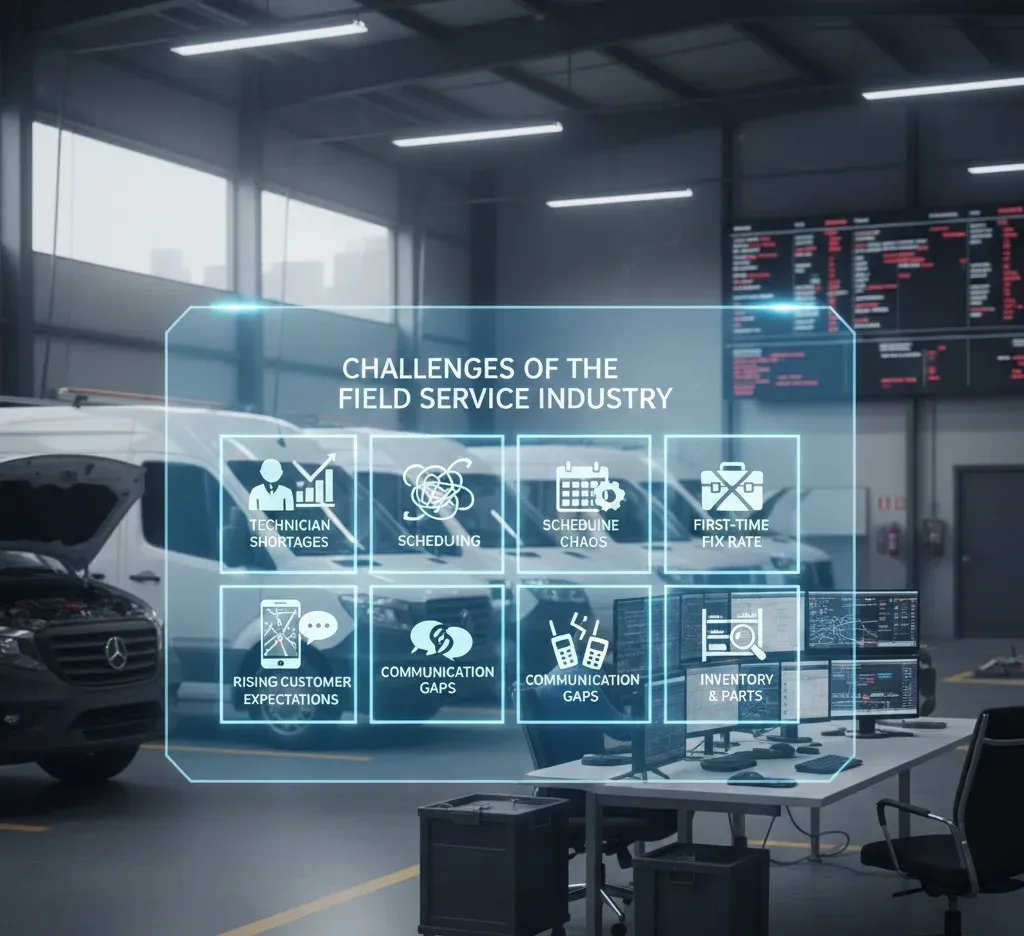
Field service looks simple from the outside. But if you run field operations, you already know it never works that cleanly.
Now let’s talk about the real challenges that hit you on the ground:
Technician shortages and the aging workforce
Hiring skilled technicians is getting harder every year. Many experienced workers are retiring, and fewer young workers are entering trades at the same pace. So even if demand grows, your technician capacity often doesn’t.
This creates a painful cycle. Your best technicians get overloaded, burnout increases, and service quality starts dropping. And once a senior tech leaves, you don’t just lose a worker, you lose years of real-world knowledge.
The bigger issue is that this shortage is not temporary. The U.S. Bureau of Labor Statistics projects 4% growth from 2022 to 2032 for installation, maintenance, and repair jobs. It means demand stays strong while the skills gap keeps widening.
Scheduling and dispatch chaos
Scheduling looks easy until real life shows up. One emergency job can destroy a perfectly planned day. And when scheduling happens manually, mistakes become unavoidable.
You’ve probably seen it happen. Two jobs overlap, a technician gets double-booked, or travel time gets ignored, so the whole day falls behind. Customers get annoyed, technicians rush, and mistakes increase.
Here’s what makes it worse. When scheduling breaks, your costs go up instantly because you waste time, fuel, and technician hours. Field teams can lose a big chunk of productive time due to inefficiencies like poor routing and dispatch planning. [Source: Global Trade Mag]
First-time fix rate problems
A job is only profitable when it gets fixed in one visit. The moment you need a second trip, your labor cost doubles and your schedule gets tighter. And the customer starts losing patience.
This happens more than many teams admit. A technician arrives, but the job details were incomplete, the part wasn’t available, or the issue was misdiagnosed.
So the technician leaves, and the job gets pushed into the next available slot.
That “one job” becomes two. And across a month, that turns into dozens of wasted truck rolls. Research shows that about 25% of customers will defect after just one bad experience.
Rising customer expectations (and lower patience)
Customers don’t want the old service experience anymore. Nobody wants an 8-hour service window. They want accurate ETAs, fast response, and clear updates.
This isn’t just a “nice-to-have” now. Customers compare you with the best experiences they get in other industries. If they can track food delivery in real time, they expect to track your technician, too.
A customer experience study found that over 73% of consumers expect service updates like arrival notifications and tracking. See how fast expectations have changed!
Communication gaps between office and field teams
Field service businesses run on communication. But ironically, communication is one of the biggest weaknesses in field operations. When the office and field don’t stay aligned, everything slows down.
This shows up in simple ways. A technician arrives without the right tools because the job details were incomplete. Or the dispatcher doesn’t know a job finished early, so they miss the chance to assign the next nearby call.
These gaps don’t look huge in isolation. But over time, they quietly destroy efficiency and customer trust.
Inventory and parts problems
Parts management is one of the most expensive hidden problems in field service. You can have the best technician in the world, but if the part isn’t available, the job still fails.
This becomes worse when inventory is spread across vans, depots, and warehouses. One location may be overstocked while another has nothing. Then you waste time hunting parts instead of completing jobs.
This is why parts visibility is directly tied to first-time fix rates. When parts tracking fails, repeat visits rise, and your daily schedule becomes harder to control.
Travel costs and wasted truck rolls
Travel is unavoidable in field service. But wasted travel is one of the biggest reasons field service companies lose profit.
It happens when dispatch is inefficient. A technician drives across town for a job that could have been assigned to someone closer. Or they return to the same location because the job wasn’t fixed the first time.
Fuel, maintenance, and vehicle wear add up fast. When your team runs multiple vehicles daily, even small routing inefficiencies can cost thousands over a year.
Safety risks and liability pressure
Field work comes with risk. Techs climb roofs, work with electricity, handle chemicals, and enter unfamiliar sites. One mistake can lead to injury, downtime, or legal trouble.
Safety also impacts retention. If technicians feel unsafe or unsupported, they leave. And replacing them becomes even harder when the labor market is already tight.
That’s why safety isn’t just a compliance issue. It’s a workforce strategy issue, too.
Compliance and regulations
Many field service industries operate under strict regulations. Utilities, healthcare equipment, manufacturing services, and electrical work all involve compliance requirements.
The challenge is not just following rules. It’s documenting compliance properly and consistently across hundreds of jobs. If your documentation is weak, you risk fines and disputes.
This adds pressure to managers because compliance needs training, audits, and strong recordkeeping. And most teams already feel stretched thin.
Struggling to keep compliance records clean and consistent?
Track job documentation, inspections, and reports without a mess!
Technology adoption and system integration issues
Most field service companies want better tools. But getting new tools adopted is not easy. You have technicians who are used to doing things their way, and legacy systems that don’t integrate smoothly.
This is not a small problem. A survey found 62% of field service professionals struggle to integrate new systems with existing ones, and 58% say technician adoption and training slow technology rollouts.
So even when software is good, implementation can fail. The issue is rarely the tool. It’s the change management.
How to Determine a Successful Field Service Operation
A field service operation is successful when work gets done on time, and customers don’t need repeat visits. If your team finishes jobs fast, fixes issues in one visit, and keeps customers happy, you’re doing it right. In simple terms, fewer complaints and fewer callbacks mean better operations.
Start with response time and on-time arrival. If technicians reach the customer within the promised window, trust goes up. If delays happen often, customer satisfaction drops fast.
Next, track your First-Time Fix Rate (FTFR). A high FTFR means your technicians show up prepared with the right skills, tools, and parts. This matters because repeat visits kill profit through extra travel and wasted hours.
Then look at job completion time and repeat service calls. Successful teams finish work within predictable time ranges and don’t leave behind unfinished problems. If customers call again within a few weeks for the same issue, the operation has a quality problem.
Also, check technician utilization, but don’t chase 100%. Overloaded technicians burn out, rush jobs, and make mistakes. A strong operation keeps workloads balanced and steady.
Finally, successful field service teams don’t rely on guesswork. They use real-time tracking, job updates, and performance reporting to spot delays early and fix bottlenecks. A tool like FieldServicely helps here because it keeps scheduling, dispatching, and technician updates in one place. In such a way, managers don’t have to chase people for status.
Try FieldServicely #1 Field Service Management Software
Try for free - No credit card required!
Conclusion
Field service doesn’t need to be chaotic. When your team shows up on time, fixes the problem without a second visit, and keeps customers in the loop, everything feels lighter, even on busy weeks. That’s what a successful operation looks like in real life.
The truth is, most teams fail because they run without visibility. And in the field service industry, that’s expensive because every delay turns into wasted hours, wasted fuel, and frustrated customers.
So track what matters, fix the leaks, and keep the workflow clean. The rest becomes easier than you think.
Frequently Asked Questions
What is the difference between field service management and workforce management?
Field service management focuses on handling service jobs, work orders, dispatching, and customer service. Workforce management focuses more on labor planning, shifts, attendance, and utilization. In simple terms, FSM runs the jobs, while WFM manages the people behind those jobs.
How do you calculate ROI from field service software?
You calculate ROI by comparing cost savings and revenue gains against the software cost. The biggest gains usually come from fewer repeat visits, reduced travel time, faster invoicing, and higher technician productivity. Many teams also see ROI through better customer retention and fewer missed appointments.
What skills make a great field service technician?
A great technician needs more than technical skill. They also need strong communication, problem-solving ability, and good documentation habits. In real operations, the best techs explain issues clearly and leave customers feeling confident.
How do you reduce technician turnover in field service?
You reduce turnover by fixing workload pressure and making work easier in the field. That includes fair scheduling, realistic job windows, proper training, and clear support from dispatch teams. Good tools also help because techs hate messy job info and constant last-minute changes.
What should a field service company standardize first?
Start with work order templates and service checklists. Standardization makes job quality consistent and reduces mistakes across technicians. Once that’s stable, you can standardize dispatch rules, inventory processes, and customer communication steps.
What to read next
