
60 Field Service Industry Statistics: Growth, Costs & Trends
Updated on 24 Feb 2026
Jump to
Summary

The field service market is estimated to expand from about $6.14B in 2026 to $13.79B by 2034 at a 10.7% CAGR.
Top performers complete repairs in ~3.7 days, compared with ~5.9 days for average teams, showing a measurable operational advantage.
Up to 82% of strategic organizations depend on mobile field workers to identify upsell and cross-sell opportunities.
63% of service leaders find it difficult to hire skilled technicians, and 75% of techs say they need more expertise now than before.
Around 47% of leaders say AI/ML will majorly impact strategy, and 65–72% deploying cloud-based FSM tools.
If you are running or managing field service operations, you know that things feel harder than they used to. Jobs take longer, customers expect instant fixes, and finding skilled technicians feels like a constant battle. Yet somehow, the pressure to cut costs and improve results never slows down.
What changed the way I look at field service wasn’t another tool or another opinion. It was the data. I could clearly see why some teams stay profitable while others struggle. Market growth, routing efficiency, first-time fix rates, workforce gaps, and technology adoption all leave very clear signals if you pay attention.
In this blog, we will discuss field service industry statistics. We will also discuss global market size and growth, trends, performance benchmarks, efficiency, and cost metrics. So let’s start!
Field Service Industry Statistics At a Glance
| Category | Metric | Key Statistic | Source |
|---|---|---|---|
Global Market Size | 2025 Market Value 2026 Market Value 2030 Projection 2031 Projection 2034 Projection | USD 5.10B – 5.37B USD 6.14B – 6.26B USD 9.17B – 11.78B USD 9.87B USD 13.79B | |
Deployment Trends | Cloud-Based Revenue Share (2025) | 64%+ | |
Regional Insights | N. America Revenue Share (2025) Asia Pacific Growth Europe Growth Latin America Growth | 31.70% 9.9% – 19.4% CAGR 8.7% CAGR 21.3% CAGR | |
Operational Efficiency | Travel Distance Reduction Time Efficiency Increase Travel Time Reduction Transport Cost Reduction Energy Use Reduction Fuel Savings Telematics Adoption Unnecessary Service Visits Avoidable Dispatch Rate | ~15% ~20% ~16% 5% – 20% 20% – 50% 20% – 30% 98% of fleets 14% 3% (top) vs 24% (low performers) | |
Revenue Impact | First-Time Fix Rate Productivity Gain AI/Automation Adoption Service as Profit Engine Belief | 81% 20% – 30% 82% of organizations 73% of professionals | |
Workforce Challenges | Technician Shortage Manufacturing Labor Shortage Firms Struggling to Recruit Skilled Technician Need Technicians with Formal FSM Training | 63% of leaders struggle with hiring 98% 70% – 85% 75% 58% | |
Technology Adoption | Enterprises Using FSM Tools Workforce Penetration Cloud Deployment AI Strategic Priority | ~60% 71%+ 65% – 72% 47% of leaders | |
IoT & Predictive Maintenance | Improved Uptime with AI/IoT Maintenance Cost Reduction Downtime Reduction | 88% of companies 25% – 30% 35% – 50% | |
Industry Challenges | Knowledge Changing Faster Than Training Technician Burnout | 85% of technicians 57% |
Key Global Field Service Management Market Size and Growth Statistics (2024–2026)
.webp?2026-02-24T06%3A52%3A46.701Z=&w=3840&q=100)
The global field service management market reached USD 5.37 billion in 2025 and USD 6.14 billion in 2026, according to Fortune Business Insights. This steady year-over-year growth shows that more companies now invest in workforce automation and service scheduling software. As customer expectations rise, businesses move faster toward digital field operations.
Fortune Business Insights also projected the market will grow from USD 6.14 billion in 2026 to USD 13.79 billion by 2034, at a 10.7% CAGR. This strong long-term growth signals sustained demand for AI-based dispatch, predictive maintenance, and mobile service apps.
At the same time, Mordor Intelligence estimates the market will reach USD 6.26 billion in 2026 and expand to USD 9.87 billion by 2031. This projection confirms that mid-term growth remains stable across industries like telecom, utilities, and manufacturing.
Meanwhile, Grand View Research forecasts the market will hit USD 11.78 billion by 2030, growing at a 13.3% CAGR between 2023 and 2030. This higher growth rate reflects rapid cloud adoption and integration with IoT-enabled devices. Companies now use connected equipment to trigger automatic service tickets before breakdowns occur.
Similarly, MarketsandMarkets values the FSM market at USD 5.10 billion in 2025, with expected growth to USD 9.17 billion by 2030 at a 12.5% CAGR. This growth highlights how field data analytics and automated billing systems reduce operational costs.
Regionally, North America accounted for 31.7% of global FSM revenue in 2025, according to Fortune Business Insights. This dominance comes from early cloud adoption and strong enterprise IT spending in the United States.
In contrast, Asia Pacific stands out as the fastest-growing region, with a projected CAGR above 9.9% through 2031, based on Mordor Intelligence. Rapid industrial expansion and growing mobile workforces drive this acceleration. Countries such as China and India increasingly deploy FSM tools to manage large technician networks.
Finally, deployment trends reinforce this shift. Cloud-based FSM solutions generated over 64% of total market revenue in 2025, according to Mordor Intelligence. Because cloud systems offer flexibility, lower infrastructure costs, and remote accessibility, businesses now favor them over traditional on-premise software.
Regional Field Service Market Statistics
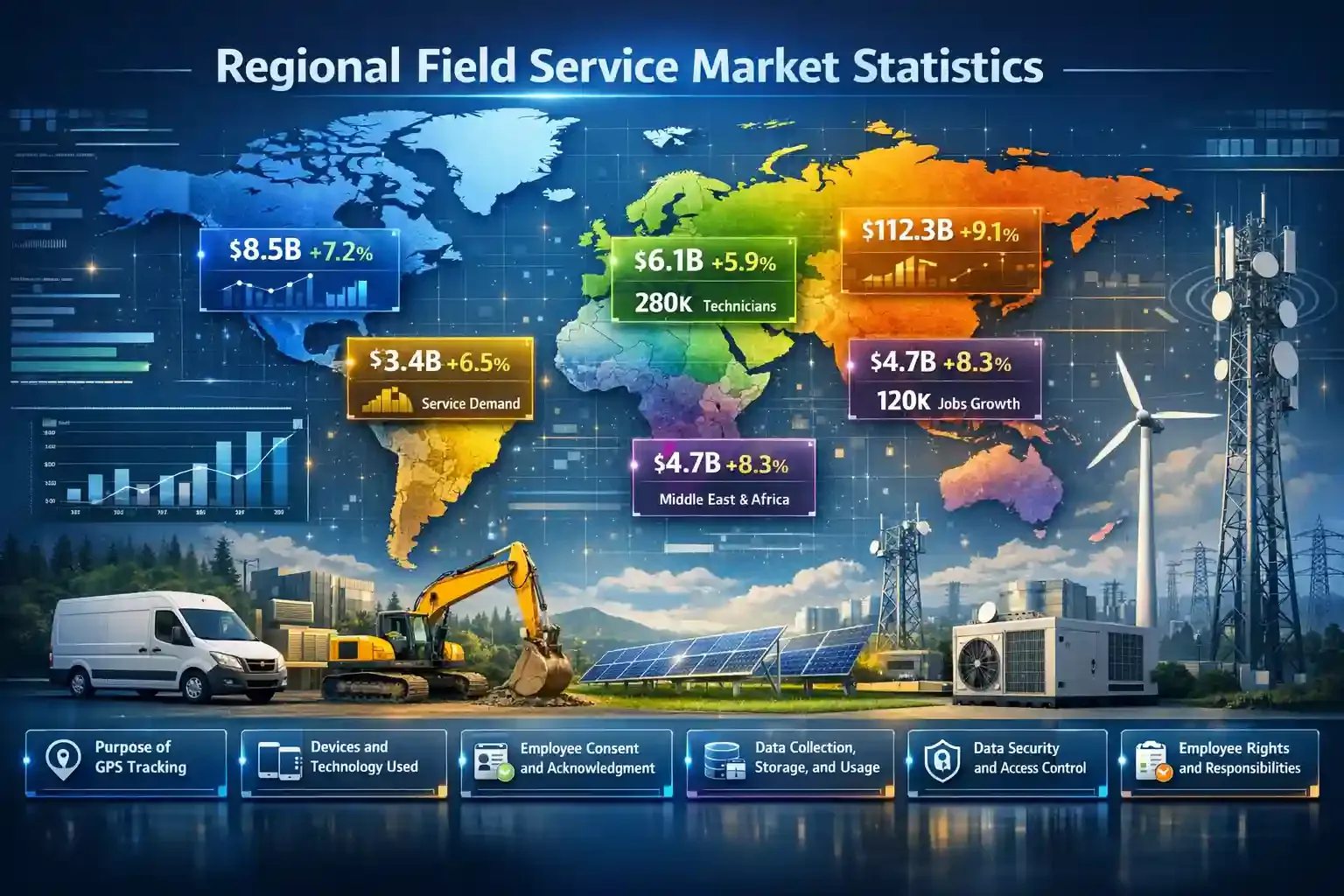
North America leads the field service management market with 31.7% of global revenue in 2025, according to Fortune Business Insights. This share makes it the largest regional market worldwide.
Asia Pacific, however, is growing the fastest. Grand View Research estimates a 15.8% to 19.4% CAGR in the region over the forecast period. Rapid industrial growth in countries like China and India, combined with rising SME digital adoption, pushes companies to replace manual service logs with mobile FSM apps.
China, India, and Japan stand at the center of this growth, according to Business Research Insights. China’s large manufacturing base drives massive technician deployment. India’s expanding telecom and energy networks, along with Japan’s advanced 5G infrastructure, create steady demand for real-time job tracking and predictive maintenance systems.
Europe shows slower but steady expansion. Market Data Forecast projects the region will grow at around 8.7% CAGR from 2026 to 2034. Companies across Germany, the UK, and France focus on cloud-native platforms and predictive maintenance to improve service uptime and reduce equipment failures.
Germany, the UK, and France account for most of Europe’s FSM adoption.
Germany’s industrial sector relies on digital field tools for machine servicing. Meanwhile, UK and French enterprises invest in remote monitoring and automated dispatch to meet strict service-level agreements. (Source: Market Data Forecast)
Latin America presents a different picture with faster acceleration. Allied Market Research estimates the region will grow at a 21.3% CAGR, mainly due to infrastructure and energy investments. Expanding power grids and public utility projects increase the need for centralized work order and asset management systems.
Brazil and Mexico drive most of that regional demand. Brazil’s oil, gas, and utility sectors deploy FSM systems to manage distributed field crews. Mexico’s manufacturing expansion also pushes companies to adopt digital service tracking to reduce downtime. (Source: Research and Markets)
The Middle East and Africa also show strong upward momentum. Verified Market Research links this growth to smart city programs, energy infrastructure upgrades, and government-backed digital transformation plans. Countries such as the UAE and Saudi Arabia invest heavily in connected service operations to support urban expansion and public utility modernization.
Scale field service operations as regional demand grows
Try for free - No credit card required!
Core Field Service Performance Benchmarks
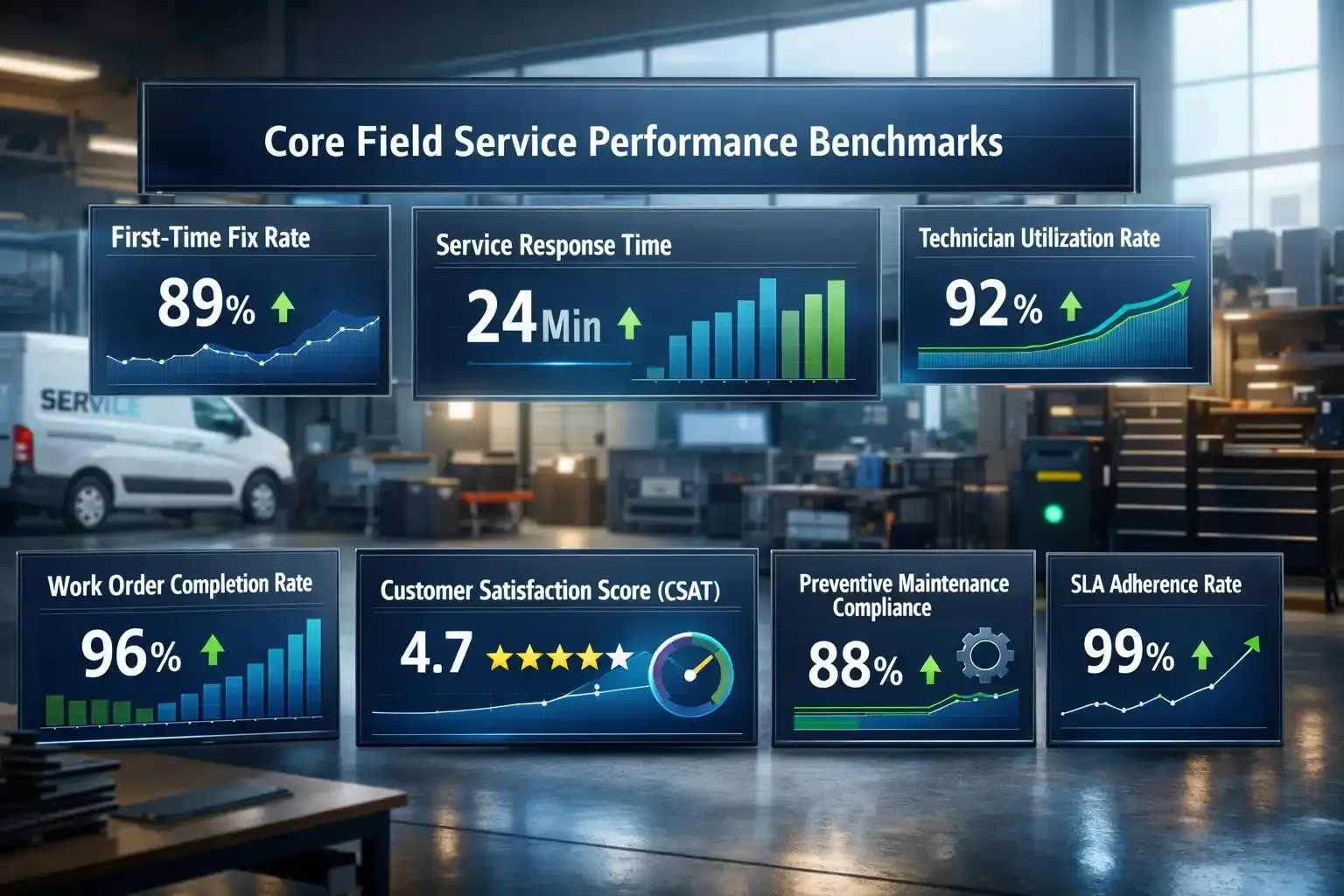
Advanced vehicle routing reduces travel distance by about 15% and improves time efficiency by nearly 20%, according to Axiv. This means technicians spend less time on the road and more time fixing equipment. As a result, companies lower fuel consumption and improve daily job completion rates.
Route optimization models also cut overall transportation costs by 5% to 20% compared to traditional routing methods. (Source: Springer).
These savings come from shorter routes, better job sequencing, and fewer repeat visits. In real operations, this translates into lower fuel bills, reduced overtime, and improved fleet utilization.
Travel time often consumes a large part of a technician’s workday, and research on Arxiv shows optimized routing can reduce travel time by around 16%. When technicians spend fewer hours driving, they complete more service calls per shift. This directly improves first-time fix rates and overall service productivity.
Efficiency and Cost Metrics in Field Operations
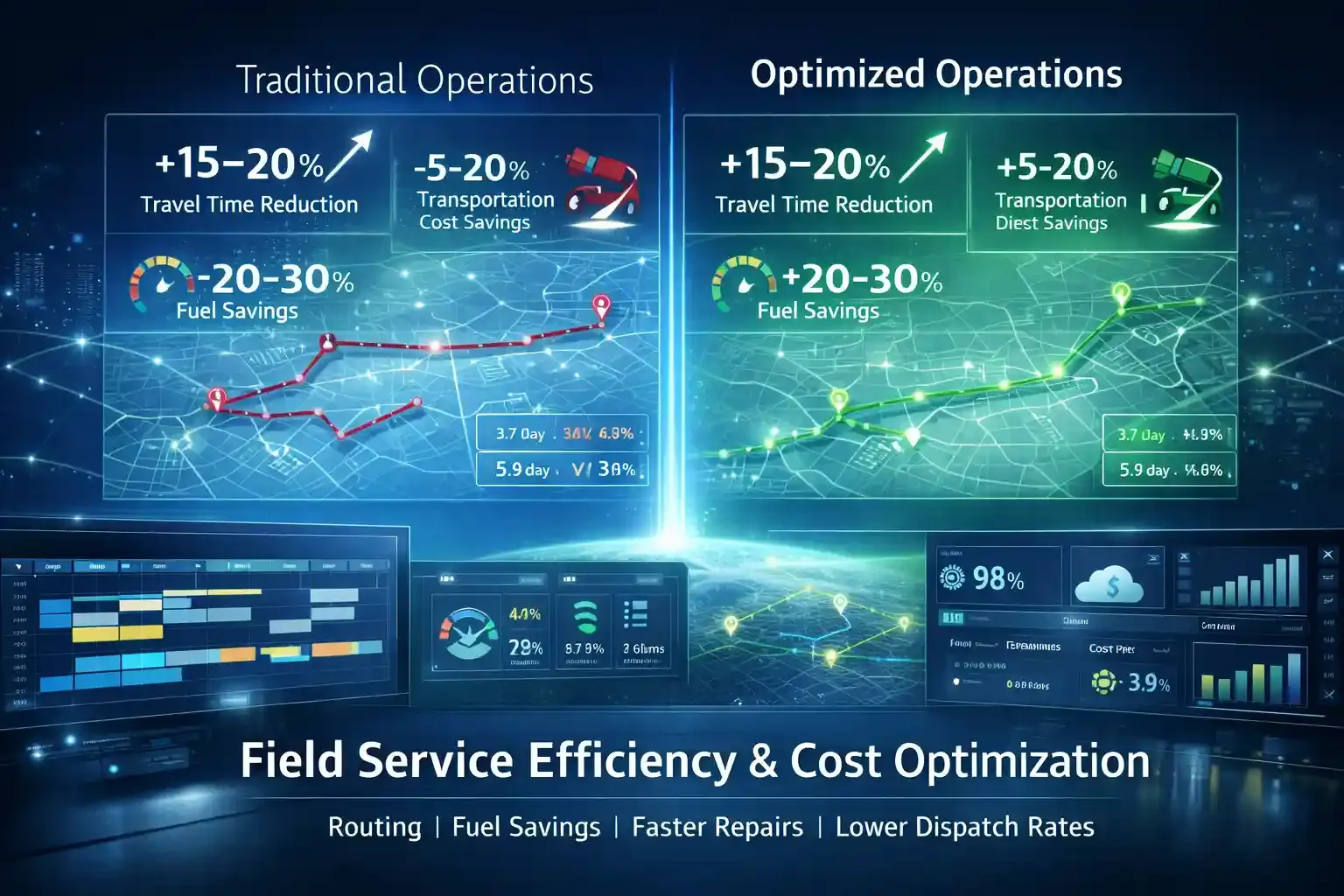
Energy-efficient routing cuts operational energy use by 20% to 50% under advanced optimization models, according to Science Direct. This reduction comes from shorter routes, fewer idle hours, and smarter job sequencing. In real fleet operations, that means lower fuel bills and less wear on vehicles.
Shorter drive time directly increases technician productivity. McKinsey reports that minimizing travel time frees up more field hours, which allows technicians to complete more service calls per day. When a team reduces daily drive time by even one hour, it can add one or two extra jobs to the schedule.
Telematics now drives most fleet efficiency decisions. Teletrac Navman reports that 98% of fleets use telematics systems to improve fuel savings and operational efficiency. This near-universal adoption shows that real-time GPS tracking, driver monitoring, and route analytics are now standard tools in field operations.
Fuel savings remain one of the strongest measurable benefits. Teletrac Navman also found that 37% of fleet operators rank fuel savings as a top benefit of telematics, which reflects an 88% increase compared to 2023 results. This sharp rise shows that companies now focus heavily on cutting fuel costs through data-driven routing.
Fully optimized fleets can achieve 20% to 30% fuel savings, according to findings published in WJARR. These savings come from route optimization, improved driver behavior, and regular vehicle performance tracking.
Repair cycle time also defines field efficiency. HubSpot data shows that top-performing teams complete repairs in about 3.7 days, while average teams take around 5.9 days. Faster resolution improves customer satisfaction and reduces repeat dispatch costs.
Unnecessary truck rolls remain a hidden cost driver. Aquant reports that about 14% of total service visits are unnecessary, which increases fuel, labor, and scheduling expenses. Reducing these avoidable trips directly improves both margins and technician availability.
Avoidable dispatch rates further highlight performance gaps. Markets Financial Contents reports that lower-performing teams show 24% avoidable dispatch rates, compared to only 3% among top performers. This large difference proves that smarter diagnostics and better triage systems dramatically cut field operation costs,
Turn efficiency gains into lower fuel and labor costs
Try for free - No credit card required!
Field Service as a Revenue Driver Statistics
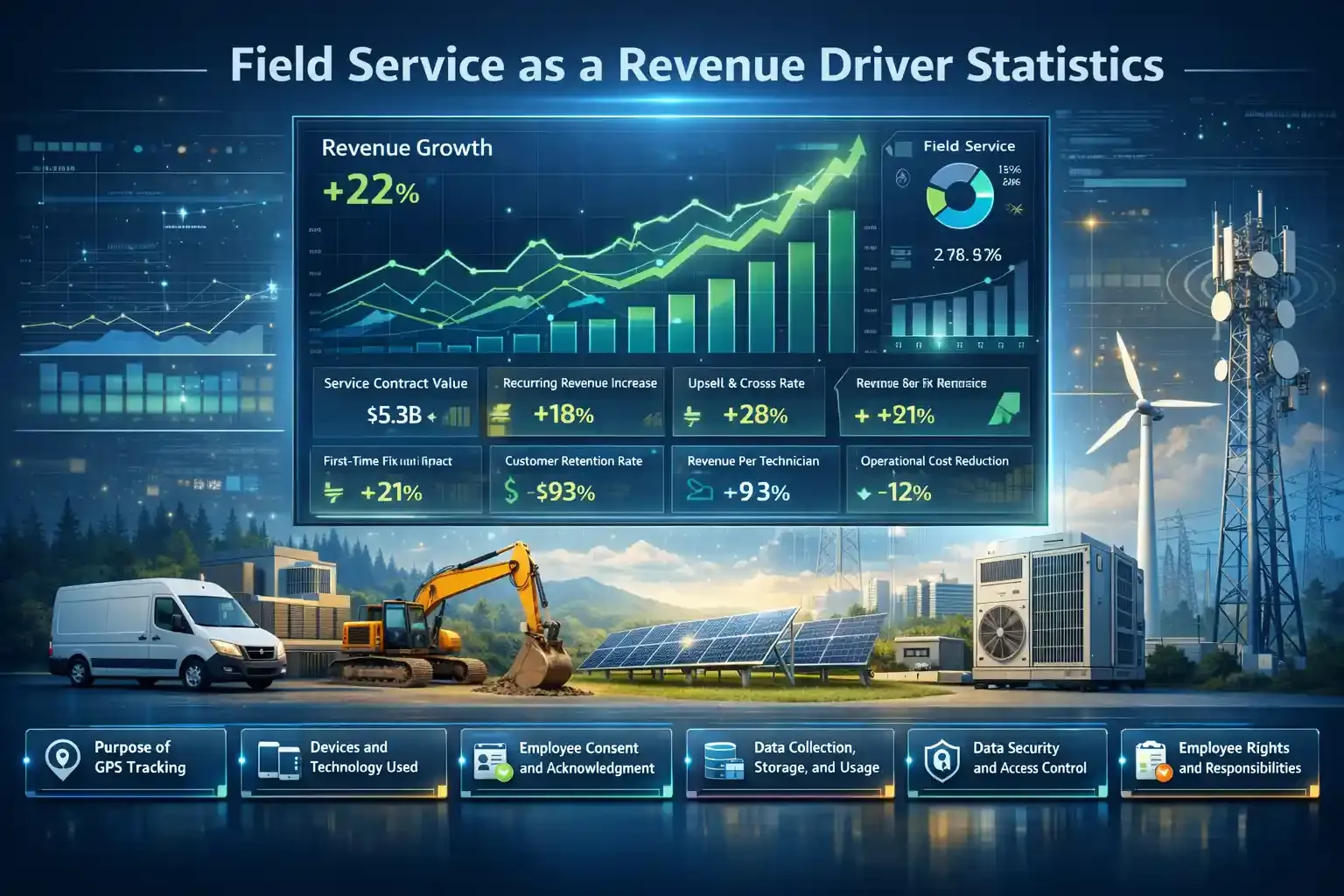
High first-time fix rates directly increase revenue because faster resolution builds customer trust. Hubspot reports that teams with FTFR as high as 81% close more jobs in one visit and create more upsell opportunities. When technicians solve problems immediately, customers feel confident signing maintenance contracts or upgrading services.
On the other hand, failed first visits slow revenue growth and raise costs. Markets Financial Contents shows that a failed first attempt can add 14 extra days and two additional visits to resolve a case. This delay increases labor expenses and weakens customer satisfaction, which directly reduces renewal and referral potential.
Because technician performance shapes these outcomes, skill gaps directly impact profit. Aquant AI estimates that if all technicians performed like the top 20%, service costs could drop by 23%. Lower costs mean higher margins, and stronger margins give companies room to invest in growth.
Mobile access strengthens this revenue shift even further. CIO reports that 82% of strategic organizations rely on mobile field workers to identify upsell and cross-sell opportunities during service visits. When technicians access service history and product data on-site, they can recommend upgrades in real time.
As productivity improves, revenue capacity grows. MSI Data finds that mobile workforce optimization delivers 20% to 30% productivity gains, allowing technicians to complete more service calls per day. More completed jobs directly increase billable hours and overall service revenue.
Because of these gains, many leaders now see service as more than support. Zuper reports that 73% of field service professionals believe their organization can transform service into an independent profit engine. This shift reflects a broader strategy to treat service operations as a revenue center.
Technology adoption reinforces that transformation. Field Service Insight reports that 82% of field service organizations increasingly rely on AI, automation, and mobile data to improve performance outcomes. These tools reduce delays, improve scheduling accuracy, and enhance customer experience.
Finally, high-performing teams clearly connect systems to financial impact. CIO reports that 94% of service professionals in top-performing organizations cite improved productivity from field service systems. Higher productivity allows companies to serve more customers without expanding headcount, which strengthens revenue efficiency.
Turn field service into a measurable profit center
Lower service costs while increasing revenue per technician
Field Service Workforce Statistics
Skilled technician shortage is now one of the biggest problems in field service. Aquant reports that 63% of service leaders struggle to find qualified technicians, which directly impacts service speed and quality. When companies cannot fill open roles, existing teams handle more jobs and burnout increases.
The shortage does not stop at service teams alone. PR Newswire reports that 98% of manufacturers face labor shortages, which pushes companies to reskill workers and invest in automation. As senior technicians retire, many companies fail to replace their deep technical knowledge fast enough.
This hiring challenge reflects a broader labor market issue. The OECD reports that 70% to 85% of firms struggle to recruit suitable staff, especially in technical roles. Field service companies now compete with manufacturing, construction, and IT firms for the same skilled workers.
Meanwhile, the skill requirements inside the job keep rising. MSI Data reports that 75% of field technicians say they need more technical expertise today than when they started. Modern technicians must understand IoT devices, remote diagnostic tools, mobile FSM apps, and even customer-communication best practices.
However, training levels do not fully match these growing demands. Market Growth Reports notes that only 58% of technicians had formal training on digital field service management systems as of 2023. That gap creates inefficiencies because many technicians use advanced scheduling and reporting tools without proper onboarding.
Protect service margins despite technician shortages
Technology Adoption in Field Service
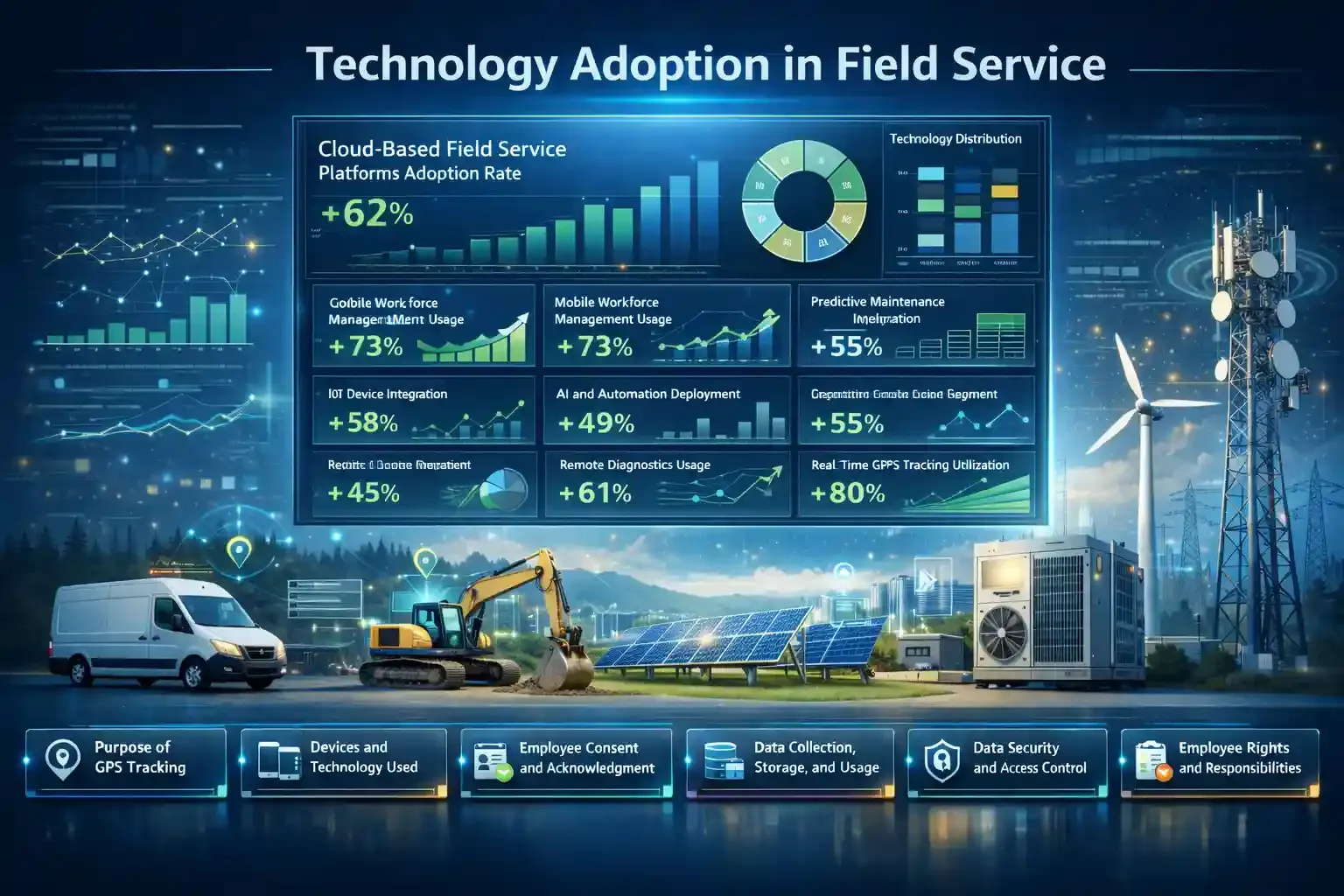
Artificial intelligence is quickly moving from experiment to priority in field service. IQPC reports that 47% of field service leaders say AI and machine learning will have the biggest impact on their strategy over the next three years. In simple terms, nearly half the industry now plans to use AI for smarter dispatch, predictive maintenance, and faster problem diagnosis.
Because strategy drives investment, software adoption has already crossed a major milestone. Business Research Insights states that around 60% of enterprises had implemented field service software by 2023. This shift shows that most companies no longer rely on paper-based work orders or manual scheduling systems.
As software adoption rises, mobility becomes the next logical step. Global Growth Insights reports that mobile workforce penetration exceeds 71%, with many firms prioritizing real-time scheduling and live updates. Technicians now check job details, customer history, and asset data directly from mobile apps while on-site.
To support this mobility, companies are increasingly moving to the cloud. Business Research Insights notes that about 65% of field service deployments are cloud-based. Cloud platforms allow teams to sync job data instantly and managers to monitor operations from anywhere.
Industry Research reinforces the same trend with similar numbers. The report shows that 66% to 72% of companies now deploy cloud-based field service management tools. When multiple research sources report similar adoption rates, it signals that cloud infrastructure has become the default model.
Meanwhile, workforce shortages push companies to adopt these technologies even faster. Bro Coders estimates a 2.6 million-worker deficit across service sectors, creating pressure to automate tasks and optimize technician schedules. When fewer skilled workers are available, AI-driven routing and remote support tools help maintain service performance.
Unify scheduling, routing, and workforce data in one system
IoT, Security, and Connected Field Operations

IoT is delivering measurable results nowadays. Geotab reports that 88% of field service companies using AI and connected tech, including IoT, improved uptime and reduced service costs.
When equipment sends real-time data back to the system, companies stop reacting to breakdowns and start predicting them. Gitnux shows that predictive maintenance powered by IoT can cut maintenance costs by 25% to 30%.
And it gets even stronger.
Organizations using IoT sensors and predictive analytics report 35% to 50% less equipment downtime compared to reactive maintenance models, according to Gitnux. Fewer breakdowns mean fewer emergency dispatches, fewer angry customers, and fewer expensive truck rolls.
Field Service Industry Upcoming Trends
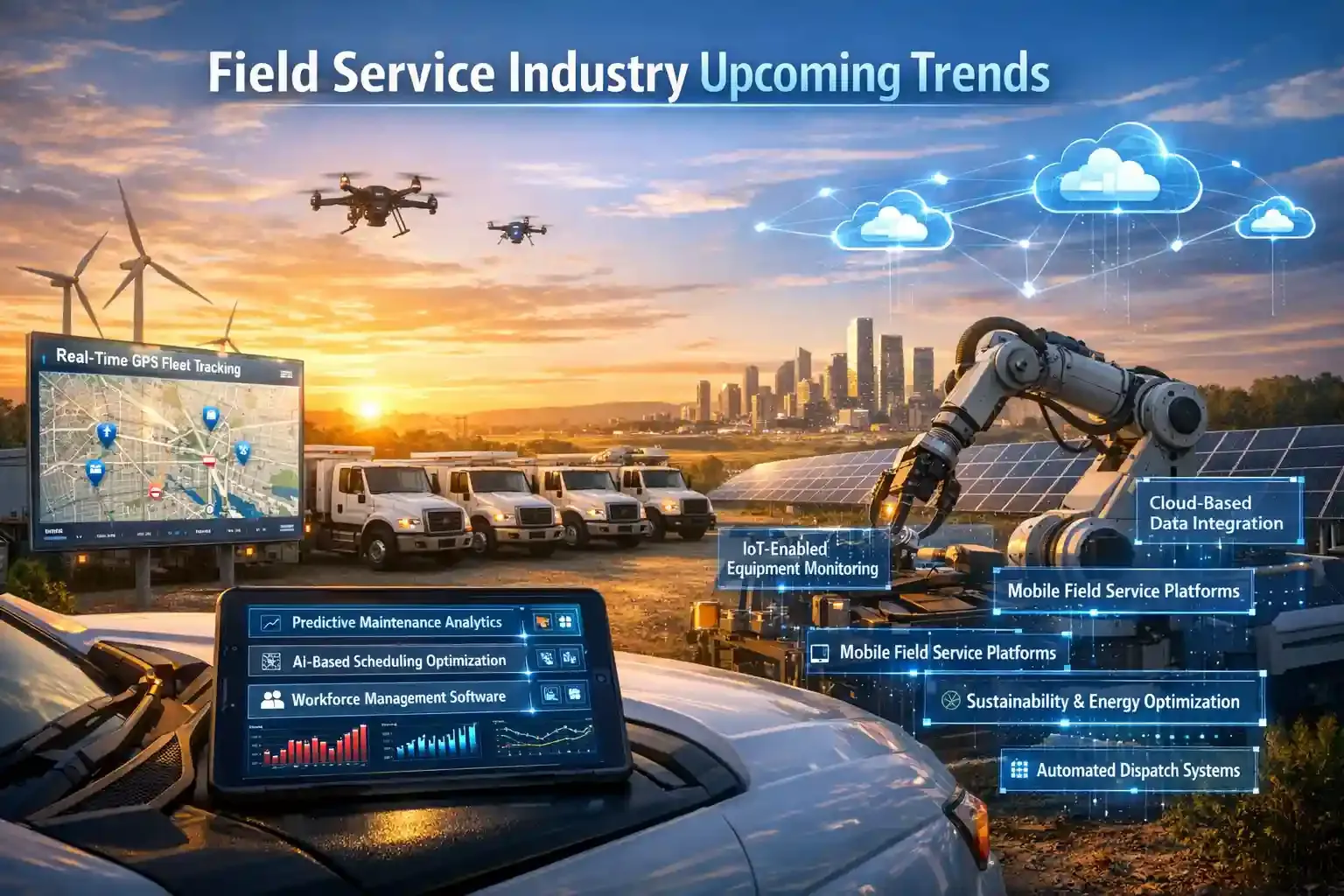
Generative AI is no longer experimental in field service. Deloitte reports that 40% of field service organizations already use generative AI for analytics, reporting, technician guidance, and workflow automation. That means AI is moving from pilot programs to daily operations.
And this shift is happening because customer expectations are changing fast. Salesforce found that 73% of field workers say customers now expect more personalized service than before. Customers want faster resolution, better communication, and technicians who show up already informed.
To meet that pressure, companies are leaning harder on automation. Geotab reports that 88% of field service organizations using AI have improved asset uptime and higher first-time fix rates. When systems analyze equipment data in advance, technicians arrive prepared instead of guessing.
The impact is measurable, not theoretical. Geotab also found that 75% of companies say AI and modern technology improved their first-time fix rates. Fewer repeat visits mean lower costs and higher revenue per job.
At the same time, real-time data is becoming non-negotiable. IQPC reports that 67% of field service leaders say real-time operational data has a major impact on efficiency. Managers now expect live dashboards, not delayed reports.
Because of this, reliance on AI will only increase. IQPC shows that about 50% of service organizations expect to increase their dependence on AI capabilities, especially predictive tools and automation. In simple terms, field service is shifting from reactive operations to intelligent systems that anticipate problems before they happen.
Stay ahead of AI-driven service cost shifts
Adopt automation before competitors reset efficiency benchmarks
Benefits of the Field Service Industry
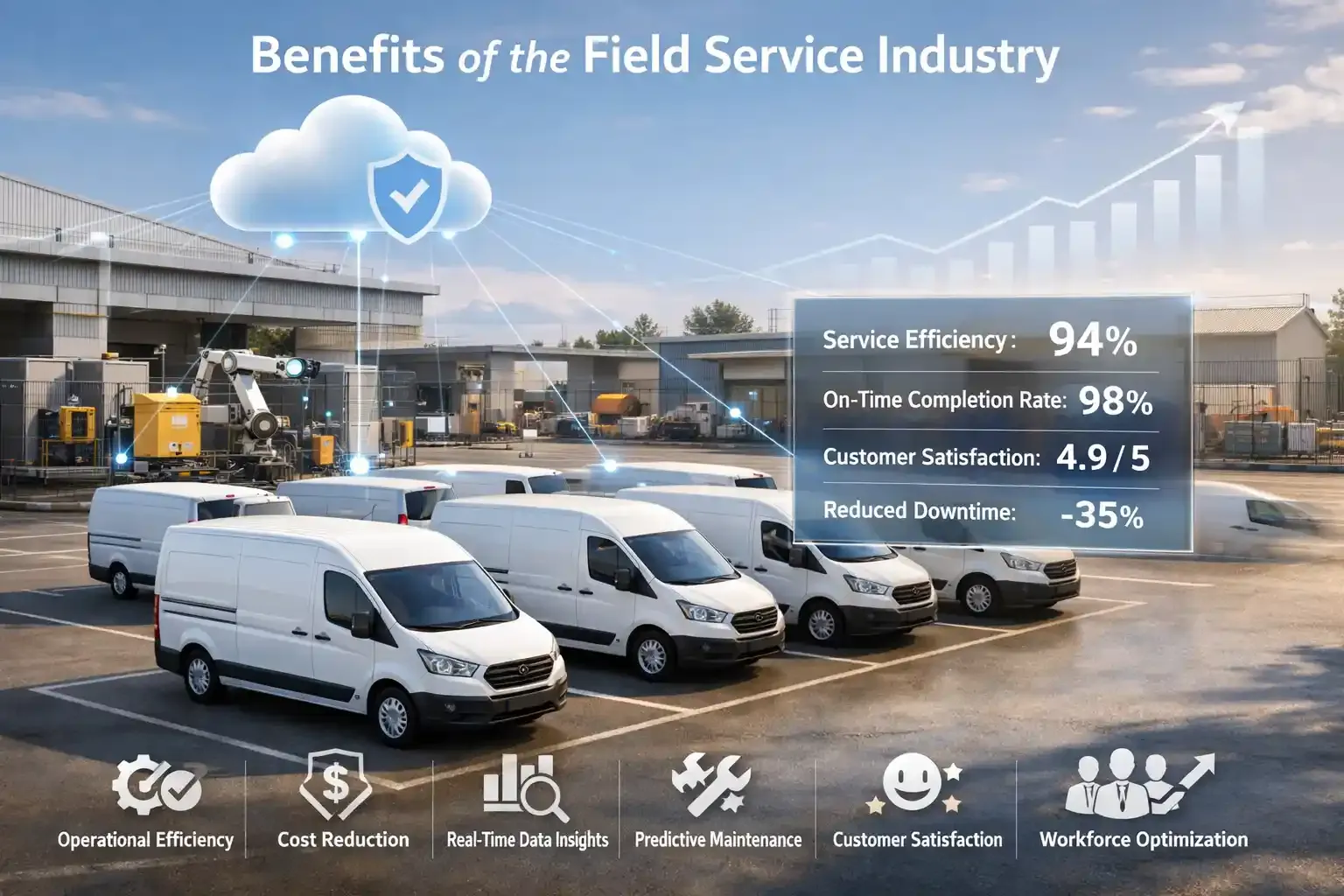
Field service increases uptime in a way that directly impacts the bottom line.
Geotab reports that 88% of organizations using AI and connected field technology improved asset uptime and reduced service costs. When machines stay operational longer, companies avoid emergency dispatches, overtime pay, and expensive downtime.
And once uptime improves, everything else starts to follow.
Customer satisfaction rises because service becomes faster and more reliable. Salesforce found that 74% of mobile workers say customers now expect higher service standards and faster response times. When technicians arrive with the right parts, full service history, and clear diagnostics, customers feel confident — and they stay loyal.
But the real multiplier is the first-time fix rate.
Geotab reports that 75% of companies saw higher first-time fix rates after adopting AI and modern field technology. That means fewer repeat visits, fewer truck rolls, and more completed jobs per technician per day.
And that’s where the financial impact becomes clear.
Higher fix rates reduce labor waste. Faster resolution improves contract renewals. Better uptime protects long-term revenue streams.
Challenges in the Field Service Industry
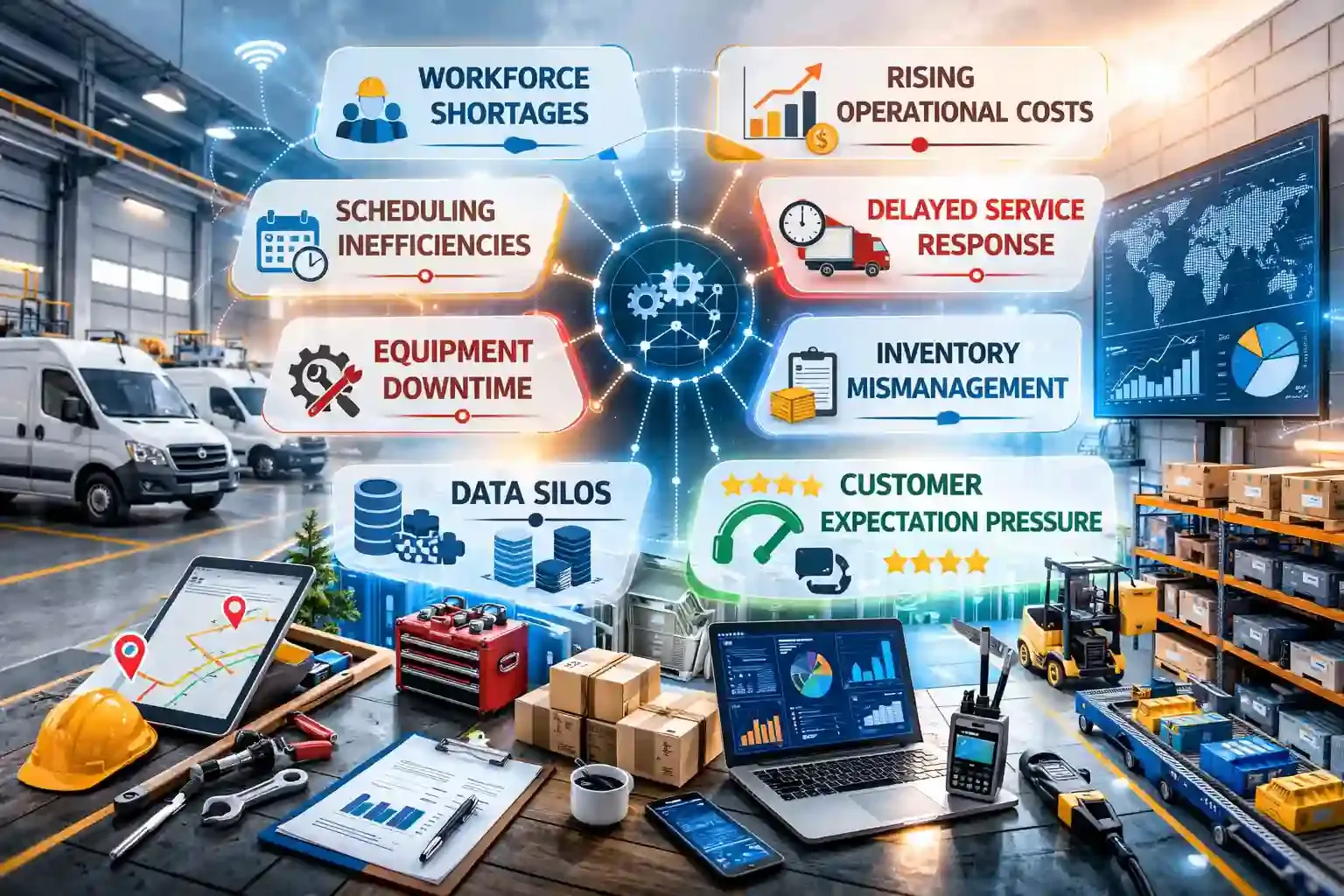
Technician skill mismatch is becoming one of the biggest challenges in field service. Salesforce reports that 85% of field technicians say the knowledge required to service equipment is changing faster than training programs can keep up. As equipment becomes more software-driven and connected, many technicians struggle to stay current.
Because skills are evolving so quickly, pressure on technicians keeps increasing. Salesforce also found that 57% of field technicians feel burned out due to rising workloads and tighter service-level agreements. When teams handle more jobs with limited training and higher customer expectations, stress naturally rises.
This combination creates a cycle that is hard to break. Skill gaps reduce first-time fix rates, and lower fix rates increase repeat visits and workload. Over time, burnout leads to turnover, which deepens the talent shortage even further.
Rising SLA pressure should not raise service costs
Balance workloads and protect productivity across the field-Start Free
If there is one thing these numbers make clear, it is this: field service is no longer just a support function. Teams that invest in routing efficiency, first-time fix rates, workforce skills, and connected technology consistently outperform those that rely on outdated processes.
That is why these field service industry statistics matter. They give you a clear benchmark, expose hidden inefficiencies, and show where smart investments actually pay off. If you use these insights as a reference point, you will make better decisions and set more realistic goals.
Frequently Asked Questions
What industries rely most heavily on field service operations?
Industries like utilities, telecom, healthcare equipment, HVAC, manufacturing, and energy depend heavily on field service teams. According to MarketsandMarkets and Fortune Business Insights, utilities and telecom remain among the largest adopters of field service management systems because downtime directly impacts revenue.
How does first-time fix rate impact profitability?
First-time fix rate directly affects cost per job and revenue per technician. Hubspot data shows top teams complete repairs in about 3.7 days compared to 5.9 days for average teams, which reduces repeat dispatches and labor waste.
Why is predictive maintenance becoming a competitive advantage?
Predictive maintenance reduces unexpected failures and emergency dispatches. Gitnux reports that IoT-powered predictive models can reduce maintenance costs by up to 25–30% and cut equipment downtime by as much as 50%.
How does technician turnover affect service performance?
Technician turnover increases training costs and lowers service consistency. Salesforce reports that 57% of technicians feel burned out, which often leads to higher attrition rates in high-pressure environments.
What role does real-time data play in field service optimization?
Real-time operational data improves scheduling accuracy and response speed. IQPC reports that 67% of field service leaders say real-time access to operational data has a major impact on efficiency. When managers can see live technician location, job status, and asset health, they make faster and more accurate dispatch decisions.