- Field Service Business
Bookkeeping for a Cleaning Business: Guide to Managing Your Finances
Updated on 17 Jul 2026
Jump to
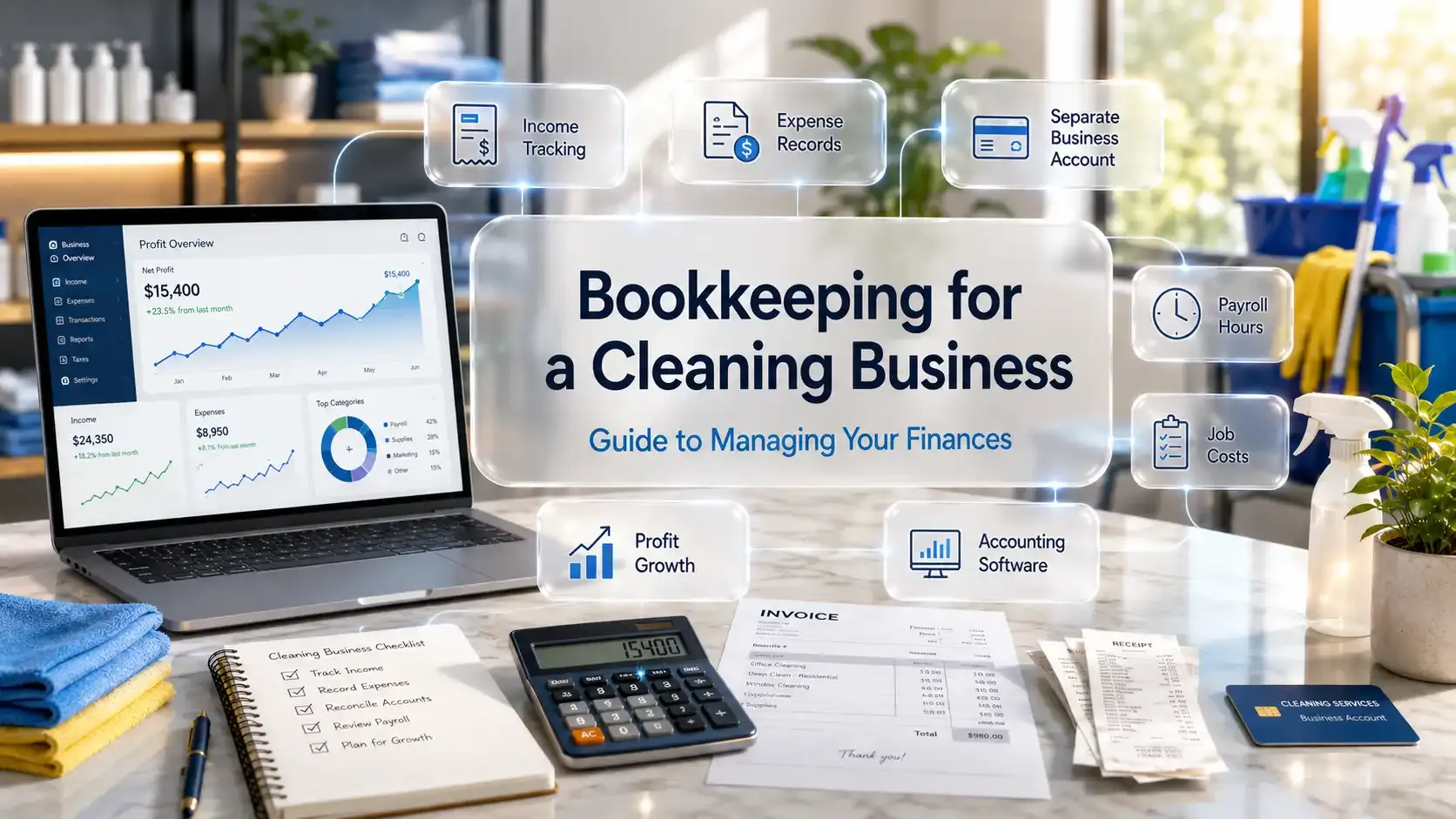
Bookkeeping for your cleaning business means keeping track of the money you earn and spend. This includes client payments, cleaning supplies, employee wages, and taxes. Good bookkeeping helps you stay organized, understand your profits, and make better decisions for your business.
This is more important than many owners realize. Poor cash flow management is a common reason small businesses struggle, and cleaning businesses often deal with lots of small invoices, changing payroll, and supply costs.
A widely cited U.S. Bank study found that poor cash flow management contributes to about 82% of small-business failures. For a cleaning business that handles many small invoices, changing payroll, and supply costs, staying on top of your books is essential.
The good news is that you don’t need to be an accountant to get started. This guide will walk you through why bookkeeping matters, how to set it up step by step, the best software options for your cleaning business, and what it may cost.
Why Bookkeeping Matters for a Cleaning Business
Good bookkeeping helps you see the real financial health of your cleaning business. Without it, you’re guessing about your money, and guessing can lead to problems.
Here’s what good bookkeeping does for you:
- Shows your cash flow: You can see what money is coming in and going out, so you can plan for slow months and avoid cash shortages.
- Shows if you’re profitable: Being busy doesn’t always mean you’re making money. Clean records show which jobs and clients actually bring in profit.
- Makes tax time easier: Organized records help you claim deductions, file accurately, and avoid penalties. The IRS requires businesses to keep records that support the income and deductions on their tax returns.
- Helps you make smart decisions: Whether you’re hiring a cleaner, buying equipment, or setting prices, real numbers help you make better choices.
For a cleaning business, this is especially important. Profit margins can be small, and little issues like untracked supply costs or unpaid invoices can add up quickly. Good bookkeeping helps you catch these problems before they hurt your business.
How to Set Up Bookkeeping for a Cleaning Business (Step by Step)
Setting up your bookkeeping system is easier than it sounds. If you follow these steps, you can keep your finances organized and make tax time much less stressful.
1. Open a Separate Business Bank Account
Keep your business money separate from your personal money. Use one bank account for all cleaning income and expenses.
To open a business account, you’ll usually need your EIN or Social Security number, a photo ID, and your business documents (U.S. Small Business Administration). Avoid paying personal expenses directly from your business account.
2. Choose a Bookkeeping Method
You can use either:
- Cash basis: Record income when you receive payment and expenses when you pay them. This is often the easiest option for small cleaning businesses.
- Accrual basis: Record income when it is earned and expenses when they are incurred, even if payment has not been made yet.
The IRS Publication 334 explains that most small businesses can choose either method.
3. Create a Chart of Accounts
A chart of accounts is simply a list of your income and expense categories. For a cleaning business, common categories include:
- Income: Residential cleaning, commercial cleaning, recurring contracts, and tips.
- Expenses: Cleaning supplies, equipment, payroll, vehicle costs, insurance, and marketing.
This helps you see where your money comes from and where it goes.
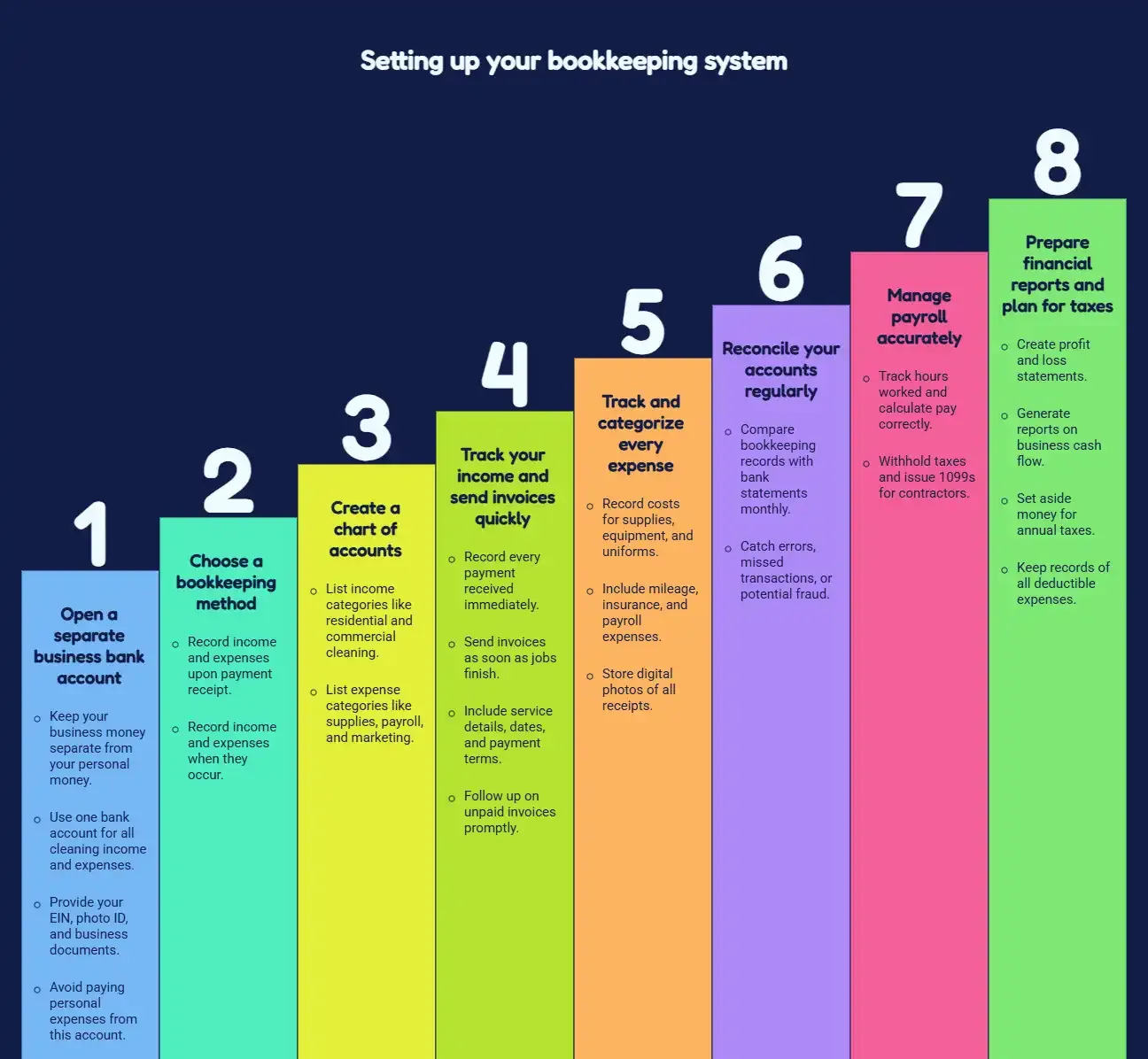
4. Track Your Income and Send Invoices Quickly
Record every payment you receive and send invoices as soon as a job is completed. Prompt invoicing helps keep your cash flow healthy.
Include the service provided, date, client name, amount owed, and payment terms. Follow up on unpaid invoices, since late payments can hurt cash flow. (SCORE).
Good field service invoicing software can automate recurring invoices for your regular clients.
5. Track and Categorize Every Expense
Record all business expenses, such as:
- Cleaning supplies and chemicals.
- Equipment and tools.
- Uniforms and protective gear.
- Mileage and vehicle expenses.
- Insurance and payroll costs.
Keep receipts by taking photos and storing them digitally. Accurate expense tracking helps you understand your profit margins and claim deductions.
6. Reconcile Your Accounts Regularly
At least once a month, compare your bookkeeping records with your bank statement. This process is called reconciliation.
Reconciling your accounts helps you catch missed transactions, recording errors, and possible fraud before they become bigger problems.
7. Manage Payroll Accurately
If you have employees or contractors, payroll will be a major part of your bookkeeping. Track hours worked, calculate pay correctly, withhold taxes for employees, and issue 1099s for contractors when required.
Accurate time tracking is important because payroll is only as reliable as the hours you record.
8. Prepare Financial Reports and Plan for Taxes
Use your records to create key reports, such as:
- Profit and loss (P&L) statement: Shows whether your business is making a profit.
- Cash flow report: Shows how money moves in and out of your business.
Set aside money for taxes throughout the year, and keep records of deductible expenses. Common cleaning business deductions may include supplies, equipment, vehicle expenses, and home-office expenses (IRS).
The right accounting software can handle many bookkeeping tasks for you, such as invoicing, tracking expenses, creating reports, and sometimes payroll.
Here are some of the best accounting software options for your cleaning business, depending on the size of your business and the features you need.
| Software | Best For | Starting Price | Free Plan |
|---|---|---|---|
QuickBooks Online | Best all-around choice | No (trial only) | |
Xero | Growing teams, unlimited users | No (trial only) | |
FreshBooks | Invoicing & service billing | No (trial only) | |
Wave | Best free option | Yes | |
Zoho Books | Budget-friendly with a free tier | Yes (free tier) |
Last verified: July 2026. Pricing changes often; check each provider's site for current rates.
QuickBooks Online
QuickBooks Online is one of the most popular choices for small businesses. It can help you manage invoicing, expenses, payroll, and financial reports, making it a strong all-around option if your cleaning business is growing.
Xero
Xero is a good option if you plan to scale your business. It allows unlimited users on every plan and includes helpful features such as bank reconciliation and financial reporting.
FreshBooks
FreshBooks is designed for service-based businesses, so it can be a natural fit for cleaning companies. It is especially useful for invoicing, time tracking, and recurring billing.
Wave
Wave is a popular free accounting option. It offers invoicing and expense tracking at no cost, which can be helpful if you are running a solo cleaning business or working with a tight budget.
Zoho Books
Zoho Books is another affordable choice. It has a free plan for very small businesses and paid plans with automation features that can simplify bookkeeping.
Advanced options for larger businesses
If you run a large commercial cleaning operation, more advanced platforms such as Sage Intacct may be better suited to your needs because they offer detailed job costing and multi-entity reporting.
How Field Service Software Makes Bookkeeping Easier
Here’s something many bookkeeping guides miss: your accounting software can only be as accurate as the information you enter. For a cleaning business, that information comes from your daily operations, such as hours worked, jobs completed, and expenses recorded.
This is where field service software can make bookkeeping much easier. When your team’s hours are tracked accurately and each job is logged properly, your records become more reliable. If time records are messy, you may end up with payroll mistakes and inaccurate job costs.
A tool like FieldServicely can help by collecting operational data through GPS-based time tracking, digital timesheets, and scheduling tools. This means the labor and job data that go into your accounting system are more accurate from the start.
This matters because payroll is often one of the largest expenses for a cleaning business. When you can trust your time records, you can also trust your payroll calculations, job costs, and profit numbers.
You can learn more about how GPS time tracking helps protect payroll and keep your bookkeeping records accurate.
The cost of bookkeeping for your cleaning business depends on whether you do it yourself or hire someone to help.
Doing it yourself with software
This is usually the most affordable option. Free tools like Wave may cost nothing, while paid platforms such as QuickBooks or Xero often cost about $15-$40 per month.
If your cleaning business is small, software plus a few hours of bookkeeping each month may be all you need.
Hiring a bookkeeper or outsourcing
If you prefer to hand off bookkeeping, the cost will be higher. Basic outsourced bookkeeping services often average around $250–$500 per month, and the price can increase if you also need tax preparation or financial advice.
Freelance bookkeepers may charge by the hour, often around $25–$60+ per hour, depending on their experience and location. The U.S. Bureau of Labor Statistics provides wage information for bookkeeping, accounting, and auditing clerks.
Which option is best for you?
- DIY software is usually enough if you are a solo cleaner or run a small operation.
- Hiring a bookkeeper can save you time and reduce mistakes as your business grows and your finances become more complex.
- A professional bookkeeper may also help you identify deductions and keep your records more accurate.
Understanding your cleaning business profit margins helps you decide when that investment makes sense.
Most Common Bookkeeping Mistakes to Avoid
Even with the right tools, a few common mistakes can make bookkeeping harder for your cleaning business. Watch out for these:
- Mixing personal and business money: Using the same account for both can make your records confusing and complicate your taxes. Keep them separate.
- Not tracking supplies and mileage: Small expenses like cleaning supplies and travel costs can add up quickly. If you don’t record them, you may miss tax deductions and underestimate your costs.
- Not reconciling regularly: Waiting until tax time to check your books can allow errors to build up. Review and reconcile your accounts at least once a month.
- Not following up on unpaid invoices: An unpaid invoice is money you have earned but not collected. Track overdue invoices and follow up promptly.
- Not setting aside money for taxes: Taxes are a regular business expense, so it helps to set aside part of each payment throughout the year.
- Trying to handle everything yourself as you grow: A simple system may work when you are a solo cleaner, but a growing team may require better software or professional bookkeeping help.
Avoiding these mistakes can keep your records accurate and help your business stay financially healthy.
For more tips on running an efficient operation, you can also read our guide on time card fraud and how it can affect payroll.
Wrapping Up
Bookkeeping for your cleaning business doesn’t have to be complicated. Once you keep your business and personal finances separate, set up a simple tracking system, and choose the right software, much of the process becomes easier to manage.
The most important step is to start now. Recording income and expenses regularly prevents receipts and records from piling up before tax season.
Accurate bookkeeping also depends on accurate daily data. Tracking employee hours, job costs, and expenses carefully makes your financial reports more reliable. A tool like FieldServicely can help you capture this operational data automatically, so your bookkeeping stays accurate as your business grows.
You can start for free with FieldServicely with no base fee, no credit card, and no long-term commitment.
Frequently Asked Questions
Can you do bookkeeping yourself?
Yes. If your cleaning business is small, you can usually handle bookkeeping yourself with accounting software. As your business grows, a bookkeeper or accountant can save you time and help reduce mistakes.
What is the best free accounting software?
Wave is one of the most popular free options because it offers invoicing and expense tracking. Zoho Books also has a free plan for very small businesses.
What expenses can you write off?
Common deductions for a cleaning business may include cleaning supplies, equipment, vehicle and mileage costs, uniforms, insurance, advertising, and home-office expenses. Keep receipts and records for everything you claim.
How often should you update your books?
It is best to update your books weekly. Recording income and expenses regularly helps keep your records accurate and prevents a stressful backlog at month-end or tax time.
What is a bookkeeping clean-up?
A bookkeeping clean-up means fixing messy or incomplete records, such as uncategorized transactions, missed reconciliations, or mixed personal and business expenses. If your books are behind, a clean-up can help make them accurate again.
Should you use cash or accrual accounting?
Cash basis accounting is usually the simplest choice for small cleaning businesses because you record income when you receive payment and expenses when you pay them. Accrual accounting can provide a clearer picture as your business grows, especially if you have recurring contracts.
Can a cleaning business be profitable?
Yes. Cleaning businesses can be profitable because they often have low startup costs and the potential for recurring revenue. Your profit will depend on pricing, controlling labor and supply costs, and keeping accurate financial records.
What to read next