- Field Service Business
Cleaning Business Profit Margins: What You Need to Know
Updated on 12 May 2026
Jump to
Summary

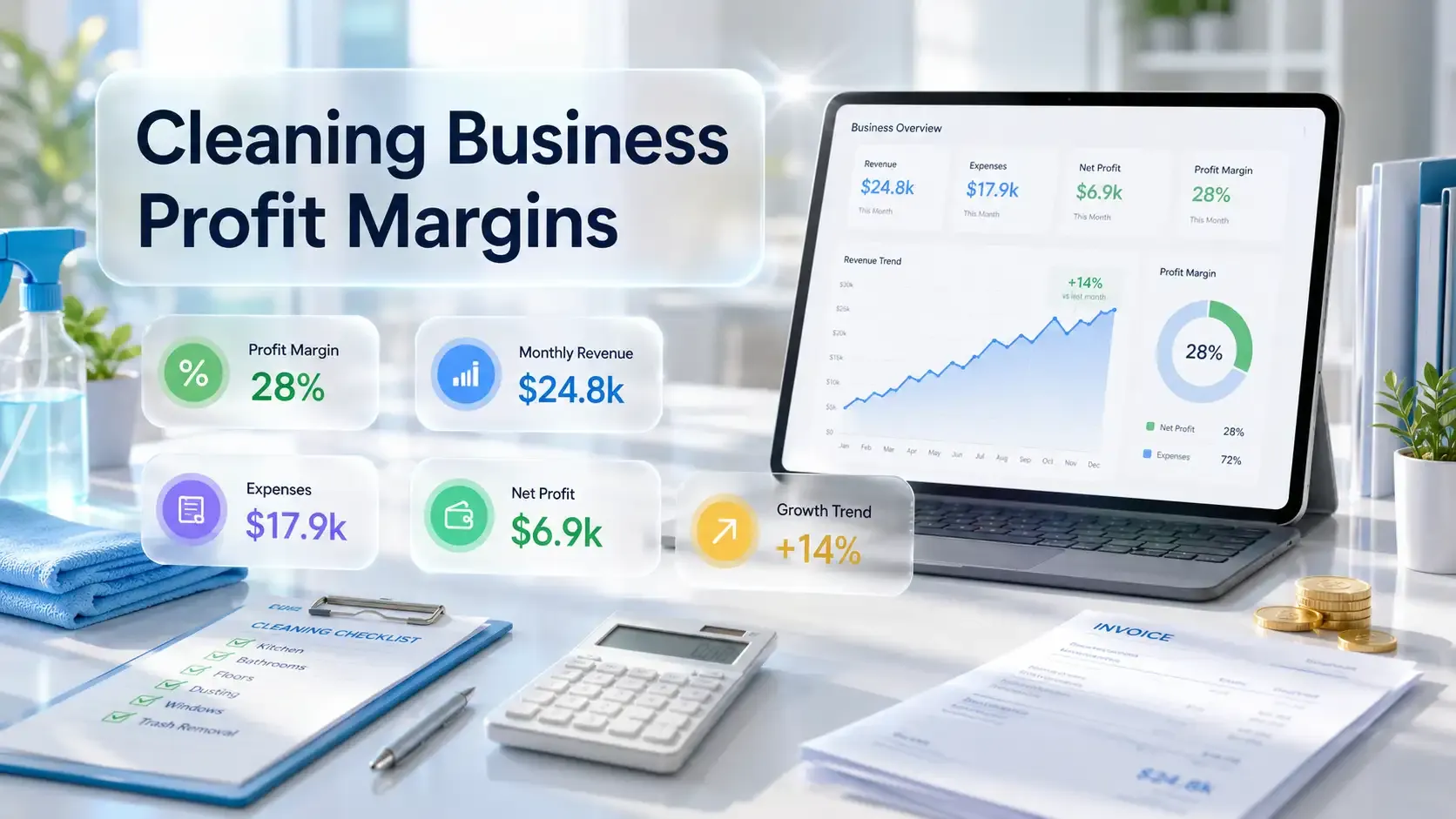
Cleaning businesses can achieve profitability, with net margins varying between 10% and 28%.
Gross margins typically range from 50% to 70%, with residential cleaning on the lower end and commercial services on the higher end.
Operational efficiency, pricing strategies, and upselling can significantly increase profit margins.
Start-up costs for cleaning businesses are low, typically ranging from $2,000 to $6,000.
Recurring contracts and client retention are crucial for steady revenue and long-term growth.
Running a cleaning business can be profitable, but profit does not come from revenue alone. You need to know what each job costs, how much labor it takes, and how much money stays after supplies.
Many cleaning business owners struggle with pricing their services correctly. This leads to undercharging or overcharging clients, which can eat into margins.
In this blog, I will discuss cleaning business profit margins, costs, and profit drivers, and explore ways to avoid common pricing mistakes.
Understanding Cleaning Business Profit Margins
A cleaning business makes money when it gets clients to pay for services like house cleaning, office cleaning, carpet cleaning, and more. Every dollar that a customer pays first shows up as revenue, but not all of that is profit.
You still need to pay people, buy supplies, cover insurance, software, fuel, and other bills before you see real profit. What tells you how well the business is doing is the profit margin.
There are two sides to this: gross margin and net margin.
For most cleaning companies today, a strong gross margin sits around 50%–70%, meaning roughly half of revenue is left after direct costs. While net profit margins, what owners actually walk away with, usually fall between 15%-25%, depending on services and efficiency.
Key Factors Impacting Cleaning Business Profit
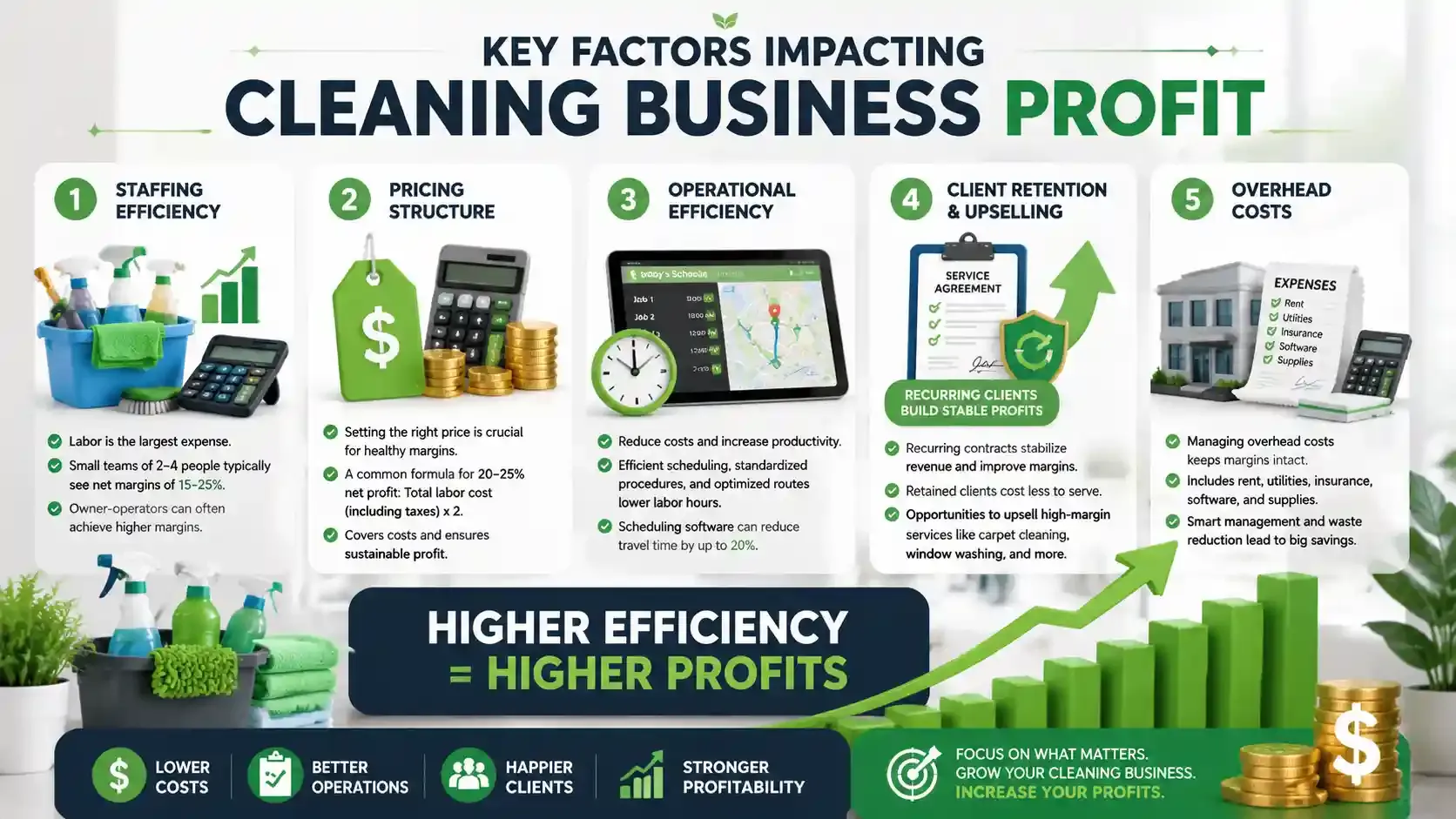
Staffing Efficiency
Labor is the largest expense in cleaning businesses. Small teams of 2–4 people typically see net margins between 15-25%. However, owner-operators, who handle most of the work themselves, can often achieve higher margins. Typical profit margins for cleaning companies often range from 10–28%, with variations depending on the niche.
Pricing Structure
Setting the right price is crucial for maintaining healthy margins. A common formula to achieve a 20-25% net profit is to calculate the total labor cost (including taxes), then multiply it by two. This ensures you're covering costs and also generating a sustainable profit.
Operational Efficiency
Maximizing operational efficiency means reducing costs and increasing productivity. Efficient scheduling, standardized cleaning procedures, and optimized route planning can lower labor hours and increase profit margins.
For example, using scheduling software like FieldServicely can reduce travel time between jobs by up to 20%, directly impacting your bottom line.
Client Retention & Upselling
Securing recurring contracts is one of the best ways to stabilize and improve profit margins. Retained clients cost less to serve, and they offer ample opportunities for upselling high-margin services like carpet cleaning or window washing.
Overhead Costs
Managing overhead costs is key to keeping margins intact. This includes rent, utilities, insurance, software subscriptions, and supplies. For example, negotiating lower rent or reducing waste in cleaning supplies can save a substantial amount over time.
Maximize margins with efficient staffing
Learn how small teams can boost profits
Average Profit Margins by Sector
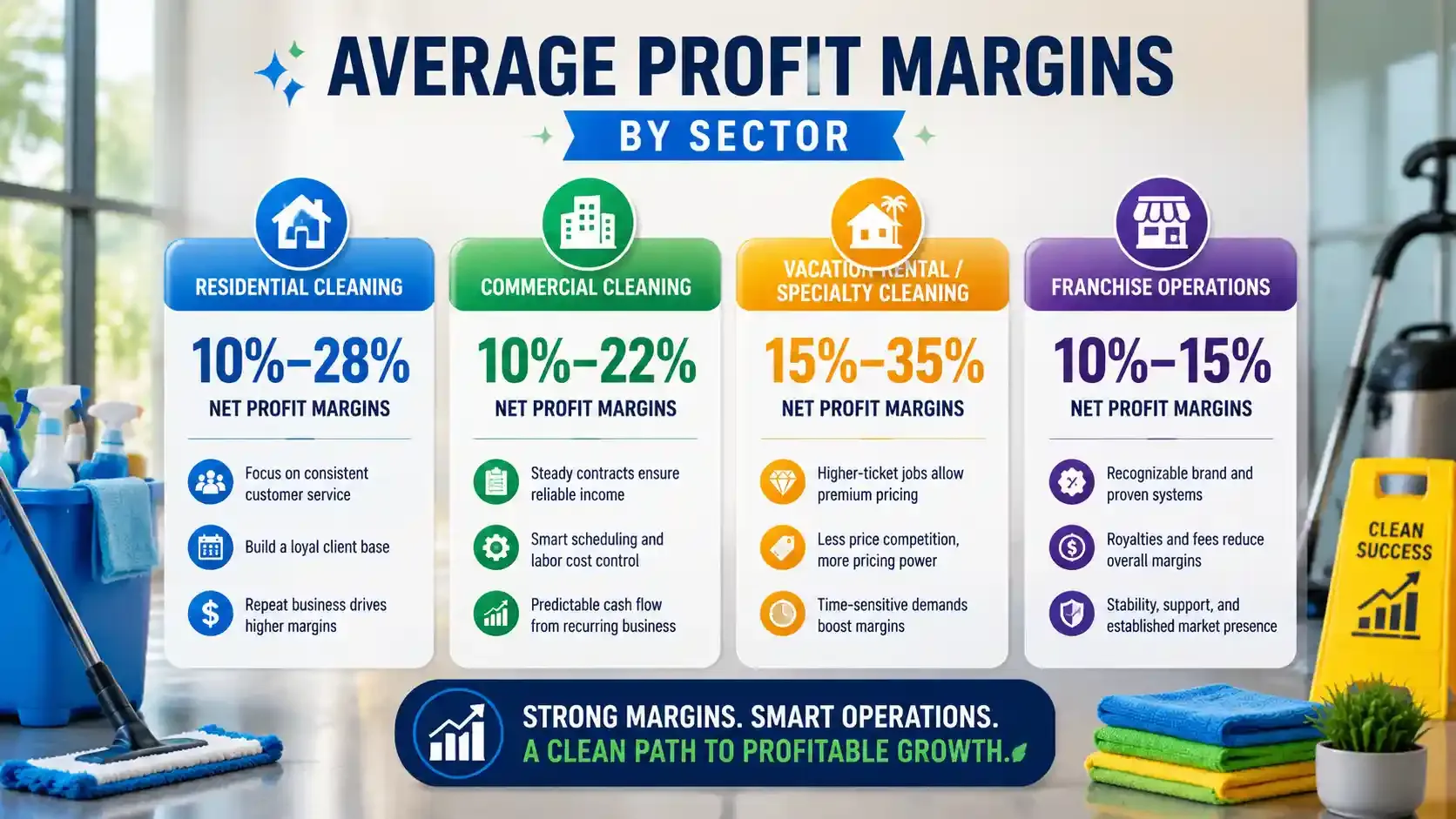
| Sector | Net Margin | Gross Margin | Notes |
|---|---|---|---|
Residential Cleaning | 10% – 28% | 50% – 65% | Low overhead, flexible scheduling, repeat business potential |
10% – 25% | 55% – 70% | Recurring contracts, large-scale jobs, price pressure from competition | |
Vacation Rental/Specialty | 15% – 35% | 60% – 70% | Premium pricing, less competition, high-ticket jobs |
Franchise Operations | 10% – 15% | 50% – 60% | Franchise fees and royalties reduce net margin |
Residential Cleaning
Residential cleaning businesses usually see net profit margins between 10% and 28%. The range is wide because small jobs and flexible schedules often come with lower pricing power. However, solo operators who control costs tightly can easily hit 20% margins.
Keeping labor and supply costs in check while focusing on consistent customer service can push margins higher. When you build a loyal client base, you create more opportunities for repeat business and steady cash flow.
Commercial Cleaning
Commercial cleaning typically lands in the 10% to 22% margin range. Steady contracts are great for reliable income, but they often come with price wars that reduce margins.
A small commercial team generating $200K–$500K annually can still target 20–25% margins if they're smart with scheduling and controlling labor costs. While the jobs are larger and more consistent, pricing pressure keeps the margins lower than you might expect.
Still, recurring business means predictable cash flow, which has its own advantages.
Vacation Rental/Specialty Cleaning
If you specialize in vacation rental or specialty cleaning, you can expect 15% to 35% margins. These services offer higher-ticket jobs, like post-construction clean-ups or carpet cleaning, allowing you to charge premium rates.
These types of jobs often have less price competition, so you can set your own pricing.
The real beauty of this niche? Well, it’s the less competition and time-sensitive demands that allow you to charge more and boost your margins.
Franchise Operations
Franchise cleaning businesses usually land between 10% and 15% net profit margins. They benefit from a recognizable brand and proven systems, but this comes at the cost of royalties and franchise fees.
These fees can eat into profits, leaving margins thinner than independent operations.
But franchises offer stability and support, which is why many franchisees trade slightly lower margins for consistent income and an established market presence.
Explore profit margins across cleaning sectors
Learn how optimizing your field operations can improve your margins
What are the Startup Costs & Early Profitability of a Cleaning Business?
Starting a cleaning business is surprisingly affordable. The typical startup costs range from $2,000 to $6,000 for essentials like cleaning supplies, equipment, insurance, and licensing.
This low initial investment is one of the main reasons cleaning businesses are so accessible!
What makes the cleaning business even more appealing is its quick return on investment (ROI). Due to low overhead costs, it’s possible to start seeing profit within the first 30 to 60 days.
This fast ROI is due to the nature of the business. With minimal overhead and flexible pricing, you can start profiting immediately.
For instance, offering bi-weekly or weekly cleanings to a handful of homes or offices can quickly cover costs and lead to stable cash flow.
How to Accurately Calculate Profit Margins for Your Cleaning Business
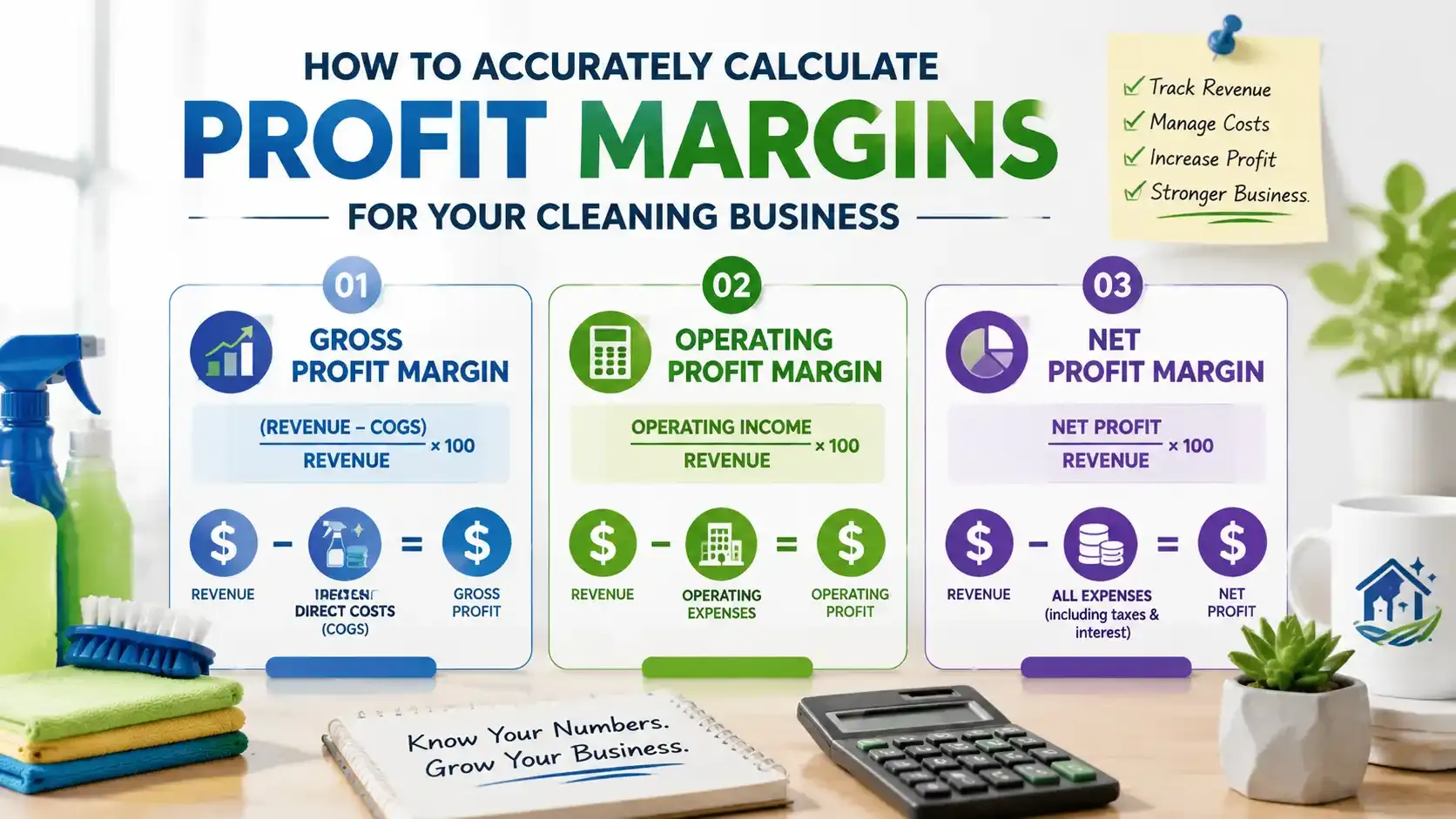
Gross Profit Margin
Gross profit margin shows how much revenue remains after covering the direct costs of providing cleaning services. This includes expenses like employee wages, cleaning supplies, and equipment.
To calculate it, use this formula:
Gross Profit Margin = (Revenue – Cost of Goods Sold) ÷ Revenue × 100
Example:
Let’s say your cleaning business earned $300,000 in revenue. If it costs $130,000 for labor, supplies, and equipment, the gross profit would be:
$300,000 (Revenue) – $130,000 (COGS) = $170,000 (Gross Profit)
To find the margin:
$170,000 ÷ $300,000 = 0.56
0.56 × 100 = 56% Gross Profit Margin
This means you’re keeping 56% of your revenue after covering direct costs.
Operating Profit Margin
Operating profit margin tells you how much profit you make after covering operating expenses like office rent, salaries, and utilities, but before taxes and interest.
The formula is:
Operating Profit Margin = (Operating Income ÷ Revenue) × 100
Example:
If your company generated $300,000 in revenue and had $160,000 in operating expenses:
$300,000 (Revenue) – $160,000 (Operating Expenses) = $140,000 (Operating Income)
Then, divide by total revenue:
$140,000 ÷ $300,000 = 0.46
0.46 × 100 = 46% Operating Profit Margin
This means your company is earning 46% from core operations after covering all operating expenses.
Net Profit Margin
Net profit margin is the ultimate indicator of your company’s profitability, showing how much money you have left after all expenses, including taxes and interest. The formula is:
Net Profit Margin = (Net Profit ÷ Revenue) × 100
Example:
Let’s say your cleaning business earned $300,000 in revenue but spent $240,000 on all expenses (including COGS, operating expenses, taxes, etc.):
$300,000 (Revenue) – $240,000 (Total Expenses) = $60,000 (Net Profit)
To calculate the margin:
$60,000 ÷ $300,000 = 0.2
0.2 × 100 = 20% Net Profit Margin
This means your cleaning business keeps 20% of its revenue as profit after all expenses.
Master your gross profit margin with precise cost tracking
Use FieldServicely’s tools to monitor labor, supplies, and equipment costs
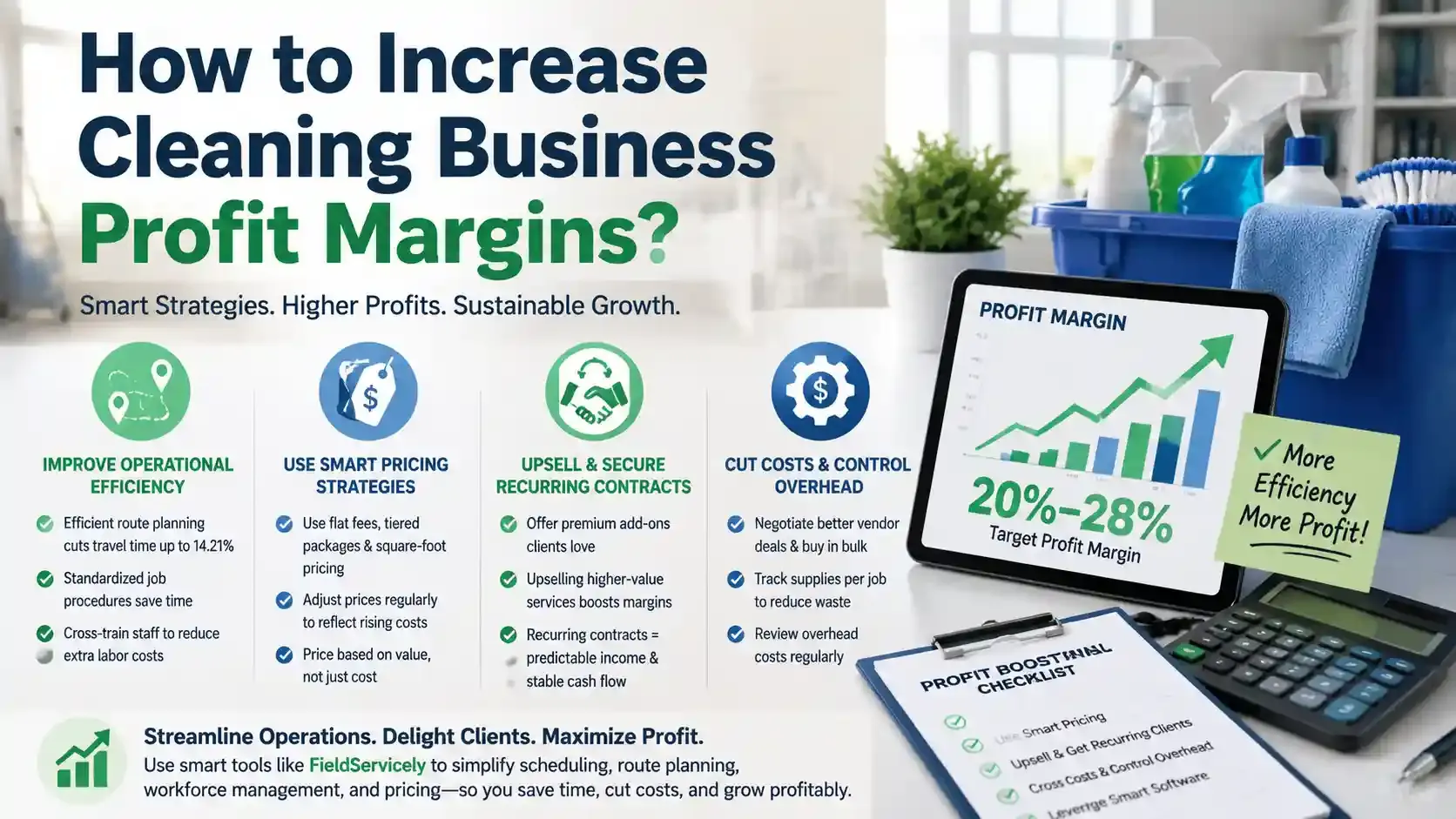
How to Increase Cleaning Business Profit Margins?
Improve Operational Efficiency
Start with better operational practices to reduce waste and increase revenue.
Efficient route planning alone can cut travel time by up to 14.21%, which directly saves money on fuel and labor. When your teams spend less time driving and more time cleaning, you serve more clients per shift and keep more revenue.
Standardized job procedures help your crew complete work faster without reducing quality. While cross‑training lets your staff handle multiple tasks, you avoid extra labor costs.
Use Smart Pricing Strategies
Pricing strategy has a huge impact on your margins. Use a mix of flat fees, tiered packages, and square‑foot pricing to match what customers want while capturing more value.
Regular price adjustments help you reflect rising costs for labor and supplies. Many cleaning business owners aim for margins of 20–28% once they nail pricing and operations. When you set prices based on value rather than just cost, you keep more profit per job.
Upsell & Secure Recurring Contracts
Upselling increases revenue without major extra work. Offer premium add‑ons like carpet cleaning, window washing, or deep cleans that clients value and are willing to pay more for.
According to Forbes, upselling higher‑value services is one of the most effective ways to raise margins. Also, selling recurring contracts (weekly or monthly cleanings) gives you a predictable income that stabilizes cash flow and reduces marketing pressure.
Cut Costs & Control Overhead
Cost-cutting directly improves your profit margins. Negotiate better deals with your vendors and buy supplies in bulk to reduce material costs.
Track your supply use per job to avoid waste and make every dollar count. Also, review overhead costs like insurance, office rent, and software. This helps you trim unnecessary expenses and keeps more money in your business.
To further optimize your cleaning business, consider using tools that streamline operations and help reduce costs. FieldServicely offers solutions that make scheduling, route planning, and workforce management more efficient, saving both time and money.
By integrating smart software, you can track resources, improve job completion times, and optimize your pricing strategies to ensure profitability.
Streamline your operations to save time and money
Reduce travel time and improve scheduling efficiency to boost your margins
Common Mistakes That Affect Cleaning Business Profitability
- Flat-rate pricing prevents underbilling and protects margins.
- Inefficient scheduling and routing increase labor costs.
- Fewer long-term clients lead to unpredictable revenue.
- Unmonitored expenses like fuel and supplies cut into profits.
- Low-ticket services limit revenue; focus on higher-margin jobs.
- Inconsistent marketing efforts waste time and money.
Conclusion
Cleaning businesses can achieve strong profitability by optimizing margins, pricing, and efficiency. Track both gross and net margins, and focus on high-margin services with opportunities for upselling. Improve staffing and scheduling, and manage overhead costs to boost efficiency. Reinvesting profits wisely will drive long-term growth.
Frequently Asked Questions
True margins on a cleaning business?
True profit margins for a cleaning business typically range from 10% to 28%, with many businesses seeing net margins between 15% and 20%. Gross margins can be higher, ranging from 50% to 70%.
What is the ideal profit margin for cleaning services?
The ideal profit margin for cleaning services typically falls between 15% and 25%. This range ensures the business is covering costs while remaining profitable and sustainable in the long term.
How much is a 1-hour clean?
The cost of a 1-hour clean varies depending on location and service type, but it generally ranges from $25 to $75 per hour. Rates can fluctuate based on the size of the space, the complexity of the cleaning, and whether it’s residential or commercial.
What cleaning business is most profitable?
Specialty cleaning businesses, such as vacation rental or post-construction cleaning, tend to be the most profitable, with margins between 15% and 35%. These services often command higher fees due to less competition and premium pricing.
How much money do I need to start a cleaning business?
Starting a cleaning business typically requires an investment of $2,000 to $6,000. This covers the cost of cleaning supplies, equipment, insurance, and licensing. The low startup cost makes it an accessible business to launch.