- Route optimization and planning
7 Practical Strategies for Efficient Route Optimization
Updated on 19 Jan 2026

Jump to
Summary

Route optimization strategy is the structured planning of routes and schedules. It reduces time, fuel, labor waste, and operational risk.
Poor routing increases fuel costs by 10–30%, cuts daily job capacity by up to 20%, and causes cascading delays.
A dedicated route optimization software automates routing and adapts in real-time through measurement and learning.
Efficient route optimization means plans and schedules to cut travel time, mileage, and operating costs. Efficiency depends on strategies that turn routing decisions into consistent, real-world performance. Smarter strategies increase fuel efficiency, stabilize schedules, and improve on-time delivery rates.
This is why I will discuss route optimization from a practical perspective in this blog. I will also explain where traditional methods fail. The challenges teams face daily, and how route optimization software solves them.
Quick Look at the Route Planning and Optimization Benefits
| Strategy Name | Problem It Solves / Benefit | Best Fit Scenario or Industry |
|---|---|---|
Route Optimization Software | Removes manual planning and human error | Field service, delivery route optimization, logistics |
Real-Time GPS Tracking & Traffic Data Analysis | Avoids delays and road congestion | Urban service teams, last-mile delivery |
Accurate Address & Job Data | Prevents wrong delivery routes and wasted time | Home services, utilities, repairs |
Dynamic Route Adjustments | Handles last-minute changes | Emergency jobs, on-demand services |
Empty Mile Reduction | Cuts fuel waste | Logistics, fleet operations |
AI-Driven Route Learning | Improves routes over time | High-volume service businesses |
System Integration | Keeps data in one place | Scaling service companies |
Why You Need a Strategy for Route Optimization
Route optimization is the process of planning how vehicles move between jobs to minimize time, fuel, and labor waste. It defines the order of stops, the roads taken, and the timing of each visit. It also handles delivery constraints like traffic, job duration, and the vehicle routing problem.
But why does this matter so much? Because routing mistakes rarely look significant at first.

Imagine a regular morning where a dispatcher plans routes quickly. The map shows a direct road to the first job. It looks fine until a construction site blocks a lane. By the time the technician arrives, the customer has already called.
And no, this is not a rare case. It is the default when routing decisions rely on habit instead of strategy.
Here is the part most teams underestimate. Routing gets complex very fast. One vehicle with ten stops creates more than 3.6 million possible route combinations. Now add time windows, job duration, technician skills, vehicle capacity, and the list goes on.
A route optimization strategy exists to manage that complexity. It answers hard questions upfront.
- Should on-time arrival matter more than distance?
- Should skilled technicians travel farther for complex jobs?
- How do you respond when a job is canceled mid-day?
- What about emergencies that appear without warning?
Without a strategy, every answer is reactive. But with a strategy, these decisions are consistent.
Just so you know, businesses that use structured route optimization report 20% fuel savings. Plus, higher first-time service completion rates. That’s a route optimization benefit that stabilizes the business the entire day.
Also, route optimization software already accounts for over 62% of total market revenue. It means most organizations have moved beyond manual or spreadsheet-based routing.
7 Efficient Route Optimization Strategies
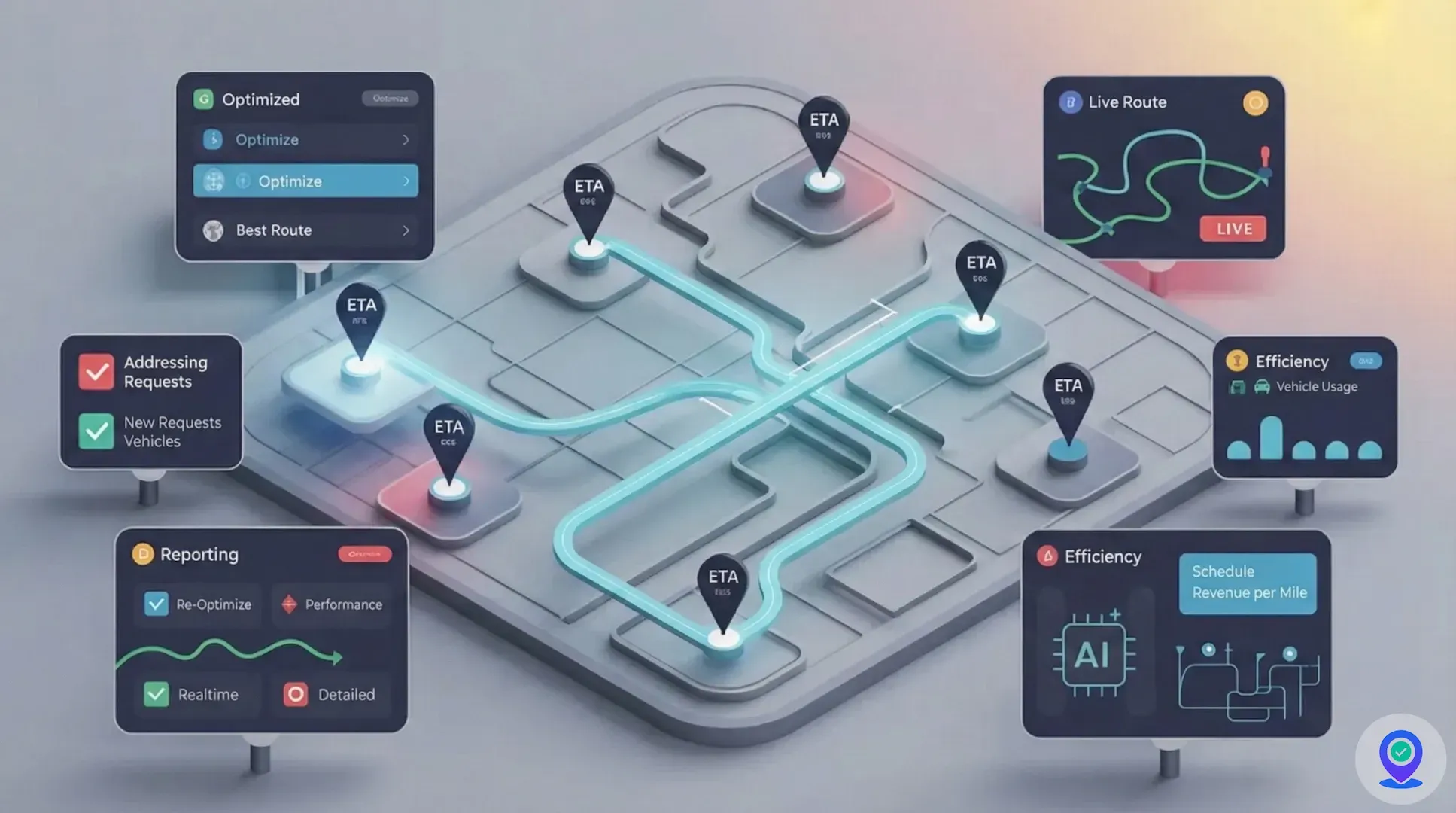
Here are the game-changing route optimization strategies listed for you:
1. Use Route Optimization Software
Best for: Field service, delivery, logistics, supply chain
Most route optimization journeys begin with a dedicated tool, and for good reason. One of the major ones is that manual planning simply does not scale. Once a business moves beyond a handful of vehicles, planners start relying on habit.
At that point, how confident can you really be that each route is the best possible option?
Route optimization software solves this by evaluating thousands of route combinations consistently.
And it's not only for one day. It is used every single day, using the same rules. Hence, it removes variability caused by time pressure or human fatigue.
2. Real-Time GPS & Traffic Data
Best for: Urban service teams, last-mile delivery optimization
Once planning becomes efficient, real-world conditions quickly expose the next weakness. That is traffic volatility.
Static routes assume roads behave predictably, which rarely happens in dense urban areas. But how often does your “perfect” morning route still work after the first accident?
Research found an average of nearly 100 road traffic accidents per day, with incidents heavily concentrated on the busiest roads.
According to INRIX, traffic congestion costs U.S. businesses over $70 billion annually in lost productivity. In practice, this leads to missed delivery windows. It also causes delays and extra support calls.
Real-time route optimization lets vehicles adjust right away without help from dispatch planning. For last-mile delivery teams, this helps keep the rest of the schedule on track. It still works even if the first stop goes wrong.
3. Accurate Address & Job Data
Best for: Home services, utilities, repairs
As routing becomes more dynamic, data quality becomes the limiting factor.
Even the most dynamic routing algorithms fail when inputs are incomplete or incorrect. Missing unit numbers can cause failed visits. Incorrect locations or vague service details often lead to repeat trips.
So, how many delays actually start with bad data rather than bad routing?
Gartner estimates that poor data quality costs organizations over $12 million per year. In field operations, that cost appears as wasted drive time and customer frustration.
4. Dynamic Route Adjustments
Best for: Emergency jobs, on-demand services
Some industries operate in constant disruption. Emergency repairs, roadside assistance, and on-demand services cannot rely on fixed schedules. New jobs appear throughout the day, often with high urgency.
Industry data shows why fixed schedules break down under this pressure. Operations using dynamic route re-optimization achieve on-time delivery rates above 90%. As delivery windows tighten, static plans cannot absorb mid-day changes.
Dynamic route adjustment lets teams add jobs without breaking the plan. Instead of overloading one technician, the system updates routes across the team.
For example, a plumbing company receives three emergency calls within one hour. Without dynamic routing, the nearest technician gets all three jobs and falls behind schedule.
With dynamic routing, the system redistributes work across nearby technicians. Thus, it preserves response times and prevents delays from cascading through the rest of the day.
5. Empty Mile Reduction
Best for: Logistics, Fleet operations
Empty miles are one of the biggest hidden costs drivers can see in logistics. Trucks consume fuel, labor, and maintenance even when they generate no revenue.
Research shows that empty miles account for an average of 29% of truck travel. Reducing them often delivers faster ROI than adding vehicles or renegotiating contracts.
A food distributor can schedule supplier pickups and warehouse transfers on return trips. Without changing fleet size, the businesses move more goods and reduce delivery costs.
6. AI-Driven Route Learning
Best for: High-volume service businesses
At higher volumes, optimization stops being static. AI-driven routing systems learn from past outcomes, not just current inputs.
Why repeat the same routing mistakes week after week?
Industry research shows that AI route optimization improves ETA accuracy and delivery performance. Studies also show up to 40% improvement in traffic predictability.
For e-commerce and subscription delivery, this leads to fewer missed delivery windows. It also reduces “where is my order” calls.
Over time, routes improve on their own. This matters when volume grows faster than planning teams.
7. System Integration
Best for: Scaling service companies
All routing strategies depend on one foundation, which is integrated systems. When orders, skills, schedules, and customer notes are in different tools, routing becomes less accurate.
Guess how scalable a system that relies on manual syncing is?
Industry research confirms this issue clearly. Research reports the market is growing at a 13.8% CAGR, driven by fragmented systems hurting operational efficiency.
Integrated systems ensure every new job inherits accurate operational constraints automatically. As volume grows, planning speed stays constant. This is how scaling companies maintain control without adding operational chaos.
Tooling & Implementation Checklist for Efficient Route Planning & Optimization
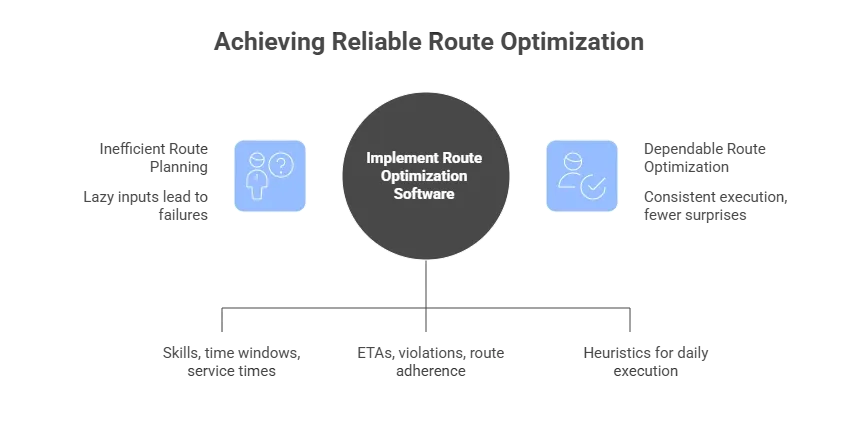
Minimum Required Inputs (Skills, Time Windows, Service Times, Depots, Shifts)
Here’s the truth. Route optimization does not fail because route optimization algorithms are bad. It fails because the inputs are lazy.
What happens when your system does not clearly know who can do which job?
This includes when a customer wants service. It also includes how long the work takes and where the routes start. And those guesses show up as late arrivals, rushed jobs, and overtime.
Skills and certifications are the first thing people skip. That shortcut always backfires.
For example, sending the closest technician feels efficient at first. The problem appears when the job fails, and someone must return. And this is true for time.
If a job takes 45 minutes, logging 30 minutes hides the issue. The problem shows up later in the day. This is why service times need honesty to earn customer trust.
That said, depots and shifts keep routes grounded in reality. They prevent routes that look great on a map but ignore labor rules or common sense. When these inputs are valid, routing stops feeling random and starts feeling dependable.
What to Log for Optimization learning (ETAs, Violations, Route Adherence, Actual Timestamps)
- Planning is only step one. But routing improves when teams track what happens after drivers leave.
- You need to know when a route said someone would arrive and when they actually did. That gap tells you more than any dashboard. Missed time windows and capacity violations also show where planning assumptions break.
- Route adherence is especially revealing. When drivers ignore suggested routes, the plan fails, and real conditions do not match the model.
- Actual timestamps matter more than averages. Arrival time, job start, job end, and departure give you the raw truth.
- Over time, patterns become obvious. Certain neighborhoods always run late. Some job types consistently take longer.
- Teams that review this data often see fewer surprises. Also, the same problems stop repeating each week.
Improve routing using real route outcomes
Try for free - No credit card required!
If Building: OR-Tools, Heuristics vs MIP/CP, Solver Time Limits, Tradeoffs
If you are building routing logic yourself, remember there is no perfect solver. Every choice is a tradeoff.
- Tools like Google OR-Tools are popular because they help teams start fast. They avoid rebuilding everything from scratch.
- Heuristics are usually the workhorse. They are quick, flexible, and good enough for most real-world routing. They may not find the absolute best route, but they find workable routes before the day starts.
- MIP or constraint programming sounds attractive because of optimality guarantees. But they struggle once the problem grows or changes mid-day.
- Solver time limits are not technical trivia. They are business decisions. A route that is ready now almost always beats a slightly better route that arrives too late.
Most teams end up mixing approaches. Fast heuristics for daily execution. Heavier solvers for planning, simulation, or offline analysis.
Use a Route Optimization Software for Easy Implementation
By this point, one thing should be clear. Route optimization fails less because of strategy and more because of execution. Knowing what to do is easy. Doing it consistently, every day, is where teams struggle.
This is where a dedicated tool actually helps. FieldServicely removes the friction between planning and execution.
It creates routes based on live jobs, technician availability, and real locations. There is no copying data between tools or reworking plans once the day starts.
For field teams, this means fewer manual decisions and fewer mistakes under pressure. Dispatchers can assign the right technician based on location and availability. They can also adjust routes when priorities change.
And this still keeps the rest of the day intact. Technicians know exactly where to go next. Managers keep visibility without micromanaging.
The real benefit is not just faster routing. It is fewer late arrivals, fewer reassignments, and fewer “Why did this go wrong” questions.
Routing works best when it shares a system with scheduling and tracking. That is when optimization works in daily operations.
Try FieldServicely #1 Route Optimization Software
Try for free - No credit card required!
Bottom Line
Manual route planning decisions create problems that quietly stack up over time. At that point, how to make your route optimization strategy efficient becomes a real business problem.
Most teams struggle because they use rigid routing methods. These routes cannot adjust once the day begins. One delay throws off the entire schedule. Efficiency is lost in the constant fixing and replanning.
FieldServicely helps field service teams break out of that cycle. It replaces manual routing with intelligent scheduling that adapts as conditions change.
Teams gain clearer visibility, better control, and a way to improve week after week. Over time, routing becomes predictable, and operations become easier to run.
Frequently Asked Questions
What are the best practices for route optimization?
Route optimization best practices include a route planning software, accurate addresses and job details, and updating routes with live GPS and traffic data. Also set clear delivery time windows, group nearby stops, and avoid empty miles by planning return trips or next jobs.
What tools can help with route optimization?
Route optimization tools include route planning software like FieldServicely. It has GPS, live tracking, traffic data, dispatch and scheduling options, and fleet tracking systems. It also keeps locations, schedules, and job details in one place, so teams drive less and finish more jobs on time.
What are common mistakes in route optimization strategy?
Common mistakes in route optimization include using wrong or outdated addresses, ignoring real-time traffic, and planning routes without current job times. Many teams also skip driver input, fail to set clear rules like time windows, vehicle limits, priorities, and do not update routes when changes happen during the day.
How can technology improve route optimization?
Technology can improve route optimization by using real-time GPS and traffic data to find the fastest routes. It can auto-adjust routes when jobs change, roads close, or delays happen. Again, it uses accurate address data and past delivery results to reduce empty miles and improve on-time delivery.
What industries benefit from route optimization?
Industries that benefit from route optimization include delivery and courier services, food and grocery delivery, field service and repair teams, sales teams, waste collection, construction and equipment transport, home healthcare, and public transit.
What to read next