- Route optimization and planning
What is Route Optimization: The Complete 2026 Guide
Updated on 22 Jan 2026
Jump to
Summary

Route optimization finds the fastest and most cost-effective way to handle multiple stops without adding drivers or vehicles.
Poor routing wastes fuel, increases stress, and costs drivers up to 49 hours yearly in traffic delays alone.
A reliable route optimization tool cuts wasted miles, adjusts routes in real time, and keeps schedules realistic as work changes.
In general, the technique you use to find the most effective, quickest path to get to a service or delivery destination is route optimization. It reduces driving time, lowers fuel costs, and helps teams complete more jobs using the same workforce.
As customer expectations rise, manual route planning fails, and daily schedules begin to slip. Route optimization solves this by cutting wasted miles, improving arrival accuracy, and supporting larger workloads without adding vehicles.
In this blog, we will explain what route optimization is, how it works, common challenges, and how to measure ROI.
What Is Route Optimization?
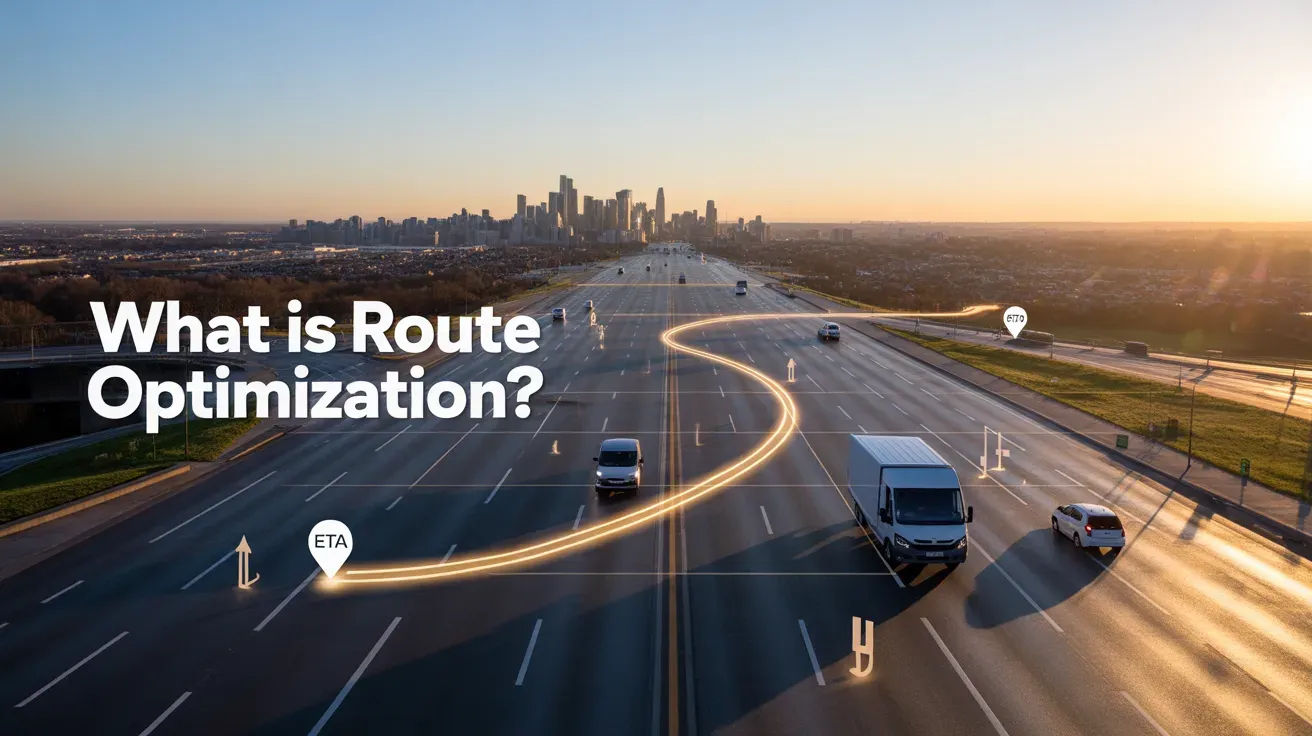
Route optimization is the process of planning the fastest and most cost-effective routes between multiple jobs.
It organizes the delivery routes that help drivers and technicians move efficiently between appointments. The goal is to minimize driving time, cut fuel costs, and complete more tasks without adding additional staff or vehicles.
Just so you know, I have seen this problem firsthand in field service teams. Jobs were assigned based on availability instead of location. That made technicians drive across the same neighborhoods repeatedly. As a result, costs increased without anyone understanding why.
Many people assume routing means finding the shortest path from point A to point B. That sounds logical, but it rarely works in real operations.
The shortest route on a map can be the slowest route on the road. Traffic congestion, parking delays, job duration, and customer time windows all change the outcome.
And did you know drivers can lose nearly 49 hours to traffic congestion?
It explains why poor routing quietly drains productivity every single day. Advanced routing methods increase energy efficiency and reduce fuel consumption.
For example, route optimizing software looks beyond simple navigation. It plans the best sequence of stops. A slightly longer route can save time by avoiding traffic and idle waiting.
Advantages of Route Optimization
There are many benefits of route optimization. The major ones are:
- Faster daily operations: When routes follow a smart order, workdays feel smoother. Drivers stop going back and forth. Studies show better routing can improve route efficiency by 15-30%
- Higher customer trust: Arriving on time builds trust fast. Clear arrival times matter because 77% of customers expect delivery within two hours or less.
- Lower operating costs: Business report 15-25% reduction in transportation route optimization cost compared to manual route planning.
- More reliable schedules: Good routes plan for real life, not perfect days. Traffic, weather, and job length are all considered. That leads to fewer missed visits.
- Smarter planning decisions: Route data shows where time gets lost. You see slow areas and long jobs clearly. That helps you fix real problems.
Better technician utilization: Workloads stay balanced across the team. No one feels overloaded or underused. That lowers burnout and delays new hiring.
Cut wasted miles with smarter route optimization
Try for free - No credit card required!
How Does Route Optimization Work?
Route optimization works by using route optimization algorithms to decide the best order for completing multiple stops. The system considers factors such as distance, traffic, job duration, time windows, vehicle capacity, and driver availability.
The process starts with data. Addresses, schedules, vehicle details, and job requirements are collected and converted into map coordinates. Then it groups the stops by location to avoid zigzagging and unnecessary driving across the same areas.
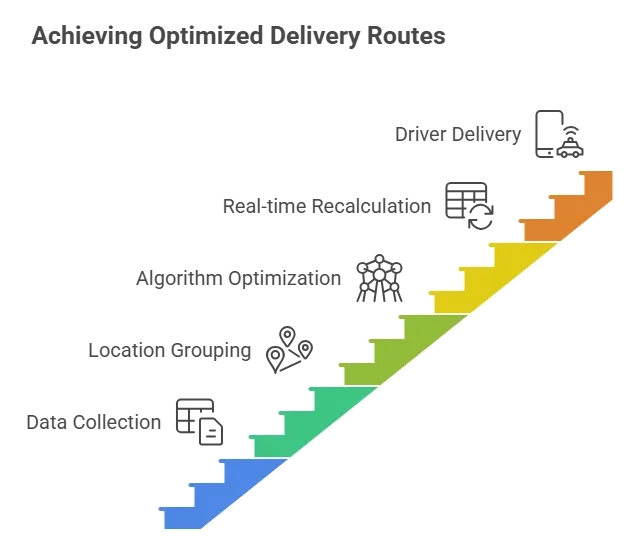
Next, optimization algorithms solve routing problems such as the Vehicle Routing Problem. They apply real-world rules like working hours, capacity limits, and customer time windows. When traffic changes or a job runs late, the system recalculates routes using live data.
Finally, drivers get the optimized routes through mobile apps. Thus, drivers receive clear directions, accurate ETAs, and real-time updates as the day changes.
Route Optimization and Planning: Practical Examples
Route optimization becomes critical when work involves travel, uncertainty, and tight schedules. Different industries face different routing problems. What stays constant is the need to save time, control costs, and meet promises.
Below are real-world examples of how route optimization works in practice:
Delivery Services
Delivery teams manage many stops with strict time windows. A route that looks fine in the morning often breaks by noon. That’s because customers reschedule, miss deliveries take place, or instructions get updated. Route optimization fixes these unnecessary miles driven by reshuffling stops in real time to avoid wasted driving.
For example, UPS uses routing software to reduce left turns and miles driven. This strategy saves millions of gallons of fuel yearly. UPS reports saving over 10 million gallons of fuel annually through optimized routing.
Plumbing and Home Repair Services
Plumbing work is unpredictable by nature. One job may finish in twenty minutes, while another may take two hours. Not to mention the practical skills.
Route optimization assigns the closest qualified technician while respecting appointment windows. Emergency calls can be inserted without ruining the full schedule. This way, teams can save hours daily by avoiding manual reshuffling.
HVAC Service Operations
HVAC companies face heavy demand during extreme weather. Appointment delays quickly lead to unhappy customers. Route planners find routes using job duration estimates and traffic data to provide the best service.
When a job runs longer, the system adjusts nearby routes. This prevents missed appointments. Studies show optimized scheduling can improve on-time delivery performance in field services.
Crew Dispatching and Field Teams
Crew dispatching adds another layer of complexity. Jobs require multiple workers, specific skills, and equipment. Thus, routes must account for team availability and workload balance.
Route optimization tools assign crews based on proximity and capacity. Hence, workloads are automatically balanced when emergencies arise. This prevents dispatcher burnout and schedule chaos.
Fleet Management and Route Optimization in Logistics
Fleet routing focuses on fuel, maintenance, and vehicle usage. Empty miles and idling hurt margins before you can realize. Fleet route optimization reduces unnecessary travel and balances loads across vehicles.
Logistic route optimization similarly plans the most efficient path for deliveries. Amazon uses an advanced routing algorithm to optimize last-mile delivery. They reported reduced miles driven and lower emissions after deployment.
Emergency and Utility Services
Emergency response depends on speed and accuracy. Utility teams respond to outages, damaged lines, and equipment failures. Optimized routes help by finding the fastest safe directions using live data.
It considers road closures and crew availability, which leads to faster tech arrival to service destination. Research shows that reduced response times improve service reliability during outages.
Turn daily routes into predictable schedules
Try for free - No credit card required!
What Is the Difference Between Route Optimization and Planning?
Many think route planning and optimization are the same thing, but they are not.
Every driver, dispatcher, or business owner with vehicles runs into the same situation. “How do I get everyone where they need to go today?”
At first, finding a route feels like enough. That is route planning. But once the day starts falling apart, you realize you need more.
Route optimization planning is the starting point. It answers a basic question: What path can the driver take to visit all required stops? It usually relies on experience or simple map tools.
This works when routes are small and predictable. A salesperson with three nearby meetings can plan their day easily.
Route optimization looks for the best way to complete all stops, not just a possible one. It considers traffic, job duration, driver hours, and customer time windows.
When something changes during the day, the route updates automatically. That difference saves hours and a lot of stress.
| Aspect | Route Planning | Route Optimization |
|---|---|---|
What it solves | Finds a workable route | Finds the most efficient route |
How decisions are made | Based on rules or experience | Based on algorithms and live data |
Information used | Stops and start location | Traffic, timing, drivers, vehicles |
Handling changes | Needs manual edits | Adjusts automatically during the day |
Result | A route that functions | A route that saves time and money |
Best use case | Small, fixed routes | Growing teams with daily changes |
Make routing part of daily field operations
Try FieldServicely free
Route Optimization Constraints
Route optimization constraints are the rules that tell the routing system how your business actually works. They define what is allowed, what is risky, and what should be avoided.
One of the most important ideas behind constraints is balance. You want to finish jobs, but not at any cost. You want to serve customers, but not by wasting hours of paid time. Constraints help the system make those tradeoffs for you.
A good example is the maximum waiting time. This constraint limits how long a driver or technician can wait at a stop.
Another major group of constraints relates to route length. These limits control how long or how far a route can go. Also, time-based constraints are the most common. They ensure routes fit within working hours and appointment windows.

Whereas distance-based constraints limit how far a vehicle can travel. Long routes increase fuel use, fatigue, and maintenance risk. These limits are often tied to driver regulations and fuel efficiency goals. Ignoring them usually costs more later.
That said, weight-based constraints matter for fleets carrying tools, parts, or cargo. As you know, some roads and vehicles have strict limits; routing systems must respect them to avoid fines, breakdowns, or unsafe conditions.
What Makes Service and Delivery Route Optimization Different
At first glance, service and delivery route optimisation software seems similar. Both involve vehicles, route, and schedule optimization. But once you look closer, the differences are hard to ignore.
| Aspect | Service Route Optimization | Delivery Route Optimization |
|---|---|---|
Primary focus | Technicians and service jobs | Packages and delivery stops |
Job duration | Variable and uncertain | Short and predictable |
Skill requirements | Mandatory and job-specific | Usually not required |
Time windows | Tight and customer-driven | Often broader |
Day disruptions | Emergencies and overruns | New orders or failed drops |
Routing goal | Stable, realistic workdays | Speed and stop density |
Success measure | SLA compliance and experience | Cost per delivery |
Operational Complexity
Suppose your delivery driver has forty packages. Each stop takes roughly the same effort. Now compare that to a field technician.
One job finishes early. The next one uncovers a deeper issue and runs an hour over. How do you plan for that?
Service route optimization assumes uncertainty from the start. Delivery routing rarely has to. That level of variation would break a delivery-style routing model very quickly.
Skill-Based Assignment
Here’s a simple question. Would you send a general technician to handle a specialized electrical repair? Of course not. Service routing must match jobs to skills, certifications, and tools.
Many times, schedules collapse only because the job was assigned to the wrong technician. Delivery routing does not face this issue. A package does not care who delivers it, but a customer definitely does.
Time Window Sensitivity
Service customers expect precision. “Between 9 and 11” usually means exactly that. If you miss the window, the visit may fail entirely.
But delivery windows tend to be more flexible. A late package is annoying, I agree, but a late service visit can shut down a business.
That is why service routing treats time windows as hard constraints.
Unplanned Work Impact
What happens when an emergency hits? Like a burst pipe or a power outage? Service teams deal with this daily. Route optimization must insert urgent jobs without breaking the rest of the schedule.
Delivery routing mostly handles volume changes. Service routing handles real urgency.
Optimization Objectives
Delivery optimization chases efficiency. Such as more stops, fewer miles, and lower cost per delivery. Service optimization chases reliability. The goal is a realistic day that technicians can actually complete.
This is why using delivery-style routing for service teams often fails. It ignores the human side of the work.
Optimize routes without extra drivers or vehicles
Try for free - No credit card required!
Challenges of Route Optimization
Route optimization stops being simple much faster than most people expect. With a handful of stops, you can plan routes by instinct. For example, you can use free tools like Google Maps for route optimization. Add a few more, and suddenly every small decision has side effects.
This is where routing stops being a planning task and turns into a math problem that no one wants to deal with.
Two old problems explain why this happens: the Traveling Salesman Problem (TSP) and the Vehicle Route Optimization Problem (VRP). Let me explain this to you:
Where TSP Breaks Down
TSP asks a clean question. You have one vehicle and a list of places. What is the shortest route that visits all of them? Sounds pretty harmless, right?
Now imagine ten stops. There are already millions of possible routes. Fifteen stops? Billions. At that point, no computer is thinking through options.
And real life is worse than the textbook version. Roads are not just a linear ride. Traffic patterns behave differently depending on direction.
So going from A to B is often not the same as going from B to A. That small detail makes the problem much harder.
This is why nobody solves TSP perfectly in real operations. They settle for a route that is good and fast enough to be useful.
Why VRP Is a Bigger Mess
Vehicle routing never starts in a vacuum. You are not assigning one driver to one delivery. Instead, you are coordinating multiple vehicles that share limited resources.
Once those initial assignments are made, the problem quickly moves beyond simple planning. Vehicles have capacity limits. Drivers can only work a fixed number of hours. Customers expect deliveries within narrow time windows. Delays at one stop quietly push the rest of the route out of balance.
As if these limits were not enough, conditions continue to change throughout the day. Traffic patterns shift. Service times vary. New orders appear out of nowhere. Each new variable forces the system to rethink earlier decisions that once seemed settled.
At that point, routing becomes a chain reaction. The plan never fully stabilizes, which is why VRP is not just difficult to solve once. But difficult to keep under control.
How to Choose a Route Optimization Software
Many teams start with simple tools. That works when jobs are few and predictable. As volume grows and work becomes more variable, those tools stop holding up. That’s why choosing the right route optimization app is important.
- A key factor is how the software behaves once the day starts. A useful route optimization system should adjust routes smoothly, without forcing dispatchers to start over or rely on phone calls.
- Another critical point is constraint handling. Field service route optimization is rarely about the shortest distance alone. Software designed specifically for field service routing tends to handle these constraints more naturally than delivery-first tools.
- Integration also plays a big role. Routing should not live on its own. It needs to work alongside job scheduling, live GPS tracking, customer records, and payroll or timesheets.
- Usability matters just as much. Dispatchers operate under pressure. Technicians rely on mobile apps in real conditions. A good software’s routing and scheduling are designed to be used quickly.
This is where FieldServicely becomes relevant for service teams. It connects directly with scheduling, live technician tracking, job execution, timesheets, and reporting. That connection keeps routes realistic, reduces manual handoffs, and helps the day stay consistent even when plans change.
Try FieldServicely #1 Field Service Management Software
Try for free - No credit card required!
How Much Does Route Optimization Software Cost?
Routing optimization software pricing varies widely. In most cases, pricing increases based on three factors. These are the number of drivers or technicians using the system, and the depth of routing features.
The table below shows how popular tools are priced:
| Software | Starting Price (Approx.) | Pricing Model | Best Fit For |
|---|---|---|---|
FieldServicely | $9 per user/month | Per user, all-in-one | Field service teams needing routing, scheduling, tracking, and payroll |
Route4Me | ~$40–$60 per user/month | Per user + paid add-ons | Delivery-heavy operations with complex routing rules |
OptimoRoute | ~$35–$45 per driver/month | Per driver | Delivery and mixed service routes |
Routific | ~$150/month (order-based) | Pay per order volume | Small to mid-sized delivery teams |
Onfleet | ~$599/month and up | Task-based, tiered | Large last-mile delivery operations |
Many routing tools charge extra for essentials like live GPS tracking, proof of service, reporting, or API access. That’s often where costs grow quietly as teams scale.
FieldServicely approaches pricing differently by bundling route optimization inside a broader field service platform. Routing works alongside scheduling, live technician tracking, job execution, timesheets, payroll, and reporting, without requiring separate tools or add-on fees.
For service businesses, this often reduces total software spend while keeping daily operations simpler.
Conclusion
Route optimization is not just about shorter routes. It means creating predictable days, realistic schedules, and reliable service outcomes.
When routing improves, planning time drops, fuel waste decreases, and daily operations feel calmer. Teams arrive on time more often, customers stop feeling rushed, and small delays no longer destroy the entire schedule.
This is where FieldServicely fits naturally for field service teams. Routing adjusts as jobs change, without breaking the day. That connection helps teams grow without adding chaos or manual effort.
Lower routing costs without stacking extra tools
Route optimization, scheduling, and tracking in one platform
What to read next