- Field Service Business
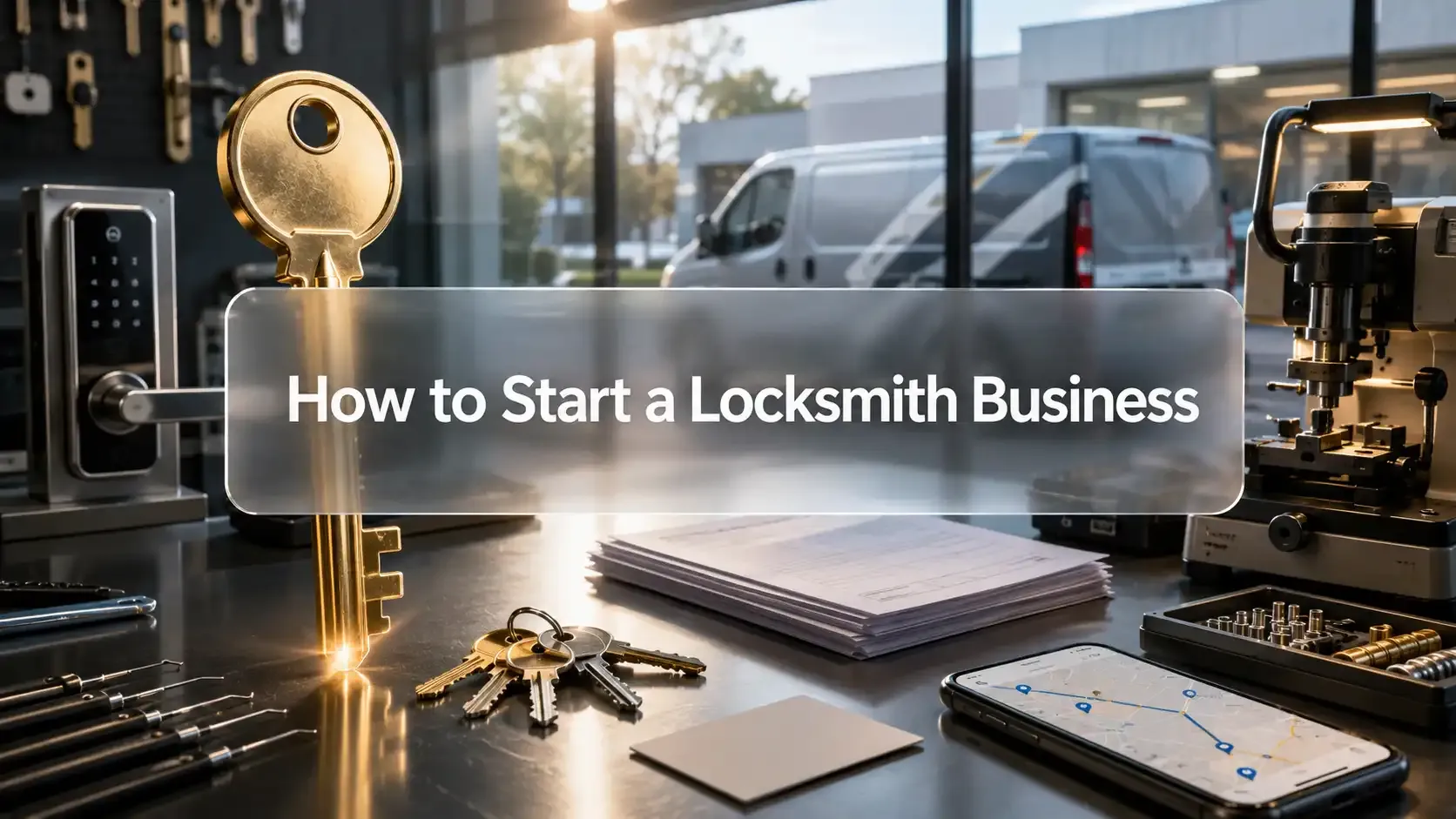
How to Start a Locksmith Business in 10 Steps (2026 Guide)
Updated on 10 Jul 2026
Jump to
Summary

Starting a locksmith business costs between $3,000 and $25,000, depending on your niche and whether you go mobile or storefront.
Thirteen states require a locksmith license, but ALOA certification builds customer trust everywhere, even where no law demands it.
Pick one specialty first: residential, automotive, commercial, or smart locks, and expand only after revenue supports it.
A Google Business Profile, a simple website, and local referral partnerships bring in your first paying customers faster than any other strategy.
Training runs $400 to $3,000, and most working locksmiths recommend apprenticing under someone before going solo.
The U.S. locksmith industry generates over $3 billion a year across nearly 30,000 businesses. People lose keys, get locked out, and move into new homes every single day. That demand is not slowing down.
To start a locksmith business, you need proper training, the right license for your state, a core set of tools, business registration, and a plan to get customers. It sounds like a lot, but each step is simpler and more affordable than most people expect.
This guide is for anyone serious about launching a locksmith business in 2026. In this blog, we will cover everything from choosing your niche and getting certified to setting your prices. So you can find your first customers and scale with the right tools and software.
Get Locksmith License and Legal Requirements by State
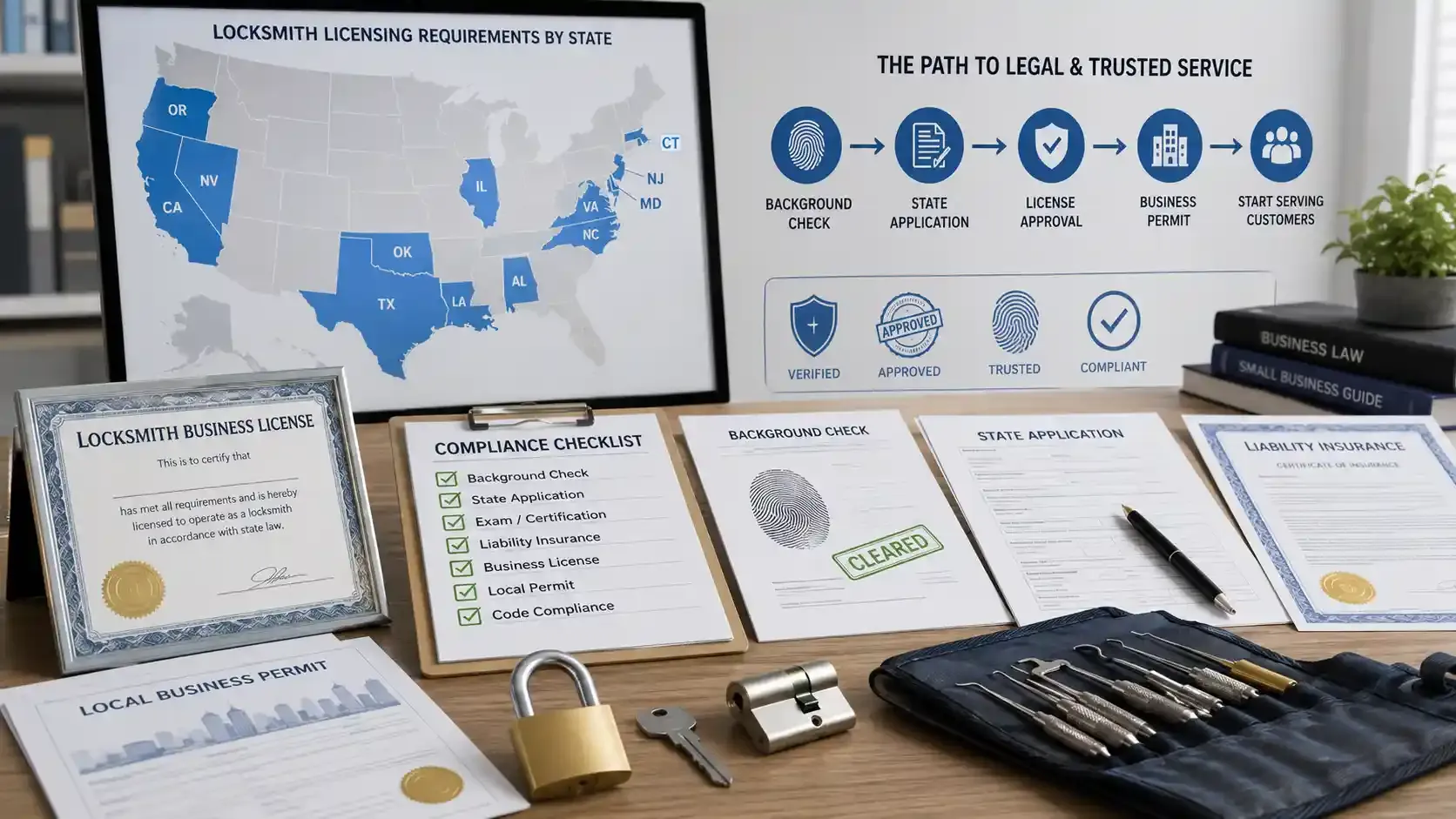
So, how to start a locksmith business? Before discussing anything else, let’s get into the license and legal requirements that vary from state to state.
Thirteen states currently require a locksmith license before you can legally take a single job. As of January 2025, those states are Alabama, California, Connecticut, Illinois, Louisiana, Maryland, Nevada, New Jersey, North Carolina, Oklahoma, Oregon, Texas, and Virginia (Source: ALOA, Advocacy).
If you operate in any of these without a license, you risk fines, legal trouble, and a reputation you cannot recover. Requirements vary, but most follow a similar pattern:
- California: Background check through DOJ and FBI, $500 initial company license fee, employee registration required separately (Source: California BSIS, Locksmith Fact Sheet)
- Illinois: State exam, fingerprinting, proof of liability, $500 application fee if using ALOA exam route
- Texas: ALOA certification or equivalent, Department of Public Safety background check
- Alabama: ALOA proficiency exam, $300 to $400 licensing fee, criminal background check through ALEA and FBI
On top of state rules, your local county or city might add its own layer. Some municipalities require a separate business permit even in states that do not regulate locksmiths at all. Always check both levels before you start advertising.
What If Your State Has No License Requirement?
You still need credentials. An experienced locksmith I spoke with put it this way: "My fingerprints are on file with the sheriff. Painters and roofers don't need to bother with that. We deal with security."
That stuck with me. Customers hand you access to their homes, their cars, their offices. ALOA certification and a clean background check tell them you take that responsibility seriously, even when no law forces you to.
Get the Right Locksmith Training and Certification
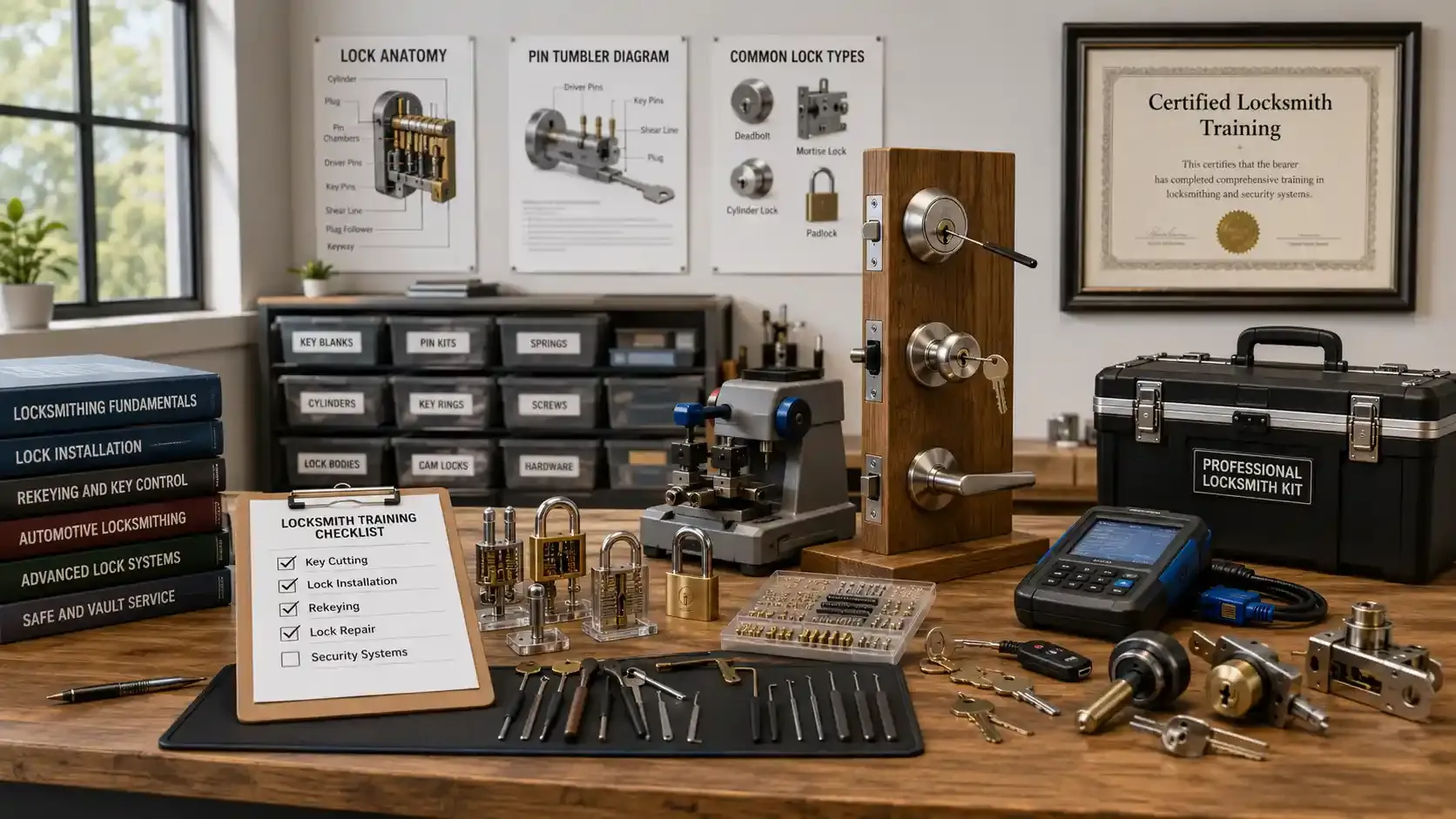
Lock picking and locksmithing are two completely different skill sets, and the sooner you understand that gap, the less money and credibility you burn through.
So before you take a single paying job, get proper training.
Your Training Options
Trade school programs like Penn Foster run about 8 to 9 months and cost under $1,000. They cover key cutting, lock installation, rekeying, and basic security systems.
If you want something faster, ALOA runs a six-day Fundamentals of Locksmithing course that earns you an ALOA Fundamental Locksmith (AFL) designation.
Online courses help with theory, but they cannot teach your hands how to feel a pin stack or decode a cylinder under time pressure. That kind of muscle memory only builds when you work on real doors for real customers.
Why Most Working Locksmiths Say "Apprentice First"
This is where training and real-world experience start to overlap. Every working locksmith I have spoken with gives the same advice.
Find someone established and work under them before going solo. Apprenticeships pay you while you learn.
On top of that, you get to watch how a real business runs day to day and figure out which niche fits you before spending your own money.
Certifications That Actually Matter
Once you have some hands-on experience, certifications give you proof that backs it up. ALOA offers the main credentials this industry recognizes.
Certified Registered Locksmith (CRL) is entry-level. Certified Professional Locksmith (CPL) follows after 12 additional elective exams. Certified Automotive Locksmith (CAL) covers car specialization.
Even in states without licensing requirements, these letters behind your name build trust with homeowners who are letting a stranger into their house.
Training costs sit between $400 and $3,000 depending on the path you choose. That spend pays for itself the moment a customer picks you over someone with zero credentials.
Ready to serve customers? Stay organized from day one.
Manage every job, customer, and invoice with one simple platform.
Choose Your Locksmith Niche (Pick One First)
.webp?2026-07-10T02%3A49%3A27.022Z=&w=3840&q=100)
When I first started, I started residential, automotive, and commercial, all at once. That mindset nearly broke me.
One niche. That is all you need to start. Get good at it, build your name around it, then expand when the revenue supports it.
Residential Locksmith
Most beginners land here because it takes the least money. You need $2,000 to $5,000 in basic tools and your own car. Lockouts, rekeying, and deadbolt installs make up most calls.
But every new locksmith also starts here, so expect a packed field. Fast Google reviews and tight local SEO decide who survives.
Automotive Locksmith
Costs more upfront, no way around it. You need $10,000 to $20,000 for a van, key cutting machine, and programmer. The average automotive lockout ticket reached $215 in 2026, up 8.1% year over year. All-keys-lost replacements bring $200 to $400 per call. Three of those a day and you are doing very well.
Commercial Locksmith
Takes longer to build because sales cycles drag and trust takes time. You will handle access control, master key setups, and high-security hardware. Jobs range from $200 to over $1,000. Once a property manager trusts your work, that relationship becomes recurring revenue.
Smart Lock and Electronic Security
Barely anyone in my area offers this. The global smart lock market crossed $2.77 billion in 2024, growing at 19.7% annually. Most locksmiths still will not touch smart locks. If you understand wireless protocols and app-based access, you step into a market with almost zero local competition.
Quick Niche Comparison
| Niche | Startup Cost | Avg Job Revenue | Competition | Best For |
|---|---|---|---|---|
Residential | $2K to $5K | $75 to $200 | High | Budget startups |
Automotive | $10K to $20K | $150 to $400 | Medium | Higher budgets |
Commercial | $5K to $15K | $200 to $1,000+ | Low to Medium | Established skills |
Smart Lock | $3K to $8K | $150 to $500 | Low | Tech-savvy locksmiths |
Choose your niche. We'll help you manage the jobs.
Schedule appointments, organize customers, and grow your locksmith business with ease.
Register Your Locksmith Business (LLC, EIN, and Structure)
.webp?2026-07-10T03%3A05%3A19.440Z=&w=3840&q=100)
An LLC is the best structure for most locksmith businesses. It separates your personal assets from your business, so a lawsuit over a damaged lock or a scratched car door does not touch your home or savings. Filing costs range from $40 to $500 depending on the state.
Here is how the registration process works:
- Pick your business structure: A sole proprietorship is the simplest but offers zero liability protection. Corporations add legal complexity that most solo locksmiths do not need. An LLC gives you liability protection, tax flexibility, and simple paperwork all in one.
- Apply for an EIN: The IRS provides Employer Identification Numbers online, free, and the process takes about five minutes. You need this number to file taxes, hire employees, and open a business bank account.
- Open a separate bank account: Run all business income and expenses through a dedicated account. Mixing personal and business funds weakens your LLC protection and creates a mess at tax time.
- File a DBA if needed: If your business operates under a name different from your registered LLC, file a "doing business as" form with your county clerk.
The entire process can wrap up in a single afternoon. No lawyer is needed unless your situation involves partners or unusual state requirements.
Register your business. Then simplify your operations.
Run scheduling, dispatching, and invoicing from one dashboard.
Essential Locksmith Tools and Equipment You Actually Need
You do not need a $12,000 tool kit on day one. I started with under $2,000 in gear and added tools only when a paying job required them. The total cost of a professional locksmith starter setup runs between $1,000 and $5,000 for residential work, and $10,000 to $12,000 if you add automotive programming.
Here is how to think about it in three tiers.
Starter Kit: Residential Focus (Under $2K)
- Lock pick set: $200 to $500
- Broken key extractor set
- Pinning kits and rekeying kits
- Basic hand tools: drill, screwdrivers, pliers, plug followers
- Key blanks inventory: $200 to $500
This covers lockouts, rekeying, and basic lock installs. Enough to take your first jobs and start building reviews.
Mid-Level Kit: Add Key Cutting ($2K to $5K)
- SEC-E9 or Miracle A9 key cutting machine: $1,500 to $3,000
- Key decoder for reading lock codes
- Electric pick gun: $300 to $800
A code-cutting machine lets you originate keys from scratch, not just duplicate. That opens up jobs where customers have zero working keys.
Advanced Kit: Automotive and Programming ($5K to $12K)
- Transponder programmer like Advanced Diagnostics Smart Pro or Hotwire by KeylessRide: $2,000 to $5,000
- Lishi picks for automotive decoding and picking
- Car opening tool set: $500 to $1,000
- Automotive key blanks and remote inventory
Programmers also require ongoing token purchases or monthly subscriptions, so factor those into your budget before committing.
Where to Buy
Stick with established locksmith distributors. Best Key Supply, American Key Supply, SouthOrd, and CLK Supplies all carry professional-grade equipment with proper support.
Avoid random Amazon listings for critical tools like pick sets and key machines. Cheap equipment fails at the worst possible moment, usually in front of a customer.
Great tools deserve great job management.
Schedule jobs, dispatch technicians, and track work without the paperwork.
Write a Simple Locksmith Business Plan
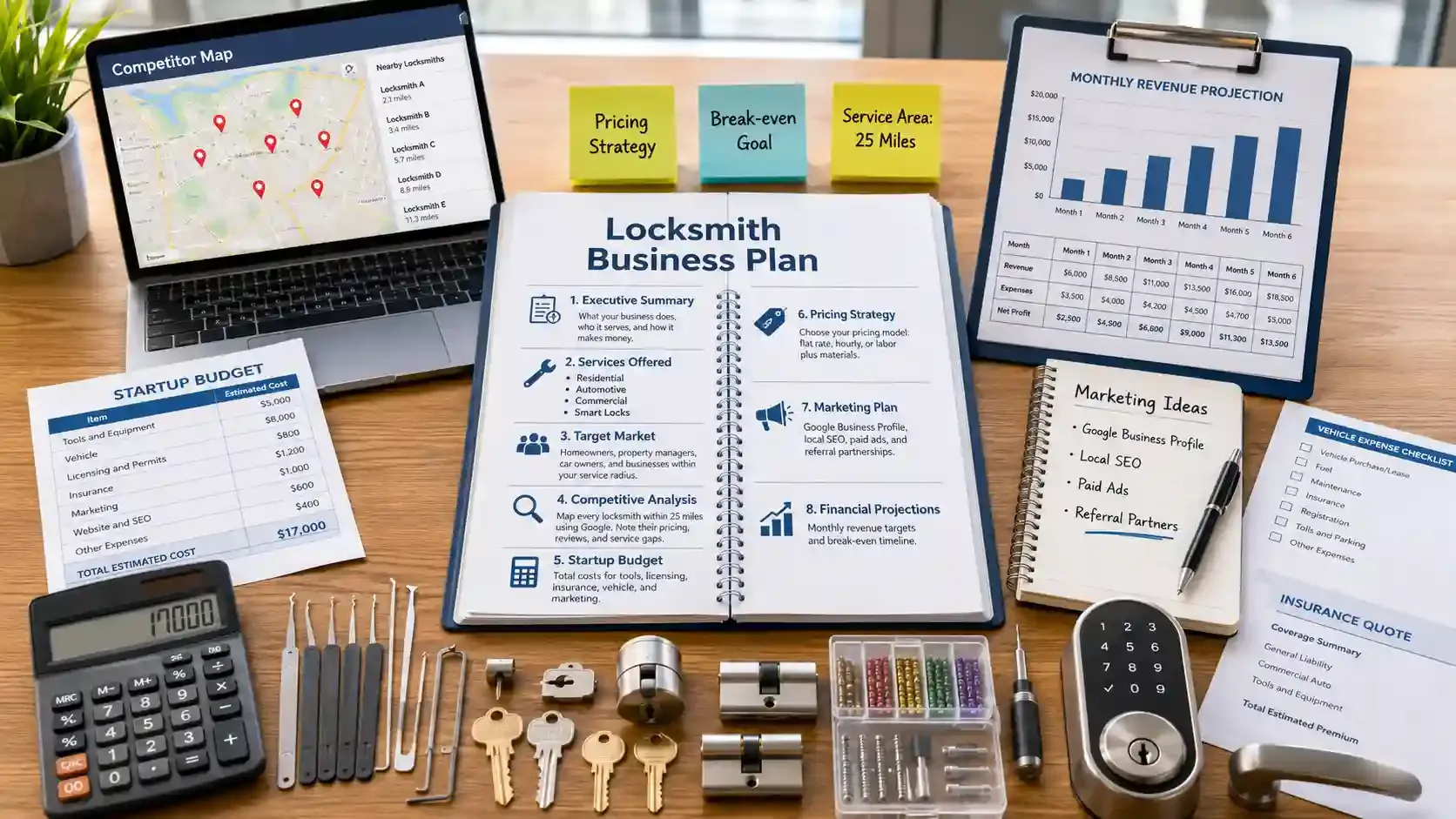
A locksmith business plan needs to be clear, realistic, and cover the basics that keep you focused and fundable. The SBA recommends including these core sections in any small business plan:
- Executive summary: What your business does, who it serves, and how it makes money
- Services offered: Residential, automotive, commercial, or smart lock specialization
- Target market: Homeowners, property managers, car owners, or businesses within your service radius
- Competitive analysis: Map every locksmith within 25 miles using Google. Note their pricing, reviews, and service gaps
- Startup budget: Total costs for tools, licensing, vehicle, and marketing
- Pricing strategy: Flat rate, hourly, or labor plus materials
- Marketing plan: Google Business Profile, local SEO, paid ads, and referral partnerships
- Financial projections: Monthly revenue targets and break-even timeline
This document also matters if you plan to apply for an SBA microloan or bank financing. Lenders want to see that you understand your market and have a clear path to profit.
Set Your Locksmith Pricing Strategy
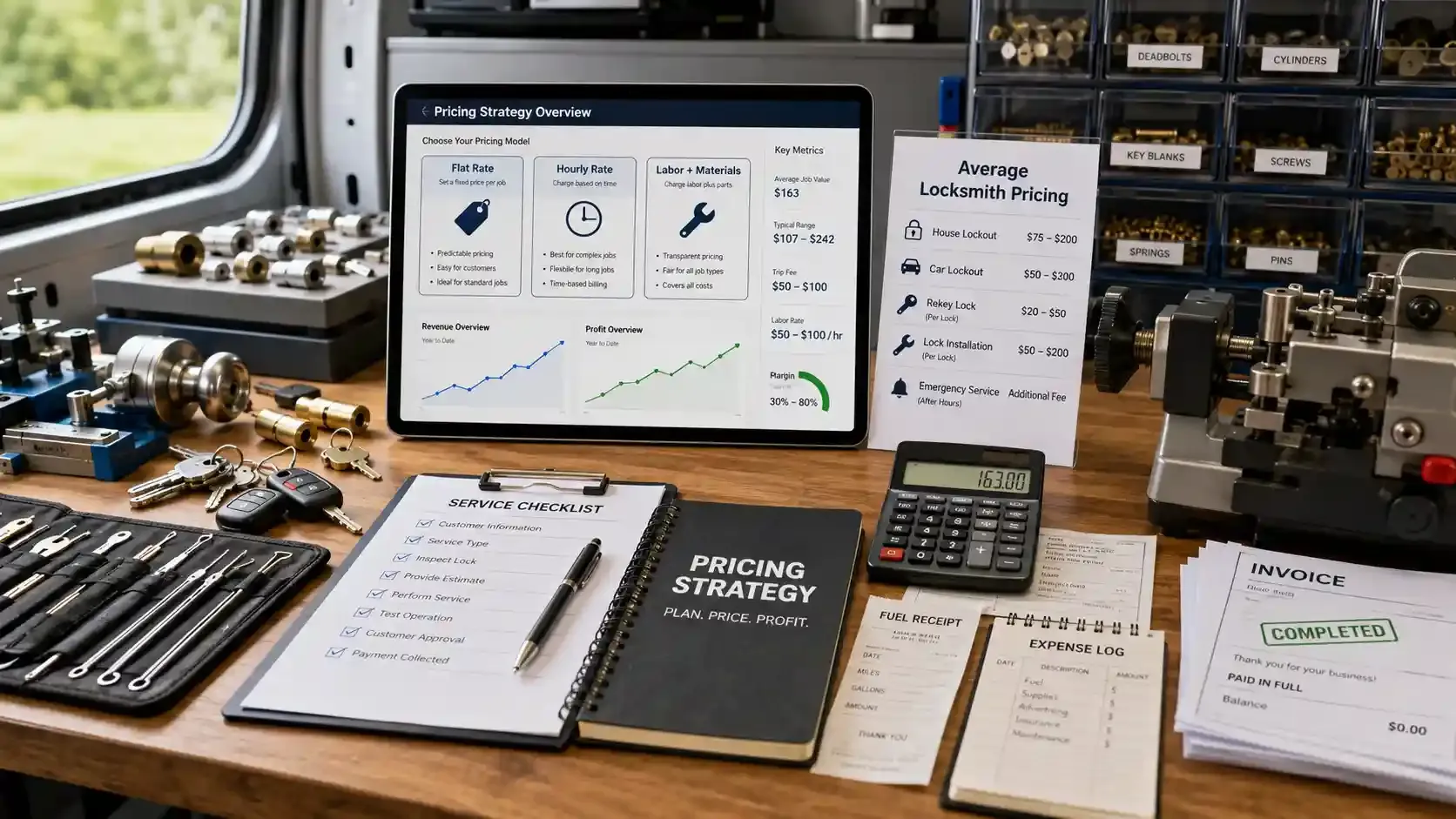
Locksmith business startup costs is average around $163, with a typical range between $107 and $242 depending on service type and complexity. Standard pricing includes a $50 to $100 trip fee plus $50 to $100 per hour for labor.
Three common pricing models work for this trade: flat rate per job, hourly rate, or labor plus materials. Flat rate works best for standard services like lockouts and rekeying. Hourly billing suits longer commercial or installation jobs.
Average Locksmith Pricing by Service
- House lockout: $75 to $200
- Car lockout: $50 to $300
- Key duplication: $5 to $25 (standard), $100 to $400 (transponder)
- Rekey per lock: $20 to $50 per cylinder, plus trip fee
- Lock installation: $50 to $200 per lock
- Automotive key replacement (all keys lost): $200 to $600
- Emergency/after-hours surcharge: $50 to $250 on top of standard rates
Source: Angi, Locksmith Cost Guide, 2026
Solo mobile locksmiths with low overhead can target around 80% profit margins on residential jobs. Once you hire staff, lease a van, and run paid ads, that margin drops closer to 30%.
How to Get Your First Locksmith Customers
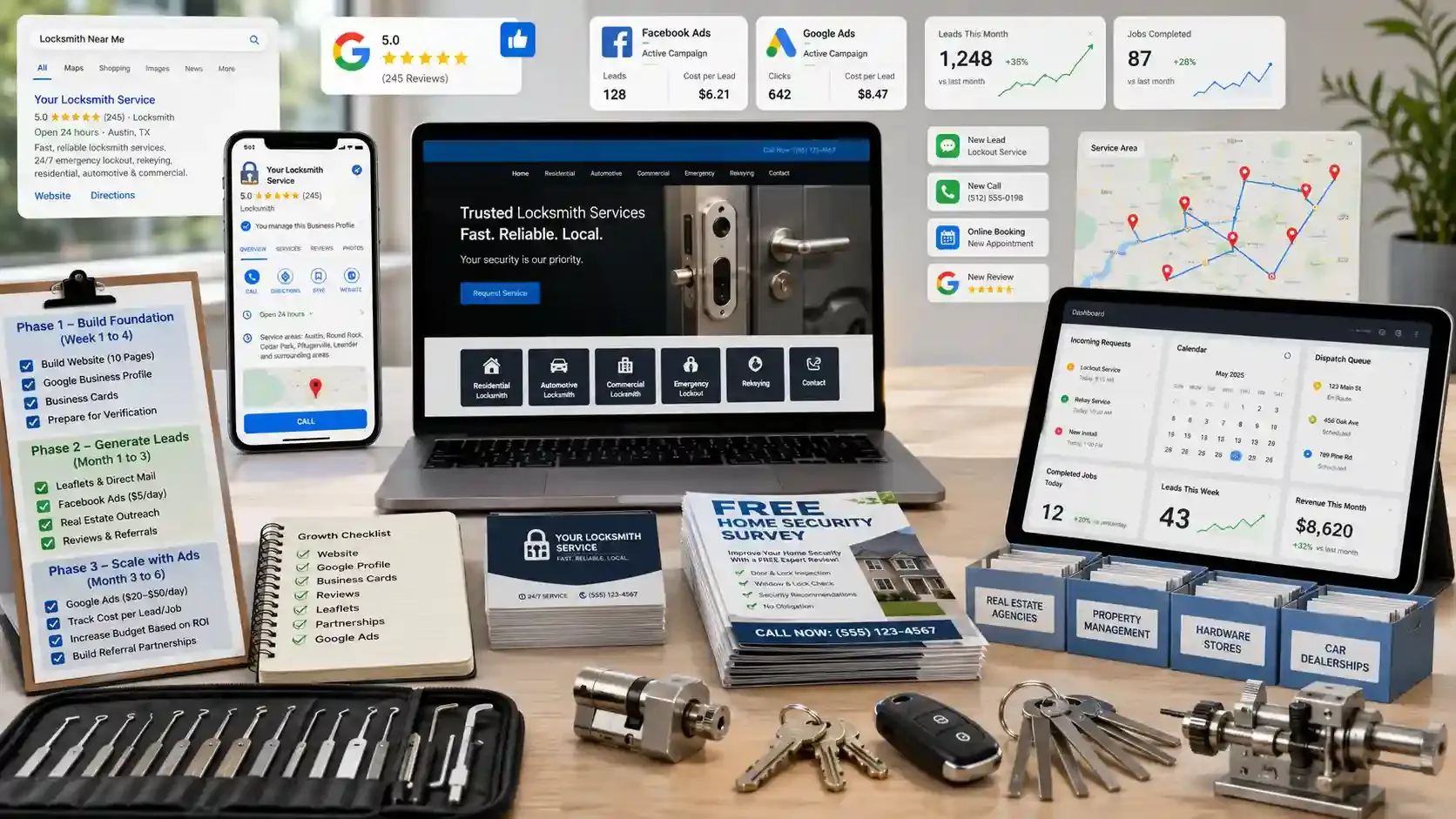
Set up a Google Business Profile before anything else. 88% of people who run a local search on their phone visit or call a business within 24 hours. If you do not show up in that search, someone else gets the call.
From there, build a simple website, print business cards, and start generating leads through a phased approach.
Phase 1: Build Your Foundation (Week 1 to 4)
- Build a website with at least 10 pages, each optimized for local keywords like "locksmith in [your city]" and "emergency lockout [your area]."
- Claim and verify your Google Business Profile. For mobile locksmiths, select "no" when asked if you serve customers at your location. Do not list your home address. Prepare for verification requests because Google is strict with locksmith listings
- Print professional business cards. Hand one to every person you interact with
Phase 2: Generate First Leads (Month 1 to 3)
- Print 5,000 to 10,000 leaflets offering a free home security survey. Deliver them yourself or hire a local distributor
- Run Facebook ads at $5 per day targeting homeowners in your service area. Use the same free security survey offer as a lead magnet
- Visit every real estate agency within 10 miles. Offer a 10% to 20% discount on tenant changeover rekeying. Property managers need locksmiths regularly and will send consistent referral work
- Take every job you can from friends, family, and neighbors. Then ask each one for a Google review. Verified profiles with active review growth appear 21% more often in local search results
Phase 3: Scale with Paid Ads (Month 3 to 6)
- Move to Google Ads at $20 to $50 per day, targeting high-intent keywords like "locksmith near me" and "locked out of house"
- Track your cost per lead and cost per job. A healthy benchmark sits around $10 in ad spend for every $80 or more in job revenue
- Increase the daily budget only after the numbers prove out. If $20 a day brings two paying jobs, push to $50 and measure again
Build Referral Partnerships
Real estate agents, property managers, car dealerships, and hardware stores all send locksmith work regularly. Approach them with a specific offer, not a generic business card drop. A 15% discount on first service or a free security check for their tenants gives them a reason to remember your name.
Software like FieldServicely helps manage incoming leads, schedule jobs, and dispatch techs as call volume grows. The free plan handles early-stage operations without adding overhead.
Winning more jobs starts with staying organized.
Manage bookings, dispatch technicians, and deliver a better customer experience.
How Much Does It Cost to Start a Locksmith Business?
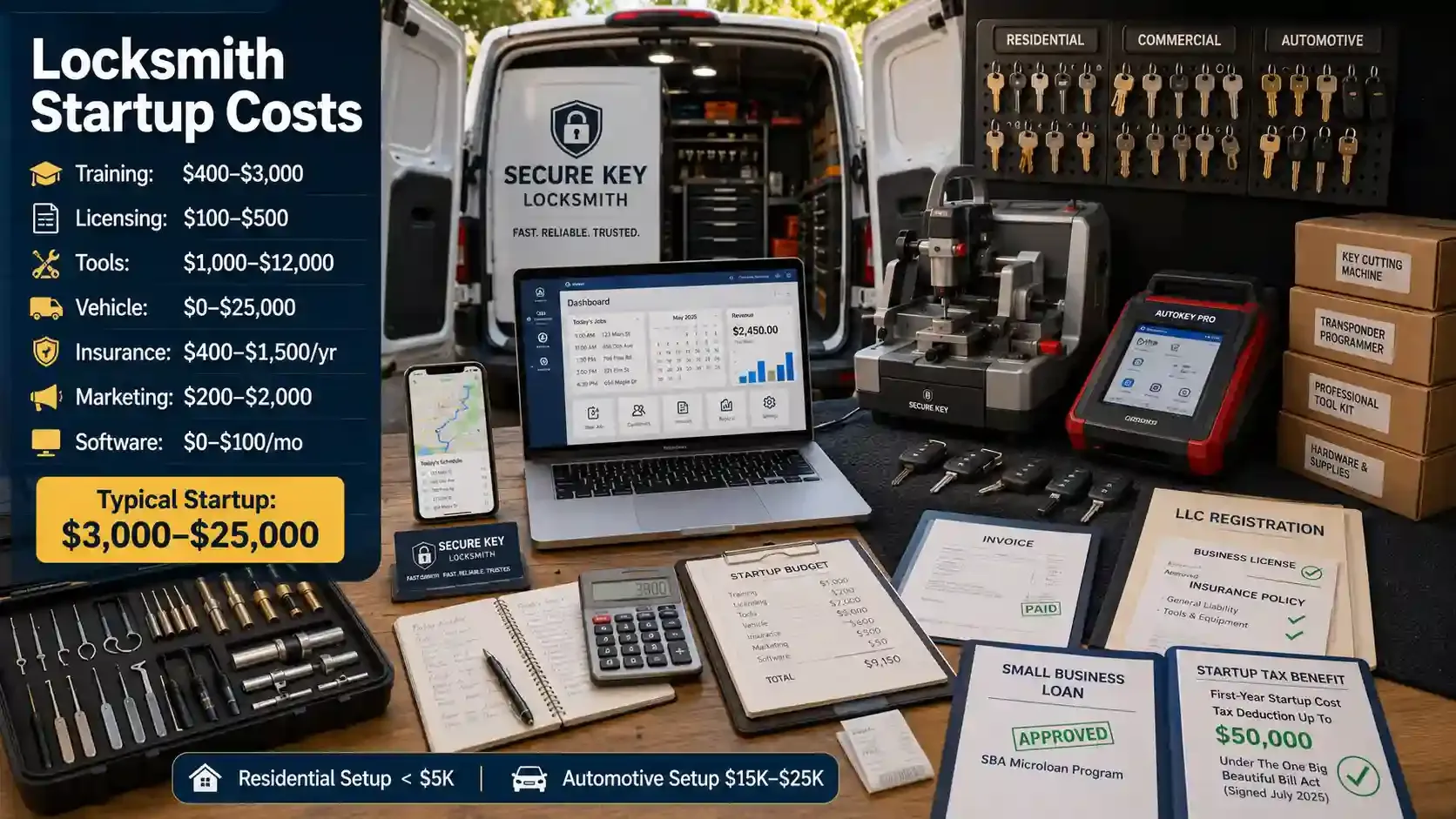
Realistically, between $3,000 and $25,000. The actual number depends on whether you go residential or automotive, and on whether you're mobile or storefront. I spent closer to $8,000 when I started because I focused only on residential work from my car.
Let me break it down:
Locksmith Startup Cost Breakdown
- Training and certification: $400 to $3,000. I took an online course through Penn Foster for under $1,000. Trade schools and ALOA programs cost more but carry stronger weight with customers.
- State licensing and registration: $100 to $500. Fifteen states require a locksmith business license, and most involve background checks. Filing an LLC adds $40 to $500 depending on your state (Source: U.S. Small Business Administration).
- Tools and equipment: $1,000 to $12,000. A basic residential kit runs $1,000 to $2,000. Add a key-cutting machine and a transponder programmer for automotive work, and those two pieces alone cost around $2,500.
- Vehicle: $0 to $25,000. I used my own car for six months. A used cargo van runs $5,000 to $15,000, and a branding wrap adds roughly $1,000.
- Marketing and website: $200 to $2,000. I built my first site for under $100 and relied on Google Business Profile for early leads.
- Business software: $0 to $100 per month. I started free, then moved to FieldServicely for scheduling, tracking, and invoicing once jobs picked up.
Budget vs. Full Setup
If your budget is under $5,000, stick to residential. Use your car. Focus on lockouts, rekeying, and lock installs. That is enough to start earning and collecting reviews.
Between $15,000 and $25,000? Go automotive. All-keys-lost jobs pay $200 to $400 per call, so the return on a bigger investment hits much faster.
How to Fund Your Locksmith Startup
The SBA Microloan program offers up to $50,000 for small business startups, with the average loan sitting around $16,000. You can use it for equipment, tools, and working capital.
Also worth knowing: the One Big Beautiful Bill Act, signed in July 2025, raised the first-year startup cost tax deduction from $5,000 to $50,000. So a solid chunk of your year-one spending can come straight off your tax bill.
Is Starting a Locksmith Business Worth It in 2026?
Yes. The U.S. locksmith industry reached $3.0 billion in 2026, with close to 29,620 businesses and over 41,000 workers across the country. That number alone told me this trade has serious demand.
But here is what sealed it for me.
The global smart door lock market hit $3.50 billion in 2025 and is growing at a 19.7% yearly rate. Locksmiths who learn smart lock installation right now will serve a market most competitors have not even noticed yet.
The earning potential makes it even harder to ignore. A median locksmith salary of $53,661 per year for employed technicians. Owners who run their own mobile operation often pull $75,000 to $150,000 depending on their niche and city.
And the barriers to entry? Lower than almost any trade. You can launch from a van, a phone, and a basic tool kit.
Common Mistakes That Sink New Locksmith Businesses
Most new locksmiths fail not because of skill, but because of bad business decisions in the first six months. These are the ones that come up again and again in locksmith communities and trade conversations:
- Buying a full tool kit before landing a single customer.
- Confusing lock picking with locksmithing. Picking is a hobby skill. The business demands key cutting, rekeying, hardware installs, and programming.
- Undercharging to win early jobs. Low prices attract price shoppers and burn you out fast. Charge what the work is worth from day one.
- Trying residential, automotive, and commercial all at once.
- Ignoring Google Business Profile and reviews. If customers cannot find you in a local search, your business does not exist to them. Ask for a review after every single job.
- Spending the entire budget on equipment and nothing on marketing.
Conclusion
Starting a locksmith business is not complicated. It just takes the right sequence. Get trained, get licensed, buy only the tools you need, register your business, and start marketing before you feel "ready." Most locksmiths who fail never get past the planning stage.
The ones who make it treat this like a real business from week one. They collect reviews, track their numbers, and reinvest in what works. The demand already exists. Your job is to show up where customers are looking and deliver work worth talking about.
Frequently Asked Questions
Can You Start a Locksmith Business as a Side Hustle?
Yes. Many locksmiths start while keeping their day job. Schedule Google Ads to run only during evenings and weekends. Take jobs around your availability and build up reviews and cash flow before making the full switch.
How Long Does It Take to Become a Locksmith?
Most trade school programs run 3 to 9 months. Online courses like Penn Foster take about 8 months. An apprenticeship under an experienced locksmith can take 1 to 2 years, but it gives you hands-on skills no course can match.
Do You Need a Van to Start a Locksmith Business?
Not right away. Residential locksmiths can start from a personal car with a basic tool kit. A van becomes necessary once you move into automotive work because you need space for key cutting machines, a workbench, and organized inventory.
What Is the Hardest Part of Running a Locksmith Business?
Getting consistent customers in the first few months. Most new locksmiths have the skills but struggle with marketing and lead generation. A strong Google Business Profile, steady review collection, and local partnerships solve this faster than paid ads alone.
Is the Locksmith Industry Dying Because of Smart Locks?
No. Smart locks are creating new work, not killing it. Homeowners and businesses still need professional installation, troubleshooting, and integration with existing security systems. Locksmiths who learn smart lock technology tap into a market growing at nearly 20% per year.
What to read next