- Field Service Business
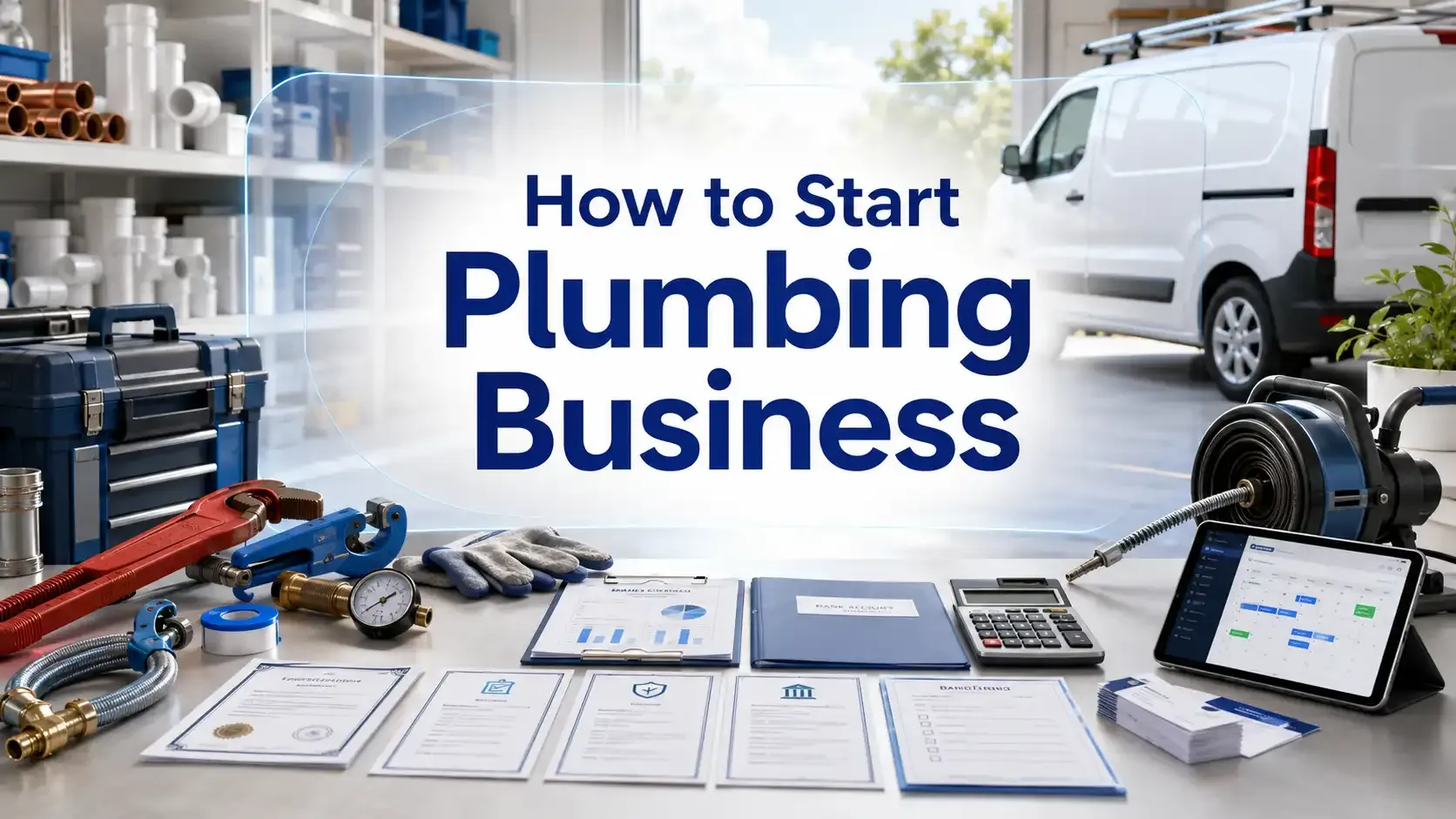
How to Start Plumbing Business: A Step-by-Step Guide (2026)
Updated on 30 Jun 2026
Jump to
Summary

A plumbing license, registered business entity, insurance, tools, and a vehicle are the bare minimum to launch.
Startup costs range from $10,000 to $50,000, but most solo plumbers launch between $15,000 and $25,000.
Register as an LLC, get an EIN, and open a separate business bank account before your first job.
Land your first customers through a Google Business Profile, a simple website, and word-of-mouth referrals.
Scale by hiring when you start turning down work, adding new services, and letting systems run your operations.
To start a plumbing business, you need a plumbing license, a registered business entity, insurance, basic tools, a reliable vehicle, and a real plan to land paying customers. Sounds simple enough, right? But most new owners skip at least two of those, and that is where things fall apart.
The opportunity is real, though. The U.S. plumbing industry sits at $191.4 billion in 2026, and the BLS projects 4% job growth through 2034. People always need working water and drainage, no matter what the economy looks like.
Still, roughly 1 in 5 new businesses shut down within the first year because the owner never figured out the business side.
So I put this guide together to fix that. Ten steps covering licensing, costs, pricing, marketing, and growth. It works for licensed plumbers going solo and for people who want to own a plumbing company without picking up a wrench themselves.
Step 1: Get Your Plumbing License and Certifications
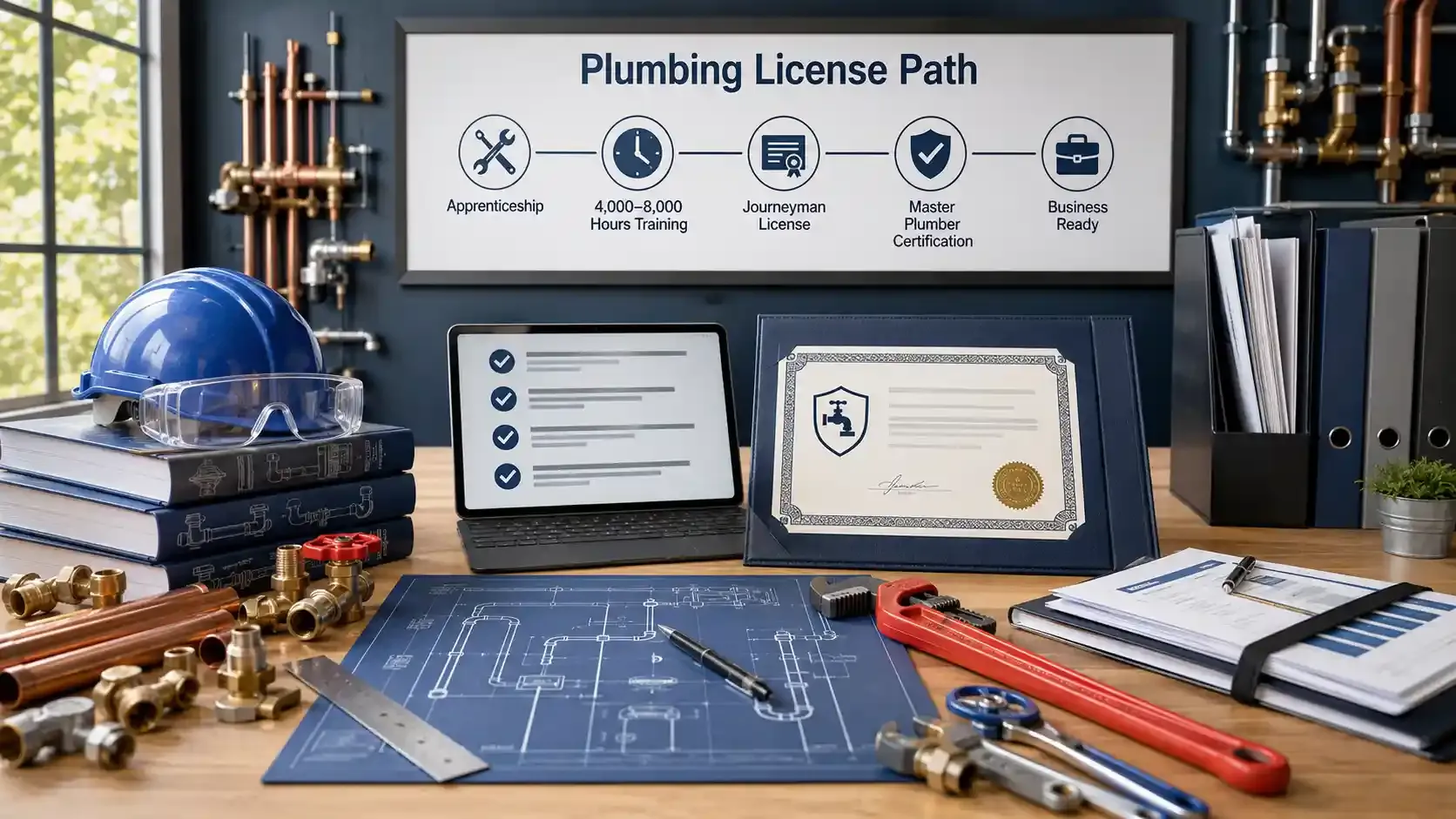
You need a journeyman or master plumber license to legally run a plumbing business. 44 out of 50 states enforce this at the state level, and the remaining six still require local permits from city or county boards.
The licensing path follows a clear ladder:
- Start with a high school diploma or GED and enroll in a trade school or apprenticeship program.
- Complete 4,000 to 8,000 hours of supervised plumbing work, which typically takes 2 to 5 years, depending on your state.
- Pass the journeyman plumber exam with a minimum score of 70% to 75%.
- Log 1 to 3 more years as a working journeyman, then sit for the master plumber exam.
A journeyman license allows you to work independently. But it does not allow you to own a plumbing company. Only a master plumber can sign off on permits, hire other plumbers, and legally operate a business in most states.
And the license is not a one-time deal either. Most states require renewal every 1 to 3 years, along with 4 to 16 hours of continuing education on updated codes and safety standards. You can find your state's exact renewal rules through NASCLA.
While you work through this process, be intentional about where you train.
If you want to run a small residential shop, apprentice under someone who already does that. If commercial plumbing is the goal, get your hours at a company that handles those contracts.
The Bureau of Labor Statistics projects roughly 44,000 plumber openings every year through 2034. Pick one that teaches you the business, not just the trade.
Build your plumbing business foundation
Stay organized as you grow your service operations
Step 2: Write a Plumbing Business Plan
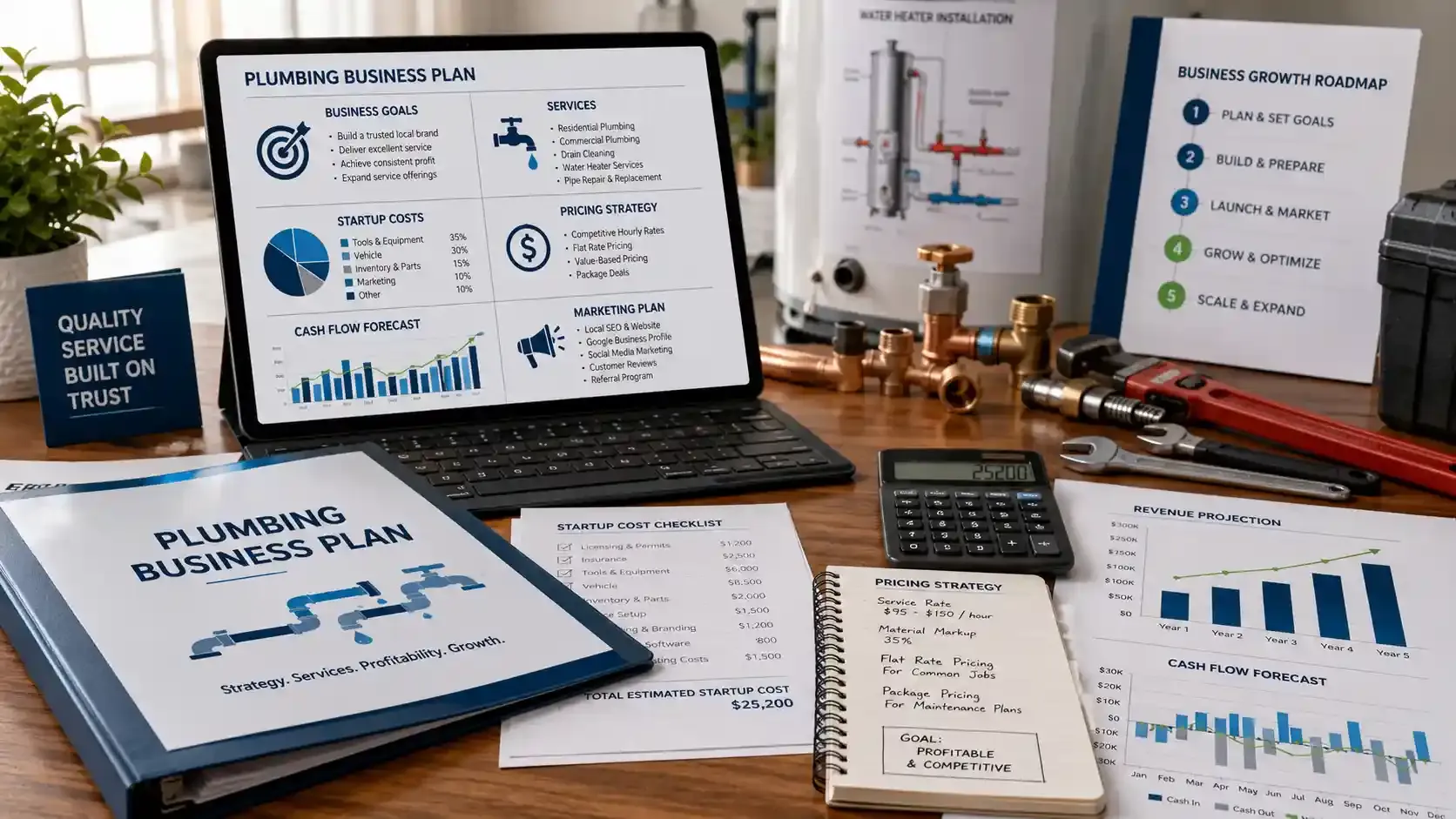
A plumbing business plan maps out your services, target market, startup costs, and how you plan to turn a profit. Without one, you are guessing your way through decisions that cost real money.
Why does this matter so much?
Because cash flow kills more businesses than bad skills ever will. 51% of small employer firms struggle with uneven cash flows, and 75% named rising costs as their top financial challenge. A solid plan forces you to face those numbers before they surprise you on the job.
For a solo plumbing operation, a focused one-page document works just fine.
Here is what to include:
- Executive summary with your mission, services, and first-year revenue goals.
- Market analysis of your local competitors, target customers, and pricing in your service area.
- Service offerings and your focus: residential plumbing, commercial plumbing, or specialty work like water heater installs and drain cleaning.
- Startup costs and funding sources so you know how much cash you need before day one.
- Pricing strategy that covers materials, labor, overhead, and your target profit margin.
- Financial projections for the first 12 to 24 months with monthly cash flow forecasts and break-even targets.
- Marketing plan for landing your first customers through local SEO, referrals, and community outreach.
Any SBA lender will ask for this document before anything else. The U.S. Small Business Administration provides free business plan templates and step-by-step guidance to help you build one from scratch.
Turn your plan into a profitable operation
Manage every job, customer, and workflow in one place
Step 3: Calculate Your Plumbing Business Startup Costs
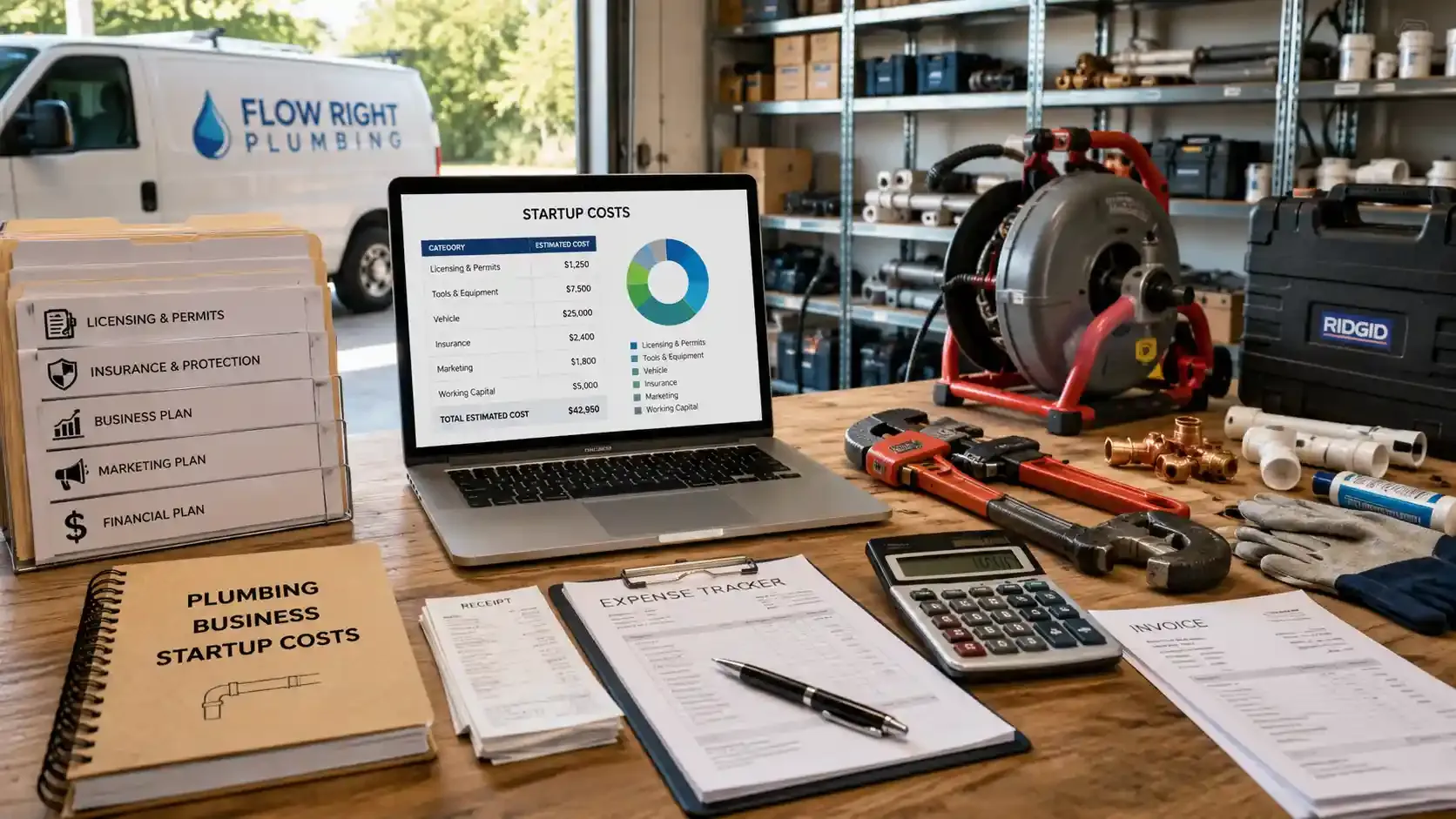
A solo plumbing business costs $10,000 to $50,000 to start. Your total depends on location, services, and whether you buy new or used. Most plumbers I have worked with spent $15,000 to $25,000 when they launched smart.
So where does the money go?
- Licensing and permits: $500 to $5,000 based on your state and local fees.
- Plumbing tools and equipment: $2,000 to $5,000 for basics like pipe wrenches, cutters, drain augers, and a soldering kit.
- Service vehicle: $5,000 to $40,000 based on used or new.
- Business insurance: $1,000 to $5,000 per year.
- Marketing and website: $500 to $3,000 for a simple site, Google Business Profile, and early ads.
- Working capital: $2,000 to $5,000 for fuel, materials, and daily costs until revenue picks up.
You do not need $50,000 on day one. Buy used plumbing tools, run things from home, and rent specialty gear only when a job calls for it. Plenty of profitable plumbing companies started this way.
Here is one thing that makes spending easier. Your van, tools, and equipment all count as tax-deductible business expenses.
The IRS Section 179 deduction lets small businesses write off up to $2.56 million in qualifying gear for 2026. Your year-one purchases cut your taxable income right away.
Know your numbers before your first job
Track costs, jobs, and business performance easily
Step 4: Secure Funding for Your Plumbing Business
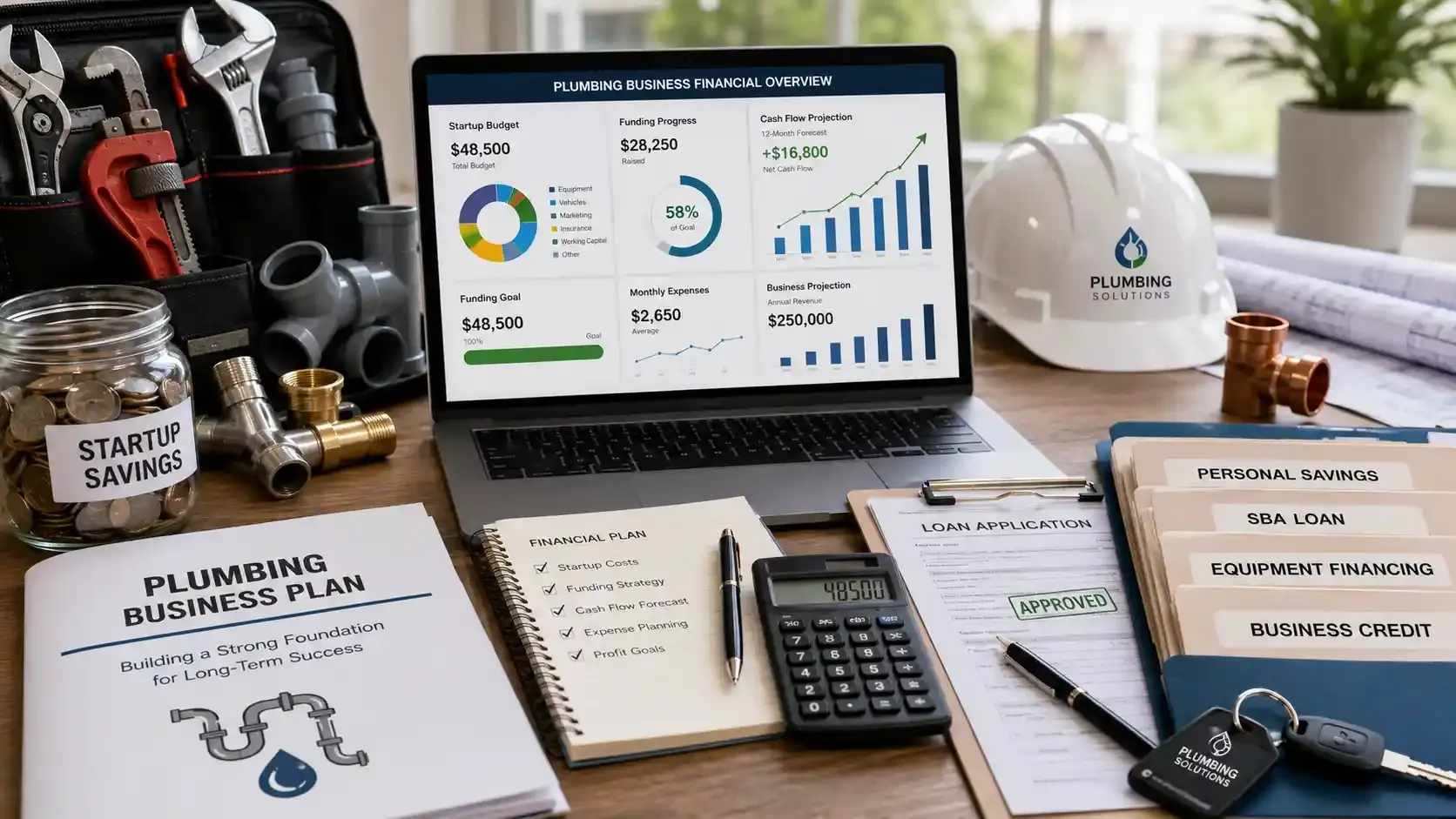
You can fund your plumbing business with personal savings, SBA loans, credit lines, or grants.
Here are the most common options:
- Personal savings from money you set aside during your apprenticeship. This keeps you debt-free but limits how fast you can move.
- SBA 7(a) loans are the most popular small business loans in the U.S. The SBA backed roughly $37 billion in 7(a) loans in fiscal year 2025. Rates sit between 9% and 11% for most borrowers.
- SBA Microloans up to $50,000 for startups that need a smaller push to get going.
- Equipment financing to cover your van, power tools, and specialty gear without draining cash reserves.
- Business credit cards for short-term buys like fuel, supplies, and ad spend.
- Friends and family loans, but always put the terms in writing to protect both sides.
Start saving the day you begin your apprenticeship. Even $200 a month over four years adds up to nearly $10,000. That covers your licensing fees, basic tools, and your first month of insurance.
If you go the loan route, lenders want a business plan, a credit score of 680 or higher, and 10% to 20% of the total cost from your own pocket.
Grow your business with better systems
Keep your operations ready for your next stage
Step 5: Register Your Plumbing Business and Get an EIN
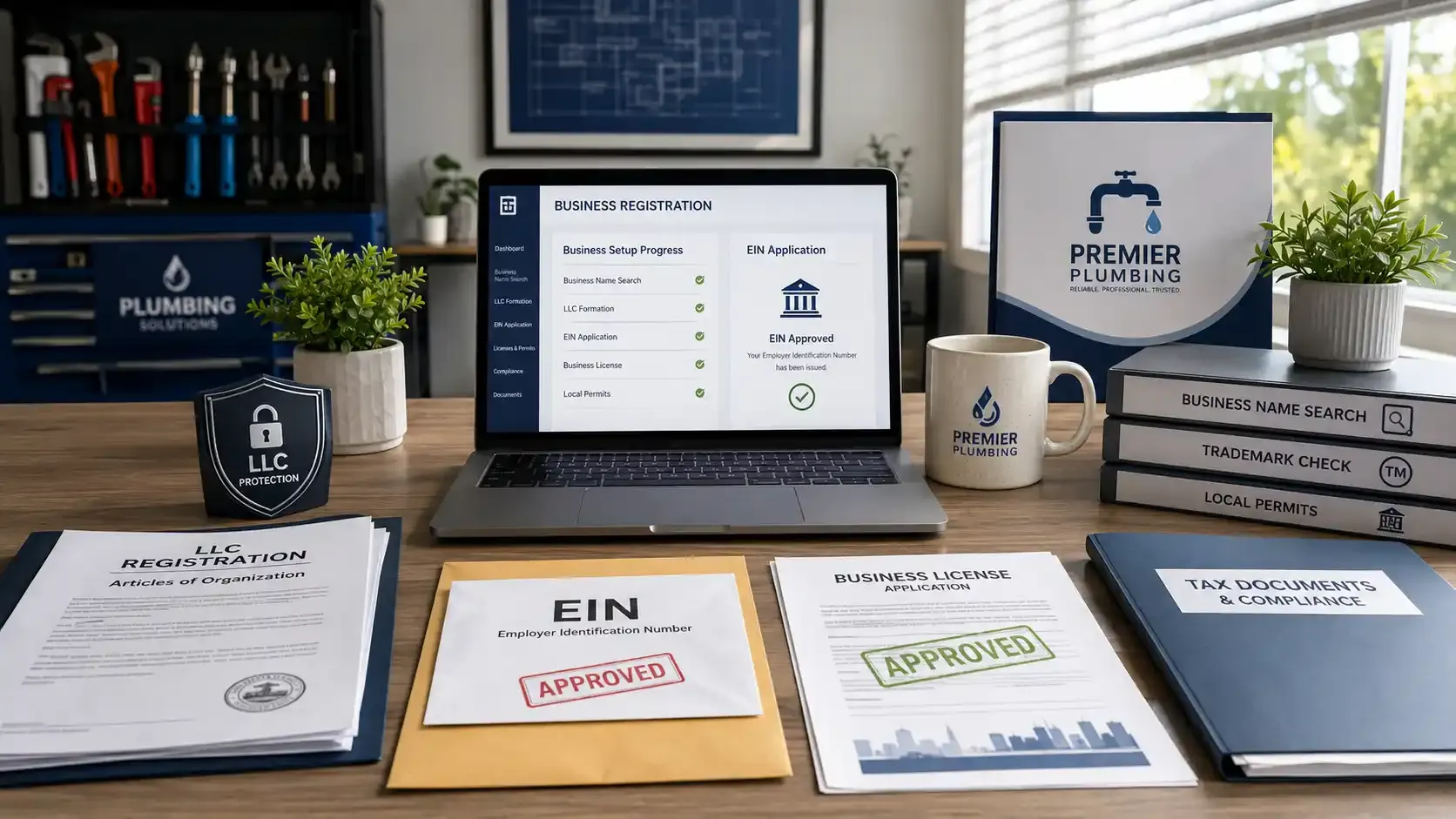
Register your plumbing business as an LLC, get an EIN from the IRS, and file for your local business license.
You have three options for your business structure:
- Sole proprietorship has zero paperwork and zero cost to start. But your home, truck, and savings are all at risk if someone sues you.
- LLC puts a wall between your personal assets and business debts. Most plumbers pick this route. The U.S. Small Business Administration says LLCs work best when owners want to protect personal property.
- S-Corp election makes sense once your net profit stays above $50,000. It cuts your self-employment tax, but adds more paperwork.
For most new plumbing companies, a single-member LLC is the sweet spot. Once you pick a structure, handle these three things:
- Get your EIN for free through the IRS website. You need it to open a business bank account, file taxes, and hire staff.
- Search your business name on the USPTO Trademark Search before you file any paperwork.
- Check local permit rules with your city and county. Some require extra permits beyond your state-level plumbing contractor license.
Set up your business the right way
Build a professional system for managing customers and jobs
Step 6: Get Plumbing Business Insurance
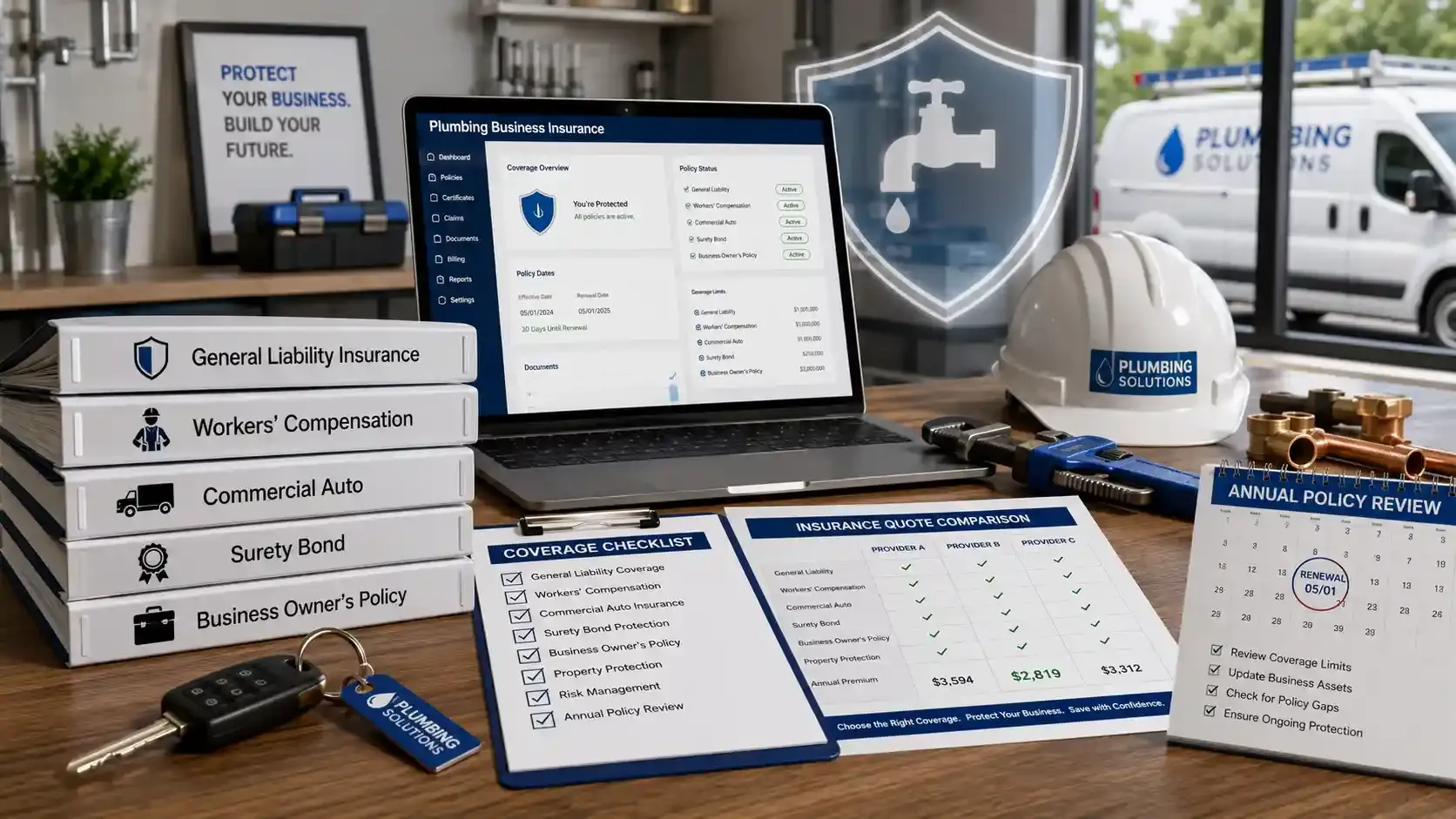
Every plumbing business needs general liability insurance before taking on a single job. Most states also require workers' compensation once you hire your first employee. Skip this step, and one bad call could wipe out everything you built.
Here is what your insurance package should cover:
- General liability for property damage and third-party injuries. The average plumber pays around $115 per month for $1 million in coverage.
- Workers' compensation for employee injuries on the job averages $195 per month.
- Commercial auto to protect your service vehicle between job sites.
- Surety bonds to guarantee you finish contracted work, averaging $100 per year.
The average property damage claim from bad plumbing tops $12,000, and mold cleanup pushes that number even higher. That is why you should get quotes from at least three providers before signing anything.
While comparing, ask about bundling general liability and commercial property into a Business Owner's Policy to save 10% to 15%. Then review your coverage every year as your crew and plumbing contracts grow.
Protect your business before problems happen
Keep your job details and customer records organized
Step 7: Buy Tools, Equipment, and a Service Vehicle
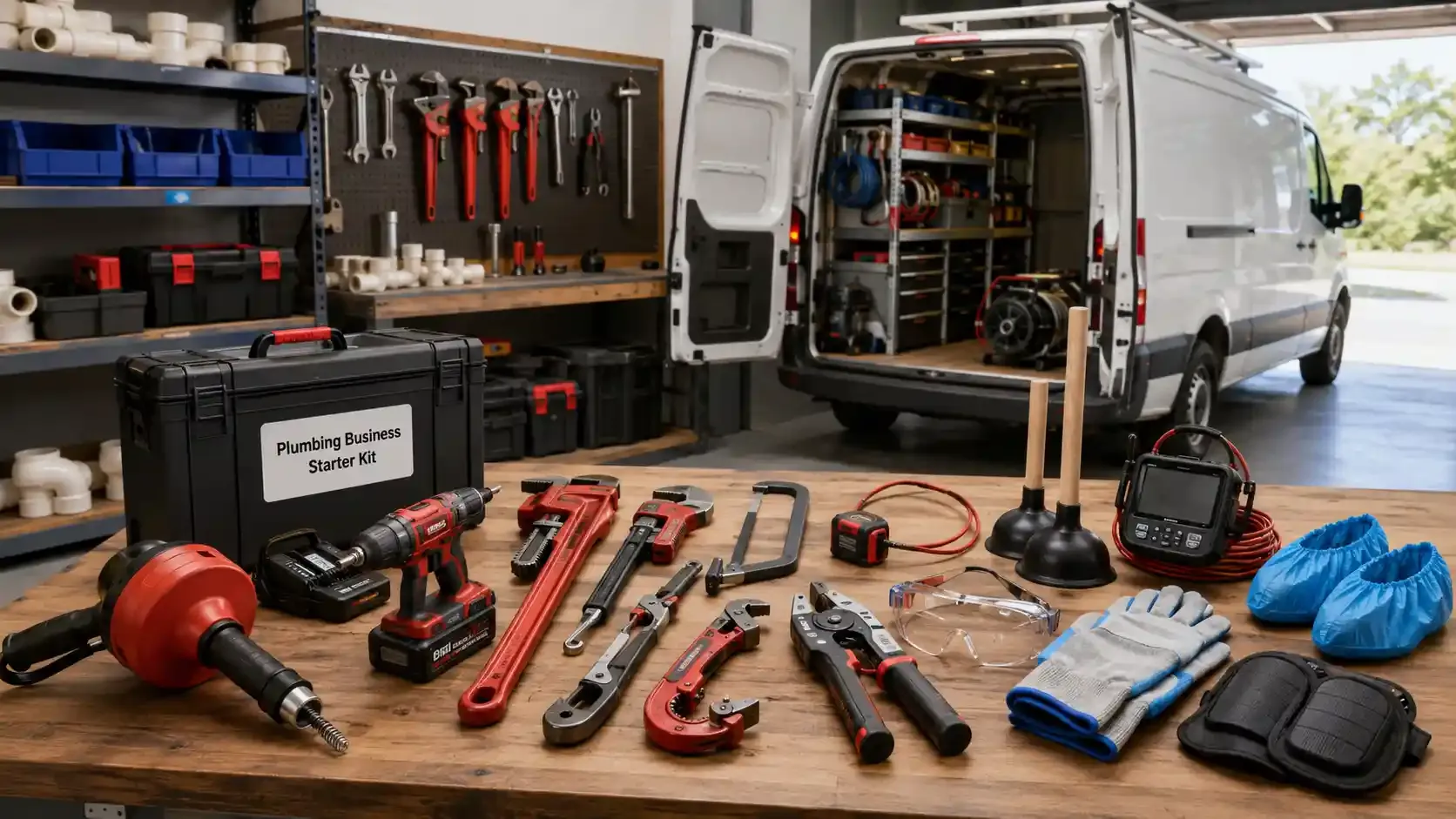
Start with essential hand tools, a cordless tool kit, safety gear, and a reliable service van or truck. You do not need every tool on day one. You just need the right ones for the jobs you plan to take first.
Your basic plumbing toolkit should include:
- Hand tools: pipe wrenches, basin wrenches, pipe cutters, plungers, tape measures, and a hacksaw.
- Power tools: cordless drill set, press tools, drain auger, and an inspection camera.
- Safety equipment: gloves, goggles, knee pads, and boot covers. As of January 2025, OSHA's updated PPE standard requires all construction safety gear to properly fit each worker on site.
Budget $2,000 to $5,000 for this starter kit. Spend more on wrenches and power tools you grab daily, since cheap ones break mid-job. Rent specialty gear like hydro-jetting machines or sewer cameras until your workload makes buying worth it.
The other big cost is your service vehicle. A used Chevy Express or Ford Transit runs $5,000 to $15,000 and does the job fine while you build up. New vans push past $30,000, so most smart owners start used and upgrade later.
Here is a rule that saves real money early on. Only buy tools for your chosen plumbing niche first. If you focus on leak repairs, skip the full sewer camera setup for now and let your revenue fund the next round of gear.
The right tools help you work smarter
FieldServicely helps you manage every service call
Step 8: Set Your Pricing Strategy
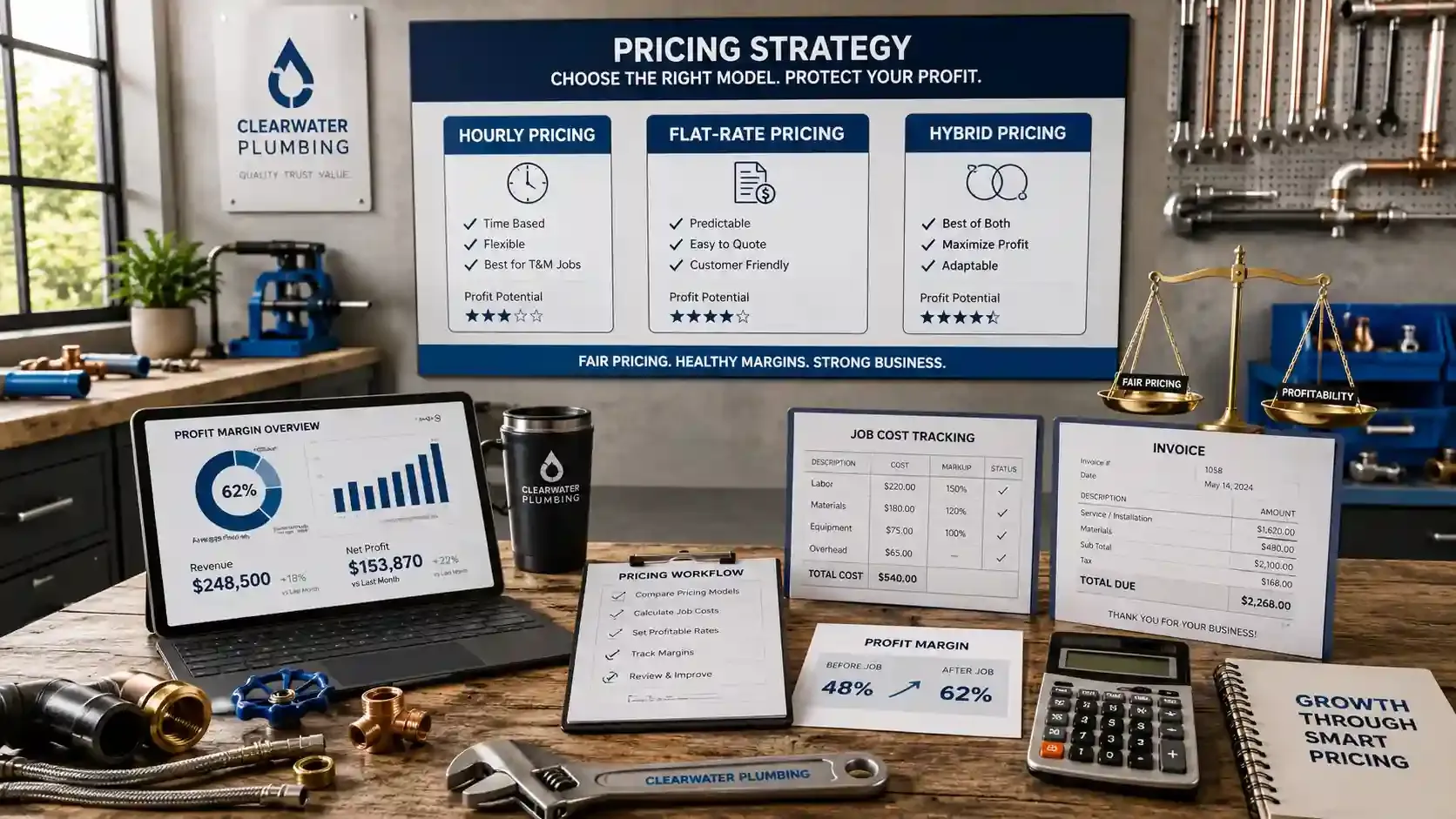
Choose between flat-rate pricing, hourly rates, or a hybrid model based on the jobs you take. This single decision shapes your revenue, your margins, and how customers perceive your plumbing business.
Here is how each model works:
- Hourly pricing charges for time spent on the job. Most residential plumbers bill between $75 and $150 per hour in 2026. Works for diagnostics and complex repairs, but the faster you get, the less you earn.
- Flat-rate pricing locks in a fixed price before you start. A water heater install billed hourly at $75 for three hours earns you $225. That same job priced at a $1,200 flat rate pays five times more for identical work. Speed and expertise become your advantage.
- Hybrid pricing gives you the best of both. Use flat rates for routine work like drain cleaning and faucet replacements. Switch to hourly for older systems where the scope can shift once you open a wall.
Before setting your numbers, research what competitors in your service area charge. Then value price, not volume. Racing to be the cheapest plumber in town is a fast path to burnout. Target a profit margin between 20% and 35% on every job.
Knowing your target margin is one thing. Seeing it per job is another. FieldServicely tracks what each job costs you versus what you billed, so you spot underpriced work before it bleeds your profits.
Price jobs confidently and protect your profits
Track job performance and avoid losing money
Step 9: Market Your Plumbing Business and Get Your First Customers
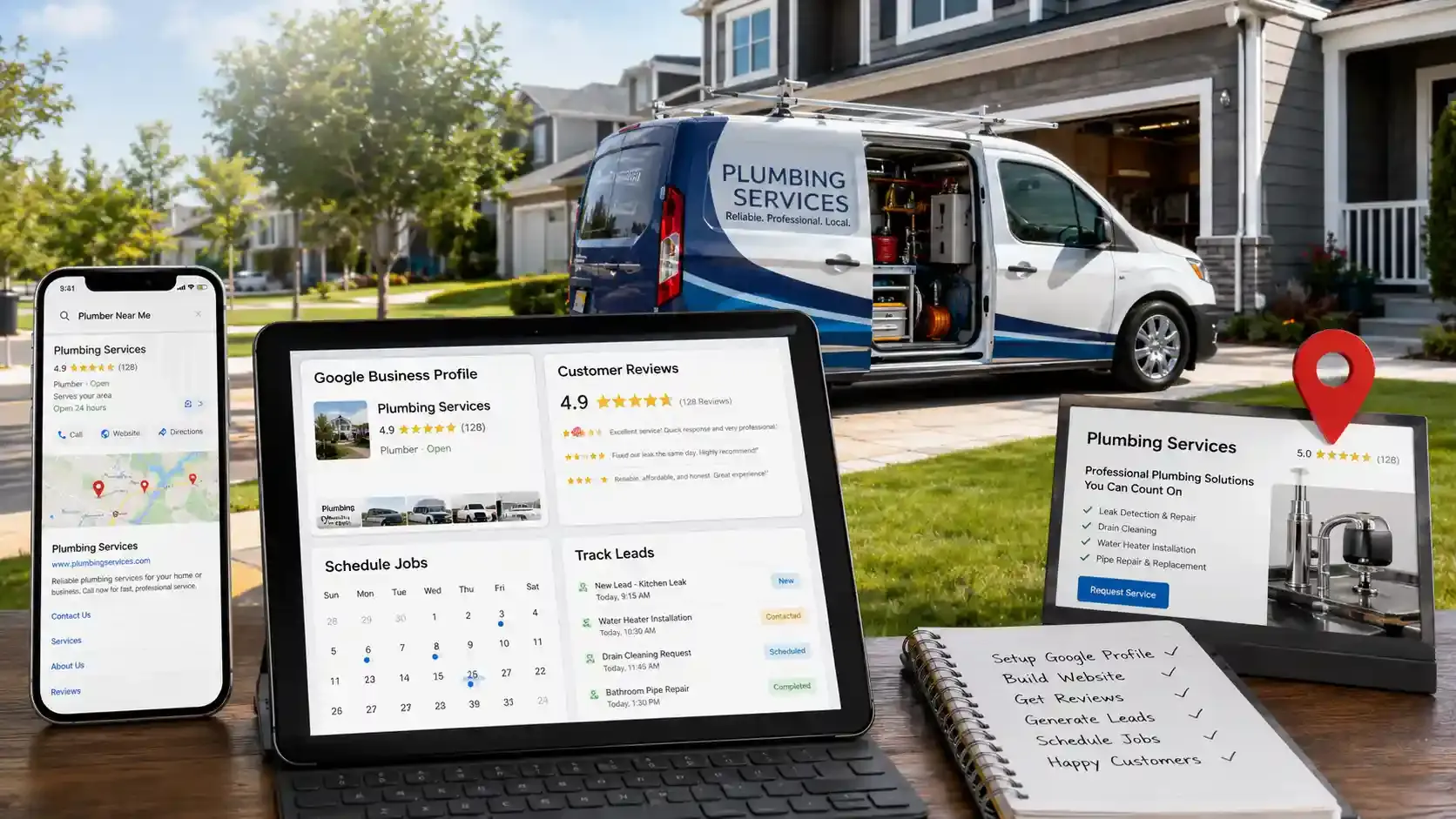
Set up a Google Business Profile, build a simple website, and lean on word-of-mouth referrals to land your first 10 customers. You do not need a big marketing budget. You just need to show up where homeowners are already looking.
Start with the free channels:
- Google Business Profile controls whether your name shows up when someone searches "plumber near me." Fill it out completely with real job photos, your service area, and hours.
- A basic website listing your services, contact info, and customer reviews. Real photos from actual jobs, not stock images.
- Google reviews after every job. 68% of consumers will only hire a business rated four stars or above. Every review you collect builds trust before you even answer the phone.
Then layer in paid and offline tactics:
- Google Local Services Ads with a $300 to $500 monthly budget typically generate 8 to 15 qualified leads for solo operators.
- Vehicle wraps that turn your van into a rolling billboard across every neighborhood you serve.
- Partnerships with realtors and property managers who need a reliable plumber on call.
The best plumbing marketing costs nothing. Do great work, show up on time, and ask for the referral. Happy customers send you their neighbors without a single dollar spent on ads.
Once leads start coming in, you need a system to catch them. FieldServicely's scheduling tools let you book, assign, and track every job without anything slipping through the cracks.
Turn more leads into booked jobs
Never miss a customer with smarter scheduling
Step 10: Grow and Scale Your Plumbing Business
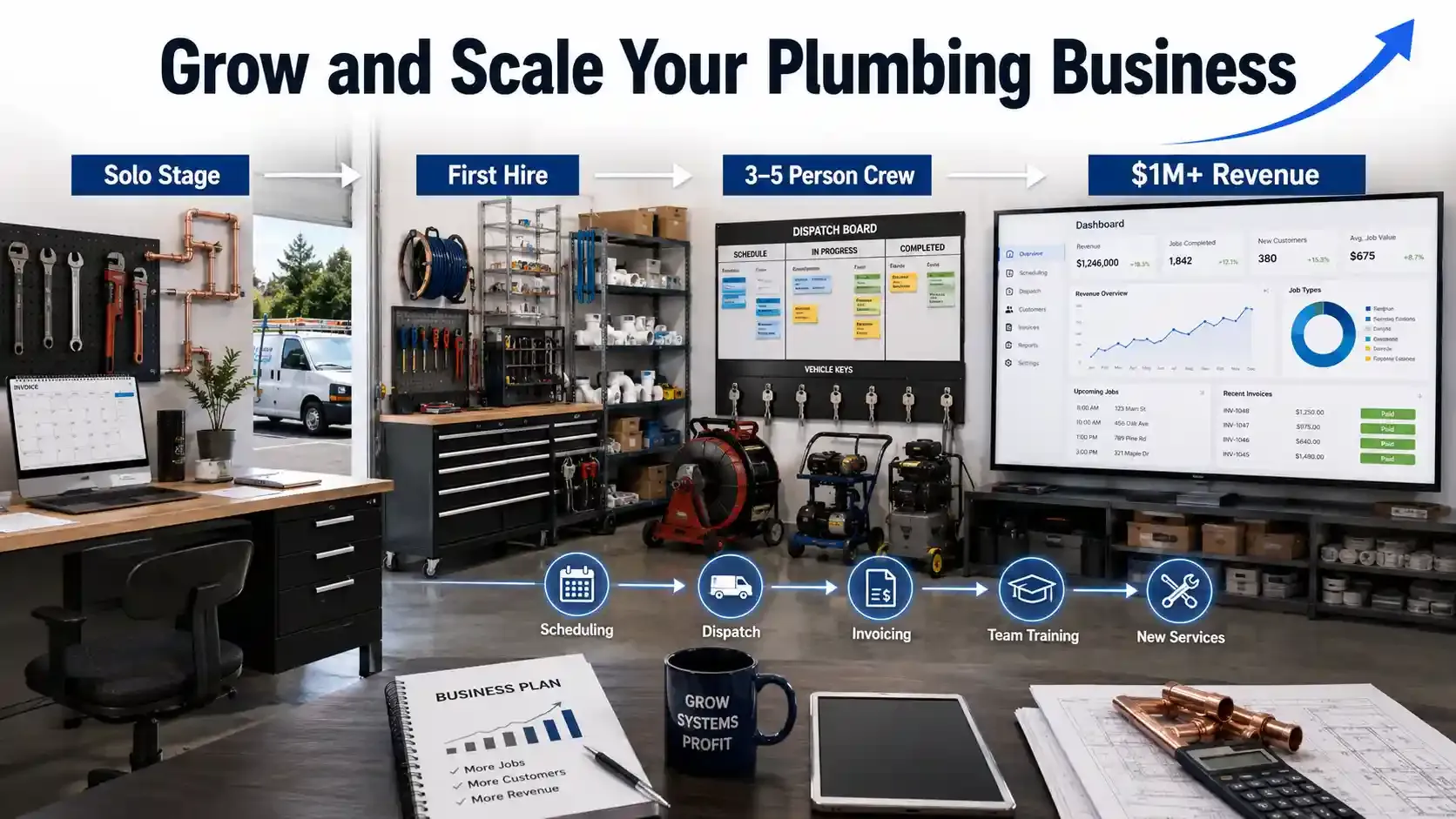
Grow by hiring your first employee, adding new services, and using field service software to stay organized. You stop being a solo plumber and become a plumbing business owner the moment you let go of doing every job yourself.
Here is how growth plays out:
- Solo stage: You take every call, do every job, send every invoice. Growth stops once your calendar is full.
- First hire: Bring on a licensed plumber when you start turning down work. That is your sign.
- 3 to 5-person crew: Add after-hours emergency calls, gas line work, or backflow testing to take on jobs you used to pass up.
- $1M+ revenue: Systems matter more than skills at this point. 94% of companies using field service management software report gains in output. Your business will not grow without scheduling, dispatch, and invoicing in one place.
Put every spare dollar back into marketing, better tools, and technician training. The U.S. faces a shortage of 550,000 plumbers by 2027. Demand keeps rising. Skilled workers keep getting harder to find. Build your team and systems now while the gap is still wide open.
Build systems that grow with your team
Manage scheduling, dispatching, and invoicing in one place
Common Mistakes New Plumbing Business Owners Make
- Underpricing jobs to beat local competitors.
- Running business money through a personal bank account.
- Operating without proper insurance or bonding.
- Not setting up marketing before the first job.
- Taking on every type of plumbing work too early.
- Hiring staff before putting systems in place.
Conclusion
You now have the full playbook. Licensing, planning, funding, registration, insurance, tools, pricing, marketing, and scaling. Every piece you need before your first service call.
Plumbing is one of the few trades where work never dries up, recession or not. But knowing how to fix a pipe and knowing how to run a company are two different skills. The owners who survive year one are the ones who nailed the business side before they grabbed a wrench.
Frequently Asked Questions
How Much Do Plumbing Business Owners Make?
Most plumbing business owners earn between $70,000 and $120,000 per year. Solo operators typically take home $40,000 to $70,000, while owners with a full crew and strong margins can clear $150,000 or more. Your income depends on location, services, and how well you control costs.
Can You Start a Plumbing Business Without Being a Plumber?
Yes. Many states allow non-plumbers to own a plumbing company as long as they hire licensed plumbers to do the work. Your role becomes running the business side: finances, marketing, hiring, and customer service. You still need to register, insure, and comply with all local rules.
Is Owning a Plumbing Business Profitable?
It is. Most plumbing businesses run net profit margins between 10% and 20%. Owners who specialize in higher-margin services like hydro-jetting, water filtration, or commercial contracts push past 25%. Tight cost control and smart pricing make the biggest difference.
How Long Does It Take to Start a Plumbing Business?
If you already hold a master plumber license, you can launch in 2 to 4 weeks once you register, get insured, and buy your gear. Starting from zero with an apprenticeship takes 4 to 7 years before you qualify to operate on your own.
What Type of Plumbing Service Makes the Most Money?
Emergency plumbing and commercial contracts bring the highest returns. After-hours calls often carry premiums of 50% to 100% above standard rates. Specialty work like sewer line replacement, gas fitting, and water treatment systems also commands top dollar in most markets.
What to read next