- Field Service Business
How to Start a Roofing Business in 2026 (Beginner's Guide)
Updated on 30 Jun 2026
Jump to
Summary

Starting a roofing business requires a contractor's license, LLC registration, insurance, basic equipment, and a marketing strategy
Startup costs range from $15,000 to $50,000, depending on gear, location, and crew size
Roofing companies earn 20% to 40% gross margins, with small operators pulling $500K to $4.9M annually
The fastest path to first clients is door knocking, claiming a Google Business Profile, and joining a local networking group.
Most roofing businesses fail within five years, not from lack of work, but from poor cash flow management, no systems, and scaling too fast.
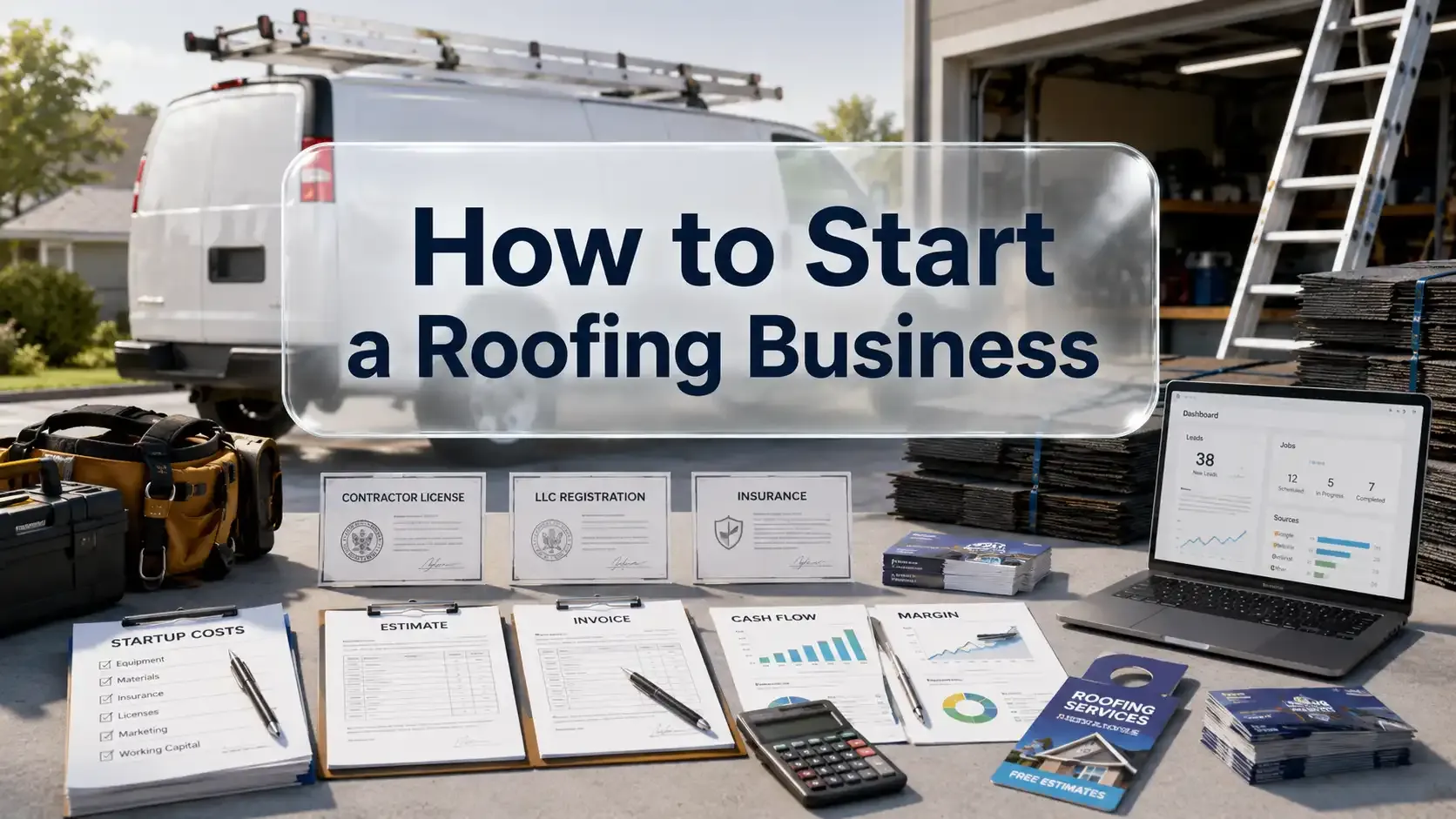
Starting a roofing business requires a contractor's license, an LLC, proper insurance, basic equipment, and a solid marketing strategy to land the first clients. That is the short answer. The real challenge is executing each step without bleeding cash.
The U.S. roofing industry hit $92.5 billion in 2026, with over 101,000 companies already competing for work. Demand never fades because every roof eventually wears out.
But a booming market does not guarantee survival. Nearly half of all new businesses shut down before year five. In roofing, the damage runs even deeper because most owners master the craft but never learn the business side.
This guide breaks down every step from picking a business model to signing the first client. It also covers the mistakes real founders wish they had skipped.
Why Start a Roofing Business in 2026?
Starting a roofing business in 2026 makes sense because demand remains steady, profit margins are strong, and the barrier to entry is lower than in most construction trades. The U.S. roofing market hit $34.66 billion this year and keeps expanding at 6.13% annually through 2031.
That kind of roofing industry growth opens real space for new companies. So, is a roofing business profitable?
Median revenue for small operators ranges from $500K to $4.9 million. This is the most reputable trade publication in the roofing industry, published in January 2026.
What makes this even better is the variety. You can focus on residential roofing, commercial projects, insurance restoration, metal roofing, or solar installations. Each one feeds a separate revenue stream.
A growing labor shortage also tilts the odds in your favor. The construction industry needs 2.17 million new workers between 2024 and 2026. Fewer roofers in the market means less competition and more work landing at your door.
Choose Your Roofing Business Model
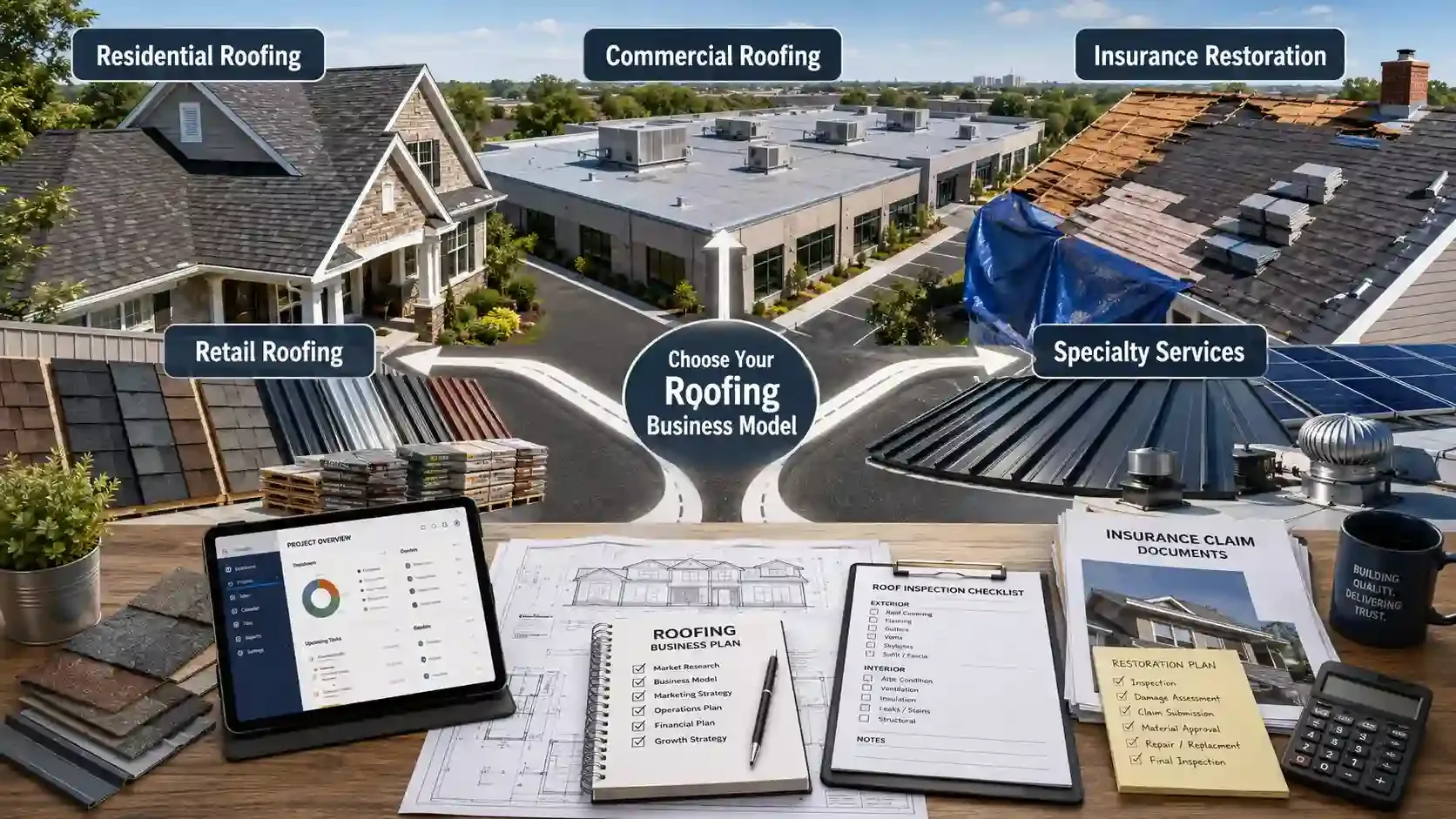
Before you write a business plan, decide what type of roofing work you want to focus on. Your business model shapes everything, from the clients you chase to how you price jobs.
The biggest split is residential vs commercial:
- Residential roofing means selling directly to homeowners, with smaller ticket sizes and faster sales cycles
- Commercial work targets property managers and building owners, where projects run larger but payment cycles stretch longer
Then comes the question of retail roofing vs insurance restoration:
- Retail means the homeowner pays you out of pocket
- Restoration means you handle storm damage claims and work alongside insurance adjusters
That second path is surging right now. U.S. roof repair and replacement costs reached $31 billion in 2024, up 30% in just two years.
But not every model fits every person. If you hate customer service, don't touch retail. If insurance adjusters test your patience, skip restoration. Pick the path that matches your temperament, not just the one that looks most profitable on paper.
You can also carve out a niche within these models:
- HOA complexes and apartment buildings
- Government and municipal contracts
- Metal roofing specialization
- Solar installations and energy-efficient upgrades
- Repairs and maintenance only
Start with one model, master it, then branch out once your crew and systems can handle the load.
Choose your roofing path. Build your system.
FieldServicely helps you stay organized as your business expands.
Get Your Roofing License and Certifications
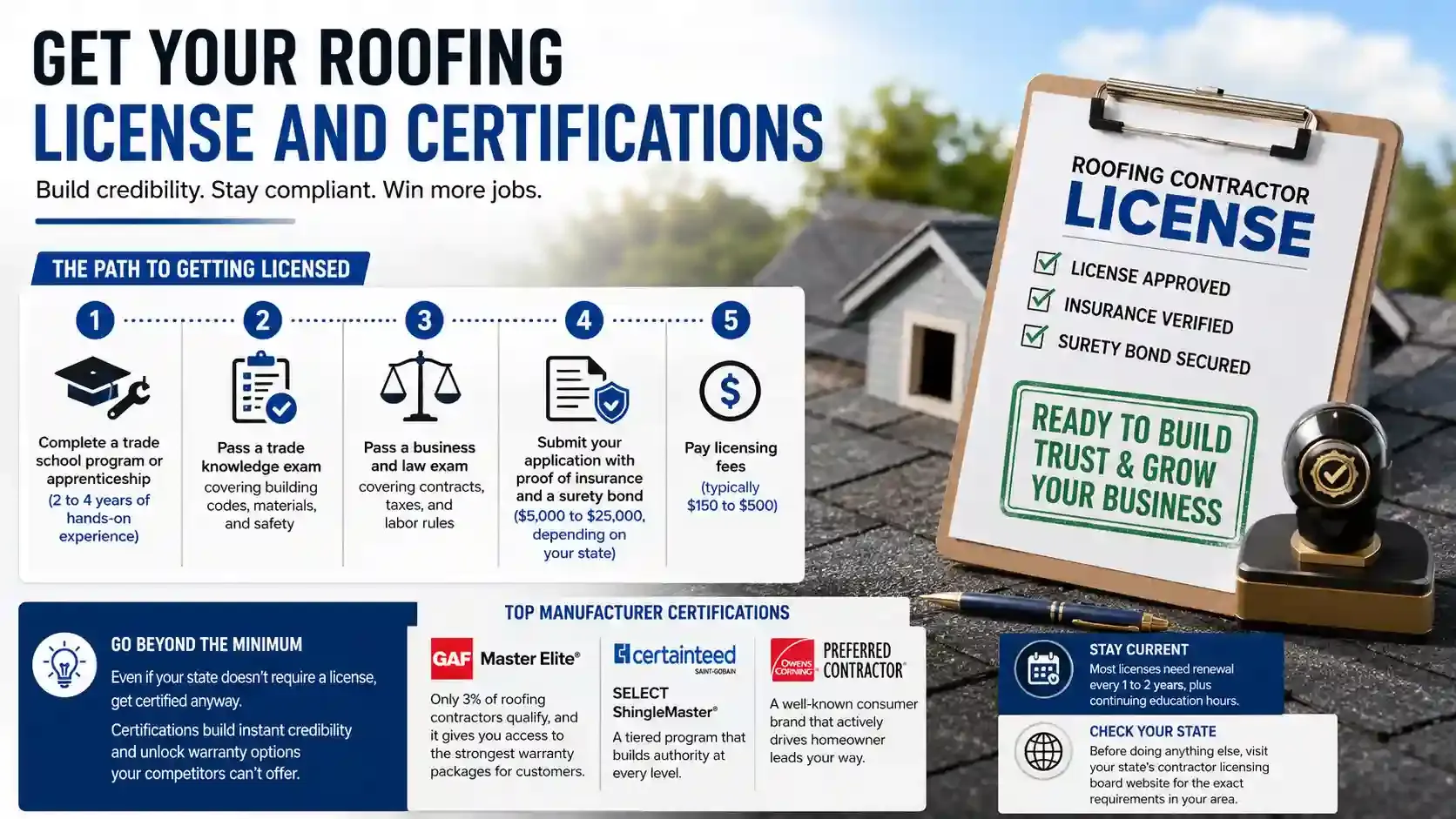
Most states require a roofing contractor's license before you can legally take on jobs. Florida and California enforce strict rules, including trade exams, years of documented experience, and surety bonds. Texas and Georgia, on the other hand, have no state-level licensing at all.
The general path to getting licensed follows a clear sequence:
- Complete a trade school program or apprenticeship (2 to 4 years of hands-on experience)
- Pass a trade knowledge exam covering building codes, materials, and safety
- Pass a business and law exam covering contracts, taxes, and labor rules
- Submit your application with proof of insurance and a surety bond ($5,000 to $25,000, depending on your state)
- Pay licensing fees (typically $150 to $500)
Now here's what separates the serious from the average. Even if your state does not require a license, get certified anyway. Certifications build instant credibility and unlock warranty options your competitors cannot offer.
These manufacturer certifications carry the most weight:
- GAF Master Elite: Only 3% of roofing contractors qualify, and it gives you access to the strongest warranty packages for customers
- CertainTeed SELECT ShingleMaster: A tiered program that builds authority at every level
- Owens Corning Preferred Contractor: A well-known consumer brand that actively drives homeowner leads your way
Most licenses need renewal every 1 to 2 years, plus continuing education hours. Before doing anything else, check your state's contractor licensing board website for the exact requirements in your area.
Write a Roofing Business Plan
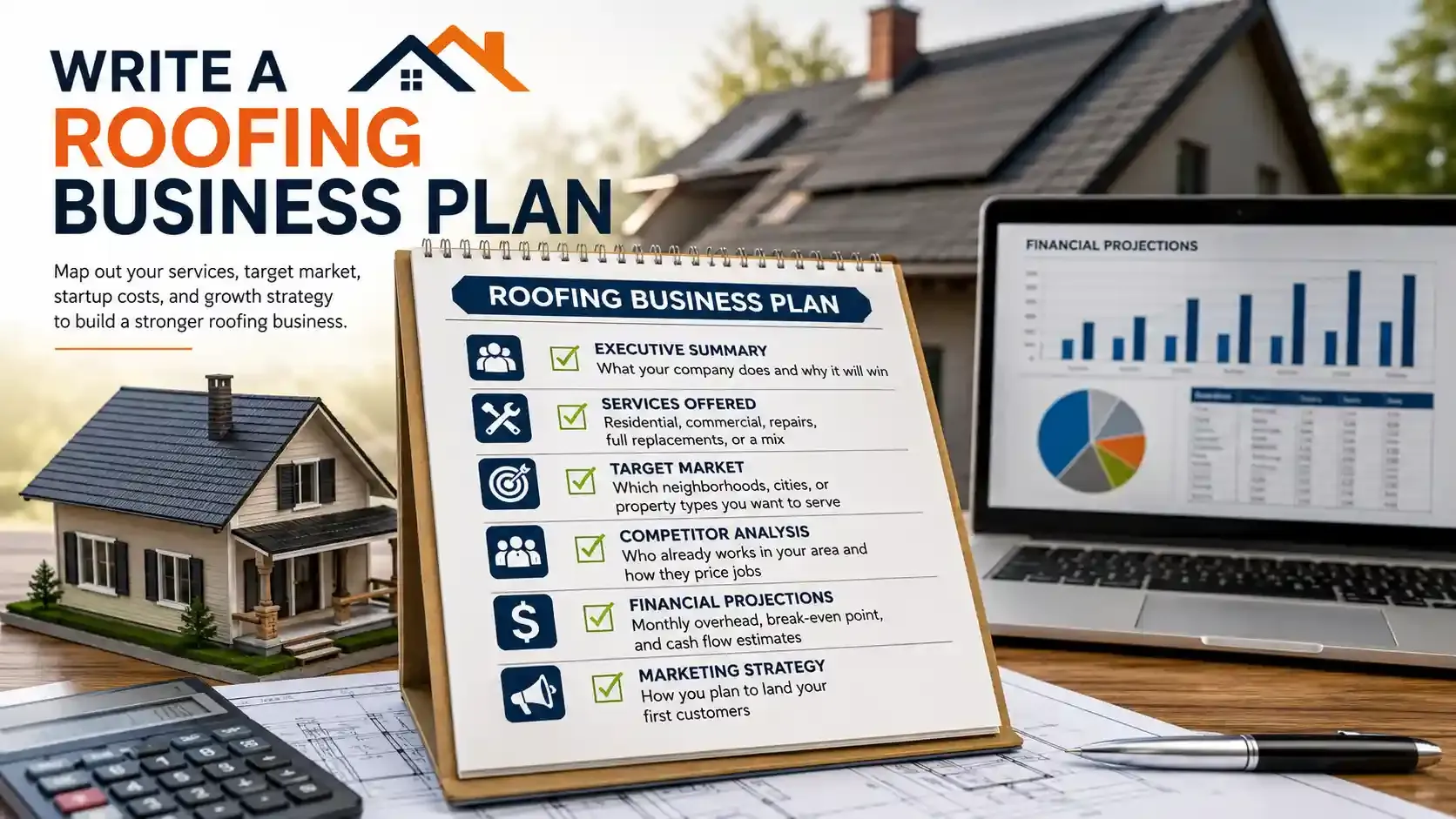
A roofing business plan maps out your services, target market, startup costs, and growth strategy. You need one to secure funding, stay focused during your first year, and stop yourself from burning cash on bad decisions.
And no, you don't need a 50-page MBA document. I wrote my first plan on a single late-night sitting. Just a checklist of everything I thought the business needed.
That checklist kept me on track for months.
But whether you write one page or ten, make sure your business plan for a roofing company covers these:
- Executive summary: What your company does and why it will win
- Services offered: Residential, commercial, repairs, full replacements, or a mix
- Target market: Which neighborhoods, cities, or property types you want to serve
- Competitor analysis: Who already works in your area and how they price jobs
- Financial projections: Monthly overhead, break-even point, and cash flow estimates
- Marketing strategy: How you plan to land your first customers
The U.S. Small Business Administration recommends quarterly projections for year one and annual forecasts for years two through five. Such detail shows lenders and investors you actually know where the money goes.
Turn your roofing plan into a profitable business.
Track leads, jobs, and growth with tools built for contractors.
Register Your Business and Choose a Legal Structure
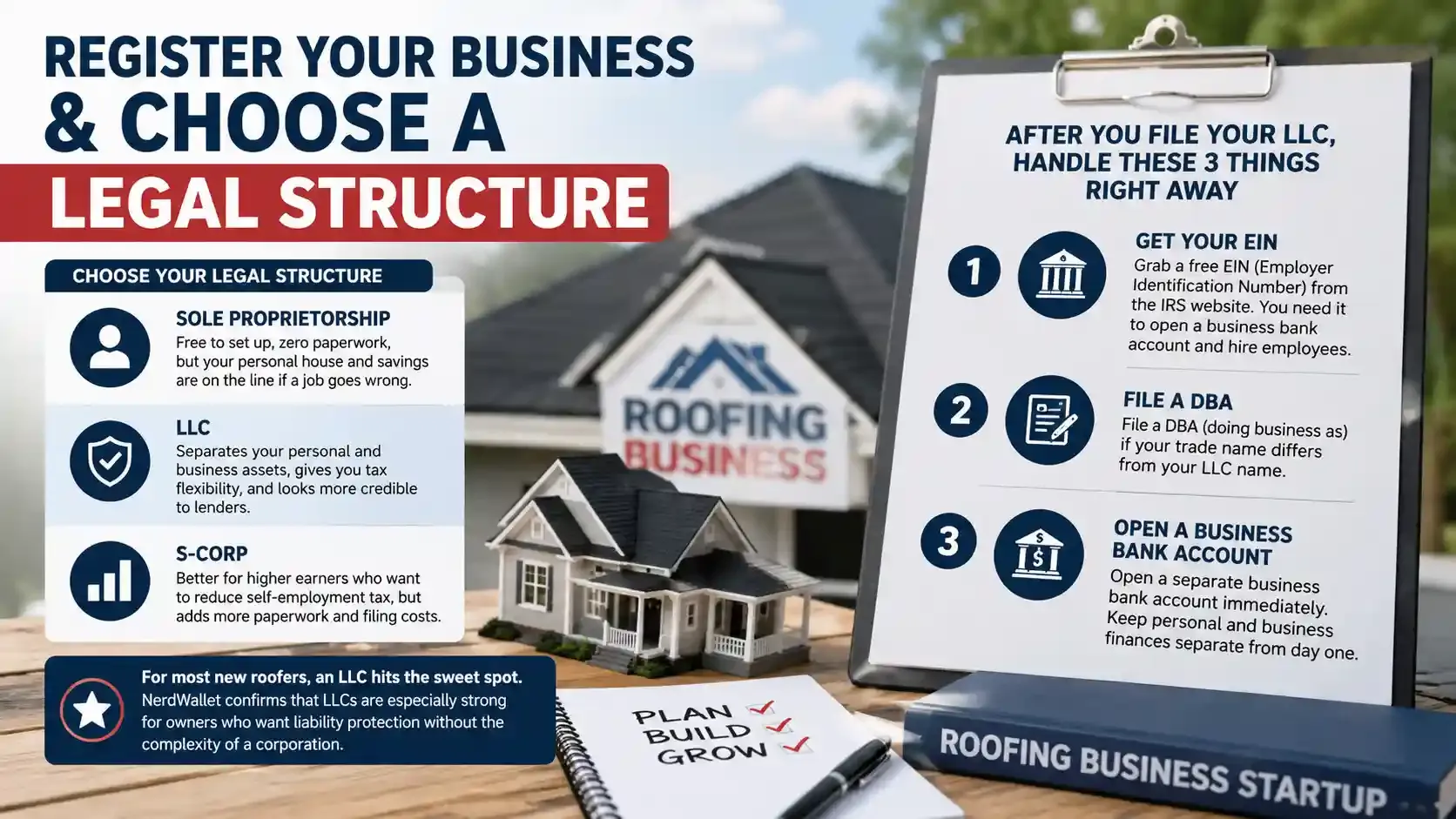
Register your roofing business as an LLC. It shields your personal assets if someone sues you, keeps taxes simple, and costs just $100 to $500 to file with your state's Secretary of State.
I looked into all three options before picking mine:
- Sole proprietorship: Free to set up, zero paperwork, but your personal house and savings are on the line if a job goes wrong
- LLC: Separates your personal and business assets, gives you tax flexibility, and looks more credible to lenders
- S-Corp: Better for higher earners who want to reduce self-employment tax, but adds more paperwork and filing costs
For most new roofers, an LLC hits the sweet spot. NerdWallet confirms that LLCs are especially strong for owners who want liability protection without the complexity of a corporation.
Once your LLC is filed, handle these three things right away:
- Grab a free EIN (Employer Identification Number) from the IRS website. You need it to open a business bank account and hire employees.
- File a DBA (doing business as) if your trade name differs from your LLC name.
- Open a separate business bank account immediately. I made the mistake of mixing personal and business money early on, and untangling it at tax time was a nightmare
Secure Funding and Manage Startup Costs

So, how much does it cost to start a roofing business?
Expect to spend between $15,000 and $50,000, depending on your equipment, location, and crew size. If you rent your gear and work solo at first, you can even start a roofing company with no money up front beyond basic registration and insurance.
The real question is where that capital comes from. Here are the most common funding paths for starting a roofing business from scratch:
- Personal savings: The fastest route with zero interest, but it puts your own cash at risk
- SBA loan for roofing: Small Business Administration-backed loans offer lower rates (6.3% to 11.5% as of Q3 2025) and longer repayment windows
- Equipment financing: Let's you spread the cost of trucks, trailers, and tools across monthly payments
- Business line of credit: Gives you flexible access to working capital when cash flow dips between jobs
- Bank loans: Traditional option, but tougher to qualify for without an established credit history
Now here's the part that catches most new owners off guard. Poor cash flow is the number one reason small businesses fail. [Source: Score]
In roofing, the pressure doubles because you buy materials upfront, but sometimes wait 30 to 60 days to collect payment. So before you spend a dollar on a logo or a truck wrap, set aside at least three months of operating expenses.
That cushion keeps you alive when payments run late or a slow season creeps in.
Protect your money with better job management.
Track estimates, payments, and business performance easily.
Invest in Essential Roofing Tools and Equipment
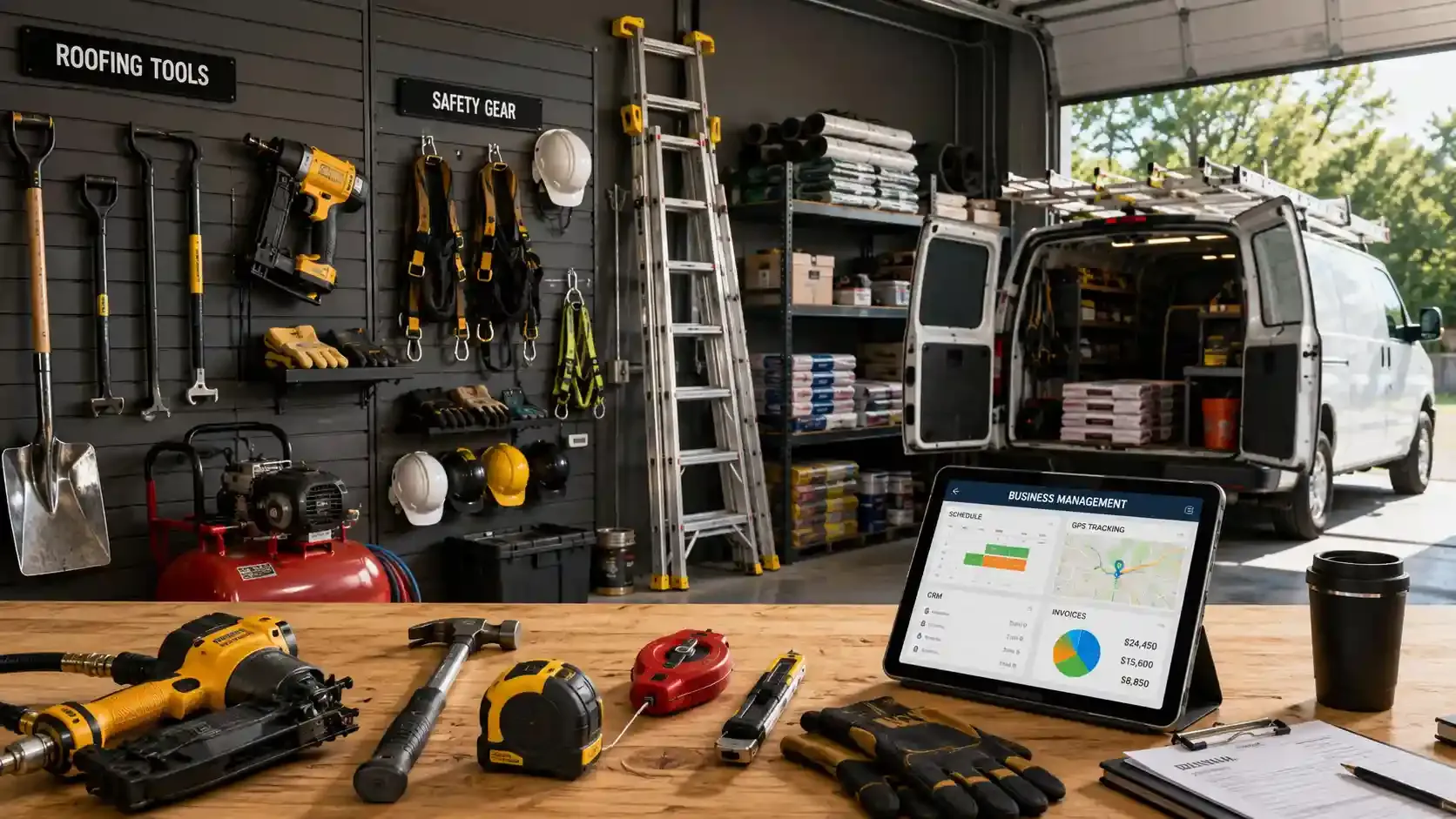
Budget $5,000 to $15,000 on your roofing tools and equipment at launch. Most of that goes toward basics you will use on every single job:
- Nail guns, an air compressor, and roofing shovels for tear-offs
- Ladders with stabilizers and safety harnesses for height work
- Hand tools: hammers, pry bars, chalk lines, tape measures, utility knives
- A reliable work vehicle to haul materials and move the crew
I rented my dump trailer, roof hoist, and dumpsters for the entire first year. Buying them upfront would have drained my cash before I closed my fifth job. Local auctions and online marketplaces also saved me thousands on quality used equipment.
Do not cut corners on safety gear. OSHA fined a Florida roofing company $172,324 in April 2026 after two workers fell without fall protection. Harnesses, hard hats, and proper ladder safety protect your crew and your wallet equally.
Physical tools keep jobs moving, but software keeps the business running. I wasted months juggling spreadsheets and group texts before switching to FieldServicely for CRM, crew scheduling, GPS tracking, and invoicing in one place.
The right tools help you build faster.
Add FieldServicely to manage the business behind the work.
Set Your Pricing and Profit Margins
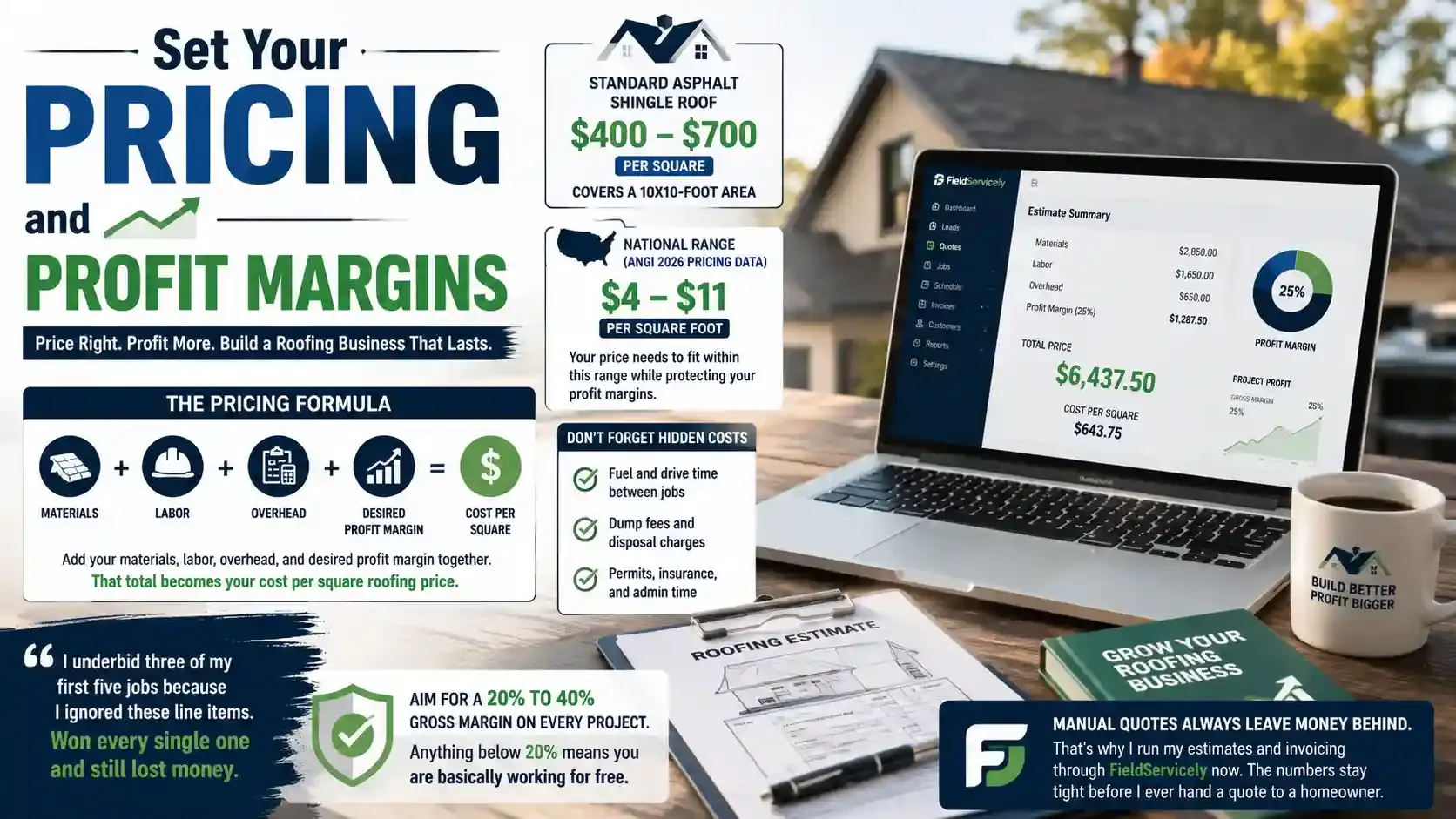
Most roofers price jobs by the square, which covers a 10x10-foot area. For a standard asphalt shingle roof, charge between $400 and $700 per square.
Angi's 2026 pricing data puts the national range at $4 to $11 per square foot, and your cut needs to sit inside that while still protecting your roofing profit margins.
The formula is simple. Add your materials, labor, overhead, and desired profit margin together. That total becomes your cost per square roofing price. Where most new owners mess up is forgetting hidden costs like:
- Fuel and drive time between jobs
- Dump fees and disposal charges
- Permits, insurance, and admin time
I underbid three of my first five jobs because I ignored these line items. Won every single one and still lost money.
Aim for a 20% to 40% gross margin on every project. Anything below 20% means you are basically working for free.
Manual quotes always leave money behind, which is why I run my estimates and invoicing through FieldServicely now. The numbers stay tight before I ever hand a quote to a homeowner.
Build Your Brand From Day One
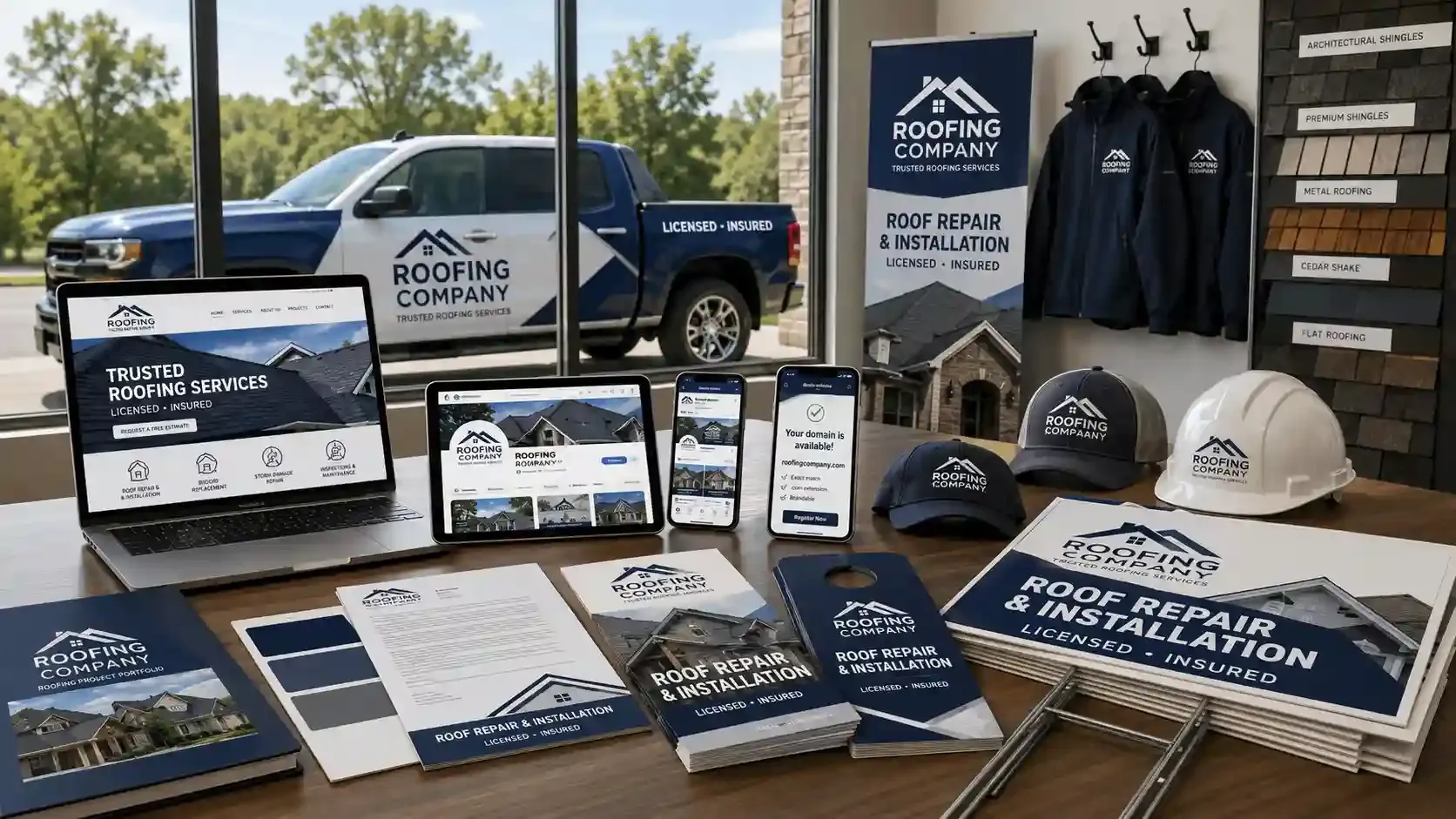
Your brand is how customers recognize and trust you. Start building it the day you file your LLC, not after you close your first job. Consistent brand presentation across all platforms can boost revenue by up to 23%.
When brainstorming roofing company name ideas, pick something memorable, easy to spell, and available as a domain name. Your roofing business logo needs to be clean enough to read from 50 feet away on a truck.
Choose two to three brand colors and stick to them across everything:
- Trucks and vehicle wraps
- Crew shirts, hats, and jackets
- Door hangers, yard signs, and business cards
- Your website and social media profiles
Within my first year, homeowners started asking if my company was a franchise. Every touchpoint looked identical, and that consistency built trust faster than any ad ever could.
Market Your Roofing Business and Land Your First Clients
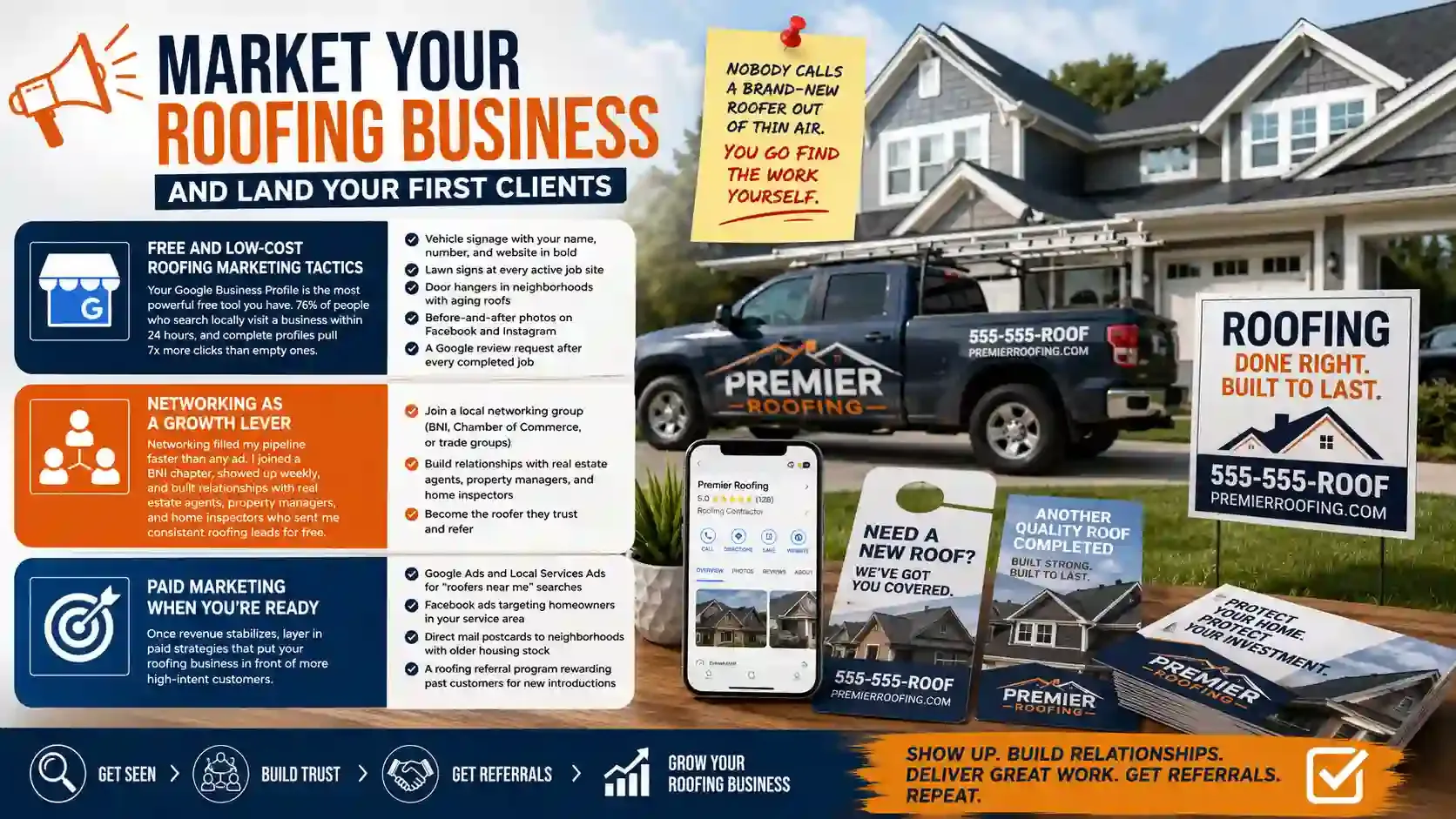
The fastest way to get roofing clients is to knock on doors, claim your Google Business Profile, and join a local networking group. Nobody calls a brand-new roofer out of thin air. You go find the work yourself.
Free and Low-Cost Roofing Marketing Tactics
Your Google Business Profile is the most powerful free tool you have. 76% of people who search locally visit a business within 24 hours, and complete profiles pull 7x more clicks than empty ones.
Stack these on top for maximum visibility:
- Vehicle signage with your name, number, and website in bold
- Lawn signs at every active job site
- Door hangers in neighborhoods with aging roofs
- Before-and-after photos on Facebook and Instagram
- A Google review request after every completed job
Networking as a Growth Lever
Networking filled my pipeline faster than any ad. I joined a BNI chapter, showed up weekly, and built relationships with real estate agents, property managers, and home inspectors who sent me consistent roofing leads for free.
Paid Marketing When You're Ready
Once revenue stabilizes, layer in:
- Google Ads and Local Services Ads for "roofers near me" searches
- Facebook ads targeting homeowners in your service area
- Direct mail postcards to neighborhoods with older housing stock
- A roofing referral program rewarding past customers for new introductions
Turn more leads into roofing jobs.
Track customer conversations and never miss follow-ups.
Hire Your First Team and Start Delegating
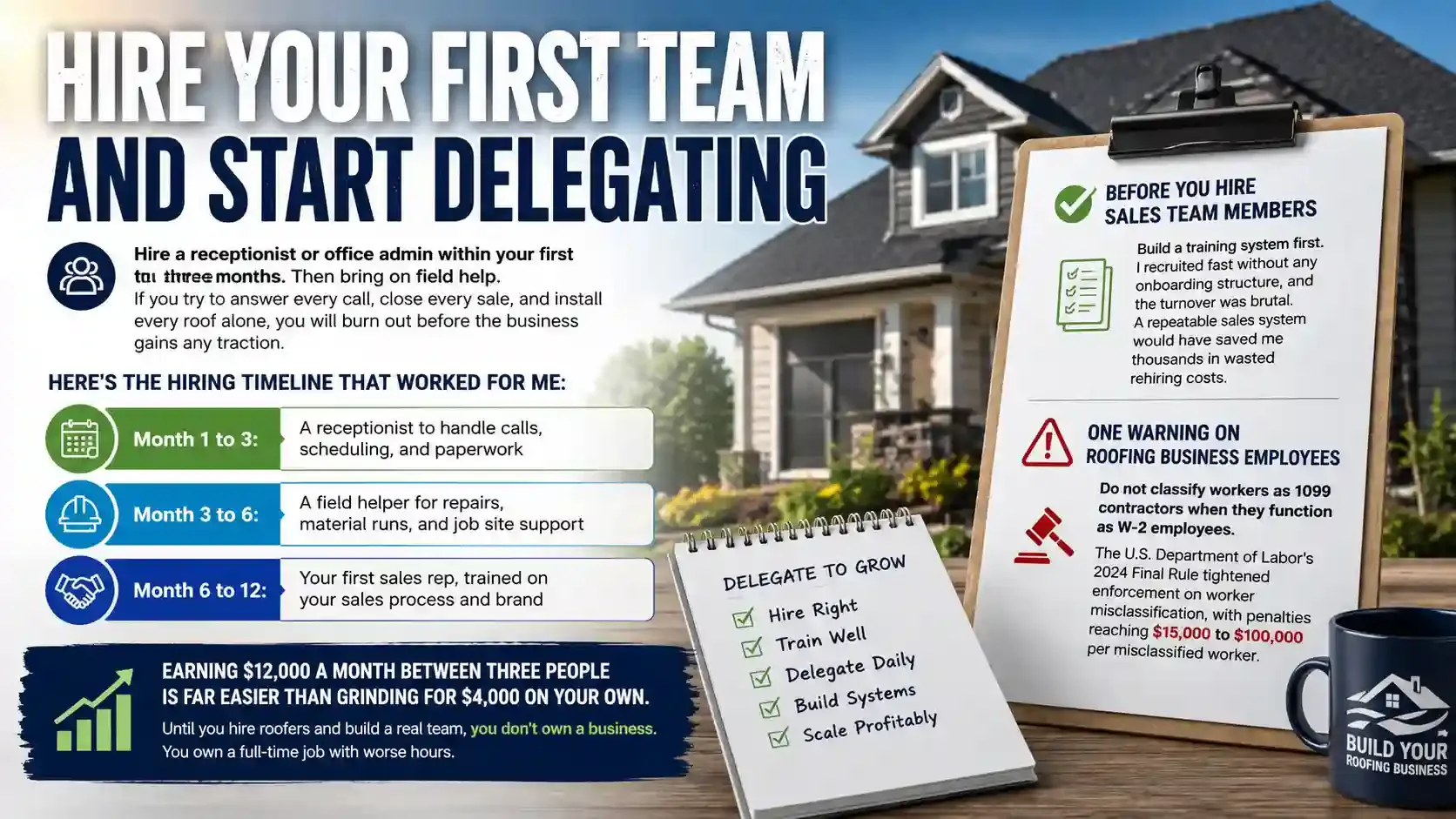
Hire a receptionist or office admin within your first three months. Then bring on field help. If you try to answer every call, close every sale, and install every roof alone, you will burn out before the business gains any traction.
Here's the hiring timeline that worked for me:
- Months 1 to 3: A receptionist to handle calls, scheduling, and paperwork.
- Months 3 to 6: A field helper for repairs, material runs, and job site support
- Months 6 to 12: Your first sales rep, trained on your sales process and brand
Earning $12,000 a month between three people is far easier than grinding for $4,000 on your own. Until you hire roofers and build a real team, you don't own a business. You own a full-time job with worse hours.
Before you bring on any roofing sales team members, build a training system first. I recruited fast without any onboarding structure, and the turnover was brutal. A repeatable sales system would have saved me thousands in wasted rehiring costs.
One warning on roofing business employees. Do not classify workers as 1099 contractors when they function as W-2 employees. The U.S. Department of Labor's 2024 Final Rule tightened enforcement on worker misclassification, with penalties reaching $15,000 to $100,000 per misclassified worker.
Avoid These Common Roofing Business Mistakes
Most roofing companies fail within five years. Because the owners repeat the same avoidable business mistakes.
- Ignoring your P&L statements and cash flow until you have no idea where your money went
- Hiring salespeople without a training system, which creates nonstop turnover and chaos
- Letting someone else own your domain and website, then losing everything when they ghost you.
- Opening new offices too early and spreading your team so thin that quality collapses
- Clinging to subcontracting work instead of fully committing to building your own brand
- Treating branding and marketing as extras instead of investing in them from day one
Conclusion
The roofing industry is massive, profitable, and not slowing down. And getting in takes less than most people assume.
Mistakes will happen. That is the price of entry. The founders who survive are the ones who mess up, learn fast, fix it, and keep moving forward.
What separates the roofing companies that make it from the ones that fold comes down to one thing. Systems. The owners who track their leads, manage their jobs, schedule their crews, and stay organized are the ones still standing five years from now.
Frequently Asked Questions
Can You Start a Roofing Business With No Experience?
Yes. Complete a trade school program or work under an established roofing company for one to two years first. Many successful owners entered the industry with zero roofing background but strong sales or management skills. Pair hands-on training with the right crew, and experience builds fast on the job.
How Long Does It Take to Launch a Roofing Company?
Most owners go from idea to first job within 30 to 90 days. Licensing, registration, and insurance take two to six weeks, depending on your state. The real timeline depends on how quickly you secure your contractor's license and close your first client.
Is Roofing a Seasonal Business?
It depends on the location. Southern and western states see year-round demand. Northern climates slow down during winter, which makes cash reserves and off-season marketing essential. Smart owners use slower months to build systems, train crews, and lock in spring contracts early.
What Is the Best State to Start a Roofing Company?
States with high storm activity, aging housing stock, and growing populations offer the strongest demand. Texas, Florida, Georgia, and North Carolina consistently rank at the top. Low or no licensing requirements in some of these states also reduce the barrier to entry.
How Many Roofs Can a Small Crew Complete Per Week?
A three-person crew typically finishes one to two standard residential roofs per week. Speed depends on roof size, pitch, weather, and tear-off complexity. Efficient scheduling and material prep cut downtime between jobs and push output closer to three per week.
What to read next