- Operations management
On-Time Delivery Metrics: KPIs, Formulas, Benchmarks & Tips
Updated on 30 Jan 2026
Jump to
Summary

On-time delivery shows whether you keep your promise, not just a box you have shipped.
The most common KPI for OTD is : (on-time deliveries ÷ total deliveries) × 100.
Customers care more about their order arriving exactly when you promised. So the accuracy of your delivery window matters.
Improve OTD with clear time windows, cleaner pick/pack, better routing, and real-time visibility.
On-time delivery metrics track whether orders or services arrive exactly when promised. These help protect your brand as late deliveries often lead to refunds, reschedules, and bad reviews.
In this article, I'm going to explain what OTD metrics are. KPIs, and their real-world impacts. So, let's get started.
What Does On-Time Delivery Metrics Mean?
On-time delivery metrics measure how often you deliver within your promised time window. These are practical KPIs for logistics, supply chain, field service, and e-commerce teams. This is because they connect operations to customer trust.
Why are On-Time Delivery Metrics Important?

On-time delivery metrics matter because they reveal whether your operation can keep promises as you scale.
They also help you spot delays early—before they become refunds, reships, or chargebacks.
McKinsey notes that many shoppers will abandon a cart when shipping costs feel too high, so delivery reliability and cost control often move together.
Customer Satisfaction
On-time delivery improves customer satisfaction because people plan their day around your ETA. OnTrac’s consumer study reported that slow delivery can push customers to switch retailers, which is why reliability is a retention issue.
Use a promise window that your operation can hit consistently, not just one that sounds impressive.
Operational Efficiency
Apart from driver performance, on-time delivery reflects process health and overall operational efficiency. Late orders often start as small upstream delays, so define when the clock starts: order placed, order released, job scheduled, or technician dispatched.
Then track stage times (pick/pack, dispatch, travel, service time) so a vague delay turns into one clear fix.
Inventory Management Issues
Inventory issues cause late delivery when you sell items that you do not have or cannot locate quickly. Fix this with real-time stock counts, clear reorder points, and clean bin locations. These make order pick up fast.
However, if your inbound supply is late, track supplier reliability. This way, you will see the root cause instead of blaming the last mile.
Order Fulfillment Issues
Fulfillment issues delay delivery when pick, pack, and labeling create rework. So try to reduce errors with scans, batch/zone picking for high-volume SKUs. And also one packing standard per SKU family.
The goal here is fewer touches and fewer exceptions, because exceptions are what break on-time rates.
Delivery Problems
Delivery problems show up after dispatch when routes, capacity, and addresses fail. For example, Loqate’s research found that many businesses treat inaccurate addresses as a primary cause of failed delivery. So accurate address record and validation pays back quickly.
In field service, the same idea applies. For instance, bad locations and missing access notes create predictable late arrivals.
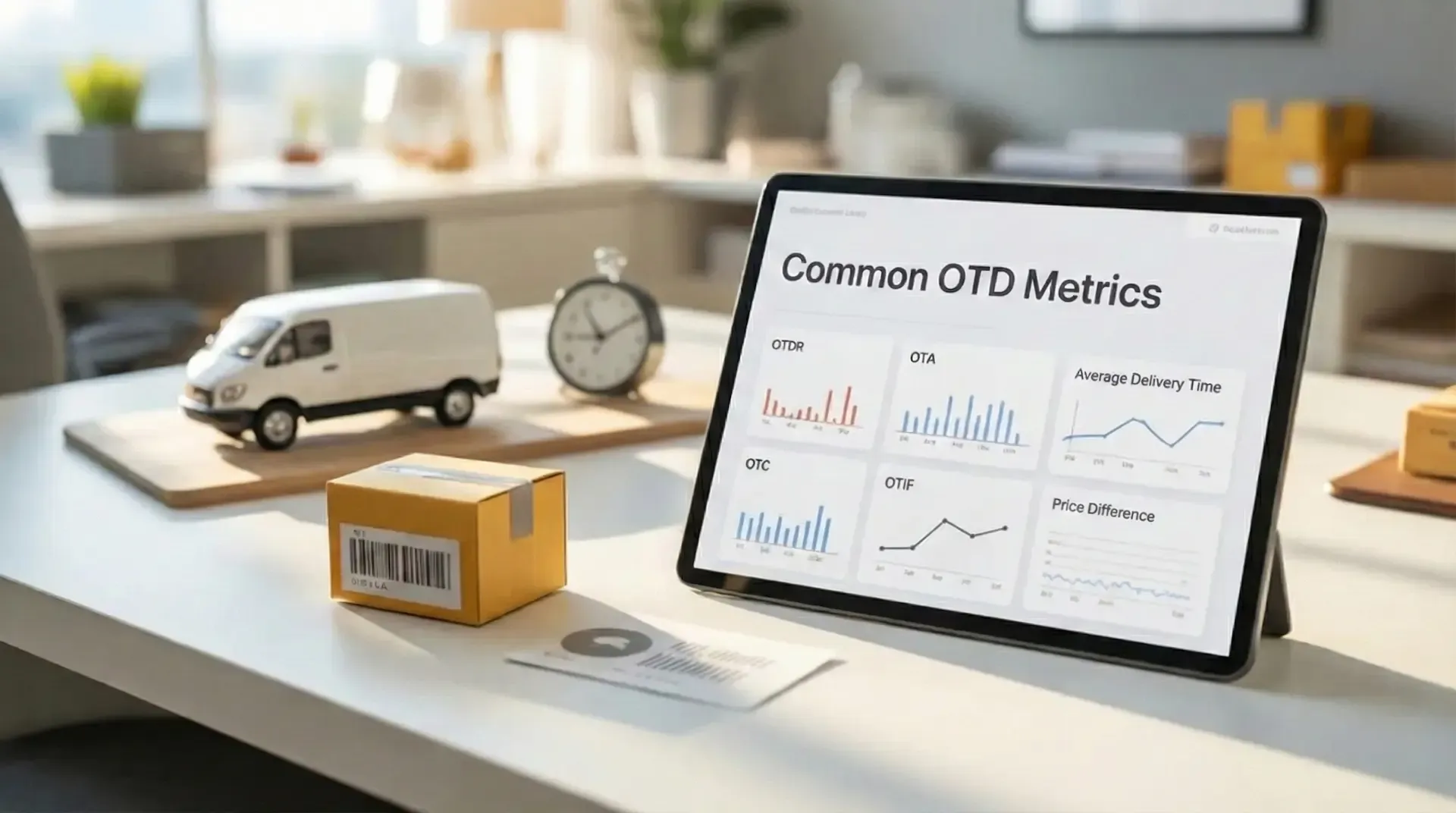
What are the Most Common On-Time Delivery Metrics
On Time Delivery Rate (OTDR)
OTDR shows the percentage of completed deliveries within your promised window.
Formula: OTDR (%) = (On-time deliveries ÷ total deliveries) × 100.
Example: 1,900 on-time deliveries out of 2,000 total deliveries = 95% OTDR.
On Time Arrival (OTA)
OTA checks whether the driver or technician arrived on time, even if the job finishes later.
Formula: On-time arrivals ÷ total stops (or appointments).
Use it for appointments and field service, where arrival time matters as much as completion time.
On Time & In Full (OTIF)
OTIF adds completeness, so you only win when the order arrives on time and complete. Use it when shortages, split shipments, or wrong items create customer penalties. ASCM’s SCOR model connects reliability to perfect order thinking, including accuracy and documentation.
On Time Completion (OTC)
OTC measures whether the full job is finished on time, not just the arrival. Apply it for installs, repairs, and multi-step service visits where you promise an end time. Pair it with the first-time fix rate so the on-time result is not hiding repeat visits.
Average Delivery Time
Average delivery time shows how long deliveries take from start to finish. Utilize it for trend lines, not for judging single orders, because averages hide spikes and bottlenecks. Pair it with percentile views, like the slowest 10%, so you can see risk.
Supplier Reliability
How often a supplier deliver on the promised time window is critical. If a supplier is late to you, you will likely be late to your customers. So, track supplier scorecards such as lead time, fill rate, and defect rate to prevent downstream misses.
Delivery Estimation Accuracy
Delivery estimation accuracy measures how close your ETA is to reality. Use better routing rules to track the gap between promised and actual arrival. This way, you can reduce the gap.
It is significant as customers value reliability. On top of that, many of them accept slightly slower delivery when the promise is accurate.
Price Difference
Price difference is the gap between your expected delivery cost and the actual cost. Track it when you pay for expedited shipments, re-delivery, or reshipments due to errors. It connects late delivery to money, so ops teams can justify route tools, packing fixes, and address validation.
Refine ETAs with smart route predictions
How to Measure On-Time Delivery Metrics KPI
Measure on-time delivery by first locking down your promise rule. Then apply it to clean delivery data.
Pick one definition:
- On the Promised Date
- Within the Promised Window
- Within a Grace Period, like “End of Business Day.”
Then pull two numbers: total deliveries and on-time deliveries, and calculate OTDR.
Example: If you delivered 2,000 orders and 100 arrived late, OTDR = (1,900 ÷ 2,000) × 100 = 95%.
McKinsey notes many consumers don’t call an order “unacceptably late” if it arrives 1–2 days after the expected time. So align KPI rules with your promise.
On Time Delivery Metrics Optimization Examples in Real Life
Top performers treat on-time delivery as a system, not a driver problem.
They combine
- Network Design
- Inventory Placement
- Routing
- Visibility
So the promise stays realistic. Here are some of the success stories that are setting the trend for on time delivery metrics optimization.
Amazon – Setting the Standard for On-Time Delivery
Amazon improves delivery speed by placing inventory closer to customers. As a result, they are expanding same-day and next-day coverage.
Amazon says it delivered items globally the same day or the next day in 2024. Prime members saw its fastest-ever delivery speeds.
UPS – Route Optimization and Delivery Consistency
UPS improves delivery consistency with its On-Road Integrated Optimization and Navigation (ORION) platform. They report ORION helps drivers cover about 10–14 fewer miles per driver per day. Which reduces time risk and fuel burn.
Save miles with smart route management
Try for free - No credit card required!
Walmart – Retailer Turned Delivery Network
Walmart uses stores as fulfillment nodes to shrink the distance to customers. Their FY25 Q4 update says it can reach 93% of U.S. households with same-day delivery. But only after expanding store-fulfilled delivery areas. [Source: Walmart]
Walmart also explains how it uses stores and its last-mile network to expand
- Next-day shipping
- Two-day shipping.
How to Optimize On-Time Delivery Metrics in Real Life
Improve on-time delivery by
- Tightening the Promise
- Removing Avoidable Work
- Making Routing and Tracking Smarter.
Use the steps below as a practical checklist you can run in 30 days.
Set Clear On-Time Delivery Goals
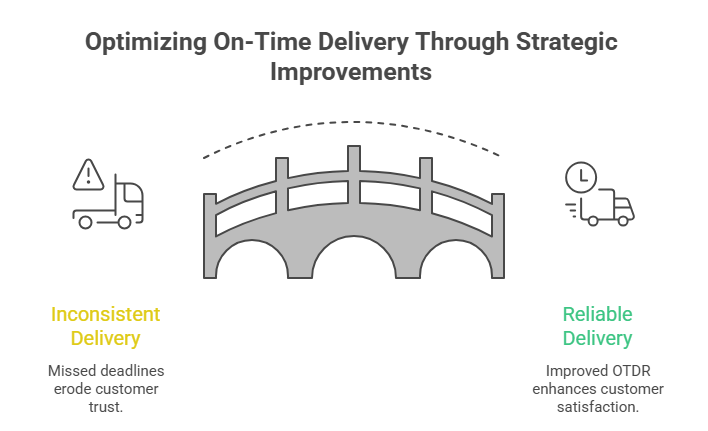
Set one OTDR target that matches your promise window and product type.
McKinsey found that about 90% of consumers will wait 2–3 days just to avoid shipping costs. So realistic promises protect OTDR.
Identify Bottlenecks Through Employee Insights
Ask warehouse staff and drivers where time gets wasted. Then verify it with scan timestamps.
Gallup’s 2024 meta-analysis links higher engagement to higher productivity and fewer defects. Which in turn helps delivery performance.
Improve Inventory Management
Use:
- Real-time inventory
- Reorder Points
- ABC Counts
To stop stockouts. Tie inbound supplier reliability, so that you can see the root cause fast.
Streamline Order Picking and Fulfillment
Switch from one-by-one picks to batch or zone picking for high-volume SKUs. Cut packing variation so teams move faster and make fewer label mistakes.
Optimize Delivery Routes
Use route optimization to shorten routes and reduce ETA swings caused by
- Traffic
- Stop orders
UPS shows how efficiency tools can cut miles per driver per day. Which reduces both cost and labor.
Optimize routes for shorter trips
Get Started- No credit card required!
Leverage Data and Predictive Analytics
Compare promised vs actual delivery by
- Lane
- Carrier
- Day of Week
Then adjust buffers.
McKinsey reports that many customers track shipment status. So proactive alerts protect satisfaction when delays happen.
Strengthen Supplier and Partner Relationships
Set clear SLAs with suppliers and carriers, and review misses weekly. Use OTIF scorecards so partners improve the same way your internal team improves.
Visualize and monitor the Process using a dashboard that shows
- OTDR
- Late Reasons
- Average Delay Minutes
Use a Kanban view for exceptions so teams clear delays before they snowball.
Train and Empower Employees
Train teams on the exact promise rules and the top three causes of misses.
Gallup found that top-quartile engagement links to higher productivity and fewer defects. Which supports faster, cleaner fulfillment.
If you run field teams, tools like FieldServicely can help you
- Plan Routes
- Track Stops
- Measure OTDR from real GPS timestamps.
Challenges of On-Time Delivery Metrics
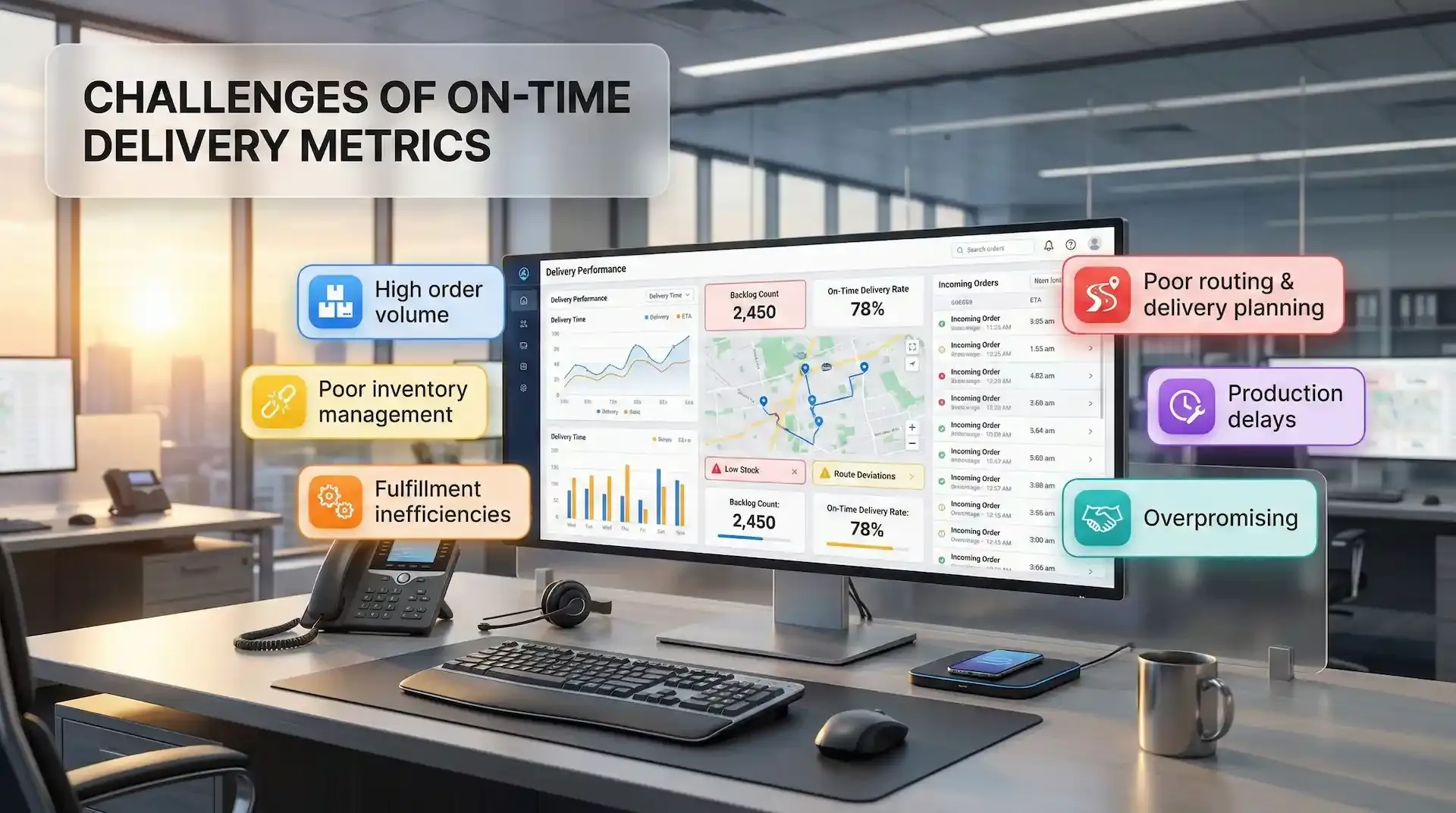
On-time delivery remains hard because of
- Demand Spikes
- Supply Disruptions and
- Availability
The worst part is that all of these hit at the same time.
Now, based on initial estimated arrival dates, McKinsey reports that on-time last-mile performance 2% in May 2020. Which has not fully returned to pre-pandemic levels. That gap means you must design promises with buffers.
Here are the major challenges of on-time delivery metrics:
High Order Volume
High order volume causes late delivery when
- Picking
- Packing
- Drivers cannot keep up.
Fix it by adding
- Cut-off times
- Staging Zones
- Capacity Rules
So your team stops accepting impossible promises.
Poor Inventory Management
Poor inventory management causes backorders and last-minute swaps. These issues make deliveries late.
Use cycle counts and demand forecasts so you don’t sell items you can’t ship.
Fulfillment Inefficiencies
Fulfillment inefficiencies show up as
- Long Pick Times
- Packing Queues
- Relabeling work
Use scan-based picking and simple pack rules to cut errors and rework.
Poor Routing and Delivery Planning
Poor routing wastes time and makes ETAs unstable, even when orders leave on time.
Use:
- Route Optimization
- Live Traffic
- Stop Sequencing
So drivers cover more stops with less variance.
Production Delays and Supply Chain Disruptions
Production delays and supply disruptions delay ship dates before a package enters delivery.
Track supplier OTIF and add safety stock for top sellers. So one late inbound truck does not break your outbound promise.
Overpromising by Sales Teams
Overpromising creates “late delivery” on paper even when ops did their best. Use shared SLA rules and an order-promise engine so sales only sell what ops can deliver.
Lack of Visibility
Lack of visibility hides delays until the customer complains. Add status checkpoints like
- Picked
- Packed
- Out for Delivery
- Delivered
So you can intervene early.
Manual Errors
Manual errors like wrong labels and bad addresses cause reroutes and re-delivery attempts. Loqate’s report highlights address accuracy as a major driver of failed deliveries. For this reason, validation pays back fast.
Prevent errors with address validation
Conclusion
On-time delivery metrics show how reliable your business is, and where your process leaks time. Track OTDR first, then add OTIF, ETA accuracy, and stage times so you can fix the real bottleneck. When you combine realistic promises, clean fulfillment, and smarter routing, you protect trust and grow faster.
What to read next