- Route optimization and planning
Route Optimization Algorithms: Benefits, Types, and Applications
Updated on 6 Feb 2026
Jump to
Summary

Route optimization algorithms pick the best stop order to cut time, miles, and fuel.
Manual routing fails because one bad sequence causes delays and late deliveries.
The system uses inputs + goals + constraints, then scores route options to pick the best one.
Common types of route optimization algorithms are: Exact, Heuristic, Metaheuristic, and Dynamic routing.
Route optimization algorithms help you choose the best stop order when a driver has multiple locations to attend. They reduce wasted miles, cut travel time, and keep routes realistic with traffic, time windows, and service time.
In this blog, we’ll break down how route optimization algorithms work, the main algorithm types, and real-world applications. So let’s start!
What is a Route Optimization Algorithm?
Route optimization algorithms find the most efficient path and stop order for a driver visiting multiple locations. It reduces travel time, distance, and fuel cost. It also respects real limits like traffic, time windows, and service time.
Here’s what this looks like in real life:
Last year, I watched a delivery driver plan his day with pure instinct. He had 14 drop-offs, a packed van, and two customers who only accepted deliveries before noon. He picked the closest stops first, because that felt right.
By 11:40 AM, he was stuck in traffic on the wrong side of town, missing both time windows. Then he spent the next hour backtracking, burning fuel, and losing momentum. The route was not bad; it was just not planned for reality.
Research shows that these algorithms produce high-quality routes that adapt to changing conditions, such as traffic and delivery windows.
In simple terms, it checks many possible sequences of stops and chooses the one that wastes the least time. To do that, it avoids zigzagging, helps drivers hit early appointments first, then flow through the rest of the city smoothly.
How Does the Route Optimization Algorithm Work?
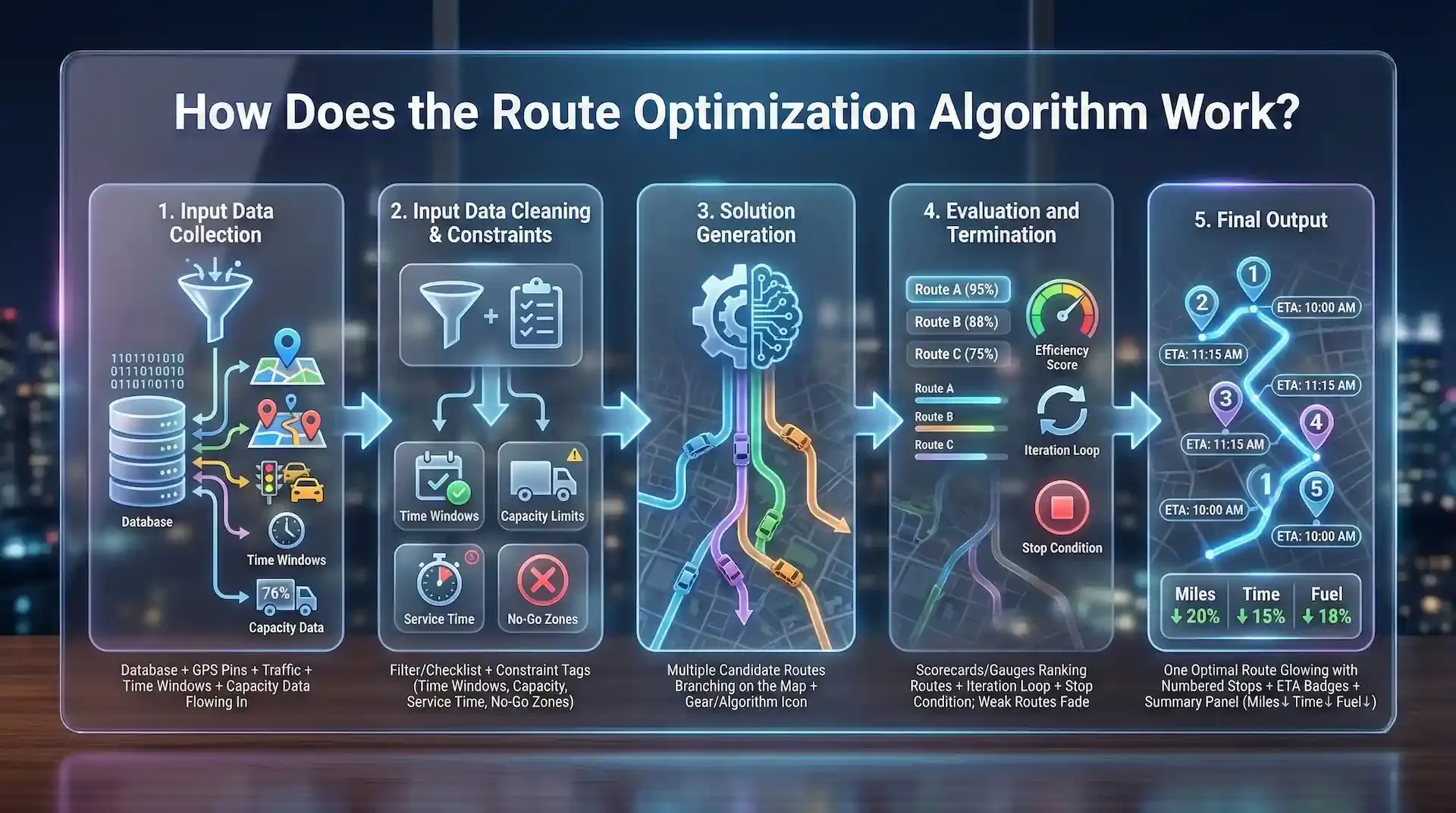
Route optimization algorithms process a variety of input data to formulate and solve complex problems like the Traveling Salesman Problem (TSP) and the Vehicle Routing Problem (VRP).
The general process involves:
Input Data Collection
Route optimization starts with input data. The system collects addresses or GPS coordinates for every stop, then pulls distances and estimated travel times between locations. It also adds operational details like time windows, service time per stop, vehicle capacity, and driver schedules.
Problem Formulation
Next, the system defines the routing goal. It can be the shortest total distance, the fastest total completion time, the least fuel use, or the maximum on-time deliveries. It also sets hard constraints like deliver before 12 PM or do not exceed an 8-hour shift.
Solution Generation
Now the system builds an initial route plan. This first plan gives a baseline sequence of stops. Then the system improves the route by trying better combinations.
After that, the system tests changes like swapping stop orders, reordering stop clusters, or moving strict-window jobs earlier. It keeps the best-performing route and repeats until the plan becomes optimized.
Evaluation and Termination
Each route options are then scored. The scoring usually includes total travel time, total distance, and penalties for violations. For example, late arrivals or overloaded vehicles have demerit points. Higher penalties push the system away from routes that look efficient but break rules.
The system stops when it reaches a limit. It may stop after a time cap, after a set number of improvements, or when the route stops getting better. This keeps routing fast enough for daily dispatch.
Unlock smarter field routing with FieldServicely today!
Book a Demo
Final Output
The final output is a usable route plan. It includes the stop sequence, estimated arrival times, and sometimes recommended start times. Drivers get a clear plan to follow, and managers get routes that stay realistic under real-world conditions.
Common Types of Route Optimization Algorithms
Different teams use different algorithm types depending on what you care about most:
- Do you want the perfect route?
- Do you want a fast route plan in seconds?
- Do you need routes that change in real time when traffic hits?
I’ve worked with teams where one late delivery triggers refunds. I’ve also worked with teams where speed matters more than perfection because dispatch has to push routes out by 8:30 AM, no matter what. That’s why choosing the right algorithm type matters.
Let’s break it down in a way you can actually apply:
| Algorithm Type | What It Does | Best For | Limitation |
|---|---|---|---|
Exact | Finds the perfect route. | Small routes, planning, and high-value jobs. | Too slow at scale. |
Heuristic | Finds a good route fast. | Daily routing, small teams, quick dispatch. | Not optimal, weak with heavy constraints. |
Metaheuristic | Finds near-optimal routes. | Large routes, many constraints, real ops. | Needs tuning + compute time. |
Dynamic / Real-Time | Re-routes during the day. | Traffic, cancellations, urgent jobs. | Needs live data + integrations. |
Hybrid and Learning-Based Algorithms | Combines multiple algorithms and improves routes over time | Large fleets, complex operations, changing conditions | Higher complexity and strong data dependency |
Exact Algorithms
Exact algorithms give you the absolutely optimal solution. If an exact method says “this is the best route,” then yes, it really is the best route.
So why doesn’t everyone use them?
Well, that’s because exact algorithms get expensive fast. The more stops you add, the more route combinations exist. And that growth becomes insane once you go beyond small route sizes. In daily operations, you often don’t have the luxury of waiting for a perfect answer.
Here’s how you’ll see exact algorithms used in the real world:
- Strategic planning (weekly/monthly)
- Smaller fleets
- High-value deliveries where every mile costs money
- Benchmarking other algorithms
Exact algorithms work great when your routing problem stays small and stable. But when you manage real routes with 40–150 stops, they become too slow to run at dispatch speed.
Common examples:
- Branch and Bound
- Integer Linear Programming (ILP)
- Dynamic Programming
Heuristic Algorithms
Heuristic algorithms focus on one thing: SPEED.
They don’t try to prove the best route, but produce a route that makes sense fast. That’s why dispatch teams love heuristics. You can generate routes quickly, send them out, and move on.
This matters because routing is not a one-time math problem. It’s a daily operational decision. And daily operations need speed.
Here’s what heuristics usually look like:
- Go to the nearest stop next.
- Cluster stops in the same area.
- Handle time-window stops early.
That may sound simple, but simple rules solve a big part of routing pain. Especially when you don’t have heavy route optimization constraints.
You’ll see heuristic algorithms used for:
- Last-mile delivery route planning
- Field service routes (techs visiting customers)
- Small businesses that want fast planning without complexity
- Teams that want a reliable baseline route
Now, here’s the limitation:
Heuristics can create routes that look good but still waste miles. They can also struggle when constraints stack up (capacity, time windows, priorities, shift limits). That’s when you need a stronger approach.
Common examples:
- Nearest Neighbor
- Clarke and Wright Savings Algorithm
- Sweep Algorithms
If you’re routing 10–30 stops with light constraints, heuristics often work fine. However, for routing 80+ stops with strict windows, heuristics alone will start breaking.
Metaheuristic Algorithms
This is where route optimization gets serious. Metaheuristics are built for messy routing problems. They don’t aim for perfection. They aim for near-optimal in a reasonable time. And in real logistics, that’s usually the sweet spot.
Metaheuristics work like smart trial-and-error. It explores routes strategically.
They start by generating a few strong candidate routes instead of trying everything. After that, they improve those routes through small, controlled changes like swapping stops or reshuffling segments.
Metaheuristics also avoid getting stuck with weak route plans. When a route stops improving, the search shifts direction to explore better options. This is how the system keeps pushing toward better performance without wasting time.
Metaheuristics are especially useful when you have:
- 50 - 300+ stops
- Tight delivery windows
- Different vehicle types
- Capacity limits
- Priority customers
- Multiple depots
And yes, research backs up why these methods are popular. Springer discussed how these approaches solve complex optimization problems across logistics and routing use cases.
Common examples:
- Genetic Algorithms
- Simulated Annealing
- Ant Colony Optimization
- Tabu Search
Dynamic / Real-Time Algorithms
Even the best route plan becomes useless if traffic spikes, a customer cancels, or a new urgent job comes in. That’s why modern route optimization is moving toward dynamic routing.
Dynamic algorithms update routes in real time. They don’t treat routing like a fixed morning plan.
Also, it responds to what actually happens on the road. It reacts to live traffic congestion, road closures, and weather issues that slow drivers down. It also adapts when new orders come in or when a delivery fails and needs a second attempt.
According to INRIX, congestion remains a major time drain in cities worldwide, which makes static routing unreliable in many regions.
Common examples:
- Real-time re-optimization
- Online route adjustments using live GPS + traffic feeds
If your business runs on tight scheduling, this algorithm becomes your safety net.
Hybrid and Learning-Based Algorithms
Hybrid and learning-based algorithms don’t rely on one rule set. Instead, they combine multiple approaches to get usable routes fast and improve them over time.
Hybrid systems usually work in layers. Heuristics generate fast initial routes. Metaheuristics refine them. Dynamic logic adjusts them in real time. Learning components analyze results and feed improvements back into the system.
Here’s how you’ll see hybrid and learning-based algorithms used in the real world:
- Daily dispatch with tight cutoff times
- Large fleets with changing conditions
- Operations that reroute during the day
- Businesses that want routes to improve week over week
Common examples:
- Hybrid heuristic–metaheuristic models
- Reinforcement learning–assisted routing
- Adaptive optimization engines
Use the best algorithm based route optimization
Try for free - No credit card required!
Benefits of Route Optimization Algorithms
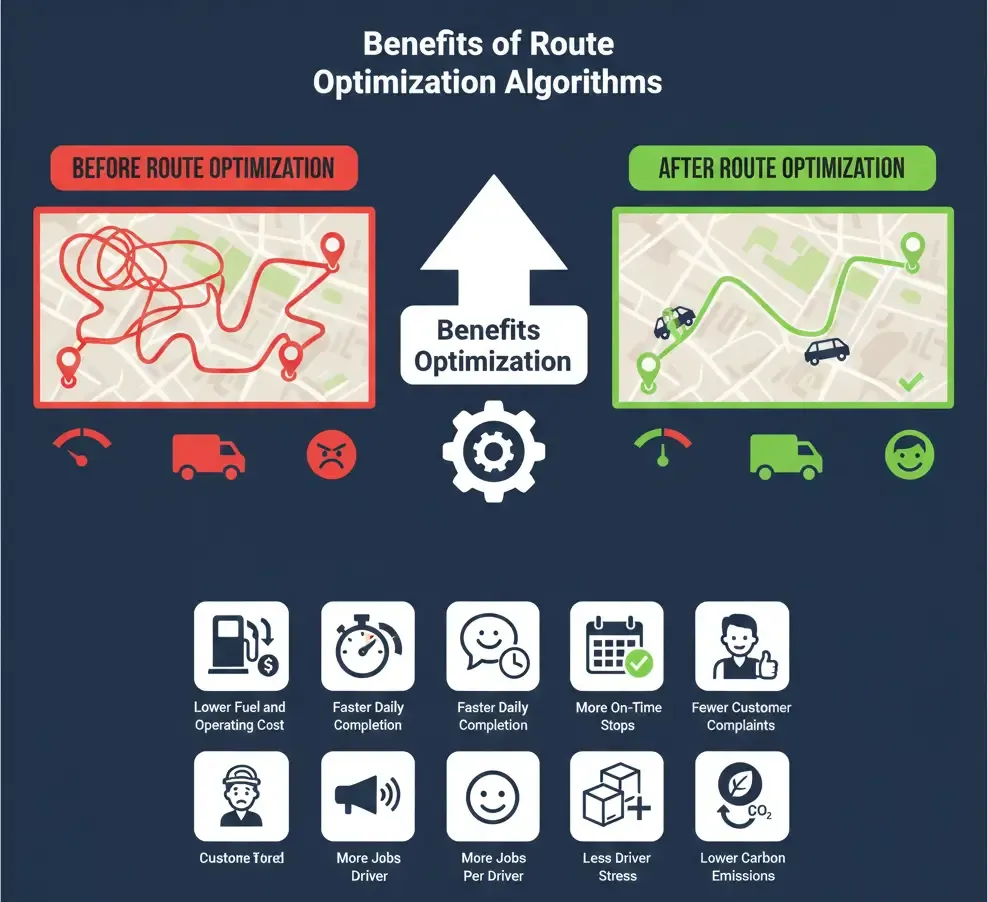
Route optimization doesn’t make problems disappear. It just makes your day far more predictable.
Here are the real advantages of route optimization algorithms:
Lower Fuel and Operating Cost
Route optimization reduces cost because vehicles drive fewer unnecessary miles. Less driving means less fuel burn, fewer repairs, and fewer overtime hours.
And this isn’t just small savings. UPS says its ORION routing system saves 10 million gallons of fuel per year by cutting unnecessary driving.
Faster Daily Completion
Route optimization makes routes faster because the stop order makes sense. Drivers stop bouncing across town. They stop hitting the same roads twice.
Research also supports this type of improvement. A 2024 study on last-mile routing optimization discusses how routing decisions affect both travel time and reliability in congested networks.
More On-Time Stops (Fewer Missed Windows)
Route optimization improves on-time performance because it protects time windows. It doesn’t just send drivers to the closest stop. It sends them to the stop that matters most right now.
That matters because missed windows create a chain reaction:
- late arrivals
- failed deliveries
- re-delivery attempts
- angry customers
Research highlights how adapting routing decisions improves service reliability under changing conditions.
FieldServicely helps you protect time windows by building routes around what matters most right now. You can prioritize strict appointment stops, reduce late-arrival risk, and keep the day on schedule even when conditions change.
Reduce missed time windows
Try for free - No credit card required!
Fewer Customer Complaints
Route optimization improves customer experience because ETAs get more accurate. Customers stop waiting all day. And your support team stops getting those “Where is the driver?” calls.
This is the benefit that doesn’t show up on a spreadsheet right away, but you feel it operationally.
More Jobs Per Driver
Optimization algorithms increase capacity by removing dead time. When drivers spend less time driving in circles, they can complete more stops in the same shift.
Less Driver Stress
Drivers are stressed less with the use of an appropriate route optimization algorithm. They stop feeling like the route is fighting them. They stop getting blamed for delays caused by bad planning.
Lower Carbon Emissions
An efficient algorithm reduces emissions as fuel usage drops. For many companies, this is now a great concern beyond cost. Sustainability reporting is becoming common in logistics and transport.
Better Planning and Less Firefighting
An optimized route algorithm makes dispatch more stable. As routes stop changing every hour, planners stop rebuilding schedules from scratch.
Real-World Applications of Route Optimization Algorithms
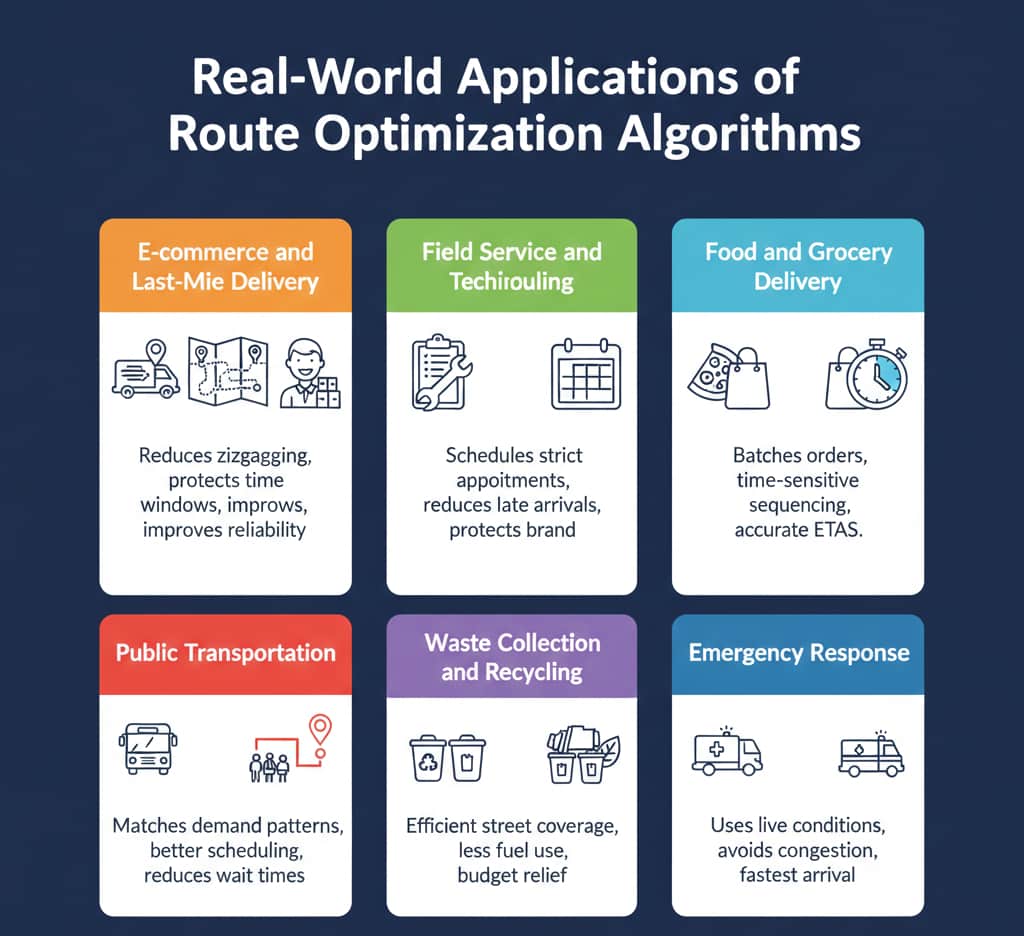
Here are the top 6 real-world applications where route optimization delivers the biggest impact.
E-commerce and Last-Mile Delivery
Last-mile delivery is where routing becomes brutal. Drivers deal with dense neighborhoods, parking issues, apartment buildings, gated communities, and customers who expect fast delivery windows.
This is also where one bad stop order can ruin everything. A driver might hit a close stop first, then spend the next hour crossing the city as the remaining stops are scattered. Now the driver misses delivery windows and burns fuel for no reason.
Route optimization fixes that by sequencing stops in a way that reduces zigzag driving. It also protects strict time windows early, so the route doesn’t collapse later in the day.
And yes, routing choices directly affect reliability. Research explains how routing decisions influence travel time and service reliability in real transport networks.
Field Service and Technician Scheduling
Field service routing looks similar to delivery, but the pain is different.
Here, you don’t just drop a package and leave. You enter a job site. You diagnose, fix, install, and then you explain. Sometimes, you might even upsell. That means service time matters as much as travel time.
Manual routing often fails because dispatch sees jobs like map pins. Dispatch often thinks that the nearby one is the next destination. But in reality, that closest job might take 90 minutes and take up another job’s slot.
Route optimization solves that by building routes around real job duration and appointment windows. It schedules strict appointments first, then fits flexible jobs around them. This reduces late arrivals and customer frustration.
Food and Grocery Delivery
Food delivery has one rule: late delivery ruins the product. Nobody wants cold fries, soggy pizza, or melted ice cream. That’s why an optimized route algorithm matters more here than in many other industries.
The hardest part is batching. Drivers often carry multiple orders at once. Without smart routing, batching becomes a disaster.
For example, the driver picks up three orders, then drops them in the wrong sequence. One customer gets food late, another cancels, and the third one complains. Now you refund, re-deliver, and lose the customer.
Route optimization reduces this by sequencing deliveries based on time sensitivity and travel time. It also helps avoid backtracking between restaurants and drop-offs. That improves delivery time and makes ETAs more accurate.
Public Transportation
Public transportation is routing at scale. Agencies plan routes, schedules, and coverage areas for thousands of riders. And unlike delivery, they don’t just optimize for cost. They optimize for service quality.
Bad routing in transit shows up fast:
- Long wait times
- Crowded buses
- Missed transfers
- Unreliable schedules
Route optimization helps transit agencies design routes that match demand patterns. It also supports better scheduling, especially during peak hours when traffic and passenger load change quickly.
Waste Collection and Recycling
Waste collection looks simple until you plan it for an entire city. Trucks have to cover thousands of streets, follow specific collection times, avoid repeating roads, and finish within shift limits.
Manual routing often creates hidden waste:
- Repeated street segments
- Unnecessary turns
- Long deadhead travel between zones
- Over time, due to poor sequencing
Taking advantage of a great algorithm for optimizing route help fix this by planning efficient street coverage. It reduces repeated segments and unnecessary travel.
And in waste collection, those savings matter as trucks carry heavy loads and burn fuel fast.
Emergency Response (Ambulance and Fire Services)
Emergency response routing is where the magic of algorithmic route optimization becomes critical, as one simple mistake can be fatal.
It’s worth noting that a route that looks short on a map can still be slow in real life because of traffic, construction, or road closures. Emergency services can’t afford that mistake.
An algorithm designed to tackle these obstacles supports emergency routing by using live road conditions. It helps select routes that avoid congestion and closures. It also adapts in real time when conditions change.
This is one of the clearest examples of why routing is not just a business tool, but a tool for public safety.
Challenges of Not Using Route OptimziOptimization Algorithm
- The first issue of not using a route optimization algorithm is wasted fuel. Drivers take longer paths, miss better turns, or backtrack between stops. Studies show fuel/emissions reductions from pre-trip eco-routing systems span from 4% to 46%
- Then there’s wasted time. Dispatchers spend hours planning routes that fall apart once traffic hits. Drivers lose even more time sitting in congestion or fixing a poor stop order.
- Then, productivity drops fast. Without optimization, drivers finish fewer deliveries per day because routes don’t balance distance, traffic, and time windows. Algorithms handle this complexity far better than humans once routes scale.
- Late deliveries become common. Static routes cannot react to accidents, road closures, or delays. Research shows real-time route optimization improves on-time delivery by constantly adjusting ETAs.
- Driver stress also increases. Poor routes mean longer shifts and constant last-minute changes. Inefficient routing leads to higher driver fatigue and turnover.
- The environmental impact adds up, too. Extra miles mean more fuel burned and higher emissions. Optimized routing consistently lowers carbon output across fleets.
Upcoming Trends in Route Optimization Algorithms
AI-Driven Routing
AI-driven routing is becoming the default for modern logistics teams. These algorithms learn from past routes, live traffic, and delivery results to improve route quality every day. McKinsey reports that companies using AI in logistics reduce delays and transportation costs at scale.
Predictive Demand Forecasting
Predictive analytics is replacing reactive route planning. Algorithms now forecast demand using historical orders, seasonal patterns, and market shifts before routes are created. This approach reduces last-minute changes and keeps delivery plans stable during peak demand.
Real-Time Traffic and Weather Responsive Routing
Real-time adaptability has become essential for reliable routing. Modern systems adjust routes instantly when traffic congestion, accidents, or weather disruptions occur. Real-time routing improves delivery reliability, especially in dense urban areas.
Sustainability-Driven Route Optimization Strategies
Sustainability is now built directly into routing decisions. New algorithms reduce fuel use, idle time, and emissions while planning routes, not after deliveries finish. The International Energy Agency highlights smart routing as a key lever for cutting transport-related emissions.
Electric Vehicle-Focused Route Optimization Models
EV-specific routing is becoming critical as fleets electrify. These algorithms account for battery range, access to charging stations, and energy efficiency to prevent route failures. Research reports strong growth in commercial EV fleets, pushing companies to rethink routing logic.
Multi-Modal and Last-Mile Route Integration
Multi-modal routing is moving into the mainstream. Algorithms now combine trucks, bikes, rail, and last-mile options into one coordinated plan. Research shows businesses using multi-modal routing reduce last-mile costs and delivery times by 15%-20%.
Conclusion
Route optimization algorithms simply remove the guessing that ruins real delivery days. Instead of picking stops by “what looks close,” you get a route that respects traffic, time windows, service time, and driver limits. So the plan doesn’t collapse the moment one delay hits. In short, smarter routing doesn’t just save miles. It keeps your entire operation calm, consistent, and reliable.
Frequently Asked Questions
What is the best algorithm for route optimization?
Exact algorithms work best for small, stable routes where accuracy matters most, while heuristic algorithms suit fast daily planning with fewer constraints. For large, real-world operations, metaheuristic and hybrid algorithms perform best because they balance route quality, speed, and real-time adaptability.
What are the 4 types of routing?
The four types of routing are Static Routing, Dynamic Routing, Interior Gateway Protocols (IGP), and Exterior Gateway Protocols (EGP). Static routing is manual and fixed, while dynamic routing updates paths automatically using routing protocols.
What data do I need to start using route optimization algorithms?
You need accurate stop addresses, service time per job, time windows (if any), driver shift hours, and vehicle limits. Even basic inputs can improve routing, but cleaner data gives better results.
How accurate are route optimization algorithms in predicting ETAs?
ETAs are usually close when the system has real traffic data and correct service time estimates. ETA accuracy drops when job durations are guessed or when drivers don’t follow the planned stop order.
Can route optimization algorithms work without live traffic data?
Yes, they can still work using historical travel times and distance-based routing. But you’ll lose real-time adjustment, which matters a lot in cities with unpredictable congestion.
How often should routes be re-optimized during the day?
Re-optimize when something major changes, like cancellations, failed deliveries, technician delays, or urgent add-on jobs. For busy operations, re-optimizing 2–5 times a day is common.
What are the biggest mistakes companies make when using route optimization?
The biggest mistake is feeding wrong inputs, especially the service time per stop. Another common mistake is overriding the suggested route too often, which breaks the optimization logic and creates chaos again.