- Route optimization and planning
Route Optimization Constraints: Types, Examples and Use Cases
Updated on 28 Jan 2026
Jump to
Summary

Route Optimization Constraints are business rules and limitations such as time windows, vehicle capacity, skills, and availability.
McKinsey reports that around 10% of last-mile deliveries require re-delivery, which costs carriers 1%–3% of revenue due to poor constraint handling.
Different industries apply constraints differently, from food freshness and medical compliance to driver skills and traffic rules.
Hard constraints enforce non-negotiable limits, while soft constraints guide efficiency and workload balance.
Well-managed constraints reduce waste, improve on-time delivery, and stabilize operations at scale.
Route optimization constraints are the rules that shape how routes are planned in real-world operations. When managed well, constraints cut costs and reduce delays. It can also improve on-time delivery and stabilize daily operations.
However, businesses struggle to define and manage these constraints correctly. Routes break when teams guess service time, ignore waiting limits, and lock plans too early.
In this blog, we will discuss types of route optimization constraints. We will also discuss how businesses can manage them effectively.
What are Route Optimization Constraints?
Route optimization constraints are business guidelines. They limit how routes are created so they remain realistic, compliant, and efficient.
Plus, they control time, distance, capacity, workload, and revenue. So routes work in real operations.
From personal experience, I have seen constraint-based routing fail, not because route optimization algorithms are weak. They fail because constraints are missing.
That is where problems usually begin.
To clarify, briefly review the most common limitations used in real-world route planning systems.
| Constraint Name | Impact on Route Planning | Challenges |
|---|---|---|
Route count limit | Controls how many routes are created from a job pool | Needs accurate fleet availability |
Route duration limit | Keeps routes within workable time limits | Often increases total routes |
Distance limitations | Prevents routes from becoming too long | Requires better stop clustering |
Stop count limit | Balances workload per driver | Hard to distribute stops evenly |
Stop spacing limit | Reduces backtracking and inefficient zig-zag routes | Limits routing flexibility |
Vehicle capacity limit | Prevents overloading vehicles | Depends on accurate order data |
Weight limit | Ensures vehicle safety and compliance | Weight data is often estimated |
Volume limit | Protects usable cargo space | Volume is hard to measure precisely |
Waiting time limit | Reduces driver idle time | Some jobs may remain unassigned |
Revenue limit | Controls value concentration per route | Requires demand forecasting |
Stop guessing. Start routing with real data
Get started free today
Understanding the Types of Route Optimization Constraints
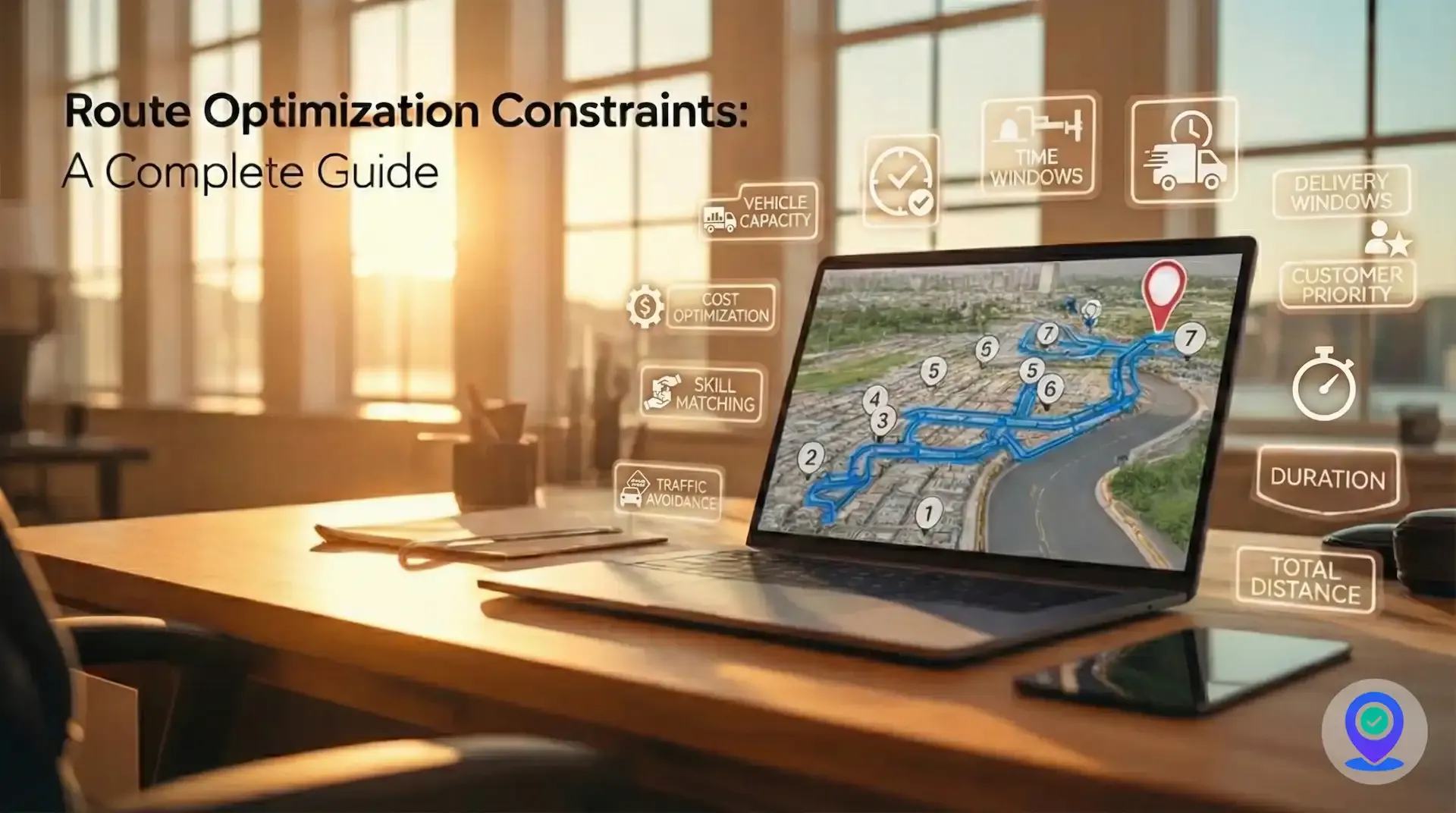
Route optimization constraints fall into clear groups tied to daily operational control. It should cover five categories: vehicle, time, location, service, and real-time changes.
Vehicle and Fleet Constraints
Vehicle and fleet constraints limit what each vehicle can carry and what kind of jobs it can accept. That means capacity by weight, volume, or package count, plus vehicle type rules like refrigerated vans for perishables.
Here’s the practical issue. Two orders can be the same weight but take very different spaces. If you plan by weight only, you still end up with a truck that cannot close its doors.
Operationally, this causes loading delays, last-minute reassignments, and idle vehicles. Each issue raises per-route costs. And then there is compatibility. Some loads simply cannot share a route, like certain medical goods and other product classes. Fleet optimization prevents those mistakes upfront.
When compatibility rules are ignored, products get damaged. Returns increase. Compliance risks grow, and customers lose trust. This impacts margins and customer trust.
Time and Schedule Constraints
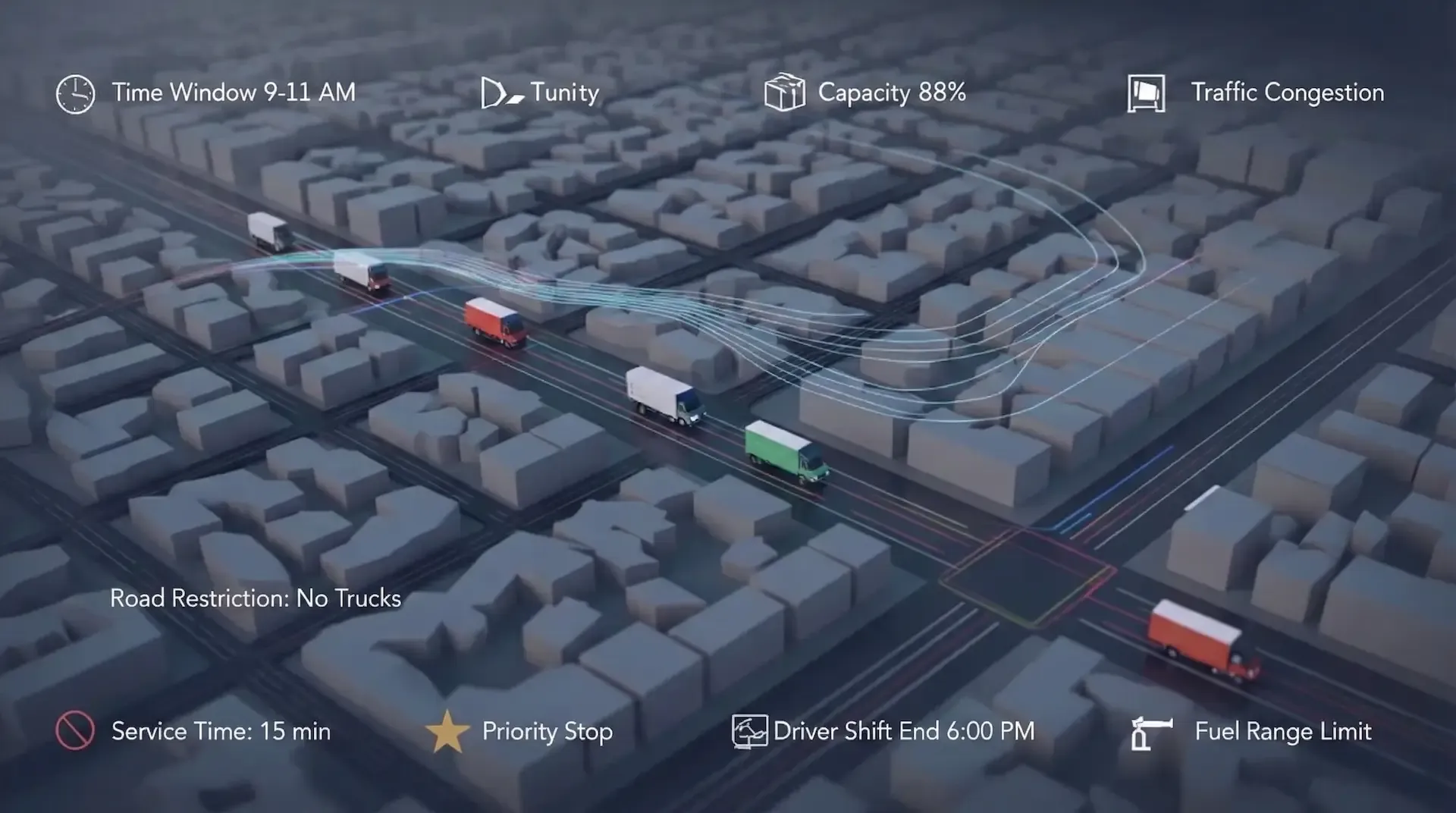
Time and schedule constraints control when stops can be served and how long work can run. This includes time window constraints, driver shift start and end times, break rules, service time at each stop, and max waiting time.
Why does this category matter so much? Because they are the backbone of on-time delivery and SLA compliance, time problems cascade.
A single missed time window can trigger re-deliveries. McKinsey notes that around 10% of last-mile packages need re-delivery, and re-deliveries can cost carriers 1% to 3% of revenue. Beyond cost, repeated failures reduce customer lifetime value and increase support overhead.
Now bring in the max waiting time. If a driver arrives early and waits too long, you pay for idle time and risk every later stop. Without waiting limits, paid hours increase while completed jobs stay flat. This hampers productivity metrics.
Pickup and Sequencing Constraints
Some jobs are connected and cannot be planned on their own. They depend on each other, so the route must handle them together.
For example, pickup and delivery rules make sure an item is picked up before it is dropped off. In the same way, sequencing rules set the correct order for doing certain jobs.
Because of this, these rules stop mistakes that would make a route impossible to complete.
Driver and Workforce Constraints
Routes must account for people, not just vehicles and distance. A plan may look efficient, but it breaks down if it ignores human limits.
First, driver working hours and required breaks set clear boundaries on how long someone can drive or work. Next, certain jobs require specific skills or certifications, so only qualified drivers can handle them.
As a result, these constraints protect compliance, reduce risk, and help deliver reliable service.
Location and Stop Constraints
Location and stop constraints define where routes must start and end, and where vehicles can or cannot go. This includes depot start and end points, geofencing for restricted zones, and priority stops.
Here’s the question most teams forget to ask: Should every customer be treated the same?
The answer is no, because you often have VIP customers, medical deliveries, or sites with tight penalties. Those stops need earlier placement, even if it adds distance. From a business perspective, this protects high-value contracts and avoids penalty clauses tied to late service.
Geofencing also matters for safety, compliance, and consistency. If drivers keep freestyling around no-go zones, you lose control of the operation. According to ESRI, geofencing is a core real-time method to detect whether assets enter or exit defined areas.
This reduces compliance violations and gives operations teams audit-level visibility into route behavior.
Geographic and Zone Constraints
Not all drivers or vehicles are allowed to go everywhere. In many cities and regions, access restrictions and zone rules limit where certain vehicles can operate. This affects how routing and planning are done in transportation and logistics.
For example, urban vehicle access regulations like low- and zero-emission zones restrict entry based on vehicle type and emission class. This rule is imposed to reduce pollution and meet environmental standards. These restricted areas can ban or charge non-compliant vehicles.
In addition to emission-based rules, location-specific restrictions such as limited traffic zones and time-based access bans further shape routes.
Service and Task Constraints
Service and task constraints ensure the right job goes to the right person with the right handling rules. This includes skill requirements, package types, and customer preferences.
Guess what the cost of sending the wrong tech is?
It is rarely just one failed visit. It is a chain of repeat dispatches, delayed resolutions, and frustrated customers. Even one mismatch creates repeats, delays, and frustrated customers. In dispatch-heavy businesses, skill constraints keep first-time fix rates from falling apart. So a higher first-time fix rate directly reduces fuel usage, labor hours, and customer churn.
Assign the right technician using skill-based routing rules
Start free trial
Dynamic and Real-Time Constraints
Dynamic and real-time constraints adjust routes when reality changes after dispatch. The biggest challenges are traffic and last-minute changes. It also includes new orders, cancellations, and driver issues.
If you rely on static plans, you get static failures.
INRIX 2025 data shows drivers in major cities lose 90 to 118 hours annually to congestion. This lost time raises labor costs, causes missed SLAs, and reduces daily route capacity.
If your system cannot re-optimize during the day, it cannot protect SLAs during busy hours.
Workload and Balance Constraints
Efficiency is not only about distance or speed. Even a short route can become problematic if the workload across drivers is uneven.
Instead, workload and balance constraints ensure that effort is spread fairly across a team. Research shows that balanced workload allocation is linked to better operational outcomes and higher acceptance of schedules among drivers.
In the real world, driver fatigue is more than a comfort issue. It affects safety and performance. Long hours without proper rest are a key factor in reduced alertness and road risks.
That’s why fair scheduling and balanced workloads are part of fatigue management strategies.
Hard vs Soft Constraints
Finally, constraints also differ in how strictly they must be followed. Some rules are absolute and leave no room for flexibility during planning or execution.
In contrast, hard constraints cannot be violated under any condition. These include vehicle capacity limits or legal working hours.
Soft constraints, however, act as optimization goals, such as reducing total distance or balancing workload. While they can be adjusted if needed, they still guide the system toward better and more practical routes.
Why Route Optimization Constraints Matter?
Route optimization constraints define how routing decisions align with real business operations. While routing software can calculate the fastest or shortest paths, constraints ensure those routes can actually be executed in the real world.
First, constraints enforce operational feasibility. Time windows ensure services happen when customers expect them. Service times and job durations prevent unrealistic back-to-back scheduling. Vehicle capacity, vehicle type, and driver working hour limits ensure routes stay compliant with physical and legal boundaries.
Research shows that effective route optimization depends on balancing cost, time, and operational rules together, not in isolation.
Second, constraints drive cost control and efficiency by reducing empty miles, increasing productive stops, and balancing workloads across drivers. Plus, they enable reliability and adaptability. This allows routes to adjust to traffic, delays, or new orders without collapsing the entire schedule.
Examples of Route Optimization Constraints
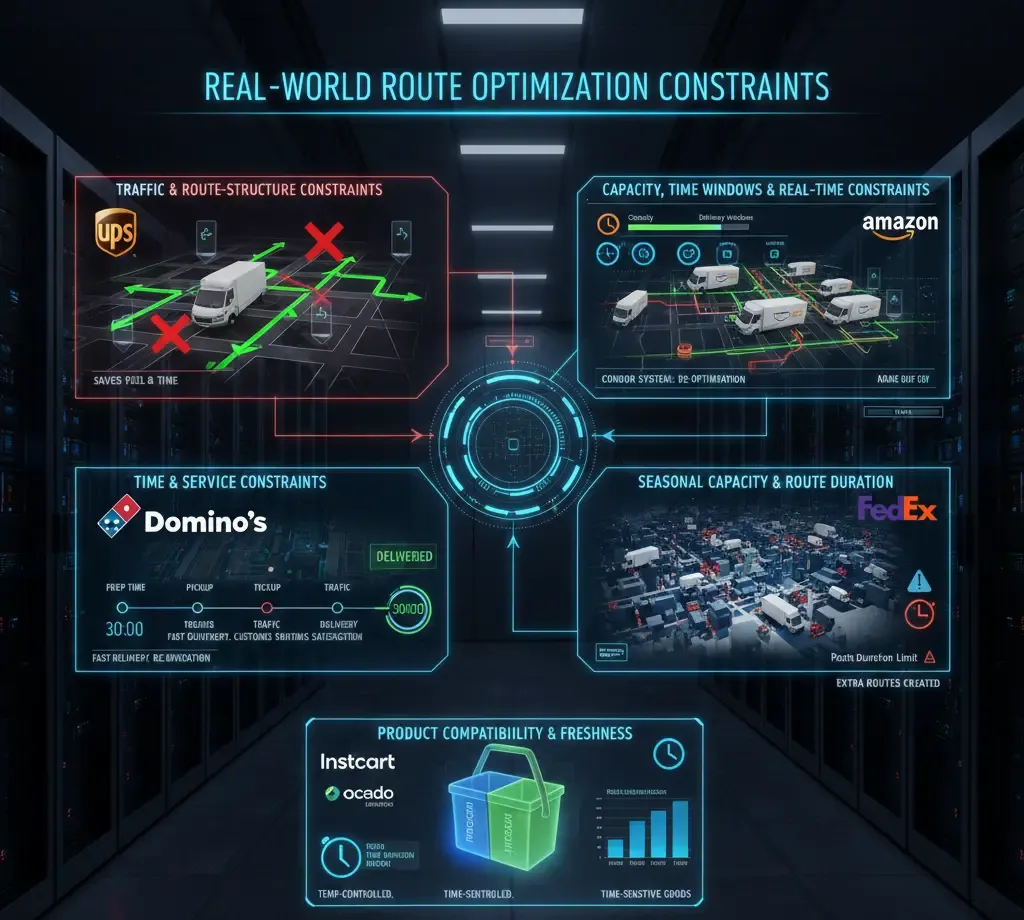
Here are some real-world route optimization constraints:
UPS: Traffic and Route-Structure Constraints
UPS is one of the most cited examples of constraint-driven route optimization. They apply strict traffic and route-structure, including limiting left turns in cities.
Just so you know, left turns increase idle time, fuel burn, and accident risk. So routes favor right turns and safer intersections instead.
As a result, drivers idle less and burn less fuel. Accident exposure also drops. UPS reports saving millions of gallons of fuel each year while improving delivery consistency.
Amazon: Capacity, Time Windows, and Real-Time Constraints
Amazon's last-mile network relies heavily on capacity, time window, and real-time re-optimization constraints. Each route must respect vehicle capacity, delivery windows, and live traffic changes. [Source: PubsOnline]
Their CONDOR system rebalances routes as conditions shift. New orders, cancellations, or traffic congestion trigger automatic re-optimization. These constraints support same-day and next-day delivery while controlling cost per package. They also protect SLAs at high volume.
Domino’s Pizza: Time and Service Constraints
Domino's delivery model is built around time-based and service constraints. So each route must account for preparation time, service time at pickup, traffic conditions, and delivery time promises.
The constraint sounds simple yet strict. Late delivery directly impacts brand trust.
By enforcing delivery-time constraints and real-time routing, Domino’s protects its core promise of fast delivery. The business impact is customer satisfaction.
FedEx: Seasonal Capacity and Route Duration Constraints
FedEx faces extreme variability during peak seasons. To manage this, the company relies on route duration, stop limits, and capacity constraints.
During holiday peaks, routes are capped to prevent driver fatigue. Plus, extra routes are automatically created when limits are reached. Also, traffic and weather constraints adjust plans throughout the day.
This constraint-driven approach allows FedEx to maintain delivery reliability even when volume spikes. They enable FedEx to absorb demand surges without losing control.
Grocery Delivery Platforms: Multi-Stop Route Optimization and Product Compatibility Constraints
Platforms like Ocado and Instacart deal with products that spoil, melt, or lose quality fast. That makes product compatibility, sequence, and freshness core to how deliveries are planned, not just logistics details.
Because items are sensitive, routes must keep frozen and fresh products within safe temperature limits from pickup to delivery. At the same time, deliveries must happen within tight customer time windows, which limits routing flexibility.
These temperature and timing limits directly affect pickup and drop-off orders. If sensitive items are delivered too late or loaded incorrectly, product quality drops even if the route is efficient.
See how constraint-driven routing works for operations
Route Optimization Constraints by Industries
Route optimization constraints change shape depending on the industry. In some industries, a delay means refunds. In others, it means safety risks. However, there are many benefits of route optimization across industries.
Logistics and E-commerce
In logistics optimization and e-commerce, scale is the biggest constraint of all. Thousands of daily stops, tight delivery windows, rising fuel costs, and limited driver hours all collide.
The constraints here are time windows, vehicle capacity, delivery density, and driver shifts. When any one of these fails, re-deliveries begin to stack up.
Industry studies show that failed deliveries can cost $17.20 per attempt. That is why routing decisions must respect constraints before vehicles leave the depot.
Field Services
Field service routing is less about distance and more about execution precision. Each job demands the right technician, the correct tools, and a viable time window.
According to research, AI route optimization significantly improves service efficiency and outcomes. Sending the wrong technician increases repeat visits, wasted labor, and customer dissatisfaction.
Reducing travel distance helps. But only after assigning the right technician and confirming accurate appointment times.
Food and Beverage Delivery
Food delivery operates under a clock that never pauses. Freshness, temperature control, and narrow delivery windows define success in this industry. Key constraints include service time, delivery windows, product compatibility, and stop sequencing.
Routes suitable for dry goods often fail for hot meals or frozen items.
A 2024 study of 356 food delivery users found that people keep using apps when deliveries meet expectations and feel reliable. That means late deliveries directly undermine satisfaction, increasing refunds and long-term customer churn.
Healthcare and Medical Services
Healthcare routing carries a different kind of weight. Here, constraints are tied to patient outcomes, not just efficiency.
Usually, time windows are strict in medical services. Skill requirements are non-negotiable. So any route delay can affect treatment schedules or patient safety. Capacity constraints also apply to mobile clinics and medical transport vehicles.
Waste Management
Waste management routes are repetitive, dense, and cost-sensitive. The goal is coverage without overlap. The key constraints are vehicle capacity, route length, stop sequencing, and depot return rules. Researchers found out that optimized collection routes can reduce fuel consumption by 15%-20%.
Emergency Services
Emergency services operate where time is the constraint that overrides all others. Therefore, response windows are measured in minutes. For such instances, routing must account for real-time traffic, road restrictions, vehicle availability, and shift coverage. Unlike other industries, rerouting must happen instantly, not after planning cycles.
For example, in cardiac emergencies, each minute without CPR or defibrillation lowers survival chances by about 7 to 10 percent.
Ride-Sharing and On-Demand Transport
Ride-sharing is built on constant change. Because traffic never stays still, demand shifts by the minute, and drivers come and go.
Constraints here include real-time traffic, driver availability, passenger wait time, and service duration. So, to find a sweet spot of supply and demand without overworking drivers is the main challenge here.
Industry mobility studies show that reducing passenger wait time by even one minute can significantly increase ride completion rates and retention.
Sales and Marketing Field Teams
Sales routing is often overlooked, but it carries hidden costs. Every extra mile driven is time not spent selling.
The main constraints are appointment windows, travel time, territory boundaries, and visit sequencing. Poor routing leads to fewer meetings and higher travel expenses. In such an instance, optimized routing increases daily client visits and operational efficiency. [Source: Arxiv]
How to Overcome Route Optimization Constraints
Teams that handle route planning and optimization constraints well prioritize control, visibility, and adaptability. The practices below help close that gap between planning and execution. Also, they lead to an efficient route optimization strategy.
Move From Static to Adaptive Routing
Static routes assume the day will unfold as planned. In practice, that assumption breaks quickly.
Traffic slows routes without any prior notice. Jobs often take longer than planned. Cancellations and urgent requests appear suddenly. As a result, early plans become outdated within hours.
When routes are treated as final, small disruptions accumulate. Missed appointments, overtime, and frustrated field teams usually follow.
Adaptive routing allows controlled changes during execution. The objective is not constant replanning. It is an early correction. When routes can absorb changes before delays spread, the rest of the schedule remains intact.
Get started with adaptive Routing
Try for free - No credit card required!
Plan With Realistic Time Assumptions
Time-related constraints break routes more often than distance. This usually happens because time is underestimated.
Service duration is guessed instead of measured. Waiting time is ignored. Breaks are treated as flexible buffers rather than fixed limits. On paper, the route appears efficient. In execution, it collapses.
Teams that perform well treat time as a fixed operational input. They plan using historical job duration, maximum waiting limits, and respecting shift boundaries.
Route density may decrease slightly, but reliability improves consistently.
Optimize for Workload Balance
Shortest paths are not always sustainable routes. Uneven workloads lead to fatigue, overtime, and inconsistent service quality.
Two routes can have the same distance and demand very different effort. One technician may handle long, complex jobs while another completes short, routine tasks. If routing only balances miles, the workload imbalance appears quickly.
Good routing balances the total workload. It considers travel time, service time, and job difficulty.
Plus, balanced routes are easier to complete. They are easier to fix when problems happen. They are also easier to manage each day.
Use Real-Time Operational Data
Constraints cannot be managed with maps alone. Planning data loses accuracy once execution begins.
Live traffic shows what is happening on the road. The technician location shows who is nearby. Job status and attendance show who is working.
This data guides better route changes. Without this visibility, teams notice problems too late. When routing decisions rely on real-time inputs, teams can act earlier.
Automate Constraint Handling at Scale
Manual planning does not scale with constraint complexity.
Capacity limits add complexity fast. Skill requirements make delivery route planning harder. Priorities and time windows add more pressure. Availability changes throughout the day.
Automation ensures these constraints are applied uniformly across routes every day.
Planners no longer need to juggle variables mentally. They can focus on exceptions, customer communication, and judgment-based decisions. This reduces dependency on individual expertise and improves operational resilience.
Introduce Constraints Incrementally
Enforcing all constraints at once often creates resistance. When you introduce too many rules at once, it becomes difficult to trust. As a result, teams often fall back on manual workarounds. Adoption drops even if the logic is correct.
High-performing teams introduce constraints gradually. They start with the issues causing the most disruption. It can be time windows or excessive travel.
Once stability improves, they add driver skills, capacity, and dynamic routing constraints. This phased approach lowers risk and improves acceptance.
FieldServicely brings scheduling, dispatch, GPS tracking, attendance, and jobs into one system. Everything teams need lives in one place.
Routing uses live technician availability and real job time. It also uses actual movement data from the field.
As work happens, plans update automatically. This keeps time windows, workloads, and availability under control all day.
Conclusion
Route optimization constraints are something businesses have to work with. Every route is shaped by limits like time, capacity, skills, and availability. It doesn't matter if those limits are planned for or not. When constraints are ignored or guessed, routes fail in execution.
FieldServicely helps close that gap. It connects planning with what is actually happening in the field. So constraints stay manageable instead of becoming daily problems.
Related contents