- Field Service Business
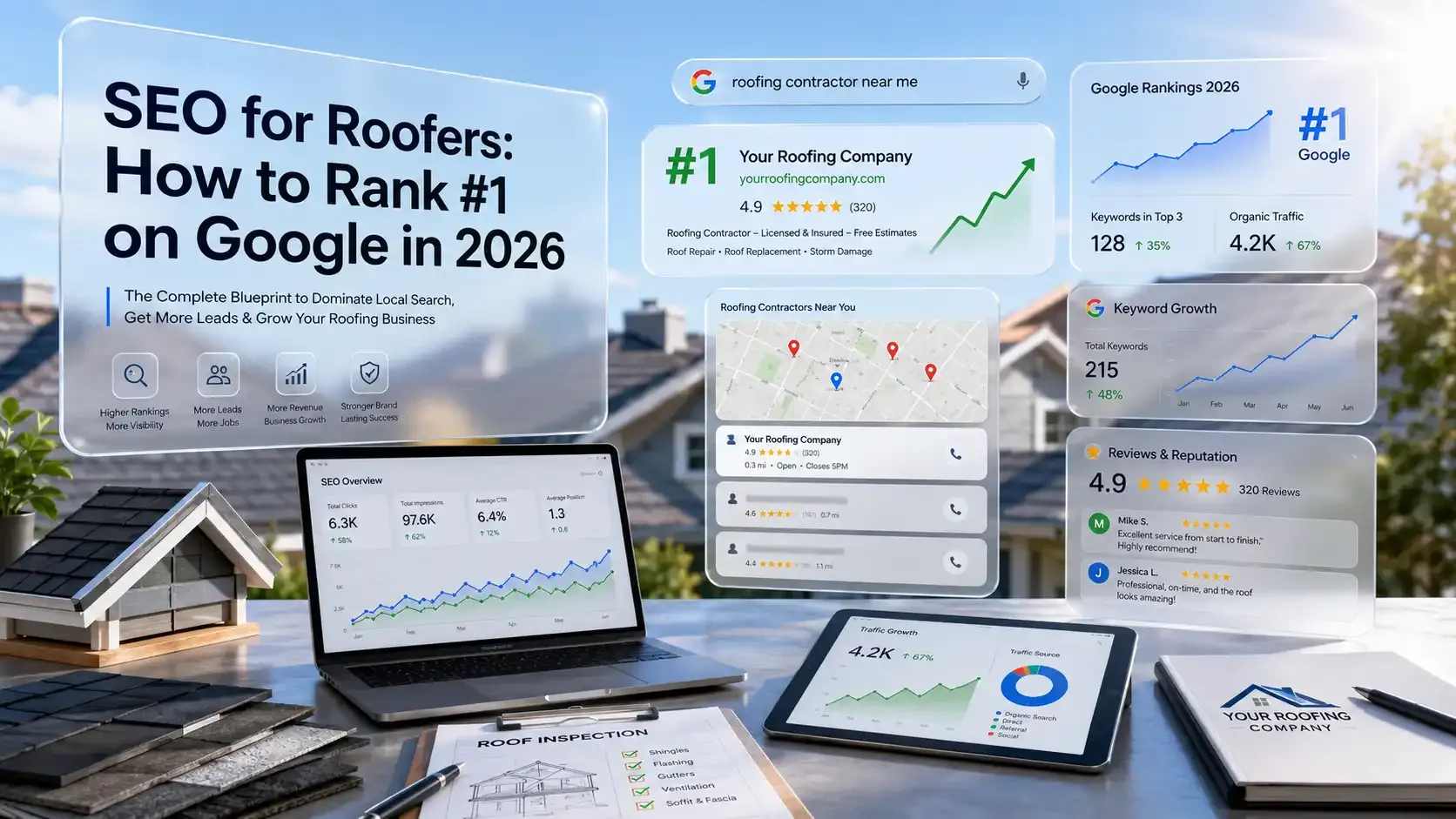
SEO for Roofing Company: How to Rank #1 on Google in 2026
Updated on 26 Jun 2026
Jump to
Summary

SEO helps roofers show up on Google organically and stop paying for every lead
Local SEO and a fully optimized Google Business Profile are the fastest way into the Map Pack
Every service, location, and keyword needs its own dedicated page to rank
Reviews, backlinks, and consistent business info across directories build trust with Google
AI search is changing how homeowners find roofers, and structured data keeps you visible
SEO for roofers is how you get your roofing company to show up on Google and generate leads without paying for every click. And right now, you're probably missing most of them.
62% of homeowners search online when they need a roofer. If you're not on page one, those people never see your name. They call whoever Google shows them first.
So what do most roofers do instead?
They throw money at ads that cost more every quarter. They buy shared leads that three other companies also got. Then they watch competitors with less experience outrank them because those guys invested in roofing SEO early.
That's what this blog is about. I'll walk you through how SEO for roofing companies actually works and what to do to start ranking higher and spending less.
What is SEO for Roofers?
Roofing company SEO is how you get your website to show up on Google when someone searches for roof repair, replacement, or inspection near them. You tweak your site, your Google Business Profile, and your online footprint so Google puts you in front of the right people.
But roofing SEO doesn't work like SEO for an online store or a blog. Not even close.
Think about how your customers find you. A homeowner's AC doesn't break the same way a roof leaks during a midnight storm. That person isn't browsing. They're panicking. They type "roofing contractor near me" and call whoever shows up first.
On top of that, demand swings with the weather. Searches for "emergency roof repair" jump 70% during storm months, and "roof leak repair" spikes 69% in the same window. Miss that wave, and your competitor catches every lead.
You also only serve a set area. That's why local SEO matters more than anything else. 76% of "near me" searchers visit or call a business the same day.
And one job pays well. A roof replacement runs $8,500 to $14,300 on a typical home. So even a handful of organic leads each month changes your bottom line.
Now, Google picks which roofer shows up based on three things:
- Relevance: Does your page actually match the search?
- Proximity: How close are you to the person searching?
- Prominence: Do your reviews, backlinks, and citations back you up?
That last one carries the most weight. So a roofer with 200 reviews and solid directory listings will outrank one that's closer but has a thinner online presence.
Why Roofing Companies Need SEO in 2026
Most roofers still throw money at Google Ads and pray something sticks. Meanwhile, over 53% of all website traffic comes from organic search. That's free traffic they're ignoring.
For local SEO for roofers, that share runs even higher. The companies ranking at the top aren't spending more. They just stopped depending on paid clicks alone.
But 2026 brought a new problem. Google AI Overviews now appear in roughly 55% of searches. These AI boxes sit above everything else on the page. They've already cut organic clicks by about 35%.
So, ranking on page one isn't enough anymore. You need the top spots, or Google's AI answer eats your traffic before anyone scrolls down.
Now look at the cost side. Roofing PPC averages $186 per lead right now. Google Ads costs jumped 19% in the last year alone.
In competitive states like Florida and Texas, roofers pay over $40 per click. Most of those clicks never turn into a phone call.
SEO for roofing companies flips that equation. Once you earn a top ranking, every lead costs zero. You own that spot, and the leads come straight to you.
| Channel | Cost Per Lead | Cost Per Lead |
|---|---|---|
Google Ads (PPC) | $186 | High intent, but expensive |
Google LSAs | $65–$95 | Declining quality |
Angi/HomeAdvisor | $50–$120 | Shared with competitors |
Organic SEO | $0 per lead* | Highest quality, exclusive |
Paid channels get pricier every quarter. Roofing SEO is the only channel where your cost per lead drops the longer you invest. Build it now, and twelve months from now you'll wonder why you ever relied on ads alone.
Every job your crew finishes is a lead you're not capturing online.
Track jobs, collect reviews, and build your Google presence in one app.
How Much Does Roofing Company SEO Cost?
Most roofing companies spend between $1,500 and $5,000 per month on SEO. The exact number depends on how many roofers you're competing against and how large your service area is.
Here's how that breaks down by market size:
| Market Size | Monthly SEO Cost | Expected Timeline |
|---|---|---|
Small market (under 5 competitors) | $750 to $1,500 | 3 to 4 months |
Mid-size city (10 to 20 competitors) | $1,500 to $3,500 | 4 to 6 months |
Major metro (30+ competitors) | $3,500 to $5,000+ | 6 to 12 months |
Those numbers probably feel steep. So let's run the math on what comes back.
The national average for a roof replacement sits at $10,800. Say your close rate on organic leads is 20%. If roofing SEO brings in 30 leads a month, that's 6 signed jobs. Six jobs at $10,800 each are $64,800 in revenue from a $3,000 SEO spend.
That's a 21x return. Even half those numbers would still crush what you'd get from paid ads.
Local SEO for Roofers: How to Dominate the Google Map Pack
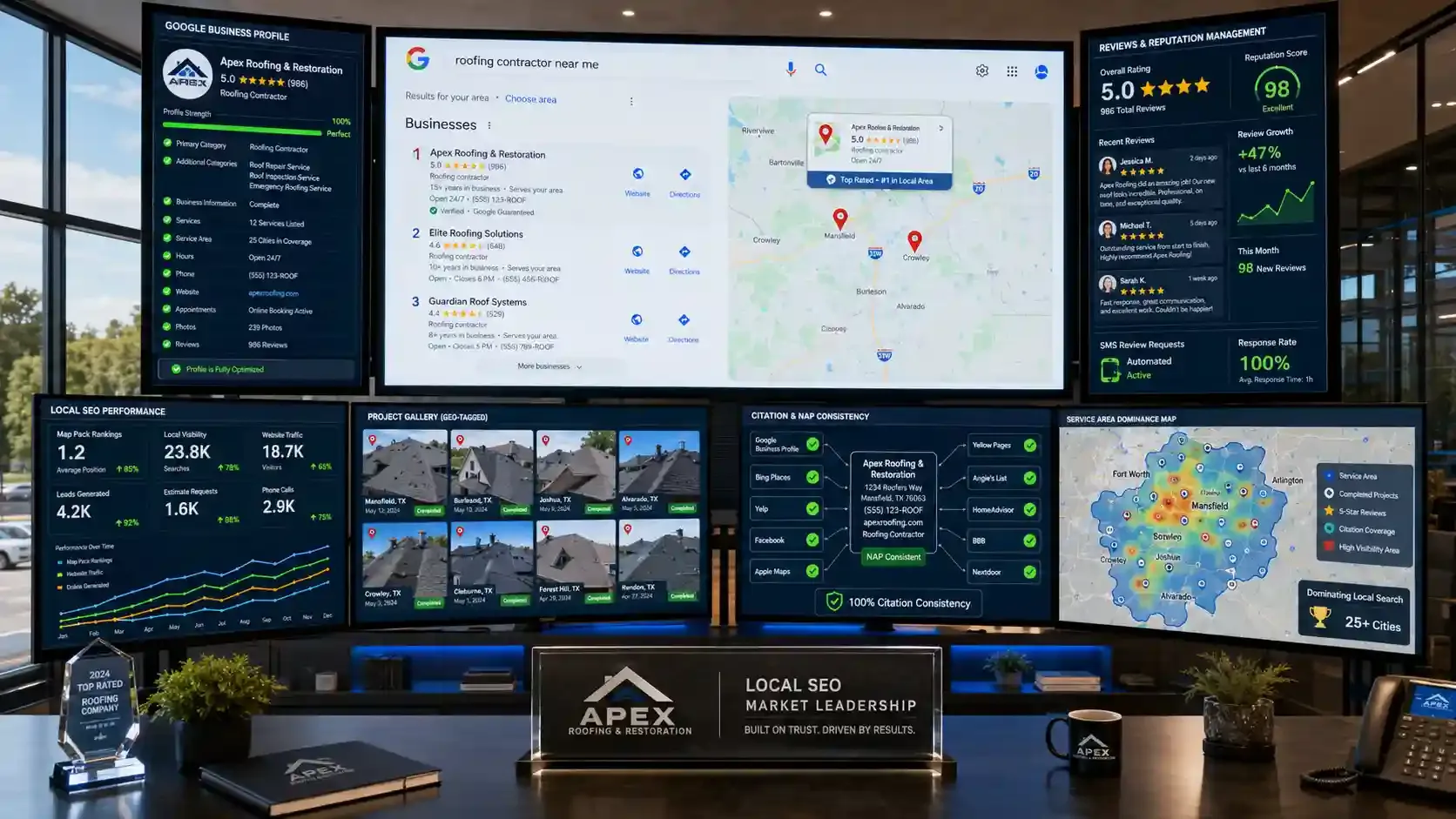
When someone searches "roofing contractor near me," Google shows three businesses above everything else. That box is the Map Pack, and 42% of all local search clicks go straight to it.
Three slots. Here's how you win yours.
Optimize Your Google Business Profile
Customers are 2.7x more likely to consider a business reputable when they find a complete Google Business Profile. They're also 70% more likely to visit and 50% more likely to buy.
To fully optimize yours:
- Pick "Roofing Contractor" as your primary category. Add secondary ones like "Roof Repair Service."
- List every service with descriptions and pricing ranges.
- Upload geo-tagged before and after photos from recent jobs. Google reads that location data to confirm where you work. FieldServicely makes this easy since your techs snap geo-tagged photos on-site through the app.
- Post weekly updates: completed jobs, seasonal promotions, storm prep tips. Google rewards profiles that stay active.
Build and Manage Customer Reviews
Review signals grew more than any other ranking factor group in the 2026 Map Pack algorithm. And 97% of consumers check reviews before choosing a local business. 74% only trust reviews from the last three months.
What actually works:
- Ask every customer for a review within 24 hours of completing the job.
- Respond to every review, good and bad. 80% of consumers prefer businesses that reply to all reviews.
- Keep your review velocity steady. Ten reviews in one week, then nothing for two months, looks unnatural. FieldServicely automates this with SMS review requests after each job closes.
NAP Consistency and Local Citations
NAP stands for Name, Address, and Phone number. If your website says "ABC Roofing LLC" but Yelp says "ABC Roofing" and Facebook lists an old phone number, Google loses confidence in your data. That pushes you down in local search results.
The fix is easier than you think:
- Match your name, address, and phone number exactly across Google Business Profile, Yelp, Facebook, Angi, BBB, and Apple Maps. Same format, same abbreviations.
- Audit your listings every quarter. Phone numbers change, offices move, and old listings stick around. A quarterly cleanup prevents small errors from compounding into ranking drops.
Get into the Map Pack with real job data, not guesswork.
Auto-collect reviews and geo-tagged photos from every job site.
Roofing Keyword Research: Find the Words Homeowners Actually Search
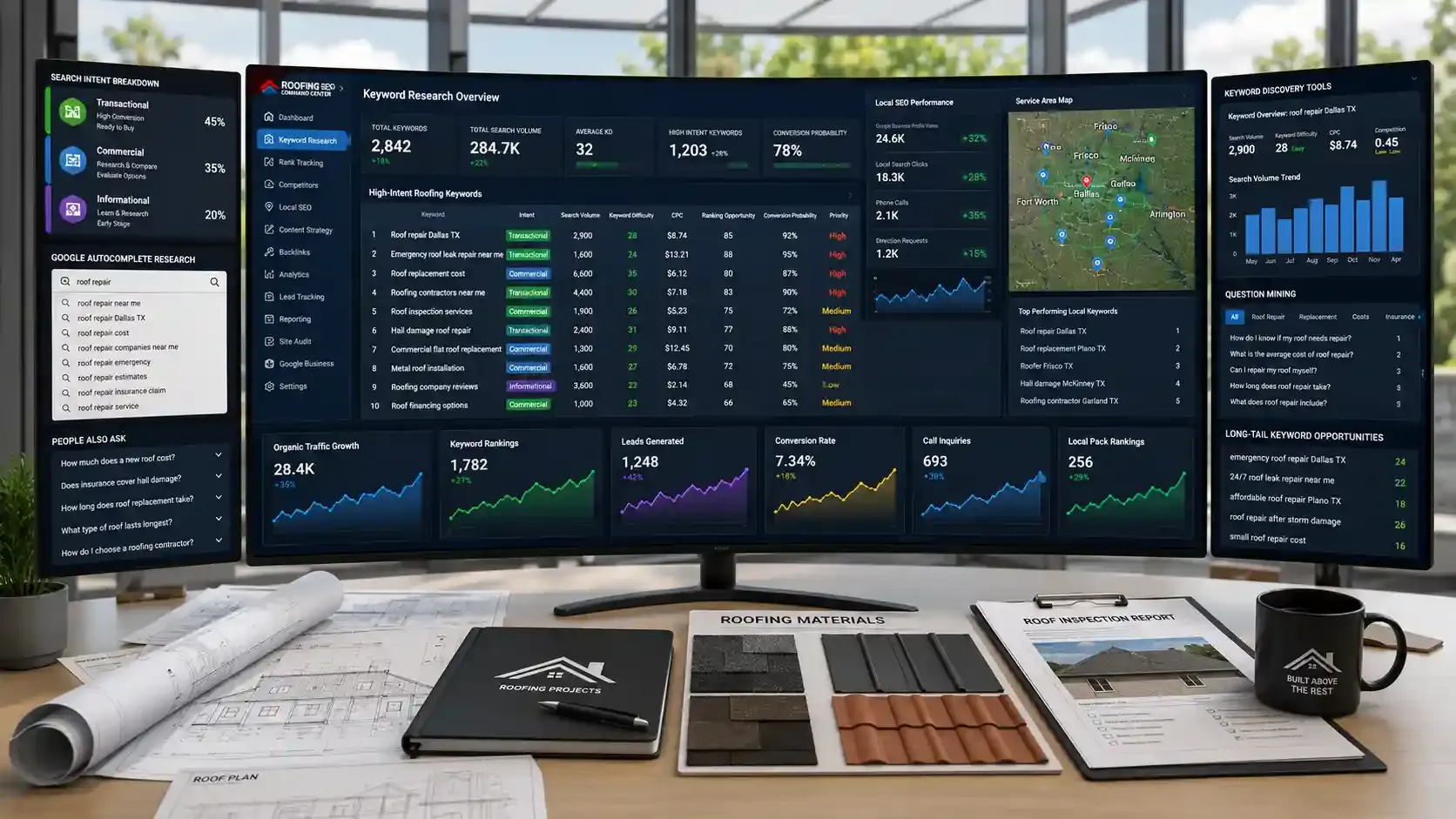
Roofing keyword research is finding the exact phrases homeowners type into Google when they need a roofer. Then use those phrases on your website, so Google shows your business. Get them right, and you show up exactly when someone needs you.
High-Intent Roofing Keywords to Target
Not all roofing keywords carry the same weight. A homeowner searching "roof repair Dallas TX" is ready to hire. Someone searching "types of shingles" is still browsing. Your priority should match the buyer's intent.
"Roof repair" alone pulls 90,500 monthly searches. "Roof replacement" gets 49,500. "Roofing companies" and "roofing contractors" each hit 40,500.
| Keyword Type | Examples | Search Intent | Priority |
|---|---|---|---|
Service + Location | "roof repair Dallas TX" | Transactional | Highest |
Emergency | "emergency roof leak repair near me" | Transactional | Highest |
Cost/Pricing | "How much does a new roof cost?" | Commercial | High |
Comparison | "metal roof vs shingle roof" | Informational | Medium |
Brand | "[company name] reviews" | Navigational | Medium |
Target the top two rows first. Those searches come from homeowners who have a problem right now and the money to fix it.
Long-Tail Keywords That Actually Convert
Long-tail keywords are longer, more specific phrases with lower search volume but much stronger buying intent. They make up over 70% of all search traffic. And searchers using them are 4x more likely to convert on a service page.
Think phrases like "Hail damage roof repair insurance claim Austin" or "flat roof replacement commercial Houston." These won't show massive volume in any tool. But the people searching for them are ready to sign.
Where to find them:
- Google autocomplete: Start typing a roofing phrase and note what Google suggests.
- People Also Ask: Check the question boxes in search results for content ideas.
- SEMrush or Ahrefs: Filter by low difficulty and high intent.
- AnswerThePublic: Pulls real questions people ask about roofing topics.
Your completed jobs already match what homeowners search for.
FieldServicely logs every service and location so your site stays relevant.
On-Page SEO for Roofing Websites
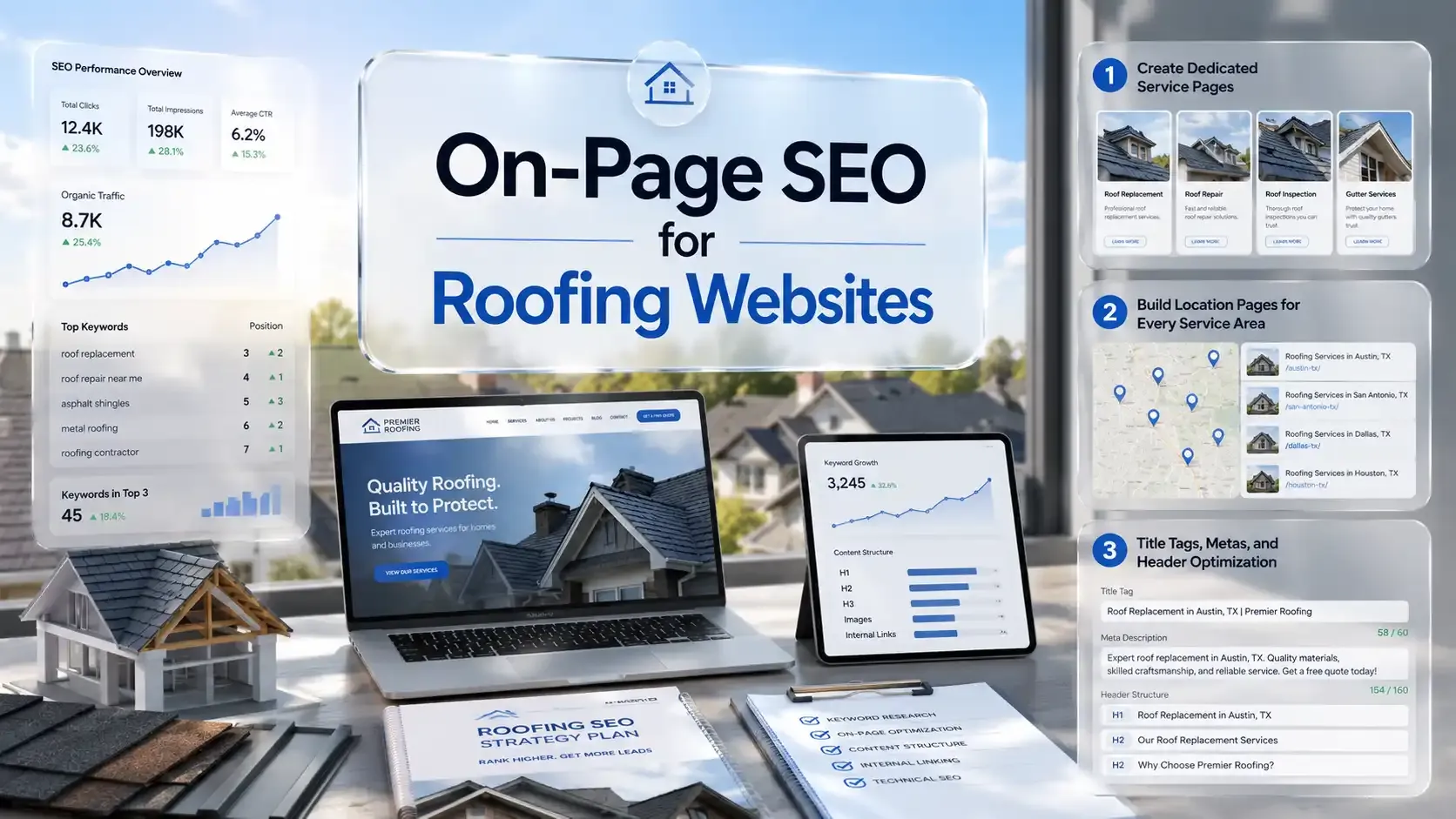
On-page SEO means optimizing each page on your roofing website so Google understands what services you offer and where you offer them. That includes titles, headings, content, images, and internal links.
Create Dedicated Service Pages
Every service you offer needs its own page. Roof repair, roof replacement, storm damage repair, commercial roofing, gutter installation, and roof inspection. One page per service, each targeting a unique keyword plus your location.
A strong service page includes:
- A clear service description explaining what you do and who it's for
- Step-by-step process so homeowners know what to expect
- A pricing range (even a ballpark builds trust)
- Before-and-after photos from real jobs
- A customer testimonial specific to that service
- A clear CTA: phone number, form, or scheduling link.
Don't lump everything onto one "Services" page. Google can't rank a single page for six different keywords. Give each service room to breathe and rank on its own.
Build Location Pages for Every Service Area
If you serve 10 cities, build 10 unique location pages. Each page targets "[service] in [city]" and gives Google a clear signal that you work in that area.
The keyword here is unique. Don't copy the same text and swap city names. Google sees through that immediately. Instead, include:
- Local landmarks and neighborhoods you serve
- A project case study or a recent job from that specific area
- An embedded Google Map showing your service coverage
- Unique testimonials from customers in that city
This takes more effort upfront. But each location page becomes a separate door into your website from local search results.
Title Tags, Metas, and Header Optimization
Your title tag is the first thing Google and searchers see. Use this formula: [Service] in [City] | [Company Name].
Example: "Roof Repair in Austin, TX | ABC Roofing."
Your meta description should stay under 155 characters. Include your primary keyword and a reason to click. Something like: "Fast, licensed roof repair in Austin. Free inspections, same-day estimates. Call now."
For headers, keep it structured. Your H1 is your main keyword. H2 covers related subtopics. H3s handle supporting details. This hierarchy tells Google exactly how your content is organized.
Build service pages with real job data, not filler content.
Pull project details, locations, and photos straight from your field app.
Content Marketing That Drives Roofing Leads
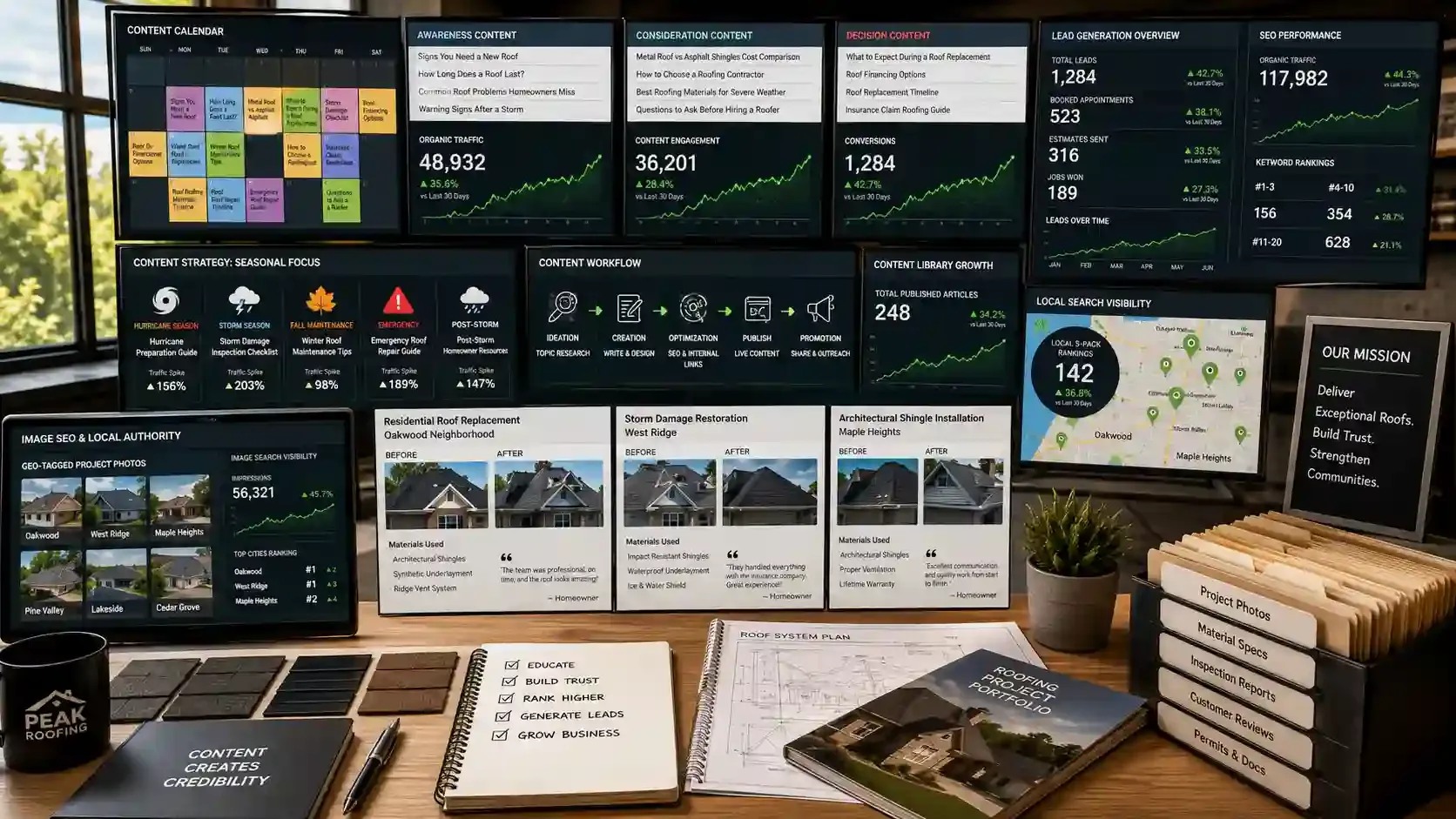
Content marketing for roofers means publishing helpful blog posts, guides, and videos that answer homeowner questions. It builds trust with Google and future customers at the same time.
Blog Topics That Attract Ready-to-Buy Homeowners
Not every blog post needs to sell. The best content meets homeowners where they are in their buying journey:
- Awareness: "Signs you need a new roof," "How long does a roof last?" These pull in people who don't know they have a problem yet.
- Consideration: "Metal roof vs asphalt shingles cost comparison," "How to choose a roofer." These help people weigh options.
- Decision: "What to expect during a roof replacement," "Roofing financing options." These close the deal.
Layer in seasonal content, too. Storm prep guides before hurricane season. Winter roof maintenance tips in the fall. Post-storm damage checklists after severe weather hits your area. These pages spike in traffic exactly when homeowners are panicking and searching.
Turn Completed Jobs Into SEO Content
Write a short case study for each completed project. Include the scope of work, materials used, before-and-after photos, and a customer quote. That's 300 words of unique, location-specific content Google has never seen before.
Geo-tag every photo with the city and neighborhood name. That signals local relevance for image SEO and helps you show up in Google Image results for your service area.
This is where your job site becomes your SEO engine. One job. Multiple SEO assets. Zero extra effort from your field team.
Turn every roof you finish into a blog post that ranks.
Job photos, service details, and customer feedback — all captured on-site.
Technical SEO for Roofing Websites
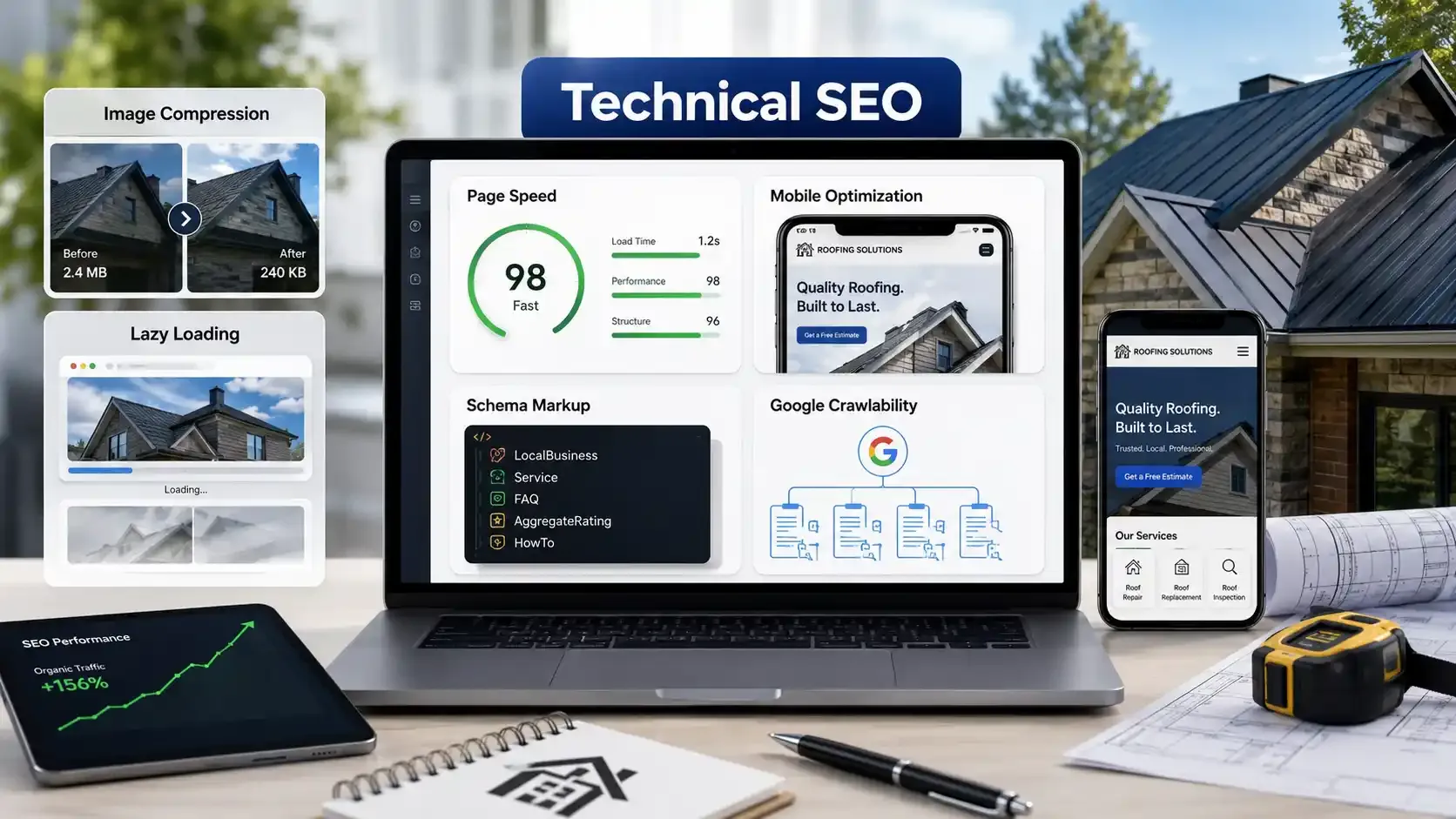
Technical SEO ensures your roofing website loads fast, works on mobile, and is easy for Google to crawl. If your site is slow or broken, no amount of content will save your rankings.
Site Speed and Mobile Optimization
Most roofing searches happen on phones. Homeowners dealing with a leak at midnight aren't opening a laptop. And 53% of mobile visitors leave if a page takes longer than three seconds to load.
To hit that three-second target:
- Compress all images (especially those before-and-after photos)
- Enable lazy loading so images only load when scrolled into view
- Minimize CSS and JavaScript files
- Use a CDN (content delivery network) for faster file delivery
- Test your speed with Google PageSpeed Insights and fix whatever it flags
A fast mobile site doesn't just help rankings. It keeps the panicked homeowner on your page long enough to call you.
Schema Markup for Roofers
Schema markup is code you add to your site that tells Google exactly what your business is. It won't change how your page looks, but it can change how you show up in search results with rich snippets, star ratings, and FAQ dropdowns.
The schemas that matter most for roofers:
- LocalBusiness: Your address, hours, service area, and contact info
- Service: Each roofing service you offer (repair, replacement, inspection)
- FAQ: Questions and answers that can appear directly in search results
- AggregateRating: Your average review score displayed in the SERPs
- HowTo: Step-by-step instructional content (like "how we replace a roof")
You don't need to code this by hand. Tools like Google's Structured Data Markup Helper or plugins like Rank Math handle it for you. Add schema to your service pages and location pages first since those drive the most leads.
Structured job data makes schema markup easy.
FieldServicely organizes services, locations, and reviews for your site.
Link Building Strategies for Roofing Companies
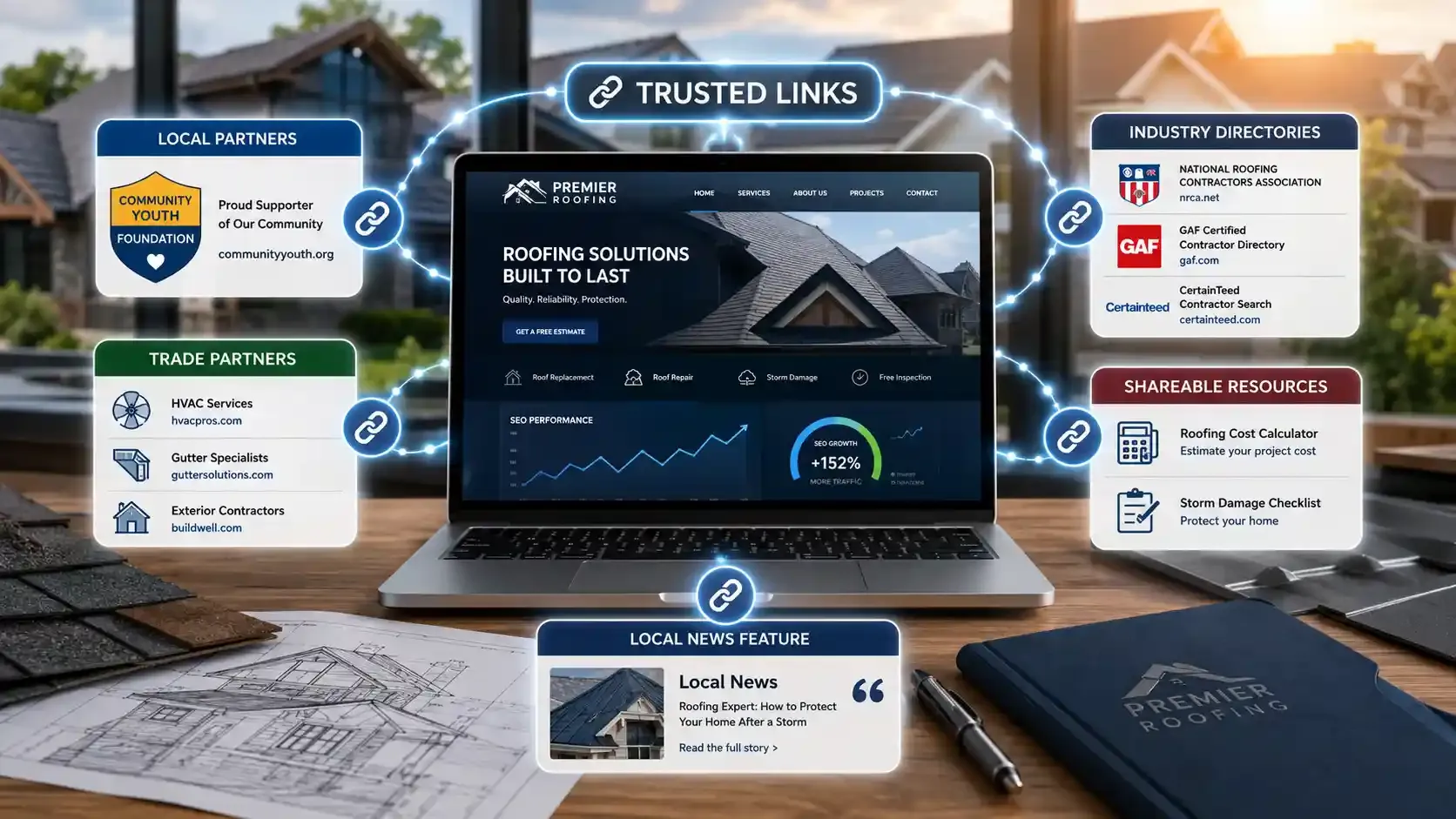
Link building for roofers means getting other websites to link back to yours. Google treats each link like a referral. The more trusted sites vouching for you, the more Google trusts your roofing company.
Most roofers skip this because it sounds complicated. It's not.
- Sponsor a Little League team or local charity. Those organizations list sponsors on their sites. That's a .org backlink you earned by showing up.
- Team up with other trades. You already refer work to HVAC guys and gutter installers. Swap website links with them.
- Get on industry directories. NRCA membership pages, manufacturer-certified contractor lists, and trade associations all link to members.
- Build something shareable. A roofing cost calculator or storm damage checklist. People link to useful tools.
- Talk to reporters after storms. Journalists need roofing experts fast. One quote in a local news article earns a link most competitors never will.
Avoid buying links, link farms, and private blog networks. Google catches that now, and one penalty can bury your site for months.
Document your best work so other sites want to link to it.
Capture before-and-after photos and job reports from the field automatically.
Roofing SEO for AI Search: How to Show Up in AI Overviews
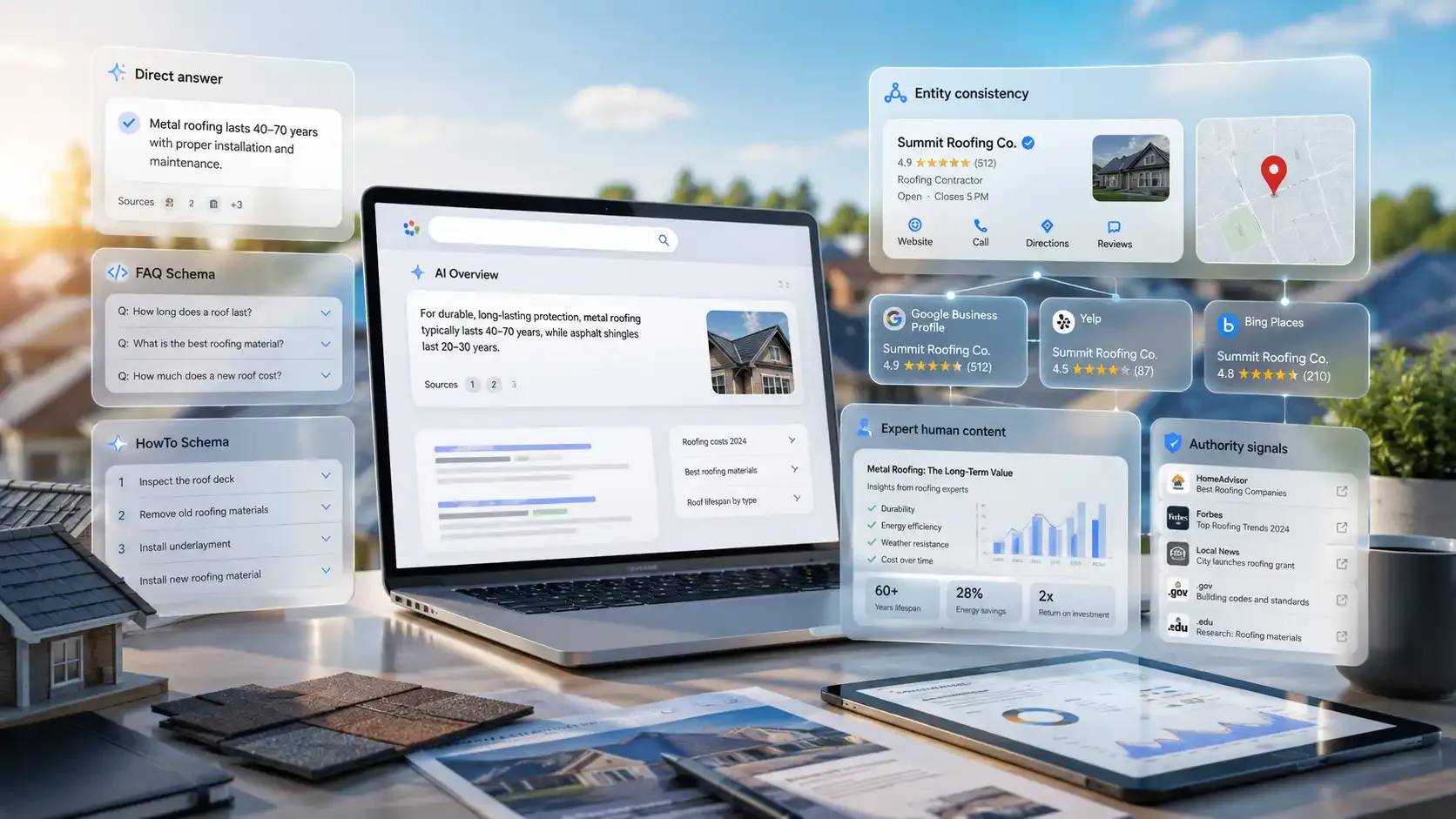
AI search optimization (also called GEO) is how your roofing company gets cited in Google AI Overviews, ChatGPT, and Perplexity. When a homeowner asks an AI tool, "Who's the best roofer near me?" you want your name in that answer.
This isn't optional anymore. Gartner predicts traditional search volume will drop 25% by the end of 2026 as people shift to AI for answers.
Here's how to get in front of it:
- Answer questions up front. Start each section with a straight answer. AI tools love pulling clean, one-sentence definitions into their responses.
- Add structured data. FAQ schema and How to schema give AI something organized to grab. You're spoon-feeding it reasons to cite you.
- Lock down your entity signals. AI trusts businesses that show up the same way on every platform.
- Write like a human who knows their stuff. Say what you mean and back it up with numbers when you can. AI skips the fluff and pulls the substance.
- Get mentioned on sites that carry weight. Industry publications, local news, .gov pages, .edu links. AI leans on these when picking which businesses to recommend.
FieldServicely captures structured job data as your crew works. Services performed, locations served, customer feedback. That's the exact type of entity-rich, location-specific info AI models pull from when answering local queries.
AI pulls answers from structured data. Your field ops generate it daily.
Services, locations, reviews logged automatically for every job.
Common Roofing SEO Mistakes That Kill Your Rankings
Most roofers don't fail at SEO because they're not trying. They fail because they're doing the wrong things. Here's what to stop doing:
- Using one "Services" page for everything instead of building a dedicated page per service
- Copy-pasting location pages and just swapping the city name
- Ignoring your Google Business Profile for months and wondering why you fell out of the Map Pack
- Not asking for reviews because you think customers don't want to be bothered
- Buying cheap backlinks from Fiverr or overseas link farms
- Listing different business names or phone numbers across directories
If you're doing even two of these, they're costing you leads right now.
Conclusion
Roofing SEO is turning what your crew does every day into something Google rewards. Every completed job, every customer review, every geo-tagged photo is a ranking signal waiting to be used.
The roofers dominating Google in 2026 aren't better at marketing. They're better at connecting field work to their online presence. They let their operations feed their SEO instead of treating them as separate worlds.
You already have the jobs, the customers, and the reputation. Now put them to work online, and turn your job site into your SEO engine.
Frequently Asked Questions
How Long Does It Take For Roofing SEO To Show Results?
Most roofers see movement in 3 to 6 months. Quick wins like Google Business Profile optimization bring visibility within weeks. Real lead flow from organic rankings takes 6 to 12 months, depending on competition.
Can I Do Roofing SEO Myself, or Should I Hire an Agency?
You can handle the basics. Claiming your Google Business Profile, collecting reviews, and writing service pages don't require an agency. Technical work like schema markup, site speed, and link building is where most roofers bring in help.
Is SEO worth it for a small roofing company?
Yes. Small roofers often see faster results because they compete in less crowded markets. A $1,500/month investment can generate 10 to 25 leads in a smaller city. And unlike ads, you're building an asset that compounds over time.
What's the difference between SEO and PPC for roofers?
SEO generates organic traffic without paying per visitor. PPC gives instant visibility but costs $8 to $45+ per click for roofing keywords. Most successful roofers run both while shifting budget toward organic as rankings grow.
How does field service software improve my roofing SEO?
It automates review requests after every job, captures geo-tagged photos on-site, and logs project details you can turn into content. Three ranking signals from work your crew already does.
What to read next