- Field Service Business
SEO for Cleaning Business: How to Rank Higher on Google
Updated on 15 May 2026
Jump to
Summary

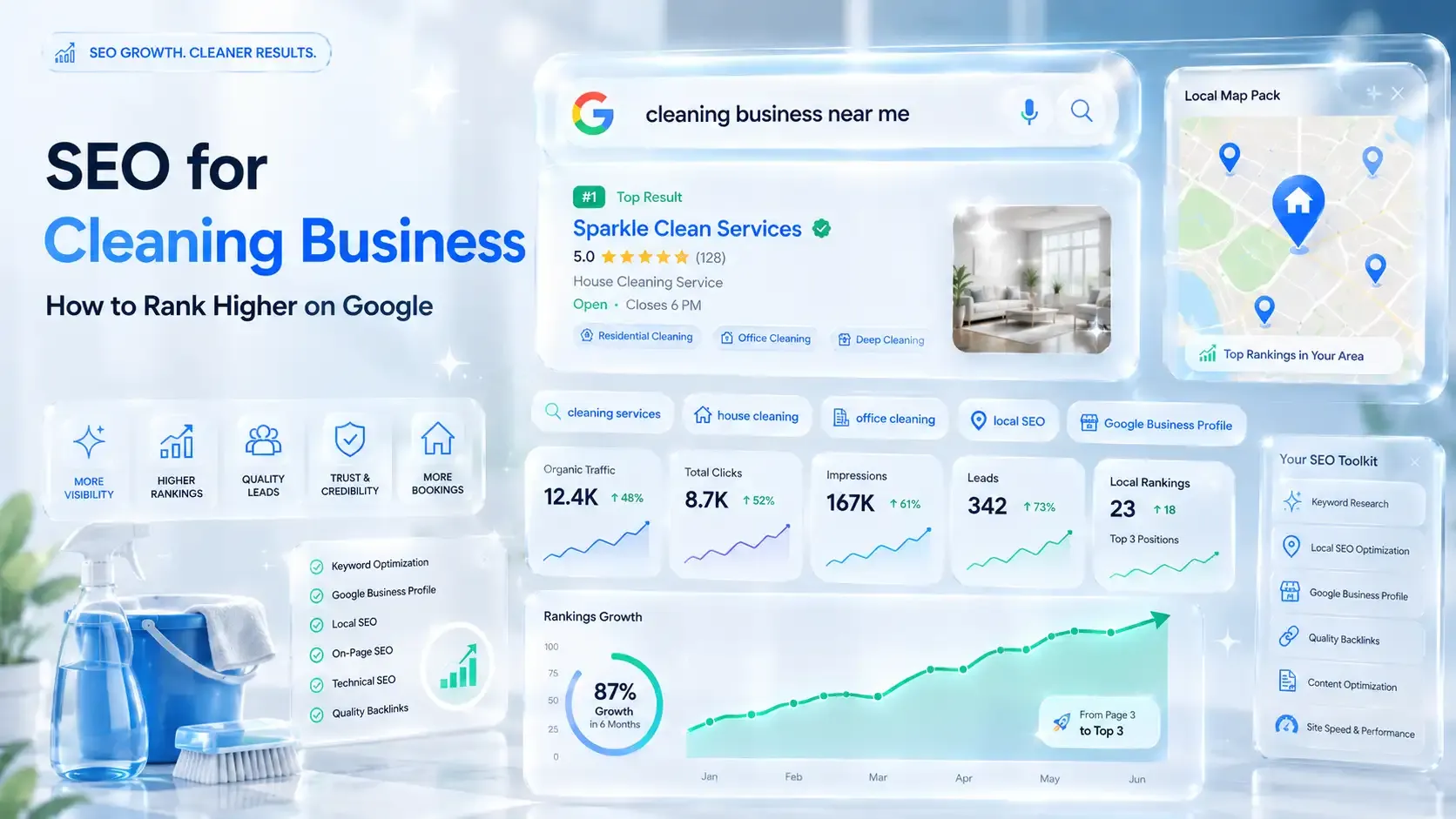
SEO helps your cleaning business show up on Google, Google Maps, and local search results.
A strong Google Business Profile, reviews, and correct service pages help customers trust you faster.
Local keywords should match both the cleaning service and the city or area you serve.
Fast pages, clear CTAs, quote forms, and call buttons turn traffic into real cleaning leads.
SEO takes time, but steady work can bring more visibility, better leads, and booked cleaning jobs.
SEO for a cleaning business means making your cleaning company easier to find on Google, Google Maps, and local search results. It helps your website and Google Business Profile show up when nearby customers search for cleaning services.
When someone needs a cleaner home before moving out, they usually do not scroll through ten pages of Google. They look at the first few results, compare reviews, check service areas, and contact the company that looks most trustworthy.
That is where cleaning business SEO matters.
In this blog, I will discuss how SEO for cleaning companies improves Google rankings, local visibility, website traffic, and customer trust. I will also discuss the exact steps to turn local searches into cleaning leads and booked jobs.
What Is Cleaning Business SEO?
Cleaning business SEO is how your cleaning company gets found when nearby customers search on Google, Google Maps, or local search results.
Think about it this way. A homeowner searches “house cleaning in Dallas,” a renter types “move out cleaning near me,” A business owner looks for “commercial cleaning company in Miami,” or an office manager searches “office cleaning services in Chicago.”
Cleaning company SEO helps your business show up before they choose someone else. But here’s where many cleaning business owners get it wrong.
Just so you know, SEO for cleaning services is not just about adding a few keywords to a website. It includes Google Business Profile optimization, local keywords, service pages, and location pages. And this doesn’t stop there!
Google reviews, local citations, backlinks, technical SEO, helpful content, and clear quote buttons matter. And yes, honest, real reviews matter a lot!
For context, only 4% of consumers never read online reviews when checking local businesses.
So, if your cleaning service SEO brings people to your profile, reviews help turn that search into leads and booked cleaning jobs.
Why SEO Matters for Cleaning Companies?
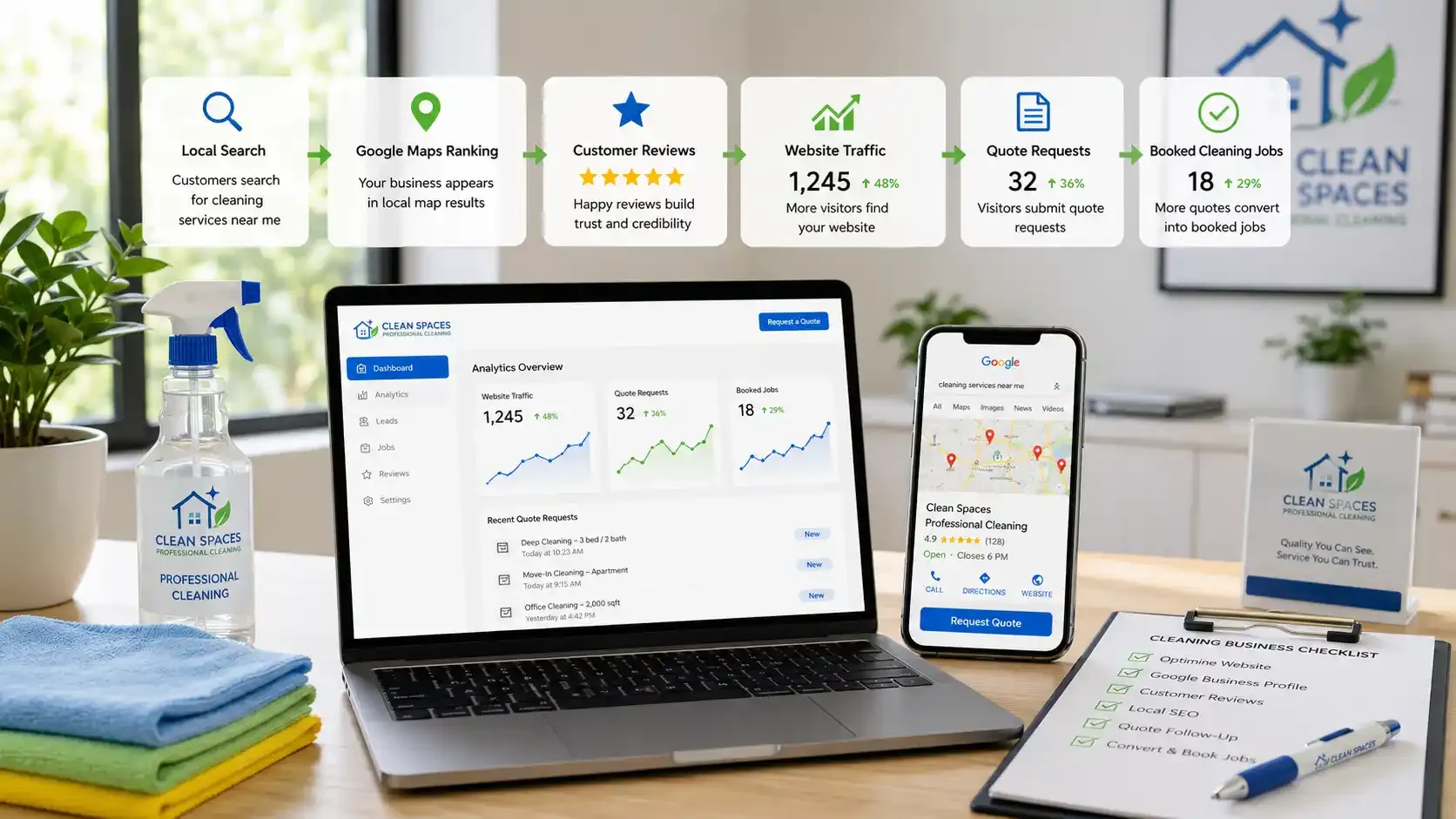
SEO matters because cleaning customers usually do not search for days. They search, compare, and call the company that looks trustworthy right when they need it.
That is the real value of SEO for a cleaning business. It puts your house, office, deep cleaning, or move-out cleaning service in front of people when they already need help.
FYI, 45% of consumers choose Google first for local searches, and 15% go straight to Google Maps. For that reason, if your cleaning company has weak local SEO, a poor Google Maps ranking, or no strong reviews, you may never enter the customer’s shortlist.
I know it’s a hard pill to swallow, but it’s the reality!
Just for the record, good SEO for a cleaning business brings more local visibility, higher Google rankings, more website traffic, and more quote requests. But the bigger win is that it turns local search into real cleaning jobs.
Now, you might be thinking of ads. Yes, paid ads can move faster. I won’t deny that. But once you stop paying, the traffic surge stops with it.
Although SEO takes more time, it builds a steady flow of local cleaning leads. And keeps working after one campaign ends.
More leads need better job control
Handle cleaning leads efficiently with FieldServicely.
How Google Ranks Local Cleaning Businesses
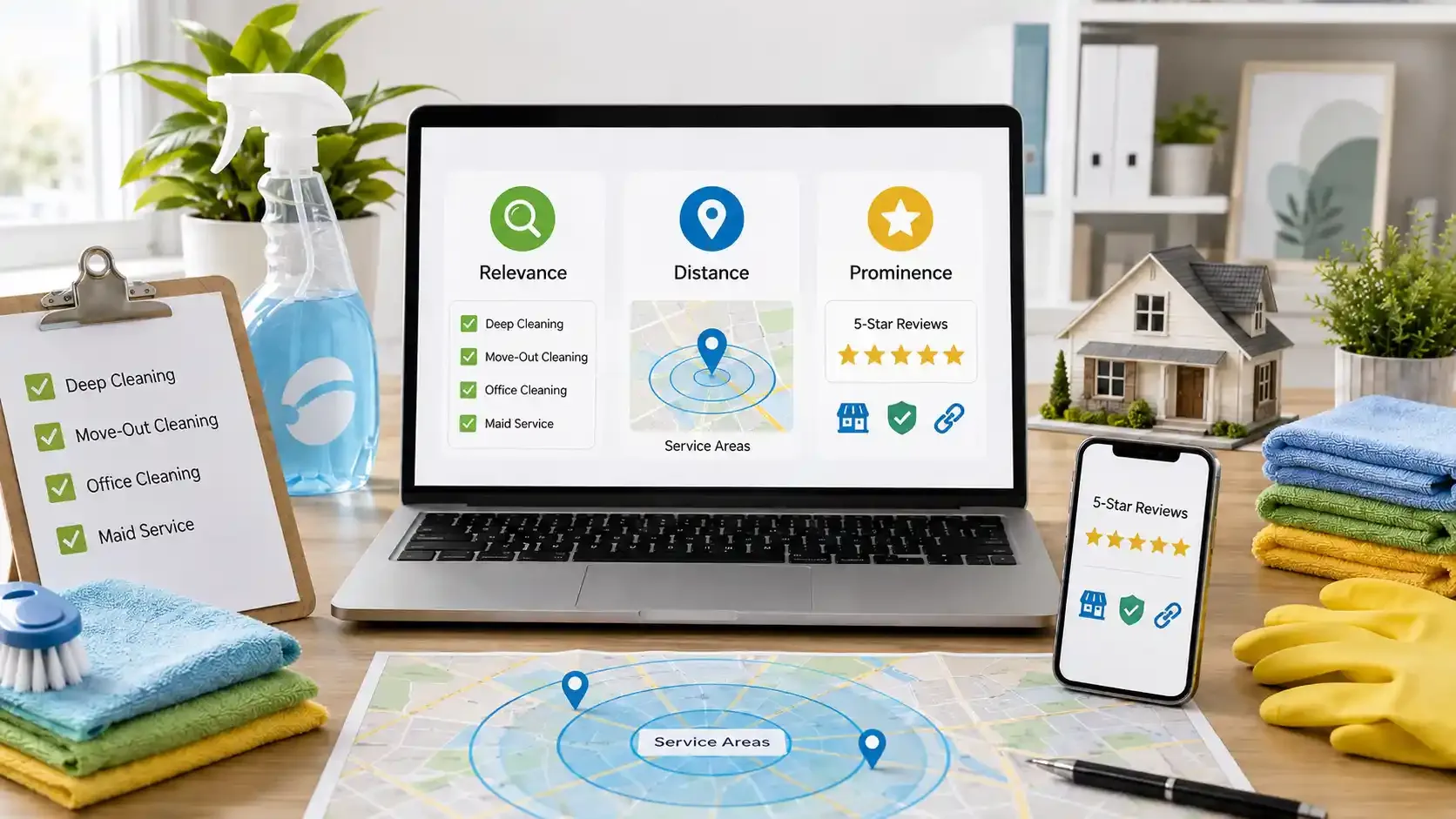
Google ranks local cleaning businesses by checking three simple things: relevance, distance, and prominence.
That sounds technical, but every business owner should know about it. So the thing is, Google is basically asking,
“Is this cleaning company a good match for the target audience?”
“Is it close enough?”, and
“Do people trust it?”
Relevance
Relevance means your business matches what the customer searched for. For example, if someone types “deep cleaning service near me,” Google wants to show cleaning companies that clearly offer deep cleaning.
So, your Google Business Profile, service pages, headings, image names, and reviews should convey the message that your business provides deep cleaning services.
This is where many cleaning company owners lose ground.
They write “cleaning services” everywhere. But they do not mention house cleaning, move-out cleaning, office cleaning, apartment cleaning, post-construction cleaning, or janitorial services in the right places.
Also, your GBP services and website services should match. Instead of relying on one thin service page for everything, make a dedicated page for each service. This helps Google to easily understand what your business is offering.
Distance
Distance means how close your cleaning business is to the searcher or the location in the search.
If someone searches “maid service in Miami,” Google checks businesses near that area first. You cannot fully control where the searcher stands, but you can control how clearly you show your service area.
That’s why location pages, city pages, neighborhood pages, and service area pages matter.
A cleaning company in Miami should not only say “We serve Florida.” It should mention places like Miami Beach, Coral Gables, Brickell, Kendall, or Doral if those are real service areas.
Remember, proximity is the strongest broad driver of Google Business Profile ranking visibility. At the same time, reviews and relevance help businesses compete inside the pack.
Prominence
Prominence means how trusted and well-known your cleaning business looks online.
Google looks at signals like Google reviews, ratings, local citations, backlinks, business listings, brand mentions, and website authority. In simple terms, Google wants proof that real people know, use, and trust your cleaning company.
This is why a cleaner with stronger reviews may beat a better cleaner with almost no online proof. Primary category choice and consistent new reviews are among the most important Google Business Profile actions for local rankings and customer trust.
Google does not rank the “best cleaner” by looking at your mop, team, or final result. It ranks the clearest, closest, and most trusted cleaning business it can understand online.
Be easy to find and easy to book.
Keep cleaning jobs, crews, routes, and customer details organized after searchers call
How to Do SEO for Your Cleaning Business: Step-by-Step Guide
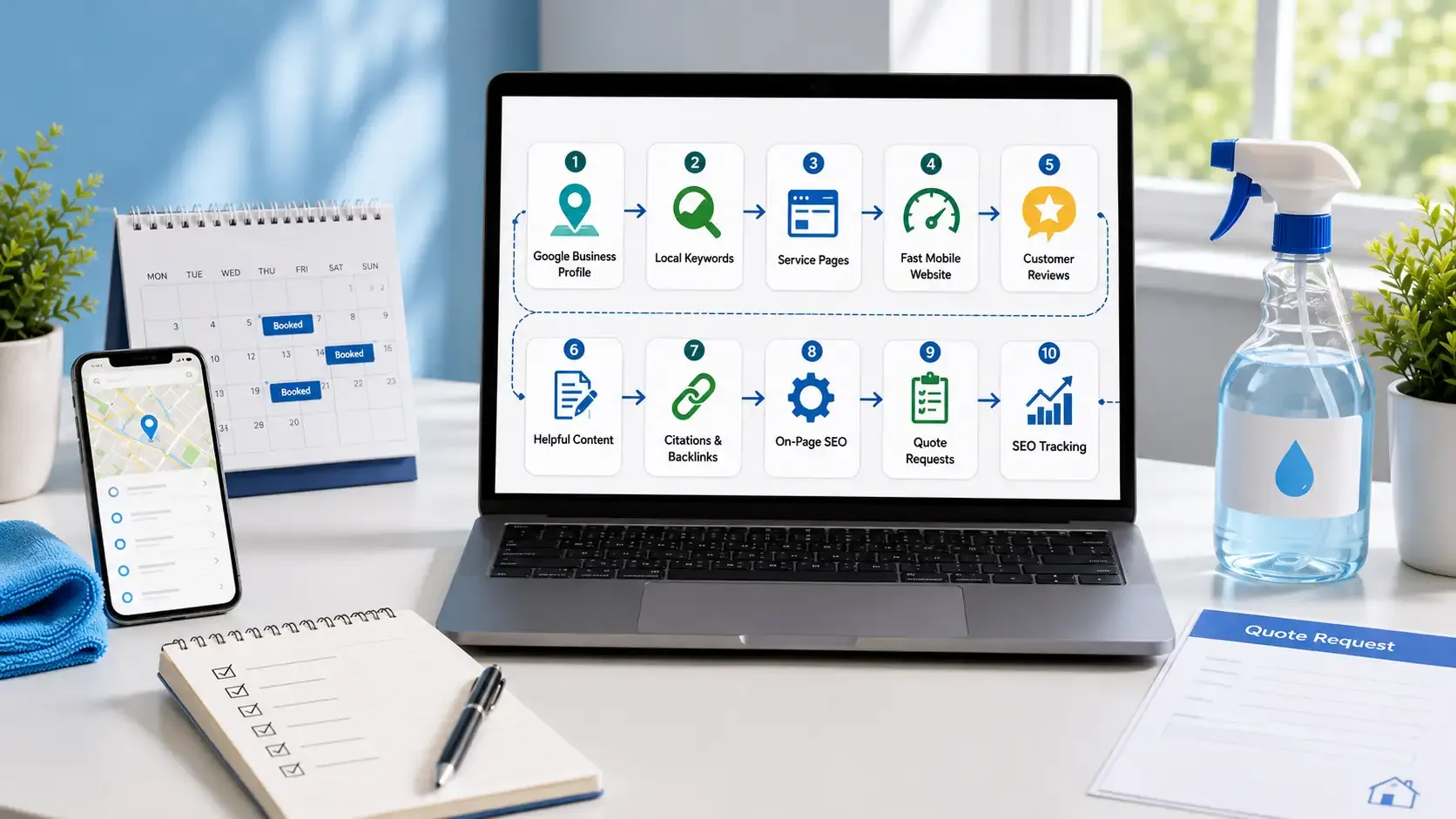
SEO for a cleaning business works best when you follow it in order.
Random blog posts, a half-filled Google Business Profile, and one “Services” page will not do much. Especially if your competitors are already showing up in the Google Map Pack.
So, let’s take it from the top:
Step 1: Start With Your Google Business Profile
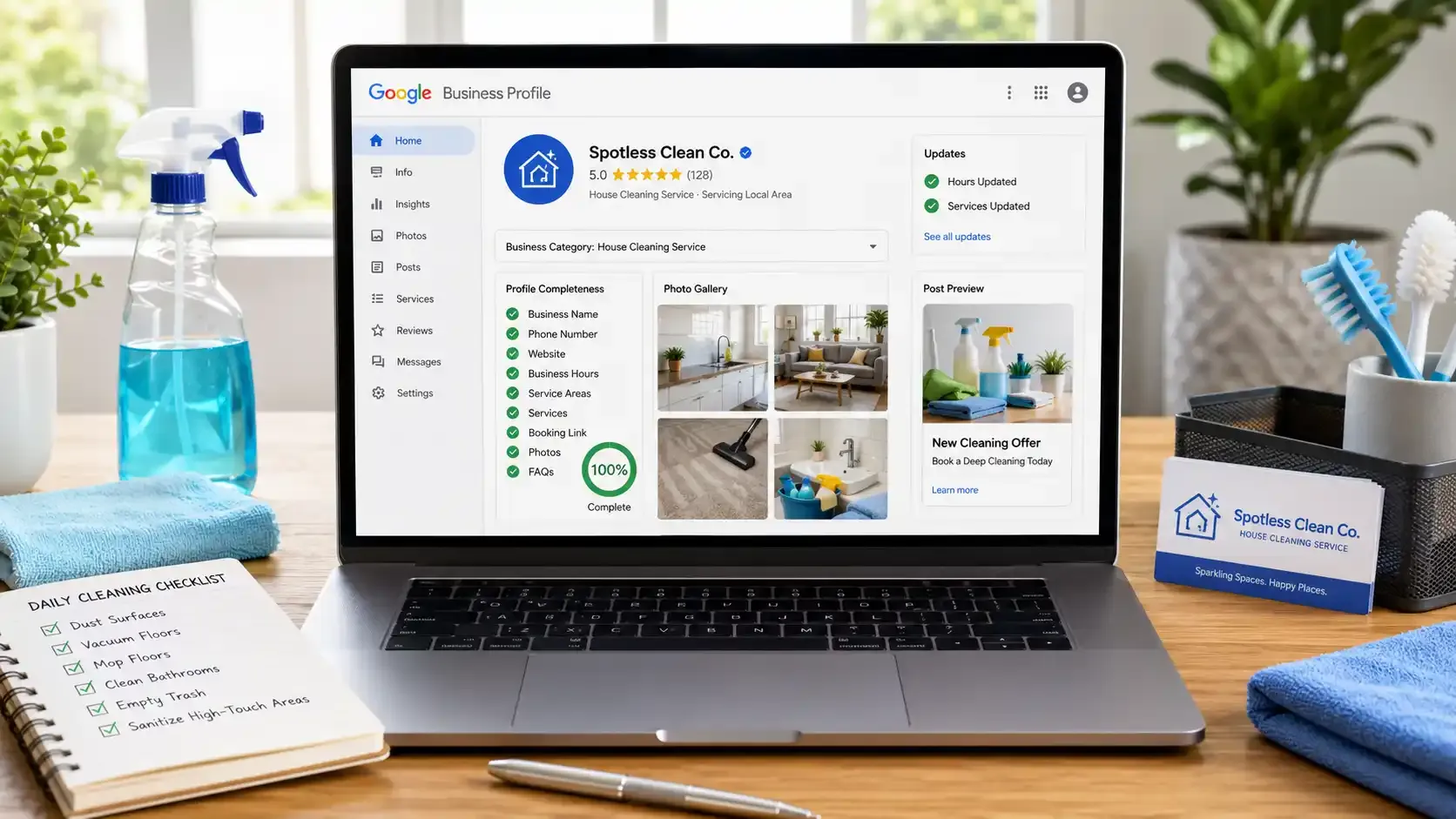
Your Google Business Profile is the first place to focus on in SEO for a cleaning business.
If your profile looks complete, active, and easy to trust, more cleaning customers will click, call, or ask for a quote.
53% of consumers are unlikely to visit a business with incorrect listings. So wrong hours, old phone numbers, and weak profile details can cost real cleaning leads.
Choose the Right Business Category
Your business category tells Google what kind of cleaning company you are.
So, choose the category that matches your main service. Do not choose a broad or vague category just because it sounds close.
Many cleaning companies choose something vague like “cleaners.” That can confuse Google because it may not clearly point to house cleaning, maid service, office cleaning, carpet cleaning, or janitorial services.
But do not add every possible cleaning category just to chase more search rankings. That makes your profile look messy.
Complete Every Important Profile Field
A complete profile helps cleaning customers make a fast decision. So, fill out every important field.
Add your business name, phone number, website, business hours, holiday hours, service areas, services, business description, appointment or booking link, photos, FAQs, and messaging if you use it.
Do not leave the profile half-finished. 85% of consumers consider contact information and opening hours important when researching local businesses.
Add Real Photos
Real photos help people trust your cleaning business faster.
As cleaning is personal, customers may let your team into their home, office, rental property, school, clinic, warehouse, or retail store. So, they want proof.
If you offer residential cleaning, show real home cleaning work.
Show apartment cleaning, condo cleaning, recurring cleaning, deep cleaning, and move-in cleaning results. These photos help a homeowner picture your team doing the job.
Keep Hours and Services Updated
Updated hours protect your calls, trust, and cleaning service bookings.
Nearly 99% of consumers say online local search tools are moderately or highly satisfactory. It means people trust these tools when checking businesses.
But when an online profile says a business is open and the customer finds it closed, 47% say they would look for a similar business nearby.
Use GBP Posts
GBP posts help your profile look active. But they should be useful.
Google Posts may not be the biggest ranking factor. But they have strong visibility and can work like free ad space on your Business Profile. So, use posts to promote real cleaning offers.
Convert Google Maps calls into jobs
Send new cleaning leads into FieldServicely to manage scheduling, dispatch, and job status in one place.
Step 2: Use Local Keywords That Match Cleaning Customers’ Searches
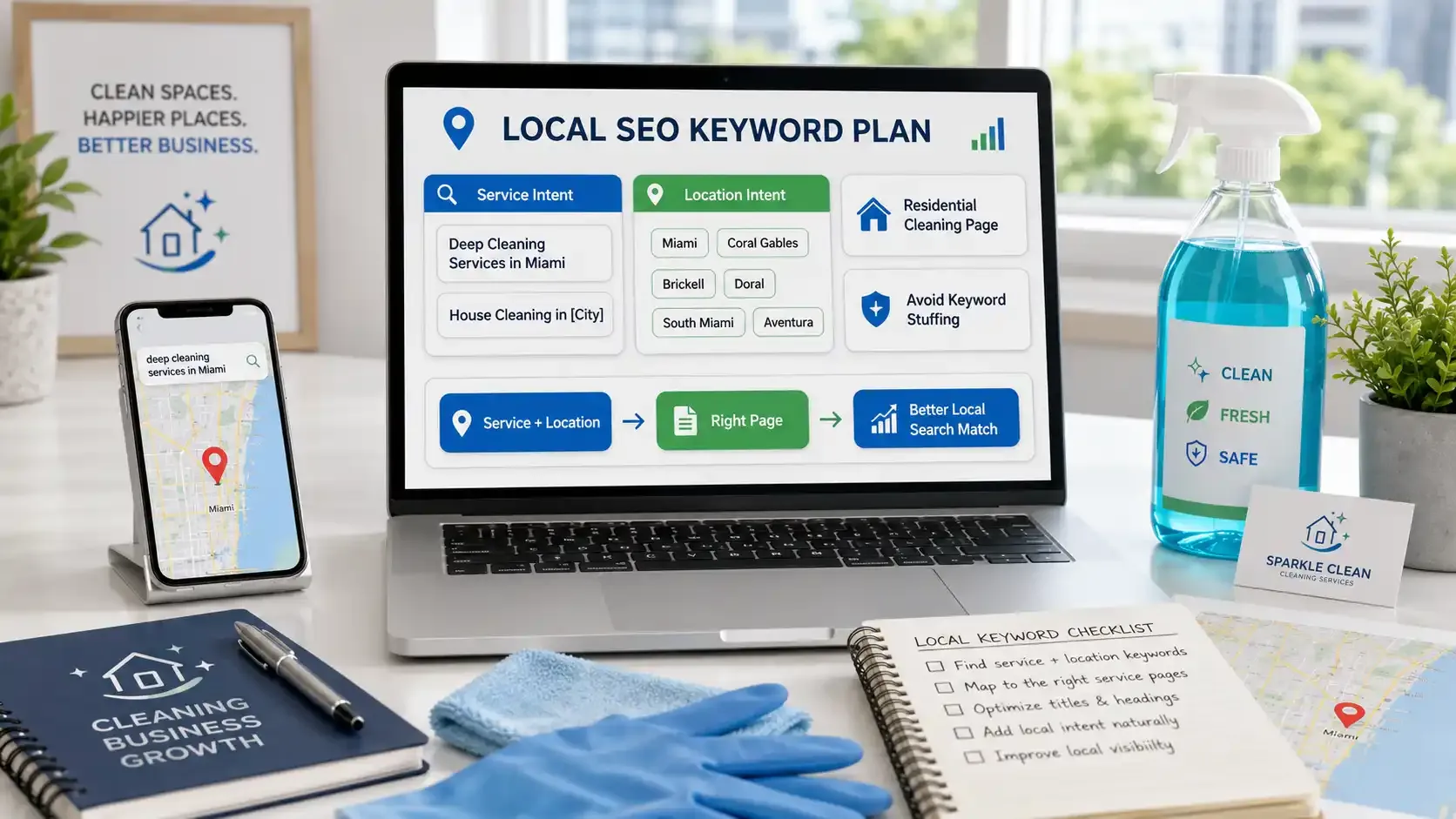
Local keywords help your cleaning business show up for the right service in the right area. And a cleaning business SEO needs two things in the keyword. It needs service intent and location intent.
For example, “deep cleaning services in Miami” is much clearer than just “cleaning.” It tells Google the service is deep cleaning, and the customer wants it in Miami.
91% of U.S. adults own a smartphone, and 16% are smartphone-only internet users. So, many cleaning customers may search for local cleaners while they are moving, working, renting, or managing a busy home.
Cleaning Business Keyword Examples
Cleaning business keywords should match the search intent, the service, and the page type.
Do not throw every keyword onto the homepage. That makes the page messy, and it makes Google work harder than it should.
A homeowner searching “house cleaning in [City]” wants a local residential cleaner. So, send them to a residential cleaning page, not a generic page that also talks about offices, carpets, windows, and warehouses.
The better the keyword matches the page, the easier it becomes for both Google and the customer.
Avoid Keyword Stuffing
Keyword stuffing makes your cleaning website sound fake. Do not repeat “cleaning business SEO” or “house cleaning in [City]” so often that the page becomes hard to read.
Google’s Search spam policies say sites can rank lower or disappear from search results when they use spam tactics that try to manipulate rankings. So, use the keyword like a human.
Turn local keyword traffic into bookings.
FieldServicely helps you schedule and assign the job fast.
Step 3: Build Service Pages for Every Cleaning Offer
Service pages help each cleaning offer rank and convert on its own.
A lot of cleaning businesses create one page called “Services” page and place every offer there. That looks simple, but it weakens your SEO.
So, give each important service its own page.
Create separate pages for house cleaning, apartment cleaning, maid service, deep cleaning, move-in cleaning, move-out cleaning, etc. This structure helps Google understand your cleaning services better.
What Each Service Page Should Include
Each service page should answer the customer’s main questions before they call.
Start with what is included. Next, explain who the service is for. Then show where you serve.
After that, explain pricing factors. Use Google reviews, short testimonials, before-and-after photos, insurance details, cleaner training, background checks, safety notes, and service guarantees.
Finally, make booking easy. Use clear CTAs like “Request a Free Quote,” “Book Your Cleaning,” “Call for Same-Day Availability,” or “Schedule a Walkthrough.”
Step 4: Make Your Website Fast, Mobile-Friendly, and Easy to Use
Your website should help a cleaning customer take action in seconds. A person looking for house cleaning, move-out cleaning, or office cleaning is usually comparing more than one company.
88% of users are less likely to return after a bad website experience. A slow or confusing website can waste the traffic your Google ranking worked hard to earn.
Here’s how to make a website mobile-friendly and easy to use:
- Start with the first screen. The top of the page should show the service, city, phone number, review proof, and quote button.
- Now, fix the mobile layout. A mobile-friendly cleaning website should not feel like a squeezed desktop page. So, make every tap easy. Use large buttons for Call Now, Request a Free Quote, and Book Your Cleaning.
- Next, shorten the form. Do not ask for too much at the start. Name, phone, email, service type, address or area, and a short message are enough for the first quote request.
- Do not block the screen with pop-ups. A discount pop-up, chat box, cookie notice, and newsletter form can cover the quote button on mobile. If you use them, keep them small and easy to close.
Step 5: Get More Customer Reviews and Respond to Them
Customer reviews help your cleaning business get trusted before the first call.
A person looking for house cleaning, move-out cleaning, or office cleaning is not only checking your price. They are asking, “Can I trust these cleaners in my home, office, rental, or building?”
Google reviews help answer that question fast. They also support local SEO prominence.
Google says review count and review score can affect local ranking, and more reviews with positive ratings can improve a business’s local ranking. Google also says replying to reviews shows that the business values customers. (Google Help)
Better service brings better reviews.
Keep cleaners on schedule, track job progress, and deliver the kind of service customers remember.
Step 6: Create Helpful Cleaning Content That Builds Authority
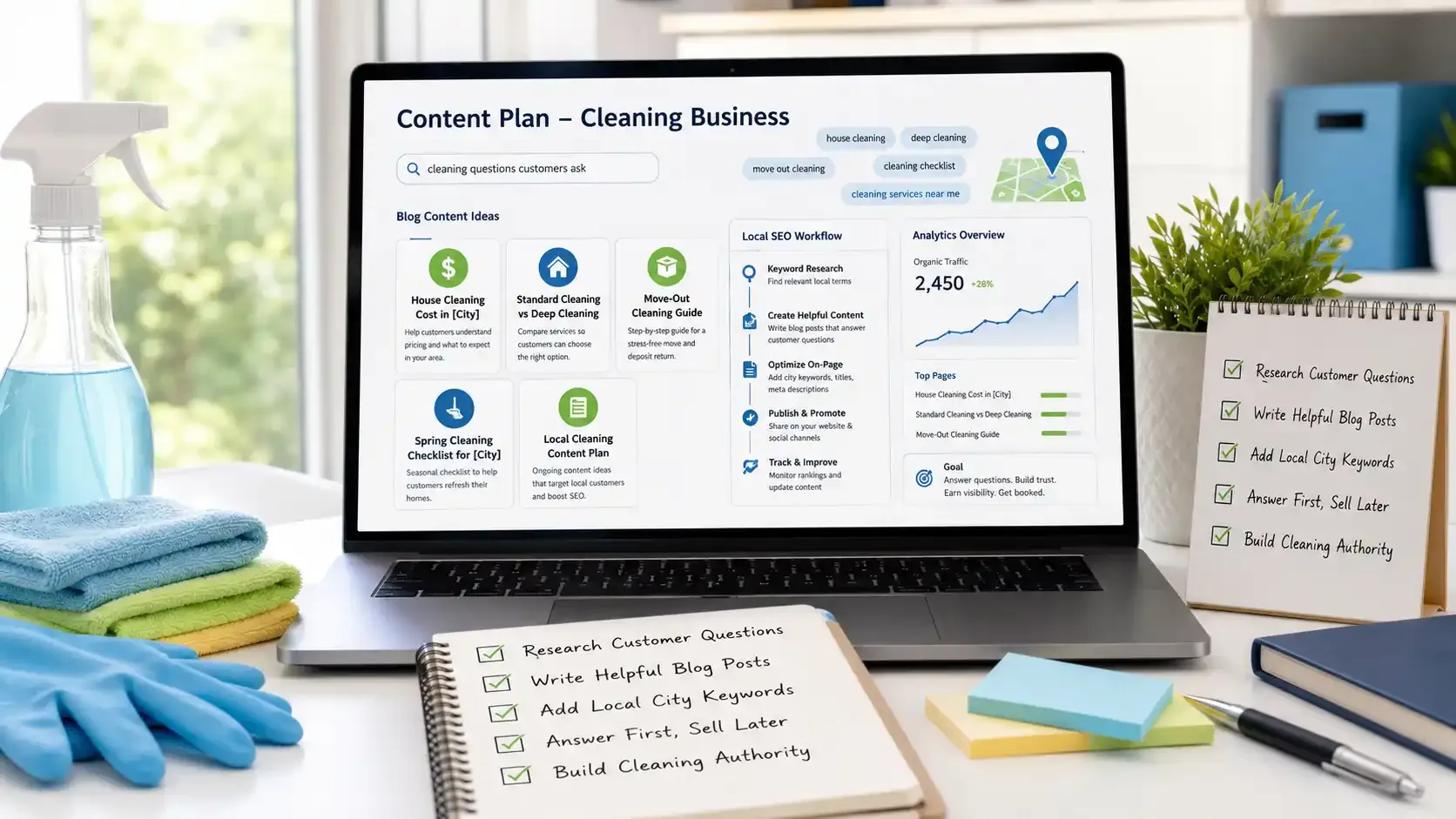
Helpful cleaning content brings people to your business before they are ready to book.
Not every customer starts with “cleaning company near me.” Some start with questions like “how much does house cleaning cost,” “standard cleaning vs deep cleaning,” or “what is included in move-out cleaning.”
So, use blog content to answer those questions early.
94% of B2B marketers use short articles and blog posts in their content marketing. Because helpful written content still works when people need answers before making a decision.
Blog Post Ideas for Cleaning Companies
Use blog topics that match real customer doubts. For example,
- How much does house cleaning cost in [City]?
- Standard cleaning vs deep cleaning: What’s the difference?
- What is included in a move-out cleaning?
- How often should you schedule house cleaning?
Each post should answer the question first.
Add Local Content
Local content makes your cleaning business feel closer to the customer.
Instead of writing only “spring cleaning checklist,” write “spring cleaning checklist for homes in [City].” Instead of “move-out cleaning guide,” write “move-out cleaning guide for renters in [City].”
This helps your content support local SEO for cleaning services.
It also shows that your company understands the area, the homes, the weather, the rental market, and the local customers’ needs.
Step 7: Build Local Citations and Backlinks
Local citations and backlinks help Google verify that your cleaning business is real, active, and trusted. But they are not the same thing.
A citation is a mention of your cleaning company’s name, address, and phone number. You will usually find citations on Google Business Profile, Yelp, Bing Places, Apple Maps, Facebook, Angi, Thumbtack, Chamber of Commerce pages, and local business directories.
A backlink is different.
A backlink is a clickable link from another website to your cleaning website. For example, if a local real estate agency lists your move-out cleaning company as a trusted vendor and links to your site, that is a backlink.
Both support cleaning business SEO, but they do different jobs.
Step 8: Use On-Page SEO to Help Google Understand Each Page
On-page SEO makes each cleaning service page clear for Google and customers.
This makes the page easy to read, easy to scan, and easy to match with a local search. If the page is about move-out cleaning in Austin, everything on that page should support that topic.
Start with one clear H1.
Do not use three main headings on one page. Use one H1 that tells the exact service and location, such as Move-Out Cleaning in Austin, TX.
Then use H2s and H3s to organize the page.
For example, use headings like What Our Move-Out Cleaning Includes, Who This Service Is For, Areas We Serve, Move-Out Cleaning FAQs, and Request a Quote.
Now, fix your title tag.
Google says title links give users a quick idea of what a result is about and why it matches their query. So your title should not be vague like Home | [Business Name]. (developers.google.com)
Next, write a real meta description.
Google says meta descriptions can help create snippets in search results, so each page should have a clear summary of what the customer will find. (developers.google.com)
Then handle images properly.
Use file names like office-cleaning-miami.webp instead of IMG_4421.jpg. Add alt text that describes the image, such as professional cleaners wiping office desks in Miami.
Finally, add FAQs and schema where useful.
Answer questions about pricing, timing, service areas, supplies, pets, and booking. Use short paragraphs because cleaning customers scan fast.
Step 9: Turn SEO Traffic Into Quote Requests and Booked Jobs
SEO traffic means nothing if visitors do not contact you. That is where many cleaning companies get stuck. They rank for house cleaning, move-out cleaning, or office cleaning, but the page does not push people toward a call, quote, or booking.
So, build every service page like a lead page.
Put your phone number above the fold. Add a clear Request a Quote button near the top. Keep the contact form short, because no one wants to fill out a long form just to ask about deep cleaning or recurring maid service.
Then explain the quote process.
Tell people what affects pricing, such as property size, cleaning type, condition, frequency, add-ons, and location.
If you offer online booking, show it clearly. If you offer same-day or next-day availability, say that too.
Once those quote requests start coming in, the next job is keeping them organized. Cleaning business tools like FieldServicely help manage bookings, assign cleaners, track job progress, and send invoices from one place. That way, SEO does not just bring more traffic; it helps create jobs your team can actually handle.
Stop losing leads after they click.
FieldServicely helps turn quote requests into assigned, tracked, and completed cleaning jobs.
Step 10: Track SEO Results That Actually Matter
Track SEO by asking one simple question: Did it bring more cleaning jobs?
Rankings are useful, of course. But a higher Google ranking does not mean much if nobody calls, fills out a quote form, or books a cleaning.
So, look beyond positions. Track:
- Booked jobs from organic search
- Quote form submissions
- Phone calls
- Google Business Profile calls
- Website clicks from Google Business Profile
- Google Maps rankings
- Conversion rate
If traffic goes up but quote requests stay flat, your page may need a clearer CTA. If Google Business Profile clicks rise but calls do not, your photos, reviews, or offer may not feel strong enough.
Turn SEO leads into scheduled cleaning jobs.
Manage bookings, cleaners, jobs, and invoices in one place.
How Long Does SEO Take for a Cleaning Business?
SEO for a cleaning business usually takes 6–12 months to bring solid results.
You may see small wins earlier. Fixing your Google Business Profile, updating title tags, adding service pages, and cleaning up citations can help Google understand your business faster.
But steady leads take time. That is why a cleaner in a small town may see movement faster than a cleaning company in Dallas, Miami, or Chicago.
- Months 1–3: fix GBP, site issues, service pages, and citations.
- Months 3–6: add content, reviews, links, and local authority.
- Months 6–12: expect stronger rankings, better leads, and clearer booking data.
Paid ads can bring calls faster. But the calls stop when the budget stops. SEO takes longer, but good work keeps bringing local leads over time.
Common SEO Mistakes Cleaning Businesses Should Avoid
- No Google Business Profile means fewer chances to appear in Google Maps and local search results.
- The wrong GBP category can confuse Google about whether you offer house cleaning, office cleaning, or janitorial services.
- One page for all services makes deep cleaning, move-out cleaning, and commercial cleaning harder to rank.
- Duplicate city pages with only the city name changed look thin and low-value.
- Weak reviews and messy NAP data reduce trust before customers call or request a quote.
- Keyword stuffing and generic AI blogs make your content sound spammy, not helpful.
- No call button, quote form, or tracking turns good SEO traffic into missed cleaning leads.
SEO for a cleaning business takes time, but it can pay off for months after the work is done. If your profile is clear, your service pages answer real questions, and your reviews show trust, customers have fewer reasons to choose someone else. Keep improving your pages, photos, links, and calls to action. Over time, your cleaning business can show up more often, get better leads, and turn those searches into booked jobs.
Frequently Asked Questions
Is SEO worth it for cleaning companies?
Yes, SEO is worth it for cleaning companies that want steady local leads. Paid ads can help fast, but SEO keeps working when your pages, reviews, and Google Business Profile stay strong. It helps your business show up when nearby customers search for cleaning services.
How long does SEO take for a cleaning business?
SEO for a cleaning business usually takes 6–12 months to show meaningful results. Some fixes, like improving your Google Business Profile or title tags, can help sooner. But stronger rankings, better leads, and booked jobs take steady work.
How do I rank my cleaning business in Google Maps?
Start with your Google Business Profile. Choose the right category, add services, upload real photos, collect reviews, and keep your name, address, and phone number consistent. Then build a local authority with citations, backlinks, and strong service pages.
What keywords should a cleaning business target?
A cleaning business should target service + location keywords. Examples include “house cleaning in [City],” “maid service in [City],” “office cleaning services in [City],” and “move out cleaning near me.” These keywords match how local customers search.
Do cleaning businesses need separate service pages?
Yes, separate service pages help a lot. A deep cleaning page, a move-out cleaning page, and an office cleaning page each answer different customer needs. They also help Google understand each service more clearly.
Should I create location pages for every city I serve?
Yes, but only for cities you actually serve. Each location page should have useful local details, service info, FAQs, and a clear quote CTA. Do not copy the same page and only change the city name.
Is local SEO better than paid ads?
Local SEO and paid ads work differently. Paid ads can bring leads faster, but the traffic stops when the budget stops. Local SEO takes longer, but it can build steady organic visibility and better long-term value.
What to read next