- Field Service Business
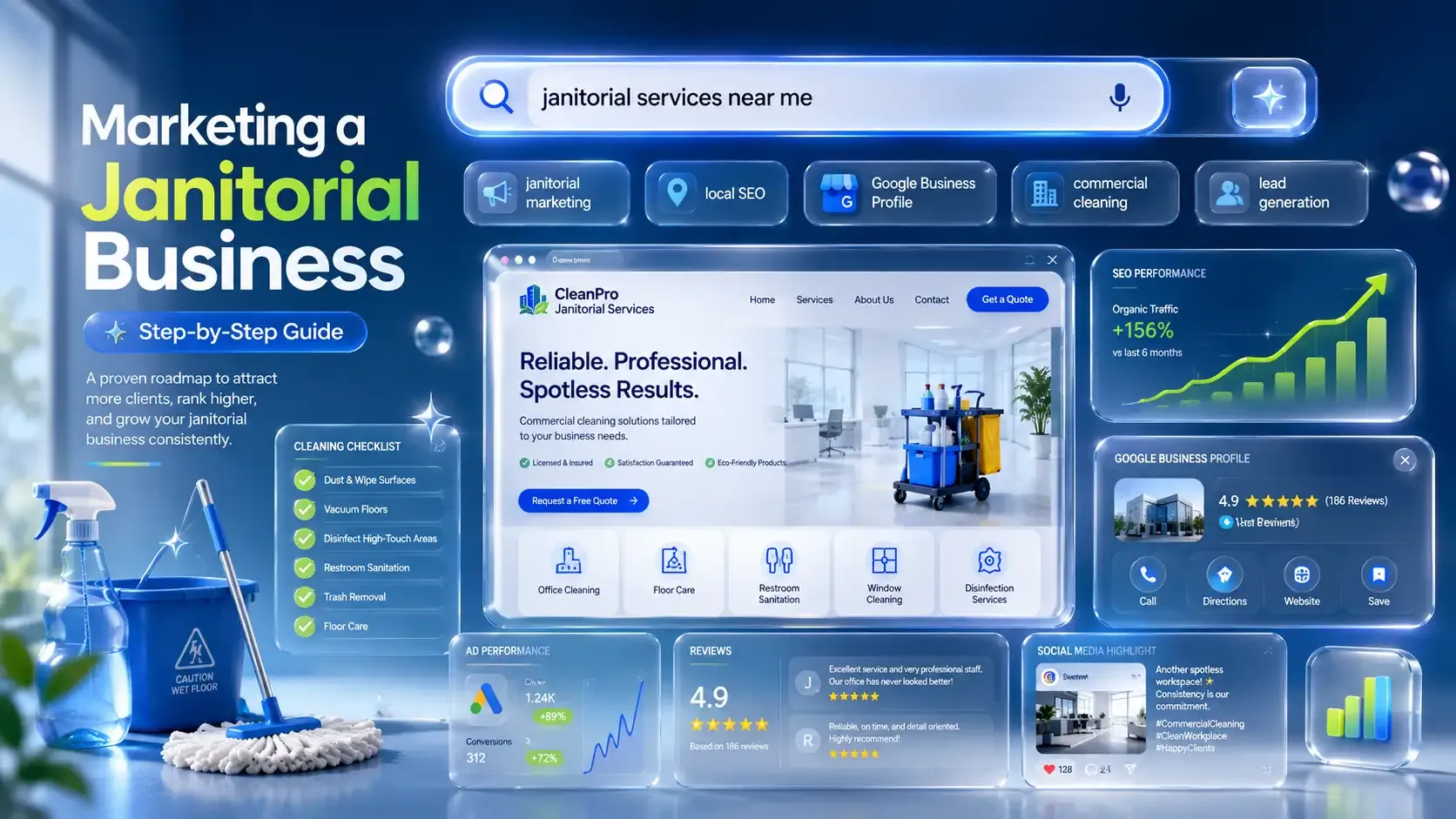
Marketing a Janitorial Business: Step-by-Step Guide
Updated on 15 May 2026
Jump to
Summary

Marketing a janitorial business helps commercial clients find and trust your team.
A clear website and Google profile can turn searches into quote requests.
Reviews, referrals, and LinkedIn help you reach better local buyers.
Ads and local SEO work best when they target high-intent searches.
Tracking leads and follow-ups helps turn one job into repeat contracts.
Marketing a janitorial business means helping local companies find and trust your cleaning service. It brings your business in front of property managers, office managers, and building owners who need steady cleaning help.
The hard part is that most janitorial companies look the same online. They fight for the same leads, miss follow-ups, depend too much on referrals, or spend money on ads without a clear plan.
That is why you need a simple system for search, reviews, ads, LinkedIn, referrals, and retention.
In this blog, I will discuss how to market a janitorial business step by step. You will also learn how to turn leads into recurring cleaning contracts.
What Does Janitorial Business Marketing Mean?
Marketing a janitorial business means getting commercial clients to find you, trust you, and call you when they need a cleaner they can rely on.
Let’s say a property manager needs a new cleaning company. They may search on Google, check your reviews, visit your website, and compare you with two other janitorial companies before they ever contact you.
That is why your local search, Google Ads, Google Business Profile, and reviews must work together.
This matters even more in B2B. 69% of the B2B buying process happens before buyers talk to sales. And 81% already pick a preferred vendor before that first sales call.
So, your janitorial business needs to show up early, not after the client is ready to sign.
Why Market a Janitorial Business?
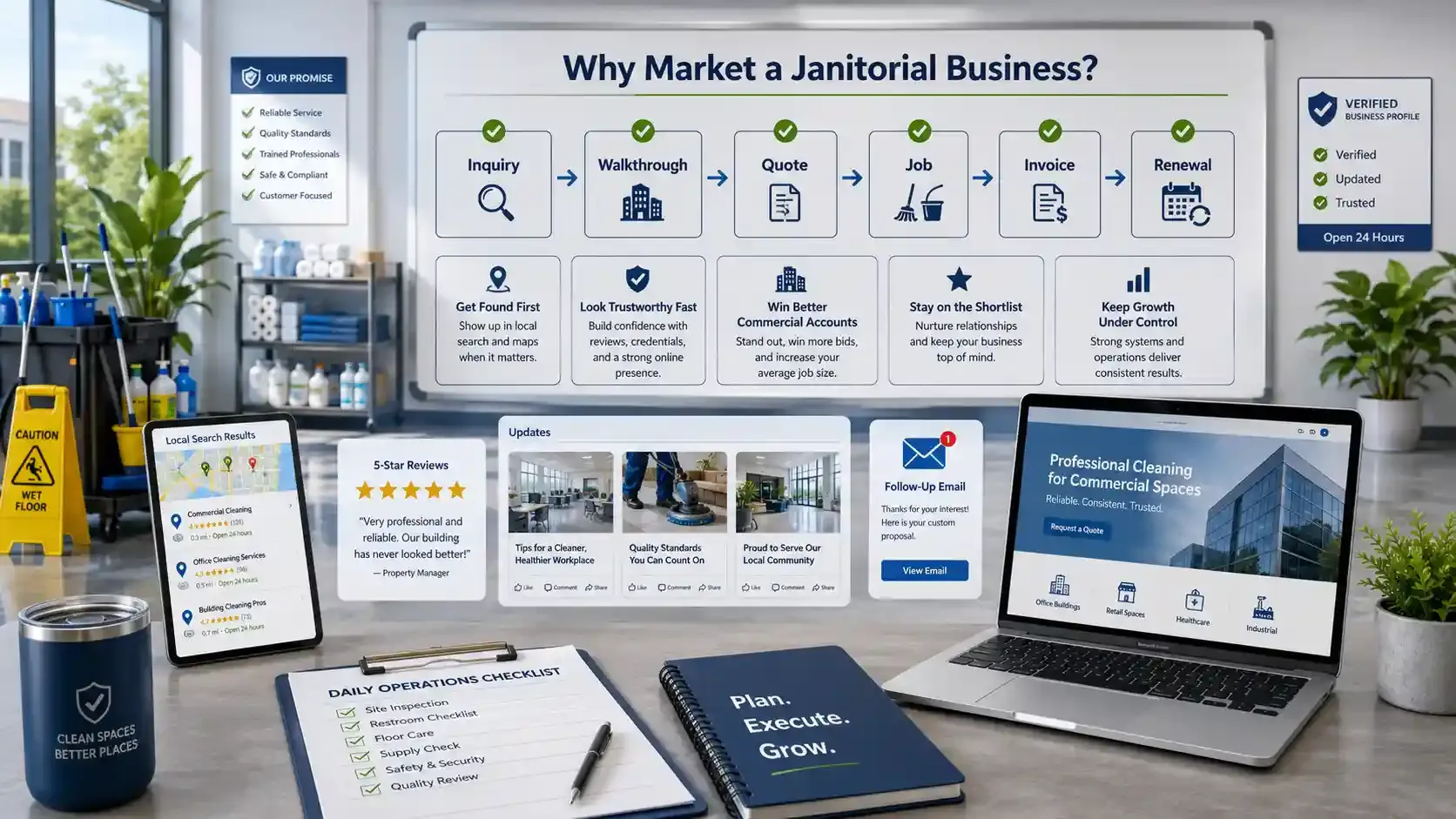
Get Found First
A janitorial business needs marketing because the best cleaner does not always get the call. The company that shows up on Google, looks active, and answers fast often gets the walkthrough first.
AP reported that Google Local Services Ads now require a verified Google Business Profile in many regions. And ads can pause if the profile details do not match. That tells you one thing. Local visibility now starts with clean, verified business information.
Look Trustworthy Fast
Trust starts before the first handshake. A property manager may check your reviews, photos, website, and service list before they ever ask for pricing.
And reviews are no small thing anymore. Yelp has more than 330 million local business reviews! And its new AI tool is built to help people sort through that review data faster.
So yes, your reputation can work for you before your sales pitch does.
Win Better Accounts
Good marketing helps you attract the right jobs, not just any job. A medical office, warehouse, school, and office building all need cleaning, but each one has a different concern.
So the message has to be clear. “We clean everything” sounds weak. “We handle office cleaning, medical office cleaning, floor care, and day porter services” sounds like a company that knows commercial work.
Stay on the Shortlist
Commercial buyers do not always choose right away. They compare vendors, read websites, check LinkedIn, ask for referrals, and come back when the current cleaner fails.
According to Forbes, around 60% of the B2B selection phase can happen before buyers contact vendors. That means your website, Google profile, reviews, LinkedIn posts, and follow-up emails need to sell even when you are not in the room.
Keep Growth Under Control
More leads can create more mess if your process is weak. Calls get missed, estimates sit too long, cleaners get double-booked, and follow-ups disappear.
That is why marketing and operations must work together.
Entrepreneurs reported that 51% of growth-focused small businesses struggle to streamline systems and operations. For a janitorial business, that means every new lead needs a clear path from inquiry to walkthrough, quote, job, invoice, and renewal.
Grow without losing control.
Keep schedules, jobs, teams, and invoices in one place.
How to Market a Janitorial Business: Step-by-Step Guide
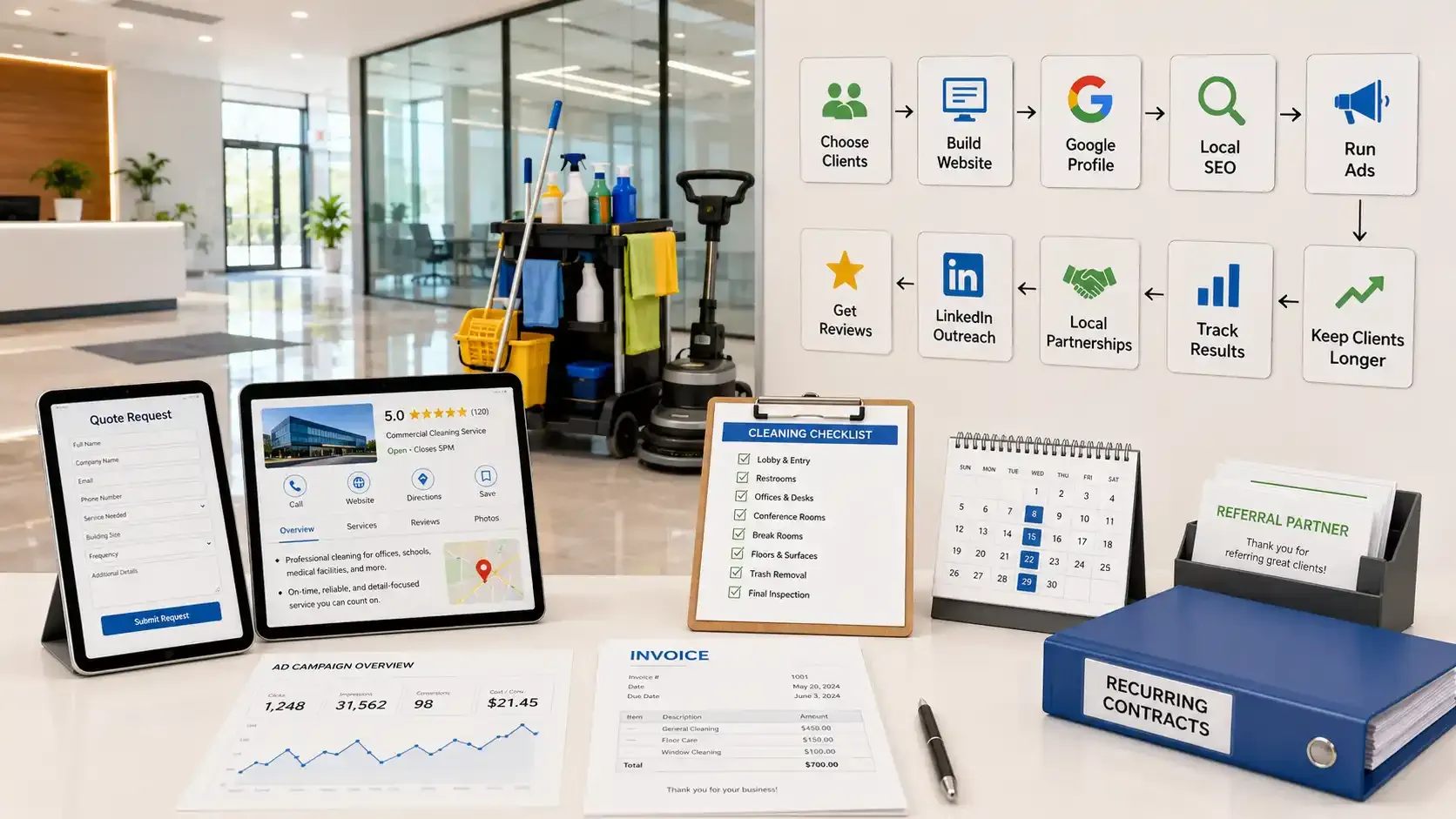
Marketing a janitorial business gets easier with a clear plan. The steps below show how to get found, build trust, and reach local business owners.
They also show how to turn quote requests into repeat cleaning contracts.
Step 1: Choose the Commercial Clients You Want to Win
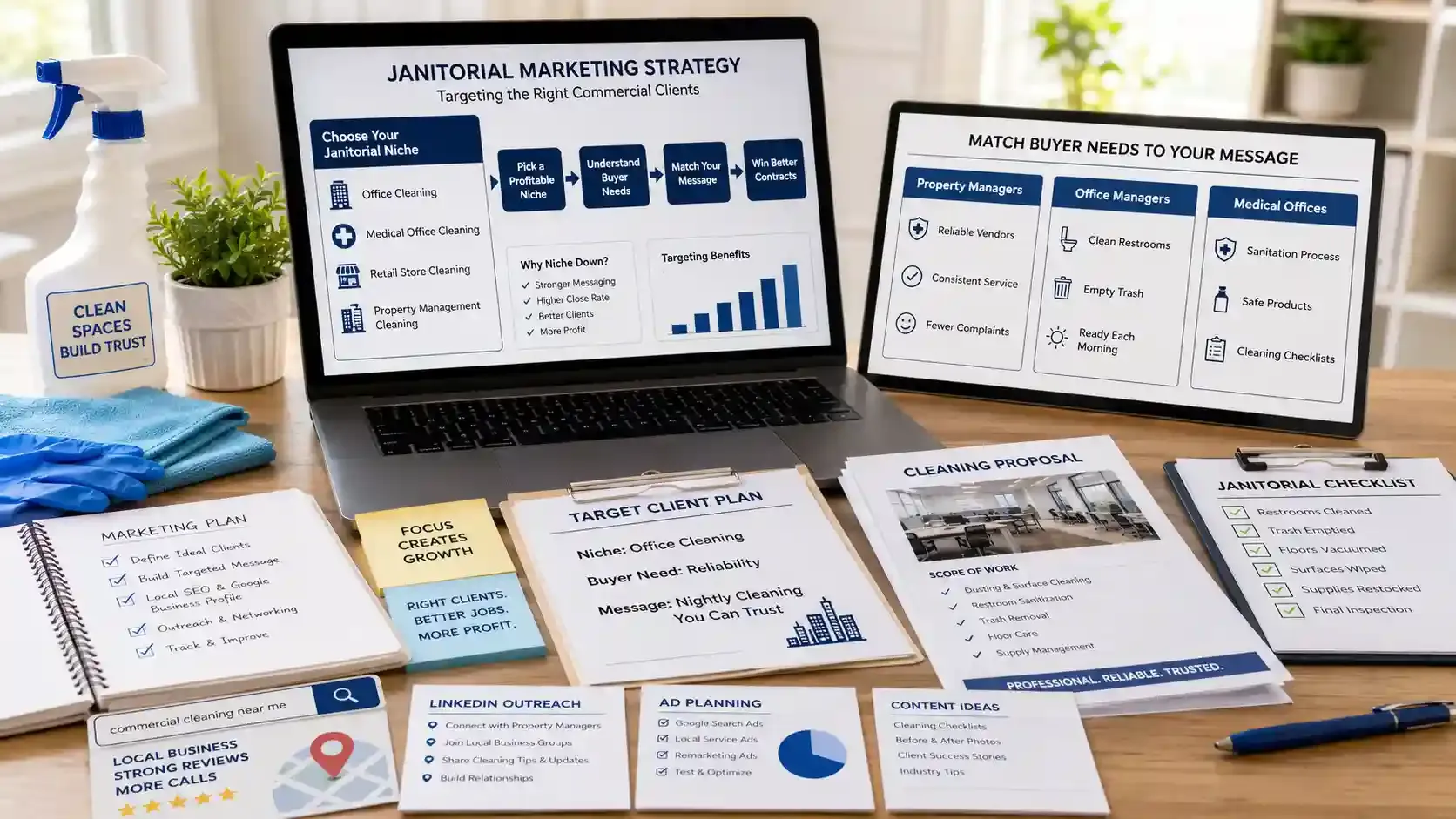
Janitorial marketing works better when you know exactly who you want to serve. Otherwise, every ad, website page, and sales message sounds too broad.
Pick a Profitable Janitorial Niche
A profitable janitorial niche gives your marketing a clear direction. It also helps you avoid low-value jobs that drain your team.
Office cleaning is a strong place to start. Offices often need nightly or weekly service, and that can lead to steady contracts. Medical office cleaning needs a different pitch. These clients care about sanitation, safer products, checklists, and fewer missed tasks.
So, niche selection helps you speak to real business needs.
Match Your Message to the Buyer
The right message makes your offer feel specific. The wrong message makes your company sound like every other cleaner.
Property managers want reliable vendors. Office managers want fewer cleaning complaints. They care about restrooms, trash, desks, break rooms, and a workplace that feels ready each morning.
On the other hand, medical offices want sanitation and process.
Your message should mention cleaning checklists, trained staff, safe products, and detailed work. This is why one message cannot fit every buyer. A medical office does not care about the same pain points as a retail store.
So, build your janitorial marketing around the clients you want most. Then write your website, ads, LinkedIn outreach, and proposals for those exact buyers.
Manage every commercial account better.
Track clients, jobs, service needs, and team tasks from one place.
Step 2: Build a Website That Turns Visitors Into Estimate Requests
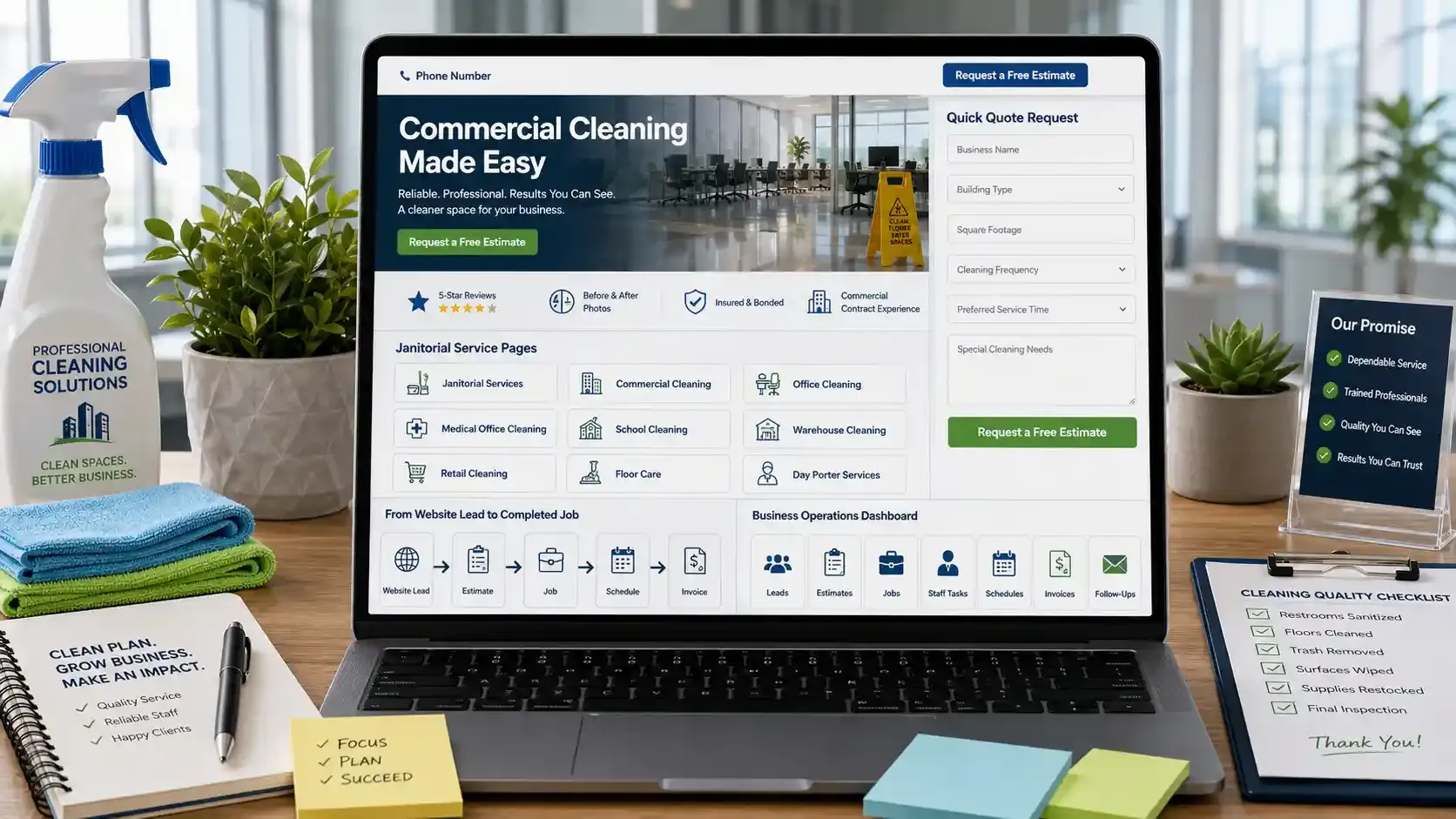
Your website should make a commercial client feel ready to call, request a quote, or book a walkthrough.
That sounds obvious. But a lot of janitorial websites make people work too hard.
Show what you clean, where you work, and how to reach you. Add your phone number in the header. Put a clear Request a Free Estimate button near the top.
Then add proof.
Reviews help. Before-and-after photos help more. Insurance, bonding details, and commercial contract experience help even more.
Add the Right Janitorial Service Pages
One general services page is not enough.
Create pages for janitorial services, commercial cleaning, office cleaning, medical office cleaning, and school cleaning. Then add pages for warehouse cleaning, retail cleaning, floor care, and day porter services.
Each page should speak to that buyer’s real concern. It also helps Google understand your services better.
Make Quote Requests Easy
Your quote form should feel quick. Ask for the business name, building type, square footage, cleaning frequency, preferred service time, and special cleaning needs.
After that, the real work begins. Leads turn into estimates. Estimates turn into jobs. Jobs turn into schedules, staff tasks, invoices, and follow-ups.
Once your website starts bringing leads, FieldServicely helps keep the backend clean. You can manage estimates, jobs, staff, schedules, and invoices in one place.
Step 3: Optimize Your Google Business Profile for Local Janitorial Leads
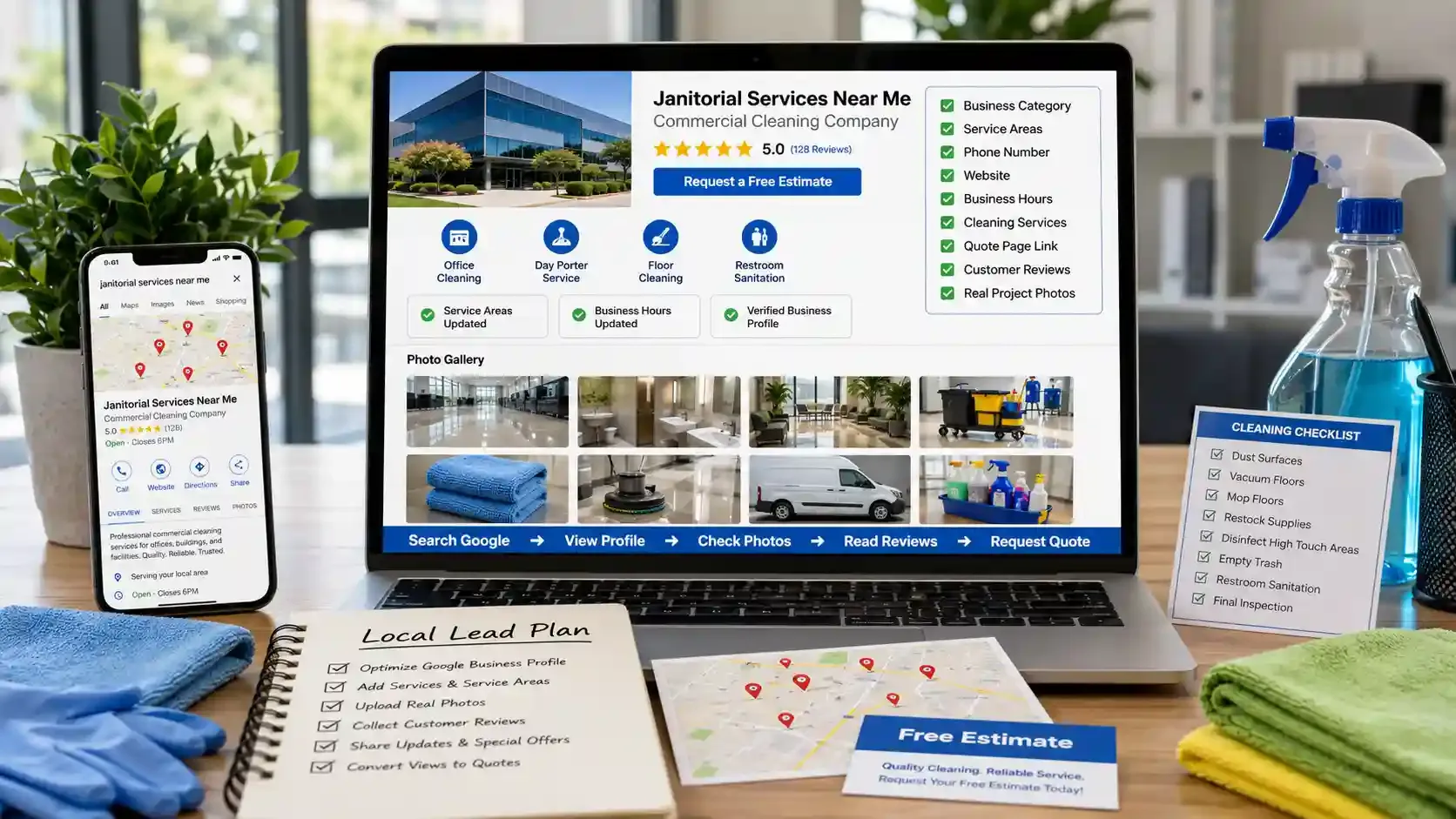
Google Business Profile is one of the most important marketing tools for a janitorial business. Because a local commercial client may search Google before calling any cleaning company.
A property manager may not know your brand yet. But they may search “janitorial services near me,” check your reviews, scan your photos, and call from your profile.
So, treat your profile like a small sales page. Claim and verify it first. Then add the right business category, service areas, business hours, phone number, website, and cleaning services.
Add Photos That Prove Your Team Is Real
Photos help buyers see that your janitorial company is active and real.
Show your team in uniform. Show your cleaning equipment, branded vehicle, floor cleaning work, office cleaning setup, and restroom sanitation process.
Before-and-after photos also help. A clean lobby, polished floor, or sanitized restroom says more than a long paragraph about quality.
Use Your Profile to Drive Quote Requests
Your profile should make the next step easy. Point people to a quote page, booking page, or phone number.
Do not send every visitor to a messy homepage.
If someone needs office cleaning, send them to an estimate page. If they need day porter service, send them to a clear service page.
Handle Google leads without chaos.
Track calls, jobs, teams, and follow-ups in one place.
Step 4: Use Local SEO to Rank for Commercial Cleaning Searches
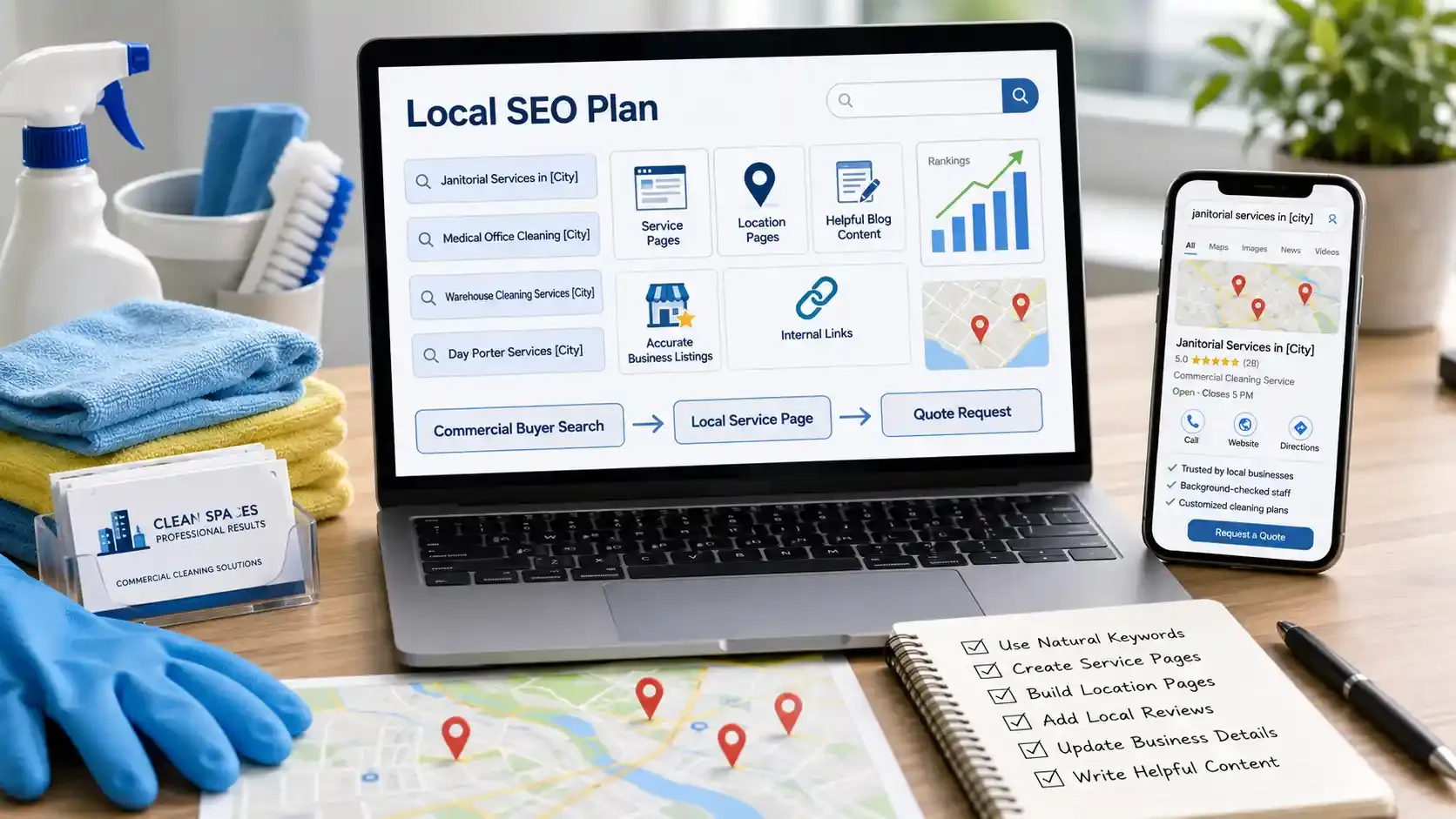
Local SEO helps your janitorial business appear when nearby companies search for cleaning services with hiring intent. That is why your website should match the way commercial buyers search.
A property manager may look for “janitorial services in [city].” A clinic owner may search “medical office cleaning [city].” A warehouse manager may type “warehouse cleaning services [city]” or “day porter services [city]” when they need help fast.
Use these keywords in a natural way across your site. Put them in page titles, headings, service pages, location pages, meta descriptions, image alt text, and internal links.
But do not stuff the same phrase everywhere. Because that makes the page hard to read and weaker for real buyers.
Organic search still plays a major role in how people find businesses online. In fact, organic search drove about 33% of overall website traffic across seven major industries.
Create Service and Location Pages
Your janitorial website should have two types of pages: service pages and location pages. Service pages explain what you offer. Location pages explain where you offer it.
This makes the page more useful for both Google and the buyer.
Avoid copying the same page and only changing the city name. That feels lazy, and it does not help the reader. Add local details, nearby service areas, real photos, reviews, and examples of buildings you clean in that area.
Write Helpful Content for Commercial Buyers
Helpful content brings in buyers before they are ready to call. Many janitorial websites only list services, but buyers often have questions first. Your blog can answer those questions and move them closer to a quote request.
Local search depends on clear and accurate information. 84% of consumers search for local businesses online daily, and 53% say wrong listing details can make them leave.
Hence, local SEO should not only bring traffic. It should help turn that traffic into real commercial cleaning leads.
Step 5: Run Google Ads and Local Services Ads for Ready-to-Hire Clients
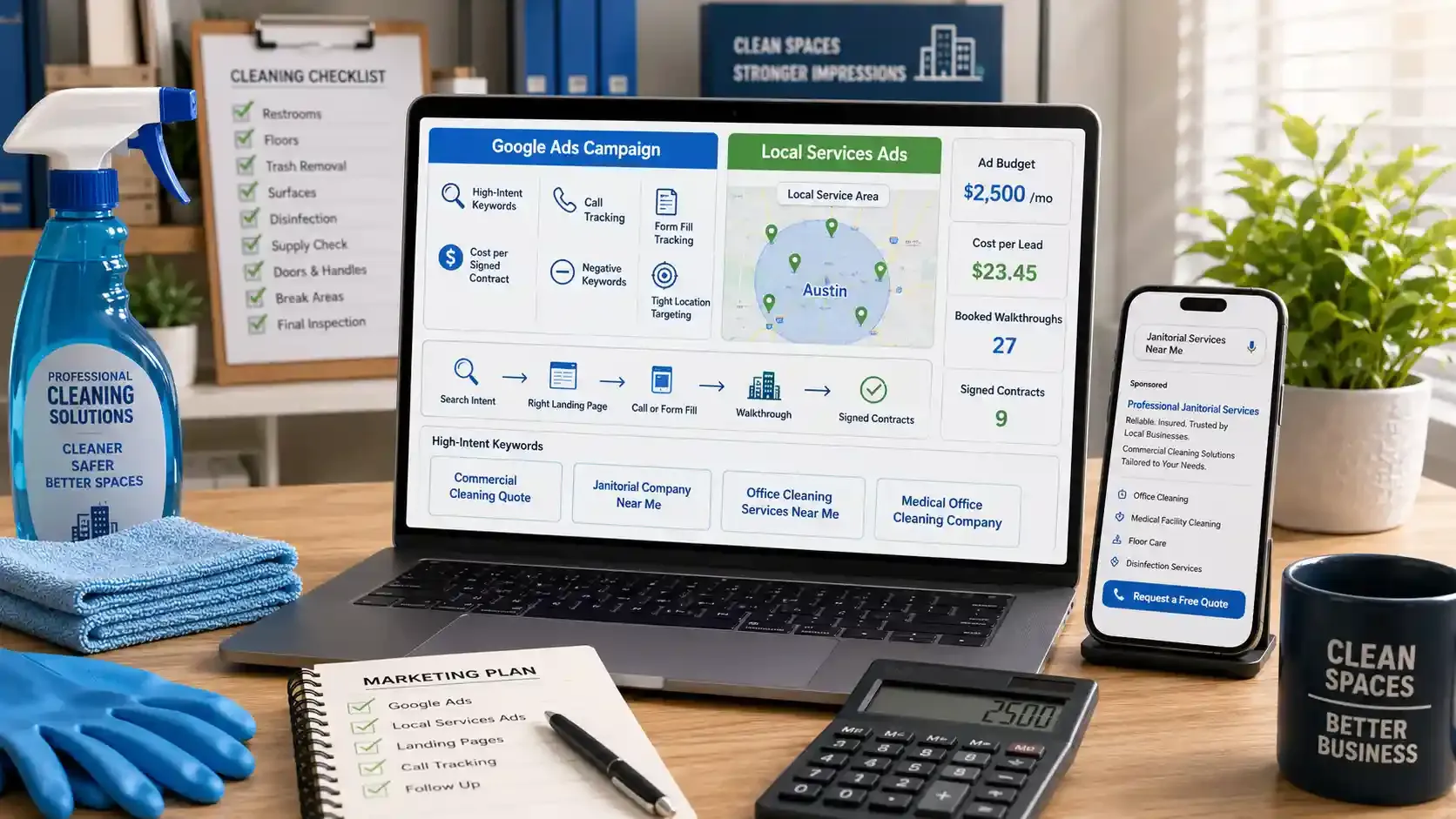
Paid ads help a janitorial business reach people who need a cleaning company marketing now. This is where Google Search Ads and Google Local Services Ads can work well.
A buyer searching for “commercial cleaning quote” or “janitorial company near me” already has a problem to solve.
But paid ads can burn money fast if you set them up loosely. Keep the location tight, track calls, measure form fills, and use negative keywords to block poor-fit searches.
Budget control matters too. According to a report, the average Google Ads cost per lead rose from $66.69 in 2024 to $70.11 in 2025.
Local Services Ads also need a clean setup now. Google says businesses must pass screening and verification. This includes business registration, insurance, license checks, background checks, and review requirements. (Source: Google)
Target Keywords With Buying Intent
High-intent keywords bring better leads than broad cleaning terms. Someone searching for “cleaning tips” wants advice. Someone searching “office cleaning services near me” may want a quote.
Start with terms like commercial cleaning quote, janitorial company near me, or office cleaning services near me.
Then tighten the campaign with location targeting. A janitorial company in Tampa should not pay for clicks from Miami unless it actually serves that area.
Send Ad Traffic to the Right Page
Ad traffic should not always land on your homepage.
A person searching for “medical office cleaning company” should land on a medical office cleaning page. That page should mention exam rooms, waiting areas, restrooms, high-touch surfaces, and after-hours cleaning.
This match makes the ad feel more relevant. It also helps the buyer take the next step without digging through your site.
Track Cost per Signed Contract
A $90 lead may look expensive, but not if it turns into a $2,000 monthly cleaning contract.
This is why call tracking and conversion tracking matter. You need to know which keywords brought calls, which calls became walkthroughs, and which walkthroughs became signed contracts.
According to Search Engine Land, businesses need a matching Google Business Profile to keep running Local Services Ads. If the profile does not match, ads can pause.
Make every paid lead easier to track.
See which leads become jobs, invoices, and revenue.
Step 6: Build Trust With Reviews, Testimonials, and Referrals
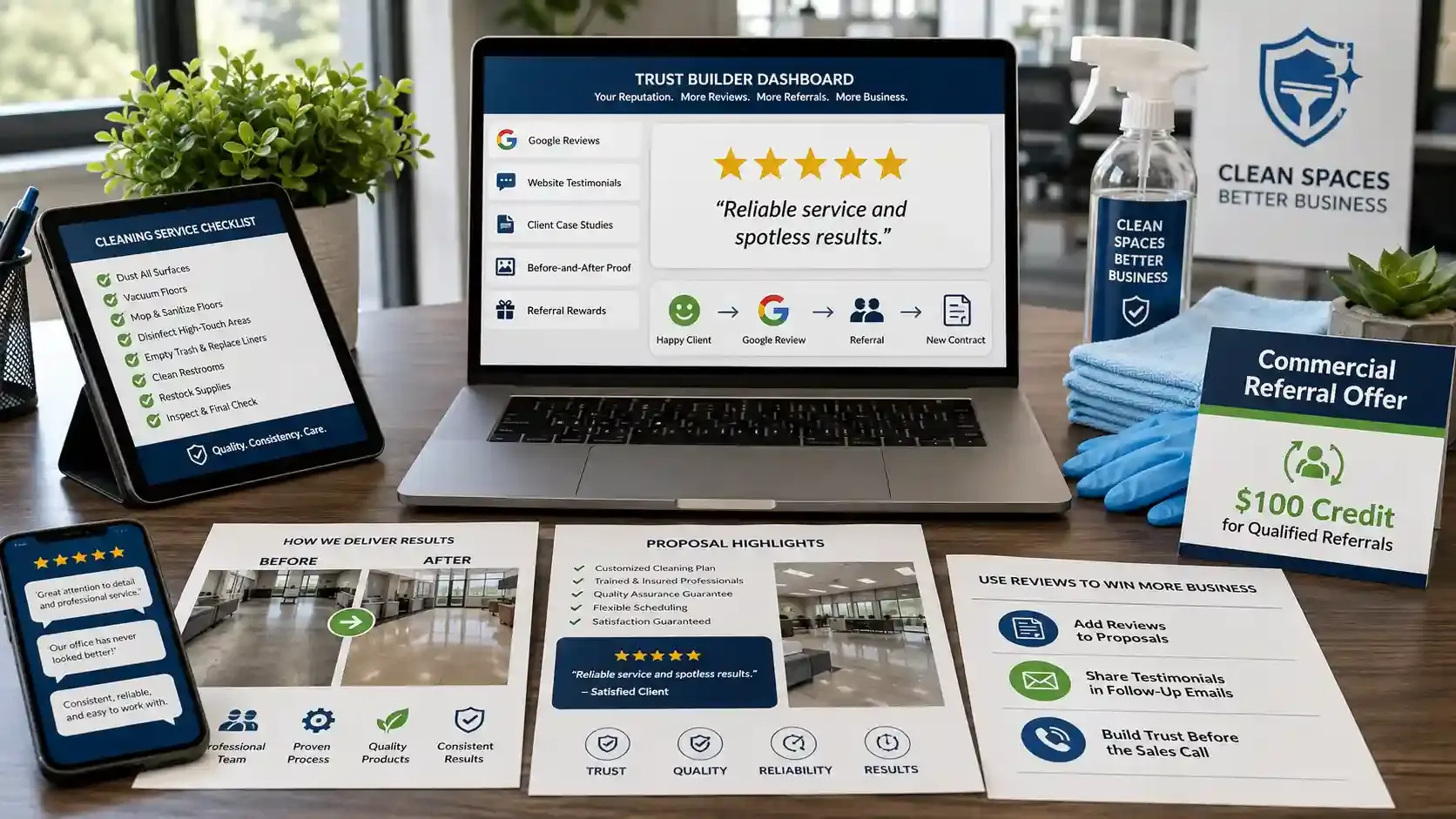
Reviews and referrals help janitorial businesses win trust before the first sales call. In fact, 75.5% of consumers trust online reviews when making a purchase decision.
That is why Google reviews, website testimonials, case studies, and before-and-after proof are important.
Ask for Reviews at the Right Time
The best time to ask is when the client already feels the value. Ask after a strong first clean, a resolved issue, a contract renewal, or a finished deep clean.
A short text or email works well. Keep it simple like “Glad the floor care went well today. Would you mind leaving us a quick Google review?”
Create a Simple Commercial Referral Offer
A referral offer should feel easy to understand. Try a $100 credit when a referred business signs a monthly contract, or a free floor care add-on after a successful referral.
For larger accounts, use tiered rewards. A small office contract may earn one reward, while a multi-location account can earn a higher one.
Use Testimonials in Your Sales Process
Testimonials should not stay on one hidden page. Add them to website pages, landing pages, your Google Business Profile, proposals, follow-up emails, and social posts.
This is where trust starts to stack. A buyer sees the review, then the photo, then the proposal quote, and the company feels safer to hire.
Step 7: Use LinkedIn to Reach Property Managers and Office Managers
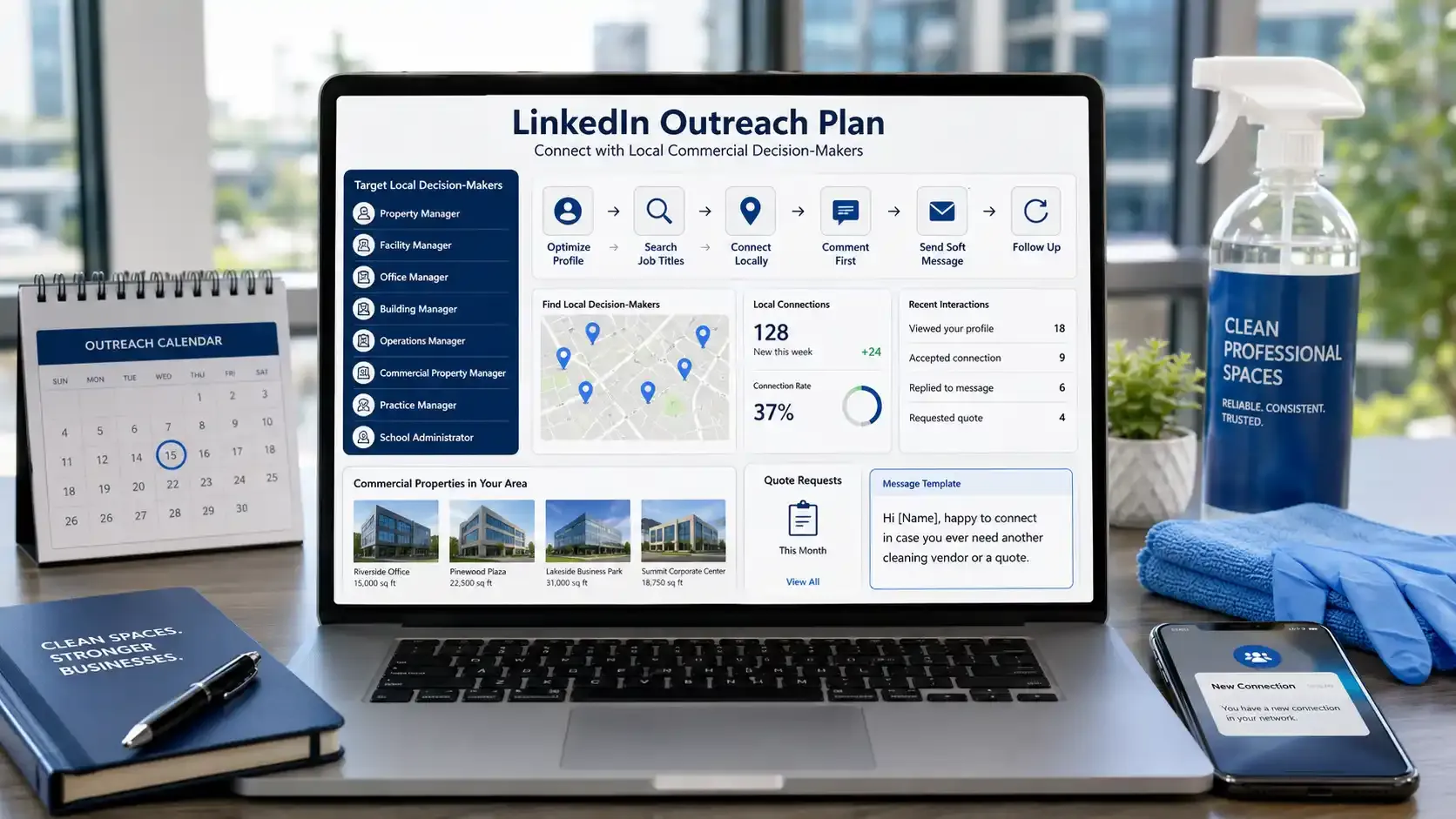
LinkedIn helps you reach people who manage buildings, offices, and commercial spaces. 85% of B2B marketers say LinkedIn delivers the best value among social platforms.
For a janitorial company, that makes sense. Your buyers are often at work when they use it.
Start with your own profile first. Add a clear headline, service area, company page, real photos, and a short line about the buildings you clean.
Search for the Right Job Titles
Search for Property Manager, Facility Manager, Office Manager, Building Manager, and Operations Manager. Also look for Commercial Property Manager, Real Estate Manager, Practice Manager, and School Administrator.
Then connect with local decision-makers. Comment before pitching, send short messages, and follow up without sounding desperate.
Use a Soft Outreach Message
Try something like this:
Hi [Name], I saw that you manage facilities in [City]. I run a local janitorial company that helps commercial buildings stay clean, consistent, and ready for staff and visitors. Happy to connect in case you ever need another cleaning vendor or a quote.
Don’t push too hard or don’t be too salesy. Try having a business relationship first.
Step 8: Build Local Partnerships and Use Offline Outreach
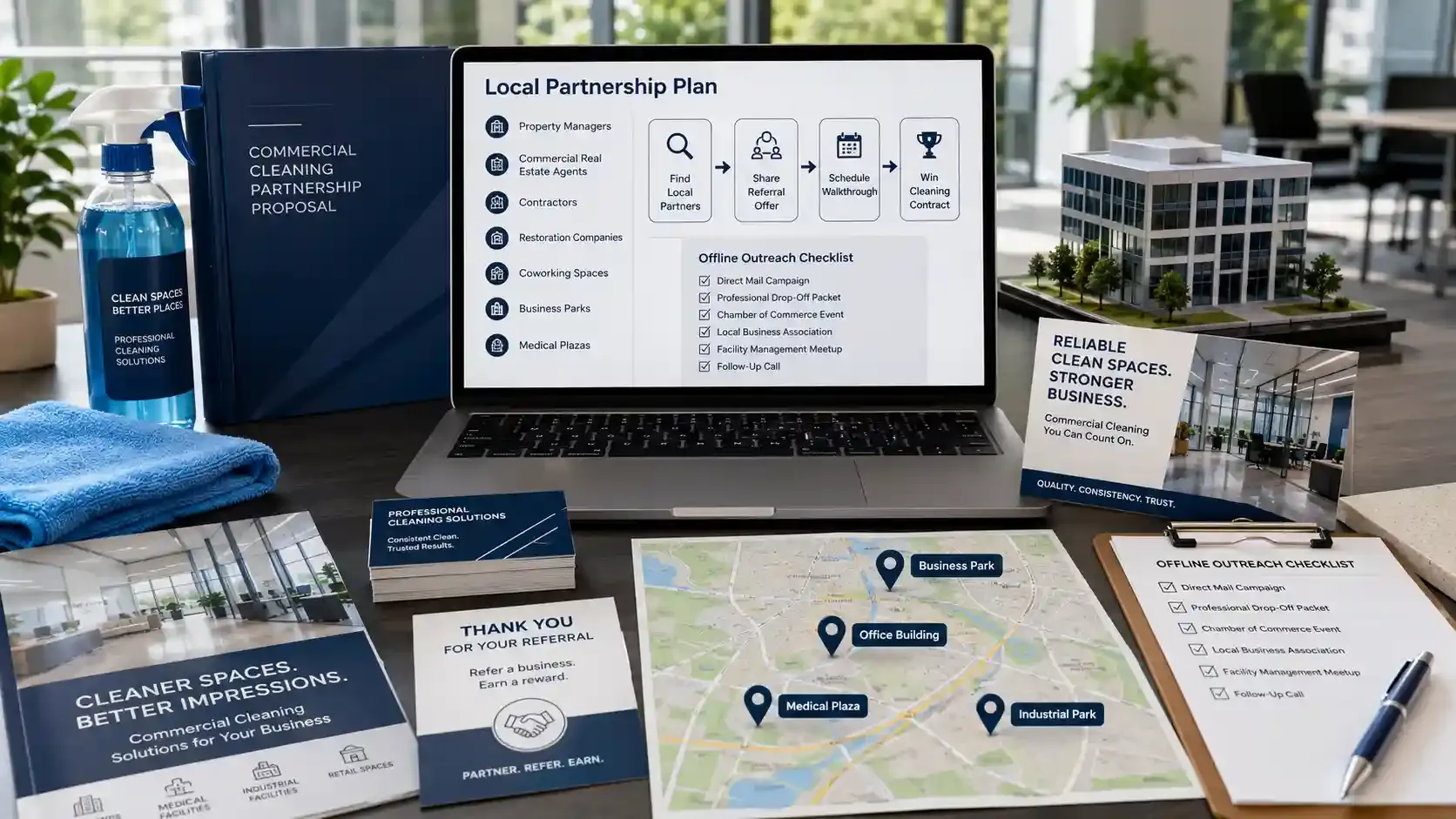
Local partnerships and offline outreach still work because many janitorial contracts come from relationships. A building owner may find you online, but a property manager may remember you because someone they trust gave your name.
That is the whole point of this step. You want to be known in the places where commercial cleaning decisions already happen.
Start with people who touch the same clients you want. That includes commercial real estate agents, property managers, contractors, restoration companies, etc.
Local areas matter too. Business parks, industrial parks, medical plazas, and office buildings are full of possible accounts.
Partner with Businesses That Serve Your Ideal Clients
The best partners already work with your future clients.
Contractors need post-construction cleaning after projects. Property managers need reliable vendors for recurring building care. Commercial real estate agents may need move-in and move-out cleaning.
Coworking spaces also make sense. They need regular office cleaning, restroom care, trash removal, and quick support when members complain.
Use Direct Mail and Drop-Offs Carefully
Direct mail can work when it looks professional and speaks to a real problem. A cheap flyer that says “best cleaning service” will likely get tossed.
Focus the message on pain points. Mention inconsistent cleaning, missed tasks, restroom complaints, poor communication, unreliable vendors, and no quality checks.
Keep the offer simple. Ask for a walkthrough, a quote request, or a short call.
Join Local Groups Where Decision-Makers Spend Time
Local groups help you meet buyers before they need a cleaner.
Try your chamber of commerce, BNI-style groups, local business associations, real estate events, facility management meetups, and community business events.
That’s because event teams still invest in B2B events, even while budgets face pressure. That shows face-to-face business spaces still matter. [Source: Forrester]
Manage partner referrals with less stress.
Keep referred jobs, schedules, teams, and invoices easy to track.
Step 9: Track Results and Keep Clients Longer
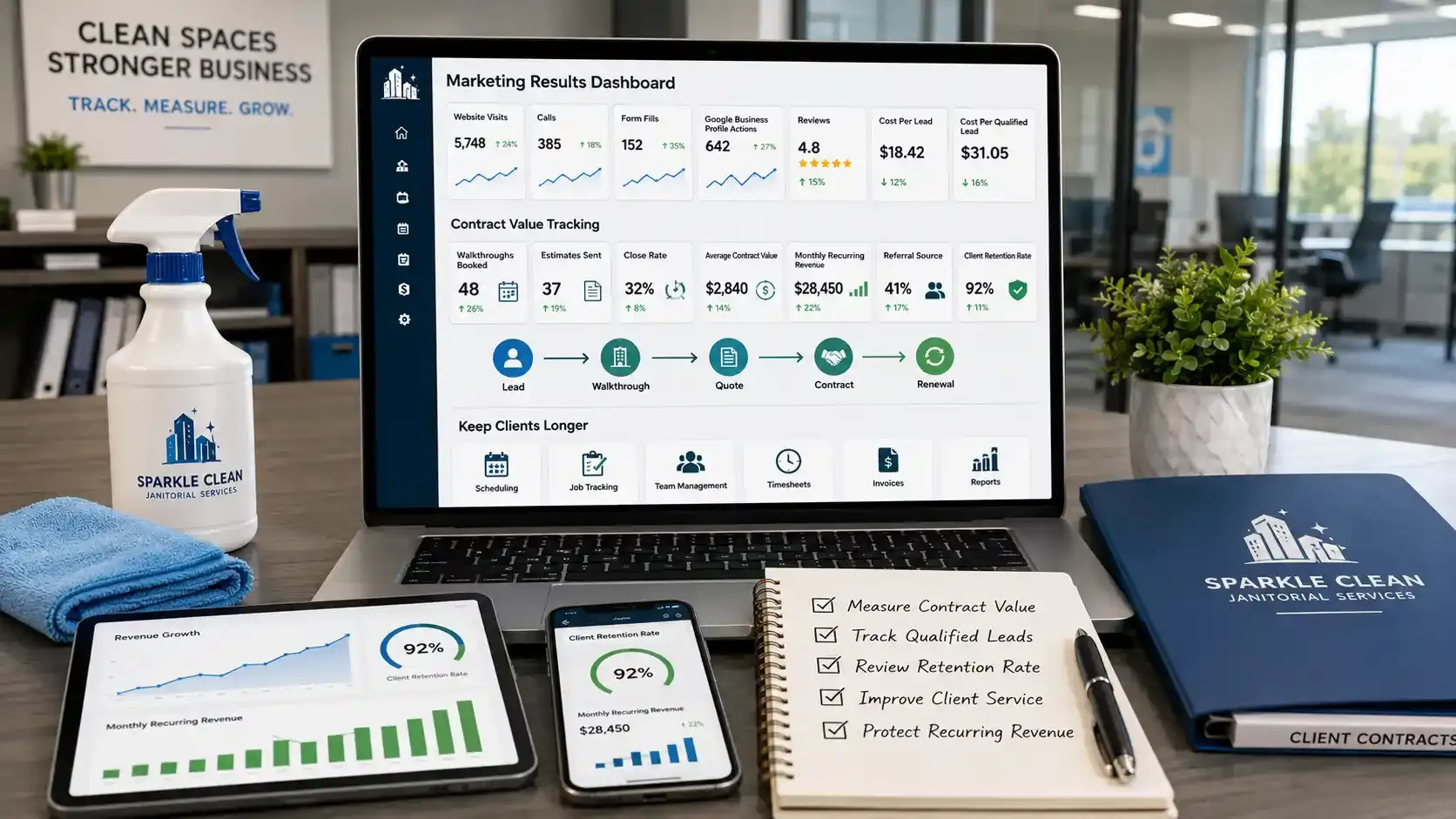
The best janitorial marketing strategy is the one you can measure, improve, and use to keep clients longer.
Start by tracking the full path. Check website visits, calls, form fills, Google Business Profile actions, reviews, cost per lead, and cost per qualified lead.
Then go deeper. Track walkthroughs booked, estimates sent, close rate, average contract value, monthly recurring revenue, referral source, and client retention rate.
The survey found that 73% of B2B marketers increased their focus on measurement and attribution because they needed to prove ROI.
Measure Contract Value, Not Just Lead Volume
A janitorial company should not only ask, “How many leads did we get?” It should ask which leads became walkthroughs, which walkthroughs became quotes, and which quotes became contracts.
Then look at the next layer. Which contracts stayed for 6–12 months? Which marketing channel brought the best clients?
A $100 lead can be cheap if it turns into a $3,000 monthly office cleaning contract.
Use Retention Marketing to Protect Revenue
Retention keeps growth from leaking out the back door.
Bad service costs more than many owners think. Even poor customer experiences put $3.8 trillion in global sales at risk!
FieldServicely helps janitorial teams keep scheduling, job tracking, team management, timesheets, invoices, and reports in one place. That makes it easier to see what happened, who did the work, and what the client needs next.
Step 10: Tips for Highest ROI in 2026
The highest-ROI janitorial marketing in 2026 should start with local trust.
First, keep your Google Business Profile clean, active, and real. Add fresh photos, respond to reviews, and avoid fake review tricks. Google Maps now warns users about some profiles with removed fake reviews. This makes an honest reputation work even more important. [Source: The Verge]
Next, build referrals with simple rewards. Offer a small credit for a signed monthly contract, then give a bigger reward for larger commercial accounts.
After that, test Nextdoor ads in tight service areas. Nextdoor reported 46.1 million weekly active users in Q1 2025, so it can help local service brands stay visible.
Finally, automate follow-up emails. Litmus says 35% of companies see email ROI of 36:1 or more, which makes retention emails worth using.
Build a cleaner system for growth.
Use FieldServicely to manage every job after marketing works.
Common Janitorial Marketing Mistakes to Avoid
- Marketing only when work gets slow makes your lead flow weak and unpredictable.
- Sending Google Ads to the homepage wastes clicks because buyers need service-specific pages.
- Targeting homeowners hurts your message when you really want offices, clinics, and warehouses.
- Skipping review requests weakens trust, especially since the FTC now bans fake review practices. (apnews.com)
- Ignoring follow-up lets warm leads choose a faster janitorial company.
- Competing only on price makes your service look cheap, not reliable.
- Using “we clean everything” messaging hides your best commercial cleaning strengths.
Conclusion
Marketing a janitorial business works best when each step supports the next one. Your website builds trust, Google brings local leads, reviews prove your work, and follow-up turns interest into contracts.
Do not chase every new tactic at once. Start with the basics, fix the gaps, and track what brings real clients. A strong janitorial marketing plan should help you get found, earn trust, book walkthroughs, and keep commercial accounts for the long run.
Frequently Asked Questions
What is the best advertising for a janitorial business?
The best advertising for a janitorial business is local search. Start with Google Business Profile, local SEO, and Google Ads because these channels reach people who already need cleaning help. Reviews and referrals make those ads work better. They help property managers and office managers trust you before they call.
How do janitorial companies get commercial contracts?
Janitorial companies get commercial contracts by reaching the right buyers. These buyers include property managers, facility managers, office managers, and building owners. A clear website, strong reviews, LinkedIn outreach, referrals, and fast follow-up can help you get noticed. After that, offer a walkthrough and send a simple quote.
Is Google Ads worth it for a janitorial business?
Google Ads can be worth it when you target high-intent searches. Terms like “office cleaning services near me” or “commercial cleaning quote” can bring buyers who are ready to act. The landing page matters too. Send each ad to a matching service page, not a general homepage.
How much should a janitorial business spend on marketing?
A janitorial business should start with a budget that it can track. Begin with low-cost work like local SEO, reviews, referrals, and direct outreach. Then test paid ads when your website and quote process are ready. Track cost per signed contract, not just cost per lead.
How can a small janitorial business compete with larger companies?
A small janitorial business can compete with speed, trust, and better local service. Pick a clear niche like offices, clinics, gyms, or warehouses. Strong reviews and personal follow-up can help you beat a bigger brand.
What to read next