AEO for Home Service: 7 Ways to Get Your Business Cited by AI
Updated on 7 Aug 2026
Jump to
Summary

AEO for home service gets your contracting business recommended by name when homeowners ask ChatGPT, Google AI Overviews, or Perplexity who to hire.
Most contractor websites are invisible to AI right now because they lack FAQ pages, schema markup, and fresh reviews.
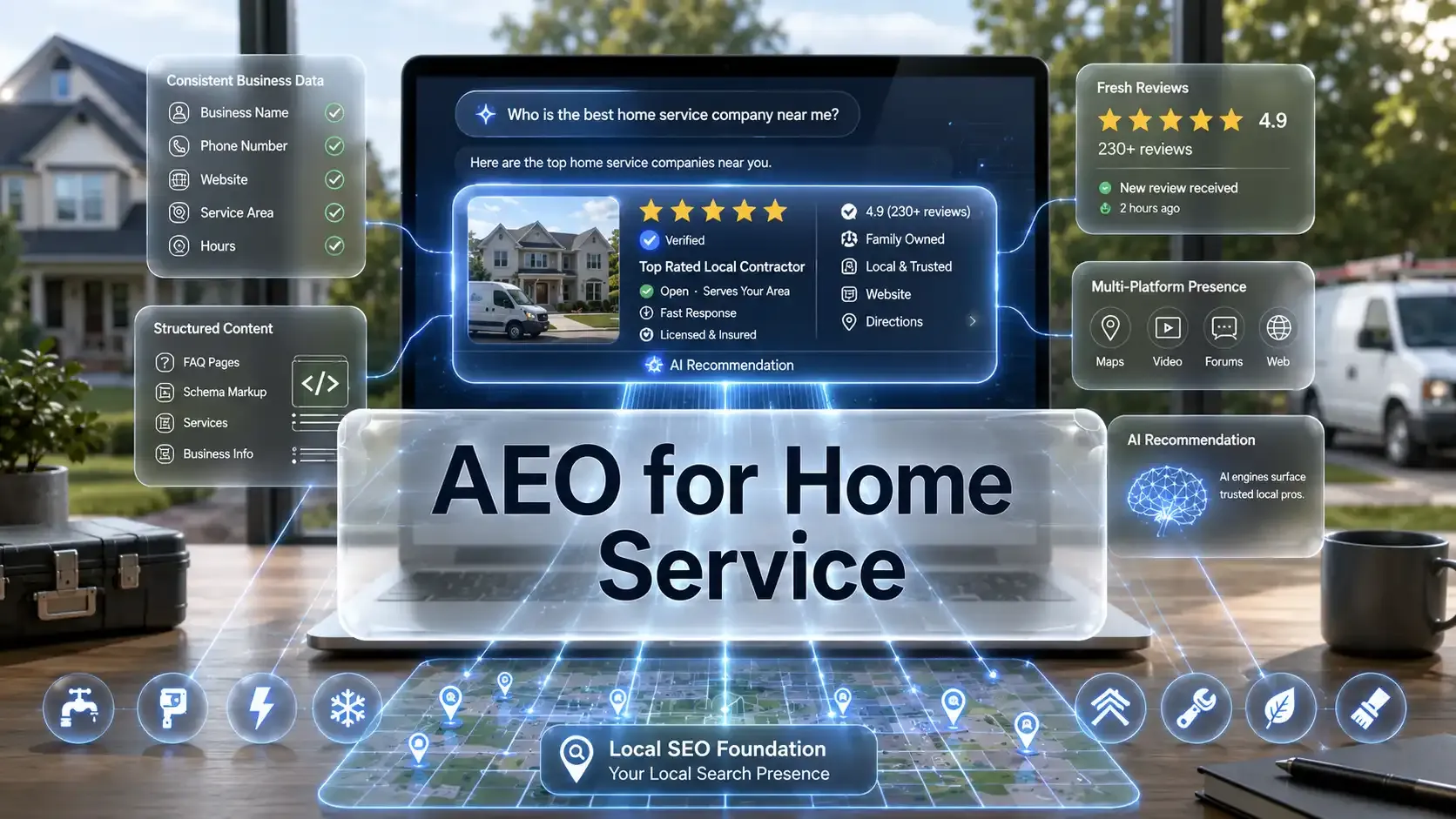
AI engines decide who to recommend based on four signals: consistent business data, structured content, review freshness, and presence on platforms like YouTube and Reddit.
AEO does not replace local SEO. It builds on top of it.
Contractors who act now will own the AI recommendations in their market before competitors catch on.
Answer engine optimization makes your online presence readable and citable by AI platforms. ChatGPT, Google AI Overviews, and Perplexity then recommend your contracting business by name when homeowners ask who to hire.
A homeowner's pipe bursts at midnight. They don't scroll through ten blue links on Google anymore. They ask ChatGPT, "Who is the best emergency plumber near me?"
AI gives one name. That contractor gets the call, the job, and the five-star review. If your business was not that name, you never had a chance. That is the problem AEO for home service solves.
In this blog, we will break down seven proven ways to fix that gap. Each strategy helps home service businesses earn AI recommendations that turn into real booked jobs.
7 Ways Home Service Businesses Win in AI Search
Most home service businesses are invisible to AI search right now. Their websites don't speak the language that ChatGPT, Google AI Overviews, and Perplexity actually understand.
I found this out when I typed "best plumber near me" into ChatGPT one afternoon. My competitor's name popped up in the response, but mine was nowhere.
So I spent weeks testing what actually gets a contractor recommended by these platforms. These seven strategies are what moved the needle for me.
1. Build FAQ Pages Around Real Customer Questions
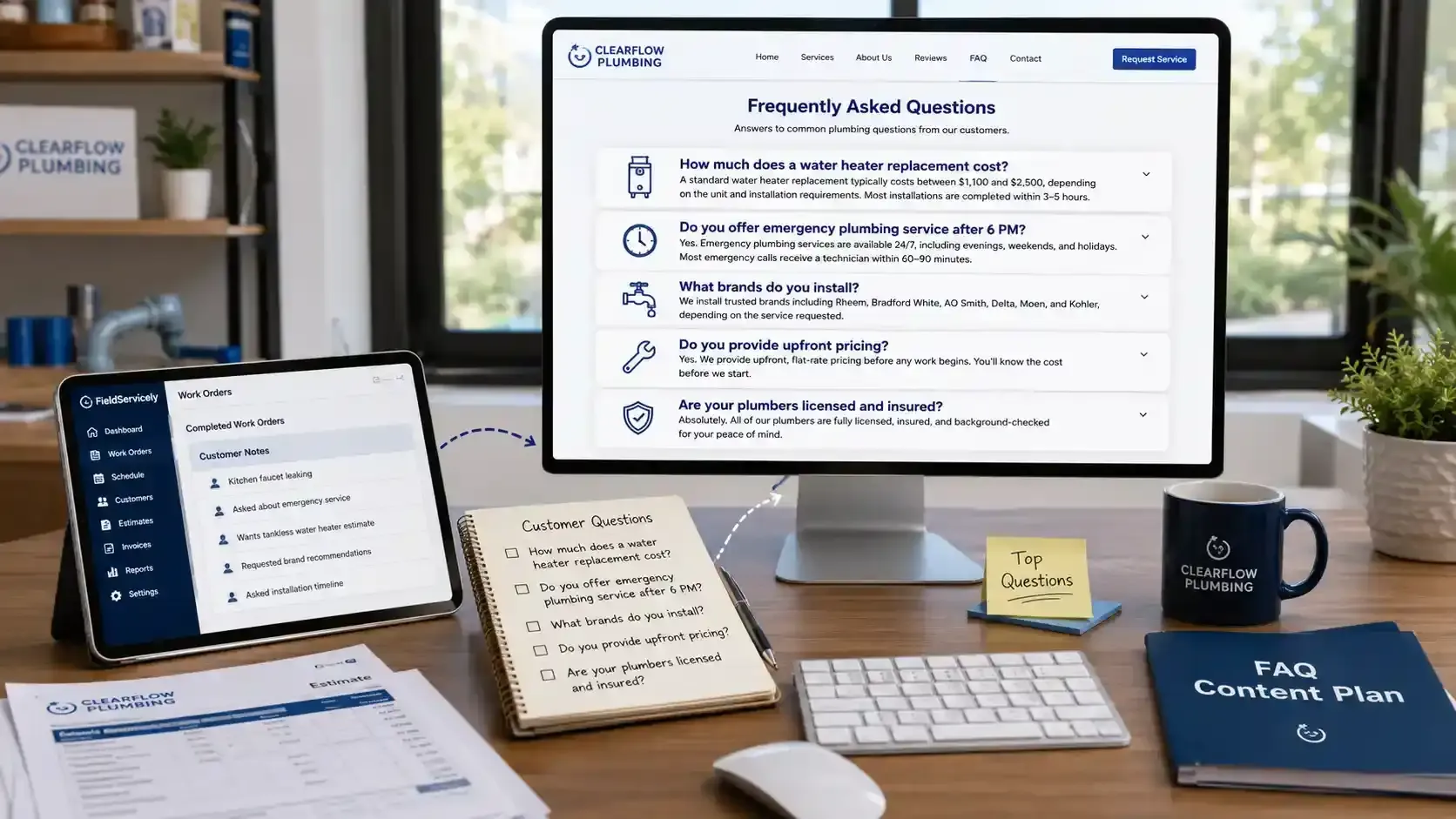
AI platforms cite pages that directly answer homeowner questions. The fastest way to earn those citations is to turn your real customer calls into FAQ content.
Every week, homeowners ask the same things on calls and estimates:
- "How much does a water heater replacement cost?"
- "Do you offer emergency service after 6 PM?"
- "What brands do you install?"
Those questions are your AEO content strategy hiding in plain sight. 87% of queries that trigger AI Overviews carry informational intent. Your FAQ pages feed exactly that.
Here's how to build them:
- Pull the top 15 to 20 questions from call logs and estimate notes.
- Write each question as its own H2 or H3 heading.
- Answer it in the first two sentences using 40 to 60 words.
- Expand with local pricing or real turnaround times.
For example, skip "We offer affordable plumbing services." Instead, write: "A kitchen faucet replacement in Austin costs between $180 and $350. We finish most faucet jobs within 90 minutes."
The second version gives AI something to grab, while the first gives it nothing.
Contractors running AEO home operations can pull these questions from their FieldServicely work order notes, where customer requests are already logged.
Read more: SEO for Plumbers: Rank Higher on Google and Get More Calls
2. Add Schema Markup to Every Service Page
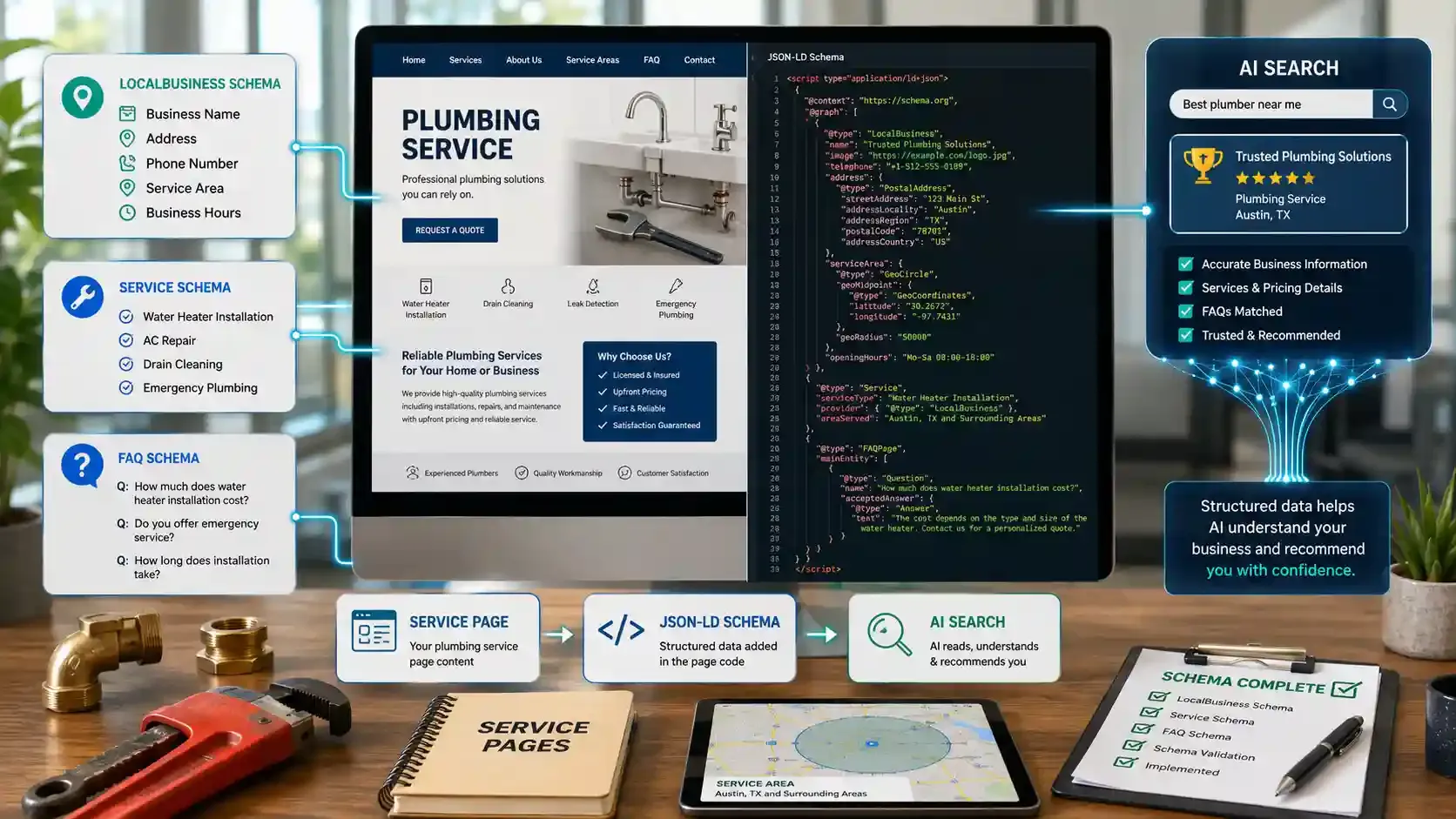
Schema markup tells AI crawlers exactly what your business does, where you operate, and what you charge. Without it, AI is guessing.
In March 2025, both Google and Microsoft confirmed they use structured data inside their generative AI features. (Source: Search Engine Land) That confirmation turned schema from a nice bonus into a requirement for AI visibility.
For home service businesses, three schema types matter most:
- LocalBusiness schema: Your business name, address, phone, service area, and hours.
- Service schema: Each trade you offer, like "water heater installation" or "AC repair."
- FAQ schema: The questions and answers from the FAQ pages you already built.
Here's what a basic JSON-LD snippet looks like for a plumbing company:
You add this code to the <head> section of each service page. Most contractors have zero schema markup on their site. That gap is your advantage right now.
Read more: SEO for HVAC Contractors: The 12-Step Guide
3. Complete Your Google Business Profile
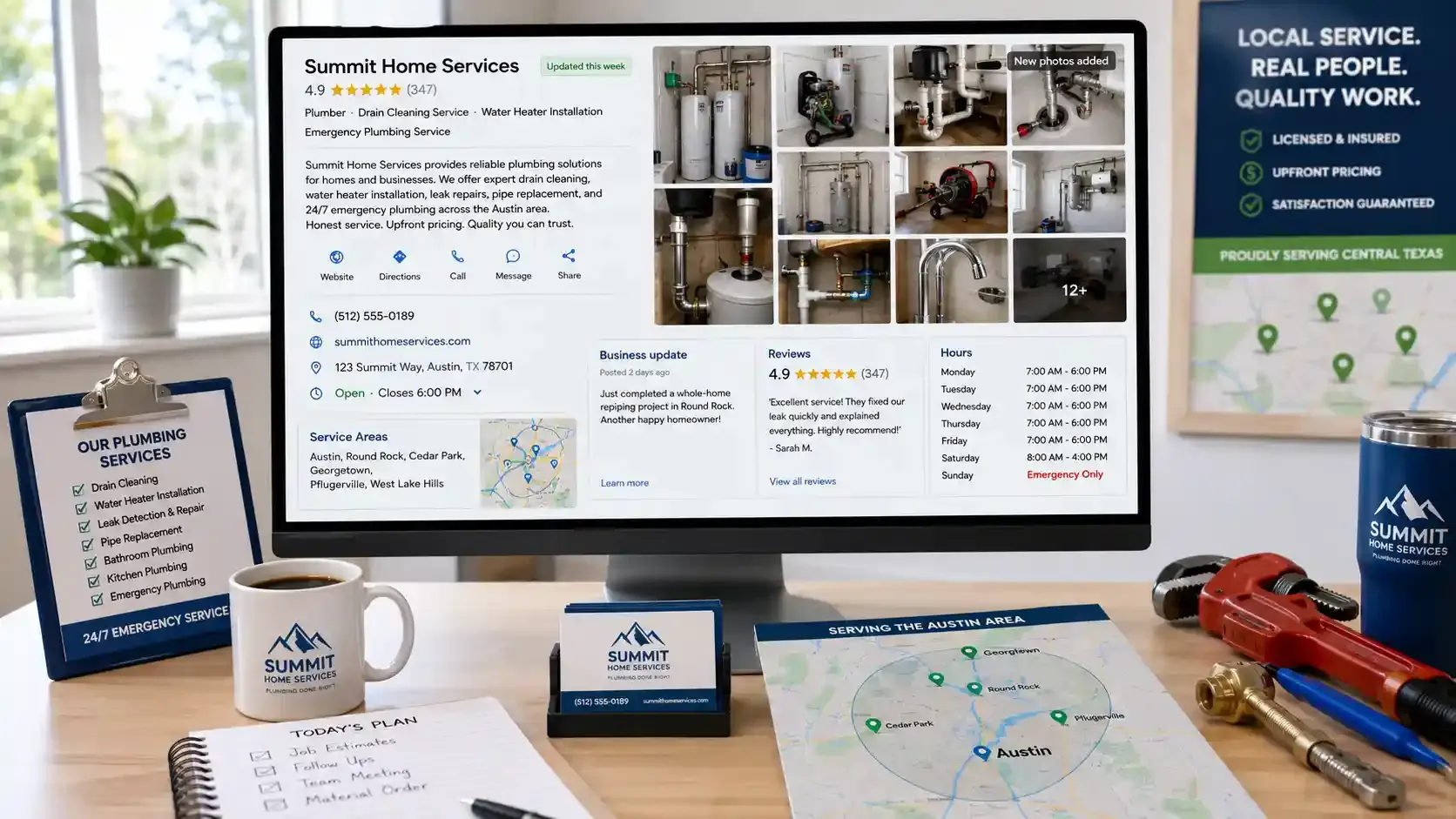
Google Business Profile is the single most important asset for AEO home service visibility. Google's AI systems read your profile before they recommend any local business to a homeowner.
According to Forbes, GBP has become the raw data feed that AI reads before recommending you. Impressions per location fell 53.8% in 2024, but actual customer actions like calls and direction requests only dropped about 5%.
Fewer people browse your profile now. But the ones who reach it carry real buying intent because AI already pre-qualified them.
So what exactly should you fill in?
- Primary and secondary categories for every service you perform.
- Service area with specific city and neighborhood names.
- Business description in plain language: what you do, where, and why homeowners trust you.
- Hours of operation, including holiday hours.
- 12 or more photos of real completed jobs. Google's Vision AI now scans your images to understand what services you actually perform.
One thing most contractors overlook is freshness. Profiles that go 30 days without an update, a new photo, or a fresh review start losing AI visibility. If your profile looks the same as it did three months ago, AI has already moved on to your competitor.
4. Get More Reviews And Get Them Consistently
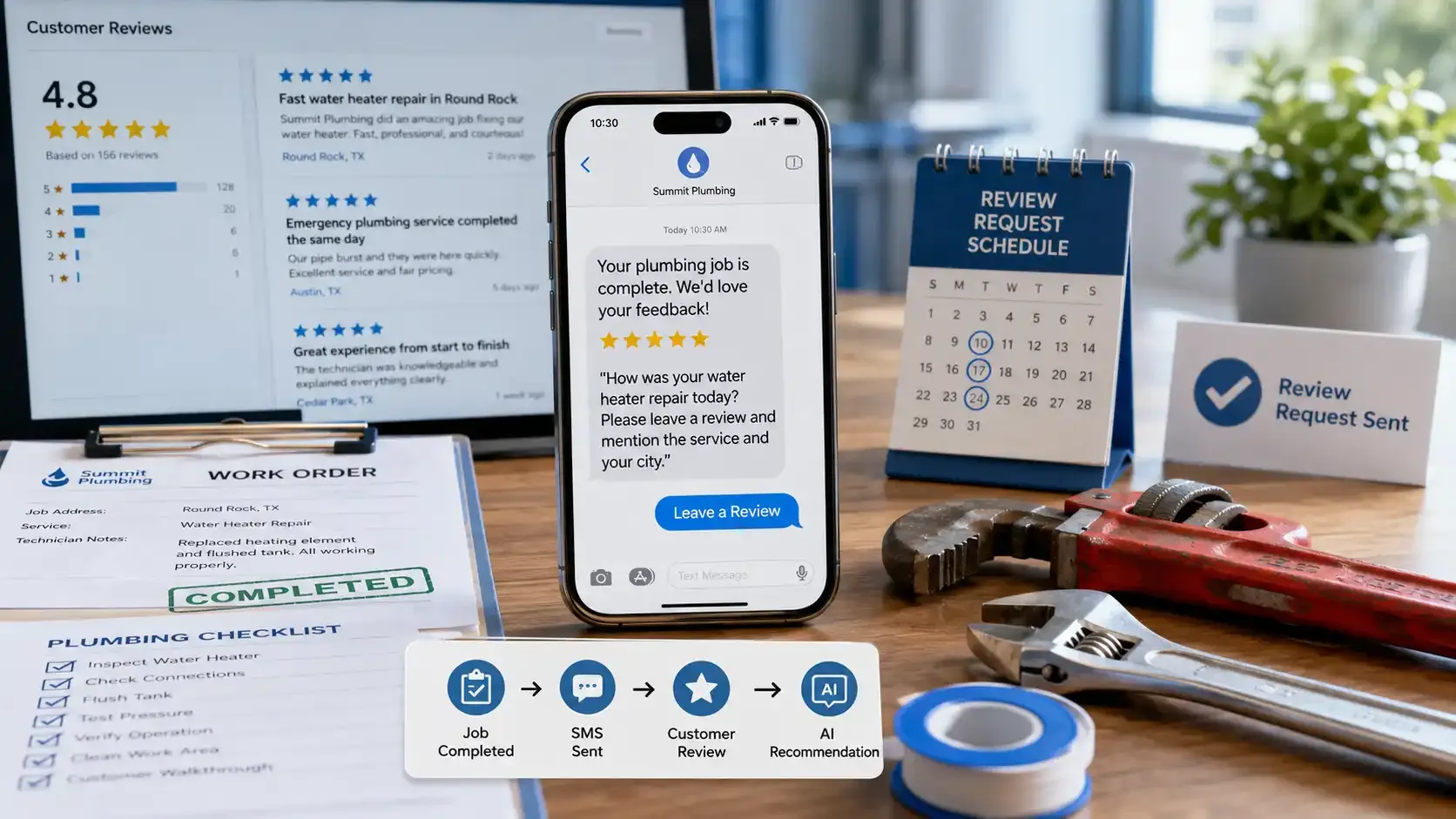
AI engines use review signals to decide which contractor is "best." Volume and freshness carry more weight than a perfect 5.0 rating.
In fact, 31% of consumers will only use a business rated 4.5 stars or higher. That jumped from just 17% a year earlier. On top of that, ChatGPT usage for local business recommendations surged from 6% to 45% in a single year.
So where do these AI platforms pull their confidence from?
Your reviews across Google, Yelp, and Angi. But not just the star count. They read the actual words customers write.
A review that says "Mike fixed our water heater in Round Rock the same day we called" gives AI a direct phrase to match against a homeowner's query. Compare that to "great service," which gives it nothing to work with.
That difference matters. So, build a system that runs without you thinking about it:
- Send an automated SMS review request within one hour of job completion.
- Ask the customer to mention the specific service and their city.
- Aim for a few new reviews each week, not a batch once a quarter.
A contractor with 10 fresh reviews this month will always outrank one sitting on 200 stale reviews from last year. Consistency wins this game every time.
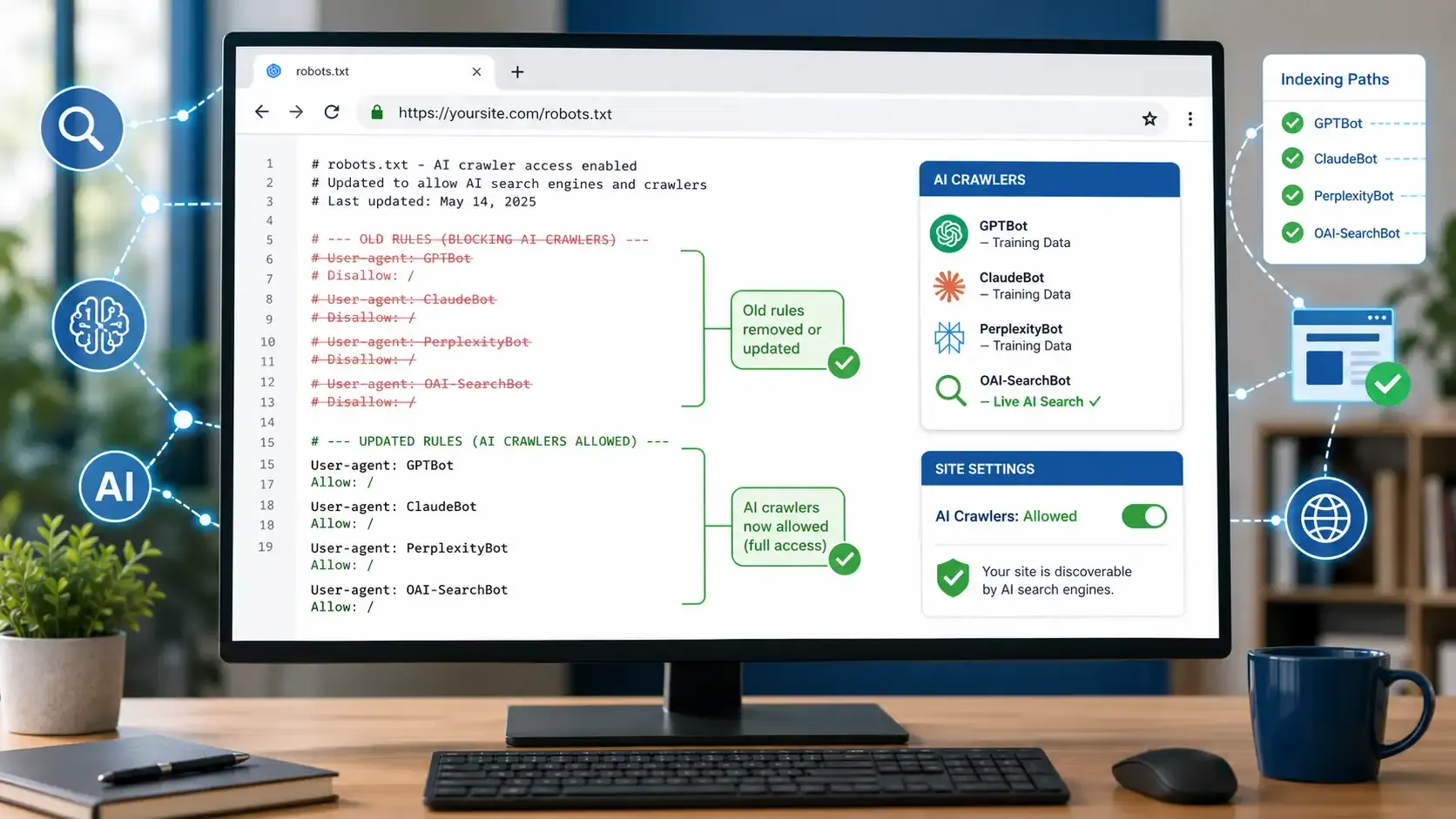
If GPTBot, ClaudeBot, and PerplexityBot are blocked in your robots.txt file, AI literally cannot read your website. You could have perfect FAQ pages, flawless schema, and 500 five-star reviews. None of it matters if AI crawlers can't get through the front door.
Most contractors have no idea this is even a problem. But in July 2025, Cloudflare started blocking AI crawlers by default for every new domain on its platform. (Source: CNBC)
If your website runs through Cloudflare, or if your hosting provider or WordPress theme added AI blocks, you might already be invisible without knowing it.
The fix takes five minutes:
- Go to yoursite.com/robots.txt in your browser.
- Look for lines that say Disallow next to GPTBot, ClaudeBot, PerplexityBot, or OAI-SearchBot.
- Remove those lines, or switch them to Allow.
- If you use Cloudflare, check your dashboard under Security and toggle AI crawlers to "Allowed."
One important detail. You can block training bots while still allowing search bots.
OpenAI runs two separate crawlers. GPTBot collects training data. OAI-SearchBot handles live search queries that send real traffic back to your site. Block the first if you want, but never block the second.
Read more: SEO for Cleaning Business: How to Rank Higher on Google
6. Create Service Area Content at Scale
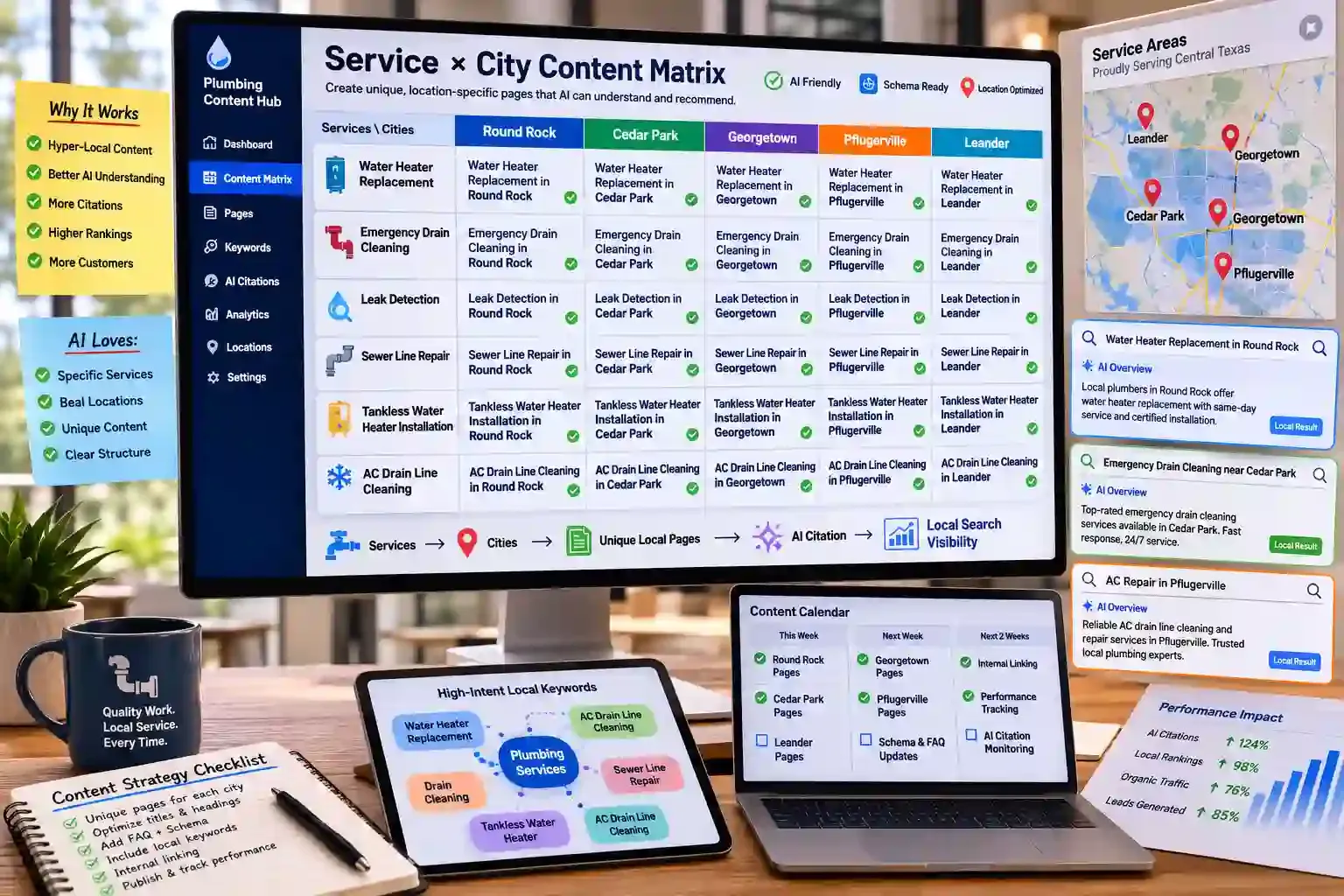
Map your services against the cities you cover. Each combination becomes a dedicated page that AI can cite for that specific location.
Real searches look nothing like generic keywords. Homeowners don't type "plumber." They type "water heater replacement in Round Rock" or "emergency drain cleaning near Cedar Park."
46% of all searches carry local intent, and 76% of "near me" mobile searches lead to a business visit within 24 hours. Every one of those searches is a page you could own.
The math is simple. If you offer 6 services across 10 cities, that gives you 60 service area pages. Each one targets a unique query like "AC repair in Pflugerville" or "tankless water heater installation in Georgetown."
But there's one rule that makes or breaks this strategy:
- Write unique content for each page. Each page should include local pricing, real job examples, and actual turnaround times for that specific city.
- Never just swap city names on a template. Google's AI and AI Overviews can detect thin, duplicated pages and will skip them entirely.
This AEO service area matrix is the fastest way to build topical authority that AI rewards. A contractor with 60 specific answer pages will always outperform one with a single "Our Services" page covering everything in two paragraphs.
Read more: SEO for HVAC Contractors: The 12-Step Guide
7. Build Your Presence Beyond Your Website
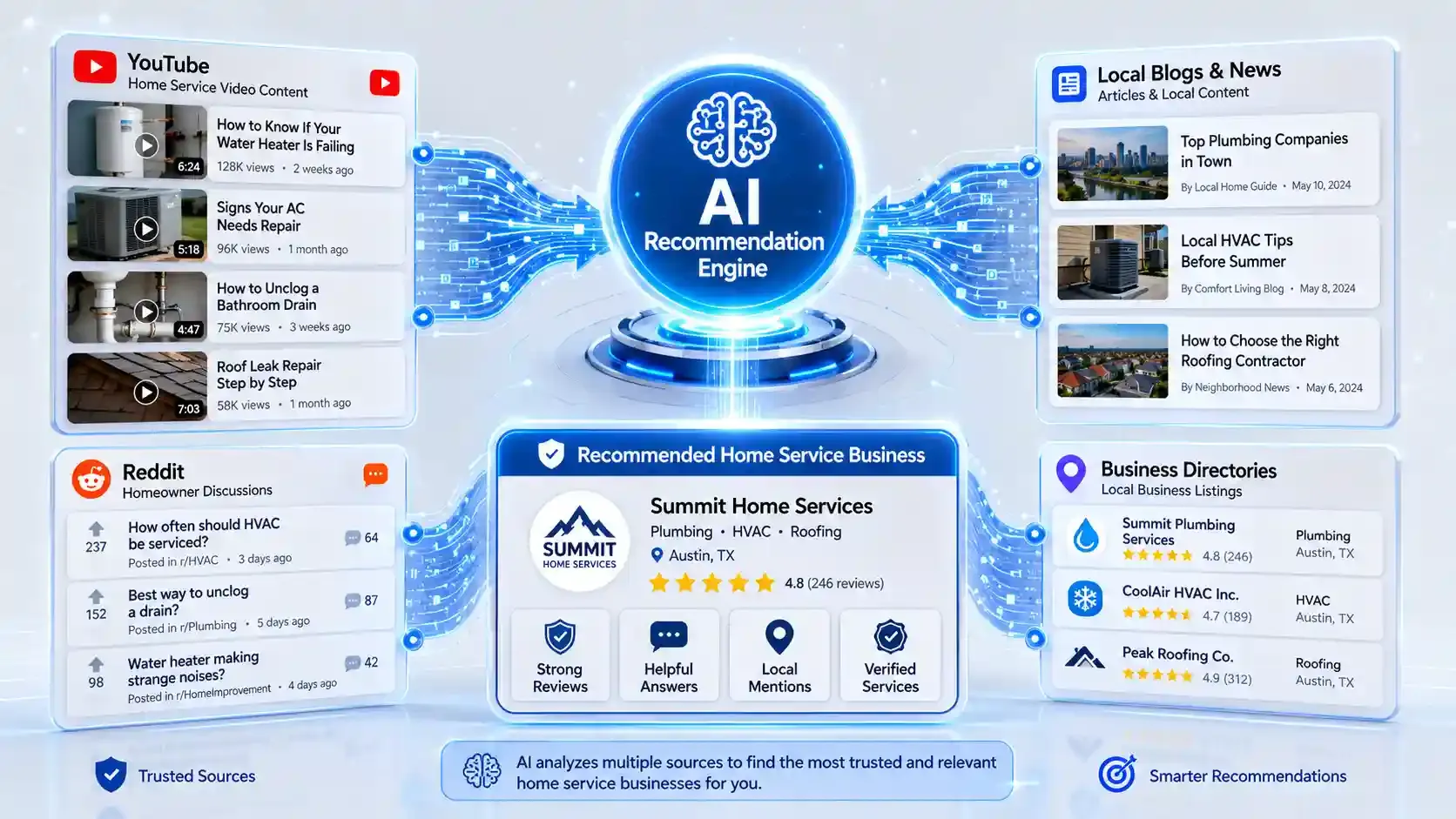
AI pulls recommendations from far more than your website alone. Your mentions on YouTube, Reddit, local blogs, and niche directories all feed the confidence AI needs before it names your business in a response.
Pew Research Center confirmed this in a 2025 study that tracked over 68,000 real Google searches. Wikipedia, YouTube, and Reddit were the three most frequently cited sources in Google AI Overviews, accounting for 15% of all sources AI summaries linked to.
If those platforms are where AI pulls its confidence from, your business needs to show up on them.
For a home service contractor, this opens up real opportunities. You don't need a PR team or a media budget. You need a presence where homeowners already ask questions.
Here's where to start:
- Answer real questions in Reddit communities like r/HomeImprovement, r/HVAC, and r/Plumbing. Share what you know without selling.
- Record short YouTube videos answering common homeowner concerns. Something like "How do I know if my water heater is failing?" This can generate AI citations for months.
- Get mentioned in local news, community blogs, or neighborhood Facebook groups. Even unlinked brand mentions count because AI doesn't need a clickable link to register your name.
So you see, AI engines don't just trust what you say about yourself. They trust what others say about you across multiple platforms.
Put Every AI Search Strategy Into Action
FieldServicely helps home service businesses streamline scheduling, manage customers, and deliver the consistent service that supports long-term business growth.
What Is AEO and How Is It Different from SEO?
SEO ranks your pages in search results. AEO gets your business cited inside AI-generated answers. Both are important, but they work at different levels.
Answer engine optimization is the practice of structuring your online presence so AI platforms recommend you by name. When a homeowner asks ChatGPT "who's the best electrician in Austin," AEO determines whether your business shows up in that response. SEO determines whether you rank in the Google Map Pack and organic results below it.
And this distinction is growing fast. 68% of all Google searches now end without a single click to any website. At the same time, brands cited inside AI Overviews earn 35% more organic clicks than those that aren't cited at all.
So the clicks are shrinking overall, but the businesses that AI trusts are capturing a bigger share of what remains.
Does that mean you should ditch SEO? No, not even close. AEO layers on top of strong local SEO. Your Google Business Profile, your backlinks, your service area pages all feed the signals that AI reads before it recommends anyone. Without that foundation, AEO has nothing to build on.
Here's how the three strategies compare for home service businesses:
| SEO | AEO | GEO | |
|---|---|---|---|
Goal | Rank in blue links and Map Pack | Get cited in AI answers | Get mentioned by LLMs |
Where you show up | Google organic, Google Maps | AI Overviews, voice search | ChatGPT, Perplexity, Gemini |
Content focus | Keywords, backlinks, GBP | FAQ structure, schema, reviews | Brand authority, third-party mentions |
Key metric | Ranking position | Citation presence | Brand mention frequency |
Replaces SEO? | — | No. Builds on top of it | No. Builds on top of both |
Build the Operations Behind Better Marketing
Strong marketing works best when your field operations run smoothly. FieldServicely helps you manage both customer expectations and daily jobs.
How to Measure Your AEO Results
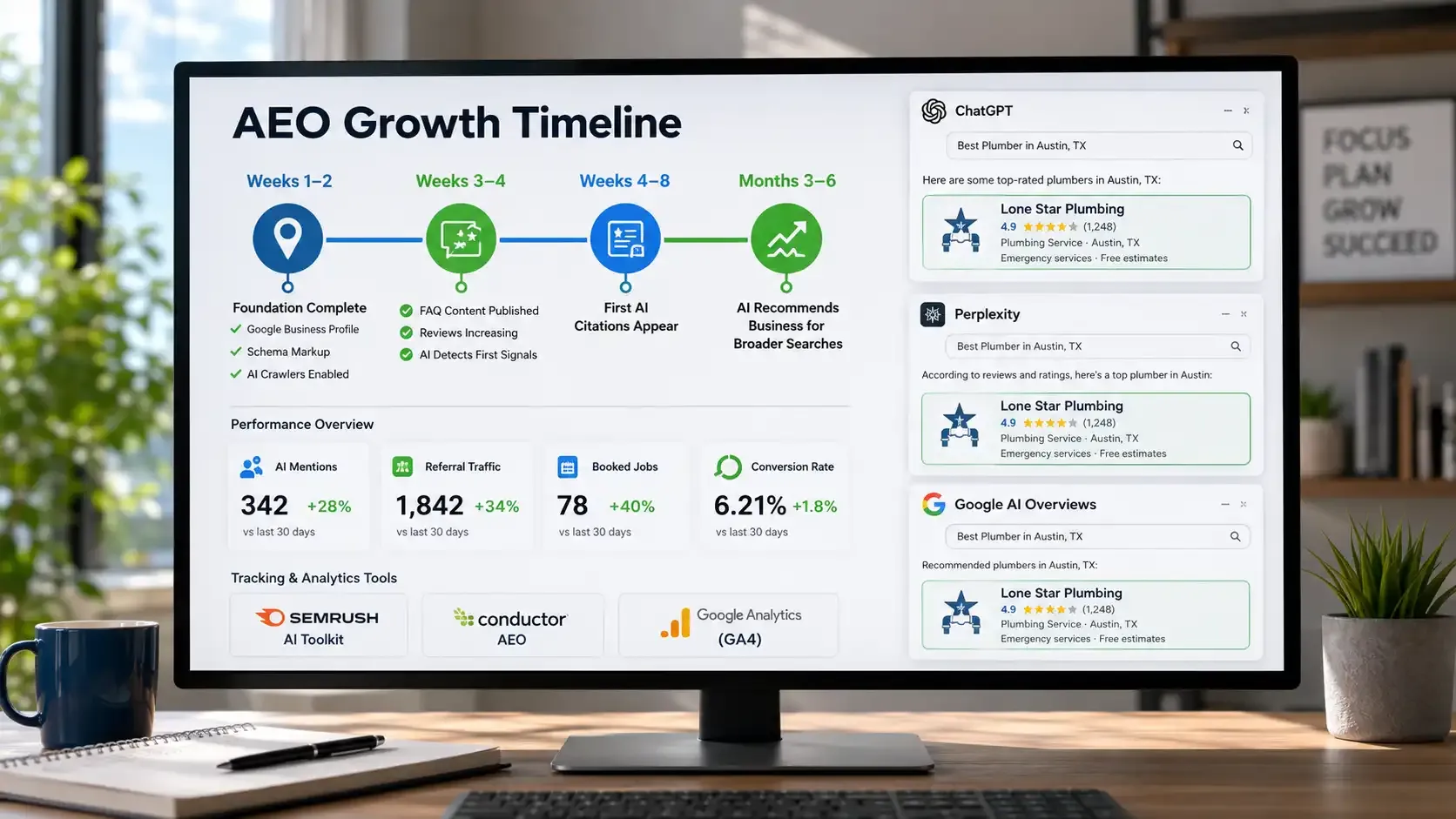
You measure AEO by checking whether AI actually names your business. No ranking report covers this, so you have to test it yourself.
The simplest method is a manual test. Open ChatGPT, Perplexity, and Google AI Overviews in separate tabs. Type "best [your trade] in [your city]" into each one. If your business shows up, AEO is working. If it doesn't, you know exactly where you stand.
Run this test once a month and screenshot every result so you can track changes over time.
This effort is worth your attention for one clear reason. Because ChatGPT now drives 87.4% of all AI referral traffic across major industries. And those visitors don't just browse your site. AI-referred visitors convert at 4.4 times the rate of traditional organic search traffic!
For ongoing tracking, these tools give you consistent data:
- Semrush AI Toolkit monitors how often AI platforms mention your brand.
- Conductor AEO tracks your citation rate across ChatGPT, Perplexity, and Gemini.
- Google Analytics (GA4) shows referral traffic from chatgpt.com and perplexity.ai under your acquisition report.
Visibility alone is not enough, though. You should also track booked jobs from these sources. A citation that never leads to a phone call or a form fill is just a number on a dashboard.
What timeline should you expect?
- Weeks 1 to 2: You set the foundation. GBP is complete, schema is live, and AI crawlers are unblocked.
- Weeks 3 to 4: FAQ content goes live. Reviews start flowing in. AI picks up the first signals from your site.
- Weeks 4 to 8: First AI citations appear when someone searches your name plus trade plus city.
- Months 3 to 6: Compound effects kick in, and AI starts recommending you for broader queries beyond your brand name.
Measure More Than Rankings
Track jobs, technicians, and customer activity from one dashboard while you grow your online visibility.
Mistakes That Keep Contractors Out of AI Results
Most contractors fail at AEO because of avoidable errors they don't even realize they're making. In fact, 17% of small businesses still have no website at all, and the ones that do often run basic five-page sites with zero content for AI to cite.
If you're doing AEO for your home service business, watch for these common traps:
- Running a thin website with no FAQ pages. A homepage, about page, services page, and contact page give AI nothing to extract. You need answer-ready content on your site.
- Blocking AI crawlers in your robots.txt without knowing it. If GPTBot and ClaudeBot can't access your site, no amount of good content will help you show up.
- Listing different business details across directories. When your phone number on Yelp doesn't match your Google Business Profile, AI loses confidence in your data and skips you entirely.
- Writing content that speaks to other contractors instead of homeowners. AI matches your content against what real people search. Homeowners ask "how much does it cost," not "we deliver industry-leading solutions."
- Treating AEO as a replacement for SEO instead of a layer built on top of it. Your local SEO foundation feeds every signal AI reads. Without it, AEO has nothing to amplify.
- Paying for expensive AEO packages that are just repackaged SEO retainers. If your agency can't show you a screenshot of AI recommending your business, ask what you're actually paying for.
Conclusion
Most home service contractors have not even started thinking about AEO. Their websites still speak only to Google, and they have no idea whether AI recommends their business or not.
That gap is your advantage right now. The contractors who set up FAQ pages, add schema markup, build fresh reviews, and unblock AI crawlers today will own the AI recommendations in their market tomorrow.
This window will not stay open forever. Once your competitors catch on, the cost and effort to break in will double.
AEO for Home Service Businesses FAQs
Does AEO Work for Small Local Contractors?
Yes. AEO works especially well for small local contractors because homeowner questions are specific and repeatable. A one-truck plumbing company that answers "How much does a slab leak repair cost in Round Rock?" can earn the same AI citation as a 50-truck competitor.
How Long Does AEO Take to Show Results?
Most home service businesses see their first AI citations within 4 to 8 weeks after setting up FAQ pages, schema markup, and a complete Google Business Profile. Compound effects start building around months 3 to 6 as AI platforms pick up more signals from your site.
Do I Need an Agency for AEO or Can I Do It Myself?
You can start on your own. The seven steps in this guide cover everything a contractor needs to begin. An agency adds value only if they track AI visibility and show proof that platforms like ChatGPT and Perplexity actually recommend your business by name.
What Is the Cost of AEO for Home Service Companies?
AEO costs nothing if you do it yourself. Writing FAQ content, adding schema markup, and optimizing your GBP are all free. Paid AEO services from agencies typically range from $500 to $2,500 per month depending on scope.
Does AEO Replace Google Ads?
No. AEO and Google Ads serve different purposes. Ads deliver instant paid visibility. AEO builds long-term organic AI visibility that compounds over time. The strongest home service marketing strategies run both together so you capture paid clicks today and AI recommendations tomorrow.
What to read next