- Field Service Business
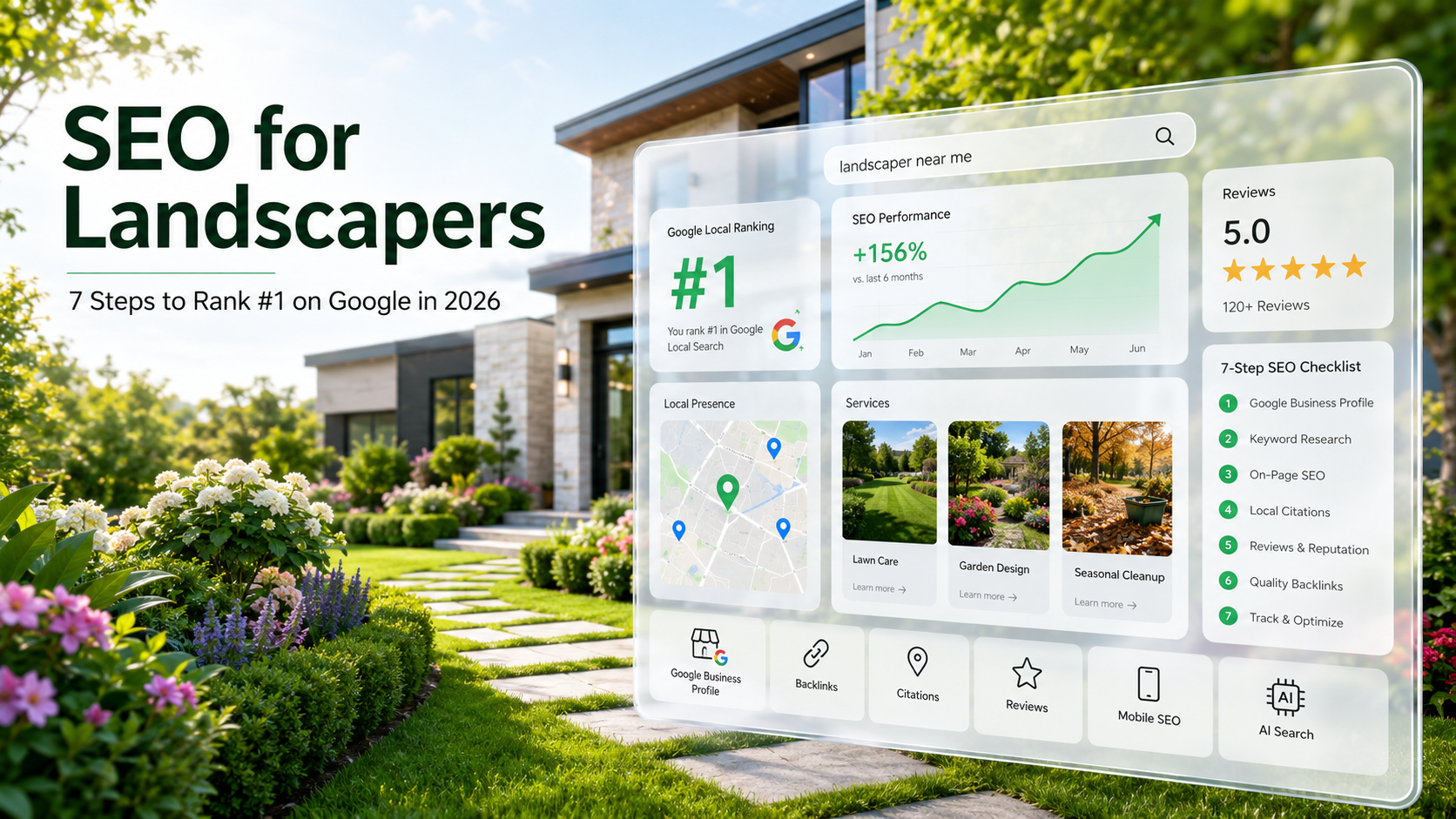
SEO for Landscapers: 7 Steps to Rank #1 on Google in 2026
Updated on 26 Jun 2026
Jump to
Summary

SEO for landscapers puts your business in front of homeowners when they search for your services on Google.
Start with your Google Business Profile, service pages, reviews, and a mobile-friendly site before anything else.
Target local, long-tail keywords that match what homeowners actually type and rotate them with the seasons.
Build local citations, earn backlinks from nearby businesses, and structure your content so AI search tools can find you.
Track everything from day one because SEO compounds over months, and you need to know what's working.
Last spring, I almost shut down my landscaping business. Plenty of five-star reviews, a solid crew, and great work. But my phone barely rang. Turns out, homeowners two blocks away had no idea I existed because my website was buried on page four of Google.
SEO for landscapers is how you fix that. It puts your business in front of homeowners the exact moment they search for lawn care, hardscaping, or landscape design in your area. More visibility means more calls, more booked jobs, and less money wasted chasing leads that go nowhere.
The real pain is watching competitors with half your skill level stay booked solid because they show up first on Google.
In this guide, we break down every step to get your landscaping company ranking higher and pulling in steady leads from organic search.
What is SEO for Landscapers (and How Does Google Decide Who Ranks)?
SEO for landscapers is the process of optimizing your website and online profiles so your business shows up when homeowners search for lawn care, landscape design, or hardscaping in your service area.
It breaks down into three buckets: on-page content, off-page signals like reviews and backlinks, and local optimization.
For the longest time, I never gave any of this a second thought. That blind spot cost me more jobs than I want to admit.
Want to know how many people you could be missing?
80% of US consumers look up local businesses online every single week. If your landscaping company doesn't appear on page one, those homeowners are already calling your competitor down the road.
So what makes this industry a different beast?
Landscaping is seasonal to its core. Spring floods Google with "lawn cleanup near me." Summer shifts the demand to "patio builders in [city]."
And 72% of consumers go straight to Google when they need a local service provider. Your optimization strategy needs to move with the calendar, not sit still.
How Google Decides Which Landscapers Show Up First
Google's own support page lays out three ranking factors for local results:
- Relevance looks at whether your site and Google Business Profile actually match what someone typed. If a homeowner searches "hardscape installation Denver" and your pages never mention hardscaping, you're invisible.
- Distance measures the gap between your business and the person searching. You can't relocate overnight. But clearly defining your service areas across your website and GBP narrows that distance in Google's eyes.
- Prominence is all about your online reputation. Reviews, backlinks, citations, brand mentions. They all stack up here.
And here's the part most landscapers overlook. 96% of people read reviews before choosing a local business. That single stat should tell you where to focus first.
Step 1: Research High-Intent Landscaping Keywords
You know what SEO is and how Google picks who shows up first. Now let's put that knowledge to work with the exact steps that turned my website into a lead machine.
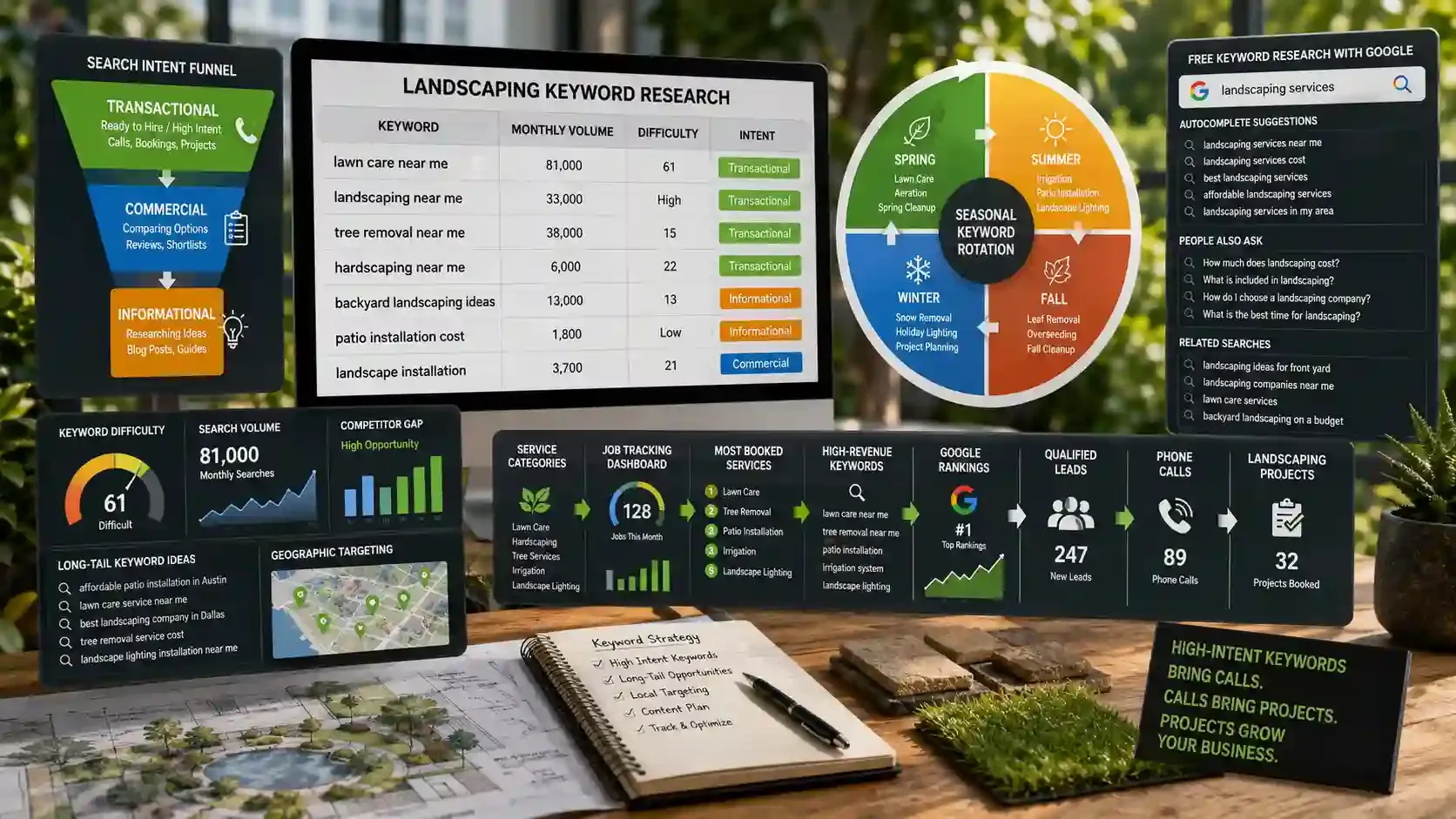
Every landscaping SEO strategy starts with one question. What are homeowners actually typing into Google when they need your services?
My first website targeted "professional landscaping solutions." Sounded great on paper. The problem was that nobody searched for that phrase. Not a single person.
Understand Keyword Intent First
Each keyword carries a different level of buying intent:
- Transactional means someone wants to hire right now. "Tree removal near me" or "lawn mowing service near me" fall here.
- Commercial signals comparison shopping. "Best landscaping company in [city]" is a good example.
- Information comes from people still researching. Think "backyard landscaping ideas" or "best time to aerate lawn."
Which ones should you chase first? The transactional terms. Those bring phone calls, not just page views.
Real Keyword Data for Landscapers
Here's what the actual numbers look like:
| Keyword | Monthly Volume | Difficulty | Intent |
|---|---|---|---|
$81,000 | 61 | Transactional | |
landscaping ideas | $52,000 | 8 | Informational |
tree removal near me | $38,000 | 15 | Transactional |
landscaping near me | $33,000 | High | Transactional |
backyard landscaping ideas | $13,000 | 13 | Informational |
hardscaping near me | $6,000 | 22 | Transactional |
landscape installation | $3,700 | 21 | Commercial |
patio installation cost | $1,800 | Low | Informational |
See the pattern? High-volume terms come with brutal difficulty. That's where long-tail phrases save you. "Affordable patio installation in [city]" pulls smaller numbers. But long-tail terms make up over 91% of all search queries. They rank faster and attract homeowners closer to booking.
Rotate Your Keywords with the Seasons
Here's something that caught me off guard. The keywords pulling calls in April go quiet by October.
- Spring: lawn care, aeration, spring cleanup
- Summer: irrigation, patio installation, landscape lighting
- Fall: leaf removal, overseeding, fall cleanup
- Winter: snow removal, holiday lighting, project planning
How to Find These Keywords for Free
So, where do you start without spending a dime?
Google itself hands you the answers. Open an incognito window, type your service, and watch three things: autocomplete suggestions, "People Also Ask" boxes, and related searches at the bottom. Semrush calls PAA one of the most overlooked free sources for content ideas.
For deeper data, Ahrefs ($29/mo) and Google Keyword Planner (free) both give you volume, difficulty, and competitor gaps.
Want a shortcut to your most profitable terms? Check which services pull the most bookings through FieldServicely's job tracking. Then build your keyword list around those high-revenue jobs first.
Know which services bring the most revenue.
FieldServicely's job tracking shows which services get booked most so you target the right keywords.
Step 2: Optimize Your Google Business Profile
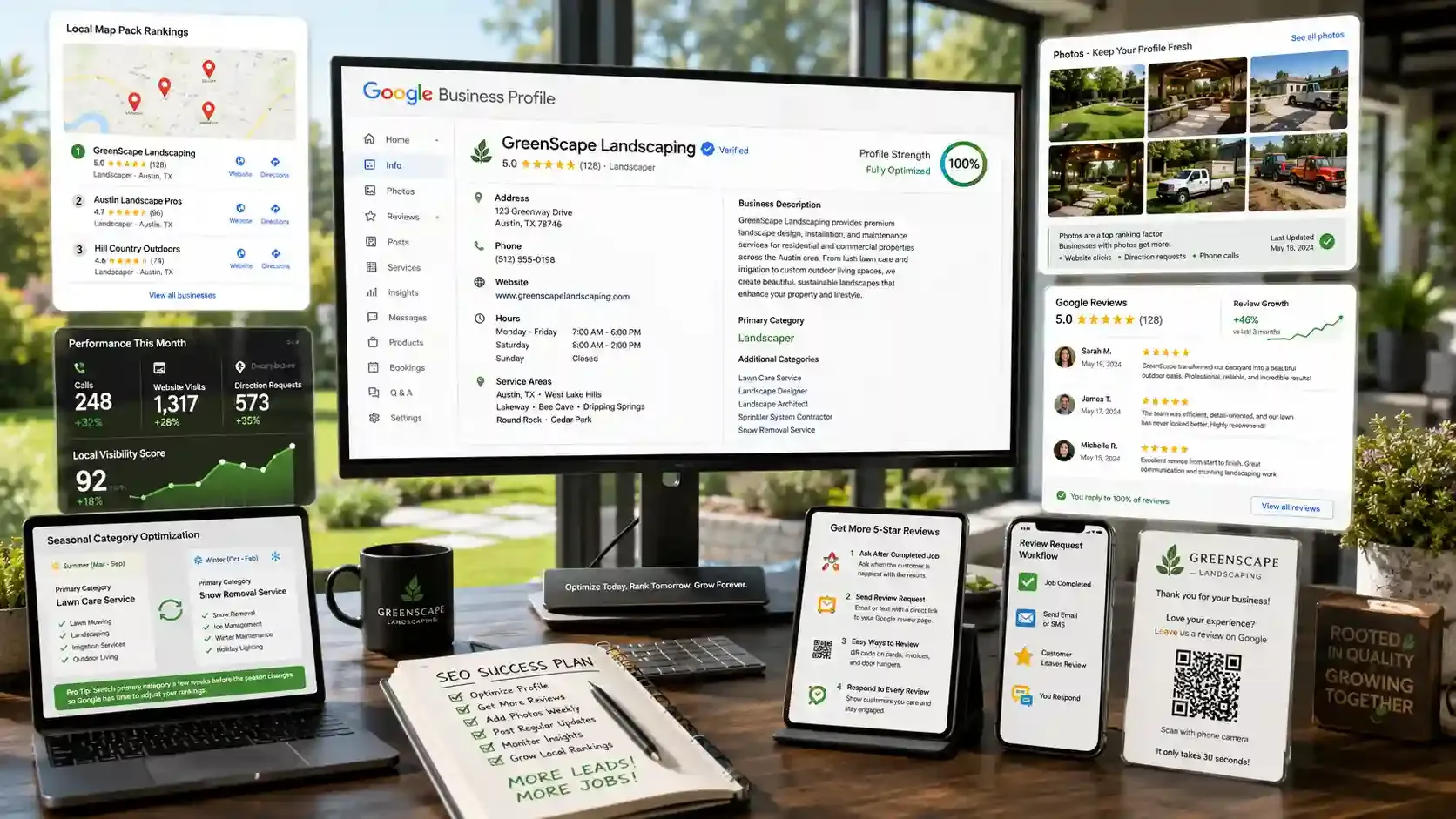
Your Google Business Profile determines whether you appear in the Map Pack. That's the top three local results that appear above everything else on Google Maps. Miss this step, and the rest of your SEO work loses half its impact.
Set Up Your Profile the Right Way
Start by claiming and verifying your listing if you haven't already. Then fill out every single field:
- Business name, address, and phone number (keep this identical to your website)
- Service areas and operating hours
- Website URL
- A keyword-rich business description that tells Google and homeowners exactly what you do
Your primary category matters more than you think. Pick "Landscaper," "Lawn Care Service," or "Landscape Designer" depending on your main offering. Then stack secondary categories for everything else you provide.
Here's a trick most competitors won't bother with. Sterling Sky recommends switching your primary category by season. Lawn care in summer. Snow removal in winter. Make the change a few weeks before demand shifts so Google has time to adjust your rankings.
Photos Are Not Optional
Verified profiles with photos consistently pull more website visits, direction requests, and calls. Upload real shots of your crew on job sites, finished projects, and branded trucks. Refresh them every quarter so your profile never looks stale.
Post weekly updates too. Seasonal promotions, project highlights, maintenance tips. Google rewards profiles that stay active.
How to Get More Google Reviews
Reviews don't just build trust. They directly push your rankings higher.
Review velocity matters more than total count. A business earning five fresh reviews per week will typically outperform a competitor sitting on hundreds of old ones. Stop getting reviews for even 18 days, and your rankings can drop noticeably.
So how do you keep that flow consistent?
- Ask right after a completed job, when the customer is still happy with the result
- Send a follow-up text or email with a direct link to your Google review page
- Print QR codes on your business cards and invoices that open the review form in one tap
- Respond to every review, positive or negative. It signals to Google that you're engaged
Great work earns great reviews. Never miss the window.
FieldServicely tells you the moment a job wraps so you follow up fast.
Step 3: Nail the On-Page SEO on Every Page
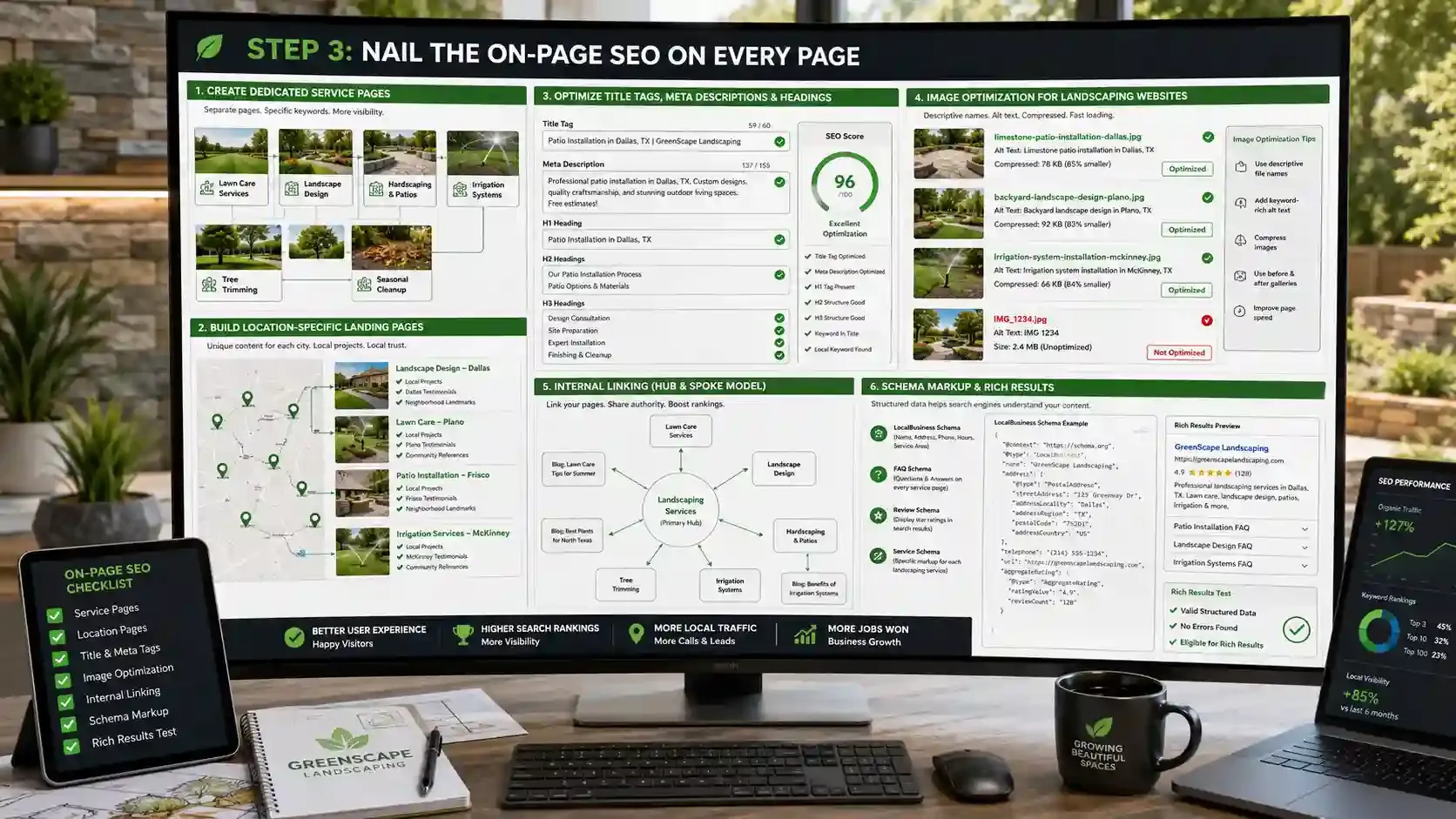
On-page SEO means optimizing the content, structure, and HTML elements on each page of your website so Google understands what you offer and where you offer it.
Create Dedicated Service Pages
Stop cramming every service onto one page. Build a separate page for lawn care, landscape design, hardscaping, irrigation, tree trimming, and seasonal cleanup. Each one targets a specific keyword plus your city name.
What goes on each page? A clear process description, pricing guidance, before-and-after photos, a short FAQ, and a strong call to action. "We install patios. Call us" is not a service page. That is a sentence pretending to be one.
Build Location-Specific Landing Pages
Serve multiple cities? Each one deserves its own page with unique content. Mention local projects you completed, pull testimonials from customers in that area, and reference neighborhood landmarks.
Whatever you do, don't copy the same paragraph and swap out the city name. Google sees right through that, and so do homeowners.
Optimize Title Tags, Meta Descriptions, and Headings
Keep titles under 60 characters. Pack in the keyword, location, and your brand. Example: "Patio Installation in Dallas, TX | [Company Name]."
Meta descriptions stay under 155 characters with a clear reason to click. One H1 per page using your main keyword. H2s breaks up sections. H3s handle the details.
Image Optimization for Landscaping Websites
Rename every file before uploading. "Limestone-patio-installation-dallas.jpg" tells Google something. "IMG_1234.jpg" tells us nothing.
Add descriptive alt text with keywords. Compress images so pages load fast. Before-and-after galleries are gold in this industry because homeowners want proof, not promises.
Internal Linking and Schema Markup
Link your service pages to each other. Point blog posts back to the relevant service page. Think hub-and-spoke: your main services page connects outward to every individual offering.
Then add schema markup. This is where most landscapers leave easy wins on the table.
- LocalBusiness schema with your name, address, phone, hours, and service area
- FAQ schema on every service page
- Review schema pulling your star ratings into search results
- Service schema for each offering
Validate everything through Google's Rich Results Test. If the tool shows errors, fix them before moving on.
Every finished project is content for your website.
Capture jobsite photos, notes, and before-and-afters right from the FieldServicely mobile app.
Step 4: Local SEO: Dominate the Map Pack
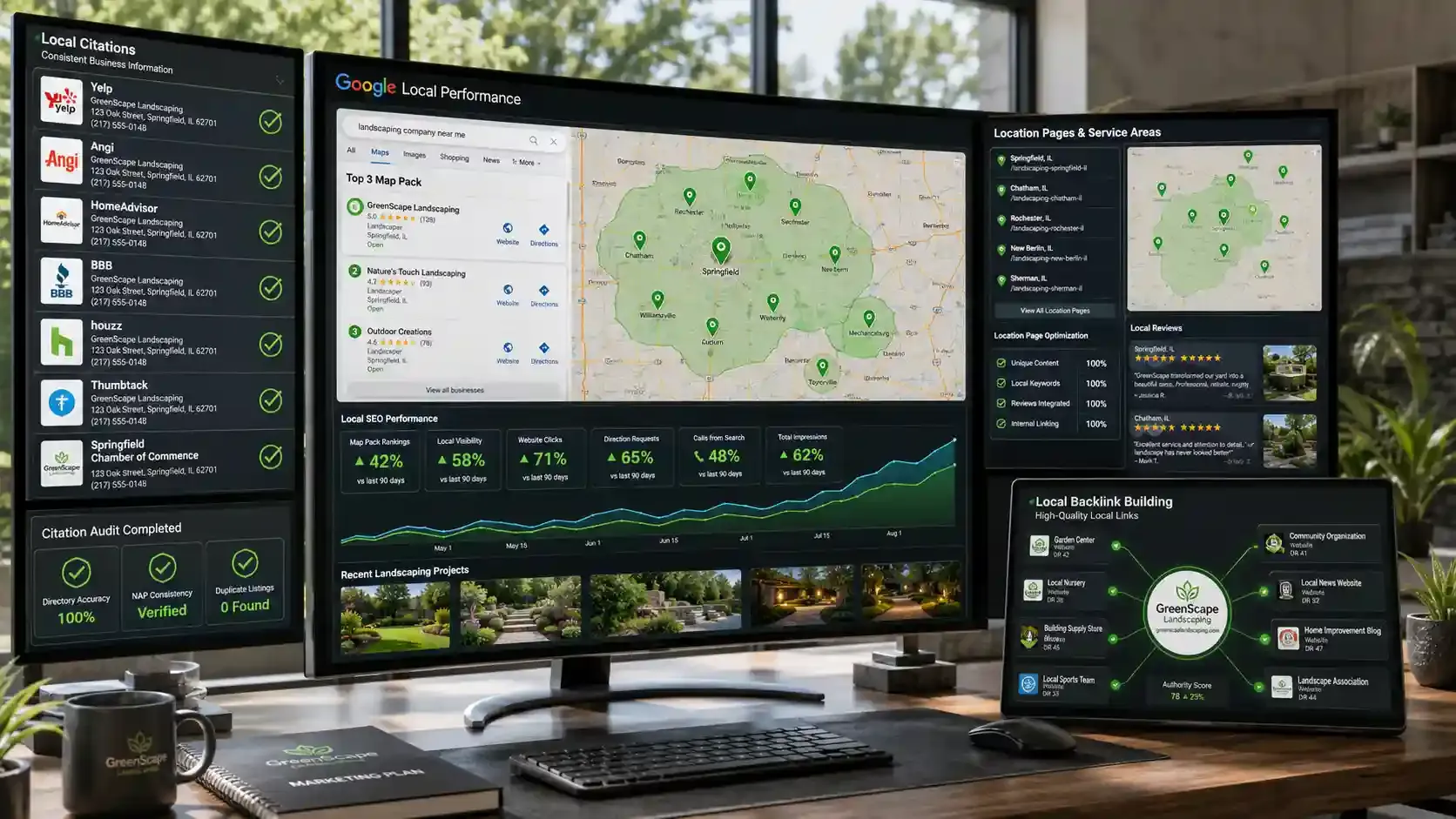
Local SEO helps your landscaping business show up in Google's map pack and local search results when homeowners nearby search for exactly what you offer.
You already optimized your Google Business Profile. Now it's time to strengthen the signals around it.
Build and Manage Local Citations
Citations are mentions of your business name, address, and phone number on other websites. Think of them as votes confirming you exist where you say you do.
Get listed on Yelp, Angi, HomeAdvisor, BBB, Houzz, Thumbtack, and your local Chamber of Commerce. But here's the catch. Every single listing must match your website and GBP exactly. "123 Oak St." on one site and "123 Oak Street" on another create confusion that Google doesn't forgive.
Audit your citations at least once a quarter. One wrong phone number in a forgotten directory can quietly drag your rankings down.
Create Location Pages for Every Service Area
We covered this in on-page SEO, but it deserves repeating from the local angle. Each city or neighborhood you serve needs its own page with real, unique content.
So, mention a drainage project you handled in that zip code. Pull a review from a customer in that town. Reference soil types or HOA rules specific to that area. Such details will signal relevance to Google and earn the trust of homeowners who are reading it.
Earn Local Backlinks
Backlinks from other local websites tell Google your business is a trusted part of the community. Where do landscapers find these?
- Partner with garden centers, nurseries, and building supply stores for mutual referrals
- Sponsor a local sports team, charity run, or community cleanup
- Get featured in local news outlets or home improvement blogs
- Join NALP or your state landscape association and claim your member profile
Want links that come to you naturally? Publish a cost guide for landscaping in your city or a seasonal plant guide for your climate zone. That kind of content earns links without you asking for them.
Stay away from paid link farms and low-quality directory spam. Google penalizes that fast, and recovery takes months.
You serve multiple areas. Track every crew across all of them.
GPS tracking and route history show exactly where your teams are in real time.
Step 5: Technical SEO for Landscaping Websites
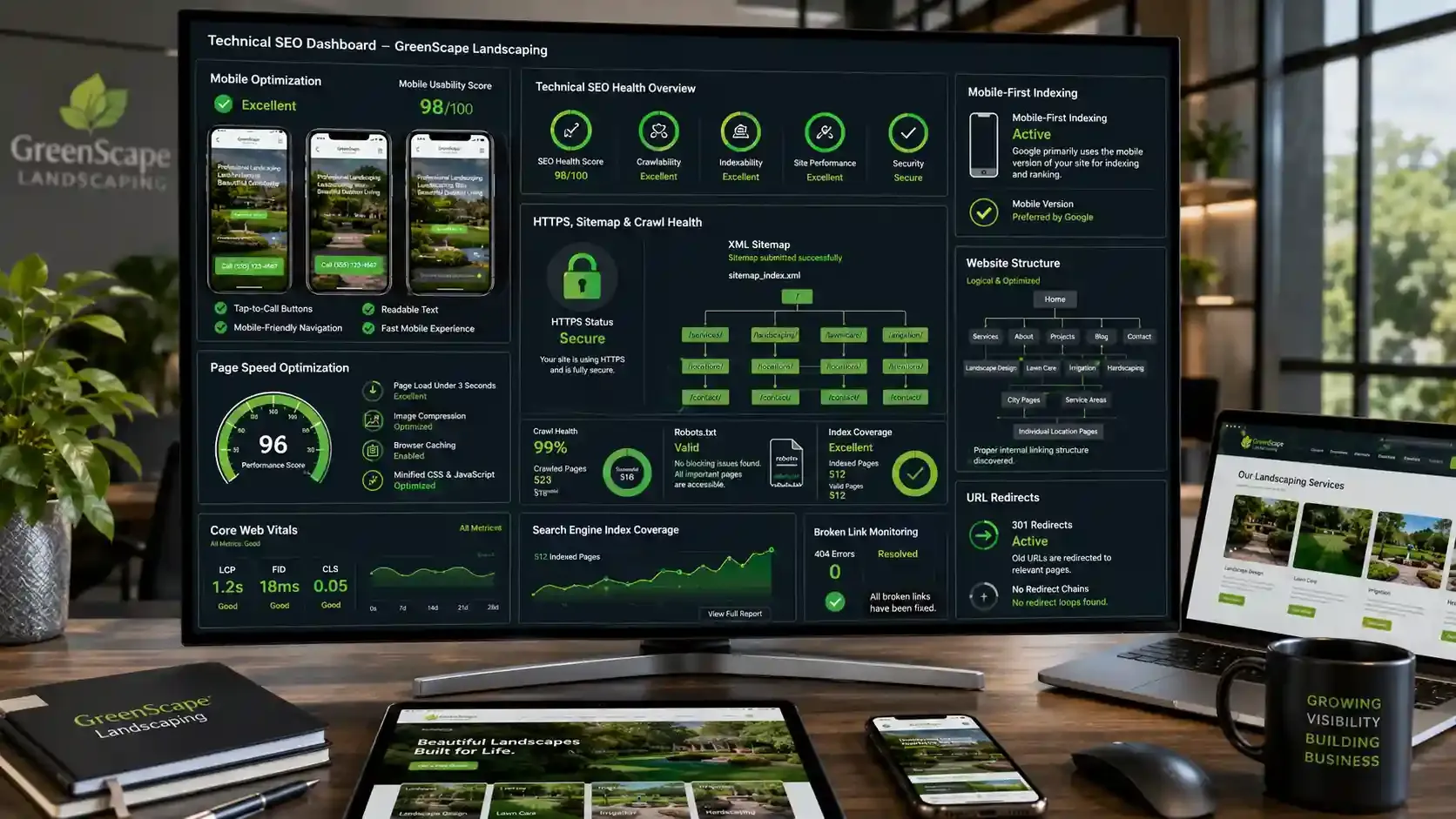
Technical SEO ensures Google can crawl, index, and understand your website without running into walls. Even the best content won't rank if your site has problems under the hood.
This is the part most landscapers skip entirely. I know because I did too, and it cost me six months of stalled rankings before I figured out what was wrong.
Mobile Optimization Is Non-Negotiable
Over 60% of landscaping searches happen on phones. Google uses mobile-first indexing, which means it looks at your mobile site before your desktop version when deciding rankings.
Run your site through Google's Mobile-Friendly Test right now. If it fails, nothing else in this guide will matter until you fix it.
What does mobile-friendly actually look like? Tap-to-call buttons on every page. Navigation that doesn't require pinching and zooming. Text that reads clean without squinting. Forms that take seconds to fill out with a thumb.
Page Speed Optimization
How long do you wait for a slow website? Your customers are less patient. Google's own data shows that 53% of mobile visitors leave a page that takes longer than three seconds to load.
Use Google PageSpeed Insight to check where you stand. Then pick the right tools for your platform:
| CMS | Free Speed Plugins | Premium Speed Plugins |
|---|---|---|
WordPress | LiteSpeed Cache, WP Optimizer, Imagify | WP Rocket, NitroPack, Perfmatters |
Wix | Speedy | Site Speed Booster |
Squarespace | TinyIMG | Website Speedy |
Shopify | Booster SEO | Page Speed Optimizer |
Compress your images before uploading. Minimize unnecessary scripts. Enable browser caching. These three fixes alone can shave seconds off your load time.
HTTPS, Sitemap, and Crawl Health
No SSL certificate? Google flags your site as "Not Secure," and visitors bounce before they even see your work.
Submit your XML sitemap through Google Search Console, so Google knows every page you want indexed. Check that your robots.txt file isn't accidentally blocking important service or location pages.
And fix your 404 errors. Every broken link is a dead end for both Google and the homeowner trying to find you. Redirect old URLs to relevant live pages so that link value doesn't go to waste.
Your customers are on their phones. Your team should be too.
FieldServicely's mobile app lets techs get jobs, update progress, and log hours from anywhere.
Step 6: Content Marketing That Actually Brings Landscaping Leads
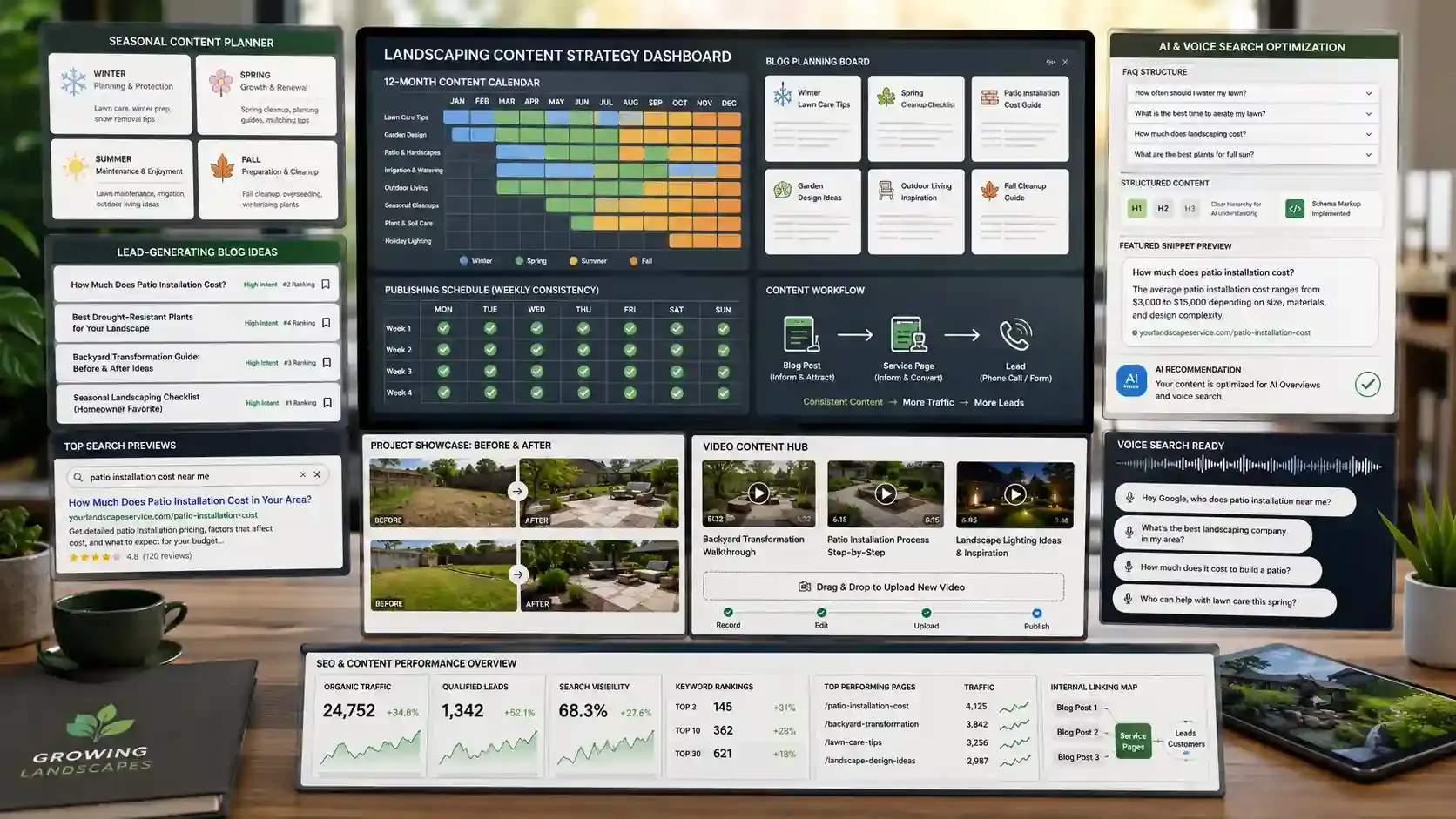
Content marketing means creating helpful blog posts, guides, and project showcases that attract homeowners searching for landscaping information and turn them into paying customers.
Your service pages sell. Your content pages attract. You need both to work together.
Plan a Seasonal Content Calendar
Here's what most landscaping blogs get wrong. They publish five posts in January, then go silent until July. Google rewards consistency, not bursts.
Map your content to what homeowners care about each month:
| Month | Content Topics |
|---|---|
January | Winter lawn care tips, planning spring projects |
February | Early spring prep, budgeting for landscaping |
March | Spring cleanup checklist, aeration guide |
April | Garden design ideas, mulching tips |
May | Irrigation setup, patio installation season |
June | Summer lawn maintenance, drought-resistant plants |
July | Outdoor living ideas, landscape lighting |
August | Late summer lawn care, fall prep |
September | Fall cleanup tips, overseeding guide |
October | Leaf removal, winterizing plants |
November | Snow removal prep, holiday lighting |
December | Year-end reviews, planning next year |
Blog Post Ideas That Drive Leads
Not every blog post pulls in phone calls. Focus on topics where the reader is close to hiring:
- "How much does patio installation cost in [city]?"
- "Best drought-resistant plants for [region]"
- "Before and after: backyard transformation in [neighborhood]."
- Seasonal checklists homeowners can't resist bookmarking
Cost guides perform especially well because the person searching already has their wallet on the table.
Project Showcases and Video Content
Every job site is content waiting to happen. Snap photos at every stage. Document the process, the challenges, and the final result.
Before-and-after posts are the easiest wins in landscaping marketing. Homeowners scroll, see the transformation, and picture their own yard looking like that.
Take it further with YouTube. Film quick walkthroughs of completed projects, seasonal maintenance tips, or answers to questions customers always ask. Embed those videos on your service pages. Google owns YouTube, and that connection is not a coincidence.
Optimizing Content for AI and Voice Search
Here's what changed in 2026. Google AI Overviews, ChatGPT, and Perplexity now recommend local businesses directly inside their answers. If your content isn't structured for AI to pull from, you're invisible in a growing chunk of searches.
What does AI-ready content look like?
- Answer the question clearly in your first 50 words. No fluff intros.
- Add FAQ schema to every service and blog page
- Include specific stats, prices, and data points that AI systems love to cite
- Structure your headings as questions homeowners actually ask
Voice search matters too. People don't speak the way they type. "Hey Google, who does affordable patio work near me?" is a real query now. Target conversational, question-based keywords and optimize for featured snippets. That snippet box is exactly where voice assistants pull their answers from.
Every job site is a blog post waiting to happen.
Snap photos, record notes, and capture before-and-afters on site with FieldServicely.
Step 7: Track, Measure, and Improve Your SEO
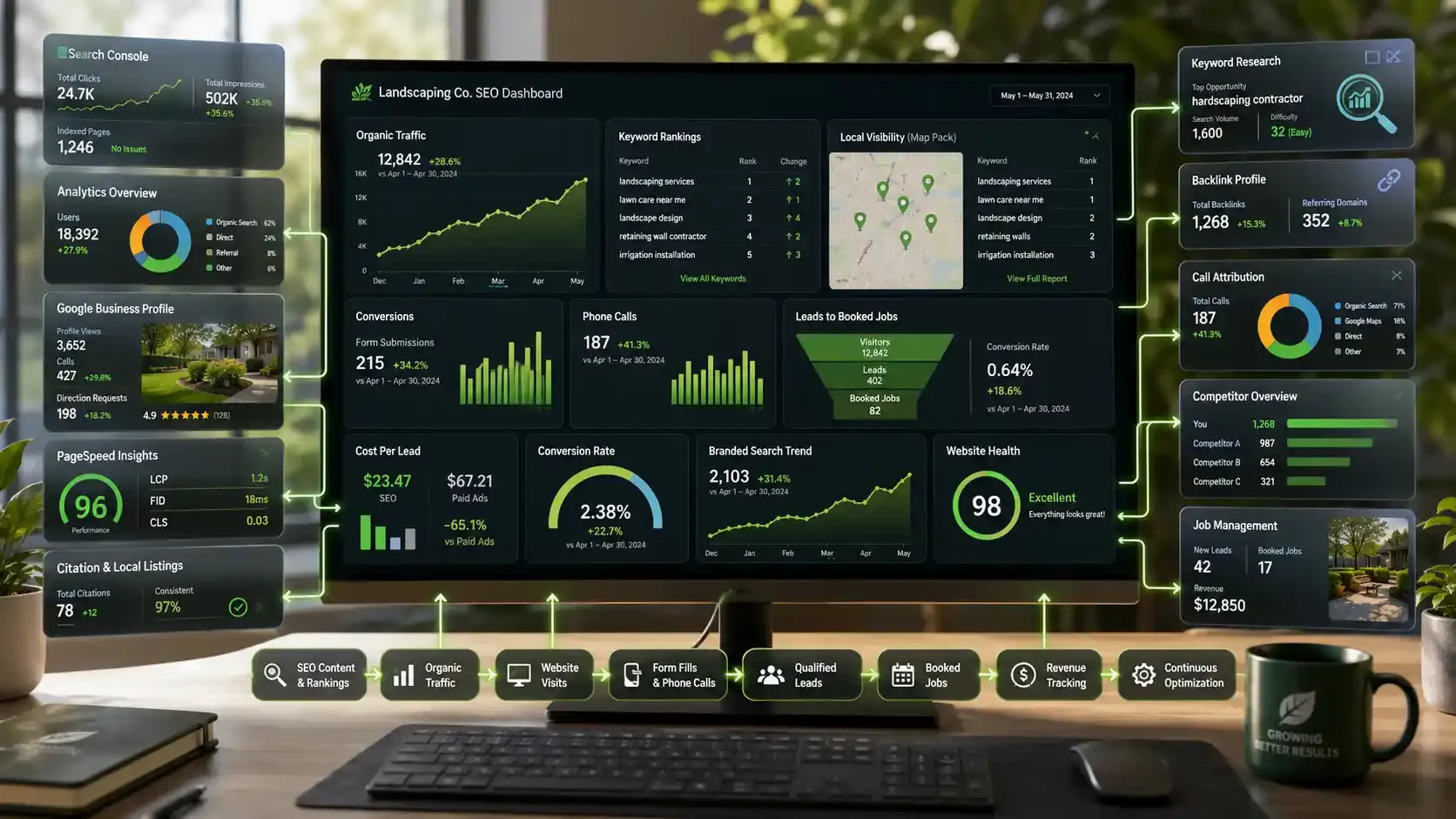
You can't improve what you don't measure. Track these metrics to know if your landscaping SEO is actually working, and use the right tools to do it.
Essential SEO Tools for Landscapers
You don't need all of these on day one. Start with the free tools and add paid ones as your budget grows.
| Tool | Purpose | Cost |
|---|---|---|
Google Business Profile | Local search visibility | Free |
Google Search Console | Track rankings, fix indexing issues | Free |
Google Analytics | Monitor traffic and conversions | Free |
Google PageSpeed Insights | Test and improve site speed | Free |
BrightLocal | Local SEO tracking and citations | $39+/month |
Semrush | Keyword research, competitor analysis | $139+/month |
Ahrefs | Backlink analysis, keyword research | $129+/month |
Moz Local | Citation management at scale | $20/year |
CallRail | Track which calls come from SEO | $50/month |
Convert SEO leads into booked jobs | $9/per user/month |
Key Metrics to Monitor
Which numbers actually matter? These six tell the full story:
- Organic traffic on a monthly trend. Is it climbing or flat?
- Keyword rankings for your target terms across service and location pages
- Map Pack visibility for your top commercial keywords
- Leads from organic search, including both form fills and phone calls
- Cost per lead from SEO compared to paid ads and referral channels
- Conversion rate from lead to booked job. Traffic without revenue is just a vanity metric.
The Attribution Challenge
Here's something that trips up every landscaper who starts tracking. SEO often plants the seed long before the phone rings.
A homeowner finds your blog post about spring cleanup in March. Bookmarks it. Google your company name in May. Calls you in June. That final visit shows as "direct traffic" in your analytics, but SEO started the entire relationship.
Watch your branded search volume. When more people Google your company name over time, that's a clear sign your SEO is building awareness even when the attribution looks messy.
The worst mistake is running SEO for months with zero tracking. You'll pour money and time into tactics with no way to know what's pulling its weight and what's dead weight.
Connect your SEO leads directly to FieldServicely so you can track which keywords produce booked jobs, not just clicks and page views. That's the number your accountant actually cares about.
SEO brings clicks. FieldServicely books jobs.
Connect your leads to real revenue by tracking which keywords produce booked jobs.
Common SEO Mistakes Landscaping Companies Make
Most of these sound obvious until you realize half your competitors are still doing them.
- Stuffing keywords into every sentence until your page reads like a robot wrote it.
- Copying the same meta description across every page on your site.
- Never checking Google Search Console for crawl errors and warnings.
- Building pages for services you don't even offer.
- Thinking you'll hit page one in two weeks flat.
- Paying a cheap agency that promises guaranteed #1 rankings.
Conclusion
SEO is not a one-time project. It's the one marketing channel that keeps paying you back long after the work is done.
The landscapers sitting at the top of Google right now are not lucky. They just started earlier. They claimed their Google Business Profile, built real service pages, earned consistent reviews, and made sure their site works on every phone screen.
You don't need to tackle all of this in a week. Start with the fundamentals. Optimize your GBP. Fix your site speed. Publish one solid service page. Then keep building from there.
SEO compounds. The work you put in today fills your schedule for three months, six months, or a year from now. The landscapers on page two will keep wondering where all the jobs went. Don't be one of them.
SEO for Landscaping Company FAQs
How Much Does SEO Cost for a Landscaping Company?
Most landscapers pay $1,200 to $3,750 per month. Small local crews spend $1,200 to $1,500. Mid-size companies run $1,950 to $3,750. Larger firms with many locations can hit $3,250 to $8,300 or more.
How Long Does Landscaping SEO Take To Show Results?
You can see ranking gains in 3 to 6 months. Steady leads start flowing between 6 and 12 months. Google Business Profile tweaks can show results in just a few weeks.
Is SEO Worth It for a Small Landscaping Business?
Yes. One landscaping customer is worth about $14,682 over time. One extra client per month from SEO adds over $176K a year in revenue. No other marketing channel touches that.
How Do I Get My Landscaping Company in the Google Maps Pack?
Fill out your Google Business Profile fully. Keep your name, address, and phone number the same everywhere. Ask for reviews often. Pick the right categories. Post fresh project photos each week.
What Is Local SEO for Landscapers?
Local SEO makes your business show up in Google Maps and local results. When a homeowner nearby searches for your services, your company appears first. That is local SEO working for you.