- Scheduling and Dispatch
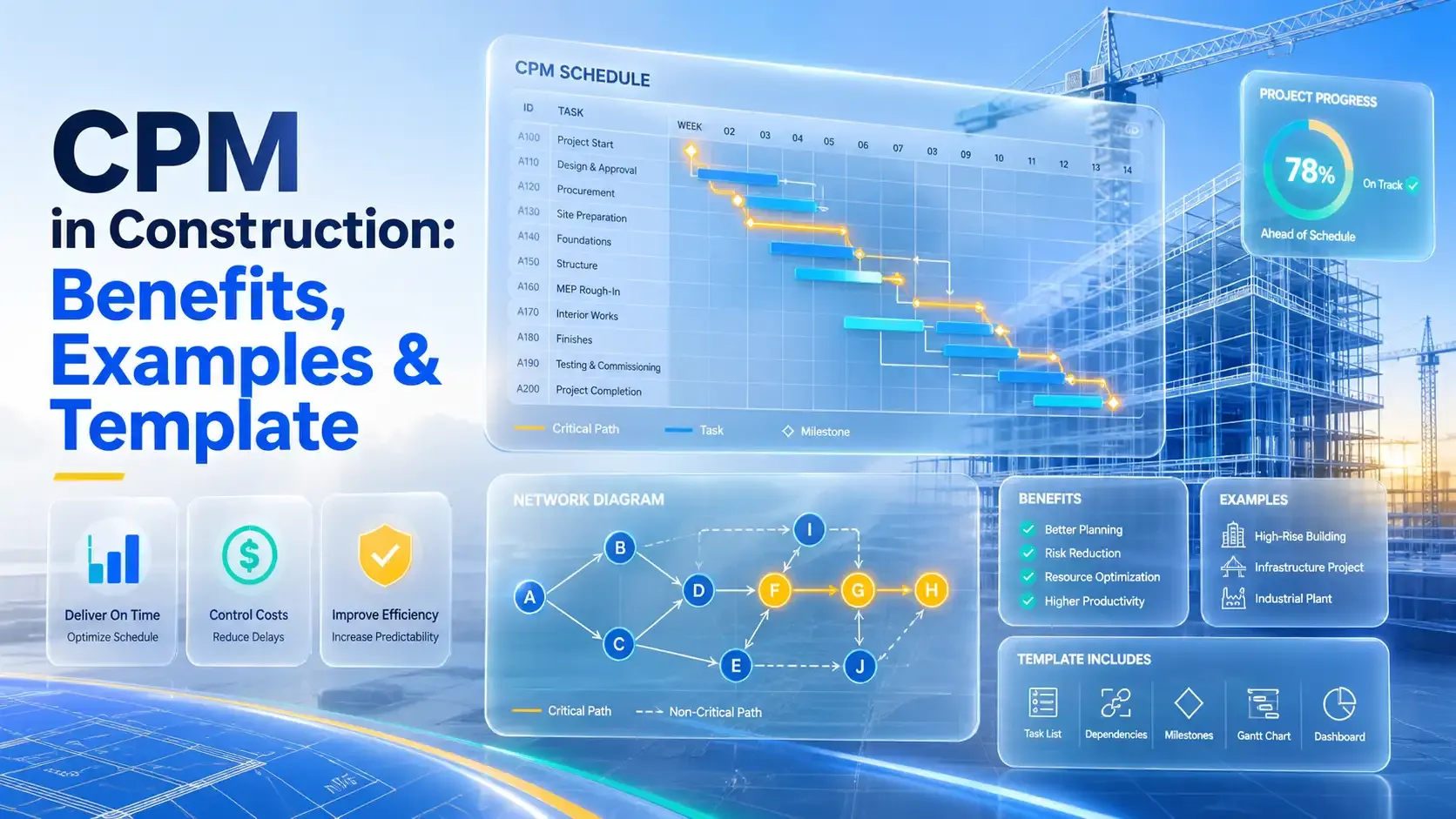
Critical Path Method in Construction: Benefits, Examples & Template
Updated on 5 May 2026
Jump to
Summary

CPM identifies the longest sequence of dependent tasks, showing which activities directly control project timelines.
It helps allocate labor, equipment, and materials efficiently while preventing costly delays on-site.
Using CPM allows managers to prioritize critical tasks, track float, and adjust schedules proactively.
CPM improves visibility, coordination, and accountability across field teams, project managers, and subcontractors.
Applying CPM consistently supports on-time delivery, resource optimization, risk management, and overall project efficiency.
The critical path method in construction is a project scheduling technique that identifies the longest sequence of dependent tasks. It also shows the shortest possible time to complete a project.
This helps project managers prioritize critical activities, allocate labor, equipment, and materials efficiently, and keep construction projects on schedule.
However, many teams face challenges like inaccurate task durations, shifting dependencies, and unpredictable site conditions. Many of them need proper training to interpret CPM results correctly.
In this blog, we will explain what CPM is, how it works, and the key steps to calculate it. We will also discuss practical examples, templates, and best practices for construction projects.
What is the Critical Path Method?
The Critical Path Method (CPM) is a tool that helps you see which tasks are truly important in a project. It shows the longest chain of dependent activities, meaning any delay in these tasks delays the entire project.
To find it, you list all tasks, note how they depend on one another, and calculate the earliest start and finish dates for each. Then you determine the latest start and finish times.
The difference gives you float, or slack, which shows where you have flexibility. Tasks with zero float form the critical path, setting the project’s minimum duration.
Using CPM, you can plan better, allocate resources wisely, and prevent bottlenecks before they happen. It turns complex projects into clear roadmaps and helps teams stay focused on what matters most.
Understanding the Critical Path Method in Construction
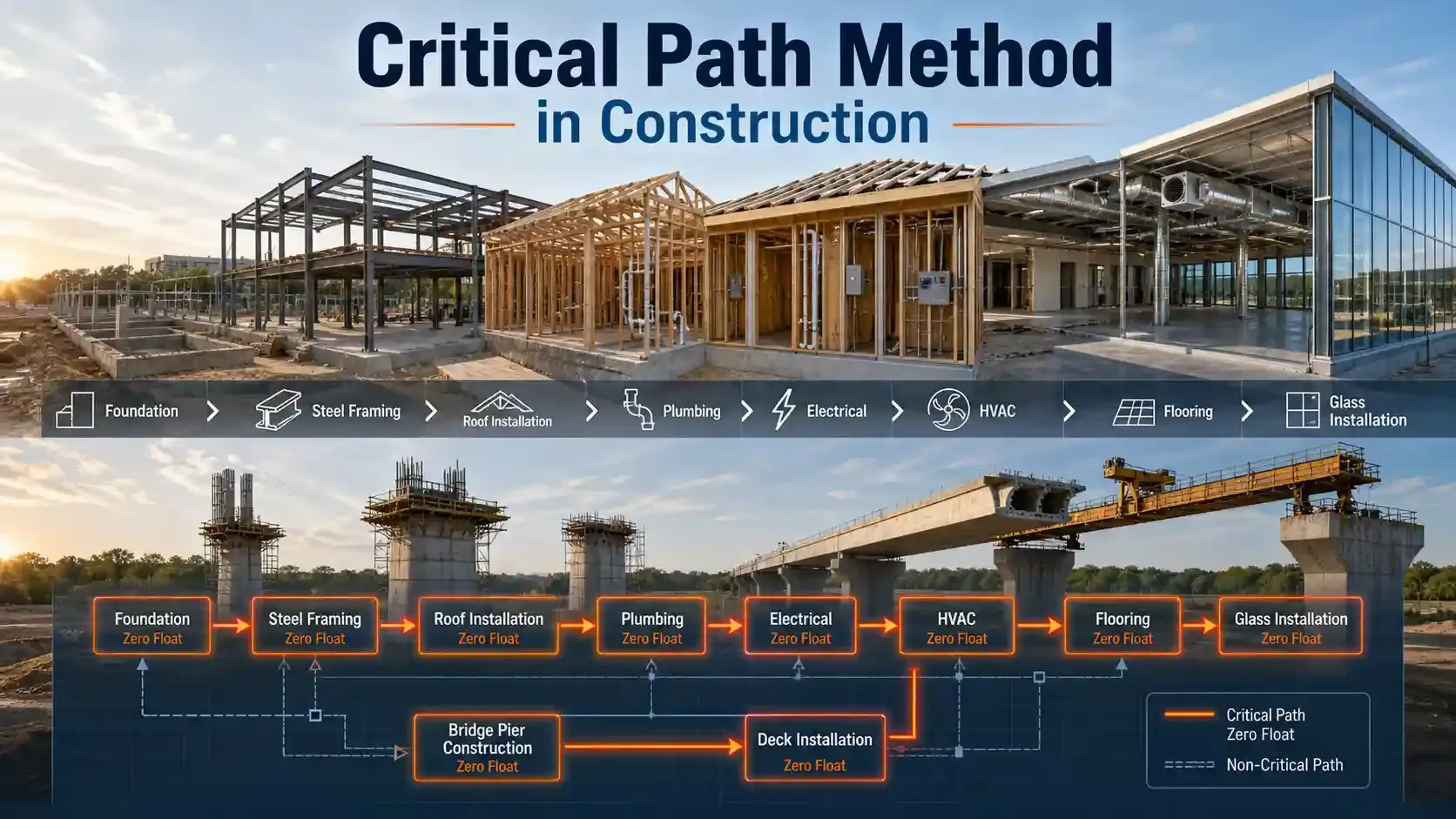
The Critical Path Method in construction management shows which construction tasks control the project completion date. I remember managing a mid-rise apartment project in which the concrete foundation, steel framing, and roof installation were all coordinated.
Any delay in the foundation would have pushed back the roof and finished work, clearly showing the critical path.
In residential construction, CPM lets you map foundation, framing, plumbing, and electrical work in order. On a commercial office project I oversaw, coordinating HVAC, flooring, and glass installation without CPM created confusion.
Using CPM, we tracked dependencies, identified tasks with zero float, and avoided costly schedule overruns.
For infrastructure projects like a highway segment I managed, multiple crews worked in parallel. CPM helped us see which tasks could slip and which could not, like bridge pier construction before deck installation.
Why Contractors Should Use the Critical Path Method?
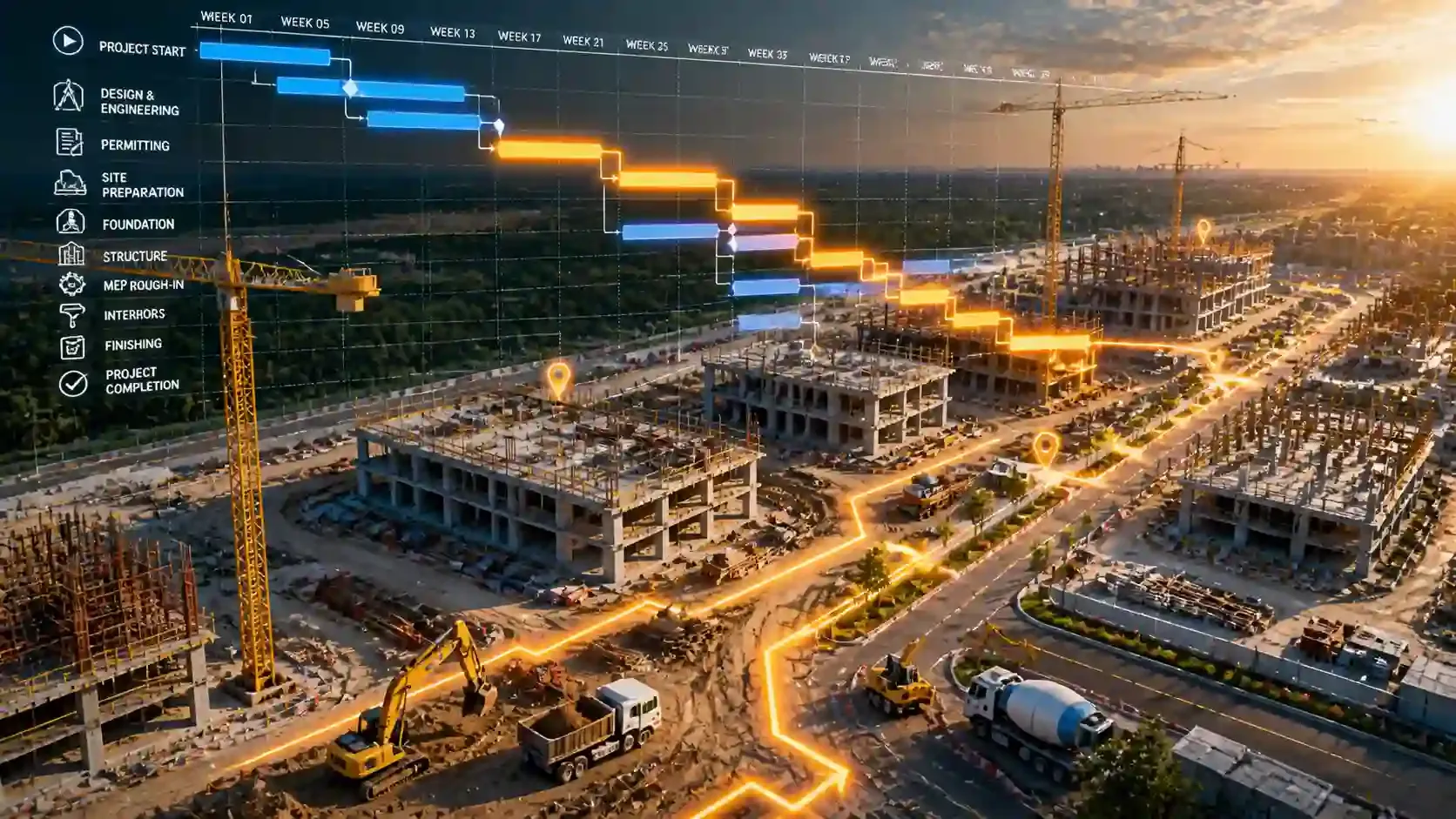
Preventing Delays and Optimizing Schedules
The Critical Path Method helps prevent costly project delays. That’s a bold statement to be honest. But the real question is: How?
CPM exposes the sequence of tasks that cannot slip without altering the end date, which lets you see where real risks live in your schedule. According to research, there is a 15–25% reduction in average delay using a systematic scheduling method.
That is simply because teams can anticipate bottlenecks before they break out.
In my years on site, I’ve watched CPM expose timing conflicts that would otherwise stay hidden. Because the method clarifies task dependencies, float, and critical sequence, you spend less time firefighting and more time steering the project.
Better Resource, Labor, and Equipment Planning
CPM helps contractors plan resources with precision rather than guesswork. When you know which tasks sit on the critical path, you can assign your best workers. Also, allocate the most reliable equipment where it is needed the most.
According to research, CPM provides dynamic analysis of activity sequencing and progress reporting, and serves as a tool for resource deployment and management
On a large residential subdivision I managed, we used the critical path method to visualize overlapping tasks like utility trenching, paving, and landscaping. By prioritizing crew assignments to critical path tasks, we reduced equipment downtime by roughly 18%!
Without this focus, you risk under‑allocating resources where they matter most or overstaffing parts of the project that have plenty of float.
Improved Project Control and Team Accountability
CPM gives everyone a single version of the truth about what needs to happen and when.
For example, when you post a schedule that clearly shows the critical path, your subs, architects, and procurement teams understand exactly what their commitments are. This shared clarity cuts down confusion and accelerates decision‑making.
During a commercial fit‑out I oversaw, we used CPM timelines to brief subcontractors weekly. When plastering and mechanical work were shown as linked with no float, the team knew delays weren’t just an inconvenience.
They had direct consequences for downstream tasks. That transparency instilled accountability and improved on‑site discipline.
Real-Time Timeline Management and Adaptation
I want you to take a moment and ask yourself: How often do my projects go exactly as planned?
You see, unexpected material delays, permitting issues, or bad weather can disrupt even the best laid plans. The Critical Path technique helps you respond fast because it lays out how changes affect the overall schedule. When a major activity slips, you immediately see how the finish date shifts.
When a foundation pour was delayed on one highway bridge job due to a storm, updating the CPM schedule in software instantly showed the new critical path. It also showed where we needed mitigation measures.
The team used that updated view to shift crews and fast‑track curing inspections, preventing further knock‑on delays.
Better Planning and Timeline Forecasting
Finally, CPM supports more accurate project planning and timeline forecasting right from the start. It’s not just a way to manage work once you’re underway. It shapes the original plan so that it is realistic and achievable.
Studies show that projects that embed scheduling discipline like CPM at the planning stage have better schedule adherence. That’s because they set baseline expectations that reflect real dependencies and risks.
In practice, this means identifying task sequences and durations early and mapping out logic ties. Then, using that information to build a schedule that’s not just optimistic, but achievable.
Optimize Your Labor and Equipment Allocation
Assign your best crews and tools to critical tasks and reduce downtime on site.
Key Elements of the Critical Path Method
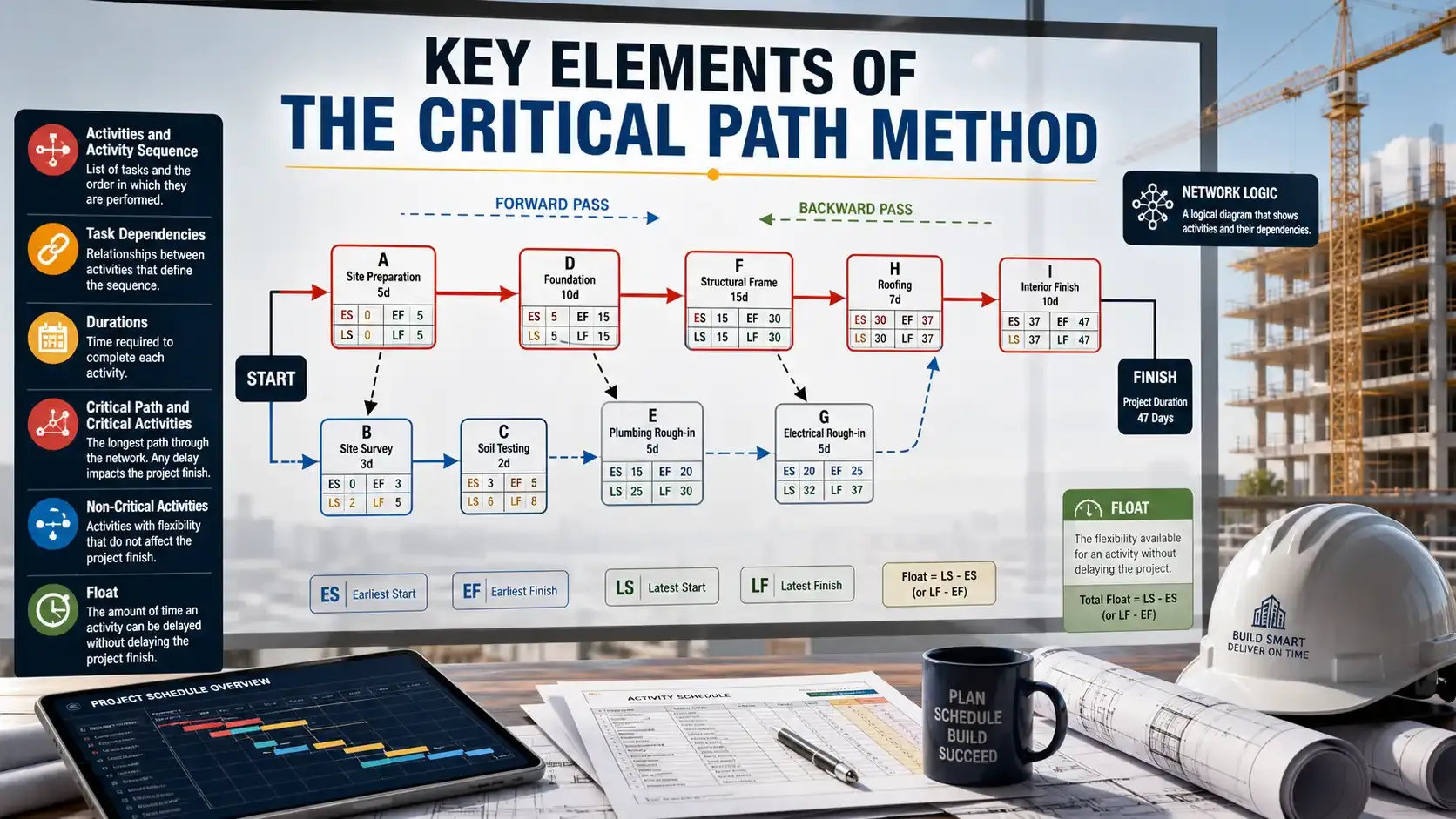
Activities and Activity Sequence
Activities are the individual tasks that make up work in a schedule. Each activity has a start, duration, and finish that you must plan before execution.
For example, in a build sequence, excavation must happen before foundation, and foundation must finish before framing starts.
The order of these activities forms the activity sequence, which becomes the basis for network logic.
Task Dependencies / Dependent Activities
Task dependencies describe how one activity is linked to another in time. If activity B cannot start until activity A finishes, this is a finish‑to‑start (FS) relationship, which is the most common in construction.
Other relationships, like start‑to‑start (SS) or finish‑to‑finish (FF), help capture parallel work, such as overlapping electrical rough‑in with plumbing on commercial projects.
Effective dependency mapping reduces rework and prevents conflicts before work begins. Clear dependencies also help software calculate the true sequence and avoid unrealistic schedules.
Durations / Activity Duration
Duration is how long an activity takes from start to finish. Estimating durations accurately is critical because it directly impacts the project timeline. Modern scheduling practice still emphasizes using historical data and crew productivity rates rather than guesswork.
For example, if site prep takes four days and framing takes eight, knowing these exact durations lets you build a realistic plan that your crew can follow.
Critical Path and Critical Activities
The critical path is the longest chain of dependent activities that dictates the minimum time needed to complete the project. These are the critical activities — ones you cannot delay without delaying the whole project.
Activities on the critical path often have zero float, meaning no buffer exists. Accurate critical path identification helps prevent surprises on site and aligns team priorities from day one.
Non‑Critical Activities
Non‑critical activities are tasks that don’t sit on the critical path. These tasks have some flexibility, known as float, and can be delayed slightly without affecting the finish date.
For example, painting interior trim may not be critical if dry‑in and inspections are still on track. Recognizing non‑critical activities helps you allocate your best workers to where they matter most first.
Float / Total Float / Free Float / Slack Time / Zero Float
Float (or slack) is the amount of time a task can be delayed without impacting others or the project end date.
Total float measures delay tolerance relative to the project completion date. Free float measures the delay tolerance before it affects the next task only. Zero float means no delay is acceptable; these tasks are on the critical path.
Forward Pass, Backward Pass, and ES, EF, LS, LF
The forward pass calculates the earliest start (ES) and earliest finish (EF) for each task by moving from the beginning of the network to the end. It shows how quickly tasks could be completed if nothing slows them down.
The backward pass calculates the latest start (LS) and latest finish (LF) by moving from the end date back to the start. This tells you how late tasks can happen without harming the project's end date.
Network Logic
Network logic is the web of relationships that define how each task connects to others.
Logic ties are the links between activities that tell scheduling software how work flows. Without accurate logic ties, the schedule won’t reflect real work conditions and will mislead your team.
For example, if concrete curing must finish before the crew starts framing, that logic must be tied into the network. Research shows that robust network logic improves forecast reliability and reduces planning errors.
Track Float and Slack Without Guesswork
Monitor total float, free float, and zero-float tasks to prevent project delays.
How to Find the Critical Path in Construction
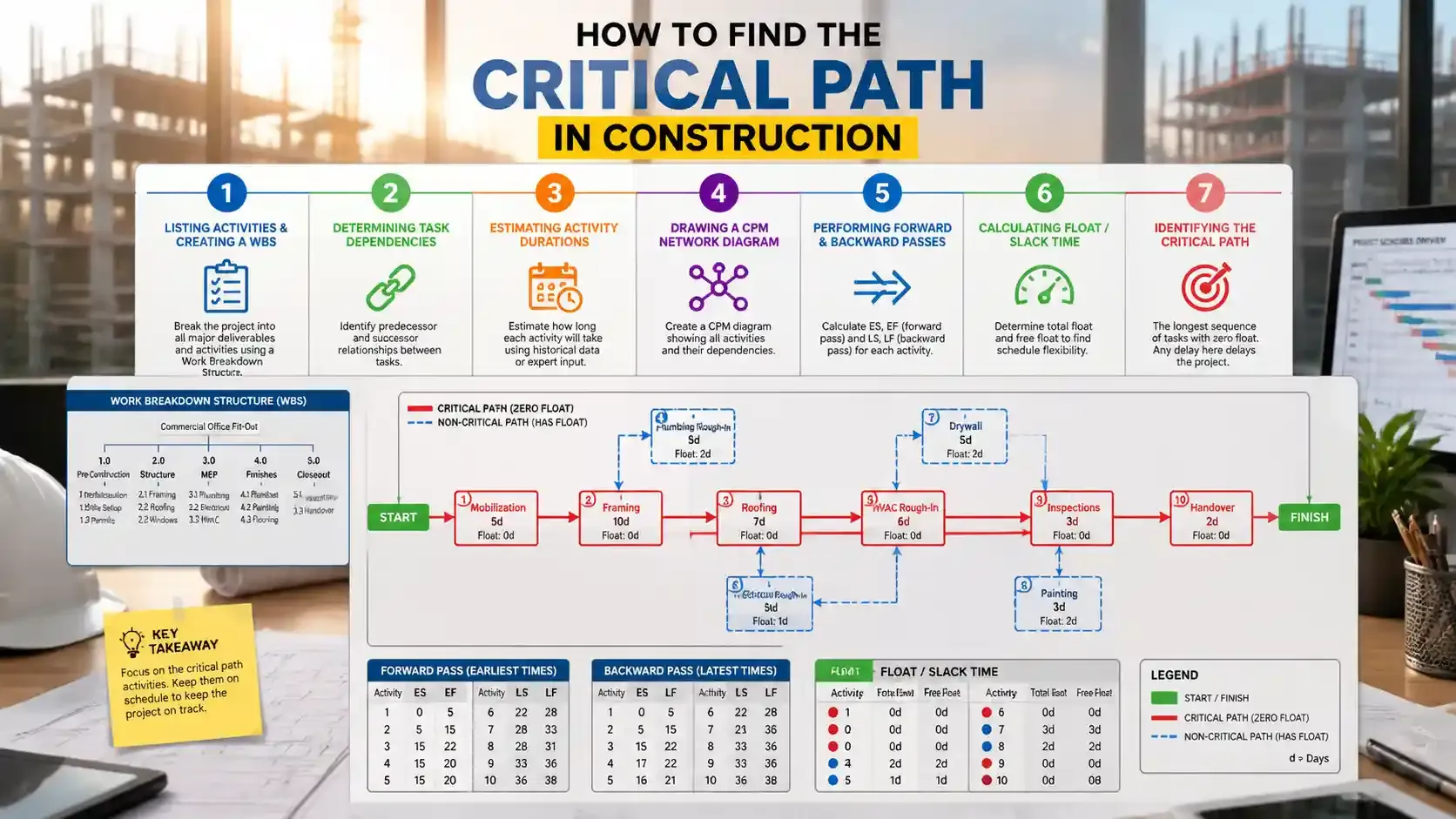
Finding the critical path in construction means identifying the longest sequence of dependent tasks that controls the project’s completion. It shows where delays will directly affect the final deadline.
Listing Activities and Creating a WBS
The first step is to list all project tasks using a Work Breakdown Structure (WBS).
I remember a commercial office fit-out where we broke the project down into tasks such as framing walls, installing windows, and roofing. Having every task listed clearly allowed us to see dependencies and assign resources efficiently.
Structured WBS lists increase retention by up to 20%.
Determining Task Dependencies
Next, you define which tasks rely on others. These are predecessor and successor activities.
On one high-rise I managed, electrical rough-in could not start until plumbing was completed. Mapping dependencies accurately ensures that the schedule reflects the true sequence and avoids unrealistic overlaps.
Estimating Activity Durations
Each task must have an estimated duration.
We rely on historical data or crew input to determine how long work takes. For example, roof decking in a mid-sized residential project took seven days based on past projects and subcontractor experience.
Accurate durations allow the forward and backward passes to calculate realistic start and finish times.
Drawing a Critical Path Diagram
After tasks and durations are set, you create a CPM diagram or network diagram. Each activity is represented visually and linked to its dependencies.
On a hospital wing project I supervised, the network diagram made it clear that structural framing, HVAC rough-in, and inspection sequencing were the key tasks.
Performing Forward and Backward Passes
The forward pass calculates the earliest start (ES) and the earliest finish (EF) for each task. You move from the project’s start to the end, adding durations along the way.
The backward pass calculates the latest start (LS) and the latest finish (LF) by moving from the project end to the start. This shows how late a task can occur without delaying the overall project.
Calculating Float / Slack Time
Float, or slack, is the time a task can be delayed without affecting other tasks or the project’s finish. Total float measures flexibility against the project end, while free float measures delay tolerance before impacting the next task.
Identifying the Critical Path
Finally, the critical path is the longest sequence of tasks with zero float. Any delay along this path directly impacts the project’s completion.
Tools like FieldServicely highlight these tasks automatically, making it easier to track progress and adjust resources where necessary.
Build Accurate Task Sequences
Create a structured WBS and visualize your project network for smoother execution.
How to Create a CPM Construction Schedule
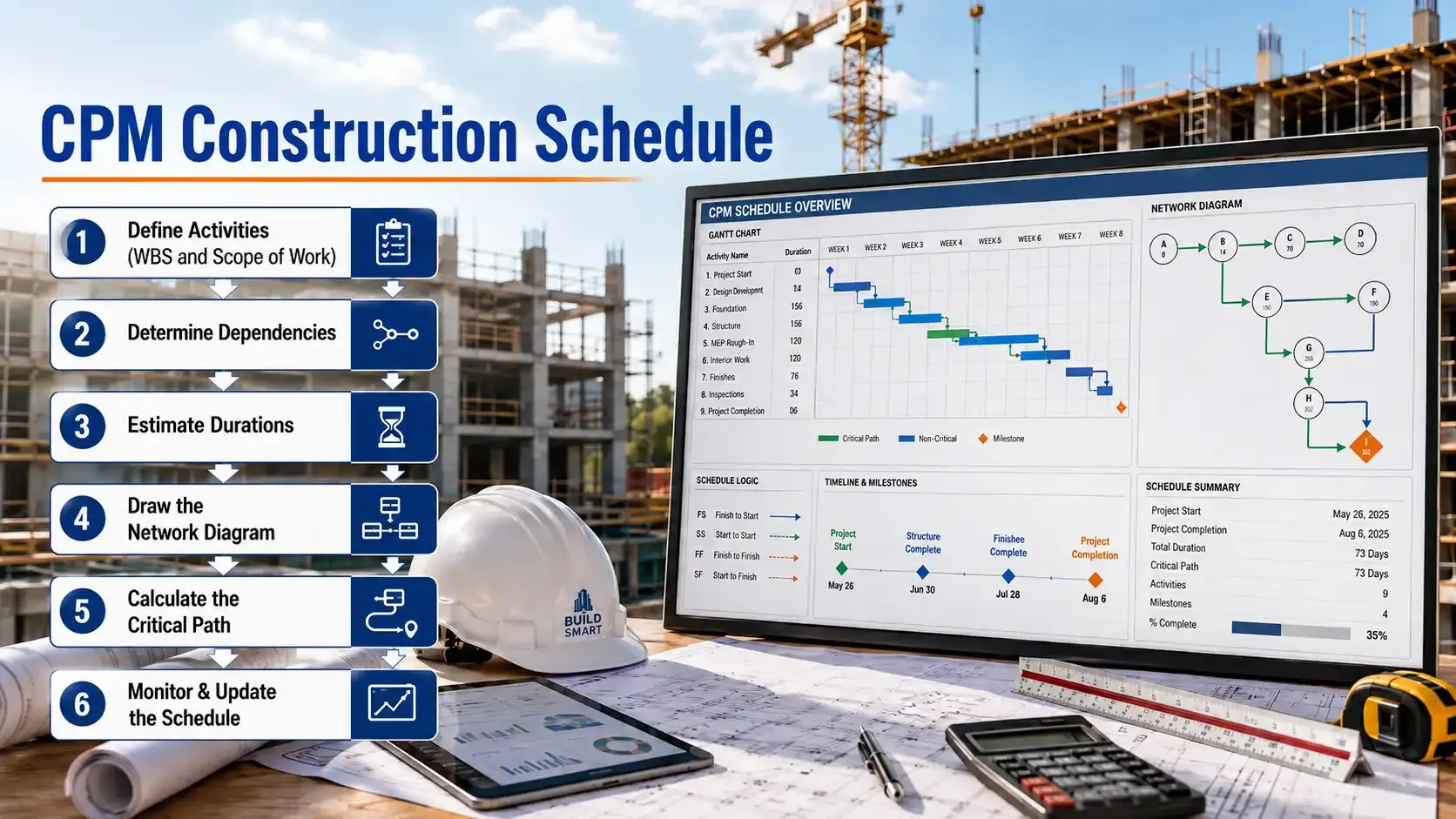
Creating a CPM schedule in construction helps you plan projects clearly, avoid delays, and allocate resources efficiently. It maps out all tasks, their dependencies, and timing, so the team knows what to focus on.
Step 1: Define Activities (WBS and Scope of Work)
The first step is to list every activity needed to complete the project. Use a Work Breakdown Structure (WBS) to divide the project into manageable tasks like foundation, framing, plumbing, and electrical.
A product-oriented Work Breakdown Structure provides a detailed framework for planning, assigning responsibility, and integrating the project schedule. [Source: U.S. Department of Energy]
Step 2: Determine Dependencies
Next, identify which tasks depend on others. Some tasks must finish before the next start (Finish-to-Start), while others can happen at the same time (Start-to-Start).
For example, on a mid-rise building, the roof can’t go on until framing is done, but window installation can overlap with exterior cladding. Correct dependencies prevent bottlenecks and keep the schedule realistic.
Step 3: Estimate Durations
Each task needs a realistic time estimate. Use historical data, crew input, and material lead times to set durations. On a highway segment project, we estimated concrete curing at five days based on experience, avoiding delays in subsequent paving tasks.
Accurate durations form the foundation for calculating the critical path.
Step 4: Draw the Network Diagram
After defining tasks and dependencies, create a CPM network diagram. Represent each task with a node and draw arrows showing how tasks connect.
In practice, I’ve used diagrams for commercial interiors to visualize overlapping trades like MEP and drywall. This clarity helps crews see which tasks affect others and prevents work conflicts.
Step 5: Calculate the Critical Path
Once the diagram is ready, perform forward and backward passes to determine the earliest and latest start and finish dates (ES, EF, LS, LF). Then calculate float or slack for each task.
Tasks with zero float form the critical path, the sequence that controls the project’s minimum completion time.
Step 6: Monitor & Update the Schedule
A CPM schedule isn’t static. Track progress, compare planned vs. actual dates, and update the critical path as work progresses. If a non-critical task slips and becomes critical, you need to adjust resources immediately.
Build Your CPM Schedule Faster
Use FieldServicely to define tasks, dependencies, and durations in one intuitive dashboard.
Free CPM Template for Construction
A CPM Excel template is a ready-to-use spreadsheet that helps you map your project from start to finish. It includes all tasks, their durations, dependencies, and automatically calculates critical metrics.
Here is a CPM template for you to calculate early and late dates, float, or the critical path.
Critical Path Method Examples in Construction
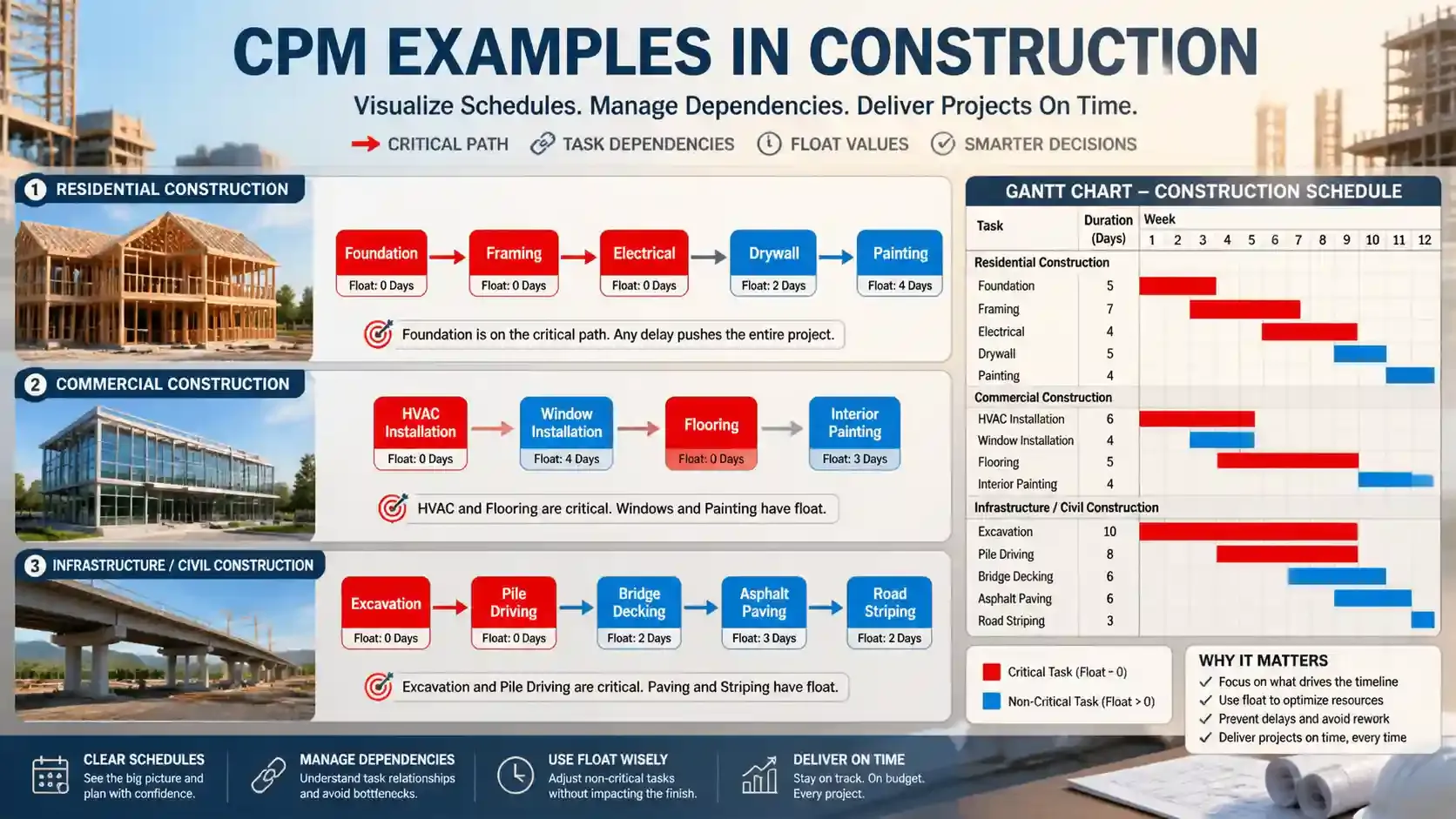
The Critical Path Method (CPM) helps teams visualize schedules, track task dependencies, and identify what drives the project timeline.
Here’s how CPM works across different construction industries.
Residential Construction Example
In residential construction, the typical sequence might be:
Foundation → Framing → Electrical → Drywall → Painting
Foundation work forms the critical path because any delay here pushes back all following tasks. Painting and finished work often have floats, allowing minor adjustments without affecting the overall completion date.
On a 2025 mid-rise apartment project, framing and electrical were zero-float tasks. Using a simple Gantt chart, we marked critical activities in red and non-critical tasks in blue.
This helped field supervisors allocate crews effectively and finish the project on time.
Commercial Construction Example
Commercial projects have more overlapping trades and longer sequences. A typical sequence could be:
HVAC Installation → Window Installation → Flooring → Interior Painting
HVAC often drives the critical path since it must be complete before many finishing activities begin. Tasks like painting or ceiling installation may have several days of float.
During a 2025 office fit-out, the critical path included HVAC and flooring. Windows and doors had a total float of four days, giving flexibility for crew scheduling.
The CPM schedule helped reallocate crews quickly when a project delay occurred, avoiding knock-on delays.
Infrastructure / Civil Construction Example
Infrastructure projects, such as highways, bridges, and tunnels, involve long-duration tasks with complex dependencies. For example, a highway project may follow:
Excavation → Pile Driving → Bridge Decking → Asphalt Paving → Road Striping.
On a 2025 highway segment I managed, excavation and pile driving were on the critical path with zero float. Asphalt paving and striping had some free float, which allowed minor adjustments without affecting the overall finish date.
Using a CPM network diagram, all crews understood which tasks required immediate attention, preventing bottlenecks.
Visualizing Critical vs Non-Critical Tasks
Across industries, a Gantt chart or CPM diagram shows critical tasks in red and non-critical tasks in blue.
Float values appear next to each task, clarifying which activities can be delayed safely. This approach makes schedule management transparent and actionable, allowing managers to make informed decisions on resource allocation.
For example, in a mixed-use project with residential and commercial sections, we highlighted framing and HVAC as critical, while non-critical tasks like painting and landscaping showed available float.
This made it easy to shuffle crews dynamically without affecting completion dates.
Apply CPM Across Industries
Manage residential, commercial, and infrastructure projects using one intuitive platform.
How to Calculate Critical Path in Construction
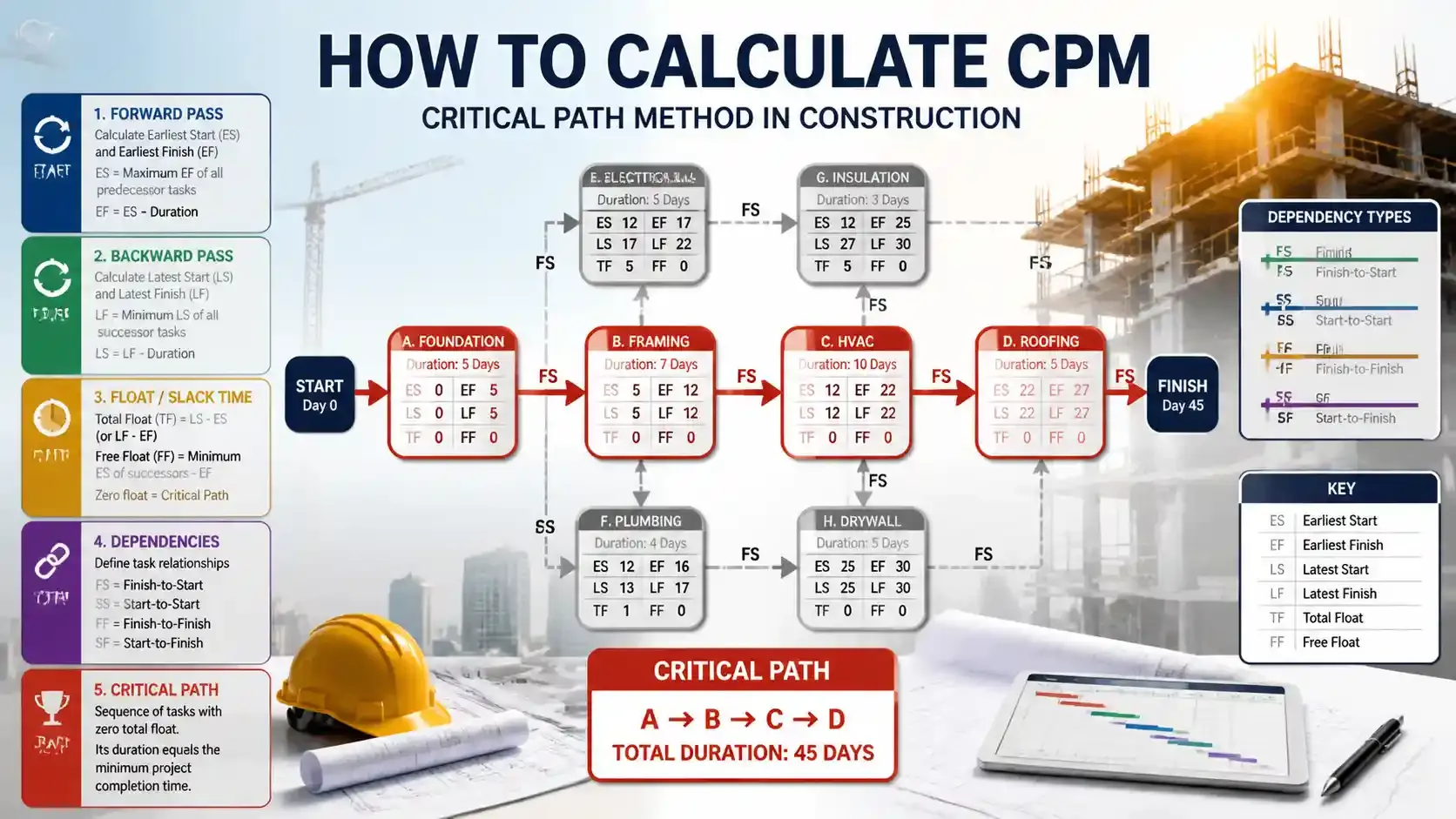
Forward Pass: Calculating Earliest Start (ES) and Earliest Finish (EF)
The forward pass starts from the beginning of the project. It calculates the earliest each task can start and finish based on dependencies.
The formula is simple:
ES = Maximum EF of all predecessor tasks
EF = ES + Duration of the task
For example, on a residential build I supervised in 2025, the foundation took 5 days. Framing depended on the foundation, so its ES was day 5, and EF became day 12 for a 7-day framing task.
Backward Pass: Calculating Latest Start (LS) and Latest Finish (LF)
The backward pass starts at the end of the project and moves backward through the network. It calculates how late tasks can start and finish without delaying the overall project.
LF = Minimum LS of all successor tasks
LS = LF - Duration
For instance, in a 2025 commercial office fit-out, drywall had an LF of day 30 and a duration of 5 days, so LS was day 25.
Calculating Float / Slack Time
Float measures how much a task can be delayed without affecting the project.
Total Float (TF) = LS - ES (or LF - EF)
Free Float (FF) = Minimum ES of successors - EF
Tasks with zero float are on the critical path, meaning any delay will impact the completion date. Negative float indicates an overly compressed schedule that needs adjustment.
Dependency Relationships and Activity Sequencing
Dependencies define how tasks relate to each other. Typical relationships are Finish-to-Start (FS), Start-to-Start (SS), Finish-to-Finish (FF), and Start-to-Finish (SF).
For example, electrical rough-in cannot begin until framing finishes (FS). HVAC installation and ductwork can start at the same time (SS). Correctly mapping these relationships ensures that forward and backward pass calculations are accurate and the critical path reflects reality.
Critical Path Duration and Project Completion
The critical path is the sequence of tasks with zero total float. Its duration equals the minimum project completion time. Any delay on these tasks will delay the entire project.
For example, on a mixed-use project, the critical path included foundation, framing, HVAC, and roofing, totaling 45 days. Identifying the critical path allows project managers to focus on high-impact tasks and adjust resources efficiently.
Track Float and Slack Automatically
Monitor total float, free float, and negative float in real time to prevent delays.
Best Practices of CPM
- Use accurate activity durations and historical data to avoid unrealistic schedules
- Update the construction project schedule regularly to reflect real-time progress and adjust the critical path
- Engage construction managers, project owners, and site managers to improve coordination and accountability
- Include risk mitigation, recovery schedules, and contingency planning to handle delays like material shortages or weather impacts
- Use construction scheduling software for complex projects to automate calculations, visualize dependencies, and highlight critical tasks
- Maintain schedule monitoring, control, and tracking to detect deviations early and keep projects on track
- Prioritize zero-float tasks so critical path activities receive resources first, while non-critical tasks with float remain flexible
Benefits of the Critical Path Method in Construction
- Optimizes resource allocation for labor, equipment, materials, and subcontractor coordination, ensuring tasks are prioritized correctly
- Supports on-time project delivery and schedule optimization by highlighting critical tasks and zero-float activities
- Reduces delays and manages project risk by identifying bottlenecks before they impact the timeline
- Improves project visibility, construction efficiency, and deadline management through clear network diagrams and Gantt chart visualization
- Enhances cost control, budget management, and productivity by allowing better planning of critical resources and minimizing idle time
- Strengthens project coordination and team accountability by providing a shared schedule and clear task ownership for all stakeholders
Risks and Challenges of CPM in Construction
- Inaccurate task duration estimates can mislead the critical path and cause unexpected delays on-site.
- Changes in dependencies, concurrent delays, or non-critical delays can shift the critical path and impact overall completion.
- Dynamic site conditions such as weather, material delivery issues, and labor shortages can disrupt the schedule unexpectedly.
- CPM has limitations for highly uncertain projects where tasks or dependencies are unpredictable, reducing reliability.
- Proper training is required to interpret CPM correctly; misreading ES/EF/LS/LF or float can lead to wrong decisions.
- Overreliance on software or incorrect data input can create false precision, masking real risks and causing schedule errors.
Conclusion
In construction, the Critical Path Method (CPM) is essential for field teams, project managers, and contractors to stay on track. It ensures that critical tasks are prioritized, resources are allocated efficiently, and potential delays are addressed before they escalate. By using CPM, teams gain better schedule visibility, prevent bottlenecks, and optimize workflow across trades.
Frequently Asked Questions
What are critical activities in construction?
Critical activities are tasks on the critical path with zero float. Any delay in these tasks directly affects the project’s finish date. Examples include foundation pouring, structural framing, or HVAC installation in complex projects.
What is the difference between CPM and a Gantt chart?
CPM identifies the longest sequence of dependent tasks to determine the shortest project duration. A Gantt chart visualizes the schedule timeline but doesn’t calculate floats or dependencies automatically. CPM is about logic; Gantt is about visualization.
What is the difference between CPM and PERT?
CPM assumes fixed task durations and is deterministic, while PERT uses probabilistic durations to estimate uncertainty. CPM is preferred for construction projects with known timelines; PERT is better for projects with high uncertainty.
Can the critical path change during a project?
Yes, the critical path can change if delays occur in non-critical tasks or if durations are updated. Updating the schedule ensures that new critical tasks are identified and managed properly.
What happens if a critical path activity is delayed?
A delay in a critical activity pushes back the entire project unless corrective actions, like reallocating resources or fast-tracking, are taken. Early identification of risks helps prevent this scenario.
Who prepares the CPM schedule in construction?
The CPM schedule is usually prepared by project managers or schedulers, often in collaboration with field engineers, site managers, and subcontractors. It combines task details, dependencies, and durations to create a complete project plan.