- Field Service Business
Landscaping Business Plan in 7 Steps (Free PDF Template)
Updated on 31 Jul 2026
Jump to
Summary

A landscaping business plan has seven sections and runs 15 to 30 pages.
Start with an LLC, get licensed, and define the target market.
Price from actual costs, not competitor rates. Budget for commercial-grade equipment.
Build revenue around recurring maintenance contracts. Add hardscaping for higher margins.
Bank three months of operating expenses before winter hits.
A landscaping business plan combines services, pricing, operations, and financial projections into a single document. This keeps the business on track and gets lenders to take the conversation seriously.
This industry reached $188.8 billion in 2025 and continues to climb. Over 726,000 businesses compete for the same residential and commercial contracts across the country.
Yet most landscapers run without a plan. They buy equipment, chase jobs, and figure out the money later. That works until winter hits and the cash runs dry.
In this blog, I break down how to write a landscaping business plan step by step and walk through a real example. I have also included a free downloadable PDF template to get started right away.
What is a Landscaping Business Plan?
A landscaping business plan is a written roadmap for your company. It covers your services, target market, daily operations, and financial projections for the next three to five years.
But who actually needs one?
Startup founders use it to dodge costly mistakes before spending on commercial-grade equipment or hiring their first crew. Existing owners stuck at the same revenue for years use it to finally break through and scale.
Then there's funding. Anyone chasing an SBA loan or investor funding needs a plan because lenders won't even schedule a sit-down without seeing real numbers on paper.
And the data proves it works. Businesses with a formal plan grow 30% faster than those running without clear goals.
Here's why that should matter to you. The U.S. landscaping services industry hit $188.8 billion in 2025, with over 726,000 businesses scrapping for the same contracts.
In a market that's packed, a solid landscaping company business plan separates owners who grow from those who just get by.
How to Write a Landscaping Business Plan
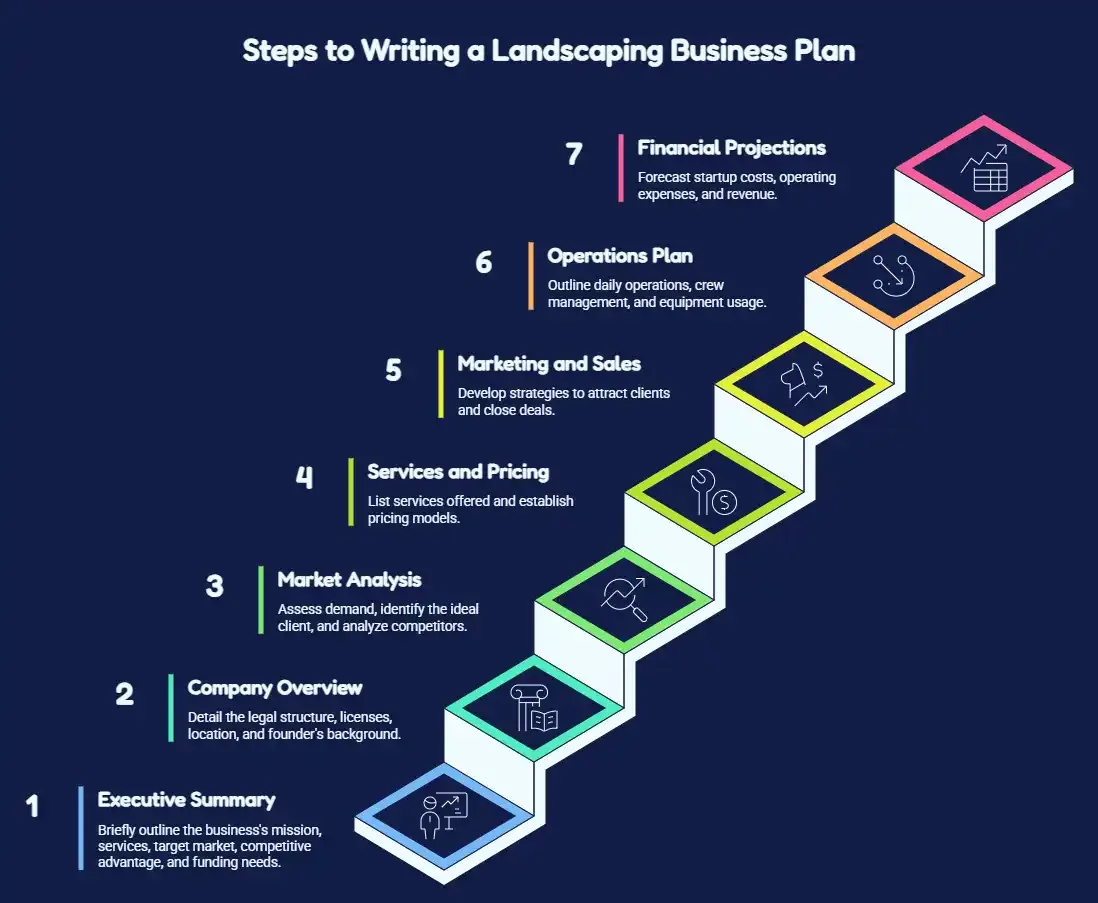
A landscaping business plan has seven sections, starting with the executive summary and ending with financial projections. Each section tackles one part of how the business earns, operates, and grows.
Here's how to handle each one.
1. Executive Summary
The executive summary opens the plan, but I always write it last. The logic is simple. Every other section feeds into this one, so finishing those first makes the summary almost automatic.
It should fit on one to two pages. Lenders scan dozens of plans in a week. This page decides if they read the rest.
Five things belong here:
- The mission statement and what the company does
- The core landscaping services on offer
- The target market and ideal client
- The strongest competitive advantage
- The funding amount and where it goes
That competitive advantage should come first. If the company runs on eco-friendly landscaping in a market of conventional crews, that detail opens the page. If the model centers on recurring monthly maintenance contracts, lead with that instead.
Either way, the differentiator earns the top spot.
Funding requests work the same way. I've gone through plans where the ask hid on page 14. No banker hunts for that number. One line on page one fixes it. Something like:
"GreenEdge Landscaping needs $45,000 in startup capital for commercial-grade equipment, a service truck, and three months of operating reserves."
Once the other six sections are done, this one comes together in about an hour.
2. Company Overview
The company overview lays out how the business is set up. It connects the legal entity, licenses, location, and founder background into one section, so a reader gets the full picture fast.
The legal structure comes first because everything else depends on it. Three options show up most in this industry:
| Structure | Liability | Tax Treatment | Best For |
|---|---|---|---|
Sole Proprietorship | None | Personal return | Solo operators starting small |
LLC | Assets safe | Pass-through | Most landscaping startups |
S-Corp | Assets safe | Salary + draws | Owners earning $80K+ profit |
An LLC fits most new landscapers because it shields personal assets without the admin load of an S-Corp. That protection matters in an industry where a single job-site accident can turn into a lawsuit.
Once the structure is picked, the next question is what licenses are needed to start a landscaping business?
Rules change by state, but most operators end up with this stack:
- A general business license from the city or county
- An Employer Identification Number (EIN) from the IRS
- A contractor license for hardscaping, irrigation, or tree work
- A Commercial Pesticide Applicator cert for spraying on client land
That last one trips people up because it's federal, not state. The EPA requires it for anyone applying restricted-use pesticides on land they don't own. State agriculture offices handle the exam and renewal from there.
After the legal setup, the overview should cover the company location and work history. Three years of crew management at another firm show a lender that the founder knows the business already.
That context shifts the conversation from "can this person do the work" to "how fast can this company grow?"
3. Market Analysis
The market analysis tests one thing: does this area have enough demand to support the business? Everything else in the plan depends on that answer. So getting it right sets the foundation for the sections that follow.
It starts with the ideal client. Most landscaping customers split into two camps:
- Residential: Homeowners earning $75K+ in the suburbs, quarter-acre lots or bigger, likely open to weekly service
- Commercial: Property managers, HOAs, office parks, and retail centers that buy maintenance on annual contracts
That client profile shapes the rest of the analysis because residential and commercial markets compete on different things. Residential buyers care about trust and curb appeal. Commercial buyers care about price and reliability.
On the demand side, the numbers are strong. The Bureau of Labor Statistics projects 4% job growth for grounds workers through 2034, adding about 171,600 openings per year. Those are national figures, though. The real test is local.
I've used a field method that works well. Drive the target area between 8 AM and noon. Count every landscaping truck on the road:
- Under 10: Room for a new crew
- 10 to 20: Tight, but gaps exist
- Over 20: A clear niche is needed to break in
The truck count shows saturation. Competitor research shows where they're weak. Study the top three local competitors this way:
- Scan their websites for services they skip
- Read Google reviews, focus on the complaints
- Check if they handle residential, commercial, or both
- Compare their rates to planned pricing
When nobody nearby offers smart irrigation or seasonal aeration, that gap is worth claiming because those services carry better margins than basic mowing.
Free tools round out the research:
| Tool | What It Shows |
|---|---|
Google Trends | Seasonal demand spikes by area |
U.S. Census Bureau | Income, housing density, property values |
Nextdoor | Real complaints and service requests |
Google Maps | Competitor spots, reviews, coverage area |
4. Services and Pricing
The services and pricing section lists what the business offers and how it charges. This part needs to be specific because vague descriptions make the rest of the plan look like guesswork.
Common landscaping services to include:
- Lawn care (mowing, edging, fertilizing, weed control)
- Hardscaping (patios, walkways, retaining walls)
- Smart irrigation install and repair
- Seasonal cleanups (spring prep, fall leaf removal)
- Snow removal (cold-climate markets)
- Tree trimming and shrub pruning
Each service type calls for a different pricing model.
Flat-rate works for recurring lawn maintenance because clients pay the same amount every visit. Project-based fits hardscaping and installs where scope changes per job. Hourly makes sense for smaller one-off tasks where time is hard to predict.
A sample table gives the plan a concrete anchor:
| Service | Price Range | Model |
|---|---|---|
Weekly lawn mowing | $40 – $80/visit | Flat-rate |
Seasonal cleanup | $200 – $500 | Project |
Patio or walkway | $1,500 – $5,000+ | Project |
Irrigation install | $2,500 – $6,000 | Project |
Tree trimming | $75 – $250/tree | Flat or hourly |
Snow removal | $50 – $150/visit | Flat-rate |
What catches new owners off guard is how much equipment shapes the pricing math. Commercial-grade mowers run $3,000 to $8,000, while residential models cost a fraction of that.
The gap sounds like savings, but it's a trap.
A home mower on a 40-lawn weekly route dies within months because it wasn't built for that pace. Commercial machines handle the daily grind and last for years, so the per-job cost drops with every property on the route.
Those equipment numbers need to feed into the rates. Pricing should cover:
- Crew wages and payroll taxes
- Fuel and vehicle maintenance
- Blade sharpening and tool repairs
- A margin buffer of 15% to 20%
5. Marketing and Sales Strategy
The marketing and sales strategy maps out how clients find the business and how deals close. The plan needs this section because the best services in town mean nothing if nobody knows about them.
The customer acquisition channels that work best in landscaping are:
- Google Business Profile: Free, local, and the first place most homeowners search. Stacking five-star reviews early builds momentum fast.
- Door-to-door: Walking new subdivisions where fresh sod needs its first mow. Simple approach, still delivers results.
- Referral programs: A free service or discount for each new client a current customer sends over. Word of mouth carries weight in this business.
- Social media: Before-and-after shots on Instagram and Facebook. I've seen these pull more leads than paid ads on smaller budgets because the visual proof does the selling.
For lead tracking, tools like Jobber handle CRM, quotes, and invoicing in one place. But when the operation also needs crew scheduling, route optimization, and GPS tracking, what should you do?
In that situation, running all of that through FieldServicely keeps things in a single platform instead of three.
The sales process works best in short. A client reaches out, you schedule a site visit that same week, send the quote within 24 hours, and follow up with one call to close. The first landscaper with a clear number almost always wins because homeowners hate waiting.
Read More: Landscaping Business Software for Smarter Operations
6. Operations Plan
The operations plan covers how the work gets done every day. This section connects the crew, the equipment, and the schedule into a system that repeats without falling apart.
Most landscaping crews roll out between 6:30 and 7:30 AM. That early start matters because it directly controls how many jobs fit into a day before the crew burns out.
Route-based staffing ties into that morning start. Grouping properties by zip code or neighborhood creates tight clusters for each crew. That structure cuts drive time, saves fuel, and reduces truck wear. Random daily scheduling does the opposite and eats into margins.
Equipment picks affect operations just as much. A commercial zero-turn mower ($5,000 to $12,000) clears a one-acre lot in half the time of a residential model. Commercial trimmers and leaf blowers handle daily abuse without constant shop visits.
The upfront cost is steeper, but faster jobs and fewer breakdowns pay it back within the first season.
Seasonal planning rounds out the operations picture:
- Spring: Ramp up crews, sign new deals, knock out cleanups
- Summer: Peak season, full deployment, upsell enhancement work
- Fall: Shift to leaf removal, aeration, final rounds
- Winter: Pivot to snow removal or build cash reserves
Tracking all these moving parts on paper falls apart fast, especially once a second crew is added. FieldServicely handles dispatching, live field tracking, and job assignments from one place. Routes stay tight, and crews stay on task without constant calls.
Read More: Landscaping Invoicing and Billing Made Simple
7. Financial Projections and Revenue Forecasting
Financial projections turn everything above into numbers. This is where the plan either holds up or falls apart under scrutiny.
Startup costs shift based on the scale of the operation:
| Business Type | Startup Cost |
|---|---|
Solo lawn care (basic gear) | $5,000 – $10,000 |
Full-service residential | $25,000 – $60,000 |
Commercial scale | $75,000 – $200,000+ |
Monthly operating costs should track these line items:
- Crew wages: $20.33/hour average per the Bureau of Labor Statistics, loaded to $26–$28/hour after payroll tax and workers' comp
- Fuel and truck upkeep: $500 – $1,500/month
- Gear repairs (blades, oil, parts): $200 – $500/month
- Marketing: $200 – $500/month
Revenue works best around recurring monthly maintenance contracts:
- 1 client at $200/month = $2,400/year
- 80 clients on one crew's route = $192,000 annually
The industry average net profit margin sits at 17% according to the 2026 report from Lawn & Landscape. Strong operators hit 15%–20% by keeping labor under 30% of revenue and tightening route density.
Break-even timeline:
- Solo operator: 6 to 12 months
- Multi-crew setup: 12 to 18 months
The biggest money mistake in this industry comes down to timing. Owners earn well from April through October and spend at the same pace. Then winter hits, and the cash is gone.
Setting aside three months of operating expenses as cash reserves before the slow season keeps the business alive through the quiet stretch.
Build your plan. Run every job with confidence.
FieldServicely helps you schedule crews, manage jobs, track progress, and grow your landscaping business from one platform.
Landscaping Business Plan Example
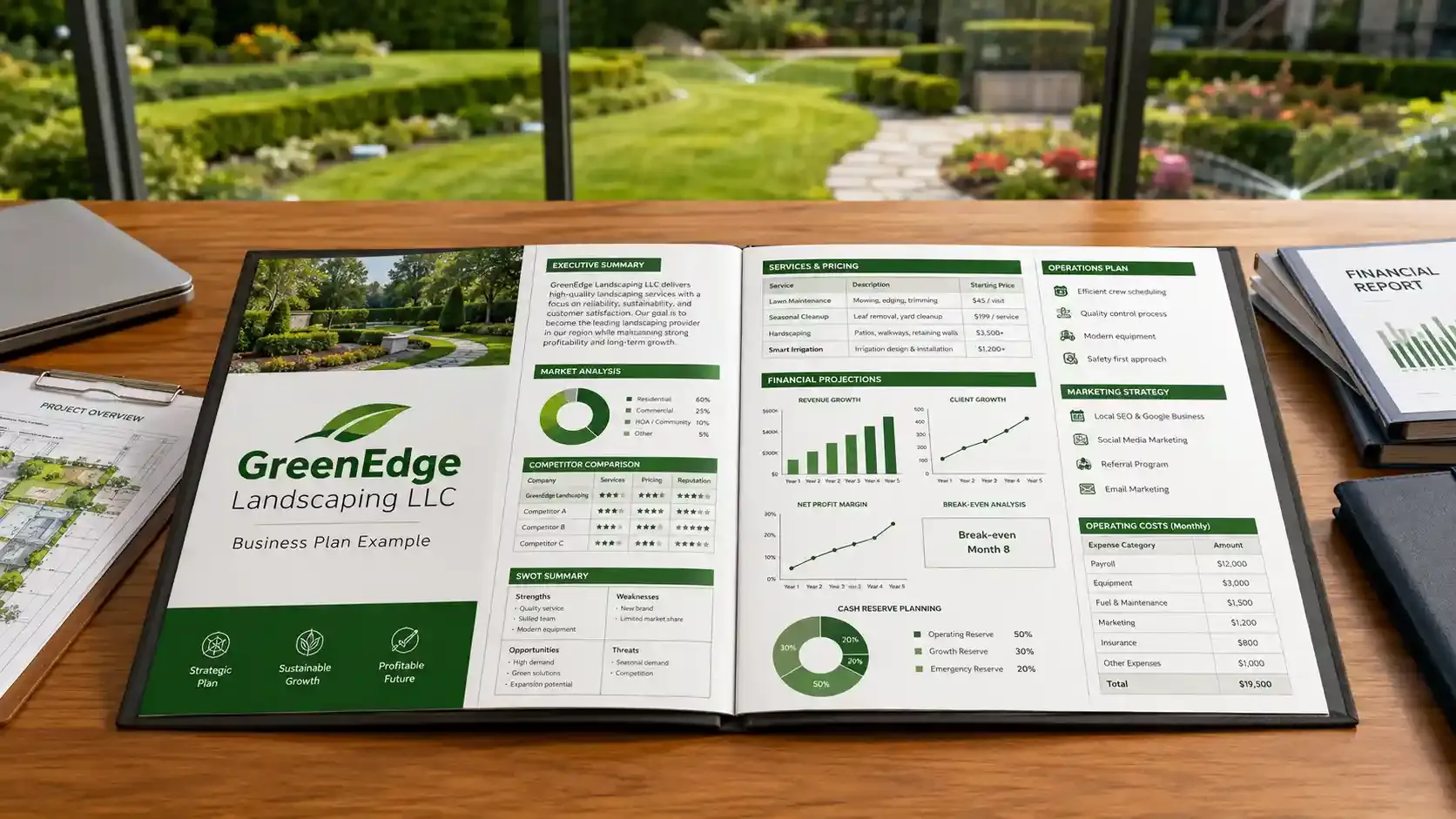
Here's what a finished plan looks like in practice.
Suppose GreenEdge Landscaping LLC operates in Austin, TX. Marcus Cole, a former crew manager with six years in the field, started it with a partner. They run two crews of three, serving homeowners and small commercial properties in the western suburbs.
Austin's median household income is $90,430, and the target zip codes skew even higher. Three local competitors serve the same area, but none offer eco-friendly options or smart irrigation. GreenEdge built its model around those gaps.
The service mix and pricing:
| Service | Price Range | Model |
|---|---|---|
Lawn Maintenance | $50 – $75/visit | Weekly flat-rate |
Seasonal Cleanup | $250 – $450 | Project |
Hardscaping | $2,000 – $6,000 | Project |
Smart Irrigation | $1,800 – $5,500 | Project |
The startup needed $45,000 for equipment, a truck, and three months of reserves. Monthly costs run about $11,100, covering wages, fuel, gear, and marketing.
The three-year outlook:
| Year 1 | Year 2 | Year 3 | |
|---|---|---|---|
Revenue | $180,000 | 310,000 | $475,000 |
Clients | 55 | 95 | 140 |
Net margin | 12% | 16% | 19% |
GreenEdge hits break-even at month 8. To handle the winter revenue dip, the company banks 15% of peak-season income as a cash reserve before the slow months start.
This is one version of how a landscaping business plan comes together. The numbers, services, and market will look different for every company. The structure stays the same.
Manage your business like a growing company.
Automate scheduling, job tracking, and customer updates from one dashboard.
Free Landscaping Business Plan Template
I put together a free landscaping business plan template in PDF format that follows the same seven-section structure covered in this guide. It includes fill-in prompts, ready-made tables, and space for every detail a lender or partner would look for.
Here's what the template covers:
- Executive Summary with a funding breakdown table
- Company Overview with a business structure checklist and license tracker
- Market Analysis with customer profile and competitor comparison tables
- Services and Pricing with a pre-built pricing grid and equipment cost sheet
- Marketing and Sales Strategy with a channel selection checklist
- Operations Plan with crew staffing and seasonal workflow tables
- Financial Projections with startup costs, monthly expenses, revenue forecasts, and break-even tracking
The template works for residential landscaping business plans, commercial operations, and companies that serve both. Adjust the service list and numbers to match the specific market.
Common Mistakes in a Landscaping Business Plan
Most landscaping business plans fail on the same handful of errors. None are hard to fix once spotted.
- Skipping the financial plan and treating the rest as enough
- Budgeting with residential equipment prices instead of commercial-grade costs
- Ignoring seasonal cash flow and running dry every winter
- Writing for investors but leaving out daily operations
- No marketing plan beyond word-of-mouth referrals
- Copying competitor pricing instead of calculating actual costs
Conclusion
A landscaping business plan doesn't need to be perfect on the first draft. It needs to exist. The companies that grow past $500K in revenue almost always have one. The ones stuck at the same number year after year rarely do.
Start with the executive summary and work through each section. Use the free template above to skip the blank page. Update the numbers every quarter as the business changes. The plan that gets written beats the one that keeps waiting.
Frequently Asked Questions
How Long Should a Landscaping Business Plan Be?
Most plans run 15 to 30 pages. A solo lawn care operation can get by with 10. A company seeking an SBA loan or investor funding should aim for 20 or more. Length matters less than clarity and real numbers.
Can I Write a Landscaping Business Plan Myself?
Yes. Most successful landscapers write their own. Nobody knows the local market, pricing, and daily operations better than the owner. Use a free template to handle the structure. Fill in the details from firsthand experience.
Do I Need a Business Plan for a Small Lawn Care Operation?
Even a solo lawn care business benefits from a basic plan. It forces real math on pricing, expenses, and seasonal gaps. Banks also require one for any loan, even a $5,000 equipment line of credit.
What Is the Most Profitable Landscaping Service?
Hardscaping and smart irrigation carry the highest margins, often between 35% and 45%. Recurring lawn maintenance earns less per job but brings steady monthly income. The best mix combines both for cash flow and profit.
How Often Should I Update My Landscaping Business Plan?
Review it every quarter. Update the numbers twice a year at minimum. Client counts, crew sizes, and expenses shift fast in this industry. A plan from January can look completely different by July.
What to read next