- Field Service Business
License for Cleaning Business: What You Need & Real Costs
Updated on 12 Jun 2026
Jump to
Summary

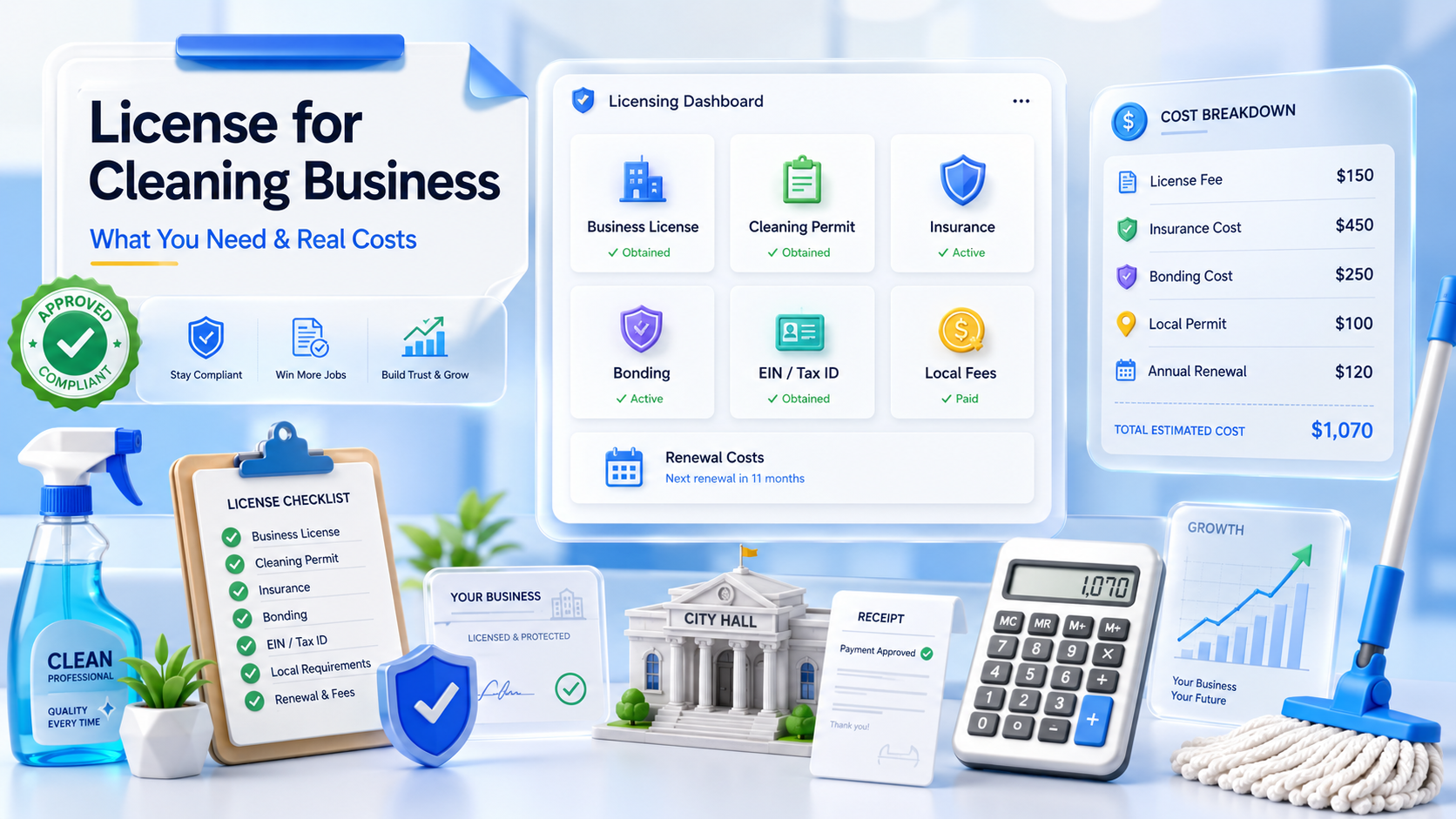
There is no federal "cleaning license," but nearly every state requires a general business license from your city or county clerk.
Common permits include a DBA ($10-$100), sales tax permit (free-$50), EIN (free), and a home occupation permit ($0-$150).
Total startup licensing costs run $700 to $1,800 for solo residential cleaners and $2,000 to $4,500+ for commercial operations.
Commercial clients require proof of general liability insurance and a janitorial bond before they will review your bid.
Licensing rules vary by state, so check both your state and local city or county requirements before filing anything.
Most people think starting a cleaning business means buying supplies and finding clients. The licensing part? They either skip it or drown in conflicting advice online.
I made both mistakes.
I lost a $10,000 commercial contract because I could not upload a valid cleaning business license to a vendor portal. A friend paid a $500 city fine for operating without one. Neither of us saw it coming.
In this guide, I will discuss every license for a cleaning business that applies to you, what they actually cost, and the exact steps to get everything filed. Plus a full state-by-state reference table so you know exactly what your location requires.
Do You Actually Need a License to Start a Cleaning Business?
Yes, you need one to start a cleaning business. But there is no special "cleaning license" the way a plumber or electrician carries one. What you need is a general business license from your city or county.
Here's the thing, though. Your cleaning business license requirements depend on three factors.
- Where you operate changes your requirements because licensing works across federal, state, and local layers.
- What you clean shifts the picture since offices and hazmat sites need more permits than houses.
- How your business is structured changes the paperwork because an LLC files differently from a sole proprietorship.
Now here's what most people ignore.
CSC Global reports that some cities fine unlicensed operators based on a percentage of gross revenue. Most commercial property managers also reject bids from unlicensed cleaners on-site.
What Licenses Do You Need for a Cleaning Business?
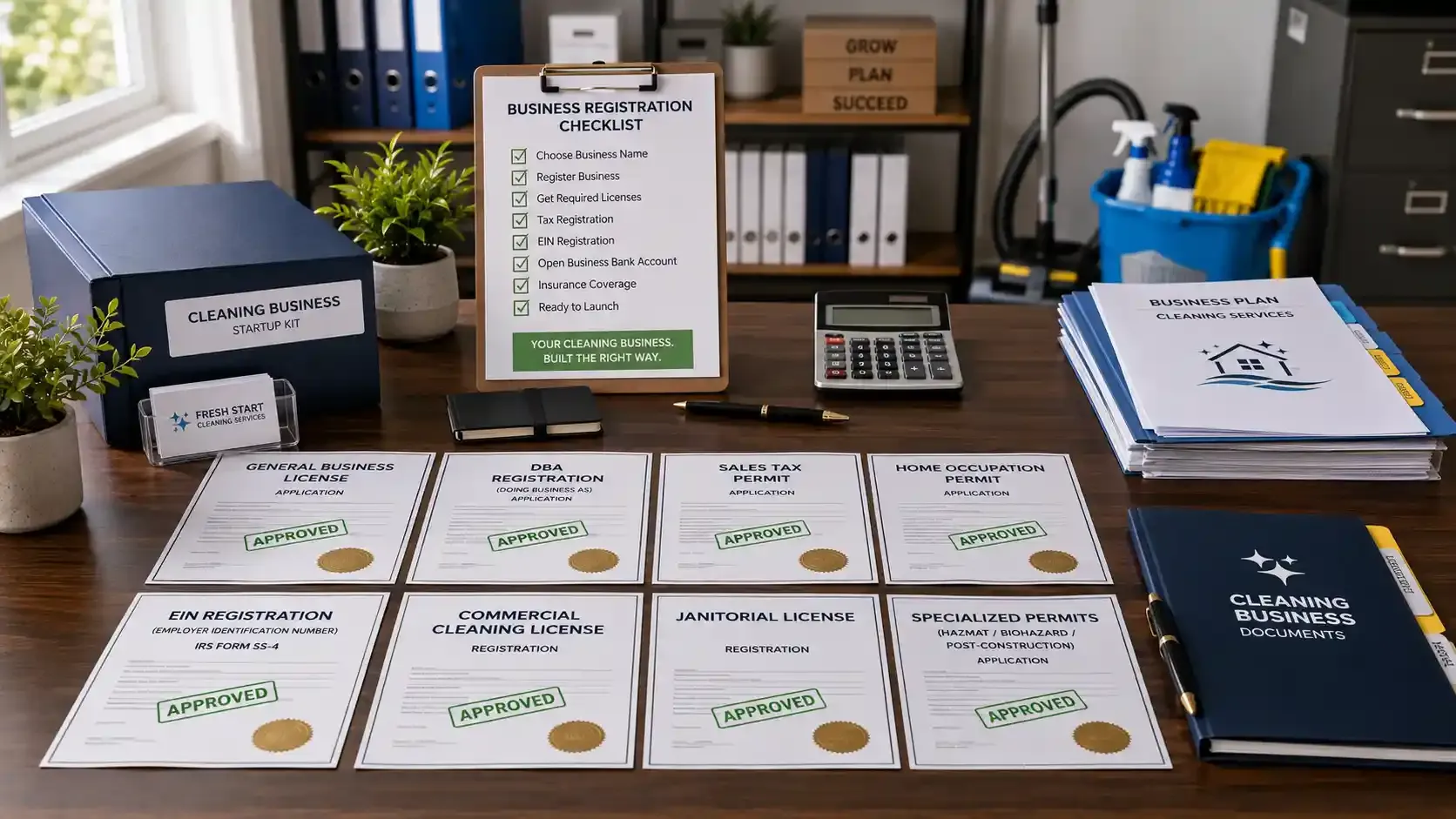
General Business License
Your city or county clerk issues this for $50 to $400. Small towns charge less, while metro cities like Chicago or Los Angeles often exceed $300.
Six states plus D.C. also require a statewide license in addition to local licenses. If a client asks about your house cleaning license, this is it. Use the SBA's license search tool to check what applies.
DBA (Doing Business As) Registration
You need a DBA registration only if your business name differs from your legal name. I registered mine because "Fresh Start Cleaners" sounds better on a van than my full legal name.
File it at your county clerk's office for $10 to $100. Banks require it before opening accounts under a trade name. Renews every five years.
Sales Tax Permit
Some states tax cleaning services directly. Others only tax product sales. You get this sales tax permit from your state's Department of Revenue for free or for under $50.
It also goes by the vendor's license or seller's permit, depending on where you live.
Home Occupation Permit
This is the one almost everyone forgets. If you store cleaning supplies at home, schedule a spare bedroom, or meet clients at your front door, as many cities require it.
It costs $0 to $150. Check your city zoning office before a code inspector does.
Employer Identification Number (EIN)
Free from the IRS. Takes five minutes online. You need one if you hire employees, form an LLC, or open a business bank account.
Even solo cleaners benefit. It keeps your Social Security number off every invoice.
Those cover the basics for most residential setups. But here is what changes when you step into commercial work.
Commercial Cleaning License and Janitorial License
These kick in when you move past houses into offices, retail, or industrial spaces. Some states bundle them. Others keep them separate.
California requires janitorial businesses to register with the Labor Commissioner before taking a single job. It costs between $100 and $500 or more.
Specialized Permits
These only apply to niche work like hazmat cleanup, biohazard restoration, or post-construction cleaning. The rules are strict, and costs vary by jurisdiction.
If your services go beyond standard residential or commercial cleaning, check your local environmental and health regulations first.
Got your permits sorted? Now organize the work behind them.
Schedule jobs, track teams live, and send invoices from one dashboard.
How to Get a License for Your Cleaning Business
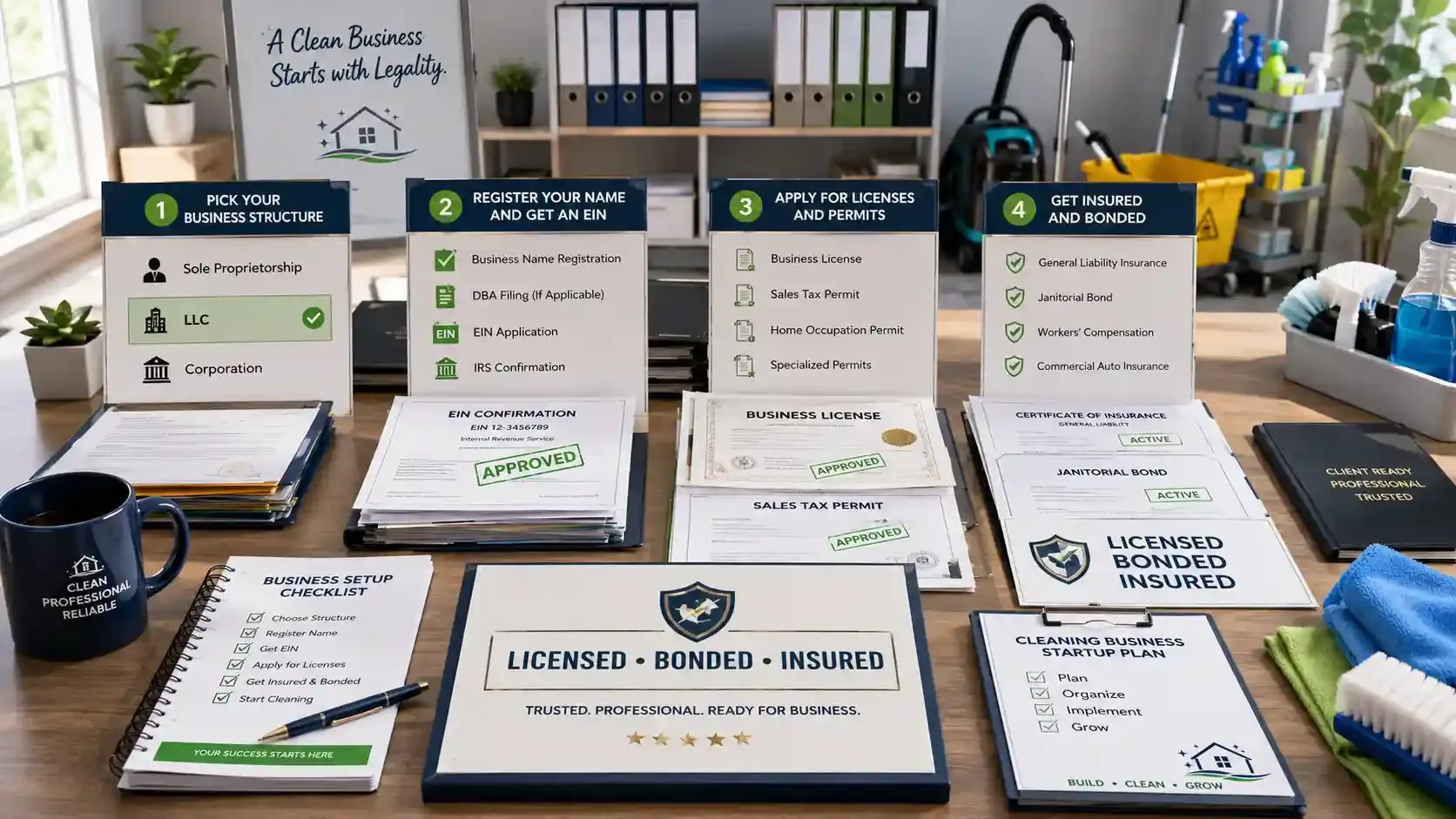
Getting licensed is not as complicated as it sounds. Here is the exact order to get a license for your cleaning business without wasting time.
Step 1: Pick Your Business Structure
This comes first because every subsequent application asks for your business type.
A sole proprietorship costs nothing to set up but ties your personal assets to every business risk. An LLC costs $50 to $500, depending on your state, and keeps your personal finances separate. A corporation works, too, but adds more complexity than most cleaners need.
I went with an LLC. Most cleaning business owners do the same.
Step 2: Register Your Name and Get an EIN
Check your business name on your state's Secretary of State website. If it is available, lock it in. File a DBA if you plan to operate under a different name. Then grab your EIN at IRS.gov. This is free and takes five minutes.
Step 3: Apply for Your Business License and Permits
Start with your general business license at your city or county clerk's office. Bring your business structure docs, EIN, address, and the fee.
Here is a tip that saves real time. Call the clerk's office before you visit. Ask exactly what documents they need.
That one phone call saved me a wasted trip and two weeks of delays. After that, file for your sales tax permit, home occupation permit, and any specialized permits.
Steps one through three handle the legal side. But here is what actually makes clients trust you enough to hand over their keys.
Run your cleaning business like a real operation.
GPS tracking, geofenced attendance, and automated payroll built for field teams.
Real Cost to License a Cleaning Business in 2026
A single business license costs $50 to $400. But that is not the real cleaning business license cost.
Nobody launches a cleaning business with just one permit. You need the LLC, the DBA, the insurance, and sometimes a bond. Here is what the full picture actually looks like.
| Item | Estimated Cost |
|---|---|
General Business License | $50–$400/year |
LLC Formation | $40–$500 (one-time) |
DBA Registration | $10–$100 |
EIN | Free |
Sales Tax Permit | Free–$50 |
Home Occupation Permit | $0–$150 |
General Liability Insurance | $612–$1,920/year |
$100–$350/year | |
Workers' Comp Insurance | $550+/year (if hiring) |
Solo Residential Total | $700–$1,800 |
Commercial w/ Employees | $2,000–$4,500+ |
So, how much does a cleaning business license cost all in?
Between $700 and $1,800 for a solo residential cleaner. Or $2,000 to $4,500 or more for commercial operations with employees.
LLC filing fees alone range from $40 in Kentucky to $500 in Massachusetts, per the U.S. Chamber of Commerce. And general liability for cleaning businesses runs $51 to $160 per month, depending on team size.
Three things push your total up or down.
One more thing to plan for! Most of these renew every year, so budget beyond just year one. I use FieldServicely to track renewal dates alongside my job scheduling. One dashboard beats a pile of sticky notes.
Renewals sneak up fast. Track every deadline in one place.
FieldServicely keeps your scheduling, compliance dates, and invoicing on one screen.
Do Residential and Commercial Cleaners Need Different Licenses?
Often yes. And the gap between the two is bigger than most new owners expect.
| Requirement | Residential | Commercial |
|---|---|---|
General Business License | Yes | Yes |
DBA Registration | If using a trade name | If using a trade name |
Sales Tax Permit | Check your state | Usually yes |
Commercial Cleaning License | No | Often required |
Rarely needed | Required by most clients | |
General Liability Insurance | Recommended | Required |
Workers' Comp | If hiring | If hiring |
Background Checks | Sometimes | Often required |
But here is a thing.
Property management companies use vendor compliance platforms like ComplianceDepot and Sage Vendor Network. These systems auto-reject bids if you cannot upload current licensing and insurance documents. FieldServicely lets you store compliance docs and share them with clients in seconds.
Scaling to commercial? You need more than a license.
Manage bids, dispatch crews, and share compliance docs with clients instantly.
Licenses vs. Certifications: Know the Difference Before You Spend
A license gives you legal permission to operate. A certification proves you know how to do the work well. The government requires the first. The second is optional, but it makes you much harder to overlook.
So which certifications actually carry weight? Three cleaning business certifications stand out.
An OSHA 10-hour safety course runs $60 to $190 online through authorized training providers and covers workplace hazard prevention. IICRC certifications in carpet cleaning, water damage, and mold remediation cost roughly $300 to $500 per course, including the $80 exam fee.
NADCA certification qualifies you for air duct cleaning, a high-margin add-on most residential cleaners overlook.
You do not need to spend that much to stand out. Even a single OSHA certification or one IICRC course puts you ahead of competitors.
State-by-State Cleaning Business License Requirements
Every state handles cleaning business license rules differently. Some require a statewide license. Others push it entirely to your city or county. A few, like California, add industry-specific registration on top of local permits.
If you want to know how to get a cleaning business license state by state, start with the table below. Then check your local city or county clerk for any additional requirements on their end.
| State | Requirements | Where To Register | |
|---|---|---|---|
Alabama | State business privilege license required through your county probate office. | ||
Alaska | A state business license is required for all businesses. | ||
Arizona | No state license. Register for a Transaction Privilege Tax (TPT) license if performing taxable services. Local licenses apply. | ||
Arkansas | Register with the state. Business licenses issued at the local level. | ||
Arkansas | Register with the state. Business licenses issued at the local level. | ||
California | Janitorial businesses must register with the Labor Commissioner. A local business license is also required. | ||
Colorado | Register your business with the Secretary of State. Local licenses apply. | ||
Colorado | Register your business with the Secretary of State. Local licenses apply. | ||
Connecticut | Register with the Secretary of State. | ||
Delaware | A general business license required from the Division of Revenue. Non-sole proprietors must also register with the Division of Corporations. | ||
Florida | Register with the Dept of State Division of Corporations. | ||
Georgia | Licensing handled locally. Register with the Secretary of State and Dept. of Revenue. | ||
Hawaii | Register with the Dept. of Commerce and Consumer Affairs (sole proprietors excepted). | ||
Idaho | Licensing handled locally. Register with the Secretary of State. | ||
Illinois | Register with the Dept of Revenue. | ||
Indiana | No general state license. Register with the Secretary of State and Dept. of Revenue. | ||
Iowa | Register with the Secretary of State. Requirements depend on business type. | ||
Kansas | Local licenses apply. Register with the Secretary of State (sole proprietors excepted). | ||
Kentucky | No state license required. Register through the One Stop Business Portal. | ||
Louisiana | No general state license. Register with the Secretary of State and Dept. of Revenue. | ||
Maine | No state license for cleaning. Register with the Secretary of State (sole proprietors excepted). | ||
Maryland | A state business license is typically required. Register through Maryland Business Express. | ||
Massachusetts | Register with the Secretary of the Commonwealth (sole proprietors and general partnerships excepted). | ||
Michigan | LLCs and corporations must file a DBA with the Dept of Licensing and Regulatory Affairs. | ||
Minnesota | No state license for general cleaning. Register with the Secretary of State. | ||
Mississippi | No state license required. Local authorities may require their own. Register with the Secretary of State. | ||
Missouri | No general state license. Register with the Secretary of State (sole proprietors and partnerships excepted). | ||
Missouri | No general state license. Register with the Secretary of State (sole proprietors and partnerships excepted). | ||
Nebraska | No state license for general cleaning. Register with the Secretary of State. | ||
Nevada | State business license required. Register through the Secretary of State. | ||
New Hampshire | No state license for general cleaning. Register with the Secretary of State. | ||
New Jersey | No general cleaning license. Register with the Division of Revenue and Enterprise Services. | ||
New Mexico | No state license required. Register with the Secretary of State. File sales tax with the Taxation and Revenue Dept. | ||
New York | No state cleaning license. Register with the Dept. of State (sole proprietors and partnerships excepted). | ||
North Carolina | No state license for general cleaning. Register with the Secretary of State and Dept. of Revenue. | ||
North Dakota | No general state license. Register with the Secretary of State. | ||
Ohio | No state license for cleaning. Register with the Secretary of State. Get a vendor's license from the county auditor. | ||
Oregon | No state license for general cleaning. Register with the Secretary of State. | ||
Pennsylvania | No state license needed. Register with the Dept. of State and file taxes through PA-100 online. | ||
Rhode Island | No general state license. Register with the Secretary of State. | ||
South Carolina | No state license issued. Local licenses may apply. Register with the Secretary of State. | ||
South Dakota | No state license required. Register your DBA with the Secretary of State. File for a sales tax license. | ||
Tennessee | A state license is required for businesses above a gross receipts threshold. Register with the Secretary of State. | ||
Texas | A state license is required for businesses above a gross receipts threshold. Register with the Secretary of State. | ||
Utah | State business license required. Register with the Dept. of Commerce. | ||
Vermont | No state license required. Register with the Secretary of State. | ||
Virginia | No state license for general cleaning. Register with the State Corporation Commission. | ||
Washington | State business license required. Register with the Secretary of State and the Department of Revenue. | ||
West Virginia | No state license for cleaning. Register with the Secretary of State and the State Tax Dept. | ||
Wisconsin | No state license for general cleaning. Register with the Dept. of Financial Institutions. File for a seller's permit if applicable. | ||
Wyoming | No state license required. Register with the Secretary of State. File for sales tax with the Dept. of Revenue. |
Avoid running jobs without a system.
FieldServicely handles scheduling, GPS tracking, timesheets, and invoicing in one app.
Mistakes That Cost New Cleaning Business Owners Time and Money
Most cleaning business license requirements are simple enough to follow. But these seven mistakes still catch new owners off guard:
- Filing state paperwork but skipping city or county permits. Both layers exist, and both carry fines.
- Thinking that a business license is the same as insurance. They cover completely different things. You need both.
- Bidding on commercial contracts without a janitorial bond. Most property managers will reject you on the spot.
- Assuming you do not need a license because you "only clean houses." Nearly every jurisdiction requires one regardless of service type.
- Running a home-based operation without checking if your city requires a home occupation permit.
- Letting a license expire and not realizing it voids your insurance coverage.
- Operating as a sole proprietor when an LLC would protect your home and savings from a single lawsuit.
Conclusion
When I started my cleaning business, licensing felt like a chore for later. That mindset cost me a contract and a fine.
A license for cleaning business is not hard to get. Pick your structure, register, file, and get insured. That is the whole process.
If I could redo it, I would handle licensing before buying a single bottle of cleaner. Scroll back to the state-by-state table and find your state. The sooner you are legal, the sooner you stop second-guessing and start building.
Frequently Asked Questions
Do I Need a License to Clean Houses?
Yes. Nearly every US city or county requires a general business license before you can legally clean homes for pay. You do not need a special "house cleaning license," but you do need that general permit plus a DBA if you use a trade name.
How Much Does a Cleaning Business License Cost?
A basic cleaning business license costs $50 to $400, depending on your city. But the real total, including LLC formation, insurance, and bonding, lands between $700 and $1,800 for solo residential cleaners and $2,000 to $4,500+ for commercial operations.
What Is a Janitorial Bond, and Do I Need One?
A janitorial bond is a surety bond that reimburses your clients if an employee steals or damages their property. It costs $100 to $350 per year. Most commercial clients and property managers require one before they will sign a contract with you.
Do I Need an LLC to Start a Cleaning Business?
No, but it is a smart move. An LLC separates your personal assets from business debts, so a lawsuit against your company cannot touch your home or savings. Formation costs $40 to $500, depending on your state.
What Happens If I Operate Without a License?
You risk fines that some cities calculate as a percentage of your gross revenue. On top of that, most insurance providers will not cover an unlicensed business, and commercial clients will reject your bids without proof of valid licensing.
What to read next