- Field Service Business
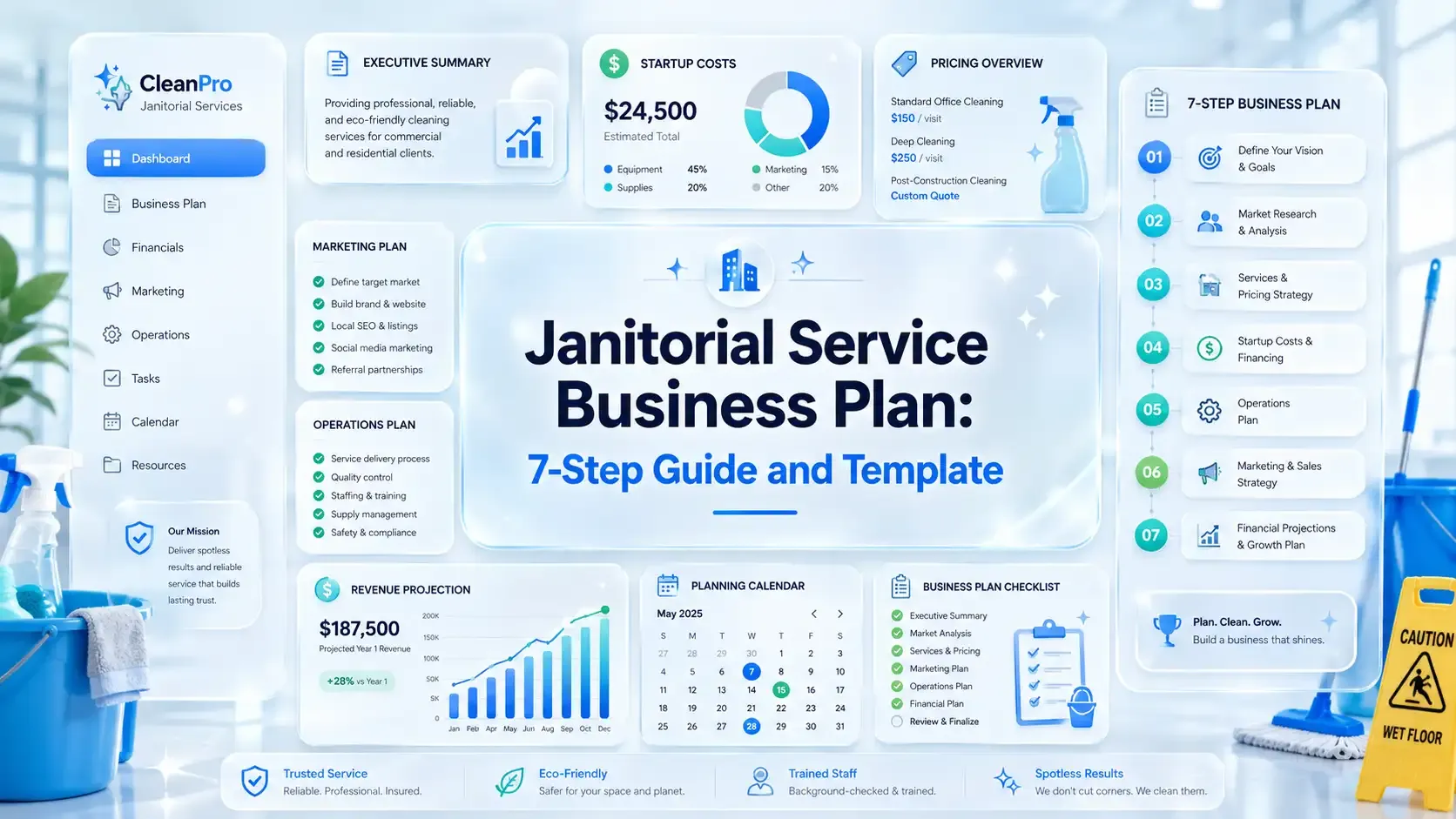
Janitorial Service Business Plan: 7-Step Guide and Template
Updated on 19 May 2026
Jump to
Summary

A janitorial business plan gives you a clear path to start, price, run, and grow your cleaning company.
Offices, clinics, schools, retail stores, warehouses, and managed buildings need different plans.
The plan defines your services, target clients, competitors, and reasons to choose you.
Strong systems keep cleaners, routes, checklists, leads, quotes, and contracts under control.
Startup costs, revenue goals, insurance, training, and safety rules protect long-term growth.
A business plan for a janitorial service is a simple roadmap for starting and growing a cleaning company. It explains your niche, services, target clients, pricing, staff, supplies, marketing plan, and profit goals.
But this is where many new owners get stuck. They buy equipment too early, price jobs too low, chase the wrong clients, or take contracts that barely cover labor and fuel.
The plan helps you slow down before money starts leaking. It gives each decision a clear reason, from choosing office cleaning to building monthly contracts.
In this blog, I will discuss how to write a janitorial service business plan step by step. I will also share what to include, what to avoid, and how to keep the plan simple.
What Is a Business Plan for a Janitorial Service?
A business plan for a janitorial service is the working map behind a cleaning company. It shows how the business will start, choose a niche, price jobs, hire cleaners, and grow with contracts.
I’ve seen new cleaners jump straight into vacuums, chemicals, flyers, and ads. It may seem exciting at first. But it gets expensive fast when the numbers are unclear.
Janitorial work needs more structure than residential cleaning. The jobs usually happen in offices, clinics, schools, retail stores, warehouses, and managed buildings. These clients want repeat service, insured staff, background checks, site checklists, and steady quality.
So, keep the plan lean and practical. Define the niche, list the services, set costs, plan staffing, and add insurance. Then build the plan around monthly contracts, not random one-time jobs.
That is how the business moves from busy cleaning work to stable revenue.
Choose Your Janitorial Service Niche Before Writing the Plan
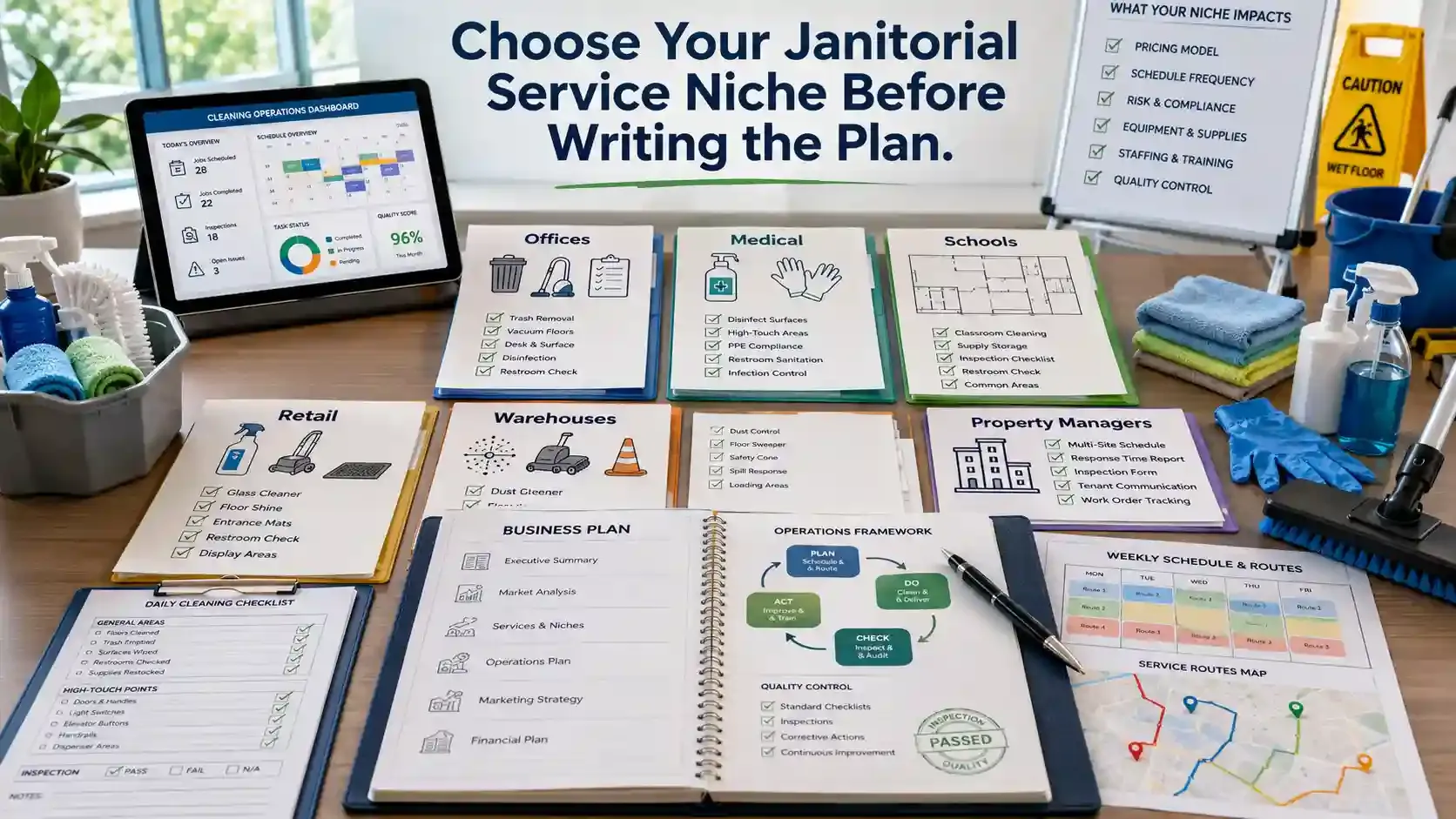
A strong janitorial business plan starts with a clear niche because each client type has different cleaning needs, schedules, risks, and pricing.
Offices
Office cleaning is usually the easiest place to start. The work is clear, the schedule is steady, and many clients need nightly or weekly cleaning.
Office demand is also recovering. Cushman & Wakefield reported that U.S. office demand gained momentum in late 2025, with positive net absorption in the final six months of the year.
So, an office-focused plan should cover trash removal, vacuuming, restroom care, desk-area cleaning, breakroom cleaning, and after-hours access.
Medical
Medical office cleaning needs tighter rules. Clinics, dental offices, and urgent care centers care about disinfection, high-touch areas, waste handling, and safe products.
CDC’s 2025 guidance says hospitals should build programs to improve high-touch surface cleaning during terminal room cleaning. That shows why healthcare cleaning needs training, not guesswork.
So, the plan should include staff training, surface checklists, PPE, disinfectant use, and clear quality checks.
Schools
School cleaning needs trust, safety, and strong routines. These jobs may include classrooms, restrooms, cafeterias, gyms, offices, and hallways.
The schedule can also change with school breaks, events, and summer deep cleaning. So, the plan should cover background checks, crew size, supply storage, floor care, and daily inspection steps.
Retail
Retail cleaning needs speed and presentation. Stores need clean floors, fitting rooms, restrooms, counters, glass, and entrance areas before customers walk in.
U.S. retail sales rose 3.7% year over year in 2025, while foot traffic grew 1.8%. That steady in-store activity makes retail a practical niche for regular cleaning work.
So, the plan should focus on early-morning cleaning, quick turnarounds, and brand-level appearance.
Warehouses
Warehouse cleaning is more physical than office work. These sites often need dust control, floor sweeping, spill cleanup, restroom care, breakroom cleaning, and loading-area upkeep.
The niche has real activity behind it. FRED’s April 2026 data shows this sector remains a major U.S. workplace category.
So, the plan should include larger equipment, safety rules, route access, and work around active operations.
Property Managers
Property manager contracts can bring steady work across many buildings. One manager may control offices, apartments, retail units, or mixed-use spaces.
This niche rewards reliability. The plan should show response time, inspection routines, reporting, billing terms, and how crews handle multiple sites without confusion.
Company Overview: Explain What Your Janitorial Business Does
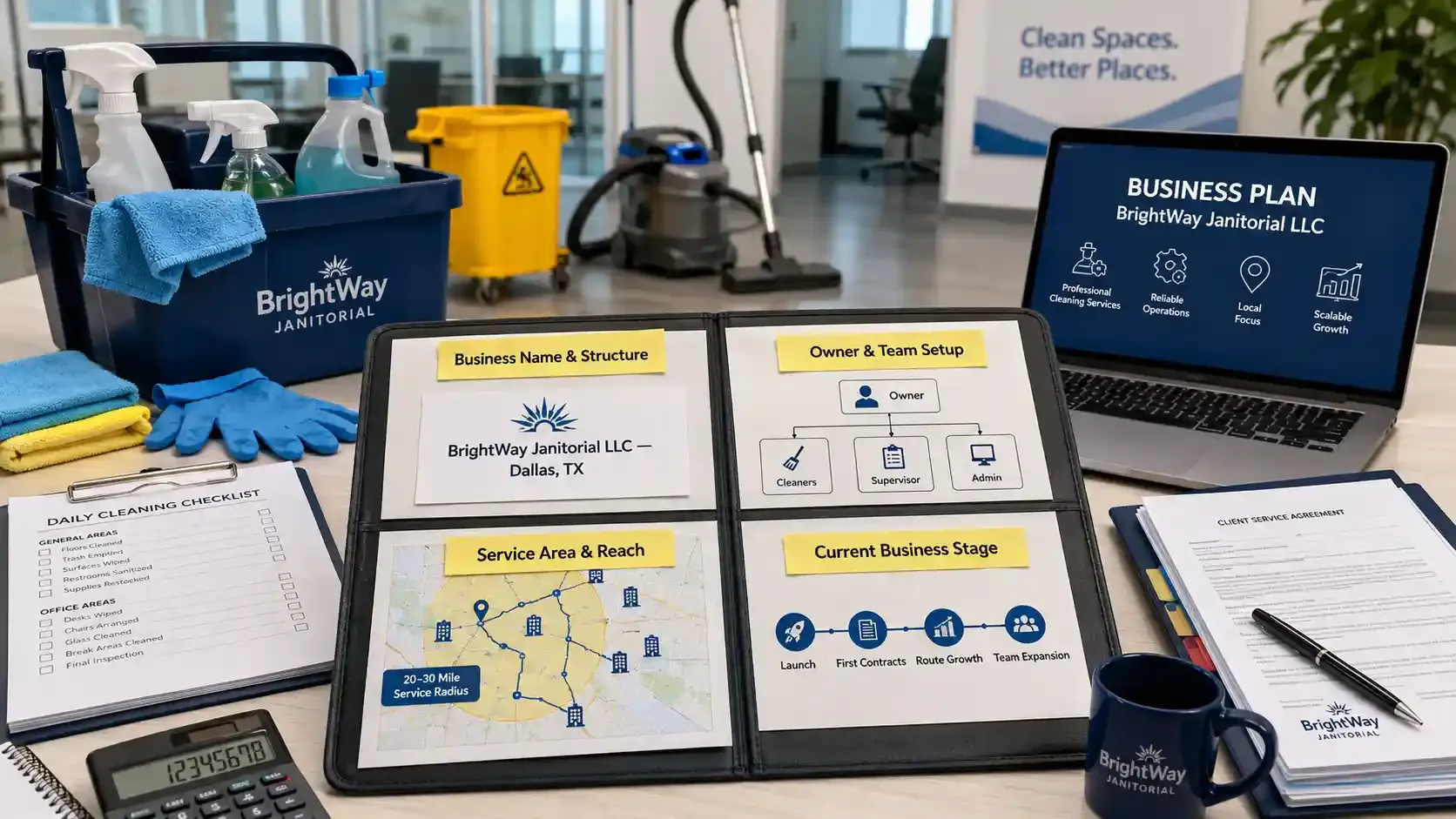
Business Name and Structure
The company name gives the plan an identity. Write the name, city, and legal setup in one clean sentence.
The name also tells the reader the brand, the location, and the business structure right away. If the company is an LLC, sole proprietorship, partnership, or corporation, say it here without overexplaining it.
Owner and Team Setup
The owner and team section should explain who runs the business now. In many janitorial startups, the owner handles sales calls, quotes, hiring, site checks, and even some cleaning work.
In fact, I’ve seen owner-led cleaning companies build stronger habits early. Because the owner sees the client complaints, supply waste, missed details, and weak spots firsthand.
But the plan should not stop there. Add how the team will grow when contracts increase.
You can mention cleaners, crew leaders, supervisors, an admin assistant, or a salesperson. Keep it honest, though. If the owner is still doing most of the work, say that and show the next hiring step.
Service Area and Reach
The service area tells readers where the company will work.
I would keep the first service area tight. One city, a group of nearby suburbs, or a 20 to 30-mile radius is easier to manage than chasing every job across the state.
This also helps with pricing. A nearby office contract may look small. But it can still be profitable if the route is clean and the crew can serve it fast.
A faraway job may look better on paper, but travel time can eat into the margin. So, write the service area like a business choice, not just a location.
Current Business Stage
The business stage shows whether the company is launching, growing, or restructuring. This one detail changes the whole plan.
A startup may focus on buying basic equipment, landing the first few contracts, and building checklists. An existing janitorial company may focus on hiring supervisors, adding floor care, improving routes, or winning larger sites.
So, make the stage clear. This also helps readers judge the financial plan later. A new company and a growing company need different budgets, staff plans, and sales goals.
Build a cleaning business with a system behind it
Keep clients, staff, jobs, work orders, and invoices in one dashboard.
Janitorial Service Business Plan Template
A janitorial service business plan does not need to be a 40-page document. In most cases, a clean 6 to 10-page plan is enough to guide the business.
I like to keep it simple because most new cleaning business owners do not fail from a lack of ideas. They fail because the plan does not connect the work, price, labor, route, and profit together.
Use this template as the base:
| Business Plan Section | What to Include |
|---|---|
Executive Summary | Your business name, niche, service area, target clients, and growth goal |
Company Overview | Legal structure, owner role, team setup, and business stage |
Services | Daily cleaning, restroom cleaning, floor care, carpet cleaning, window cleaning, and add-ons |
Target Market | Offices, clinics, schools, retail stores, warehouses, property managers, or other clients |
Competitor Research | Local competitors, their services, reviews, pricing style, and weak points |
Pricing Strategy | Hourly rates, flat monthly contracts, per-square-foot pricing, and add-on pricing |
Operations Plan | Staff, training, equipment, routes, site access, checklists, and quality checks |
Marketing Plan | Website, Google Business Profile, referrals, cold outreach, local SEO, and follow-ups |
Financial Plan | Startup costs, monthly expenses, revenue forecast, and break-even point |
Risk Plan | Insurance, bonding, safety training, chemical handling, and worker screening |
Market Analysis for a Janitorial Service Business Plan
Target Customers
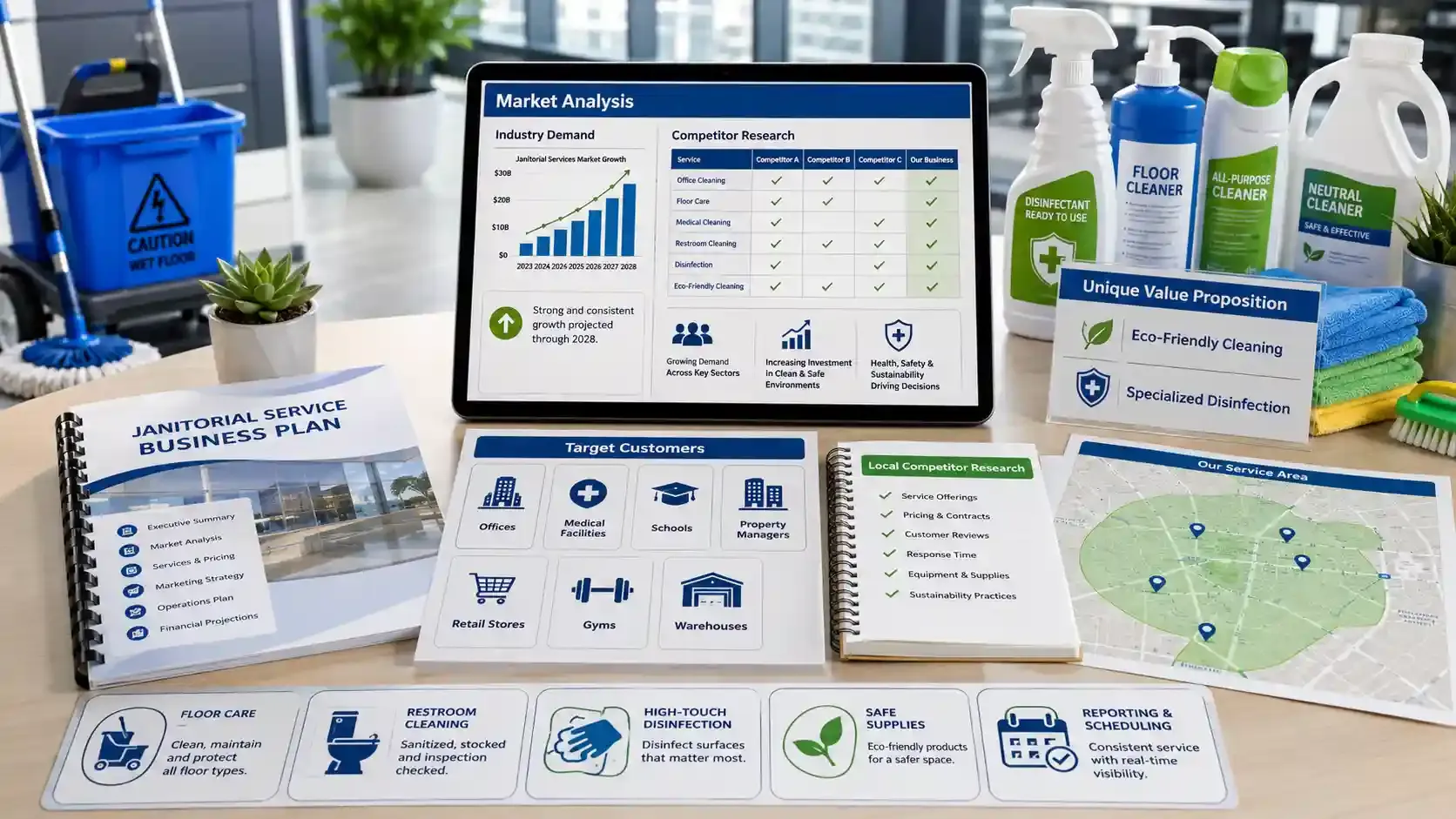
Target customers are the businesses that need clean, safe, and reliable spaces. For a janitorial service, the best starting points are small-to-medium offices, medical facilities, schools, property managers, retail stores, gyms, and warehouses.
Each group has a different reason to hire cleaners. Offices want steady nightly cleaning, while gyms need restroom care, floor cleaning, and high-touch surface cleaning more often.
Medical offices usually need a tighter process. Schools need trust and routine. Background checks, safe supplies, restroom cleaning, cafeteria cleaning, and floor care should sit inside the plan from day one.
Property managers can be strong clients because one relationship may bring many buildings. That is why I like this niche for janitorial startups that can handle schedules, reports, and fast issue response.
Industry Demand
Industry demand is strong because businesses still need clean spaces, even when budgets get tight. Clean offices, clinics, stores, and shared buildings support safety, comfort, and a better client experience.
The commercial janitorial space also has real money behind it. A report values the global commercial janitorial services market at $81.13 billion in 2026 and projects it to reach $105.48 billion by 2030.
That means the demand exists. But the plan must show how your company will earn trust in a crowded market.
Labor planning also belongs here. BLS says janitors and building cleaners had a median hourly wage of $17.27 in May 2024, and employment should grow 2% from 2024 to 2034.
Competitor Research
Competitor research shows who already serves your market. Start with local cleaning companies, franchise cleaners, and independent cleaners in your service area.
Look at their websites, Google reviews, service pages, photos, offers, and service locations. Then check what they seem to push most, such as office cleaning, floor care, medical cleaning, or post-construction cleanup.
Pricing needs close attention as well. Some cleaners charge hourly, some use square footage, and many offer flat monthly contracts for repeat commercial work.
Reviews can tell you more than the website. Complaints about missed areas, poor communication, late arrivals, or changing crews show gaps your company can use.
Service area also matters. A competitor may rank well online, but they may not serve your exact suburbs, building types, or after-hours schedule.
Unique Value Proposition
Your unique value proposition shows why a client should choose your janitorial company over another cleaner.
Start with the client’s main concern. Offices may want fewer complaints, while schools and clinics may care more about safe products and trusted staff.
Eco-friendly cleaning can work for offices, schools, gyms, and shared buildings. These clients often care about chemical smell, indoor air, and daily safety.
Specialized disinfection builds trust in clinics, gyms, schools, and high-traffic spaces. It shows your team knows high-touch areas, contact time, and safe product use.
Win clients with better proof and faster follow-up
Track visits, job notes, and reports so clients see your team is reliable.
Operations Plan: How Your Janitorial Service Will Run
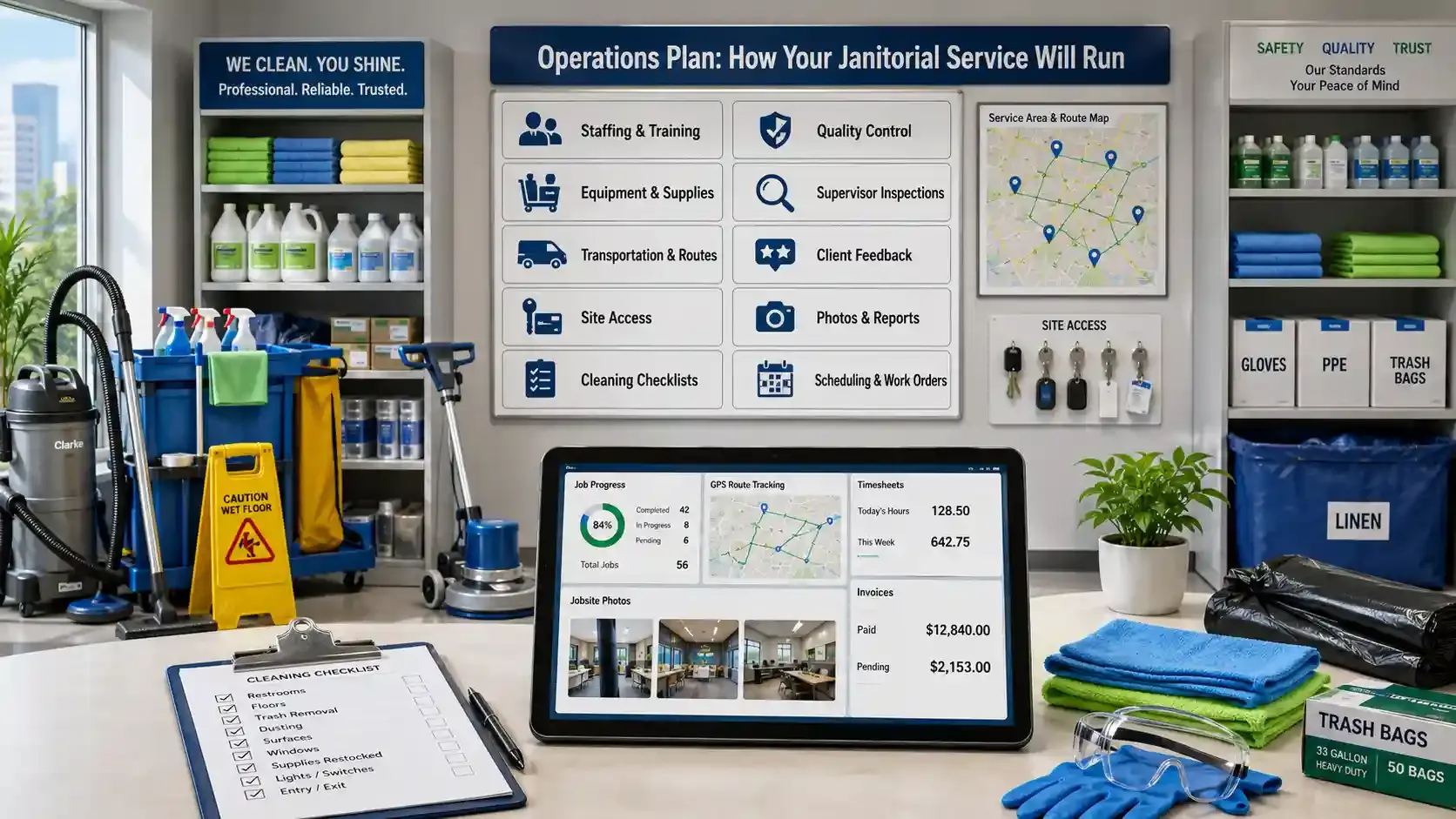
The operations plan explains how your janitorial business will deliver consistent cleaning every day. This is where the plan moves from “we clean buildings” to “this is exactly how the work gets done.”
Staffing and Training
Staffing explains who will clean each site and who will check the work. A startup may begin with the owner and two cleaners, but the plan should show when crew leaders will join.
Training should start before the first cleaner enters a client’s building. Cover cleaning checklists, chemical safety, restroom standards, floor care, customer service, and site-specific rules.
Background checks also belong here, especially for schools, clinics, offices, and after-hours jobs. Clients want to know who has keys, alarm codes, and access to private areas.
Equipment and Supplies
Equipment planning shows what your cleaners need to do the job right. Start with commercial vacuums, mops, buckets, cleaning carts, microfiber cloths, trash bags, gloves, PPE, and safe cleaning chemicals.
Then add larger tools based on your service list. Floor buffers, carpet extractors, wet-floor signs, and window cleaning tools make sense if you offer floor care, carpet work, or glass cleaning.
Transportation and Logistics
Transportation explains how cleaners, tools, and supplies reach each site. A personal vehicle can work at first, but a company van may make more sense once routes and storage needs grow.
Route planning can protect your profit more than most owners expect. Two small offices near each other may beat one larger job across town if fuel, traffic, and paid travel time get out of control.
Site access also needs a clear process. Write down who holds keys, who gets alarm codes, where supplies stay, and how after-hours entry works.
Site Checks and Quality Control
Site checks help prevent bad service before it turns into a lost contract. Start with a walkthrough before quoting so you can see square footage, floors, restrooms, trash needs, access points, and special requests.
After that, turn the walkthrough into a job checklist. The cleaner should know what to clean, when to clean it, what products to use, and what the client expects.
Supervisor inspections keep quality steady as the team grows. Use photos, notes, client feedback, and quick reviews to catch missed areas.
A complaint process also belongs in the plan. Show who responds, how fast they act, and how the issue gets fixed on the next visit.
This is where FieldServicely works wonders. It helps janitorial teams manage schedules, work orders, GPS tracking, job progress, timesheets, payroll, invoices, reports, and jobsite photos from one place.
Run every cleaning job without chasing updates
Assign cleaners, track GPS, manage job details with FieldServicely
Marketing and Sales Strategy for a Janitorial Service
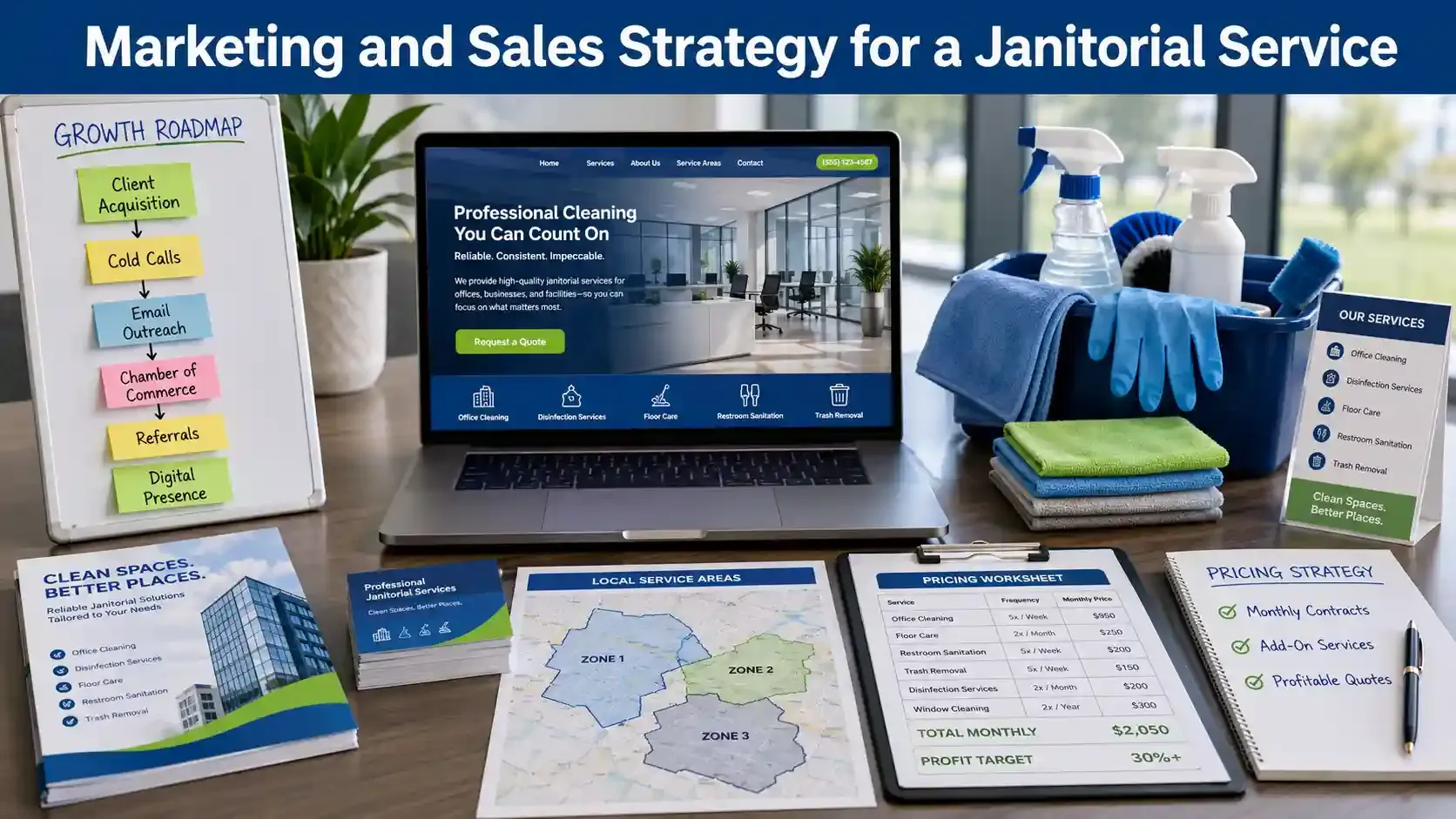
Client Acquisition Channels
Client acquisition starts with people who already manage buildings. Cold call property managers, email office managers, and reach out to business owners in your service area.
Also, try to join the local chamber of commerce if the budget allows it. It puts your name near small business owners, realtors, facility managers, and local decision-makers.
Referrals can bring better leads than random ads. Realtors, property managers, office admins, and building owners often know who needs a cleaner before that person searches online.
Digital Presence
Your digital presence should make the company look real before a client speaks with you. A clean website, clear service pages, and an easy quote request form can remove doubt fast.
Each niche should have its own page. Office cleaning, medical cleaning, school cleaning, retail cleaning, warehouse cleaning, and property manager cleaning all need different proof points.
City pages can help if you serve more than one area. Keep them useful with local service details, not copied text with only the city name changed.
Pricing Strategy
Pricing strategy shows how you will charge without cutting into profit. For early planning, you can test hourly rates like $40–$55 per hour, flat monthly contracts, and per-square-foot pricing.
Monthly contracts often work better for commercial cleaning. They give the client a steady cost and give your business repeat revenue.
Add-on pricing can raise each account’s value. Floor waxing, carpet cleaning, window washing, and disinfecting should not get buried inside a basic cleaning quote.
But pricing needs discipline. Every quote should cover labor, supplies, travel, insurance, admin time, taxes, and profit.
CTA
Turn leads into booked cleaning jobs faster.
Keep quotes, clients, schedules, and follow-ups easier to manage after each walkthrough.
Button: Get Started Free
Financial Plan for a Janitorial Service Business
Startup Costs
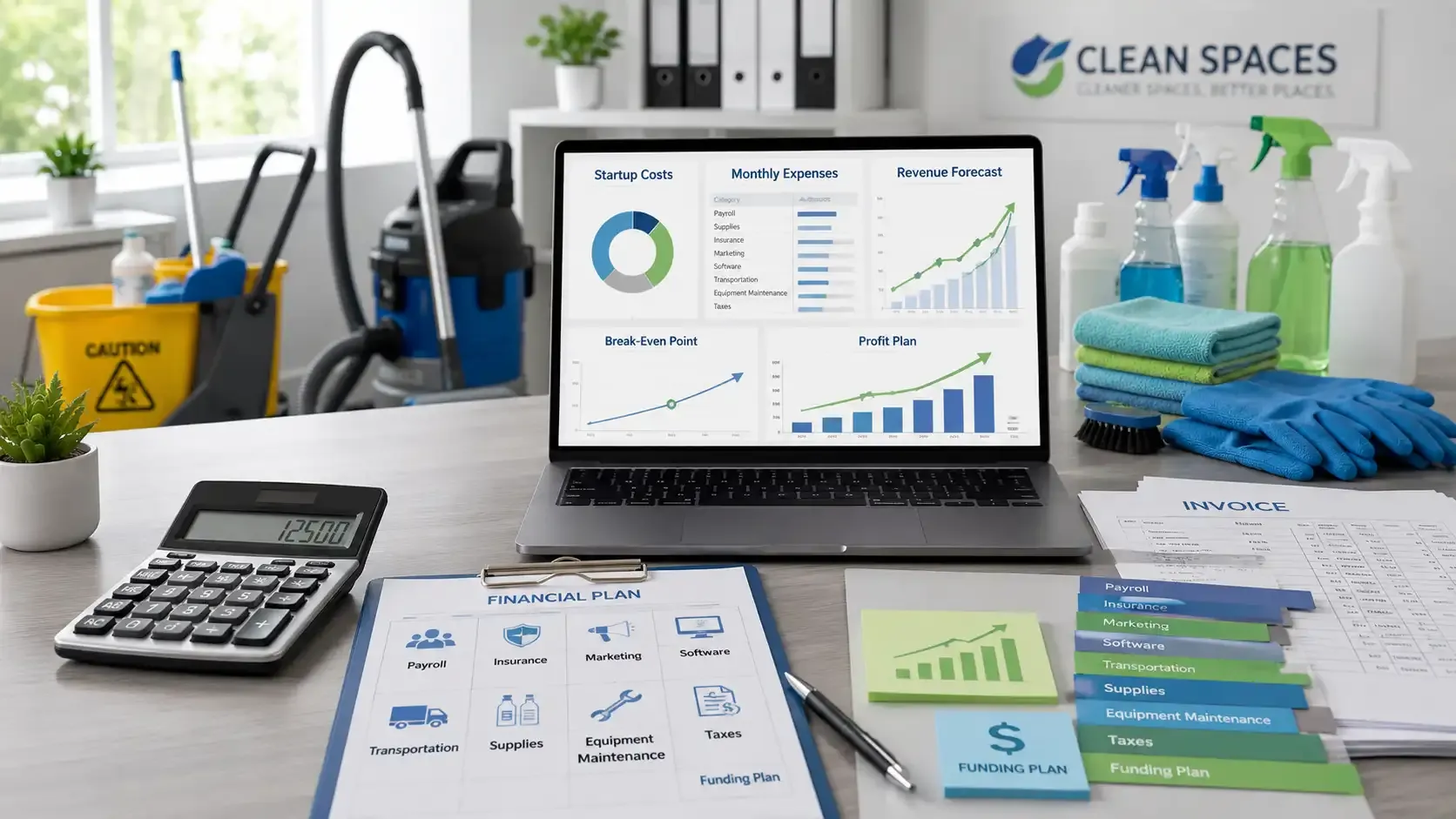
Startup costs show what you need before the first paid job. For a lean janitorial startup, this may land around $2,000 to $10,000+, depending on your setup.
| Startup Cost | Estimated Cost |
|---|---|
Legal registration | $2,000 |
Insurance and bonding | $3,000 |
Equipment | $5,000+ |
Marketing and website | $1,000–$3,000+ |
Supplies | $500–$2,000+ |
Software | Varies by tool |
Transportation | Personal vehicle or van |
That range works for a small owner-operator model. But a larger setup with vans, rent, storage, office tools, bigger equipment, and cash reserves can cost much more.
Ongoing Expenses
Ongoing expenses show what the business must pay each month. This part protects you from quoting jobs that look good but leave no profit.
Count payroll, cleaning supplies, fuel, insurance, software, marketing, equipment maintenance, taxes, and vehicle costs. Add a small buffer, because machines break and supplies run out faster than expected.
Revenue Forecast
Revenue projections show what the company expects to earn in years one, two, and three.
Start with the expected number of monthly contracts. Then multiply that by the average monthly contract value.
For example, 10 contracts at $1,200 per month gives you $12,000 in monthly revenue. Add floor care, carpet cleaning, window washing, or disinfecting as separate add-on income, not free extras.
Year one should stay conservative. Year two can include more contracts, better routes, and stronger referrals.
Year three can add larger accounts, crew leaders, and more profitable specialty services. But every number should connect back to staff, schedule, and capacity.
Break-Even Point
Break-even is the point where monthly revenue covers labor, supplies, insurance, software, marketing, and other costs. After that point, the business can start building real profit.
I like to calculate this before accepting large jobs. A big contract can still hurt you if it needs too many cleaning hours, too much travel, or expensive supplies. Funding planning also belongs here.
Know where jobs, hours, and costs go.
Use timesheets, payroll, invoices, and reports to keep work tied to real numbers.
Services to Include in a Janitorial Business Plan
A good janitorial business plan should show exactly what the company will clean. How often will it be cleaned, and which services cost extra? This helps with pricing. It also prevents client confusion down the road.
Recurring Janitorial Cleaning
Recurring cleaning is the basis of the business. This may include trash removal, vacuuming, mopping, restroom and breakroom cleaning, dusting, and high-touch surface cleaning.
This is where most janitorial companies build a steady income. Because one-time deep cleans are a good achievement, but recurring contracts keep the schedule full.
Restroom Cleaning
Restrooms need their own service line because they take time and carry more complaints. So, the plan should include toilets, urinals, sinks, mirrors, counters, partitions, floors, soap dispensers, paper products, trash, odor control, and touchpoints.
Floor Care
Floor care can include sweeping, mopping, buffing, stripping, waxing, burnishing, and machine scrubbing. This should usually be priced as an add-on.
Just so you know, floor work can turn into a margin problem. Notably, if the company includes it inside a basic cleaning contract without counting labor, chemicals, pads, equipment, and drying time.
Carpet Cleaning
Offices and clinics often need this a few times per year, especially in entry areas, hallways, and waiting rooms. So, add it to the plan as a seasonal or quarterly upsell.
Window and Glass Cleaning
Interior glass, doors, partitions, and entryway windows can be part of regular service. Exterior window cleaning may need separate pricing.
This is a small detail, but it matters. I’ve seen cleaning companies lose time because the client assumed “windows” meant everything, while the cleaner only meant interior glass.
Disinfection Services
Disinfection is useful for clinics, gyms, schools, daycare centers, and high-traffic buildings. OSHA also has guidance for workers who use cleaning chemicals, including hazard communication, labels, safety data sheets, and protective equipment.
Supply Restocking
Supply restocking includes toilet paper, paper towels, hand soap, liners, and sanitizer. This can become a simple add-on revenue stream. It also makes the service more valuable for offices and property managers as they do not have to manage supplies separately.
Post-Construction Cleanup
Post-construction cleanup can pay well, but it is not the same as regular janitorial work. It may include dust removal, debris cleanup, sticker removal, floor cleaning, window cleaning, and detailed surface cleaning.
It also needs better safety planning because construction sites can have nails, dust, sharp materials, and unfinished areas
Risk Management for a Janitorial Service Business
.webp?2026-05-19T10%3A26%3A24.770Z=&w=3840&q=100)
Insurance and Bonding
Insurance and bonding protect the business when something goes wrong on a client site. Start with general liability insurance. It helps cover third-party injuries, property damage, and common jobsite claims for cleaning businesses.
Workers’ compensation should come next if you hire employees. Most states require it when a cleaning business has workers, and it can help employees recover from work-related injuries or illness. (Source: The Hartford)
Commercial auto insurance also belongs in the plan if cleaners drive for work. A janitorial bond can add another layer of trust. Many commercial clients like it because it helps protect them from theft or dishonest acts by employees.
Employee Screening and Safety
Safety training protects both the worker and the company. The plan should cover PPE, wet-floor signs, lifting rules, site access, incident reporting, and what to do when something breaks or spills.
Chemical handling needs extra care. That means your team should know how to read labels, use products safely, store chemicals, and report exposure.
The risk is real, too. According to BLS data, which employers can use to review safety risk by industry and case type.
Certifications and Training
Certifications can help your janitorial company win trust in higher-risk work. This is useful for healthcare cleaning, disinfection, biohazard response, green cleaning, or large commercial sites.
GBAC training fits disinfection-focused work. GBAC also offers technician training for workers who need the planning, knowledge, and process to respond to a biohazard crisis in the workplace. That can help when your service plan includes clinics, gyms, schools, or high-traffic facilities.
OSHA-related safety training should stay in the plan where it applies. Cleaners use chemicals, lift supplies, handle equipment, and work around wet floors, so training cannot wait until after an accident.
Keep job proof and site details easy to find.
Use notes, photos, GPS records, and reports to support cleaner accountability.
Conclusion
A business plan for a janitorial service does not need to be complicated. It should clearly explain your niche, services, clients, costs, marketing plan, operations, and financial goals.
Keep it lean. Use real numbers. Start with one clear niche. Focus on recurring contracts. Review the plan every few months.
And once clients start coming in, use tools like FieldServicely. It will manage jobs, schedules, cleaners, invoices, and daily work without letting small tasks pile up as the business grows each month.
Frequently Asked Questions
How much does it cost to start a janitorial service?
A small janitorial service can start with around $2,000 to $10,000+. This may cover legal setup, insurance, supplies, basic equipment, marketing, and transport. Costs can rise fast if you add vans, floor buffers, storage space, or paid staff early.
Is a janitorial business profitable?
Yes, a janitorial business can be profitable when pricing, labor, and supply costs stay under control. Recurring commercial contracts help because they bring steady monthly income. Profit depends on your niche, service quality, route planning, and how well you avoid underpriced jobs.
How do janitorial companies get clients?
Janitorial companies get clients through local SEO, Google Business Profile, referrals, cold calls, and email outreach. Property managers, office managers, realtors, and local business owners are strong lead sources. Good reviews and clear service pages also help turn searchers into quote requests.
How do I price janitorial services?
Price janitorial services by counting labor, supplies, travel, insurance, taxes, admin time, and profit. You can charge hourly, per square foot, or through flat monthly contracts.