
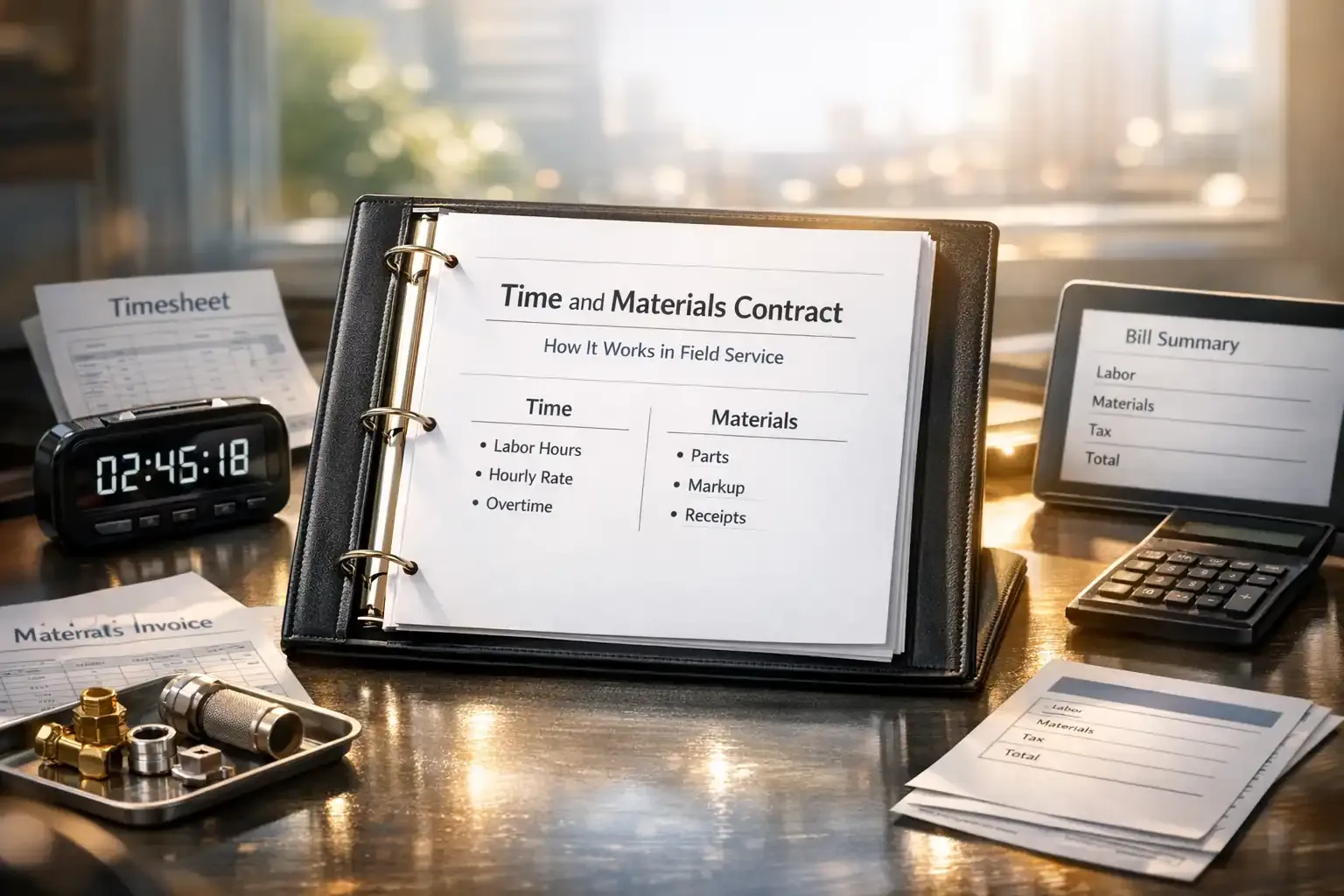
Time and Materials Contract: How It Works in Field Service
Updated on 6 Mar 2026
Jump to
Summary

Time and Materials charges clients for actual labor hours and real materials used, offering flexibility and fair billing for unpredictable field service jobs.
Strong contracts with clear scope, labor rates, markup rules, NTE clauses, and change processes reduce disputes and protect both margin and trust.
T&M works best in evolving, diagnostic, or phased projects where cost visibility and real-time control matter more than upfront price certainty.
The model carries risks like budget uncertainty and disputes, but disciplined tracking and structured approvals minimize those issues.
Real-time logging, mobile material capture, automated sync, digital sign-offs, and fast invoicing prevent revenue leakage and speed up payment.
Time and materials is a billing model where clients pay for the actual labor hours worked and the materials used on a job. Instead of charging one fixed price, you bill based on the real time spent and the real parts installed. This model gives flexibility, protects contractors from underbidding, and keeps payment aligned with actual work performed.
However, this model creates challenges. Costs can feel unpredictable for clients. Poor tracking can lead to revenue leakage. Weak documentation can slow down payment.
In this blog, we will break down how time and materials work in field service. We will also explain how to control risk, protect profit, and speed up billing.
What Is Time and Materials Contract in Field Service?

Time and Materials in field service is a pricing method where you charge for the actual worked hours and the parts used on a job. Here’s how it works:
You set an hourly labor rate. Then you add the cost of materials with a markup. And finally, calculate labor hours with parts. This model fits repair work because the job scope often changes after inspection.
For example, a customer may report that the AC is not cooling. After opening the unit, the technician may find a failed capacitor, a refrigerant leak, or a damaged coil.
Each issue changes the time and parts required. A one-hour estimate can turn into three hours of work. Plus, the customer may need extra components too.
Under flat-rate pricing, you quote one fixed number before starting. That works for repeatable tasks like installing a thermostat or replacing a faucet. But it becomes risky when the problem is unknown.
If the repair takes longer than expected, you either absorb the extra cost or ask the customer to approve more charges. Both affect the margin of trust.
Protect your margin on diagnostic-heavy repairs
Capture every minute and every component installed.
Example of Time and Materials Contract
As we discussed earlier, a Time and Materials (T&M) contract charges for the actual labor time and materials used during a project. The formula:
Labor Hours × Hourly Rate + Material Costs + Markup = Total Cost
For example, consider an electrical repair project. An electrician spends 20 hours repairing wiring and circuit breakers at $75 per hour, which equals $1,500 in labor costs. During the repair, materials such as wiring, outlets, and breakers cost $350.
If the contractor applies a 10% markup on materials, an additional $35 is added. As a result, the final project cost becomes $1,885.
A similar approach appears in mobile app bug-fixing projects. A developer spends 35 hours diagnosing and resolving software issues at $60 per hour, resulting in $2,100 in labor costs. The developer also purchases stock images and testing tools costing $150.
Since the project follows the T&M model, the total cost becomes $2,250, reflecting the exact work performed.
Key Components of a T&M Contract
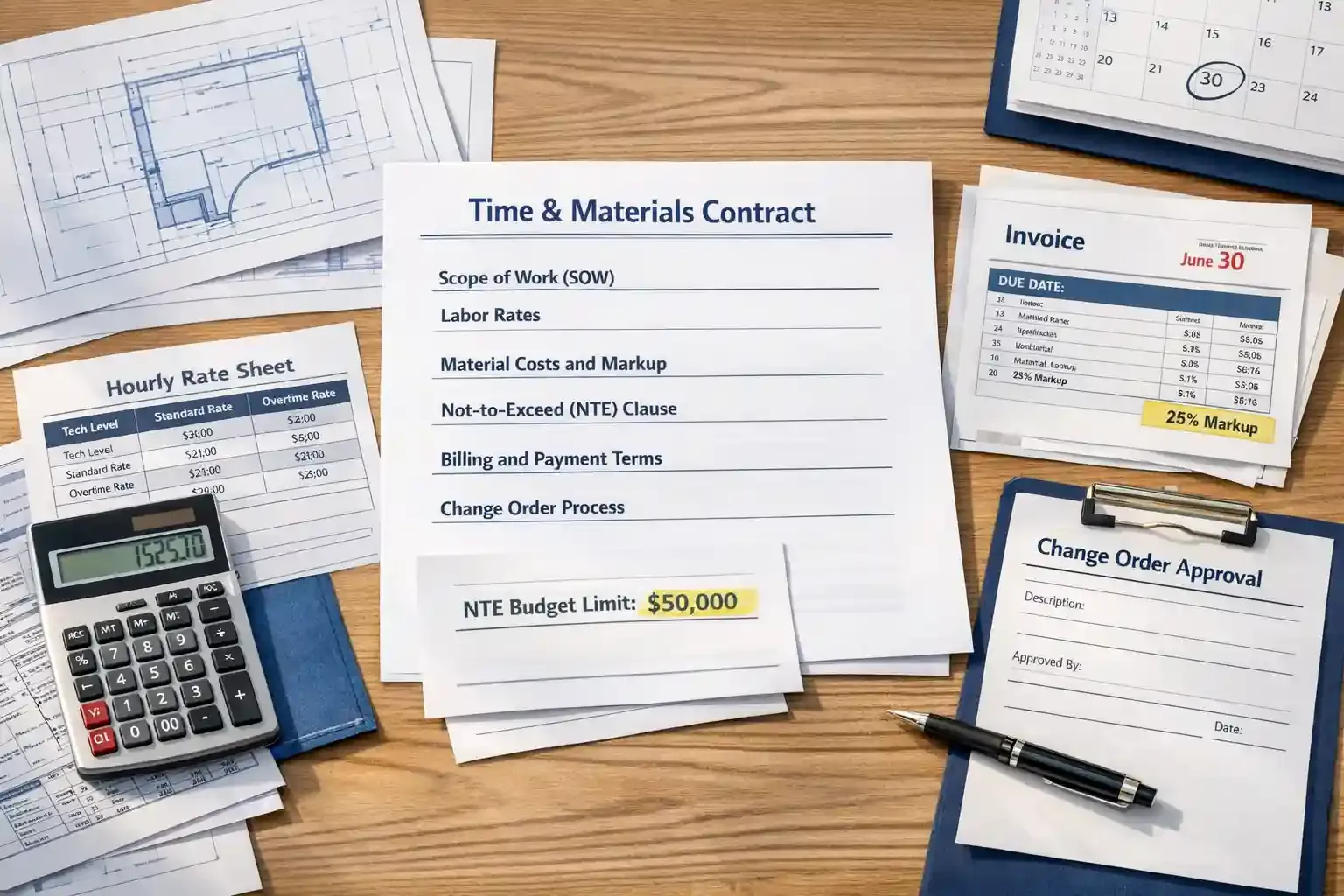
The Scope of Work defines exactly what the technician will do and what stays outside the agreement. It outlines service limits, task boundaries, and expected deliverables.
Did you know that contractual ambiguities, including vague or poorly drafted contract language, continue to be a leading cause of disputes in the construction industry? [Source: Arcadis Global Construction Disputes Report]
A clear scope reduces billing conflict. Field service jobs often expand after inspection, so the contract must define how additional work is handled. That structure protects both revenue and client expectations.
Labor Rates
Labor rates must be clearly stated in the contract. The agreement should list hourly pricing for each technician level or trade. According to the U.S. Bureau of Labor Statistics, the median hourly wage for electricians was $29.98. This highlights how labor costs can quickly affect total billing.
Just so you know, when both parties approve the hourly structure upfront, invoices are easier to justify.
Material Costs and Markup
Material pricing must explain how parts are billed. Most T&M contracts charge actual cost plus a fixed markup percentage. Industry practice commonly places markup between 15% and 35% to cover handling, inventory, and overhead.
Clear markup language prevents confusion, as clients understand that pricing follows a defined formula.
Not-to-Exceed (NTE) Clause
An NTE clause sets a maximum spending limit. This ceiling protects the client while keeping flexible billing in place. The Federal Acquisition Regulation (FAR) requires a ceiling price in government T&M contracts to control risk.
A clear cap balances flexibility and cost control. It also prevents uncontrolled budget growth.
Billing and Payment Terms
Billing terms must define invoice timing and payment deadlines. The contract should specify required documentation, such as time logs and part receipts. Clear payment rules protect cash flow. Predictable invoice keeps operations stable.
Change Order Process
Change order terms explain how additional work gets approved. The contract should require written authorization before invoicing extra labor or materials. This step prevents surprise charges.
Add structure to every Time and Materials agreement
Track scope changes, approvals, and billing terms in one place.
When to Use a Time and Materials Contract
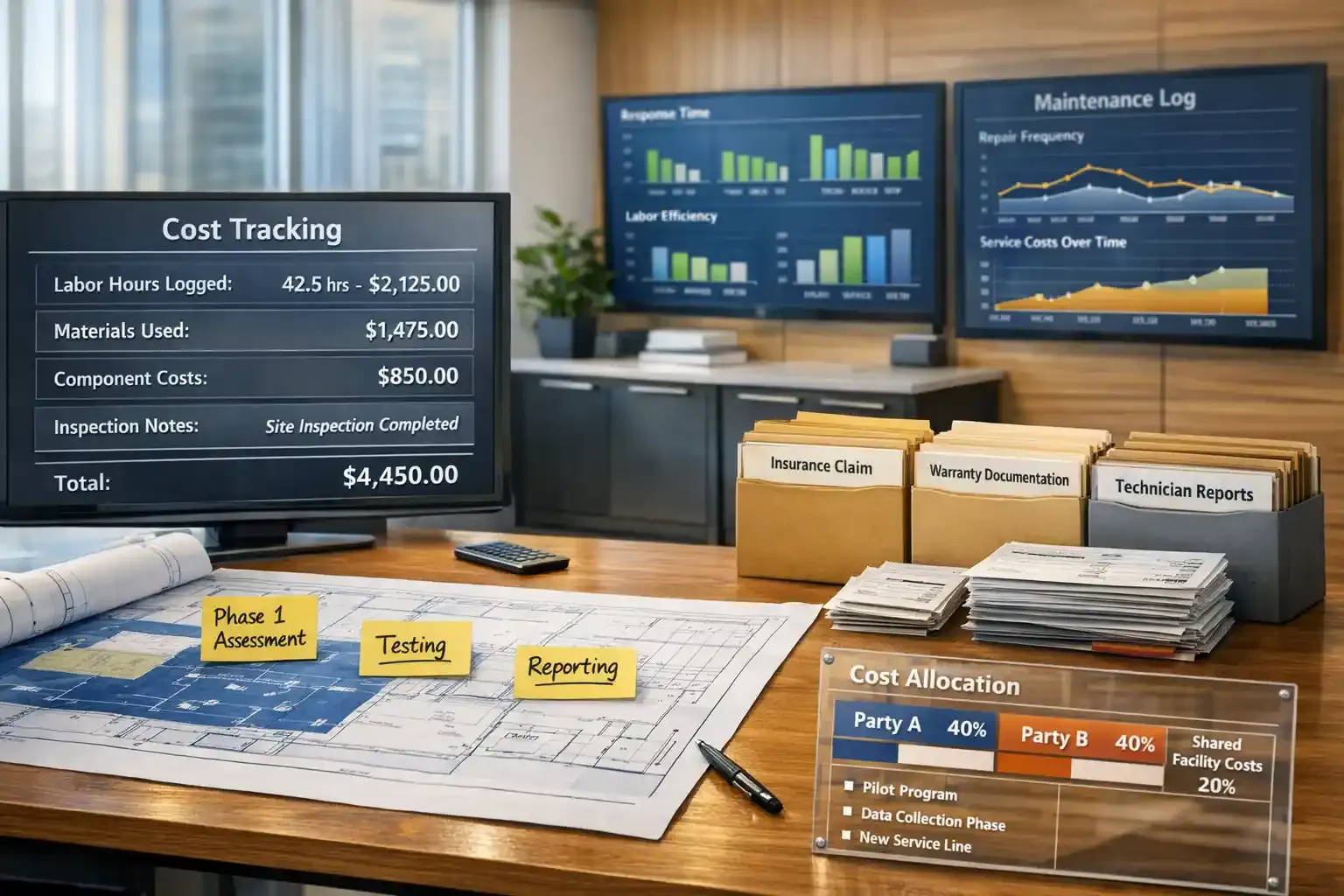
Time and Materials is not just for uncertain jobs. I use it when control matters more than prediction.
Early-Stage Projects
Some projects start before full planning is complete. A facility may approve an initial investigation before committing to full replacement.
In those cases, I structure the first phase under T&M. It allows assessment, testing, and reporting without forcing a premature total price.
This model fits phased rollouts. It keeps momentum without locking into numbers too early.
Budget-Controlled Environments
Some clients operate under strict budget tracking systems. They want detailed breakdowns for accounting, insurance claims, or internal reporting.
A time and material contract provides line-by-line visibility of labor and materials. As a result, every hour and every component gets documented. Such a level of transparency supports audit trails.
Insurance or Warranty Claims
Insurance-driven repairs often require proof of actual work performed. Carriers review labor hours, material invoices, and technician notes.
A fixed lump sum can trigger additional documentation requests. Time and material contracts already produce detailed records by default. In my experience, insurers process itemized invoices faster than bundled totals.
Resource Allocation Testing
Sometimes the goal is to test the workload before committing to a larger contract. For instance, a client may want to evaluate service efficiency, response time, and labor demand.
T&M contract allows tracking real effort without locking into a long-term fixed agreement. It provides data for future contract decisions. This approach works well in pilot programs or new vendor relationships.
Workforce Cost Benchmarking
Some companies use T&M to measure internal cost performance. By reviewing labor hours across similar jobs, they refine staffing and pricing strategies.
For example, comparing three similar electrical repairs under T&M reveals the average labor time. This data helps refine future fixed-price bids.
Equipment Lifecycle Decisions
Clients sometimes need a cost history before replacing equipment. Repeated T&M service calls show how often repairs occur and how much they cost.
When repair expenses approach replacement cost, the data support upgrade decisions. T&M invoices provide that record. This model becomes useful when the maintenance strategy drives the discussion.
Vendor Trust Development
New client relationships require proof. Early projects often run under T&M to build trust.
The client sees real hours, real parts, and real documentation. This level of transparency reduces skepticism.
Performance-Based Evaluation
Some organizations evaluate contractors based on response time, efficiency, and documentation quality. A time and materials contract gives measurable performance metrics.
Technician time logs show arrival time and task duration. Material records show usage accuracy. This data-driven view helps clients compare providers objectively.
Cost-Sharing Situations
In shared facilities or joint ventures, multiple parties may split costs. Itemized billing becomes essential.
T&M simplifies allocation. Labor hours and parts can be divided proportionally based on responsibility. Fixed lump sums complicate shared cost attribution.
Limited Historical Data
New service lines or emerging technologies often lack pricing history. Estimating fixed totals without data increases risk.
A time and materials contract allows real-world cost capture before creating standardized packages. Once enough data exists, pricing models can evolve. This approach reduces early-stage pricing mistakes.
Turn early-stage projects into measurable data
Capture labor and material insights before locking into fixed pricing.
Time and Materials Contracts VS Other Contracts
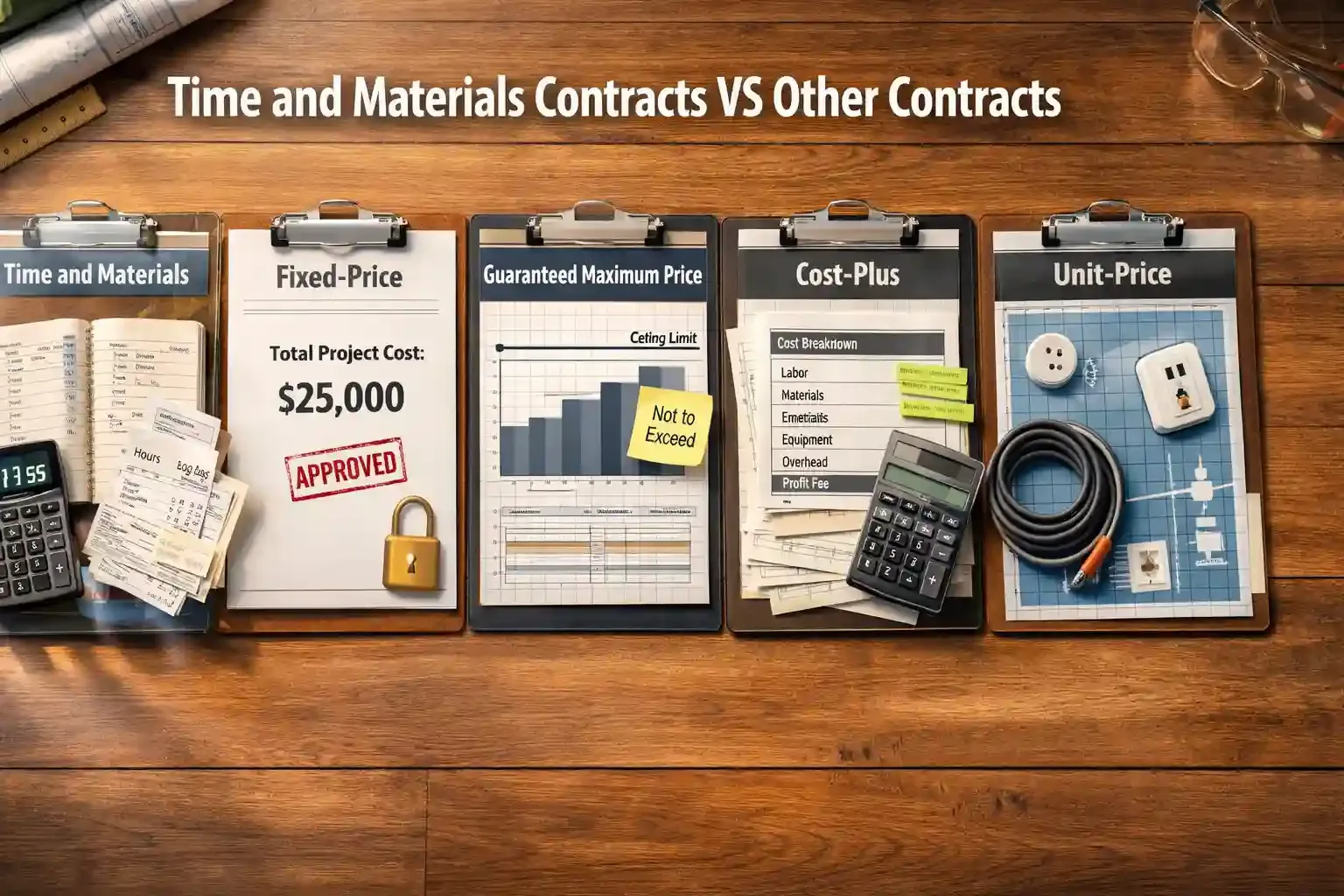
Time and Materials (T&M) is flexible. Other contracts trade flexibility for cost certainty or tighter control. The right choice depends on scope clarity and risk tolerance.
Let’s compare them:
| Comparison | How the Other Contract Works | Best For | Limitation |
|---|---|---|---|
T&M vs Fixed-Price | One total cost set before work starts. | Predictable tasks like standard installs or replacements. | Scope changes require change orders. |
T&M vs GMP | Costs can rise but cannot exceed a set ceiling. | Projects with variable scope but budget protection. | Contractor faces pressure near the cap. |
T&M vs Cost-Plus | Reimburses all expenses plus a profit fee. | Large construction or government projects. | Complex accounting across many cost categories. |
T&M vs Unit-Price | Charges per measurable unit of work. | Repetitive work with known quantities. | Hard to use when scope is uncertain. |
Time and Materials vs Fixed-Price Contracts
Fixed-price contracts set one total amount before the job starts. The client knows the cost upfront. The contractor agrees to deliver within that price.
In predictable work, this model works well. Installing standard fixtures, replacing known components, or performing repeatable upgrades fits fixed pricing. But fixed-price struggles when the scope is uncertain.
Time and Materials vs Guaranteed Maximum Price (GMP)
Guaranteed Maximum Price adds a ceiling. Costs can rise as work progresses, but they cannot exceed a defined cap without approval.
This structure works well when clients want cost protection but understand that the scope may shift. I’ve used GMP for multi-room upgrades or phased facility improvements where variation is expected but controlled.
Time and Materials vs Cost-Plus Contracts
Cost-plus reimburses actual project expenses and then adds a separate profit fee. It often includes labor, materials, equipment, overhead, and indirect costs. I’ve mostly seen cost-plus in large construction or government projects. It demands detailed accounting across multiple cost categories.
Time and Materials vs Unit-Price Contracts
Unit-price contracts charge per measurable output. For example, per foot of cable installed or per outlet mounted.
This model works well when quantities are known. Large wiring runs, flooring installation, or repetitive installs benefit from unit pricing. When the scope is defined by measurable output, pricing becomes efficient.
Balance flexibility with cost control
Use real-time tracking with optional spending limits.
Pros and Cons of Time and Materials in Field Service
Time and Materials works well in field service, but it is not perfect. The model protects flexibility, but it also demands discipline.
Pros
Flexible
Time and Materials allows the job scope to adjust as work unfolds. In field service, inspection often changes the repair plan. For example, a minor electrical fault can reveal panel damage once opened.
This flexibility reduces the need for constant contract renegotiation. Under the 2025 Federal Acquisition Regulation update, time-and-materials contracts continue to be permitted in situation. It is permissible where it is not possible at the outset to estimate the extent or duration of work.
That supports its use in unpredictable environments.
Transparent
Time and Materials creates clear cost breakdowns. The invoice shows labor hours, hourly rates, and specific materials used. Clients can see exactly where money goes.
Transparency builds trust when documentation is strong. Digital tracking tools reduce disputes by recording time and parts in real time. In my projects, detailed logs have prevented billing arguments more than once.
Clear breakdowns also protect the contractor. When every hour and part is recorded, questions become easier to answer.
Fair for Complex Jobs
Time and Materials protects margin on complex or diagnostic-heavy jobs. In field service, you often do not know the full scope until you inspect the equipment. A fixed quote in those cases can lead to underpricing.
This model ensures the contractor gets paid for actual labor and materials. From practical experience, T&M feels fair on repair work. If the job takes longer because hidden damage appears, billing reflects reality.
Cons
Harder to Predict
Time and Materials makes the total cost harder to estimate upfront. Clients often ask for a clear number before work begins. Under T&M, I can only provide an estimate range.
Budget uncertainty can slow approvals. Some clients prefer fixed-price contracts because they want strict financial planning. Without a Not-to-Exceed clause, cost exposure feels open-ended.
In my experience, adding a cost ceiling reduces anxiety. However, the final total still depends on actual labor and materials.
Can Cause Disputes
Time and Materials can create tension if tracking is weak. Clients may question the time spent on-site or the material quantities used. Even small discrepancies can damage trust.
Disputes often arise when documentation lacks detail. I have seen arguments start over missing time logs or unclear part descriptions. Clear records prevent most of these issues.
Strong communication also matters. Explaining findings during the job reduces surprise at invoicing.
Requires Tight Tracking
Time and Materials demands strict operational control. Technicians must log hours accurately and record parts immediately. Without discipline, billing errors increase.
Tracking takes effort. It requires structured processes and often software support. Poor tracking can lead to lost revenue or billing disputes.
In my experience, T&M works only when time tracking and inventory systems stay accurate. Flexibility without control creates risk.
Reduce budget anxiety with better visibility
Monitor labor, parts, and cost ceilings from one dashboard.
How to Structure a Time and Materials Job Properly
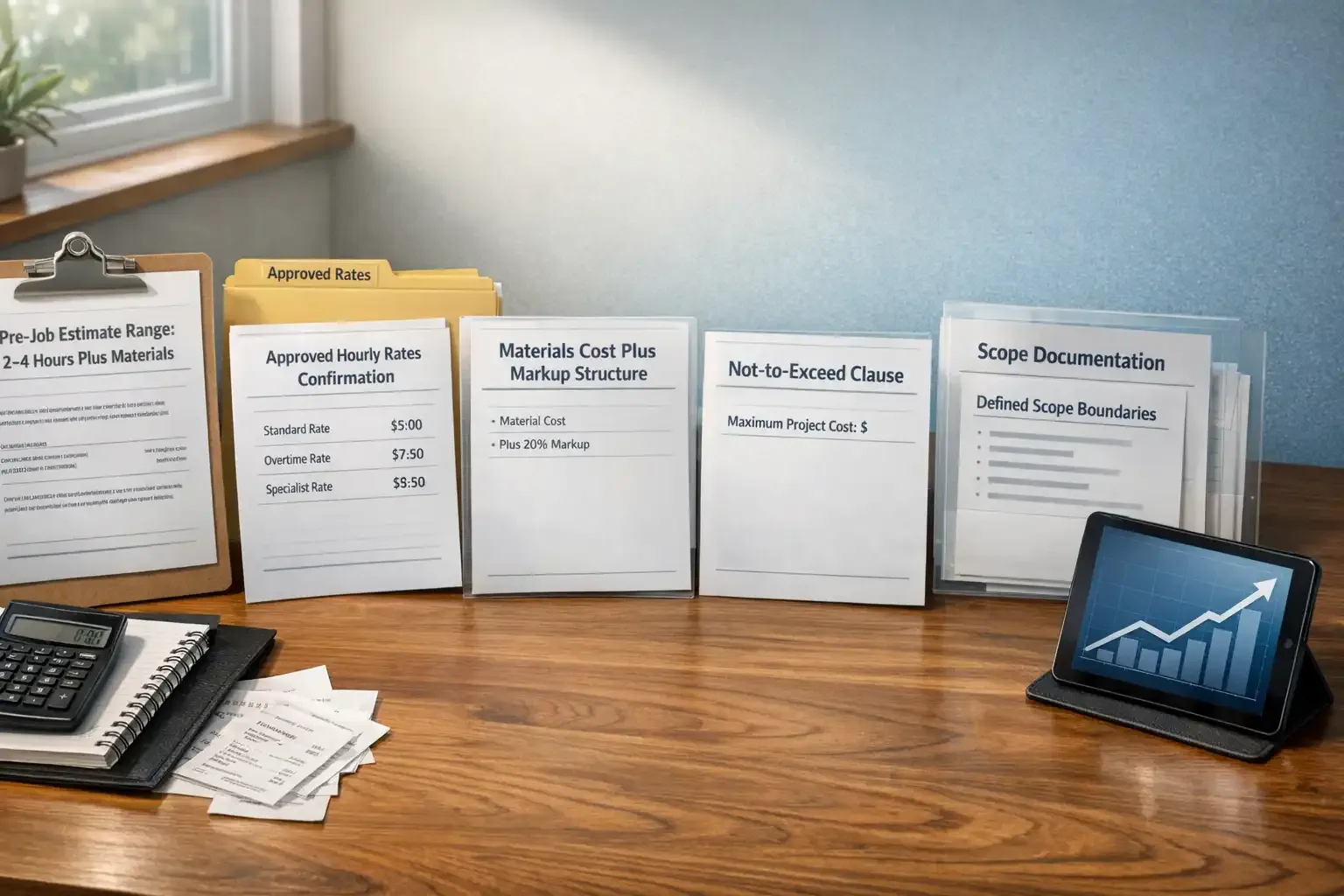
Start With a Pre-Job Estimate
A Time and Materials job must begin with a realistic estimate range. I always give a labor window based on similar past jobs, such as “2–4 hours plus materials.” This sets expectations without locking the client into a fixed total.
Clients worry about open-ended costs. According to the Small Business Index, inflation and related cost pressures remained among the top concerns for small business owners. A defined range reduces anxiety while keeping flexibility intact.
Make it clear that the number is a working estimate, not a fixed quote.
Lock in Approved Hourly Rates
Approved hourly rates must be documented before work starts. I list standard technician rates, overtime rates, and any specialist pricing in writing.
Labor costs continue to increase across trades. If rates are not approved upfront, billing discussions become harder later.
Written confirmation removes negotiation from the invoice stage.
Define the Materials Markup Structure
Materials must follow a clear pricing formula. I state that materials are billed at cost plus a fixed markup percentage. That percentage stays consistent across projects.
Markup covers procurement effort, inventory handling, warranty risk, and overhead. When markup is not defined early, clients often question part pricing.
I also confirm that receipts can be shared if needed. Transparency keeps trust stable.
Add a Not-to-Exceed Clause
A Not-to-Exceed clause limits financial exposure. Even under T&M, I often set a ceiling unless the job is extremely open-ended.
Under the Federal Acquisition Regulation (FAR), time-and-materials contracts continue to require a ceiling price. That reflects a broader risk-control principle: flexibility should have boundaries.
An NTE clause prevents uncontrolled labor expansion. It protects both margin and client confidence.
Document Clear Scope Boundaries
Scope documentation must define what the job covers and what it does not. I describe the known issue clearly and list exclusions unless inspection confirms otherwise.
For example, I may state that breaker repair does not include full panel replacement unless internal damage is found. That wording reduces confusion if new problems appear.
Clear scope notes make change approvals faster. They prevent disputes when work expands.
Establish a Customer Sign-Off Process
Customer approval must happen before, during, and after the job. I obtain written approval for rates, markup structure, estimate range, and any ceiling clause before dispatch.
If labor approaches the top of the estimate range, I notify the client immediately and confirm continuation. I do not wait until invoicing.
At completion, I provide a detailed breakdown of labor hours and materials used. The client signs the service report acknowledging the documented work.
Lock in rates and prevent invoice-stage negotiations
Document hourly pricing and client approvals digitally.
How to Prevent Revenue Leakage in Time and Materials Jobs
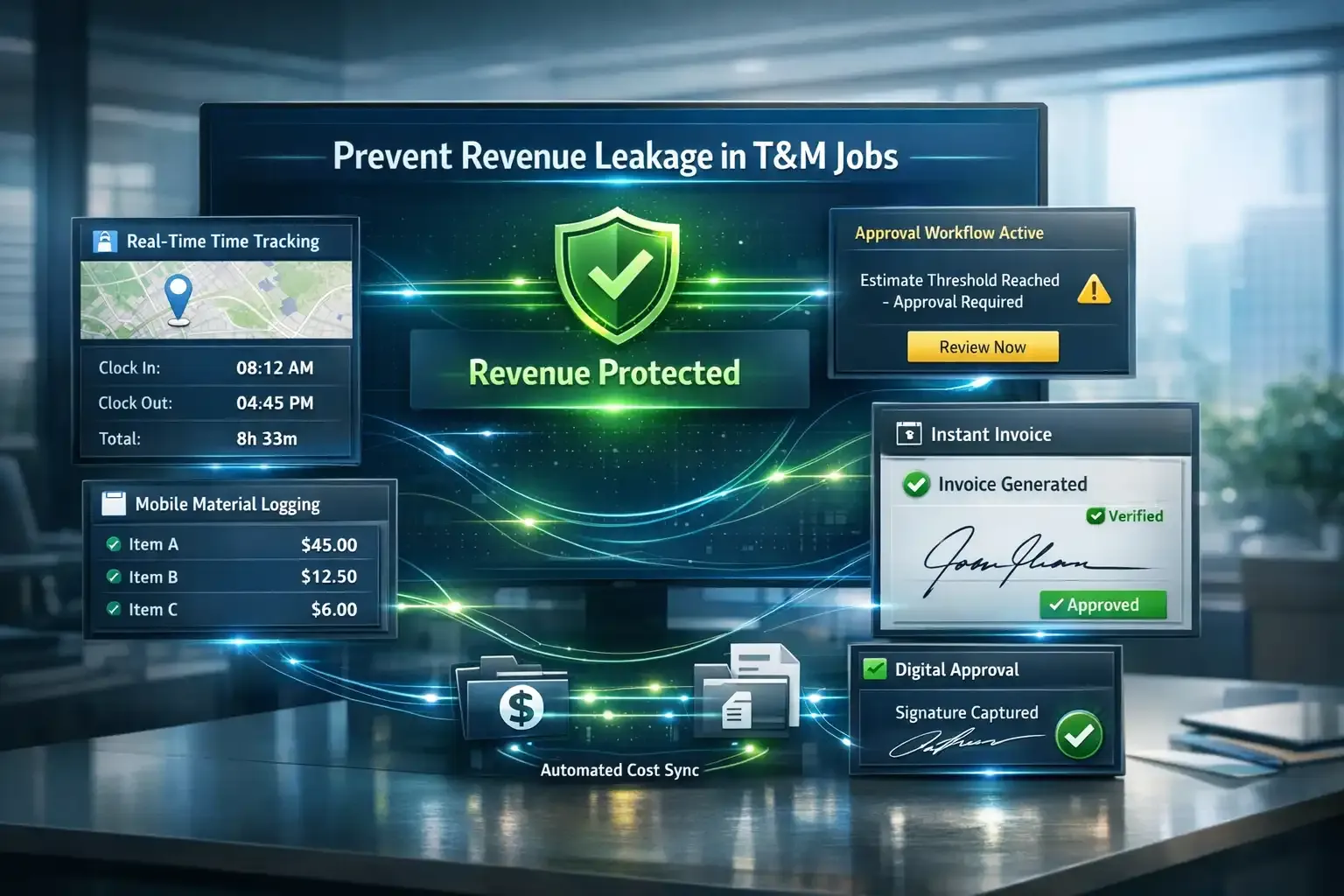
Real-Time Technician Time Tracking
Real-time technician time tracking protects billable labor. When technicians record hours at the end of the day, they round down unintentionally. Small reductions accumulate across weeks.
According to the U.S. Department of Labor, wage and hour violations continued to be identified and addressed across industries. If payroll tracking can be inaccurate, billable tracking can be inaccurate too. Real-time logging protects both compliance and revenue.
Mobile Material Logging
Mobile material logging prevents invisible loss. In many field operations, technicians install parts and document them later. That delay leads to omissions.
Every part must be logged at the moment of installation. This includes small consumables that feel minor. Individually, they seem insignificant, but collectively, they reduce gross margin.
Mobile logging tied to inventory solves this. The technician selects the part, and the system pulls pricing automatically. This protects markup without manual calculation.
Automated Cost Sync
Automated cost sync keeps field data aligned with accounting. If payroll rates increase but billing rates stay outdated, the company absorbs the difference. And if material costs change in purchasing, but invoices still use old cost data, profit shrinks silently.
Small businesses continue to report financial challenges such as uneven cash flow and difficulty covering operating expenses. [Source: Federal Reserve’s 2024 Small Business Credit Survey]
Manual billing processes increase delay and error risk. Automation reduces this exposure. Thanks to accurate cost sync, it protects profitability without adding administrative load.
On-Site Digital Signatures
On-site digital signatures reduce payment friction. When clients approve work before the technician leaves, documentation ends immediately.
Close every time and materials job with a digital signature on labor hours and materials used. So that the client can review the breakdown on site. And if they have any questions, they get resolved in real time.
Signed confirmation reduces disputes significantly. It also accelerates invoice acceptance.
Instant Invoice Generation
Instant invoice generation improves cash velocity. Waiting until the end of the week or month delays revenue recognition.
Faster invoicing also improves liquidity because clients respond better to prompt billing. When the service is fresh, they remember the work clearly.
Approval Workflows
Approval workflows prevent uncontrolled labor expansion. T&M jobs can drift if no checkpoints exist.
I set automated triggers inside the system. When logged hours approach the top of the estimate range, the client receives a notification. Work continues only after confirmation.
Without approval gates, technicians may continue under the assumption. That creates billing shock later
To reduce those tracking gaps in real field operations, many teams rely on field service software. A tool like FieldServicely brings GPS time tracking, mobile part logging, digital signatures, and instant invoicing into a single workflow. When everything connects in real time, time and material billing becomes tighter, cleaner, and far more profitable.
Close jobs faster and speed up cash flow
Generate invoices and collect digital signatures on-site.
Time and Materials Contract Template
This Time and Materials Contract is made on the ___ day of _______, between:
Owner: ______________________________
Contractor: __________________________
The Owner and Contractor agree as follows.
1. Scope of Work
The Contractor agrees to perform the following work:
The Contractor will provide all labor, materials, tools, equipment, transportation, and services necessary to complete the work described above.
Supporting documents included in this Contract:
- Contractor Proposal (Appendix A)
- Price Sheet / Rate Schedule (Appendix B)
- Terms and Conditions (Appendix C)
2. Compensation
The Owner agrees to pay the Contractor based on actual labor hours and materials used.
Labor rates and material markups will follow the pricing listed in Appendix B.
Estimated project cost: $________________
Not-to-Exceed Amount (if applicable): $________________
Invoices will include:
- Labor hours worked
- Materials used
- Equipment or subcontractor costs
All invoices are subject to Owner review and approval.
3. Materials and Subcontractors
If subcontractors, equipment, or additional materials are required, the Contractor will pay for them and include those costs in the invoice.
The Contractor will confirm that subcontractors and suppliers have been paid.
4. Payment Terms
Payments shall be made within ____ days after invoice submission.
Late payments may result in work suspension until payment is received.
5. Cost Notification
The Contractor will notify the Owner in writing if project costs are expected to exceed 75% of the estimated budget or approach the Not-to-Exceed amount.
6. Changes in Scope
If the scope of work changes, the Contractor may adjust labor hours, materials, and total cost accordingly.
7. Agreement
By signing below, both parties agree to the terms of this Contract.
Owner Signature: __________________________
Date: __________________
Contractor Signature: ______________________
Date: __________________
Try FieldServicely #1 Field Service Management Software
Try for free - No credit card required!
Conclusion
Time and materials work best when control and flexibility matter more than prediction. It protects contractor business from underpricing complex jobs and gives clients visibility into real labor and material costs.
However, it only performs well when tracking, approvals, and billing stay tight. Without strong systems, revenue leaks through missed hours and unlogged parts.
Frequently Asked Questions
Can time and materials contracts include overtime rates?
Yes, T&M contracts can include separate overtime, weekend, or emergency labor rates. These rates must be clearly defined upfront to prevent billing disputes later.
How do you estimate a T&M job before starting?
You provide a labor hour range based on similar past jobs and explain that materials will be billed at actual cost plus markup. The estimate sets expectations but does not lock the final price.
Who carries the financial risk in a T&M contract?
The client carries cost variability risk because the final price depends on actual hours and materials used. However, contractors carry tracking and documentation risk.
Can T&M be combined with maintenance contracts?
Yes, many companies use T&M for corrective repairs while preventive maintenance stays on a fixed contract. This hybrid approach balances predictability and flexibility.
Is time and materials suitable for small field service businesses?
Yes, especially for repair-driven businesses. It reduces underbidding risk and works well when job scope changes frequently after inspection.