- Scheduling and Dispatch
How to Assign the Right Technician to the Right Job
Updated on 28 Apr 2026
Jump to
Summary

Getting the right technician on the right job comes down to skill fit, timing, and clear job understanding.
A structured approach makes daily operations smoother and cuts down on repeat visits and delays.
Factors like workload, location, and customer timing quietly shape how well assignments actually work.
Smart tools and simple systems help teams stay organized without overcomplicating decisions.
Small mistakes in planning or matching can quickly turn into bigger issues across the entire schedule.
Assigning the right technician to the right job means matching each task with someone who has the right skills, tools, and timing. This improves productivity, reduces travel time, and increases first-time fix rates.
However, many businesses struggle with unclear job details, poor scheduling, skill mismatches, and last-minute changes that disrupt the entire workflow daily.
These issues often lead to delays, repeat visits, and frustrated customers who lose trust in the service over time.
In this blog, we will discuss how to assign the right technician step by step. We will also cover key strategies, mistakes to avoid, and a proven framework to improve your assignment process.
What Does “Assigning the Right Technician” Really Mean?
Assigning the right technician means matching a job with a technician who can fix it correctly on the first visit. It considers skills, location, availability, and urgency to deliver faster and better service.
It starts with matching skills, experience, and certifications to the job. Next, it considers location, availability, and urgency to reduce delays. A nearby technician can reach faster, cut fuel costs, and improve response time.
Then, it focuses on first-time fix success and efficiency in real situations.
According to research, companies that assign based on skills and data achieve up to 20-30% first-time fix rates, which reduces repeat visits.
Finally, it uses smart tools and data-driven scheduling to optimize every assignment. Modern field service platforms analyze technician profiles, job history, and real-time conditions to improve productivity and customer satisfaction.
Why Proper Technician Assignment Matters
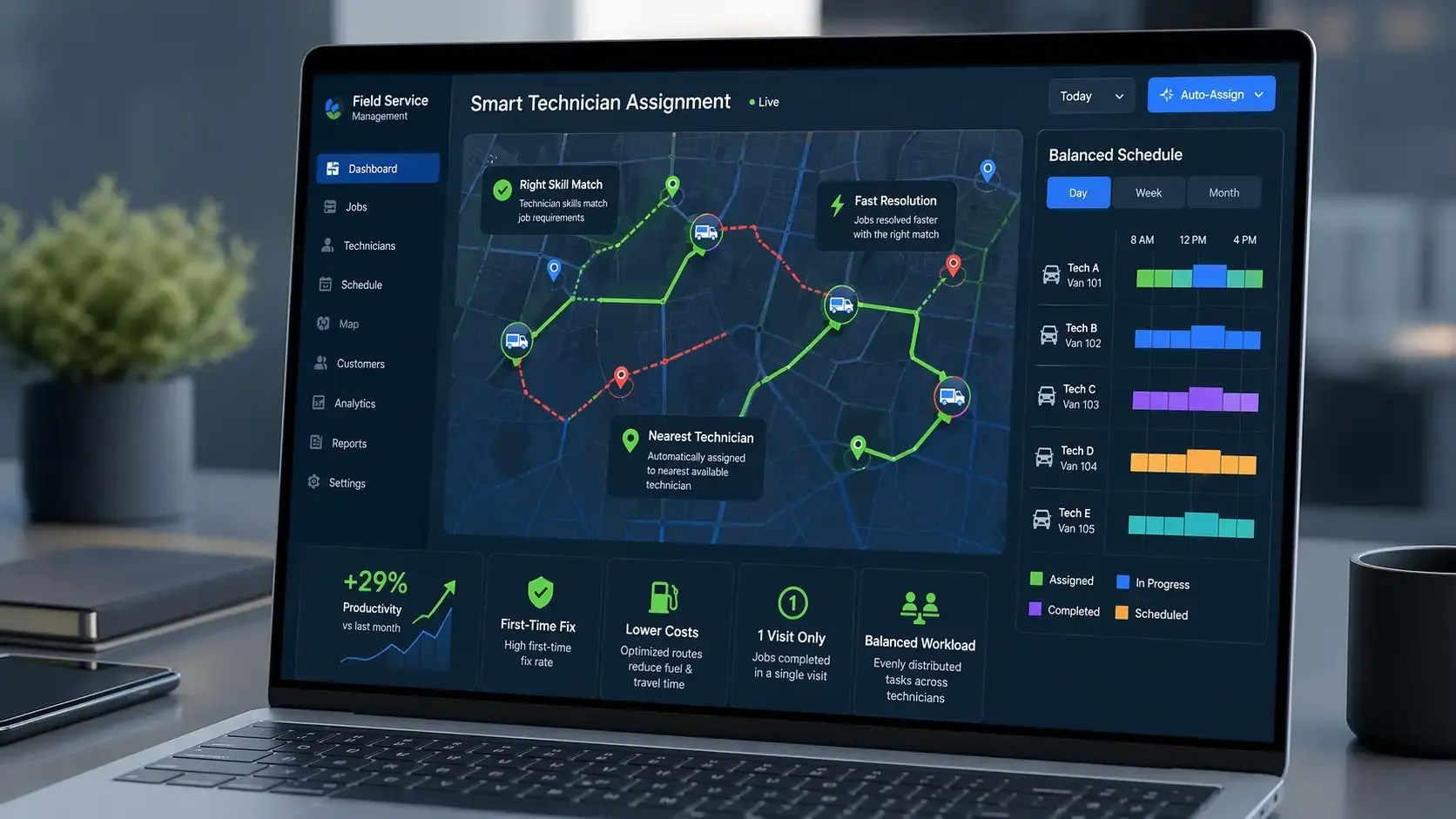
Boosts Productivity
Productivity improves when each job goes to a technician who knows exactly how to handle it. A technician with the right experience solves issues faster and avoids trial-and-error delays.
McKinsey shows that optimized field operations can boost productivity by 29% through better job matching and routing.
That means more completed jobs per day without increasing team size.
Improves Customer Satisfaction
Customer satisfaction rises when problems get fixed on the first visit.
No one likes waiting for a second appointment because the first technician lacked the right skills. According to Salesforce, 9 out of 10 customers are more likely to buy if they get good service.
A correct assignment ensures quick resolution, which builds confidence and long-term loyalty.
Reduces Costs
Costs rise quickly when technicians spend hours traveling instead of working. Assigning someone far away wastes fuel, time, and daily job capacity.
13% to 19% of logistics costs can stem from inefficient interactions in logistics operations. Smart assignment keeps jobs close, which lowers expenses and improves margins.
Cuts Repeat Visits
Repeat visits damage both efficiency and profitability. Sending the wrong technician the first time doubles the effort for a single job.
Advanced analytics can reduce frontline workforce costs by 15% to 20%. This shows how better service operations can materially lower costs.
Fixing the issue once saves time, labor, and customer frustration.
Eliminates Inefficiency
Inefficiency grows when some technicians are overloaded while others stay idle. Unbalanced schedules lead to delays, burnout, and missed deadlines.
Salesforce reported that scheduling conflicts are the number-one productivity blocker in field service, with 47% of appointments not going as planned.
A balanced assignment ensures a steady workflow and better team performance.
/ct
Turn Every Job Into a First-Time Fix
Assign the right technician faster and complete more jobs daily without increasing your team size.
Key Factors to Consider Before Assigning a Technician
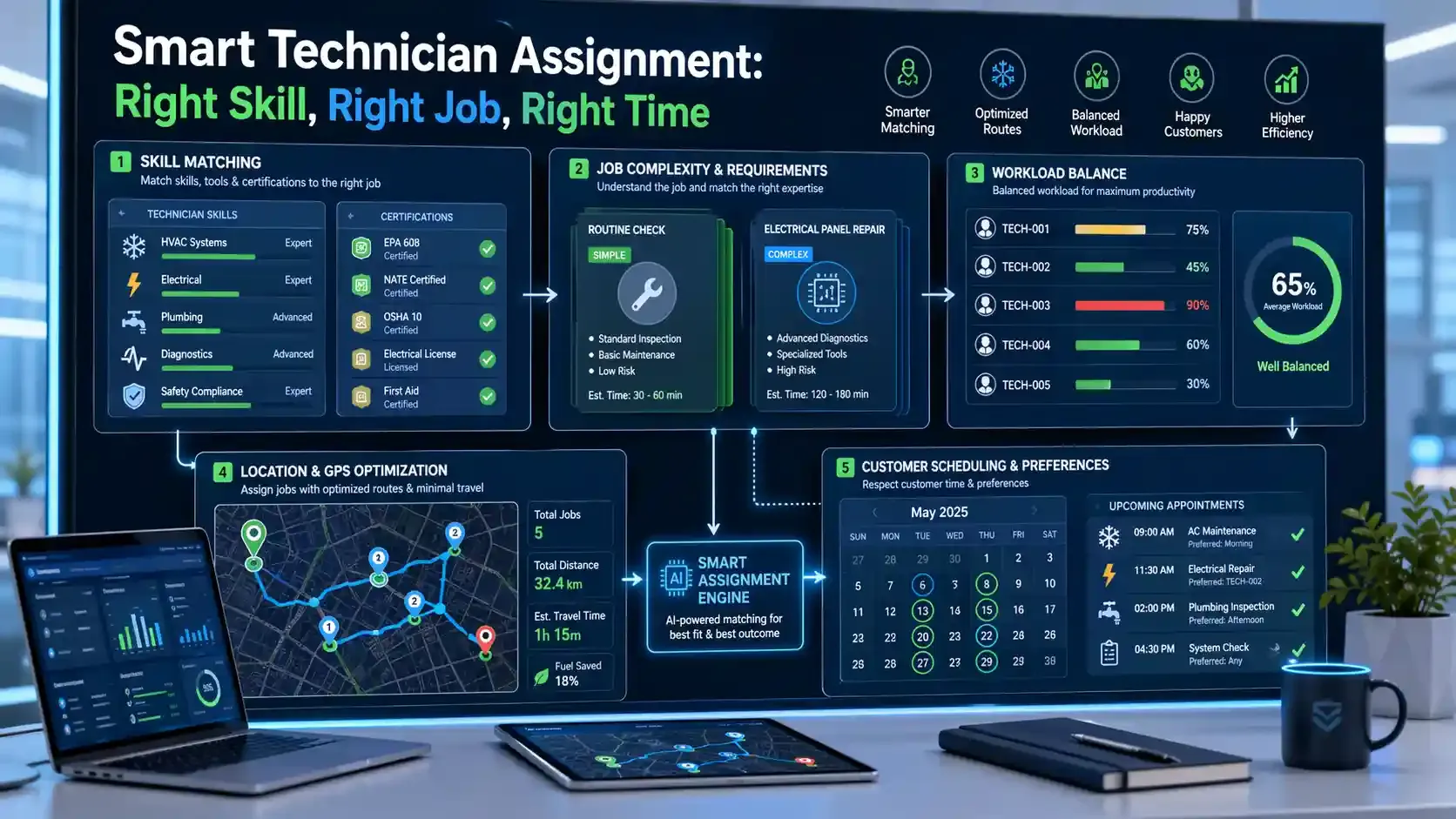
Skill, Experience & Certifications
I once sent a technician who had basic knowledge, and he spent 40 minutes just diagnosing a fault that a specialist later fixed in 10 minutes. Experience shows in speed and confidence.
A technician who has handled similar issues before will not guess; he will act with clarity.
Certifications matter more than most people think. Licensed professionals follow proper procedures, which reduces risk, errors, and safety issues.
Even skill-aligned workforce deployment improves task efficiency by over 49% in technical industries.
Job Complexity & Requirements
Not every job needs a senior technician, but the wrong assignment can turn a small issue into a bigger one.
I remember assigning a routine check to a technician without reviewing the job notes properly. The issue turned out to be deeper, and the technician did not carry the right tools.
That mistake caused a delay and required a second visit. The customer lost time, and the schedule shifted for the rest of the day.
Technician Availability & Workload
Availability alone does not guarantee good performance. A technician may be free, but a packed schedule can reduce focus and accuracy.
I’ve seen top-performing technicians make small mistakes when they have back-to-back jobs without breaks. The pressure builds quietly and affects decision-making.
Workload balance plays a bigger role than most teams realize. When one technician handles too many jobs, delays increase, and quality drops.
It also helps technicians stay focused and deliver consistent results.
Location & Travel Time (GPS Optimization)
A technician spending hours on the road cannot complete as many tasks as one working in a nearby area.
I’ve seen two technicians with the same skill level produce completely different results in one day. The only difference was location and travel time.
One handled five jobs in a compact area. The other finished only two because of long travel distances.
Smart assignment keeps technicians within a defined zone. It reduces travel, saves energy, and increases the number of completed jobs.
Customer Availability & Preferences
A technician can arrive on time, but if the customer is not ready, the entire trip becomes wasted effort.
I’ve faced situations where one missed appointment affected three other jobs scheduled later in the day. Everything shifted because of one mismatch.
Customer preferences also play a role in service quality. Some clients prefer specific time slots or even specific technicians they trust.
According to research, over 58% of customers expect flexible scheduling options. Ignoring this expectation leads to frustration and a poor service experience.
Clear confirmation before dispatch prevents unnecessary trips. It keeps the schedule stable and ensures the technician’s time goes into actual work, not waiting.
Cut Travel Time. Complete More Jobs.
Match every job with the right skills and avoid delays, errors, and repeat visits.
The 5-Step Framework to Assign the Right Technician
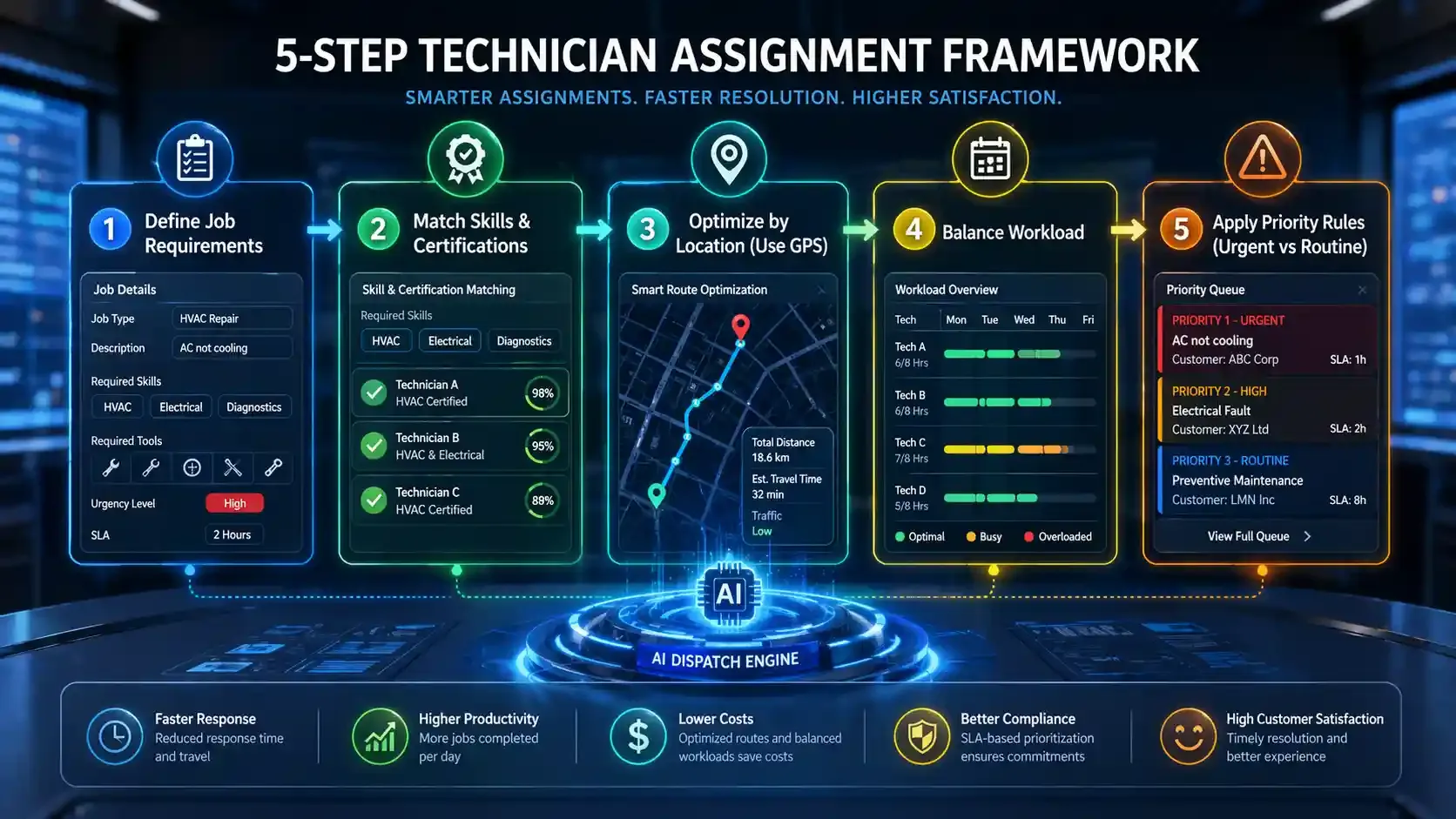
Step 1: Define Job Requirements Clearly
Clear job details decide the direction of the assignment. Each job needs defined skills, required tools, and an urgency level before dispatch.
A missing detail often causes delays, wrong tools, or repeat visits.
Task- and skills-based approaches give organizations more detail to refine their approach and home in on critical needs. [Source: Deloitte]
Step 2: Match Skills & Certifications First
Skill matching decides whether the job gets fixed on the first visit. Assigning based on availability alone creates mismatches and increases rework. Certified technicians follow correct procedures and reduce risk in technical jobs.
According to Weforum, skills-based workforce planning improves deployment decisions, job-skill matching, and broader business outcomes
Step 3: Optimize by Location (Use GPS)
Location impacts how many jobs get completed in a day. Assigning a nearby technician reduces travel time and improves response speed.
Long travel distances lower productivity and increase fuel costs.
Companies using AI-enabled daily route optimization saw a 15% reduction in travel time for drivers
Step 4: Check Availability & Workload Balance
Workload balance keeps performance consistent across the team. Overloaded schedules lead to rushed work, delays, and lower quality outcomes.
Balanced assignments help maintain steady output and reduce errors. This directly links to performance.
Employee well-being interventions are correlated with productivity improvements of 10% to 21%.
Step 5: Apply Priority Rules (Urgent vs Routine)
Priority rules ensure urgent jobs get immediate attention. Emergency requests and SLA-based tasks should move ahead of routine work.
Ignoring priority leads to missed deadlines and customer dissatisfaction.
According to Microsoft, SLA-based prioritization helps organizations set and manage faster response-time targets by issue severity.
Turn This 5-Step Process Into Automation
Try for free - No credit card required!
Key Strategies for Optimal Technician Assignment
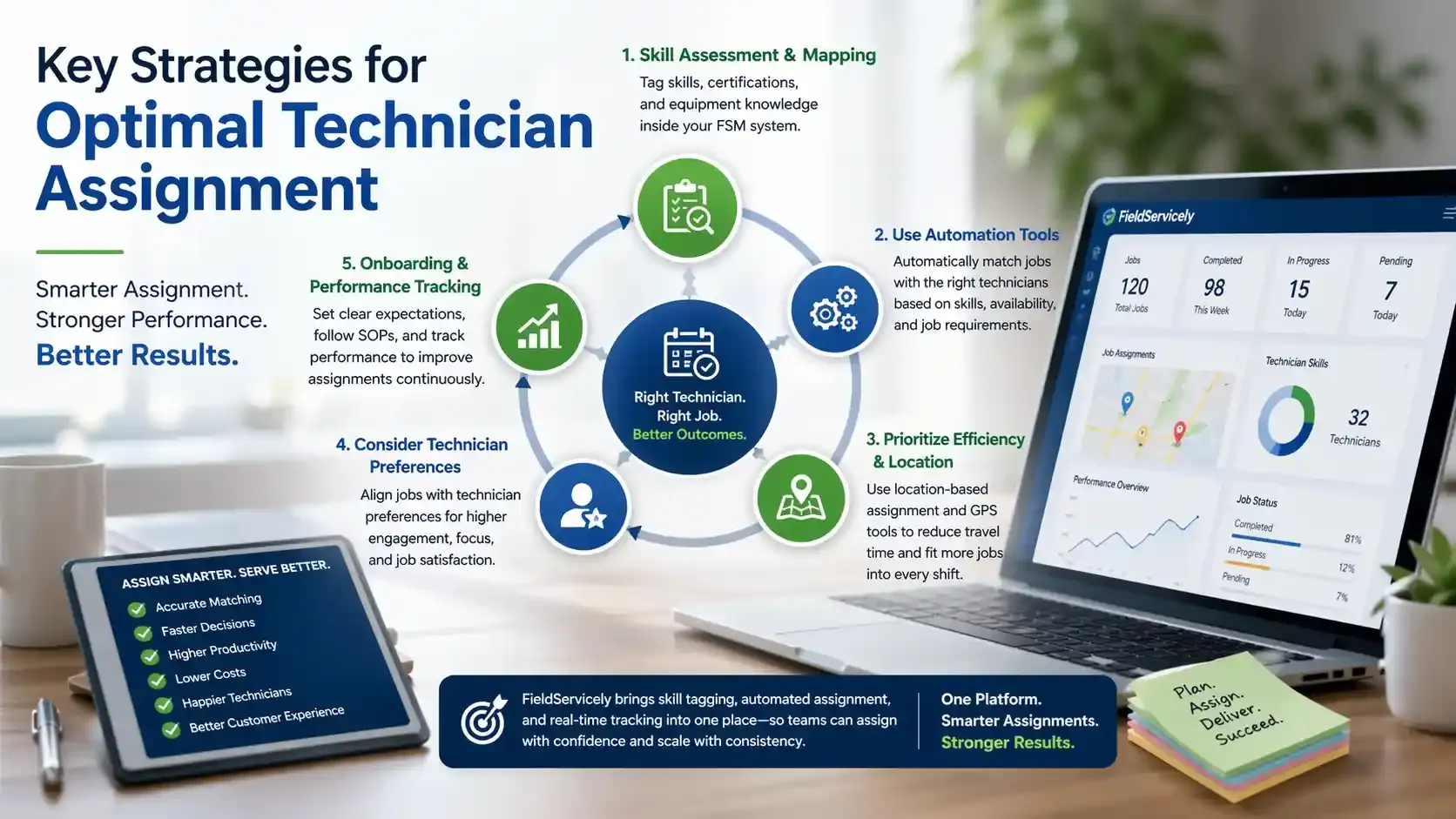
Skill Assessment & Mapping
Skill mapping builds the foundation for accurate technician assignment. Each technician needs clear tags for skills, certifications, and equipment knowledge inside your FSM system.
A tagged system removes guesswork and speeds up decision-making during dispatch. This approach creates a clear link between job requirements and technician capability.
Use Automation Tools
Automation reduces manual errors and speeds up assignment decisions. FSM software can instantly match jobs with technicians based on skills, availability, and job requirements.
Modern systems also detect mismatches before dispatch. If a technician lacks the required skill or tool, the system flags it immediately.
Effective field service management implementation can reduce operational costs by nearly 20%. That gain comes from faster decisions and fewer human errors.
Prioritize Efficiency & Location
Location-based assignment improves both speed and output. Dispatch boards and GPS tools help visualize where each technician is and where they should go next.
Shorter travel routes allow more jobs to fit into a single shift. This directly increases daily productivity without increasing workforce size. Less travel means more work completed and lower expenses.
Consider Technician Preferences
Technician preferences affect performance more than most teams expect. Some technicians perform better in specific service zones or job types due to familiarity and comfort.
Ignoring these preferences can lead to slower work and lower job satisfaction. On the other hand, aligned assignments improve focus and reduce resistance.
Companies embedding skills data across all HR functions are boosting productivity by up to 15%. Better engagement leads to better service outcomes.
Onboarding & Performance Tracking
Structured onboarding sets clear expectations from day one. Standard operating procedures (SOPs) help technicians understand how to handle different job types consistently.
Tracking performance over the first 30 days reveals strengths and gaps early. Metrics like job completion time and accuracy show whether assignments match technician capability.
Also, early tracking ensures continuous improvement and smarter assignment decisions.
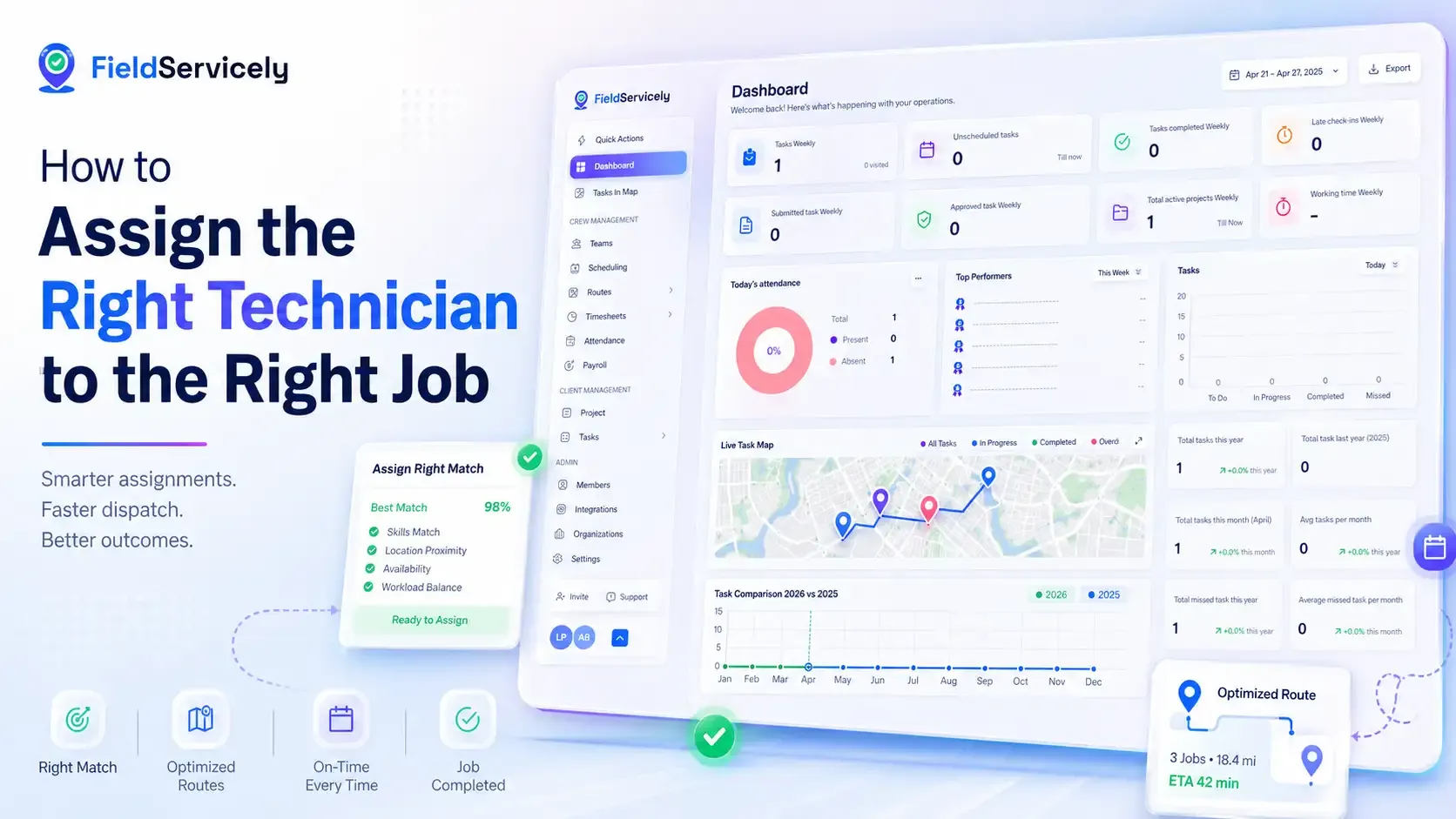
FieldServicely brings skill tagging, automated assignment, and real-time tracking into one place, so decisions happen faster and with better accuracy.
Instead of relying on manual coordination, teams can see clear data and assign jobs with confidence.
That shift helps maintain consistency, especially when operations start scaling.
Manage Skills, Jobs, and Teams in One Place
Try for free - No credit card required!
Common Mistakes to Avoid
- Choosing the first available technician instead of the right one leads to wrong assignments and repeated visits.
- Skipping a proper job review sends technicians without the right tools or preparation.
- Ignoring real-time updates causes delays when jobs run longer or schedules change.
- Planning scattered routes increases travel time and reduces daily job output.
- Relying too much on one technician creates workload imbalance and burnout risk.
- Poor communication between dispatch and field teams leads to confusion and missed steps.
- Failing to adjust schedules quickly turns small delays into bigger disruptions.
Conclusion
A structured system always outperforms guesswork when assigning technicians. Clear processes, skill matching, and smart scheduling improve efficiency, reduce costs, and increase customer satisfaction. When every job goes to the right person at the right time, teams work faster and avoid repeat visits.
Frequently Asked Questions
How do you handle last-minute job cancellations?
Handle cancellations by instantly reallocating the technician to the nearest available job. Keeping buffer slots in the schedule helps absorb sudden changes without disrupting the whole day.
What role does inventory play in technician assignment?
Inventory decides whether a technician can complete the job on the first visit. Assigning without checking parts availability often leads to delays and repeat trips.
Should junior technicians be included in complex jobs?
Junior technicians should assist, not lead, in complex jobs. Pairing them with senior technicians helps with training while maintaining service quality.
How often should technician performance be reviewed?
Performance should be reviewed weekly or monthly based on job volume. Regular reviews help identify skill gaps and improve future assignments.
Can technician assignment improve team retention?
Better assignments improve job satisfaction and reduce burnout. When work matches skills and workload stays balanced, technicians stay longer and perform better.