- Scheduling and Dispatch
Staffing and Scheduling: Key Differences and Strategies
Updated on 21 Apr 2026
Jump to
Summary

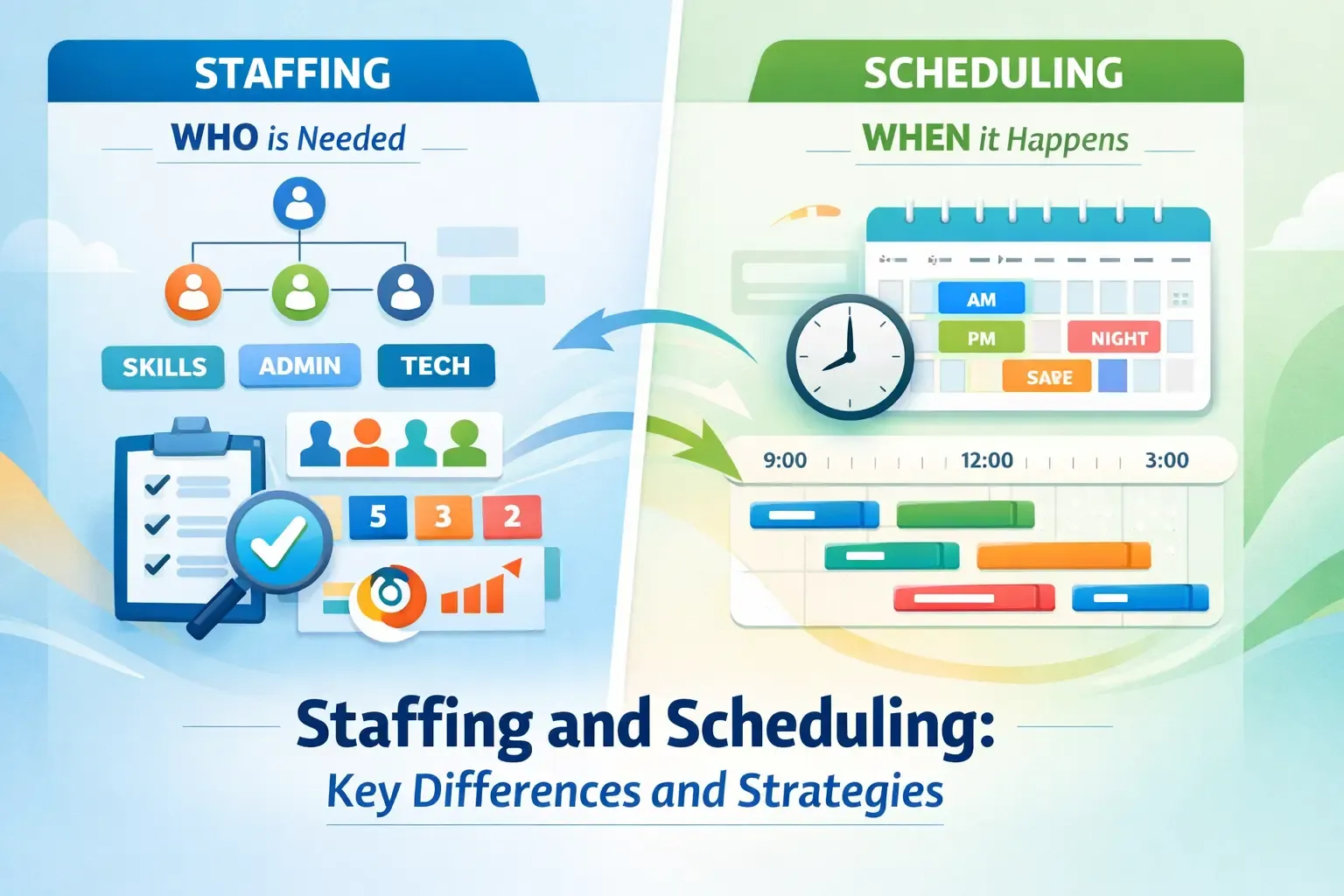
Staffing builds your team, while scheduling decides how that team works daily
Most problems, like overtime and burnout, come from poor scheduling, not a lack of staff
Fixing scheduling improves efficiency, reduces costs, and balances workload
Manual planning creates errors, while automated tools improve visibility and control
Field service teams need real-time scheduling to handle changing demand effectively
Staffing and scheduling sit at the center of how any business runs. One decides who you bring into your team, while the other decides how that team actually gets used day to day.
When both work together, operations feel smooth, costs stay under control, and work gets done on time.
But that’s not how it usually plays out. Many teams deal with overtime, missed deadlines, and frustrated employees, even when they have enough people on board. The problem often isn’t a lack of staff; it’s how that staff is scheduled.
This confusion leads to poor decisions and wasted effort. In this blog, we’ll break down the difference clearly and help you spot what’s really going wrong.
What is Staffing and Scheduling?
Staffing means building the right workforce for your business, while scheduling means using that workforce at the right time. Sounds similar, but they solve very different problems in daily operations.
Staffing answers one simple question: who should do the job?
It focuses on hiring skilled people, training them, and preparing them for future demand. 66% of managers say new hires lack required experience, which shows how critical proper staffing really is.
On the other hand, scheduling software answers when the job should be done.
It focuses on assigning shifts, tasks, and working hours based on real-time demand and employee availability. A 2025 study shows optimized scheduling improves performance by 66% vs manual scheduling.
Let me give an example.
A plumbing company hires 10 technicians to handle service requests, and that is staffing. Then, the manager assigns those technicians to jobs across the week, which is scheduling.
So, both must work together to keep operations stable. If staffing is strong but scheduling breaks, teams become either overworked or underused, and performance drops quickly.
What are the Key Elements of Scheduling and Staffing?
Key Elements of Staffing
1. Demand Forecasting
Staffing begins with predicting what you’ll need. Using past data, like sales trends or customer interactions, you can forecast peak periods and understand how much workforce you’ll need to meet the demand. This ensures you don’t overstaff during slow times or underprepare during busy periods.
2. Manpower Planning and Recruitment
Once demand is forecasted, it’s time to define roles and skills needed. Hiring the right people requires a clear understanding of what tasks need to be completed and the skill sets required. Recruitment ensures you have the right number of staff with the appropriate skills to handle specific responsibilities.
3. Skill-based Assignment (Cross-training)
Cross-training employees is an effective way to increase flexibility. By training staff to handle multiple roles, you can adapt quickly to changing demands. For example, a nurse in a hospital can be trained to assist with patient intake during busy hours, ensuring there’s no gap in coverage.
4. Retention and Development
Staffing doesn’t end with recruitment. Retaining skilled employees is just as important. This includes offering professional development opportunities, performance appraisals, and training to improve skills.
Key Elements of Scheduling
1. Shift Planning and Coverage
Scheduling is about assigning shifts based on demand. You need to balance employee preferences with business needs. For instance, a restaurant may require more wait staff during dinner hours and fewer during the afternoon.
2. Employee Availability and Preferences
It’s important to factor in employee availability and preferences to keep them engaged and satisfied. Gathering this information can help create schedules that accommodate their needs, like family commitments or school hours.
3. Compliance Management
Adhering to labor laws is a critical part of scheduling. This includes ensuring employees don’t exceed maximum working hours, mandating breaks, and respecting overtime laws.
4. Managing Unexpected Absences
Absences are a common issue that can disrupt a well-laid plan. Scheduling requires flexibility to handle unforeseen absences. Modern scheduling tools help managers quickly identify available staff to fill in.
The Differences Between Staffing and Scheduling
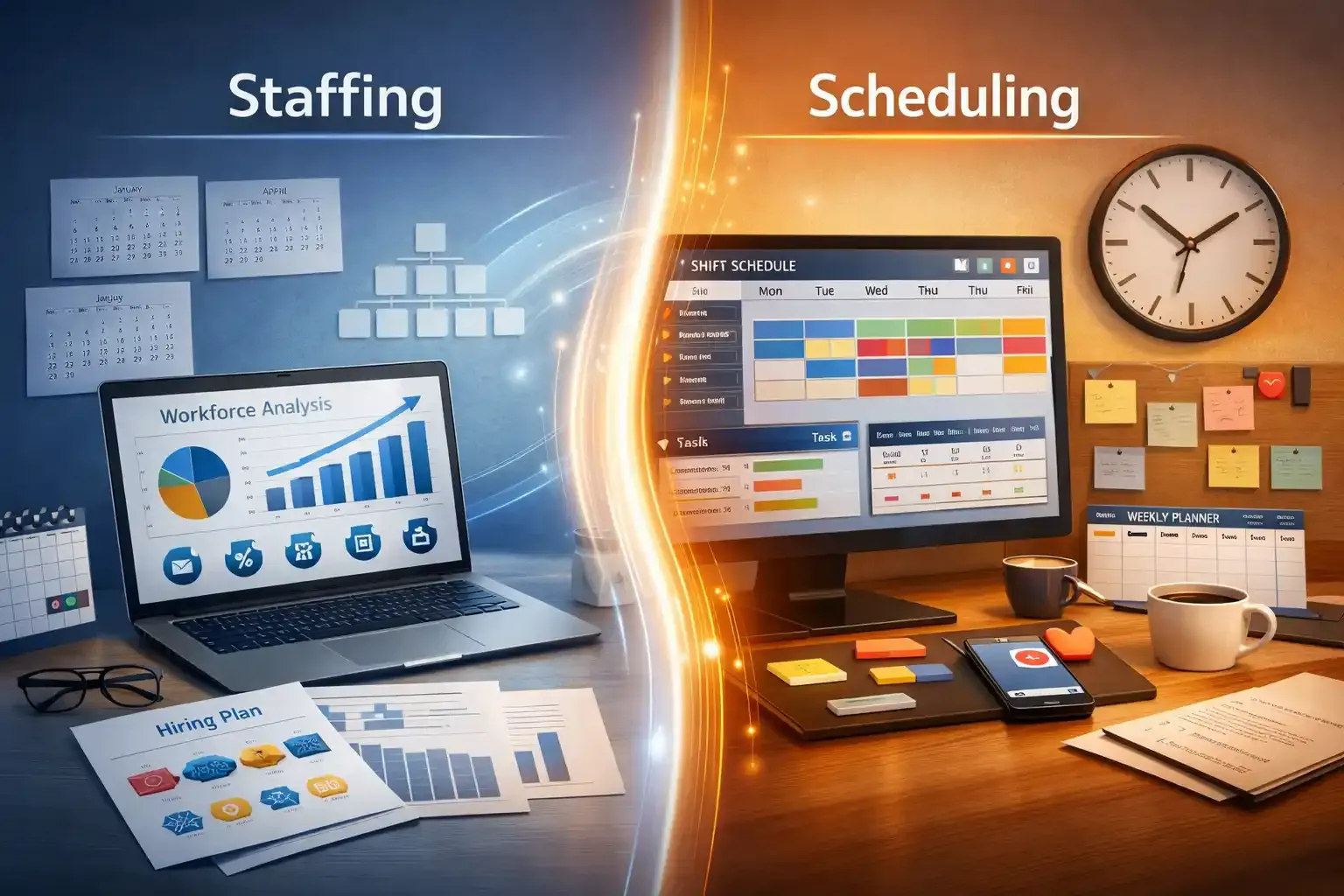
Here are the key differences between scheduling and staffing:
| Aspect | Staffing | Scheduling |
|---|---|---|
Role | Strategic planning | Operational execution |
Focus | Skills and workforce | Time and task allocation |
Timeframe | Long-term (months/years) | Short-term (daily/weekly) |
Driver | Business growth | Daily demand |
Purpose | Build workforce capacity | Use the workforce efficiently |
Scope | Organization-wide | Task and shift level |
Data Used | Historical data and forecasts | Real-time availability and workload |
Key Activities | Hiring, training, retention | Shift planning, task assignment |
Common Issue | Skill gaps, understaffing | Over time, idle time, conflicts |
Outcome | Strong workforce foundation |
Strategy vs Execution
Staffing focuses on long-term workforce planning, while scheduling handles short-term execution. You hire, train, and build a team over months or years, but you assign shifts daily or weekly.
72% of organizations recognize organizational stability as critical, but only 39% are effectively acting on it. It means companies that implement structured planning gain a clear advantage in stability
However, without strong scheduling, even a well-built team fails at on-time delivery.
Skills vs Time
Staffing ensures you have the right skills, while scheduling ensures those skills are used at the right time. You hire based on expertise, but you assign work based on demand.
For example, a hospital may hire skilled nurses, but if night shifts are understaffed, care quality drops. Poor shift planning increases workload pressure and impacts service delivery. [Source: ResearchGate]
Growth vs Demand
Staffing decisions depend on business growth, while scheduling decisions depend on daily workload. You expand your team when demand grows, but you distribute work based on real-time needs.
Demand-based scheduling reduces labor waste by aligning staffing with real-time demand, delivering up to 15% cost savings. So, growth planning alone is not enough without proper daily alignment.
Capacity vs Allocation
Staffing builds your workforce capacity, while scheduling distributes that capacity. You ensure you have enough employees first, then decide how to use them.
For example, a cleaning company may hire enough staff, but poor shift allocation leads to idle time on slow days. This shows how allocation impacts operational efficiency directly.
Broad vs Focused
Staffing looks at the entire organization, while scheduling focuses on daily operations. You consider market trends and long-term goals during staffing, but you focus on immediate tasks during scheduling.
For instance, a construction company hires based on project pipelines, but managers assign daily tasks based on deadlines. This makes scheduling more dynamic and situation-driven.
Data vs Real-Time Inputs
Staffing uses long-term data, while scheduling depends on real-time inputs. You analyze trends and forecasts for hiring, but you adjust schedules based on availability and workload.
Real-time scheduling improves workforce utilization by up to 30%. This proves flexibility is key in scheduling decisions.
Problem Signals
Staffing issues appear as skill shortages, while scheduling issues appear as overtime or idle time. You notice staffing problems when work cannot be completed, but scheduling problems show up as inefficiency.
For example, field teams often miss jobs not due to a lack of staff, but due to poor shift planning. This difference helps identify the real issue faster.
Turn workforce planning into real execution
Align your team with daily demand and eliminate scheduling gaps instantly
Why Businesses Fail at Staffing and Scheduling
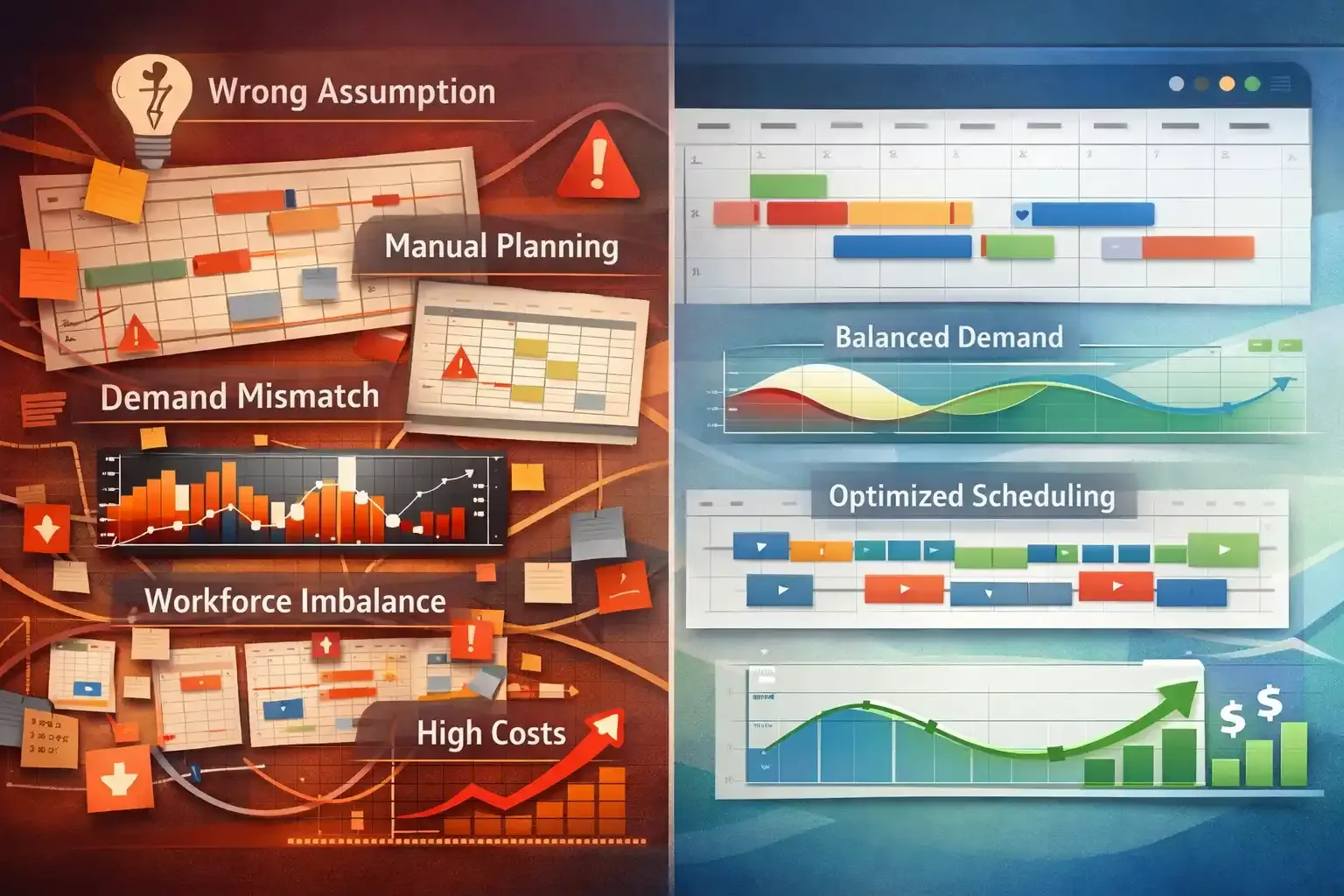
Most businesses fail because they don’t use their existing workforce the right way.
You might think hiring more staff will fix delays or missed work. But the real issue usually lies in how your team is scheduled every day.
Wrong Assumption
Everything starts breaking when you assume the problem is staffing. Delays, missed jobs, and slow output often look like a shortage of people. But in reality, the issue is poor workforce allocation.
According to McKinsey, nearly 30% of inefficiencies come from how teams are deployed. Not from staff shortages.
So, when you hire more without fixing scheduling, the situation doesn’t improve. You simply add more people to an already inefficient system, which increases confusion and cost.
Manual Planning
Once the assumption is wrong, most teams fall back on manual scheduling. Spreadsheets, calls, and basic tools feel simple at first, but they create hidden problems over time.
Small mistakes like double bookings, missed shifts, or uneven workload start to appear. Manual scheduling increases error rates by up to 30%.
So, instead of improving operations, managers spend more time fixing mistakes. Over time, this slows down the entire workflow and reduces efficiency.
Demand Mismatch
Scheduling fails when demand is not clearly understood. Teams assign shifts based on availability instead of actual workload patterns.
This creates a clear imbalance where some hours are overstaffed while others are understaffed. For example, a service team may have too many technicians during slow periods and not enough during peak hours.
According to research, demand-based scheduling improves efficiency. So, without proper forecasting, businesses lose both productivity and revenue.
Workforce Imbalance
As the imbalance builds, the impact shifts to your team. Some employees get overloaded with work, while others remain underutilized.
Schedules also change without proper notice, which creates frustration. Employees struggle to manage their time when shifts are unpredictable.
Unpredictable schedules increase burnout and reduce engagement. So, what starts as a scheduling issue quickly turns into a morale and retention problem.
Cost Impact
The financial impact shows up next. Poor scheduling increases overtime because managers rely on the same employees repeatedly.
At the same time, unused capacity still exists within the team. This means you are paying more without getting full value from your workforce.
The McKinsey report shows that optimized scheduling can improve workforce utilization by up to 20 to 30 percent. So, inefficient scheduling directly leads to higher labor costs and lower field productivity.
Fix scheduling issues before hiring more staff
Use smarter tools to allocate your existing workforce more efficiently
Do You Have a Staffing Problem or a Scheduling Problem?
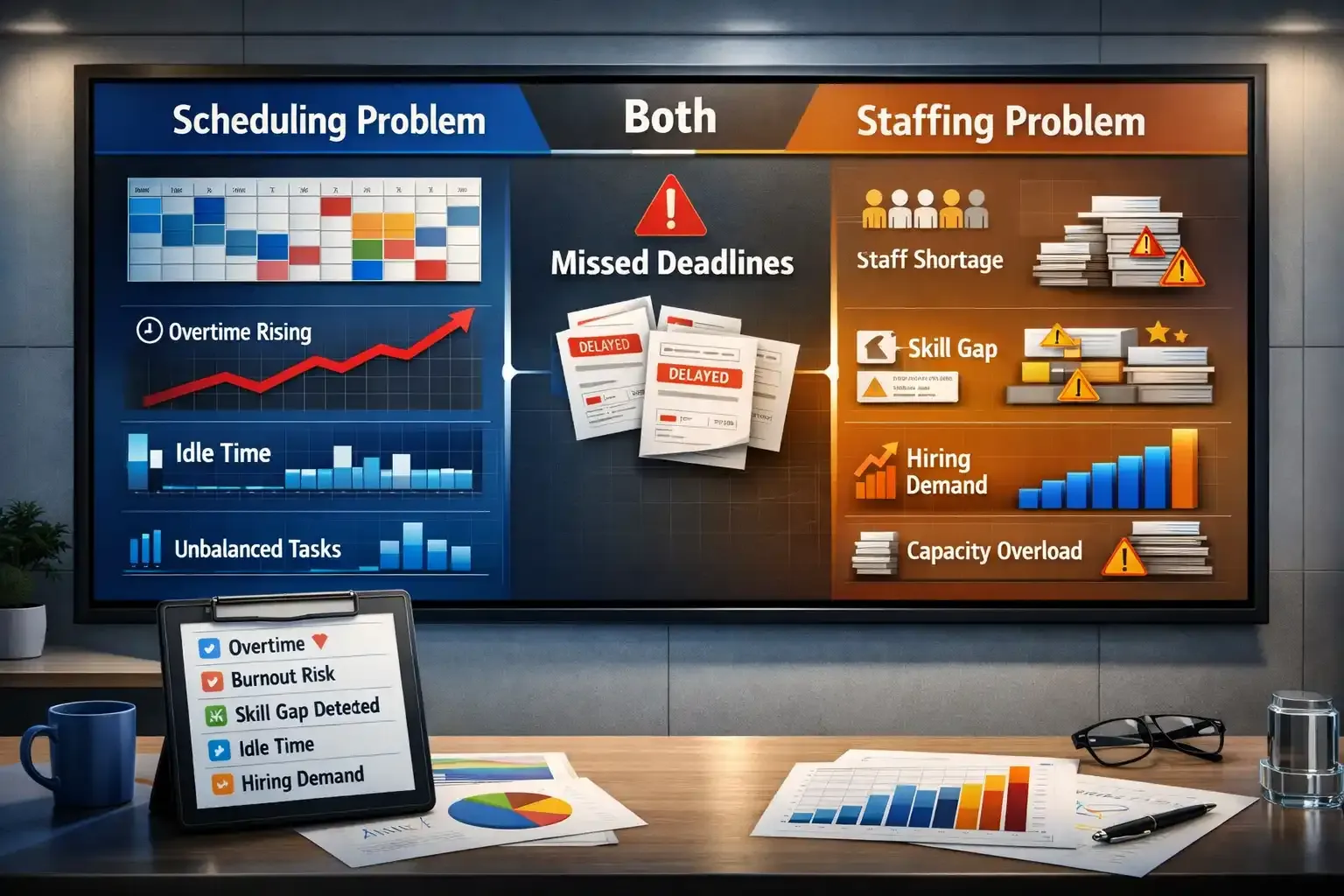
Here’s how to know whether you have a staffing or scheduling problem:
| Problem | Likely Cause |
|---|---|
Overtime rising | Scheduling |
Employee burnout | Scheduling |
Skill gaps | Staffing |
Idle employees | Scheduling |
Missed deadlines | Both |
High hiring needs | Staffing |
Check Overtime Trends
Over time, rising usually points to a scheduling problem. You already have people, but you keep assigning the same employees again and again.
This happens when shifts are not distributed properly. Overtime is often caused by staffing shortages and poor planning, increasing operational strain. [Source: IJRPR]
So, if overtime keeps increasing while your team size stays the same, your scheduling needs fixing.
Look at Employee Burnout
Employee burnout often signals a scheduling issue. Some team members get overloaded, while others stay underutilized.
This imbalance creates stress and frustration. So, if your team feels exhausted but you still have enough staff, the issue is not hiring. It is how work is distributed.
Identify Skill Gaps
Skill gaps clearly indicate a staffing problem. You may have enough employees, but they do not have the right skills to complete the work.
This shows up when tasks get delayed or quality drops. In this case, scheduling will not fix the issue. You need to hire or train the right people.
Watch for Idle Time
Idle employees usually point to a scheduling problem. You have people available, but they are not assigned work at the right time.
This often happens when demand is not matched with shifts. According to research, poor shift allocation leads to significant underutilization in service industries.
So, if your team has free time during work hours, scheduling needs improvement.
Track Missed Deadlines
Missed deadlines can signal both staffing and scheduling problems. The root cause depends on what is happening behind the scenes.
If your team is overloaded and cannot keep up, it may be a staffing issue. But if work is unevenly distributed, it is more likely a scheduling problem.
That’s when you need to look deeper instead of assuming the cause. It helps you avoid fixing the wrong issue.
Analyze Hiring Needs
High hiring demand usually points to a staffing issue. You simply do not have enough people to handle the workload.
This becomes clear when your team consistently struggles even with balanced schedules. For example, rapid business growth often creates this situation.
If demand keeps increasing and your team cannot keep up, hiring becomes necessary.
Find out what’s really causing your delays
Identify scheduling gaps and fix them before adding more staff
The Staffing Process: How Businesses Build Workforce
.webp?2026-04-21T09%3A25%3A53.377Z=&w=3840&q=100)
Workforce Planning
Workforce planning defines what your team should look like. You review your current setup, spot missing capabilities, and prepare for future demand.
This step removes uncertainty from hiring decisions. Structured workforce planning improves workforce readiness and reduces hiring gaps, achieving up to 300% higher revenue per employee.
When planning is missing, businesses keep reacting instead of preparing.
Recruitment & Selection
Recruitment decides who enters your system. That’s how you choose how work will be executed. And this choice directly impacts output quality.
A report shows 73% of hiring professionals now focus on skills because it improves team performance. A poor hiring decision creates friction that shows up in every task afterward.
Onboarding & Training
Onboarding sets the starting point for performance. New employees learn how work flows, what tools to use, and what is expected.
Training strengthens that foundation over time. A study shows that structured onboarding improves early productivity by up to 70%.
Without this step, even capable hires take longer to deliver results.
Skill Development
Skill development expands what your team can handle. Employees gain the ability to take on different tasks without delays.
This flexibility becomes critical when demand shifts. Teams with broader capabilities move faster and avoid bottlenecks. When skills stay narrow, work slows down the moment conditions change.
Retention Strategy
Retention protects the strength of your workforce. Keeping experienced employees maintains stability and consistency.
Losing them creates gaps that take time to recover. According to a report, replacing an employee can cost up to 213% of their annual salary.
Frequent turnover resets progress and weakens team performance.
Make smarter hiring decisions every time
Align your workforce with real demand and avoid costly hiring mistakes
Effective Scheduling Strategies That Actually Work
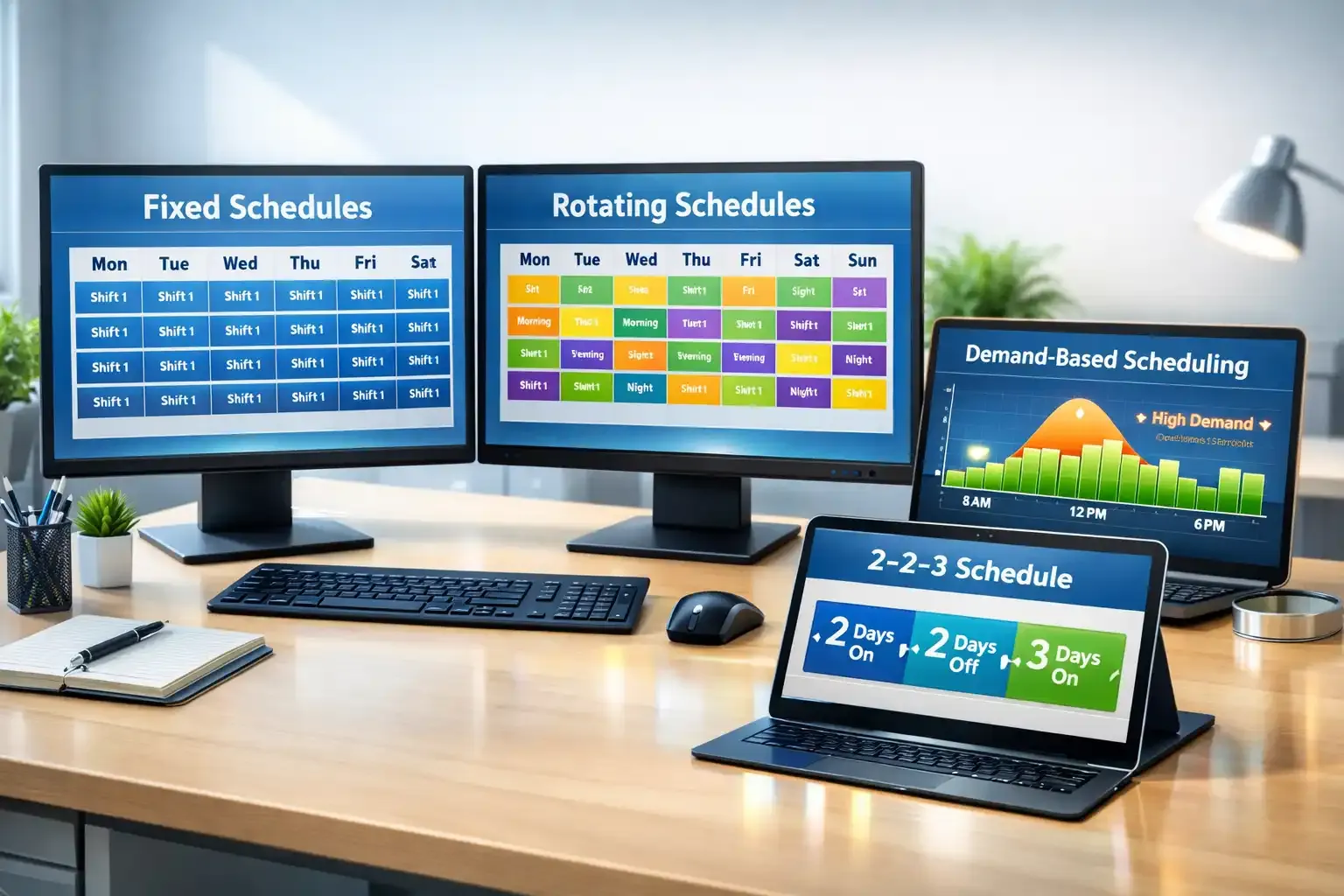
Fixed Schedules
Fixed schedules work best when your workload stays stable. Employees follow the same shifts every week, which creates predictability.
This makes planning easier for both managers and employees. Teams know when they work, which reduces confusion and improves attendance.
However, this model struggles when demand changes frequently. So, it fits businesses with consistent operations like offices or admin teams.
Rotating Schedules
Rotating schedules distributes work fairly across the team. Employees switch shifts over time instead of staying in one fixed pattern.
This approach prevents the same people from always handling difficult or unpopular shifts. It also improves fairness and team morale.
For example, healthcare and customer support teams often use this model. It keeps the workload balanced without overburdening specific employees.
Demand-Based Scheduling
Demand-based scheduling aligns shifts with real workload. You assign employees based on peak hours, customer traffic, or service demand.
This approach reduces both overstaffing and understaffing. Plus, matching schedules with demand improves efficiency and reduces labor waste significantly.
For example, retail stores schedule more staff during weekends and fewer during slow hours. This keeps operations efficient without increasing costs.
2-2-3 Schedule
The 2-2-3 schedule is built for continuous operations. Employees work 2 days, take 2 days off, and then work 3 days.
This pattern repeats and ensures consistent coverage. It also gives employees regular rest periods, which helps reduce fatigue.
This model works best in field service industries that operate 24/7, like manufacturing or emergency services. It keeps operations running without overloading the team.
Simplify shift planning across your team
Create, update, and manage schedules without confusion or delays
Staffing and Scheduling in Field Service Industries
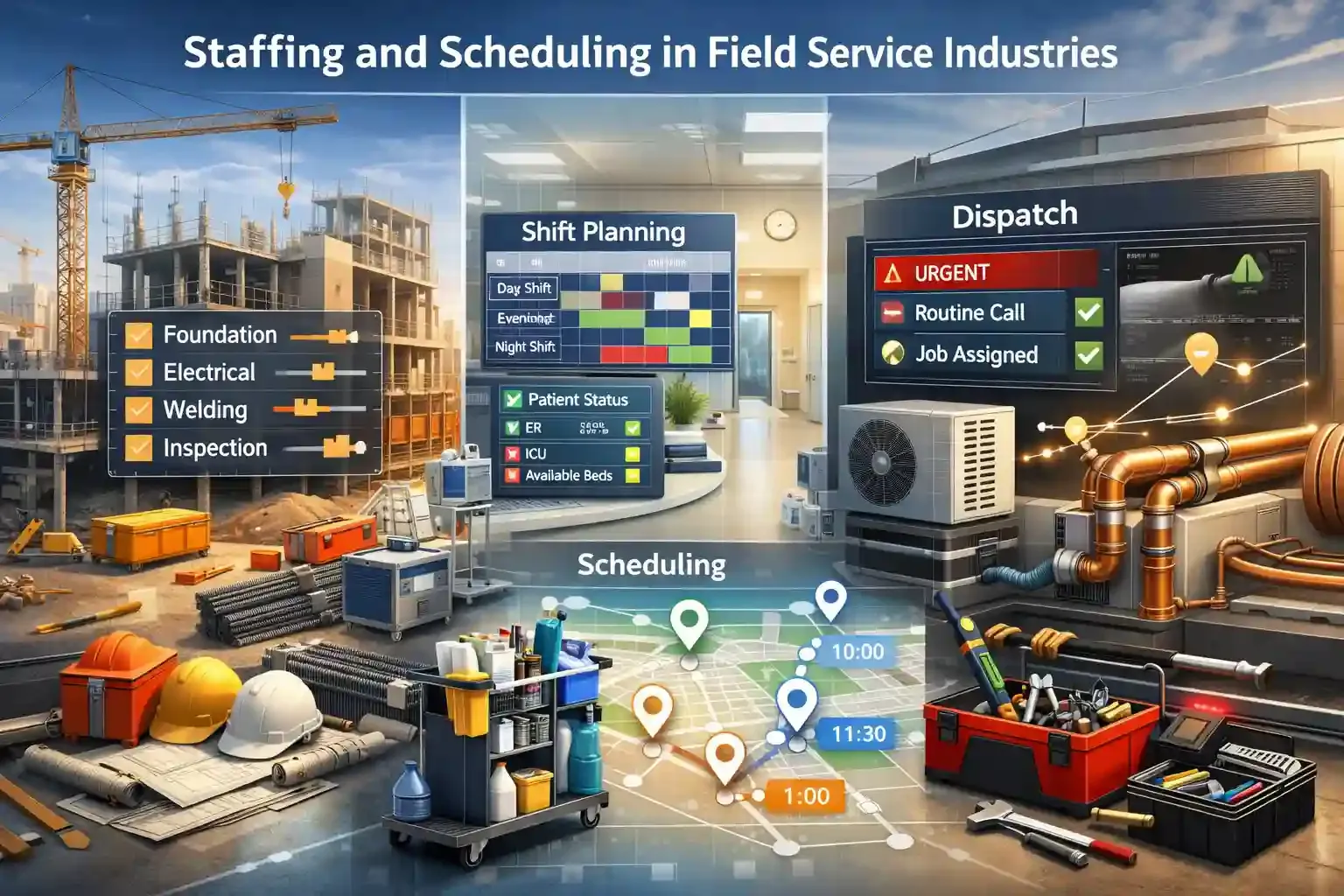
Construction
Construction depends on skilled labor to keep projects moving. You need the right workers, like electricians, welders, and site engineers, to match project needs. At the same time, optimized scheduling controls timelines and site coordination. Teams must show up in the right sequence, or the entire project slows down.
Healthcare
Healthcare relies on highly trained staff like nurses, doctors, and specialists. Staffing ensures the right expertise is available to handle patient care.
However, scheduling becomes critical because demand changes constantly. Hospitals must cover shifts, emergencies, and patient loads in real time.
Staffing shortages combined with poor shift planning increase workload pressure and reduce care quality. So, both availability and timing directly affect outcomes.
Cleaning Services
Cleaning services depend on the workforce size to handle multiple clients. Staffing ensures enough workers are available to cover contracts.
But field service scheduling decides how efficiently those workers move between locations. Teams must reach the right site at the right time to meet service commitments.
In many cases, poor scheduling leads to missed visits or delays. That directly affects customer satisfaction and repeat business.
Plumbing & HVAC
Plumbing and HVAC services rely on certified technicians. Staffing ensures you have skilled workers who can handle installations and repairs.
Scheduling becomes even more important because jobs vary in urgency. Emergency calls must be prioritized, while routine maintenance still needs attention.
Research shows that faster response times improve customer retention in home services. So, assigning the right technician at the right time directly impacts revenue.
Manage field teams without delays
Assign jobs, track teams, and keep schedules updated in real time
Common Staffing and Scheduling Challenges
- Understaffing during peak demand slows down operations and overloads your team.
- Overstaffing during slow periods increases labor costs without adding value.
- Scheduling conflicts create confusion when multiple employees are assigned incorrectly.
- Last-minute absences disrupt workflow and force managers to make rushed decisions.
- Compliance issues arise when shifts ignore labor laws, breaks, or overtime limits.
- Manual planning errors lead to missed shifts, double bookings, and poor coordination.
- Poor demand forecasting creates an imbalance between workload and available staff.
- Skill mismatch happens when the wrong employee gets assigned to the wrong task.
How to Improve Staffing and Scheduling
Staffing Improvement Steps
1. Align Staffing with Business Strategy
Start by aligning your staffing plan with your business strategy. This means identifying the right number of people with the necessary skills to meet your business goals.
2. Understand Ideal Staffing Levels
Knowing how many employees you need to achieve optimal performance is critical. Too many employees may lead to excess costs, while too few could result in missed opportunities or overworked staff.
3. Hire a Dedicated Staffing Manager
Hiring a staffing manager can streamline your staffing operations. This individual would oversee recruitment, training, and retention processes, ensuring that the workforce is always aligned with business needs.
4. Build a Diverse Talent Pool
A diverse talent pool ensures you have a wide range of skills available. By hiring people with different backgrounds and experiences, you can adapt quickly to unexpected situations.
5. Cross-Train Employees
Cross-training employees is a vital strategy to improve flexibility. This provides employees with opportunities for professional growth while ensuring your business can maintain operations when someone is absent.
Scheduling Improvement Steps
1. Get to Know Your Team
To schedule effectively, you need to understand your team’s skills and preferences. Knowing who can do what and what hours they are available ensures that tasks are assigned logically.
2. Use Scheduling Software
Implementing scheduling software can significantly improve your scheduling process. Tools like FieldServicely allow you to manage team availability, track projects, and adjust shifts with ease.
3. Prepare for Emergencies
Having a "Plan B" is essential for dealing with unexpected absences or emergencies. This could include creating a pool of on-call employees who can step in at short notice.
4. Regularly Review and Update the Schedule
Schedules should be regularly reviewed and updated to reflect any changes. Changes in employee availability, unexpected absences, or alterations in demand should be reflected in the schedule promptly.
5. Balance Employee Preferences and Business Needs
Balancing employee preferences with business needs is essential for improving scheduling. Collecting employee availability and preferences helps managers create schedules that respect personal time while meeting operational demands.
6. Use Data to Predict Peak Times
Analyzing historical data to identify peak times can optimize staffing levels and scheduling. This helps avoid understaffing, which can lead to customer dissatisfaction, or overstaffing, which can increase unnecessary labor costs.
7. Implement Fair Shift Policies
Adopting fair shift policies promotes employee satisfaction and reduces turnover. Ensure that shifts are distributed equally and that employees are not overburdened. Offering flexible shifts or rotating schedules can ensure that everyone gets a fair workload and that the business is covered at all times.
Manual vs Automated Staffing and Scheduling
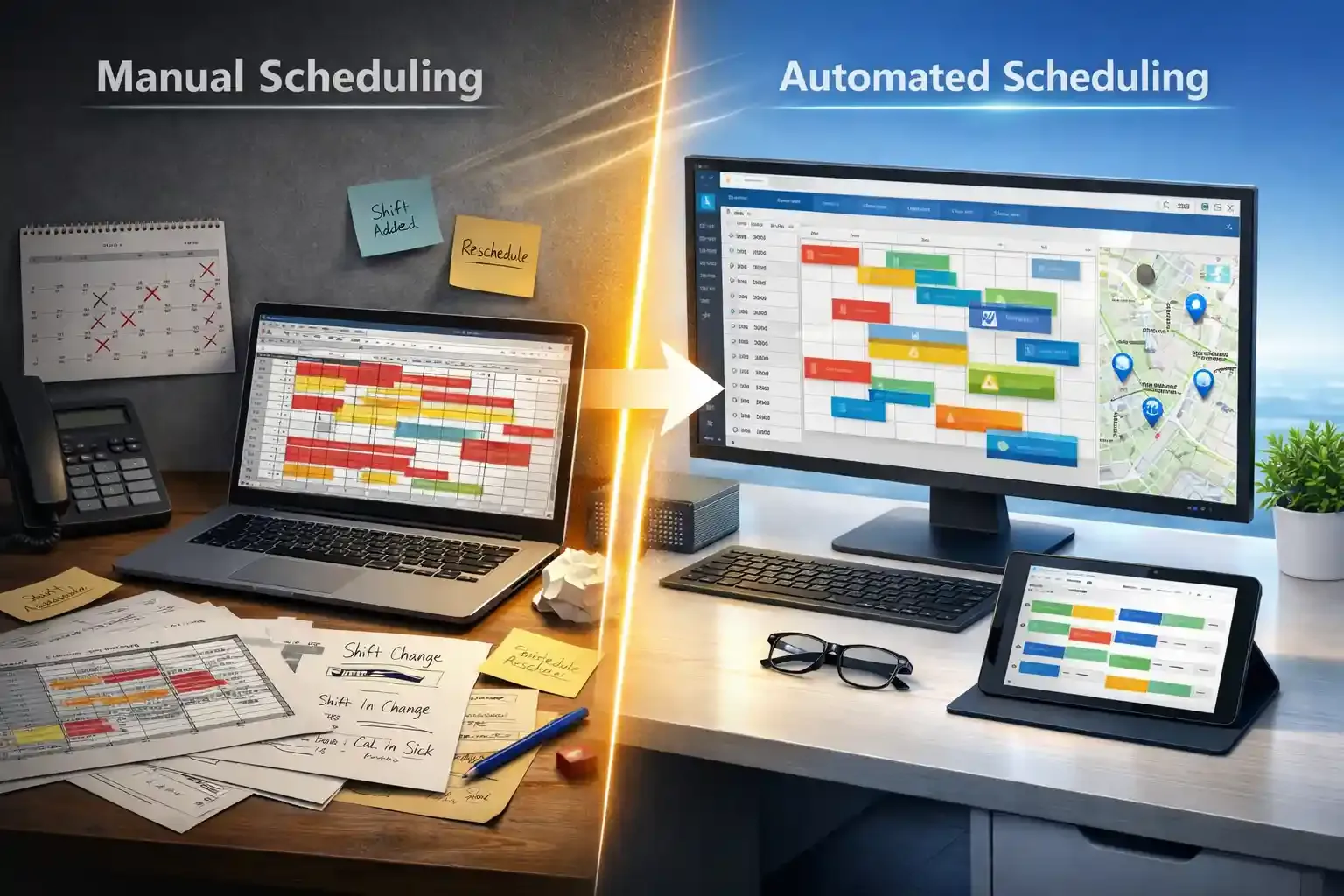
Manual Approach (Spreadsheets)
Manual scheduling relies on spreadsheets, calls, or basic tools. It works for very small businesses, but it becomes hard to manage as soon as complexity increases.
The biggest issue is time. Managers spend hours updating shifts, fixing conflicts, and handling last-minute changes.
Errors also happen more often than expected. Double bookings, missed shifts, and incorrect assignments create daily disruptions.
At the same time, there is no real-time visibility. If someone calls in sick or demands changes, the system cannot adapt quickly.
This creates a reactive workflow. Managers keep fixing problems instead of improving operations.
So, while manual methods look simple at first, they slow down growth and increase operational risk.
Automated Approach (Software)
Automated scheduling uses software to handle planning, updates, and coordination. It matches employee availability, skills, and demand in real time.
The biggest advantage is speed. What takes hours manually can be done in minutes with automated systems.
Accuracy also improves significantly. The system reduces conflicts, prevents double bookings, and keeps schedules aligned.
Visibility becomes much clearer. Managers can see who is available, who is assigned, and where gaps exist at any moment.
Cost control improves as well. Better scheduling reduces overtime, avoids overstaffing, and increases workforce utilization.
Most importantly, the system adapts instantly. If something changes, schedules update without disrupting the entire workflow.
Modern tools solve the gaps that manual systems cannot handle. They bring real-time updates, better coordination, and full visibility into daily operations.
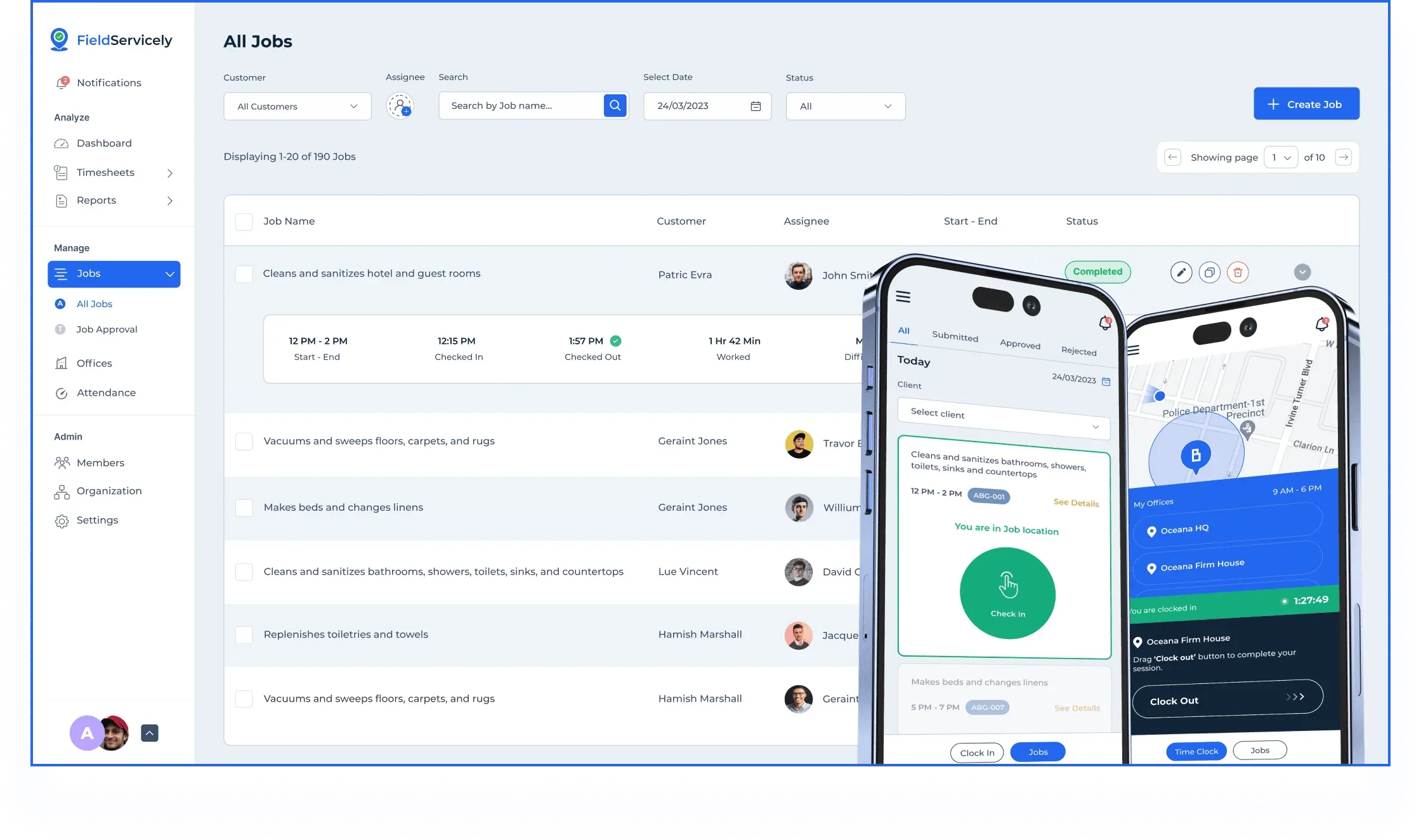
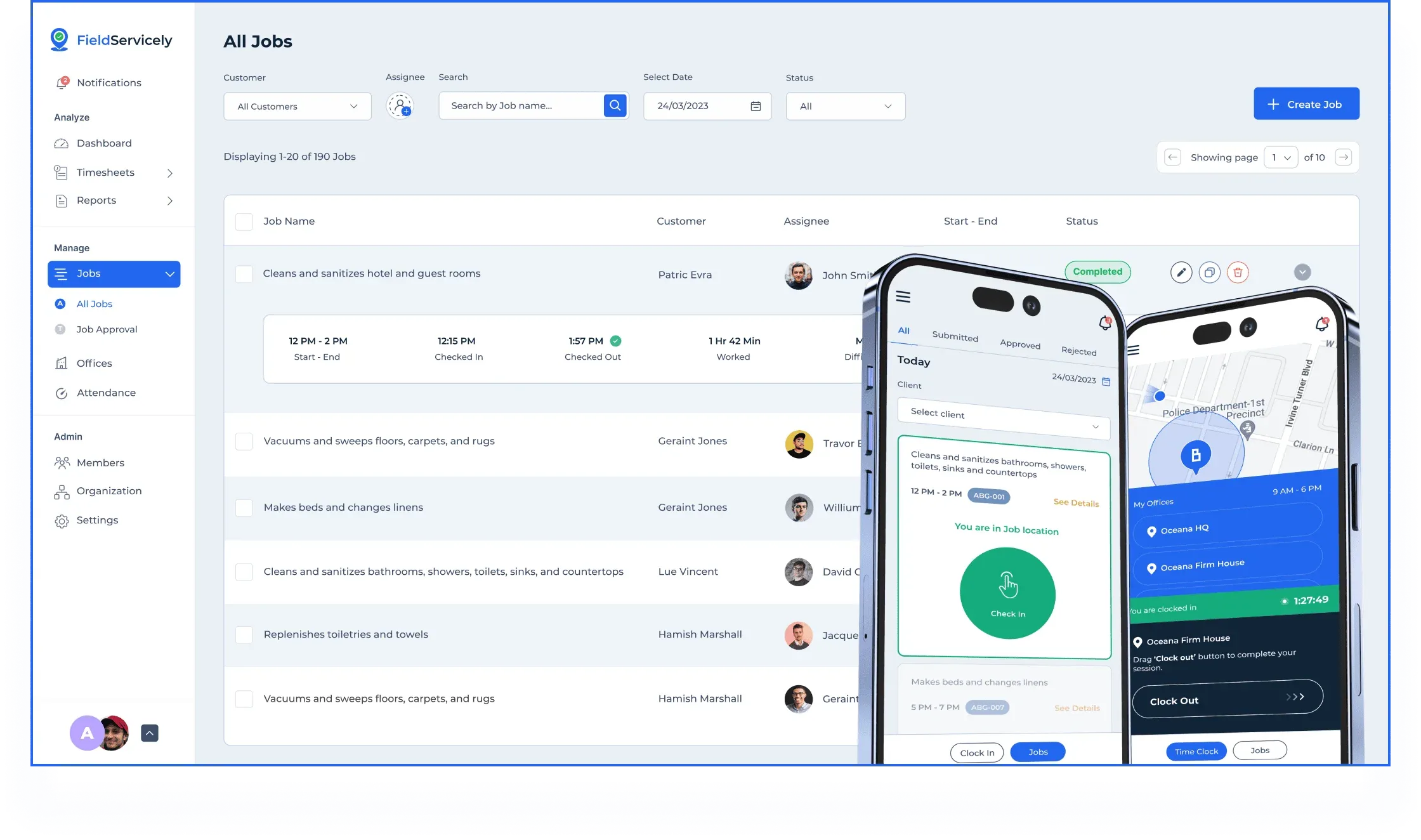
FieldServicely helps teams assign jobs, track technicians, and update schedules instantly from one dashboard. It combines job scheduling, GPS tracking, and real-time updates so managers always know what is happening on the ground.
This system works especially well for field service teams. It keeps schedules flexible, improves response time, and helps teams handle changes without chaos.
Move beyond spreadsheets with FieldServicely
Automate scheduling, reduce errors, and manage your team in real time
Conclusion
Staffing and scheduling work together, but they play very different roles. Staffing builds the foundation by bringing the right people into your business, while scheduling ensures those people deliver results at the right time.
Most businesses struggle because they mix these up and fix the wrong problem. The team is already there, but it is not used effectively. When you focus on improving scheduling, many operational issues like delays, overtime, and burnout start to resolve quickly.
Frequently Asked Questions
What is the difference between workforce planning and staffing?
Workforce planning focuses on future needs, while staffing executes those plans. Planning identifies gaps and demand, and staffing fills those gaps with the right people.
How often should you update employee schedules?
You should update schedules weekly or in real time for dynamic industries. Frequent updates help adjust to demand changes, absences, and workload shifts.
Can small businesses benefit from automated scheduling?
Yes, small businesses benefit even more because they have limited resources. Automation saves time, reduces errors, and improves team coordination without adding extra staff.
What industries need advanced scheduling the most?
Industries like healthcare, construction, retail, and field services need advanced scheduling. These sectors deal with shifting demand, multiple locations, and time-sensitive work.
How do you measure scheduling efficiency?
You measure it using metrics like overtime hours, idle time, job completion rate, and employee utilization. Lower overtime and balanced workloads indicate better scheduling performance.