- Scheduling and Dispatch
What Is Field Service Scheduling? Types, Models & Benefits
Updated on 8 Apr 2026

Jump to
Summary

Field service scheduling connects technician skills, routing, and job priorities into one decision system that drives efficiency
Optimized scheduling improves first-time fix rates, reduces travel time, and increases overall productivity
Different scheduling models, like reactive, preventive, and predictive, help businesses handle both urgent and planned work
Industry-specific constraints like SLAs, compliance, and recurring tasks shape how scheduling works in real operations
Advanced tools and systems turn scheduling from manual coordination into a data-driven, continuously improving process
Field service scheduling is the process of planning and managing how technicians handle jobs in the field. It helps businesses assign the right person to the right task based on skills, location, and availability. When done well, it improves productivity, reduces travel time, and increases first-time fix rates.
But it also comes with challenges like last-minute changes, poor planning, and mismatched job assignments. These issues often lead to delays, repeat visits, and wasted resources.
So, understanding how scheduling works is critical for any field operation.
In this blog, we will break down how field service scheduling works in real scenarios. We will also explore its models, common mistakes, and how to improve them effectively.
What is Field Service Scheduling
Field service scheduling is the process of planning, assigning, and managing technicians for jobs at customer locations. It ensures the right technician, with the right skills, parts, and availability, reaches the right job at the right time.
But this is not just calendar management. Instead, it functions as a connected decision system in which each factor directly affects job success.
For example, technician availability decides who can take the job without delays. At the same time, skills and certifications ensure the technician can fix the issue in one visit, which improves first-time fix rates.
Then, job priority controls urgency, especially during breakdowns or outages. Travel time and routing reduce wasted hours, and research shows that better routing can reduce delivery time by around 15% in field operations.
Next, territory limits, time windows, and parts availability shape whether a job can even be completed. On top of that, real-time disruptions like traffic or cancellations constantly change schedules during the day.
So, field service scheduling connects all these variables into one system. That is why it is a real-time optimization problem, not a booking task.
Why Field Service Scheduling Matters to Business Performance
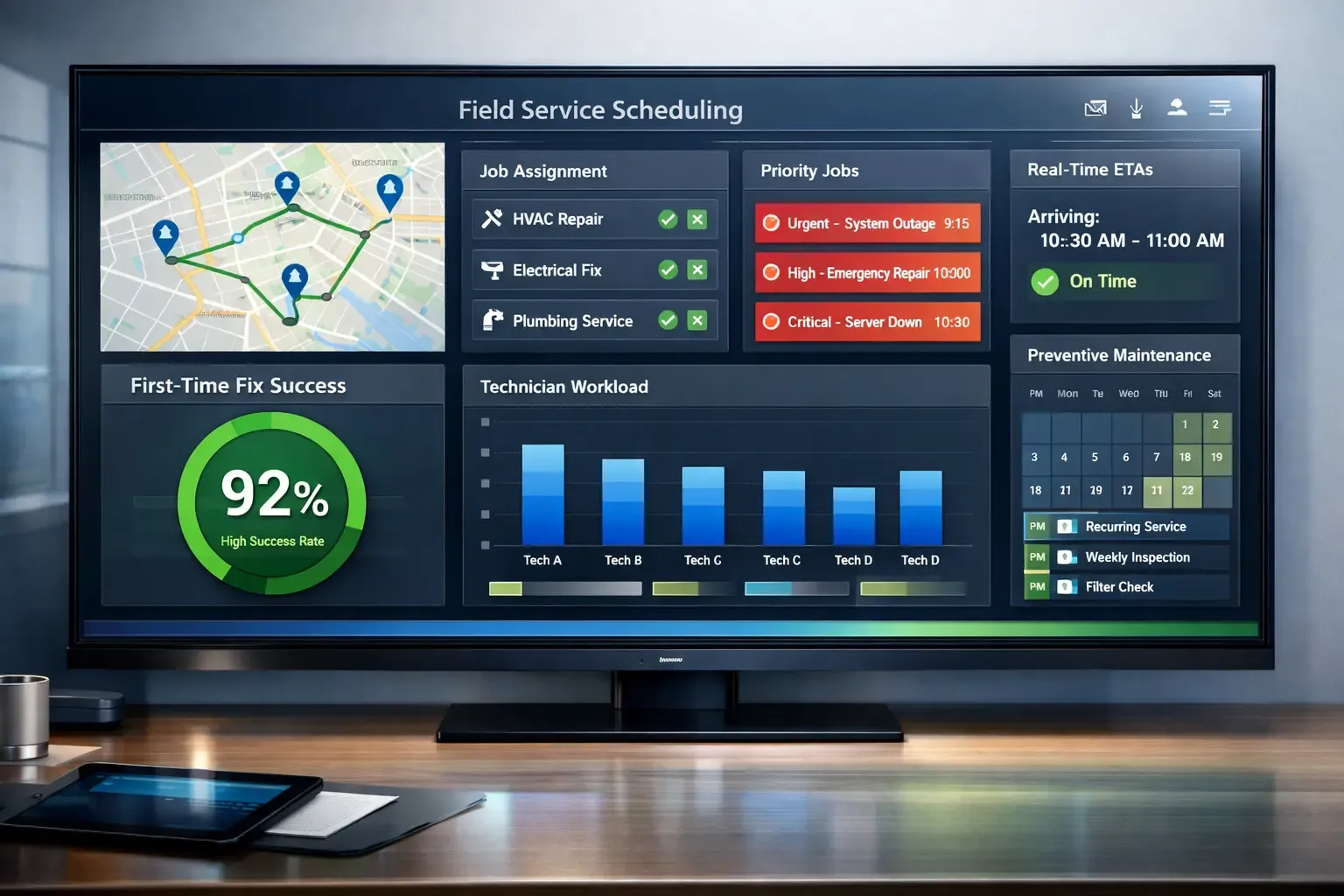
Better First-Time Fix Rates
If you’ve ever sent a technician twice for the same job, you already know the cost. It wastes time, increases expenses, and frustrates customers instantly.
Scheduling solves this by matching the right technician with the right skills and parts from the very beginning. That’s why companies with strong scheduling systems reach up to between 89% and 98% first-time fix rates.
And once you fix it right the first time, everything flows better. Fewer callbacks, smoother operations, and customers who actually trust your service.
Lower Travel Time and Fuel Waste
If your technicians spend more time on the road than on the job, something is off. I’ve seen teams lose 2–3 hours daily just driving between poorly planned jobs.
Field service scheduling reduces this by optimizing routes and grouping nearby jobs. According to research, route optimization minimizes travel time and distance simultaneously by balancing cost and efficiency constraints.
Stronger SLA Performance and Faster Response
If you deal with urgent service calls, you know how quickly schedules break. One emergency can delay everything else if there’s no priority system in place.
Field service scheduling handles this by ranking jobs based on urgency and availability. According to research, dynamic scheduling improves response time by 7.7%.
So instead of reacting late, you respond faster and stay within SLA commitments.
Better Technician Utilization Without Burnout
If you try to keep every technician busy all day, you might actually hurt performance. I’ve seen overloaded teams make more mistakes and miss deadlines.
Field service scheduling improves utilization by balancing workloads instead of overpacking schedules. A 2025 Deloitte study shows balanced scheduling improves productivity and reduces labor costs by 12.3%.
More Accurate Customer Communication
If customers don’t know when your technician will arrive, they begin to lose trust. Missed windows and vague timings often cause more frustration than the issue itself.
Field service scheduling improves this with real-time ETAs and accurate appointment windows. That’s important because 88% of customers expect live updates for service visits.
So when you keep customers informed, you don’t just deliver service. You deliver reliability.
Better Preventive Maintenance Execution
If you only fix problems after they happen, you’re always playing catch-up. I’ve seen businesses stuck in constant emergency mode because they ignore preventive work.
Field service scheduling changes by automating recurring maintenance jobs. Even preventive maintenance can reduce equipment downtime by up to 45%.
And once you move to planned maintenance, your operations become predictable and far less chaotic.
Still sending technicians twice for the same job?
Fix it with smarter scheduling that gets it right the first time.
Key Aspects of Field Service Scheduling
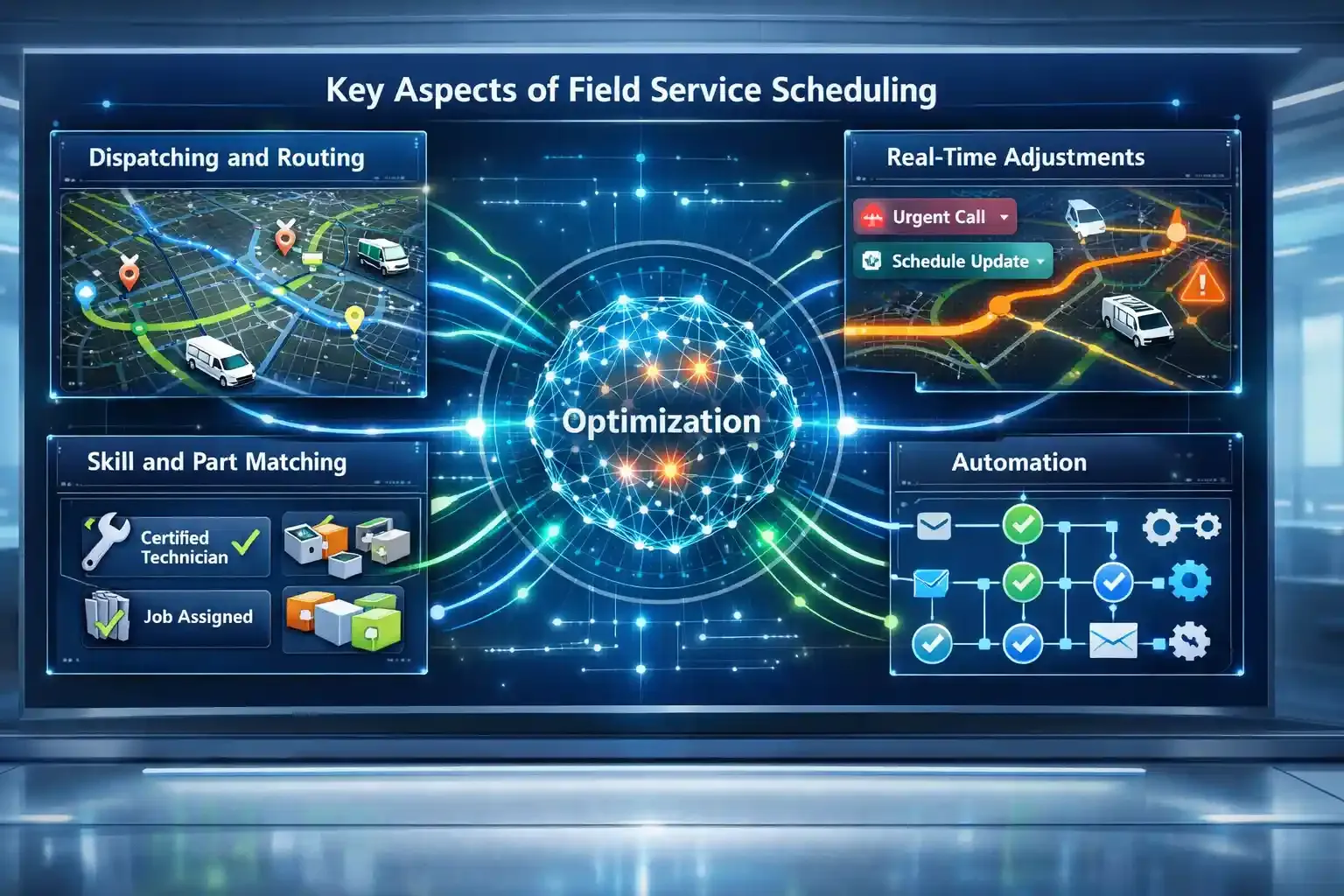
Dispatching and Routing
Dispatching assigns the right technician to the right job based on availability and location. Routing then decides the fastest and most efficient way to get there.
Now, when both work together, you reduce idle time and increase job completion rates. According to research, AI-driven dispatch systems have been shown to reduce idle time by up to 30%.
So instead of guessing who should go where, the system makes faster and smarter decisions.
Skill and Part Matching
Skill matching ensures the technician can handle the job without trial and error. Part matching ensures they have everything needed before leaving for the job.
Now imagine sending a technician without the required part. The job gets delayed, and the customer has to wait again.
That is why modern scheduling systems check both skill and inventory together. This directly improves first-time fix rates and reduces repeat visits.
Real-Time Adjustments
Real-time adjustments keep the schedule flexible when things change. Traffic, cancellations, and emergency calls can disrupt even the best plans.
So instead of breaking the schedule, the system reshuffles jobs based on priority and availability. According to research, real-time scheduling has become essential due to rising operational complexity.
And honestly, without this, your schedule will fall apart within hours.
Automation
Automation handles repetitive decisions without manual input. It assigns jobs, updates schedules, and sends notifications instantly.
This reduces human error, such as double booking or missed appointments. Research showed that automation plays a key role in improving operational efficiency and reducing scheduling mistakes.
So instead of relying on manual coordination, the system keeps everything moving smoothly.
Optimization
Optimization connects all these components into one decision engine. It balances skills, routes, availability, and priorities at the same time.
This is where scheduling becomes powerful. A report shows AI-driven optimization can improve throughput by 20% in industrial systems.
So instead of reacting to problems, the system continuously improves performance.
Too many scheduling errors are slowing your team down?
Automate repetitive decisions and reduce manual mistakes instantly.
Types of Field Service Scheduling Models
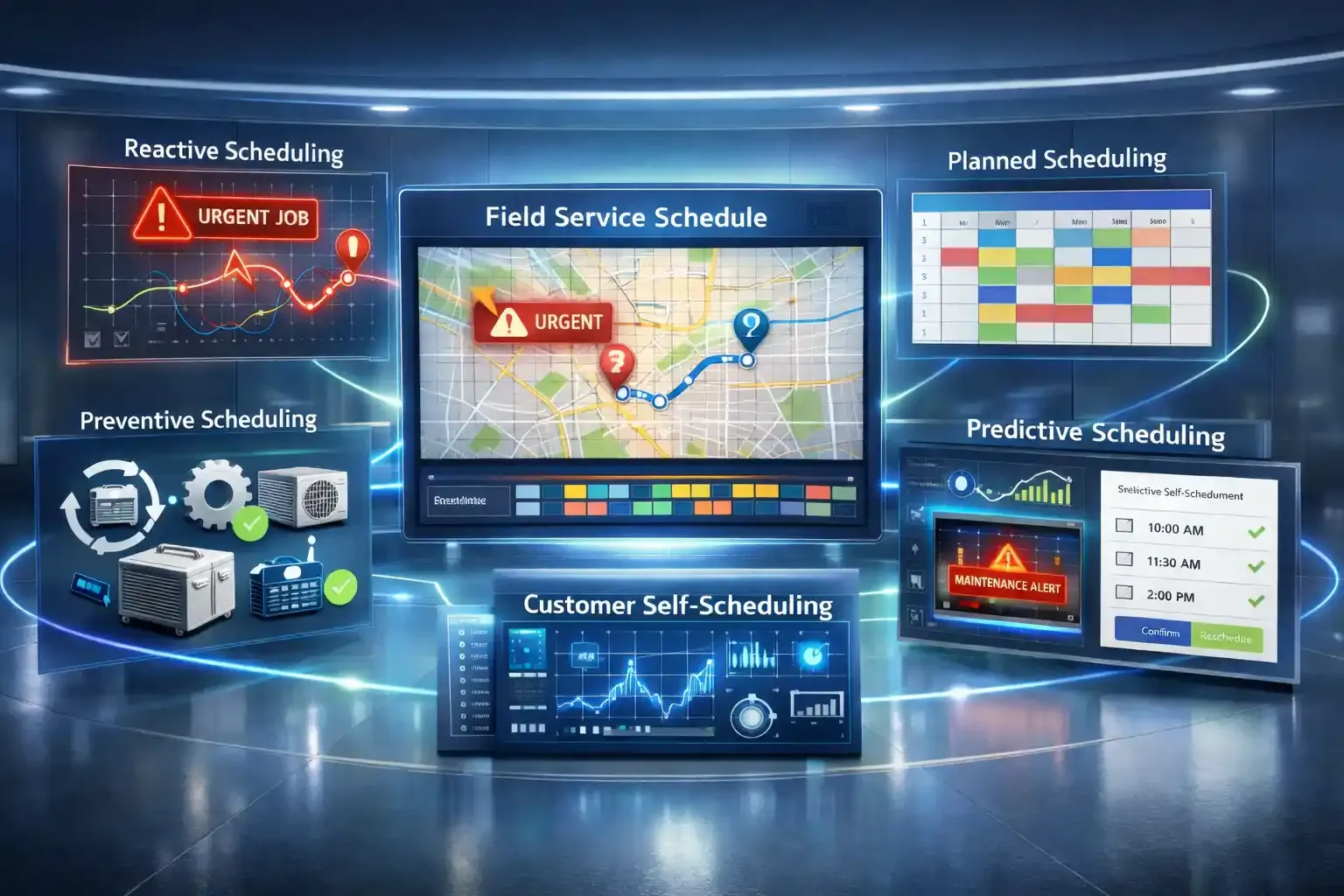
Field service scheduling does not follow one single model. Different businesses use different approaches based on job type, urgency, and operational complexity.
Let me break this down:
Reactive Scheduling
Reactive scheduling handles emergency or break-fix jobs as they come in. When something breaks, the system assigns the nearest available technician immediately.
This works well for industries like HVAC or plumbing, where urgency matters more than planning. Even reactive work still accounts for nearly 60% of service calls in repair-driven industries.
But over-relying on reactive scheduling increases travel costs and disrupts planned work.
Planned Scheduling
Planned scheduling handles jobs that are known in advance, like installations or inspections. You assign technicians based on time slots, availability, and location.
This makes operations predictable because teams can prepare tools, parts, and schedules ahead of time. Companies reduce last-minute chaos just by shifting more work into planned scheduling.
And when you plan properly, you reduce delays and improve job completion rates.
Preventive Scheduling
Preventive scheduling focuses on recurring maintenance tasks. Instead of waiting for failures, you schedule regular service based on time or usage.
This keeps equipment running smoothly and reduces emergency breakdowns. According to Deloitte, predictive maintenance can reduce breakdowns by 70%.
So instead of reacting to problems, you avoid them before they happen.
Predictive or Condition-Based Scheduling
Predictive scheduling uses data and IoT signals to decide when a job is needed. Sensors track equipment condition and trigger service only when required.
This makes scheduling smarter because it is based on actual usage, not guesswork. For example, industrial companies use sensor data to schedule repairs before failure occurs.
The same Deloitte reports that predictive maintenance can reduce maintenance costs by up to 25%. So now scheduling becomes data-driven, not time-based.
Customer Self-Scheduling
Customer self-scheduling allows customers to book, reschedule, or cancel appointments on their own. This reduces manual coordination and improves customer engagement with a rich experience.
This has become a modern expectation, especially in home services and telecom.
Now think about it. When customers choose their own time slots, missed appointments drop significantly.
Prevent breakdowns instead of chasing them all day.
Use recurring scheduling to keep operations stable and efficient.
How Do Different Industries Schedule?

HVAC / Plumbing / Electrical
HVAC, plumbing, and electrical teams rely heavily on reactive scheduling. Most jobs come from emergency calls like leaks, breakdowns, or power failures.
This creates high variability because no one can predict when the next job will come in. Scheduling here focuses on quick dispatch, location-based routing, and handling urgent jobs without collapsing the rest of the day.
Utilities / Telecom
Utilities and telecom companies schedule around strict SLAs and large service areas. When outages happen, response time becomes the top priority.
This means scheduling must balance urgency with geography. Technicians often cover wide territories, so route planning becomes critical to meet deadlines.
According to research, telecom service demand continues to grow with network expansion, increasing pressure on field teams to respond faster.
So here, scheduling is less about convenience and more about meeting service commitments under pressure.
Medical / Industrial Service
Medical device and industrial service teams schedule based on compliance, expertise, and parts availability. Not every technician can handle every job due to certifications and safety requirements.
This makes scheduling more restrictive because you must match the exact skill set and ensure the right parts are available. Missing either one can delay operations or even create safety risks.
Facilities / Property Operations
Facilities management teams rely on planned and preventive scheduling. Most work includes recurring maintenance, inspections, and multi-site coordination.
This creates a structured schedule where tasks repeat weekly, monthly, or quarterly. For example, managing HVAC systems across multiple buildings requires consistent planning and tracking.
Here, scheduling means consistency, planning, and managing multiple locations at once.
In-Home Healthcare
Healthcare scheduling depends on strict timing and continuity of care. Patients often require services at specific times, and consistency with the same caregiver matters.
This makes scheduling highly sensitive because delays or mismatches can affect patient outcomes. Unlike other industries, you cannot simply reassign jobs without considering patient history.
Scheduling in healthcare focuses on precision, trust, and maintaining consistent caregiver relationships.
Meet strict SLAs and manage large service areas with better planning.
Keep response times fast without losing control.
Common Field Service Scheduling Mistakes
- Treating scheduling as admin work reduces it to a simple booking instead of a decision system
- Confusing scheduling vs dispatching blurs planning and execution, and creates operational confusion
- Ignoring parts readiness leads to failed first visits and repeat jobs
- Matching availability, not skill, sends the wrong technician and lowers fix rates
- Overpromising time windows creates missed appointments and unhappy customers
- Over-optimizing utilization burns out technicians and reduces long-term productivity
- Ignoring multi-day or crew constraints breaks complex job timelines and coordination
- Using spreadsheets for too long causes errors, delays, and poor scalability
- Not learning from scheduling outcomes stops improvement and repeats the same mistakes
A Maturity Model for Field Service Scheduling
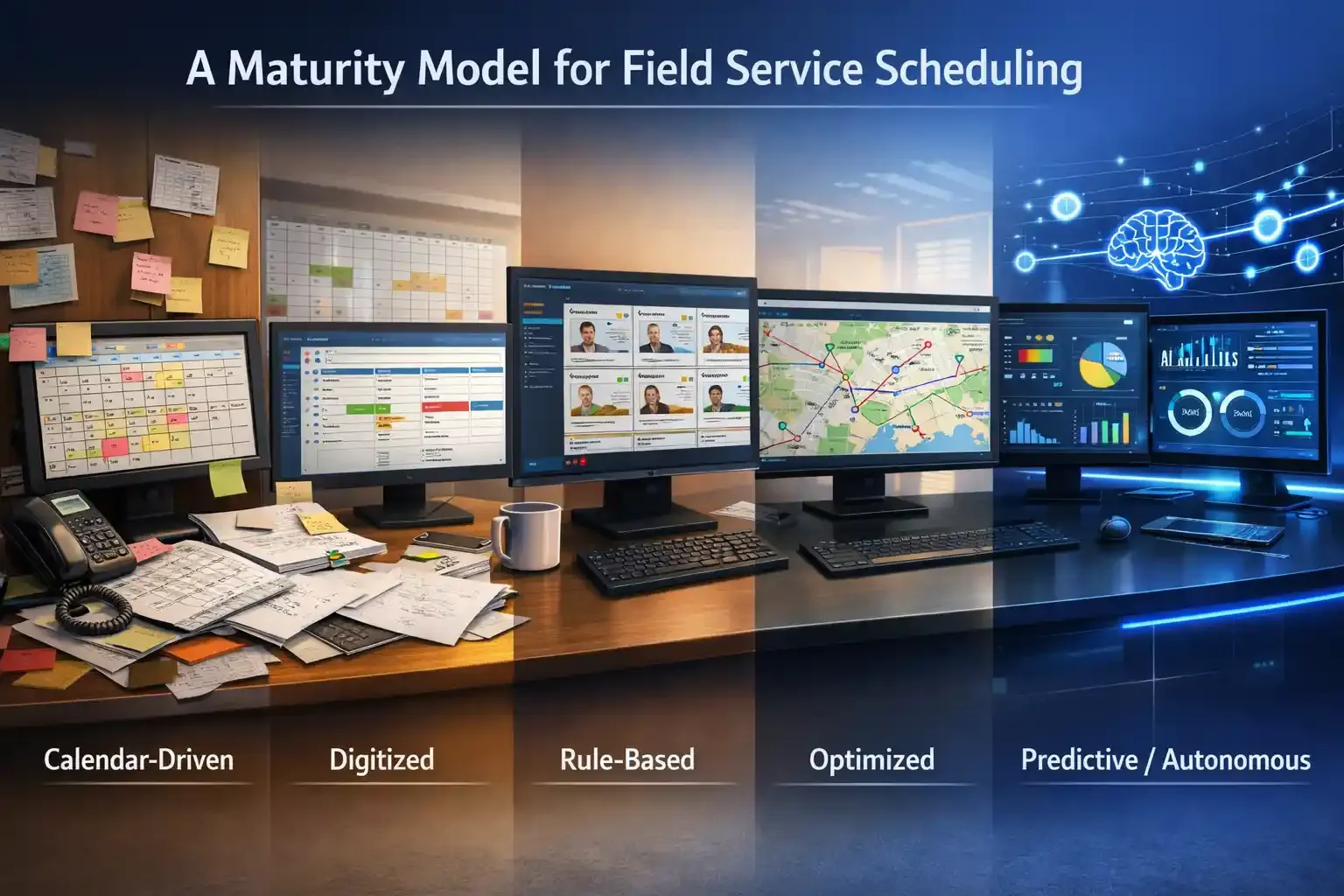
Field service scheduling does not stay the same as your business grows. It evolves in stages, and each stage changes how efficiently your operations run.
Let me walk you through how this maturity actually develops in real-world teams.
Stage 1: Calendar-Driven
This stage relies on manual scheduling using spreadsheets, calls, or basic calendars. Teams react to problems instead of planning, and dispatchers handle everything manually.
This creates delays, errors, and poor visibility because no system connects decisions. So at this point, scheduling feels chaotic and heavily dependent on individual effort.
Stage 2: Digitized
This stage introduces shared schedules and basic digital tools. Teams can now see who is available and track jobs in real time.
This improves visibility because everyone works from the same system instead of scattered tools. According to research, digitized field teams improve productivity up to 87%.
But here’s the limitation. Scheduling is still mostly manual, just faster than before.
Stage 3: Rule-Based
This stage uses rules to guide scheduling decisions. The system starts assigning jobs based on skills, territories, and job priority.
This reduces guesswork because decisions follow predefined logic instead of human judgment alone. For example, a certified technician gets assigned automatically to specialized tasks.
So instead of reacting, teams start operating with structure and consistency.
Stage 4: Optimized
This stage focuses on improving operational efficiency across the entire system. Scheduling now considers routing, SLA commitments, and workload balancing together.
This increases productivity because technicians travel less and complete more jobs. Now scheduling becomes proactive, not just rule-based.
Stage 5: Predictive / Autonomous
This stage uses AI and data to drive scheduling decisions automatically. Systems predict when jobs will be needed and assign technicians without manual input.
This includes self-service booking and IoT-triggered jobs based on real equipment data. At this level, scheduling becomes fully data-driven and continuously improving.
Move beyond manual scheduling and reduce daily chaos.
Build a system that grows with your operations.
What Modern Field Service Scheduling Software Should Handle
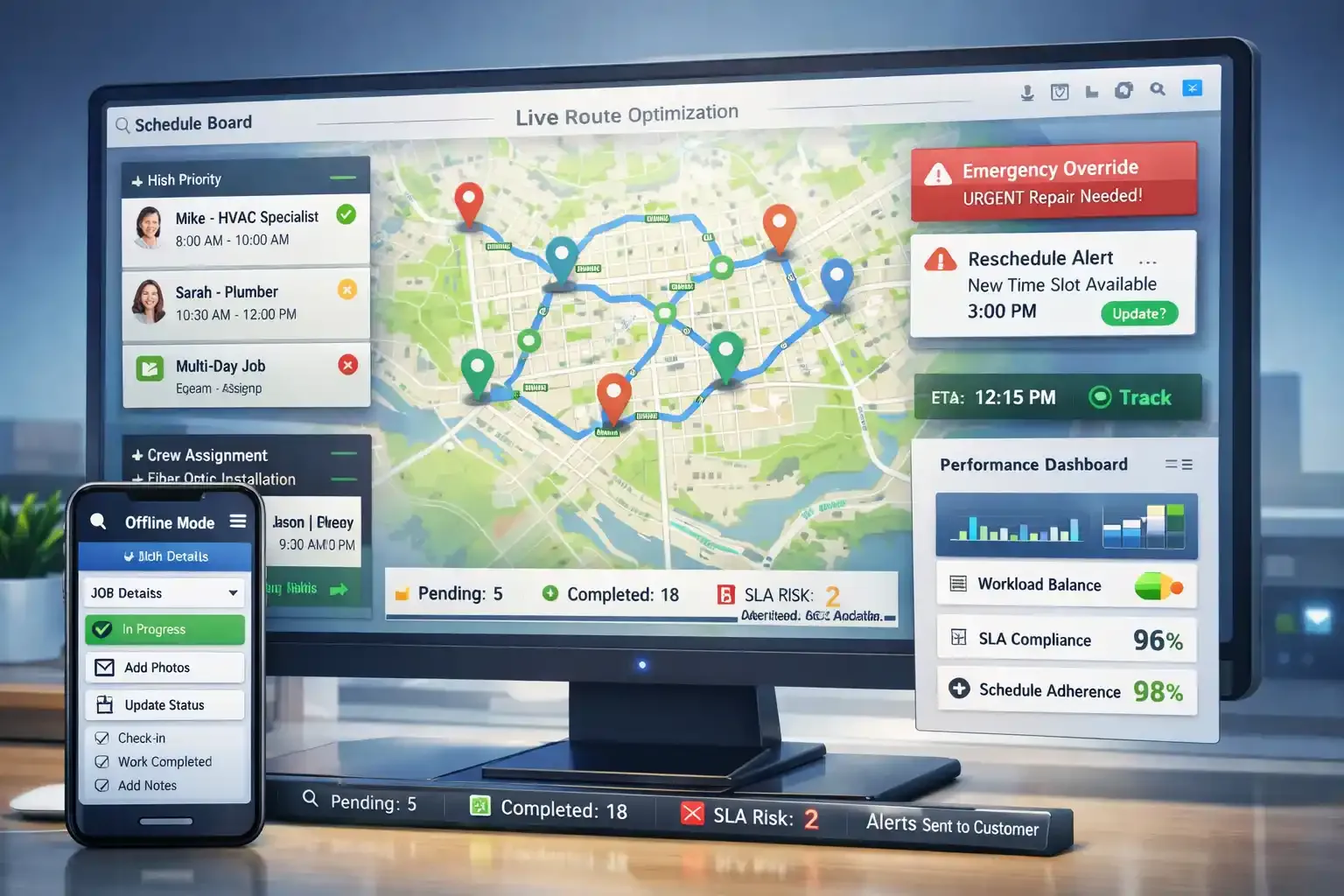
Modern field service scheduling software must make decisions, not just assign jobs. It should match technicians based on skills, location, and availability, and then adjust based on travel time and job priority. That’s because intelligent scheduling improves field productivity by over 30%.
Because of that, the system must also handle recurring jobs, emergency overrides, and multi-day work without breaking the flow. It should support crew scheduling as well, especially when multiple technicians are needed for one job.
So instead of managing tasks separately, everything stays connected in one workflow.
Now, once the schedule is created, execution becomes the next challenge. Technicians need mobile access to job details, even without internet, so offline support matters. They should update the status, add notes, and upload photos in real time.
At the same time, customer experience depends on how accurate your scheduling is. The software should provide live ETAs, allow easy rescheduling, and send automatic notifications.
Then, operational visibility ties everything together. Managers need to track workload balance, SLA risks, and schedule adherence in one place.
This is exactly where FieldServicely fits in. It connects scheduling intelligence, field execution, and performance tracking into one system. So instead of juggling tools, you manage everything from one place and keep operations running smoothly.
Stop managing jobs manually across different tools.
Handle scheduling, execution, and tracking with FieldServicely.
Conclusion
Field service scheduling shapes how efficiently your entire operation runs. It connects planning, execution, and customer experience into one system that either drives growth or creates constant friction. When you move beyond basic scheduling and start using structured or optimized approaches, you reduce delays, improve service quality, and gain better control over your workforce.
Frequently Asked Questions
What is the difference between field service scheduling and field service management?
Field service scheduling focuses on assigning and planning technician jobs efficiently. Field service management covers the entire operation, including scheduling, dispatching, inventory, and customer service. So, scheduling is one part of a larger system.
What tools are used for field service scheduling?
Field service scheduling uses software tools with features like job assignment, route optimization, and real-time tracking. These tools replace manual methods like spreadsheets and reduce errors. Most modern systems also include mobile apps for field technicians.
How does field service scheduling improve first-time fix rates?
Field service scheduling improves fix rates by assigning technicians based on skills, job history, and parts availability. This ensures technicians arrive prepared for the job. As a result, fewer repeat visits are needed.
Can small businesses benefit from field service scheduling software?
Field service scheduling software helps small businesses reduce manual work and improve job efficiency. Even with a small team, better scheduling reduces delays and missed appointments. It also helps scale operations without adding more administrative work.
What challenges do companies face when implementing field service scheduling?
Companies often struggle with data accuracy, team adoption, and process changes during implementation. Poor setup can lead to incorrect job assignments or scheduling conflicts. However, proper training and system setup solve most of these issues over time.