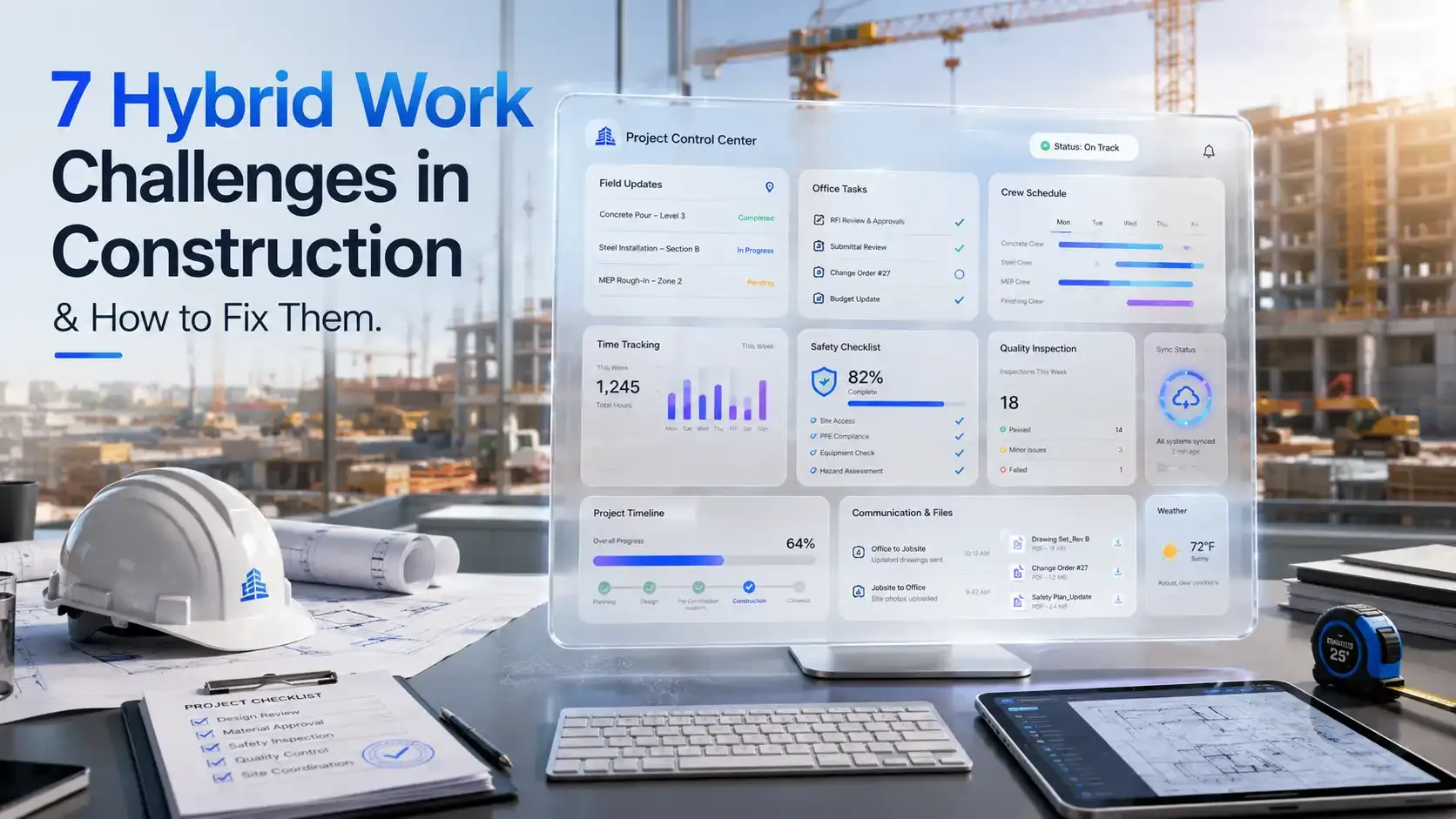
7 Hybrid Work Challenges in Construction & How to Fix Them
Updated on 18 Jun 2026
Jump to
Summary

92% of construction firms now use hybrid work, up from 52% before COVID.
Communication gaps between office and field crews cause rework, delays, and safety risks.
Time tracking, scheduling, and quality control break down when teams are split across locations.
Clear hybrid policies, role-specific training, and structured daily check-ins fix most of these problems.
The shift is permanent. Firms that adapt will hire and retain better than those that resist.
Hybrid work challenges in the construction industry hit differently than in any other field. A miscommunication in tech means a missed deadline. A miscommunication on a jobsite means someone gets hurt.
McKinsey found that 9 out of 10 organizations plan to mix remote and on-site work permanently. In construction specifically, 92% of firms now allow some form of hybrid or remote work. Before COVID, that number was 52%.
But construction is not a laptop-and-coffee-shop industry. Boots need to be on the ground. When your workforce splits between the field and a home office, everything from safety to scheduling to payroll gets harder.
This blog breaks down the 7 biggest hybrid work challenges construction companies face right now, why they happen, and what actually fixes them.
What Does Hybrid Work Actually Look Like in Construction?
The hybrid work model in construction is not "working from home." It means splitting your workforce into roles that stay onsite, roles that operate remotely, and roles that flex between both.
Estimators, project managers, safety coordinators, BIM modelers, and procurement staff spend most of their time on digital dashboards and virtual meetings. Electricians, plumbers, equipment operators, and laborers, on the other hand, do physical work that no video call can replace.
Then some inspectors and superintendents handle site checks in person but finish reporting and documentation remotely. So why are construction firms bothering with this split?
The industry needs 349,000 new workers in 2026 just to meet demand. That labor shortage is forcing companies to offer flexibility wherever possible. And 40% of workers would start job hunting if flexible work disappeared.
The hybrid construction workforce is real. But making it work without losing field coordination or accountability? That is where things fall apart.
Why In-Person Collaboration Still Matters on the Jobsite
- Construction is relationship-driven. When a concrete pour goes sideways, or a sub misses a deadline, you need to solve this face-to-face.
- Real-time decisions on large-scale projects harm schedules, and budgets directly. That pressure demands people in the same room.
- Mentorship only works up close. Younger workers learn by standing next to experienced supervisors, watching how they read a site and make calls under pressure. Screen shares don't teach that.
- The goal is not to go fully remote. Companies that treat in-person and hybrid as complementary, not competing, hold onto their best people longer.
But finding that balance is exactly where things break down. Here are the real challenges.
7 Hybrid Work Challenges in the Construction Industry
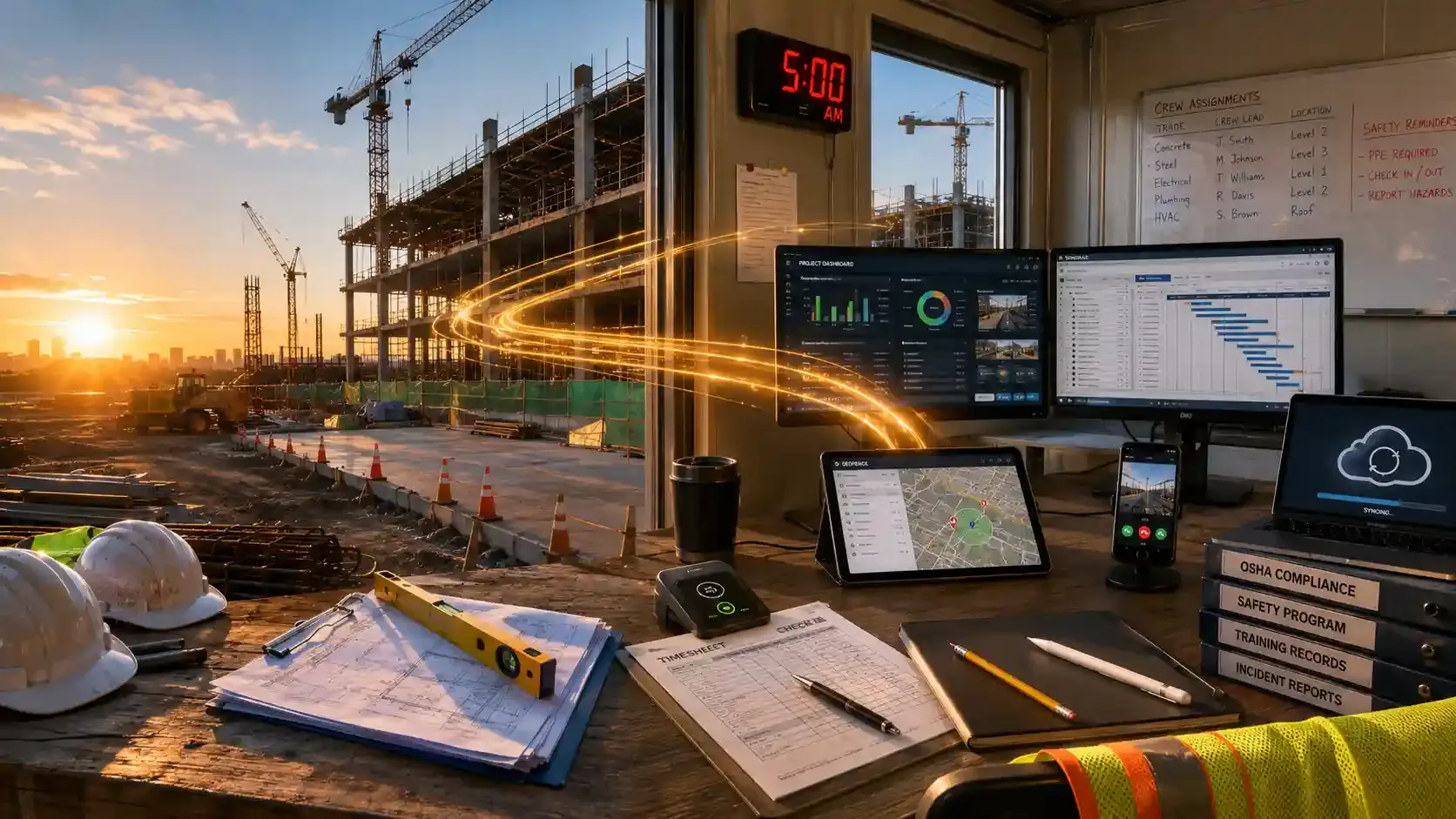
Hybrid work challenges catch construction companies off guard. Because nobody talks about them until projects start bleeding money.
Communication Breakdowns Between Office and Field
Ask any GC what breaks first in a hybrid setup. They are most likely to reply that it is communication. Every single time.
I had my PM reviewing submittals from his kitchen table last year. Meanwhile, the foreman needed an answer on a footing change in the next ten minutes. That answer sat in an email for three hours. We poured the wrong spec.
53% of workers say they find it harder to feel connected to their coworkers. Mostly because nobody trained them properly. On a jobsite, you grab a guy, point at the wall, and get a decision in two minutes.
Over Zoom? That same conversation takes a day and a half. Then the schedule slips, and the client calls.
Tracking Time and Attendance Across Scattered Crews
I used to run timesheets on paper. It worked fine when everyone clocked in at the same gate every morning.
Then we went hybrid. Crews on three different sites. Office staff at home. And suddenly I had no idea who was actually where.
One crew lead was logging eight hours for a guy who left at noon. We caught it six weeks later. Six weeks of overpaid hours, gone.
FieldServicely fixed that for us. Geofence clock-in with selfie verification. Workers log time only when GPS confirms they are standing on the site. That one change cleaned up our payroll overnight.
Supervising Work Quality Without Being on Site
I have walked a slab and felt something was off before I even looked at the level. That instinct comes from being there. A progress photo on a dashboard does not give you that.
Remote supervision tracks milestones fine. It tells you a task got marked complete. It does not tell you the framing crew cut a corner on the second floor because nobody was watching.
Some of our supers started requiring photo and audio uploads after every inspection. It helped a lot. Still not the same as boots on concrete, but it closed gaps we did not know we had.
Scheduling and Dispatching Across Multiple Sites
Four active jobs. Crews split between sites, the office, and home. I ran that off a whiteboard and group texts for longer than I should have.
Here is what hybrid scheduling actually looks like. A rainstorm kills your Tuesday pour. Two guys call in sick on Wednesday. Materials get pushed to Thursday.
Now you need to reshuffle three crews across four sites before 6 AM, and the only tool you have is a phone call chain.
Nobody checks the group chat fast enough when plans change at 5 in the morning. One delayed crew cascades into missed deadlines on projects that had nothing to do with the original problem.
Safety and Compliance Gaps in a Hybrid Setup
OSHA does not care that your safety coordinator works from home on Tuesdays. They care about the inspection log.
We had a near-miss on a framing job last spring. The safety guy was remote that morning. Nobody caught a missing guardrail until a laborer almost walked off the edge.
Throw multi-state compliance on top. Admin in Texas, crew in Oklahoma. Different overtime rules. Every project turns into its own regulatory puzzle.
Getting Experienced Workers to Actually Use New Tools
My best foreman has been doing this for 28 years. He does not want an app. He wants his clipboard and a pencil.
Did you know high-growth firms spend 47% more on tech than the average contractor? But nearly 10% of that budget goes to tools nobody touches.
One afternoon webinar will not undo three decades of habit. Training has to be hands-on, role-specific, and ongoing, or it is wasted money.
Keeping Team Culture and Mentorship Alive
My best project lead did not learn the job from a manual. He learned it standing next to a super for two years, watching him handle a difficult sub, figuring out when to push and when to back off.
This learning only happens in person. Hybrid takes it away. And you do not realize the cost until a junior PM sits in their first owner meeting with nothing to say.
One platform for scheduling, tracking, and payroll.
See where your crew is and what they are working on right now.
How to Tackle Hybrid Work Challenges in Construction
- There are different tools to track the project. But they do not track your people. For that, you need a field service management platform.
- FieldServicely covers GPS time tracking, geofenced attendance, dispatching, timesheets, payroll, and scheduling in one place. Free to start.
- Write a hybrid work policy before problems start. Which roles qualify, how many remote days, response time expectations, and performance benchmarks.
- Make everything role-specific. An estimator's hybrid setup looks nothing like a superintendent's.
- Train crews on the actual tools they will use. Hands-on, role-matched, and repeated every few months. One onboarding webinar does not stick.
- Replace hallway conversations with structured daily standups and weekly syncs. Document decisions. Verbal agreements get forgotten by Friday.
Is Hybrid Work the Future of the Construction Industry?
For roles that do not require constant physical presence, yes. This is a permanent shift, not a pandemic leftover.
Modular and prefab construction is shrinking onsite crew sizes every year. More components get built in controlled factory settings and assembled on site with smaller, specialized teams. Remote coordination becomes practical when half the work happens off-site before a single foundation gets poured.
AI-powered scheduling is getting sharper too. The construction software market hit $10,96 billion in 2024 and is projected to reach $19,12 billion by 2030. The tools are not slowing down.
The firms that treat hybrid as a recruiting and retention advantage will run leaner and hire faster. The ones still forcing everyone on site five days a week will keep losing people to companies that figured it out.
Conclusion
Hybrid work in construction is not going anywhere. The companies getting it right are not choosing between flexibility and field control. They are building systems that handle both.
Set clear policies. Train your crews on the tools they actually use. Fix communication before it costs you a project. And track your people with the same precision you track your materials.
The firms that figure this out will hire faster, retain longer, and run tighter jobs than everyone still stuck debating whether hybrid even works.
Frequently Asked Questions
1. How do you measure productivity for remote construction staff?
Track deliverables, not hours. Set weekly output targets for each remote role. Submittals reviewed, RFIs closed, schedules updated. Use dashboards that show task completion rates in real time. If a PM clears 12 RFIs a week from home versus 8 in the office, the numbers speak for themselves.
2. Does hybrid work increase cybersecurity risks for construction firms?
Yes. Remote logins from personal devices and public Wi-Fi expose project data, bid documents, and client contracts. Require VPN access, two-factor authentication, and encrypted file sharing for every remote connection. One breached bid proposal can cost you a project before it starts.
3. How do construction unions handle hybrid work arrangements?
Most union contracts were written for on-site work. Hybrid roles can trigger disputes over pay rates, overtime rules, and jurisdiction. Talk to your local hall before rolling out any remote arrangements for union trades. Get hybrid terms added to the next CBA negotiation so everyone operates from the same playbook.
4. Can small contractors with under 20 employees make hybrid work?
They can, and many already do. A five-person office does not need enterprise software. Free or low-cost tools for GPS tracking, cloud-based plan sharing, and video check-ins cover the basics. Small firms actually adapt faster because they skip the bureaucracy that slows down large rollouts.
5. What happens when jobsite internet is too weak for hybrid tools?
Rural and early-phase sites often have poor connectivity. Choose apps that sync offline and push updates once the signal returns. Mobile hotspots and mesh Wi-Fi units solve most gaps for under $200 a month. If your tool requires constant internet to function, it was not built for field conditions.