
10 Proven Time Management Tips for Construction Project Managers
Updated on 25 May 2026
Jump to
Summary

Time management works best when the schedule leads the day, not emails or random site calls.
Small delays become costly when crews, materials, inspections, and task owners are not aligned early.
Critical path work needs protected time because it decides whether the project stays on track.
Field reports, meeting buffers, and power hours help PMs reduce admin pressure and act faster.
Strong construction workflow comes from simple daily habits, clear ownership, and repeatable systems.
Time management keeps construction schedule in control. A clear plan helps protect the critical path before small site issues spread.
From there, field reporting shows whether crews, materials, and tasks match the plan. The pain starts when the schedule says work should move, but the crew still waits.
Maybe materials are missing, an RFI sits open, or the field update lacks detail. That small gap can turn into construction delays, admin overload, and a messy construction workflow.
Good construction time management keeps people, tasks, and decisions connected. In this blog, I will discuss practical time management tips for construction project managers. I will also show how to reduce pressure without making daily work more complex.
Why Time Management Matters in Construction Project Management
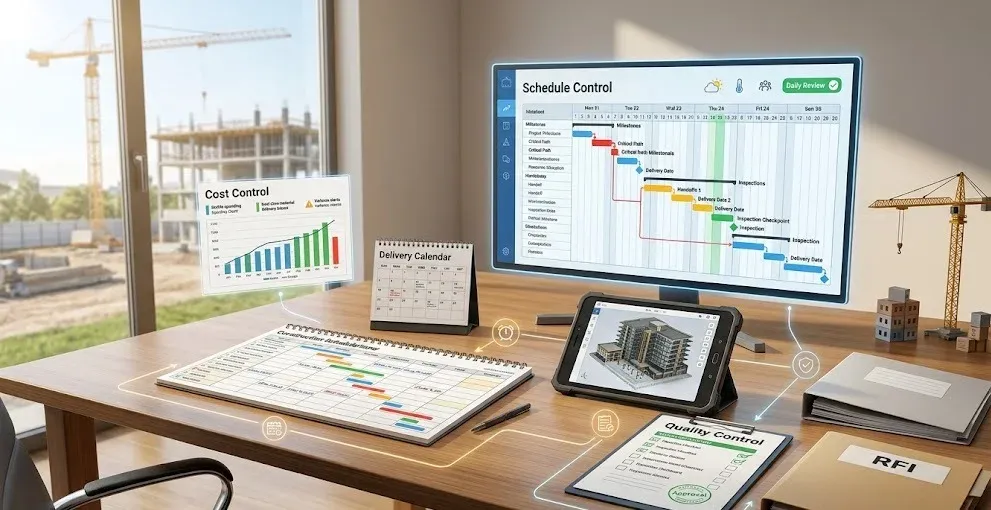
Schedule Control
The schedule is the first place a construction project starts to win or lose control. One missed handoff can push the next crew, the next delivery, and the next inspection out of place.
Didn’t one small delay just become everyone’s problem?
That is why construction project time management should start before the first call, email, or site walk. Because construction is not a small side industry. This industry made up 5.2% of U.S. nonfarm payroll employment and 4.5% of GDP in 2024.
Cost Control
Project costs often rise when time starts leaking. Believe it or not, the budget problem usually begins before anyone calls it a budget problem.
A delayed delivery adds waiting time. A late inspection adds another day. A missed decision adds more calls, more supervision, more equipment time, and more overhead.
The pressure becomes worse when construction inputs keep moving. Can a weak schedule survive rising input costs, labor pressure, and late decisions at the same time?
Usually, no.
That is why the best construction manager productivity tips are a must. Review the schedule daily, spot variance early, confirm owners, and fix the blocker while it is still small.
Quality Control
Quality starts to break when teams rush to recover lost time. You know how it goes, right? People skip checks, push crews harder, and hope the mistake does not show up later.
But construction rarely rewards hope. A missed detail can create rework, delay inspections, damage client satisfaction, and force the team to redo work that should have been finished once.
According to a study on bridge project rework, Earned Value Management can measure the cost and time effects of rework and connect those impacts with BIM-based project performance.
Good time management gives supervisors time to check drawings, review RFIs, confirm approvals, and catch errors before they spread across the site.
Stop letting small site gaps turn into delays.
Keep schedules, crews, and field updates connected with FieldServicely.
10 Best Time Management Hacks for Construction Leaders in 2026
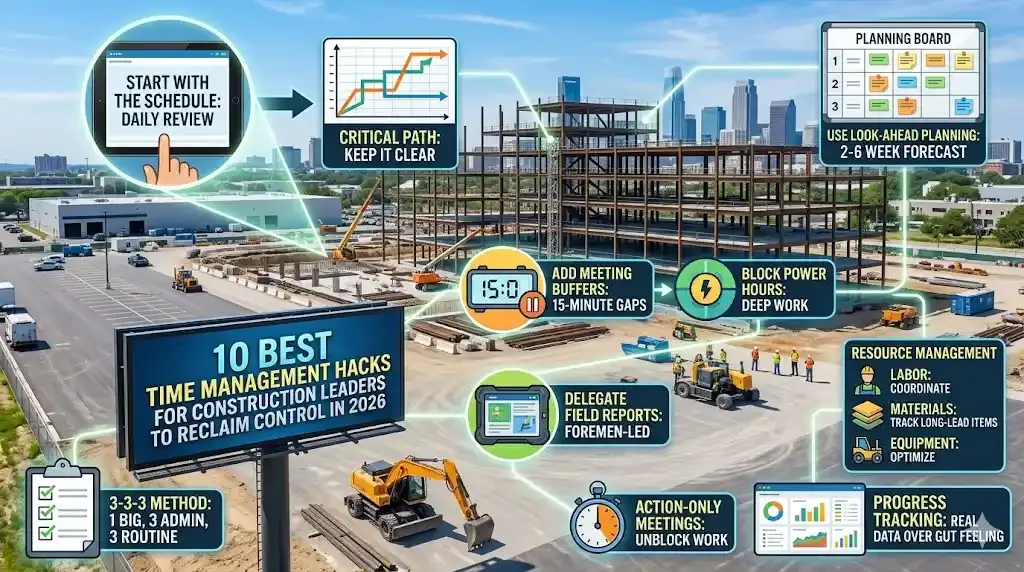
1. Start With the Schedule
Start with the schedule before the day starts shouting at you. I learned this after too many mornings where I opened email first and lost the next hour to random updates.
By the time I checked the project schedule, one delivery was late. And nobody was fully sure who owned the next step.
So now, I check today’s planned work against actual progress. If the framing crew starts today, I want to know whether the site is ready, the materials are in place, and the task owner has confirmed it.
Then I look for delay risks.
Is an inspection still pending?
Is one subcontractor blocking another?
Is there any schedule variance that can hurt the project timeline?
This daily schedule review changes the whole tone of the day. You stop reacting to noise and start leading from the plan.
2. Keep the Deadline Path Clear
The critical path is the part of the project I never treat as “just another task.” It is the line between finishing on time and having to explain another delay to the client.
On a real site, this could mean foundation work, framing, MEP rough-ins, inspections, long-lead materials, submittals, or commissioning. If one of these critical path activities slips, dependent tasks start waiting. And once crews start waiting, the project completion date gets exposed.
So I look for blockers early.
Is the approval missing? Is the material still in transit? Is one trade holding up the next trade?
A 2025 study notes that volatile activity durations can increase schedule risk and lead to construction delay, cost overrun, and safety issues.
So yes, protect decision time. One clear answer today can stop three construction project delays next week.
3. Use Look-Ahead Planning
Friday afternoon is where next week either gets easier or messier. I keep that time lighter because a rushed Monday plan usually means the real planning never happened.
In a weekly look-ahead plan, I check what the next three weeks need. Labor availability, material delivery, inspection dates, weather risk, and subcontractor readiness all go on the table before they turn into site drama.
This is where construction project planning becomes less stressful. If the plumber needs wall access on Wednesday, the framing issue cannot wait until Tuesday night.
Look-ahead planning for construction project managers works because it turns future trouble into today’s decision. In fact, look-ahead plans often cover the next two to six weeks. This helps teams spot constraints, resource needs, and work sequences before crews reach the task. [Source: ScienceDirect]
4. Add Meeting Buffers
I never trust a back-to-back meeting day on a construction project. It looks neat on the calendar, but the site never works that neatly.
That’s why I add 15-minute meeting buffers between calls, walkthroughs, and trade talks. This small gap gives you room to answer one urgent site issue, call a foreman back, update a note, or stop a jobsite interruption.
Do you know what usually breaks calendar control? It is not one big emergency. It is five small things with no space between them.
This is why meeting buffers for construction managers belong on every list of real-time management tips for construction managers. Even workers still spent 14.8 hours a week in meetings, with an average meeting length of 51.9 minutes.
5. Block Power Hours
Power hours protect the work that requires a clear head. For construction project managers, this means RFI review, submittal review, procurement checks, change orders, and schedule updates.
These tasks should not compete with every call, email, and small site question. If they do, they get pushed to the end of the day, when focus is already gone.
That is why time blocking for construction managers works so well. It creates one quiet window for deep work before the day gets broken into pieces.
The need is real. Employees face about 275 interruptions a day from meetings, emails, and chats. That equals one interruption every two minutes during core work hours.
6. Apply the 3-3-3 Method
The 3-3-3 method keeps the day from turning into a pile of half-finished tasks. It gives construction project managers one clear plan: one big task, three admin tasks, and three routine checks.
Start with the big task because that is the one that protects the job. It could be clearing a procurement issue, fixing a crew handoff, or reviewing a change order before it slows the schedule.
Once that moves, handle three admin tasks that still matter. Send the meeting notes, approve the small update, or answer the RFI that does not need a long debate.
Then finish with three routine checks. Look at crew readiness, material status, and tomorrow’s daily priorities so the next day does not start messy.
7. Delegate Field Reports
Delegating field reports saves time because the person closest to the work can report it faster. Foremen already see crew attendance, work completed, material issues, site photos, and small blockers before they reach the project manager.
That is why construction field reporting should not depend on the PM chasing updates all day. If the foreman owns the daily field report, the PM can spend more time on schedule control, job tracking, and decisions that move the project forward.
The handoff has to stay simple, though. Ask for the same few details every day.
Who was on site? What got done? What slowed the crew? What photos prove progress? And what needs attention tomorrow?
This is where construction workflow management becomes easier. The report stops being a last-minute task and becomes part of how the site runs.
FieldServicely centralizes field updates, job tracking, time tracking, and team reporting in one place. Its construction scheduling page also says it helps teams prevent overlaps, missed handoffs, and delays.
So, the goal is not to remove the PM from the details. The goal is better construction project manager time management and to keep the schedule under control.
Better time control starts with better field visibility.
Use FieldServicely to track jobs, teams, and progress from one place.
8. Run Action-Only Meetings
A meeting should not feel like punishment for being busy.
If everyone already knows the update, do not waste ten minutes repeating it. Put the update in the notes before the meeting and use the room for the messy part.
That is where construction meeting management earns its keep.
Keep the meeting tight around three things. What is blocking work, who can clear it, and when it needs to happen. Anything else can go in the meeting minutes.
For example, “HVAC cannot start until framing signs off” is useful. “We are still reviewing progress” is not.
Good project meeting productivity is not about talking faster. It is about leaving with fewer open loops than you had when you walked in.
9. Coordinate Labor, Materials, and Equipment Before Work Starts
A crew should never arrive before the site is ready for them. That sounds basic, but this is where many schedules start bleeding time.
Good construction resource management starts with three checks: who is coming, what they need, and whether the site can actually support the work. If the material delivery is late, the lift is not booked, or the previous trade has not finished, the crew will only burn hours.
That is why long-lead items need attention early. Steel, windows, electrical panels, HVAC units, and specialty fixtures can slow the whole project if nobody tracks them before installation week.
10. Monitor Progress With Real Project Data
Progress tracking should not depend on gut feeling. If the plan says rough-in should be 60% done, but the field update shows 35%, that gap is not “a note.” It is a schedule variance that needs action.
This is where construction project progress tracking earns its place. Good data also makes old mistakes useful. If past projects show the same bottlenecks around inspections, material delivery, or crew handoffs, the next schedule should not repeat them.
In fact, construction teams need better forecasting at stages like 30%, 50%, and 90% progress, not only at the end of a project. [Source: Frontiersin]
That is why construction time management software matters. It turns historical project data into clearer forecasts, sharper construction productivity tips, and better daily decisions.
Turn these time-saving habits into a daily system.
FieldServicely helps you plan jobs, assign crews, and track updates without messy follow-ups.
Common Time Management Mistakes Construction Project Managers Should Avoid
- Starting with email turns the day reactive before the schedule gets checked.
- Treating every task as urgent hides the work that can cause construction delays.
- Running weak meetings wastes time when no owner, deadline, or action is clear.
- Micromanaging foremen slows field updates and weakens the construction project manager's time management.
- Ignoring small delays lets minor issues grow into bigger construction productivity problems.
- Scattering documents across emails, chats, and folders creates rework and confusion.
- Chasing updates all day keeps managers away from decisions that move the project forward.
Daily Time Management Checklist for Construction Project Managers
- Review critical path tasks before emails take over.
- Check the latest field report for delays or blockers.
- Confirm the labor plan, material status, and crew readiness.
- Review open RFIs before they slow site work.
- Check subcontractor readiness for today’s active tasks.
- Block power hours for high-value project decisions.
- Add meeting buffers so small issues do not break the day.
- Update the schedule before the daily log closes.
Weekly Time Management Checklist for Construction Project Managers
- Review next week’s schedule before small risks become site delays.
- Check critical work tied to the project deadline.
- Confirm long-lead materials before crews need them.
- Verify inspections, permits, and subcontractor availability early.
- Update the WBS action plan with clear owners.
- Close open items before Friday planning ends.
- Set Monday priorities so the week starts clean.
Conclusion
The best proven time management tips construction project managers use are not about doing more tasks. They are about protecting time for schedule control, field operations, and critical path decisions.
Strong construction project management and time management keep crews, documents, and jobsite productivity aligned. It also helps stop small delays before they damage the full construction workflow.
Use these construction time management tips as daily habits. Over time, scalable systems create better project control and less daily stress.
Frequently Asked Questions
How can construction project managers reduce project delays?
Construction project delays can be reduced by checking schedule variance early and acting before small blockers spread. Managers should confirm subcontractor readiness, material delivery, and inspections before crews arrive on site. This keeps the job moving and stops waiting time from turning into a bigger delay.
Why is critical path planning important in construction time management?
Critical path construction matters because it shows the tasks that control the project completion date. If one critical task slips, dependent tasks can also fall behind. Good sequencing lowers schedule risk and keeps the project timeline clear.
How can construction project managers avoid administrative burnout?
Construction project manager productivity tips should focus on delegation, templates, power hours, and reporting automation. These simple systems reduce admin overload and stop managers from chasing every small update. That gives them more time for decisions, field teams, and schedule control.
How can foremen help construction project managers save time?
Foremen help through clear construction field reporting. Daily reports can show crew attendance, job updates, site photos, and completed work. This helps project managers review field progress without chasing every detail.
.webp?2026-04-24T06%3A07%3A09.841Z=&w=3840&q=100)
