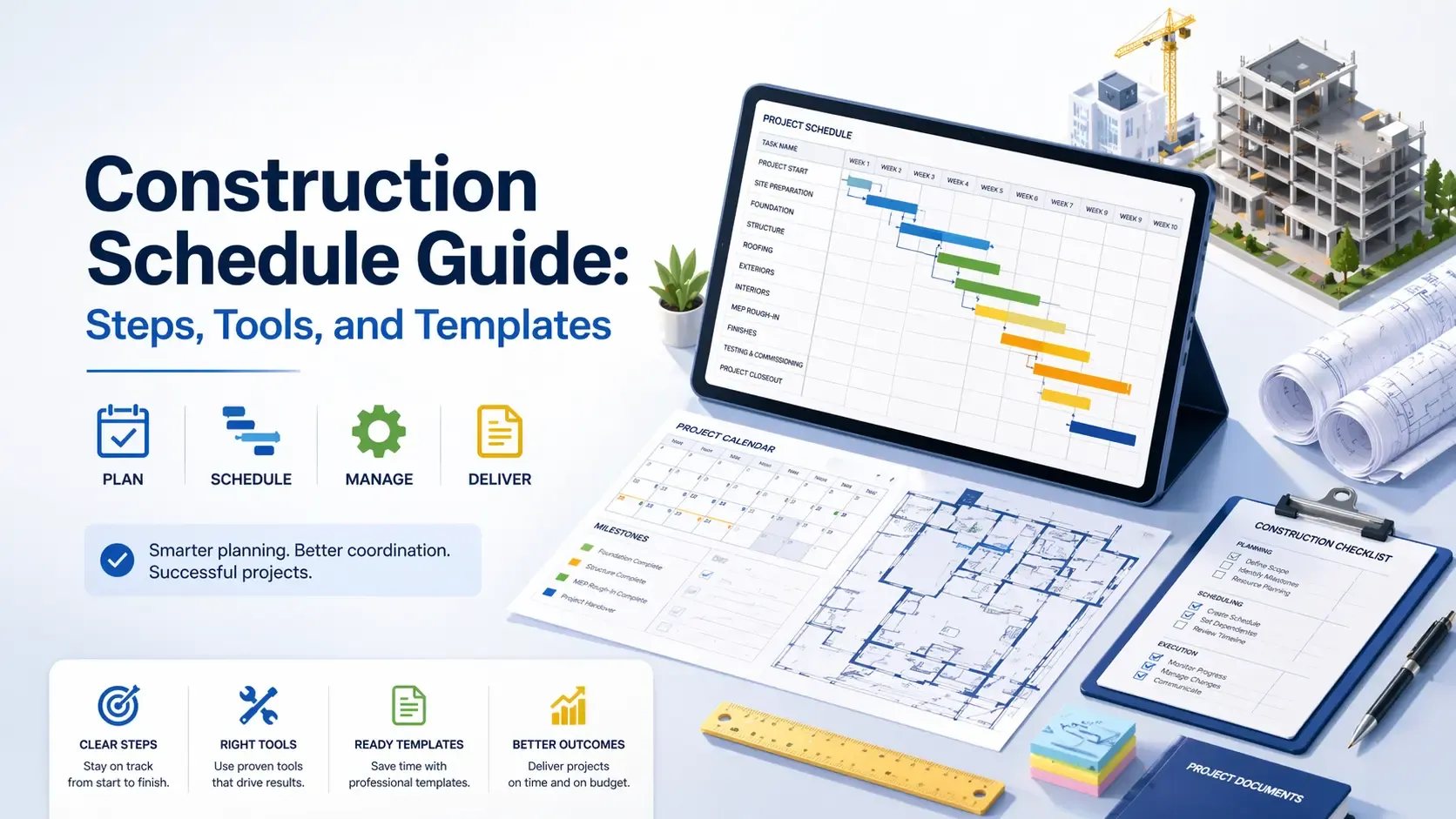
- Scheduling and Dispatch
Construction Scheduling Techniques: Methods & Examples
Updated on 24 Apr 2026
.webp?2026-04-24T06%3A07%3A09.841Z=&w=3840&q=100)
Jump to
Summary

Construction scheduling techniques control timelines, resources, and task flow to keep projects on track
Poor scheduling leads to delays, cost overruns, and resource conflicts across projects
Different methods like CPM, Gantt, and LPS solve different scheduling challenges
Choosing the right technique depends on project size, complexity, and resource availability
Effective scheduling requires continuous updates, team coordination, and real-time tracking
Construction scheduling techniques help you plan, organize, and control every task in a project from start to finish. They define timelines, manage resources, and set the right sequence so work moves without confusion or delays.
In real projects, this becomes the backbone of execution. However, many projects still struggle. Teams often face unrealistic timelines, poor resource planning, and a lack of updates, which lead to delays and cost overruns.
To tackle all of these, in this blog, I will break down the methods of scheduling in construction. I will also show you how to choose and apply them in real-world projects.
What Are Construction Scheduling Techniques?
Construction scheduling techniques are methods you use to plan tasks, timelines, and resources so that a project progresses in the right order. In simple terms, they define what happens, when it happens, and who handles it.
For example, if foundation work gets delayed, every dependent task, like framing and electrical work, shifts automatically.
Because of that, scheduling in field service directly controls how smoothly a project runs on-site. This is exactly why scheduling decides project success or failure.
Just to give you some context, a KPMG Global Construction Survey found that only 31% of projects stay within 10% of their original timeline. And guess what?
Poor planning and coordination are the culprits behind this. This boils down to scheduling, which is not just planning. Rather, it’s about controlling the execution in every step.
Ergo, if the schedule holds, the project moves. If it breaks, everything else follows.
Common Construction Scheduling Methods
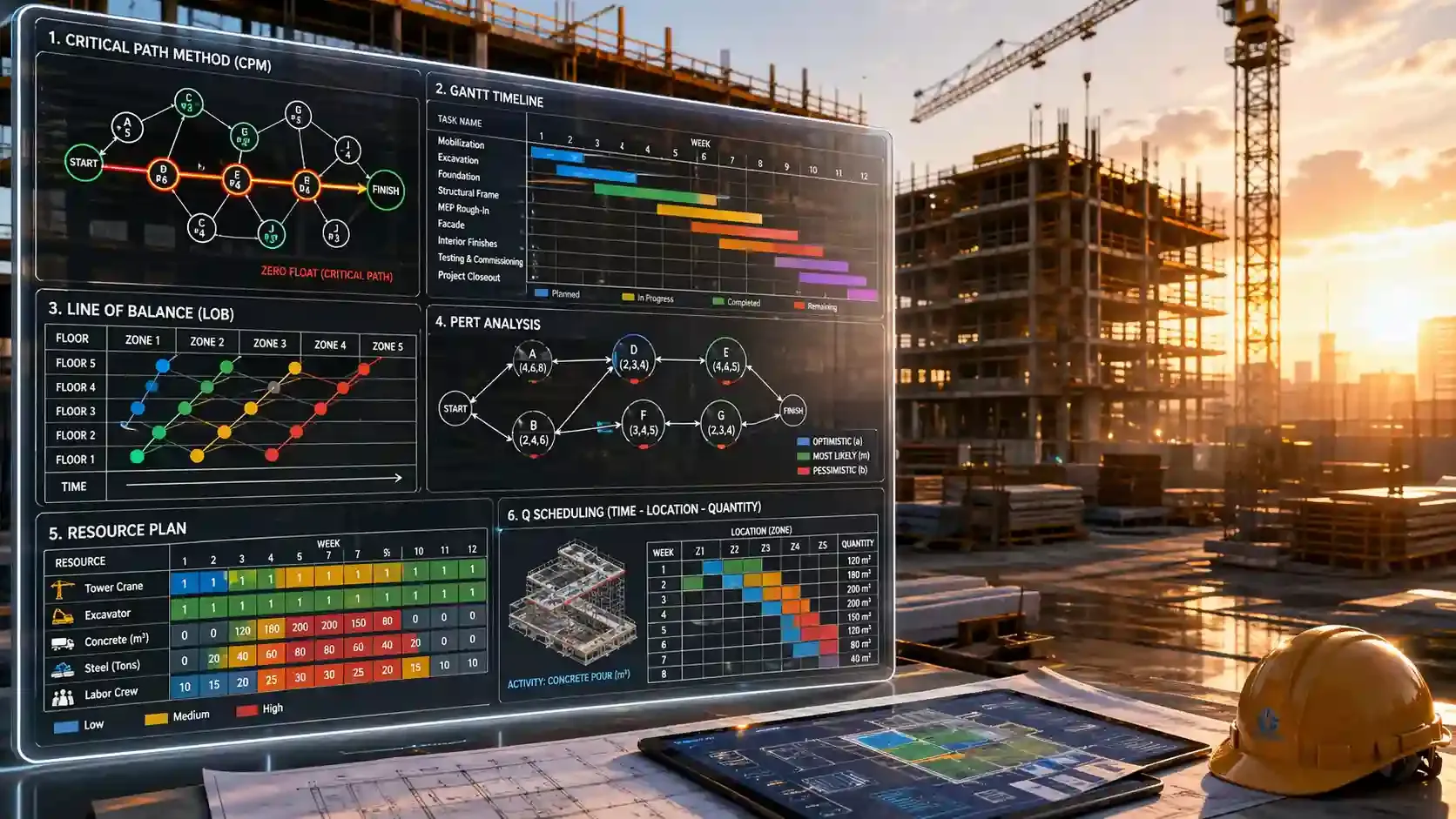
Each method serves a different purpose in construction scheduling. Some focus on timelines, others on resources, and some on workflow efficiency.
Construction method comparisons
| Method | Best For | Key Strength | Limitation |
|---|---|---|---|
Critical Path Method (CPM) | Complex projects | Identifies critical | Needs accurate data |
Gantt Charts | Tracking & reporting | Easy to visualize | Gets cluttered |
Last Planner System (LPS) | Team coordination | Improves execution | Needs strong collaboration |
Line of Balance (LOB) | Repetitive work | Keeps workflow steady | Not for unique tasks |
Program Evaluation & Review Technique (PERT) | Uncertain timelines | Handles risk well | Time-consuming |
Resource-Oriented Scheduling | Limited resources | Avoids conflicts | Needs constant updates |
Q Scheduling | Large projects | Maps time + location | Hard to implement |
Critical Path Method (CPM)
CPM identifies the exact sequence of tasks that controls your project's finish date. If any task in this chain gets delayed, the entire project timeline moves with it.
This makes it one of the most relied-on methods in large construction projects.
In real scenarios, CPM helps you map dependencies clearly. For example, excavation must finish before foundation work starts, and structural work must follow that sequence. This logical flow prevents teams from starting work out of order.
What makes CPM powerful is its ability to highlight “zero float” tasks. These are tasks with no room for delay, so managers focus resources there to protect deadlines.
I’ve used CPM in projects with tight deadlines, and it quickly highlights where attention is needed. According to an analysis, critical path tracking remains one of the most reliable ways to control schedule risk in large projects.
However, the method depends heavily on accurate input, so poor estimates can break the entire plan.
Pros
- Clearly shows which tasks control project completion
- Helps prioritize time, cost, and resources
- Improves decision-making during delays
Cons
- Requires accurate data to work effectively
- Becomes complex in large projects
- Needs to be combined with resource planning
When to use CPM
Use CPM when your project has strict deadlines and many dependent tasks. It works best in commercial builds, infrastructure projects, and any job where delays are expensive.
Gantt Charts
Gantt charts show your project timeline in a simple visual format. Each task appears as a bar, making it easy to see start dates, end dates, and overlaps.
This method works well for communication. Teams, clients, and stakeholders can quickly understand project progress without technical knowledge. It also helps managers track whether tasks are on schedule or falling behind.
But as projects grow, Gantt charts become harder to manage. Too many tasks can clutter the view, making it difficult to identify key activities.
Pros
- Easy to understand and share
- Provides a clear visual timeline
- Useful for tracking progress
Cons
- Gets cluttered in complex projects
- Needs frequent updates
- Limited for deep analysis
When to use Gantt Charts
Use Gantt charts when you need clear visibility and easy communication. They work best for tracking progress and keeping stakeholders aligned.
Last Planner System (LPS) / Pull Planning
LPS focuses on planning work based on real conditions at the site. Instead of assigning tasks from the top, teams plan backward from milestones and commit to what they can realistically complete.
This approach improves execution. Workers who are closest to the job decide the schedule, which makes plans more accurate and achievable. It also reduces delays caused by unrealistic expectations.
According to research, pull planning aligns activities collaboratively and ensures tasks are ready, helping reduce variability and improve workflow performance.
Another advantage is better coordination. Teams meet regularly to review progress and adjust plans, which keeps everyone aligned. However, the system requires strong collaboration and discipline to work effectively.
Pros
- Improves the reliability of task completion
- Encourages team collaboration
- Reduces last-minute changes
Cons
- Depends on team participation
- Requires frequent coordination
- Less effective for long-term planning
When to use Lean / Pull Planning
Use this method when multiple teams need to coordinate closely. It works best in complex projects where communication and flexibility matter more than rigid planning.
Line of Balance (LOB)
LOB is designed for projects with repetitive tasks. It focuses on maintaining a steady workflow across multiple units, such as floors in a high-rise or houses in a development.
The method works well in high-rise buildings where the same tasks repeat floor by floor. According to McKinsey, organizations that focus on workflow optimization achieve higher efficiency and productivity gains at scale.
LOB relies on accurate production rates. If one task slows down, it affects the entire workflow.
Pros
- Improves efficiency in repetitive work
- Reduces downtime
- Maintains steady workflow
Cons
- Not suitable for non-repetitive projects
- Requires precise planning
- Can be complex to implement
When to use LOB
Use LOB when your project involves repeated tasks across multiple areas. It works best in housing developments, high-rise construction, and infrastructure projects with repetitive processes.
Program Evaluation and Review Technique (PERT)
PERT is used when task durations are uncertain. It calculates timelines using three estimates: optimistic, pessimistic, and most likely.
This method provides a more realistic schedule. It helps teams prepare for uncertainties like weather delays or supply issues. Instead of relying on one fixed estimate, it gives a range of possible outcomes.
PERT also helps identify risky tasks. Activities with higher uncertainty get more attention, which improves planning. However, it requires more effort to calculate and maintain.
Pros
- Handles uncertainty effectively
- Provides realistic time estimates
- Highlights risk areas
Cons
- Time-consuming to set up
- Depends on the accuracy of the estimate
- Adds complexity to scheduling
When to use PERT
Use PERT when your project has uncertain timelines or high risk. It works best in early-stage planning or complex builds with unpredictable factors.
Resource-Oriented Scheduling
Resource-oriented scheduling focuses on the availability of labor, equipment, and materials. It ensures that resources are used efficiently without conflicts.
This method solves a common problem in construction. Two teams needing the same equipment at the same time can delay work, and this approach prevents that. It aligns tasks with actual resource availability.
It also improves productivity. Teams work when resources are ready, not when they become available. However, it requires constant monitoring and updates.
Pros
- Prevents resource conflicts
- Improves efficiency
- Aligns tasks with resources
Cons
- Requires continuous updates
- Becomes complex in large projects
- Needs detailed tracking
When to use Resource-Oriented Scheduling
Use Resource-Oriented Scheduling when labor, equipment, or crews are the main constraint.
Q Scheduling
Q scheduling combines time, location, and resource quantities into one system. It helps managers understand how work progresses across different areas of a project.
This method is useful for large and complex projects. It allows teams to plan material flow and resource usage more effectively. It also helps identify potential disruptions early.
Despite its benefits, Q scheduling is not widely used. It requires advanced planning and detailed data, which makes it harder to implement.
Pros
- Combines multiple planning factors
- Improves visibility in complex projects
- Helps manage resource flow
Cons
- Limited adoption
- Requires advanced skills
- Not suitable for smaller projects
When to use Q Scheduling
Use Q Scheduling on repetitive, location-based, resource-heavy projects. Especially when you must track work quantities, crew flow, and zone-by-zone progress more visually than CPM alone.
Fix Scheduling Before It Breaks Your Project
How to Choose the Right Construction Scheduling Technique
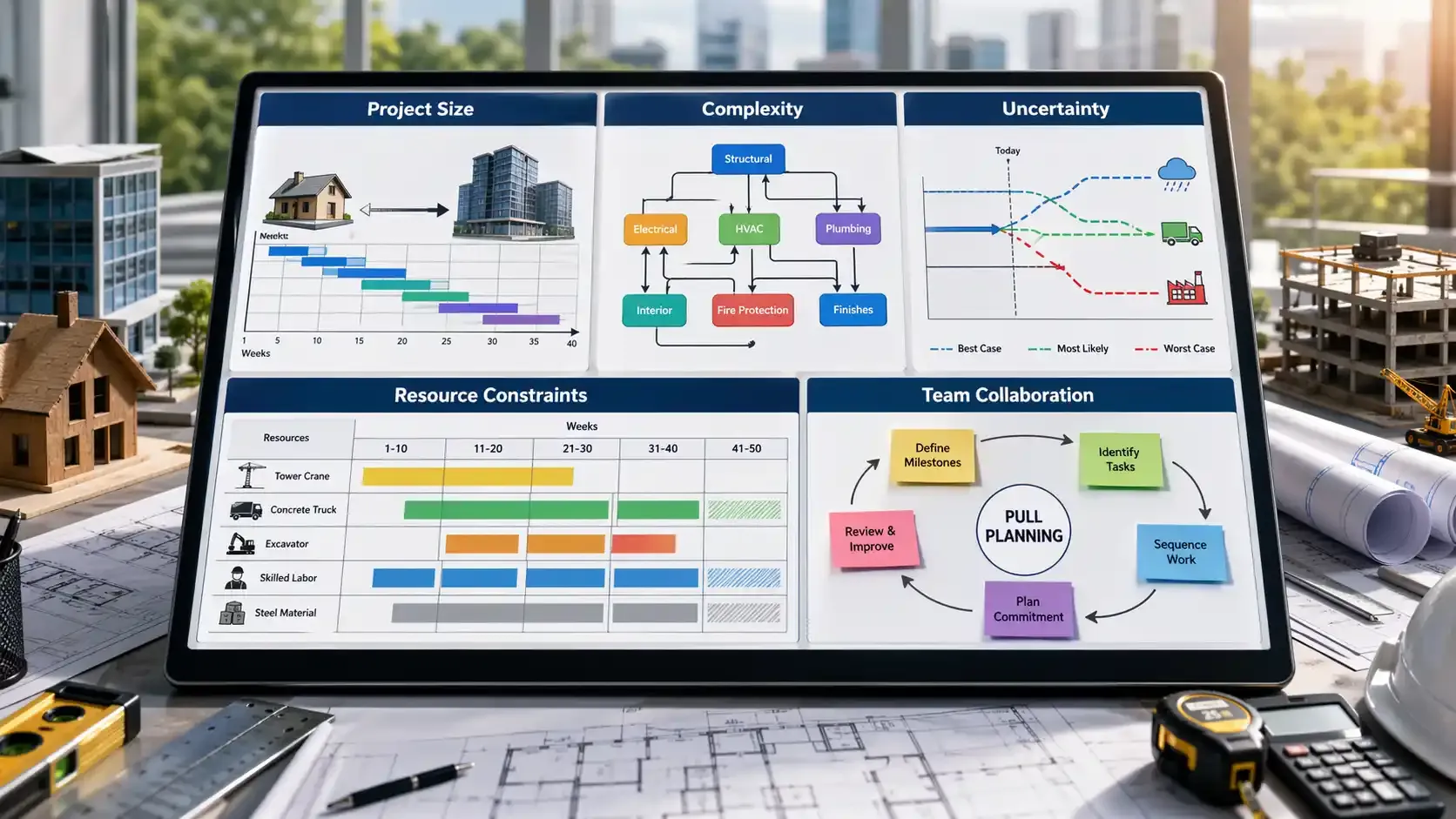
Based on Project Size
Project size decides how simple or detailed your schedule needs to be. Small projects like a single house or interior renovation usually work fine with Gantt charts because you just need a clear timeline.
As projects grow, things change quickly. Large builds like commercial towers or highways involve hundreds of tasks and dependencies, so methods like CPM become necessary to control the flow.
Over 50% of large projects use advanced scheduling methods like CPM to manage scale and coordination.
Based on Complexity
Project complexity determines how much logic your schedule needs. Simple projects with fewer dependencies can run on basic timelines without much analysis.
However, complex projects require deeper planning. When multiple trades depend on each other, like HVAC, electrical, and structural teams working together, CPM becomes essential to manage those relationships.
Based on Uncertainty
Uncertainty changes how you estimate timelines. Projects exposed to risks like weather, supply chain issues, or new construction methods cannot rely on fixed schedules.
This is where PERT becomes useful. It allows you to plan using multiple time estimates instead of one fixed guess, which gives you a realistic range.
The risk is real here. When uncertainty increases, your scheduling method must become flexible.
Based on Resource Constraints
Resource availability shapes how work actually gets done. Even the best timeline fails if labor, equipment, or materials are not available when needed.
This is where resource-oriented scheduling becomes critical. It aligns tasks with real resource availability so teams do not compete for the same equipment or workforce.
So, if your project has limited resources, your scheduling method must focus on allocation, not just timelines.
Based on Team Collaboration Needs
Team structure decides how scheduling should flow. Projects with multiple contractors, subcontractors, and stakeholders need strong coordination.
This is where LPS or pull planning works best. It allows teams to plan together and commit to realistic short-term goals instead of following a rigid top-down schedule.
Build Schedules That Fit Your Project
Construction Scheduling Example (Real-World Workflow)
.webp?2026-04-24T08%3A25%3A23.815Z=&w=3840&q=100)
Project Scenario (Commercial Building)
Let’s take a mid-size commercial office building as an example. The project includes foundation work, structural framing, electrical systems, HVAC installation, and final finishing.
This type of project involves multiple teams working at the same time. That creates dependency risks, resource conflicts, and tight deadlines that need careful scheduling.
Task Breakdown (Work Breakdown Structure)
The first step is breaking the project into smaller tasks. This is called a Work Breakdown Structure, and it turns a large project into manageable pieces.
For example, “foundation work” gets divided into excavation, formwork, reinforcement, and concrete pouring. Each task gets its own timeline and dependency.
Applying CPM + Gantt + LPS
Next, the team applies CPM to identify the critical path. This shows which tasks directly control the project timeline and cannot be delayed.
Then, the same plan is visualized using a Gantt chart. This helps managers and stakeholders see the schedule clearly and track progress easily.
After that, LPS comes into play for execution. Teams plan weekly work based on real site conditions, which improves reliability and reduces delays.
Resource Allocation
Once tasks are defined, the next step is assigning resources. This includes labor, equipment, and materials needed for each activity.
For example, structural work requires cranes, steel, and specialized crews. If two teams need the same crane at the same time, one must wait, which causes delays.
This is why resource planning must align with the schedule.
Even inefficient resource allocation contributes to nearly 35% of productivity loss in construction projects.
Monitoring and Updates
Once work starts, the schedule must be monitored continuously. Project managers compare actual progress with the planned schedule to identify delays early.
If a task falls behind, adjustments are made immediately. This may include reallocating resources, changing task sequences, or updating timelines.
This process keeps the project under control.
Keep your projects moving without disruption
Key Construction Scheduling Concepts You Must Know
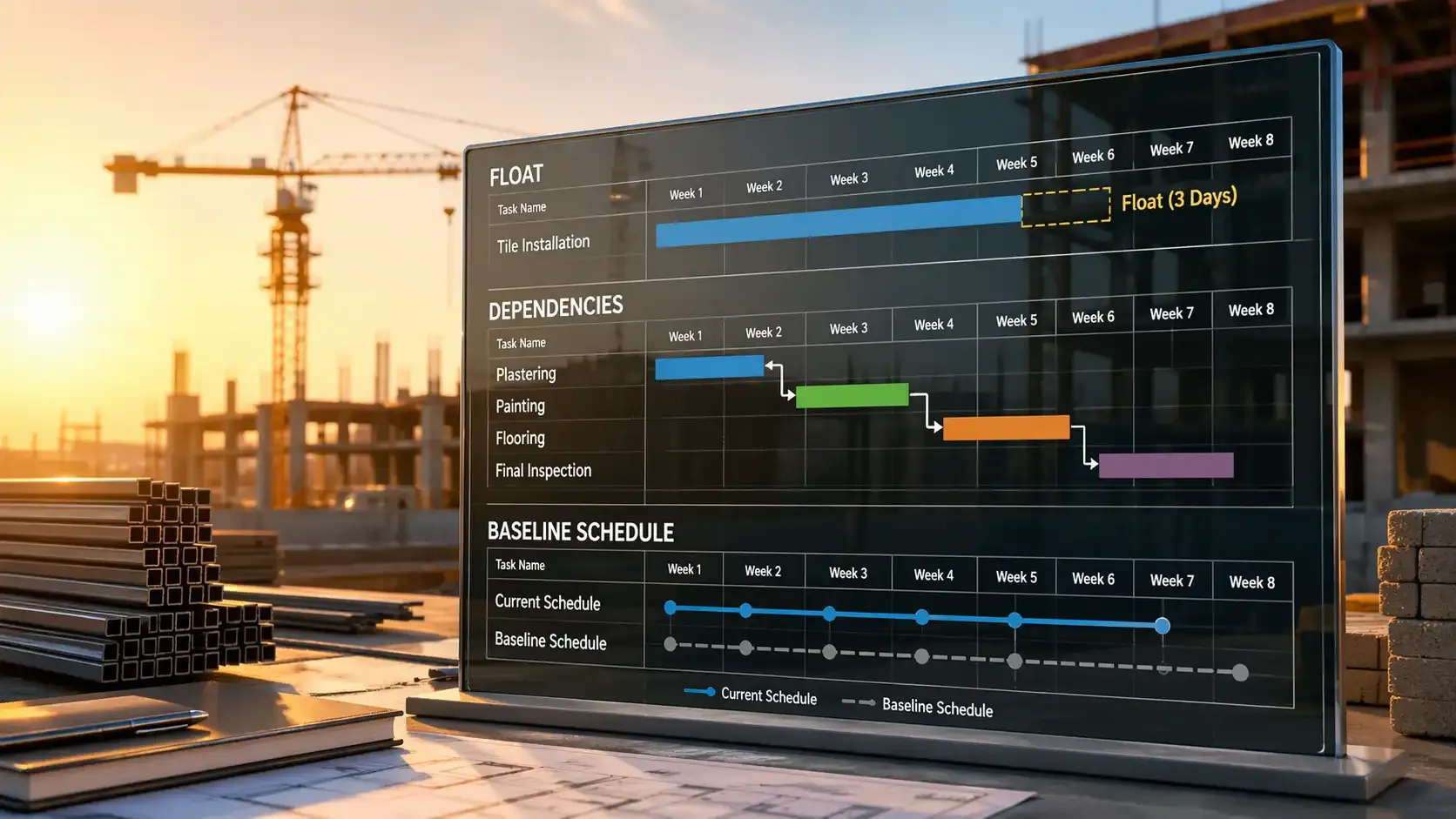
Float
Float shows how much flexibility a task has before it affects the final deadline. In simple terms, it tells you how long you can delay a task without breaking the overall schedule.
This becomes useful when things shift on-site. For example, if tile delivery is delayed by two days but the task has three days of float, the project still stays on track.
However, float is often misunderstood. Teams sometimes use it casually, which creates hidden delays across the project.
Dependencies
Dependencies define how tasks connect. They tell you what must happen first and what can happen next.
This structure keeps the project logical. For example, you cannot start painting before completing plastering, and ignoring that order leads to rework and wasted effort.
Baseline Schedule
The baseline schedule shows the original plan before execution begins. It acts as a fixed reference to measure actual progress.
This is how teams track performance. If work falls behind the baseline, managers can quickly identify where delays started and take action.
Without a baseline, field tracking becomes guesswork. Projects using baseline comparison improve schedule control accuracy.
Manage complex schedules without slowing down
Handle multiple workflows and tasks in one place
Best Practices for Effective Construction Scheduling
Combine Multiple Techniques
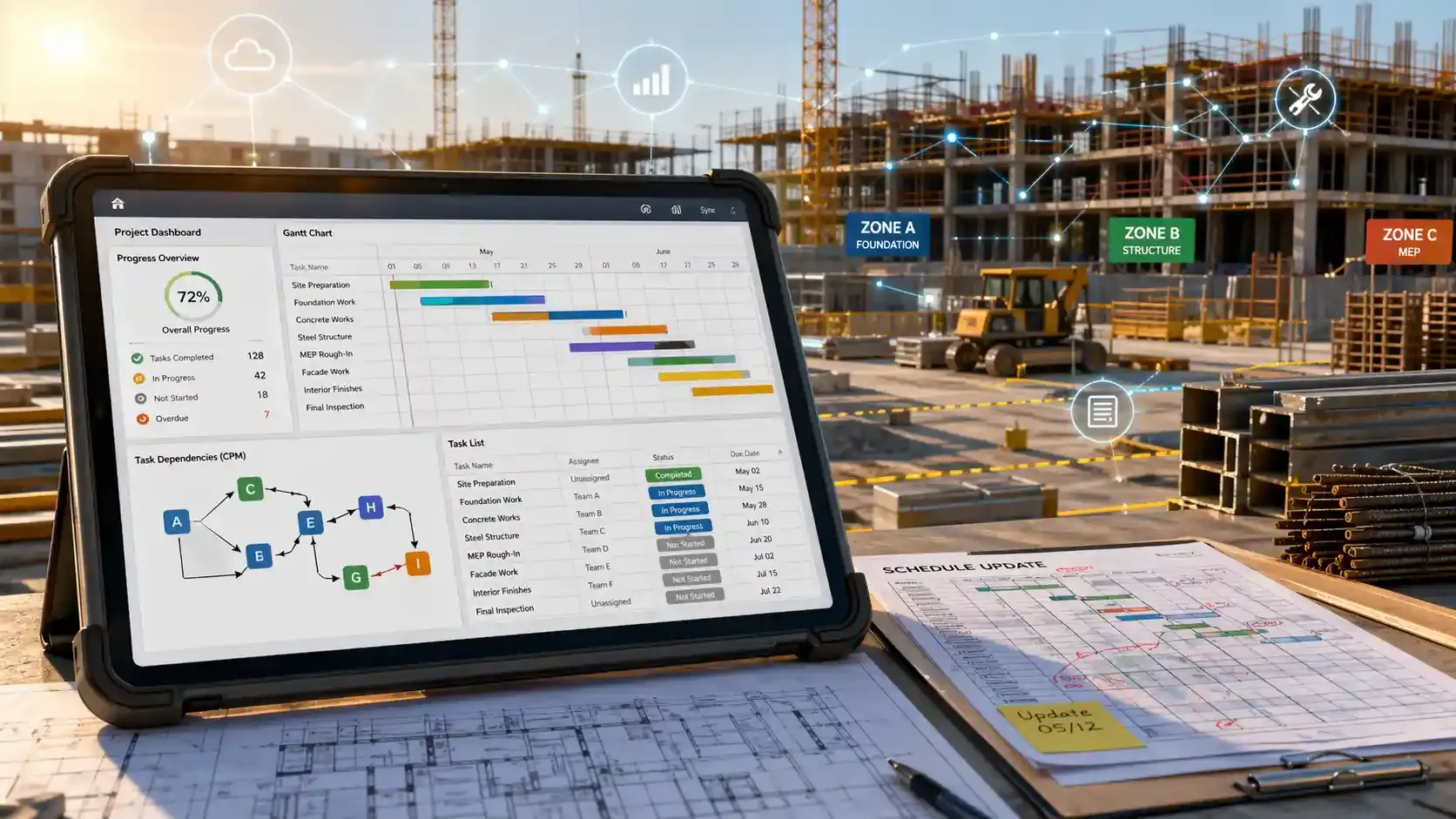
Using only one scheduling method rarely works in real projects. Each technique handles a different part of the problem, so combining them gives better control.
For example, CPM helps manage dependencies, Gantt charts improve visibility, and LPS improves on-site execution. When you use them together, your schedule becomes more practical, not just theoretical.
This is how experienced teams work. They don’t rely on one tool. They build a system that covers planning, tracking, and execution.
Use Real-Time Tracking Tools
A live time tracking tool for construction, like Fieldservicely help you see what is actually happening on-site. Instead of guessing progress, you get clear updates as work moves forward.
This makes a big difference when things go wrong. If a task falls behind, you can fix it early instead of letting it delay the entire project.
It also improves decision-making. You act based on real data, not assumptions.
Involve Field Teams Early
Involving field teams early makes your schedule more realistic. The people on-site understand actual conditions better than anyone else.
This helps avoid common mistakes. Crews can identify issues such as access problems, material delays, or task conflicts before work starts.
It also builds accountability. When teams help create the schedule, they are more committed to following it.
Continuously Update Schedules
Updating your schedule regularly keeps it relevant. A static schedule quickly becomes useless once work begins.
This allows you to adapt to changes. When delays or changes happen, you adjust the plan instead of reacting too late.
It also keeps everyone aligned. Teams always know what is current, not what was planned weeks ago.
FieldServicely supports this process by keeping scheduling, team coordination, and real-time updates in one place. Instead of switching between systems, teams can track tasks, assign work, and monitor progress without losing visibility.
This makes it easier to keep schedules accurate as conditions change on-site.
Stop Managing Scheduling Across Multiple Tools
Conclusion
Construction scheduling controls how work actually moves on-site from start to finish. The right approach helps you reduce delays, manage resources better, and keep teams aligned throughout the project.
At the same time, no single method works for every situation. Each project demands a mix of techniques based on its size, complexity, and workflow needs.
Frequently Asked Questions
What is the difference between construction planning and scheduling?
Construction planning defines what needs to be done, while scheduling defines when and in what order tasks happen. Planning focuses on scope and strategy, while scheduling focuses on timelines and execution.
What software is used for construction scheduling?
Common tools include Primavera P6, Microsoft Project, and cloud-based platforms like FieldServicely. These tools help manage timelines, assign resources, and track progress in real time.
How often should a construction schedule be updated?
A construction schedule should be updated weekly or whenever major changes occur. Regular updates help teams identify delays early and adjust plans quickly.
What is the role of milestones in construction scheduling?
Milestones mark key points in a project, such as phase completion or delivery deadlines. They help track progress and ensure the project stays aligned with goals.
Can small construction projects benefit from scheduling techniques?
Yes, even small projects benefit from structured scheduling. Simple methods like Gantt charts help organize tasks, avoid overlaps, and improve efficiency. Without scheduling, even small jobs can face delays and cost issues.
What to read next