Construction Risks: Examples, Safety Hazards & Solutions
Updated on 21 May 2026
Jump to
Summary

Construction risks can hurt cost, time, safety, quality, and profit.
Common risks include delays, safety hazards, poor scope, and late materials.
Financial risks grow when estimates, payments, or change orders go wrong.
Safety risks need early checks, proper PPE, and clear site rules.
Risk management helps teams find problems early and control them faster.
Construction risks can damage a project’s budget, timeline, safety, quality, and profit if teams do not find them early. The biggest risks often come from safety hazards, poor planning, unclear scope, late materials, labor gaps, contract issues, and weak field communication.
The hard part is how quiet these risks feel at first. A delayed delivery, a missed update, or one vague change request may not look serious at the moment. But soon, crews wait, costs rise, and the schedule starts to slip.
That is why construction risk management matters before the job gets messy.
In this blog, I will discuss the most common construction risks, real examples, safety hazards, and simple ways to reduce them. I will also cover risk management steps that help teams protect cost, time, safety, and work quality.
What is Construction Risk?
Construction risks are uncertain events or conditions that can hurt a project’s cost, schedule, safety, quality, compliance, or profit. They are the things that turn a normal job into a late job, an over-budget job, or worse, an unsafe one.
Some risks start inside the project. Poor planning, weak supervision, unclear scope, bad estimates, and missing documents can quietly create rework, change orders, payment disputes, and delays.
Other risks come from outside the team.
The weather can stop work. Suppliers can miss delivery dates, prices can rise, permits can drag, and hidden site conditions can break the original plan. In 2025, 45% of surveyed construction firms reported project delays because of worker shortages.
This shows how fast outside pressure can hit the schedule.
Even with all these demerits, you cannot remove every construction risk. But you can reduce, transfer, monitor, or accept it before it becomes expensive.
Why Construction Projects Have So Many Risks
Construction projects are risky because too many moving parts must work at the same time. Owners, contractors, subcontractors, suppliers, architects, engineers, and inspectors all touch the job. So one slow answer can push the whole schedule sideways.
That is where the trouble usually starts. A drawing needs approval, a permit takes longer than planned, or one subcontractor misses a date. And suddenly, the next crew has nothing useful to do!
The jobsite itself adds another layer of risk.
Workers deal with heights, trenches, live power, heavy equipment, dust, heat, and moving vehicles every day. In 2024, construction and extraction workers had 1,032 fatal injuries in the U.S. Among them, 370 came from falls, slips, or trips.
Then comes the supply chain.
A project can look ready on paper. But if steel, concrete, wiring, HVAC parts, or fixtures arrive late, the plan breaks fast. Recent global supply shocks have shown how one missing material can stall whole projects and raise costs almost overnight. [Source: Financial Times]
Labor pressure makes that even harder. In fact, 92% of firms struggled to hire, while the industry still needs hundreds of thousands of new workers each year.
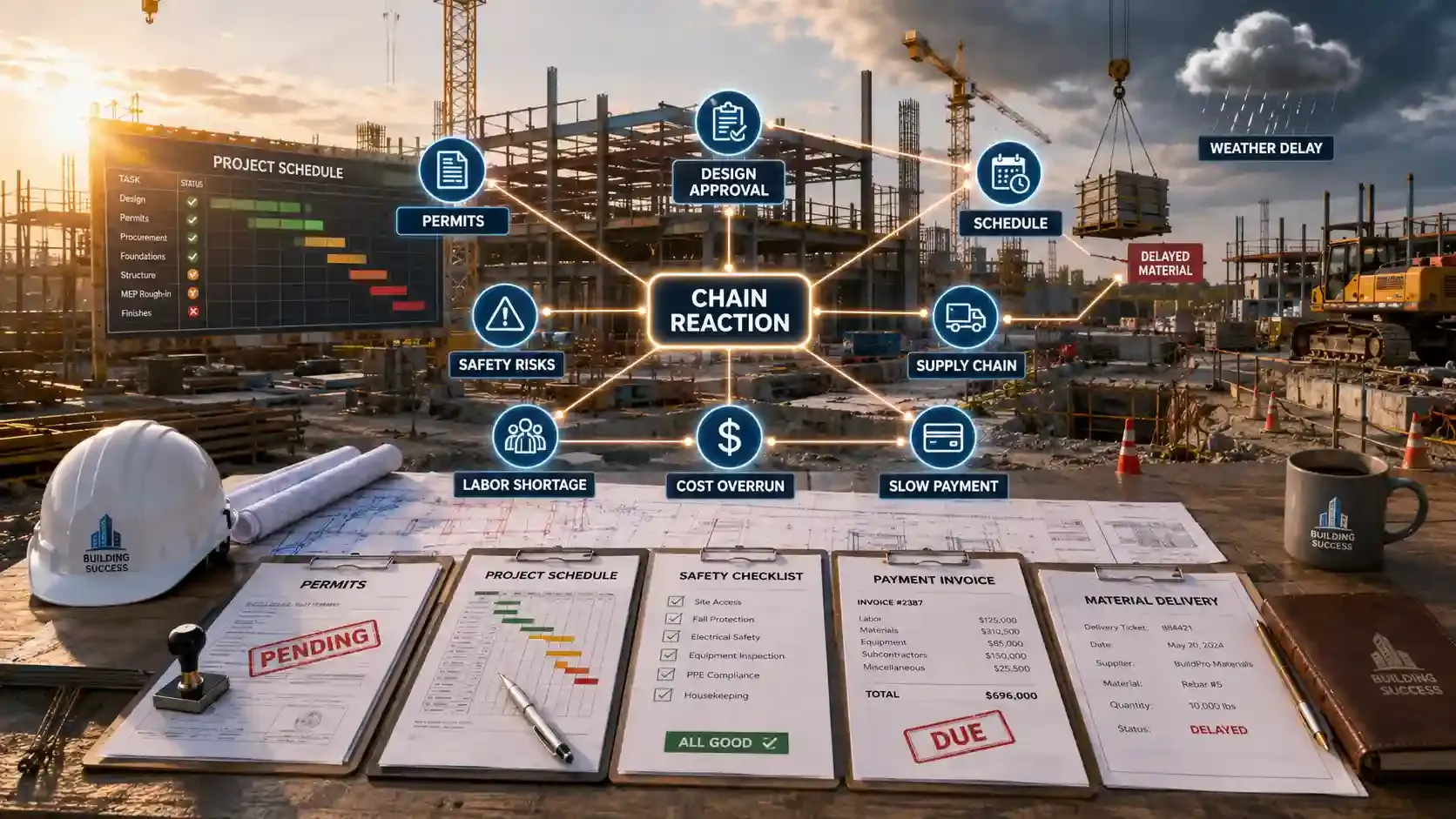
So the real risk is not one big problem. It is the chain reaction. Tight margins, slow payments, permit delays, weather, and too many documents can turn one small gap into a budget hit, a safety issue, or a missed deadline.
Bring the office and site together.
Give managers live field visibility without chasing every crew.
What Are the Risks on a Construction site?
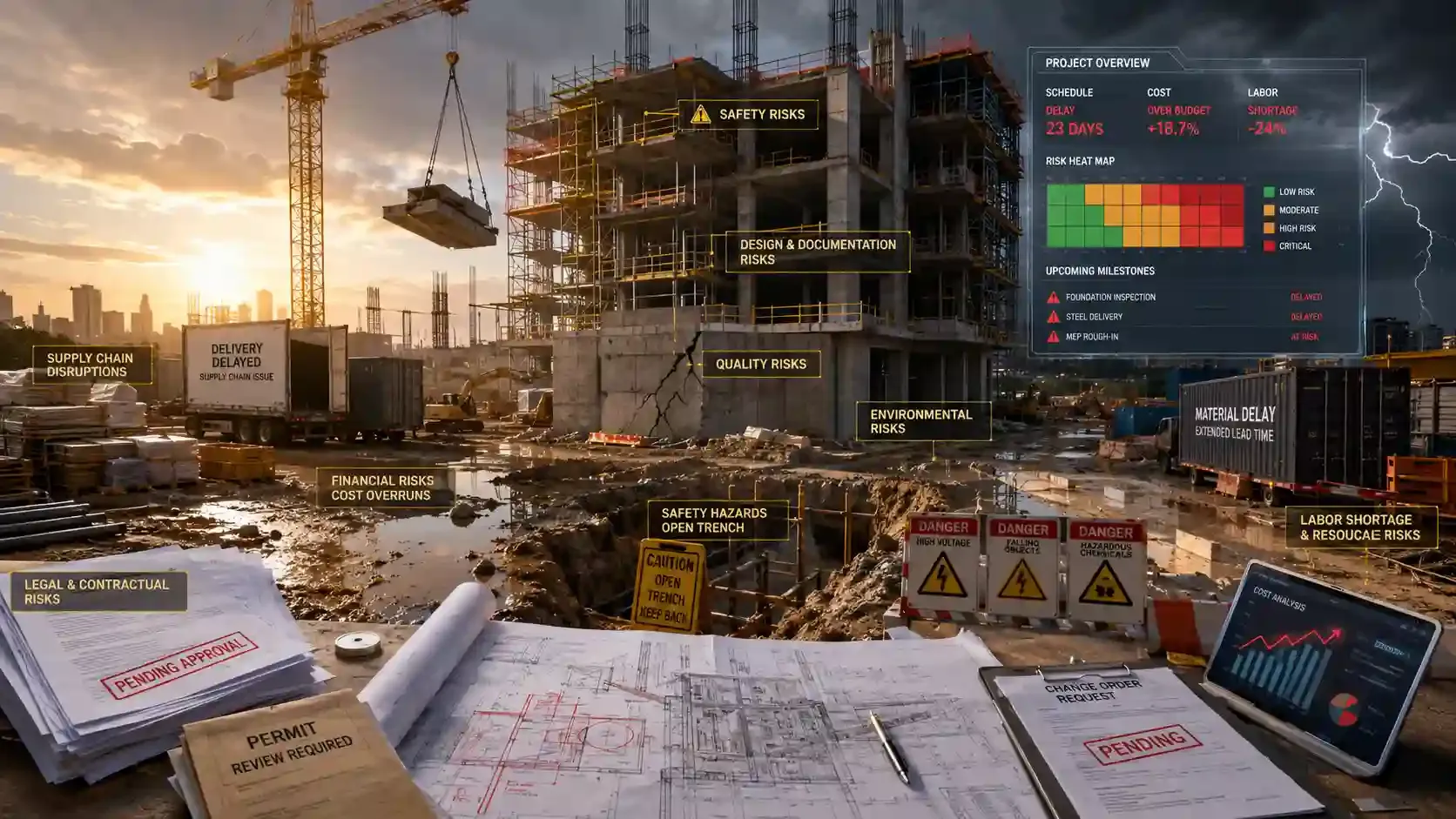
The main types of construction risks include safety, financial, schedule, legal, contractual, environmental, operational, labor, supply chain, design, and quality risks.
Once you know the type of risk, you can decide what to do next.
Safety Risks
Safety risks are the fastest way a construction project can turn serious. Falls, live wires, falling tools, trench cave-ins, moving machines, heat, dust, and chemicals can hurt workers before the budget even becomes the main problem.
That is why safety risk starts with the daily jobsite. A missing guardrail, an open trench, or one worker inside a blind spot can create a real hazard in seconds.
Surprisingly, OSHA’s 2024 most-cited standards still put fall protection, ladders, fall protection training, scaffolding, and eye and face protection among the top workplace violations.
Financial Risks
Financial risks often start before anyone notices the budget is in trouble. Once in a project, the estimate looked fine at kickoff. But the scope had soft edges, and the contingency was too thin.
At first, the job still looked healthy. The crew stayed active, materials arrived, and the client asked for a few “small” changes that felt harmless.
Then the cost gap opened. Extra labor had no signed change order, material prices moved, and payment slowed because the paperwork did not match the work.
That is how budget overruns grow in real life. Material costs make that worse. Construction input prices rose more in the first four months of 2026 than in the prior three years combined.
Payment delays add the final squeeze. In 2025, 70% of contractors reported delayed payments.
Delays and Schedule Risks
Schedule risks are the dominoes of construction. One late permit, missed inspection, storm day, or material shortage can push every trade behind it.
The delay often starts before the site looks stuck. A supplier misses a delivery, the concrete crew waits, the electrical team loses its slot, and the whole sequence starts to wobble.
construction leaders now face rising pressure from fragile supply chains and tougher regulatory demands, based on responses from 375 executives worldwide.
Legal and Contractual Risks
Legal and contractual risks hide in the parts people skim. A loose scope, missed notice date, weak insurance clause, or unclear indemnity term can turn normal project stress into a claim.
This usually shows up when work changes. The owner asks for a revision, the subcontractor moves fast, and nobody locks the approval in writing.
Then the dispute starts.
Who pays for the extra labor? Who owns the design error? Who covers the code issue?
HKA’s 2025 construction claims review found that “change in scope” remains a top cause of claims across major delivery methods.
Know who is on site.
Use geofenced attendance and live crew updates to reduce guesswork.
Design and Documentation Risks
Design and documentation risks begin when the crew reads the plan, and the plan does not answer the field question. The drawing shows one thing, the spec says another, and the RFI sits open while people wait.
That waiting is the real cost.
A missing detail can freeze a trade, delay an inspection, or force a supervisor to choose between stopping work and guessing. And guessing is where rework begins.
Contextually, errors and omissions in construction contract documents were the number one cause of disputes in North America. [Source: Autodesk]
Labor and Subcontractor Risks
Labor and subcontractor risks show up on the crew board first. The plan says eight workers, but only five arrive. Then one trade falls behind, and the next trade stacks on top of them.
That is when productivity drops. Crews rush, supervisors juggle people, and poor workmanship starts to slip into the job because everyone is trying to recover lost time.
The pressure is real, too. The U.S. construction industry needed 439,000 net new workers in 2025 to meet demand, and the need could rise again in 2026.
Environmental and Site Risks
Bad soil, hidden utilities, contamination, erosion, and flooding can change the plan after the budget is already set. Think about excavation day. The drawings look clean, but the crew finds soft ground, an old utility line, or polluted soil that needs special handling.
Then the job stops for answers. Engineers review the soil, utility teams mark the line, inspectors step in, and the schedule loses days before real construction even starts.
Flooding adds another layer.
The U.S. had 23 billion-dollar weather and climate disasters in 2025, causing $115 billion in damage. That kind of weather pressure can flood sites, damage stored materials, and wash out access roads.
Track every moving part.
Manage jobs, crews, schedules, time, and field activity from one place.
Construction Risks Examples: What Can Go Wrong on a Project?
Construction risks do not always arrive like a big warning sign. Most of them start as one small miss that nobody wants to stop for.
| Construction Risk | Real Example | What It Can Cause |
|---|---|---|
Scope creep | The client keeps adding small tasks without approval | Budget dispute and delay |
Inaccurate estimate | Labor hours are underpriced | Lower profit margin |
Design error | Drawings conflict with actual site conditions | Rework and extra cost |
Documentation error | The notice deadline is missed | Lost claim rights or payment delay |
Change order issue | Work starts before approval | |
Supply chain disruption | Steel, concrete, or equipment arrives late | Idle labor and missed milestones |
Labor shortage | The subcontractor cannot provide enough workers | Slow progress |
Trade partner walks off the job | Re-hiring cost and schedule damage | |
Safety incident | Worker falls from an unprotected edge | Injury, shutdown, investigation |
Weather disruption | Heavy rain floods the site | Lost workdays and material damage |
Payment dispute | Owner delays payment after disputed work | |
Poor project management | Trades are scheduled in the wrong order | Rework, waste, and delay |
Top 10 Safety Risks in Construction
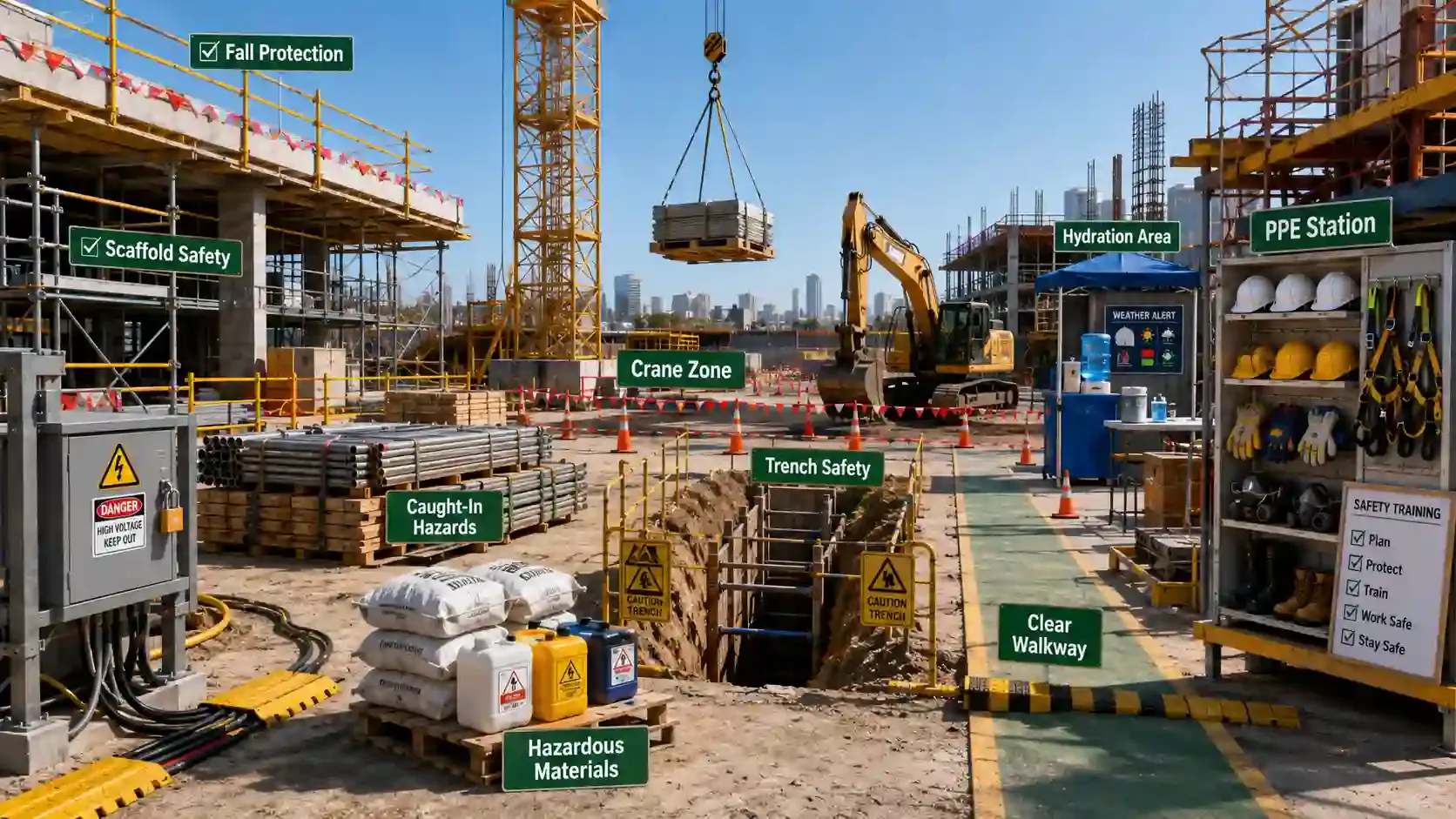
Falls from Heights
Falls from heights are one of the quickest ways a normal task can turn dangerous. A worker may be on a roof, ladder, scaffold, floor opening, or open edge for only a few minutes.
But height does not need much time to create harm. One loose plank, one wet ladder step, or one uncovered floor hole can change the whole day.
Struck-By Objects
Struck-by risks come from movement around the worker. A tool drops from above, a load swings from a crane, or a vehicle moves through a tight path.
The danger feels sudden because the worker often has little time to react. That is what makes this risk different from many others.
Clear zones help a lot here. Workers need marked walkways, secured tools, crane swing zones, spotters, and simple rules about where not to stand.
Caught-In or Caught-Between Hazards
Caught-in or caught-between hazards are the risks that trap the body before the worker can step away. They happen near trench walls, rotating parts, machines, stacked materials, and backing vehicles.
This one is scary because force does the damage fast. A worker can get pinned between equipment and a wall or caught inside moving machinery.
The safer approach is to control space. Keep workers away from pinch points, guard machine parts, block materials, and never let people enter an unsafe trench.
Electrocution
Electrocution risks often hide behind ordinary site work. A damaged cord, live wire, wet surface, overhead power line, or weak ground connection may not look serious at first.
Then one touch can be enough. That is why electrical risk needs more respect than it often gets on busy sites.
Trenching and Excavation Hazards
Trench hazards start underground, where the danger is not always visible. Soil can look stable from the top and still collapse without warning.
Buried utilities add another problem. One wrong dig can hit gas, water, power, or communication lines and stop the whole site.
Before anyone enters, the trench needs a real safety check. Soil type, cave-in protection, safe entry, utility marks, and daily inspection all matter here.
Heavy Equipment Accidents
Heavy equipment risks feel different because the machines are loud, large, and hard to stop quickly. Forklifts, excavators, cranes, loaders, and backing trucks all create blind spots.
A worker may think the operator can see them. The operator may think the worker has moved away.
That gap creates accidents. Spotters, backup alarms, high-visibility clothing, clear routes, and no-walk zones help keep people away from machine paths.
Hazardous Materials Exposure
Hazardous materials do not always hurt workers right away. Dust, fumes, asbestos, lead, chemicals, silica, and contaminated soil can damage health over time.
That slow harm makes this risk easy to ignore. The site may look calm while workers breathe in dust or handle unsafe material.
Protection starts with knowing what is on site. Crews need labels, masks or respirators, ventilation, wet cutting, safe storage, and clear cleanup steps.
Heat Stress and Weather Exposure
Heat stress builds while workers lift, climb, dig, carry, and pour under sun, humidity, wind, or storm pressure. At first, the signs can look small. A worker feels dizzy, slows down, stops sweating, or makes simple mistakes.
That is the warning. Water, shade, rest breaks, weather checks, and lighter task planning can keep heat and storm risk from becoming an emergency.
Slips, Trips, and Same-Level Falls
Slips and trips sound minor until someone lands hard. Loose cables, wet floors, mud, debris, uneven ground, and scattered tools can take down even an experienced worker.
This risk usually grows from messy habits. One crew leaves material in the path, and the next crew pays for it.
Poor PPE and Weak Safety Training
Poor PPE turns known risks into open danger. Missing hard hats, gloves, eye protection, harnesses, boots, or respirators leaves workers exposed before the task even starts.
Weak training makes it worse. A worker may wear the wrong gear, skip a check, or enter a risky area without knowing the danger.
Keep jobsite checks visible.
Use photos, notes, and field reports to support safer daily work.
The Construction Risk Management Process
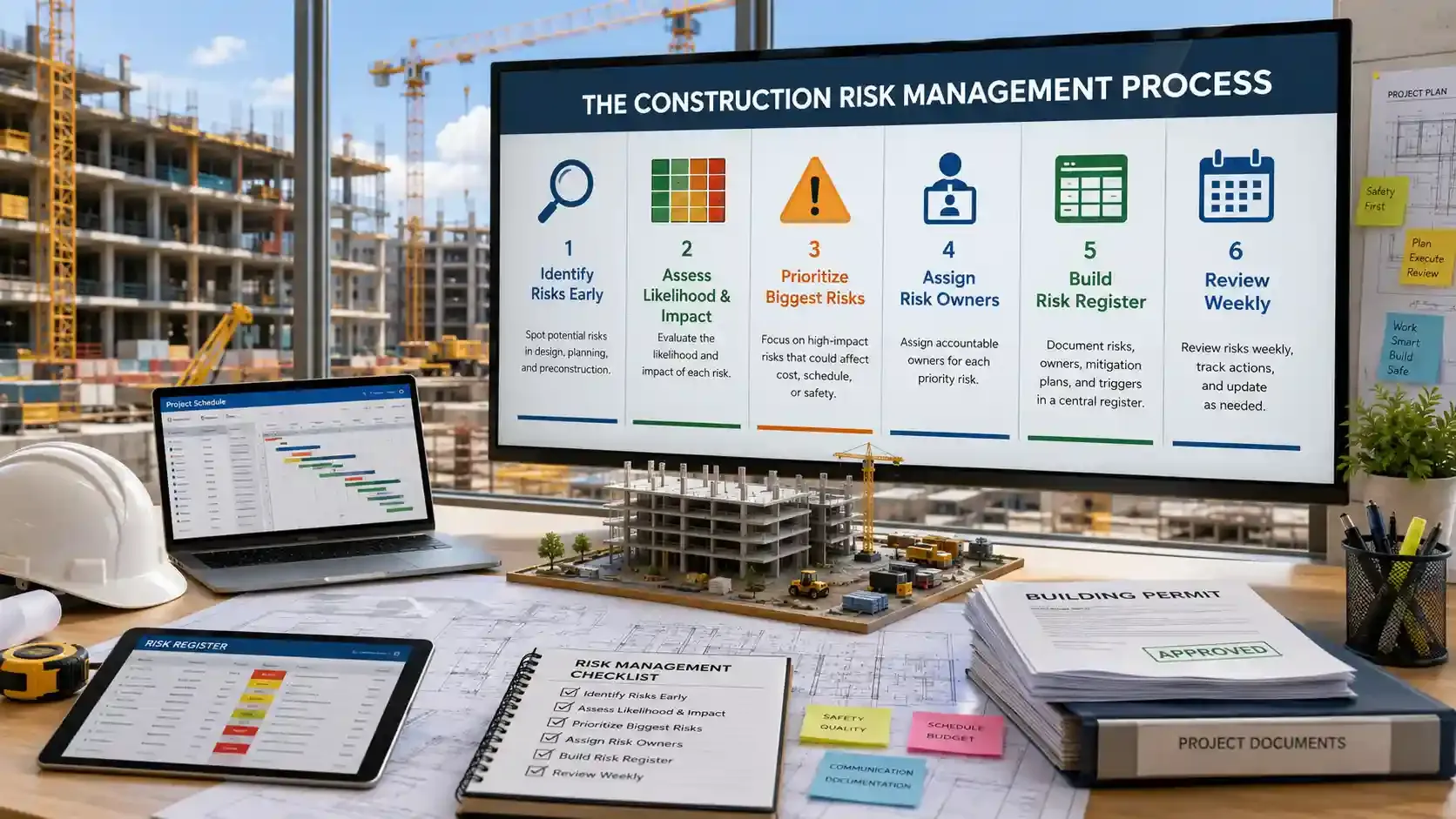
Identify Construction Risks Early
Risk identification works best before the site gets busy. The team should list what can go wrong with scope, labor, design, safety, materials, permits, weather, and cash flow.
This is where the best clues come from. Past projects show old mistakes, site checks reveal hidden conditions, design reviews catch drawing gaps, and contract reviews expose weak terms.
Stakeholder input matters too. Owners, architects, engineers, subcontractors, suppliers, and field supervisors often see different risks before they appear on the schedule.
Assess Likelihood and Impact
Risk assessment turns a long worry list into a clear work plan. Each risk needs two simple scores:
1. How likely it is to happen and
2. How much damage it can cause.
Use high, medium, or low. A late paint delivery may be low impact, but a missing structural steel package can hit cost, labor, and schedule at the same time.
This step keeps the team honest. It stops people from treating every issue like an emergency and helps them focus on the risks that can truly hurt the job.
Prioritize the Biggest Risks
The biggest risks deserve attention first. Start with problems that are both likely to happen and costly if they happen.
For example, a weak subcontractor on a critical path trade should move near the top of the list. So should unknown site conditions, long-lead materials, permit delays, and unclear change order rules.
Small risks still matter, but timing matters more. A smart team handles the expensive risks early, then works down to the lower-impact items.
Assign Risk Owners
Every major risk needs one person watching it. Without an owner, the risk floats around the meeting until it becomes someone’s problem too late.
A risk owner does not need to solve everything alone. But that person must track updates, ask for decisions, warn the team, and push the next action.
This is where field visibility helps. If a supervisor owns labor risk, they need real updates on attendance, crew size, task progress, and missed work.
Build a Risk Register
A risk register is the project’s risk map. It should show the risk, owner, probability, impact, response plan, status, and next action.
Keep it simple enough that people use it. A good risk register should answer, “What can go wrong, who is watching it, and what happens next?”
That one document can save hours of confusion. It gives owners, project managers, and trade partners one shared place to discuss risk without guessing.
Review Risks Weekly
Risk reviews should happen every week, not only when the project feels stuck. Scope, schedule, labor, materials, weather, and site conditions can change fast.
Use project meetings to check what moved, what got worse, and what needs a decision. Then update the risk register before the next issue spreads.
That is the real point of the process. Find the risk early, score it clearly, give it an owner, track it weekly, and stop it before it becomes the story of the job.
This is also where a tool like FieldServicely can help without making risk management feel heavy. When managers can see attendance, job progress, task updates, and field reports in one place, they can catch small issues before they turn into schedule or labor risks.
It gives the office and field team the same picture of the work. And in construction, this visibility can be the difference between fixing a problem today and explaining a delay next week.
Turn risk checks into action.
Assign tasks, track owners, and review job progress from one dashboard.
Construction Risks and Solutions
| Construction Risk | Practical Solution |
|---|---|
Poor scope definition | Create a clear scope before signing. |
Design errors | Review drawings before mobilization. |
Safety incidents | Use training, PPE checks, and inspections. |
Labor shortages | Confirm manpower before awarding work. |
Supply disruption | Track long-lead materials early. |
Payment delays | Document approvals, notices, and change orders. |
Weather disruption | Add schedule floats and protect materials. |
Subcontractor default | Prequalify trades and monitor progress. |
Poor communication | Use shared updates and daily reports using tools like FieldServicely. |
Benefits of Risk Management in Construction
- Teams catch delays early before they stop the job.
- Budgets stay tighter when surprise costs are reduced.
- Jobsites become safer when hazards are found early.
- Payment disputes drop when records stay clear.
- Rework goes down when mistakes are caught sooner.
- Subcontractors perform better when progress is tracked.
- Clients trust the team more when updates are clear.
Conclusion
Construction risks never disappear fully, but they become easier to control when teams stop treating them as surprises. A clear scope, strong safety checks, better documents, reliable subcontractors, and regular field updates can prevent many issues before they spread.
The goal is not to make every project perfect. The goal is to catch problems while they are still small. When teams track risks early and act fast, they protect the budget, schedule, workers, client trust, and final project quality.
Frequently Asked Questions
What causes budget overruns in construction?
Budget overruns happen when the real project cost grows beyond the planned budget. Common causes include poor estimates, scope creep, material price hikes, labor gaps, rework, and payment disputes. Even one weak cost item can affect labor, materials, cash flow, and profit, so teams need clear scope, updated estimates, and tight change order control.
How can construction delays be reduced?
Construction delays can be reduced with early planning, supplier tracking, schedule buffers, and permit planning. Teams should also check long-lead materials before work starts and keep daily field updates active during the project. Clear communication helps managers spot delays before they block the next trade.
What is a construction risk register?
A construction risk register is a simple record that tracks each project risk, owner, likelihood, impact, response plan, status, and next action. It helps the team see what can go wrong and who is responsible for watching it. This makes risk review easier during project meetings.
Why do construction projects face payment disputes?
Payment disputes happen when work, cost, or approval records do not match. This often comes from unclear scope, verbal changes, missing notices, or delayed change orders. Once proof is weak, payment slows, and cash flow gets tight, so clear daily reports and signed approvals help prevent disputes.
How often should construction risks be reviewed?
Construction risks should be reviewed weekly or whenever the project changes. Scope changes, weather, labor gaps, late materials, and permit issues can shift risk fast. A short weekly review helps managers fix small problems before they grow.
What to read next
Scheduling and Dispatch
