- Field Service Business
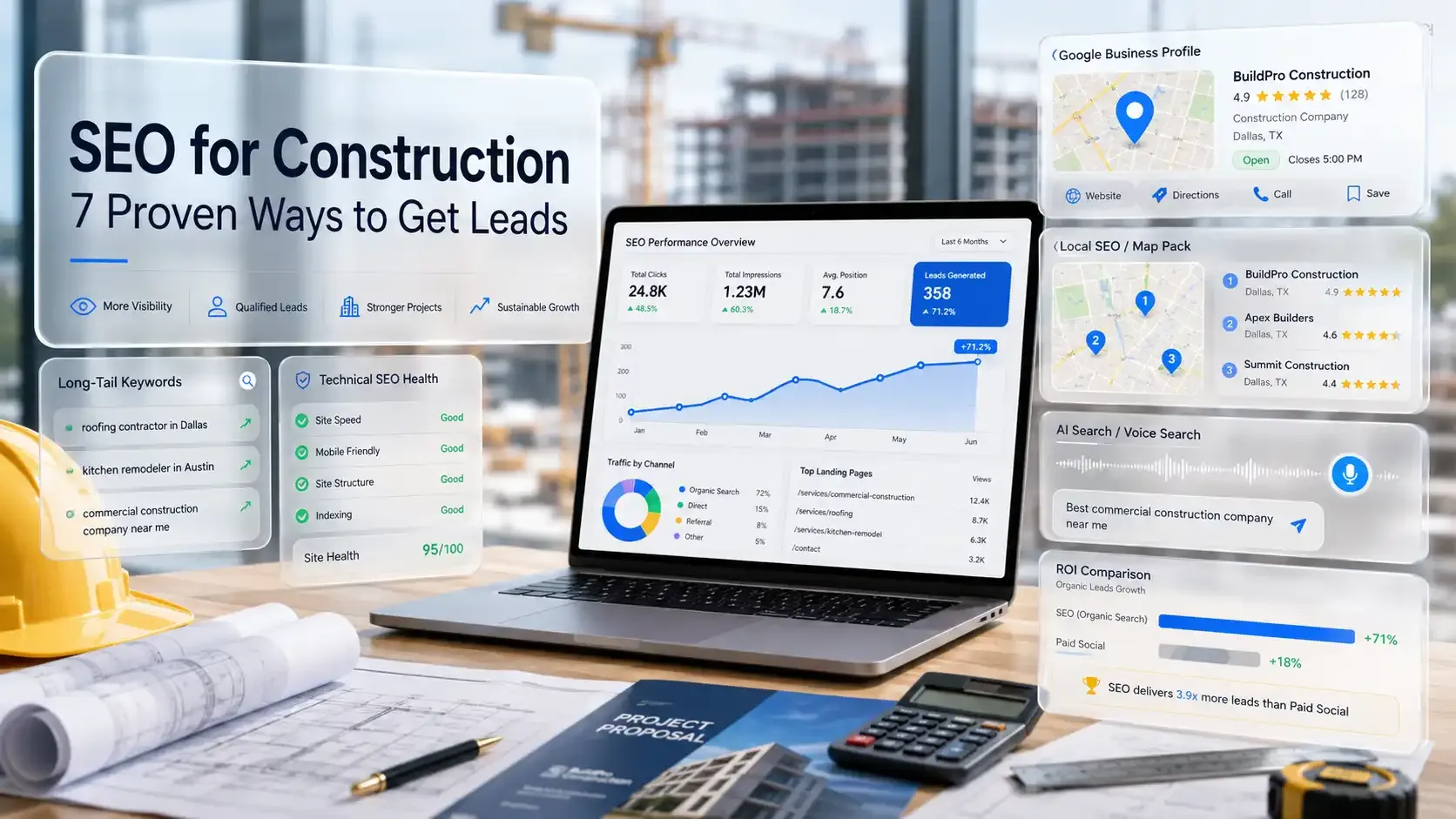
SEO for Construction: 7 Proven Ways to Get More Leads
Updated on 30 Jun 2026
Jump to
Summary

Construction company SEO delivers a 681% ROI, nearly 7x the return of paid social, making it the most cost-effective lead channel for contractors.
Local SEO and a fully optimized Google Business Profile are your #1 lead source since 46% of all Google searches carry local intent.
Target long-tail, location-based keywords over broad terms to attract clients who are ready to hire today.
Fix your technical SEO first because a slow, poorly structured website kills rankings before your content even gets a chance.
Optimize for AI search and voice search now, since Google AI Overviews already appear on 48% of all tracked searches.
Construction SEO is the process of optimizing your website so potential clients find you on Google when they search for contractors or builders in their area.
If you are still relying only on referrals or burning cash on Google Ads, you are leaving money on the table. Because SEO delivers a 681% ROI for construction companies, nearly 7x the return of paid social.
Meanwhile, the average Google Ads cost per lead for contractors sits at $165.67. Yet most contractors still treat their website like a digital business card. And that is exactly why their competitors keep outranking them.
In this blog, we break down 13 proven construction SEO strategies to help you rank higher, show up in local search, and generate leads on autopilot.
What is SEO for Construction Companies?
SEO for construction companies is how you make your business show up on Google when someone searches for a contractor or builder nearby. It puts your website in front of people who are ready to hire, not just browsing.
But why is construction SEO different from regular search engine optimization?
Because construction runs on location, trust, and big budgets. The U.S. construction market alone hit $2.2 trillion in 2025 and is set to reach $2.31 trillion in 2026.
With that much money moving through the industry, your clients compare multiple contractors before calling anyone. And a roofer in Dallas does not compete with one in Miami.
That local factor changes everything about how you approach:
- Keyword research and what terms you target
- Content on your service and portfolio pages
- Your Google Business Profile setup and visibility
So what does a real SEO for construction business plan look like? It breaks into four core areas:
- Local SEO gets your business on Google Maps and the local pack.
- On-page optimization sharpens your service pages, project portfolio, meta descriptions, and headings.
- Technical SEO fixes your site speed, mobile-friendly website setup, and schema markup.
- Off-page SEO builds credibility through backlinks, citations, and online reviews.
Each one feeds the other. Skip one, and the rest fall flat.
Why SEO Matters for Construction Businesses in 2026
Construction SEO matters because over 53% of all website traffic still comes from organic search, not paid ads or social media. If your construction website does not rank on Google's first page, your competitors are taking those clicks and those leads.
Here's the real kicker.
Paid ads stop working the second you stop paying. SEO keeps bringing in qualified leads months and even years after you publish a single page. In fact, SEO delivers a median ROI of 748%, meaning businesses earn $7.48 back for every $1 they invest in organic search.
Now compare that to PPC. The average cost per lead for Construction & Contractors via Google Ads is $165.67. On the other hand, SEO leads cost roughly $31 on average.
That is a 5x difference in cost per lead!
And it does not stop at cost savings. Search engine optimization also builds long-term trust with potential clients.
When your construction company consistently appears in local search rankings and search engine results pages, people start to see you as the go-to contractor in your area. Paid ads do not build that kind of credibility.
So, if you are still relying only on referrals or paid advertising, you are leaving serious money on the table.
More Leads Mean Nothing Without a System to Manage Them
FieldServicely keeps your scheduling, dispatching, and invoicing organized as your pipeline grows.
How to Do Keyword Research for Construction
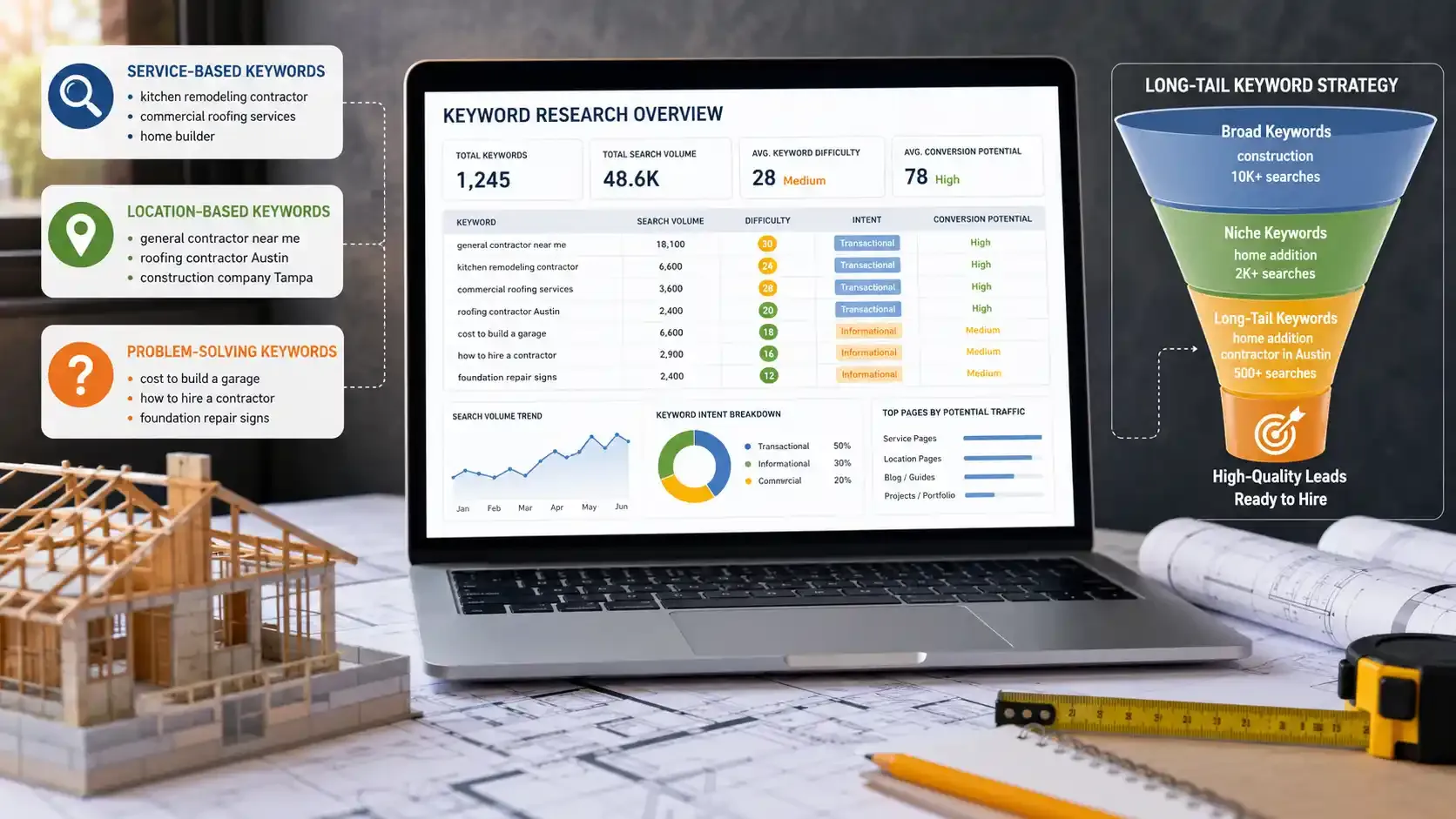
Keyword research for construction companies means finding the exact search terms your potential clients type into Google when they need a contractor. When I first started doing SEO for my construction business, I targeted broad terms like "construction company". I was competing against national brands and Wikipedia pages.
That experience taught me something. You do not win by chasing the biggest keywords. You win by targeting the right ones, and those fall into three categories:
- Service-based keywords describe what you do, like "kitchen remodeling contractor" or "commercial roofing services."
- Location-based keywords pair your service with your city, like "general contractor in Austin" or "home builder near Tampa."
- Problem-solving keywords target people seeking answers before hiring, like "how much does a home addition cost" or "signs you need foundation repair."
Ready-to-Use Construction Keyword Table
| Keyword | Intent | Est. Monthly Volume |
|---|---|---|
general contractor near me | Transactional | 18,100 |
home remodeling contractor | Transactional | 6,600 |
commercial construction company | Transactional | 3,600 |
roofing contractor [city] | Transactional | 2,400 |
bathroom remodel contractor [city] | Transactional | 1,900 |
emergency roof repair near me | Transactional | 1,300 |
deck builder [city] | Transactional | 1,000 |
ADU construction company [city] | Transactional | 880 |
commercial tenant buildout contractor | Transactional | 720 |
green building contractor near me | Transactional | 590 |
best home builders near me | Commercial | 5,400 |
top rated contractors near me | Commercial | 4,400 |
how to hire a general contractor | Commercial | 2,900 |
construction company reviews | Commercial | 1,900 |
residential vs commercial contractor | Commercial | 1,300 |
kitchen remodel cost 2026 | Informational | 8,100 |
cost to build a garage | Informational | 6,600 |
how much does a home addition cost | Informational | 5,400 |
what does a general contractor do | Informational | 4,400 |
do I need a permit for renovation | Informational | 3,100 |
signs you need foundation repair | Informational | 2,400 |
how long does a home renovation take | Informational | 1,600 |
Note: Search volumes are approximate and vary by location. Run these through Google Keyword Planner, filtered to your service area for exact local data.
Why Long-Tail Keywords Convert Better for Contractors
A term like "roof repair" gets thousands of searches, but the competition is brutal. A phrase like "flat roof repair contractor in Denver" gets far less volume, but the person typing it is ready to hire today.
Focus on these long-tail construction keywords because they convert at much higher rates.
Use Google Keyword Planner for free local volume data, Ahrefs for keyword difficulty scores, and Semrush for competitor gap analysis. Start with 10 to 15 low-competition, high-intent keywords and build your content marketing plan around them.
Turning Search Traffic Into Booked Jobs
Use FieldServicely to schedule, assign, and track every project that comes through your website.
Local SEO for Construction (Your #1 Lead Source)
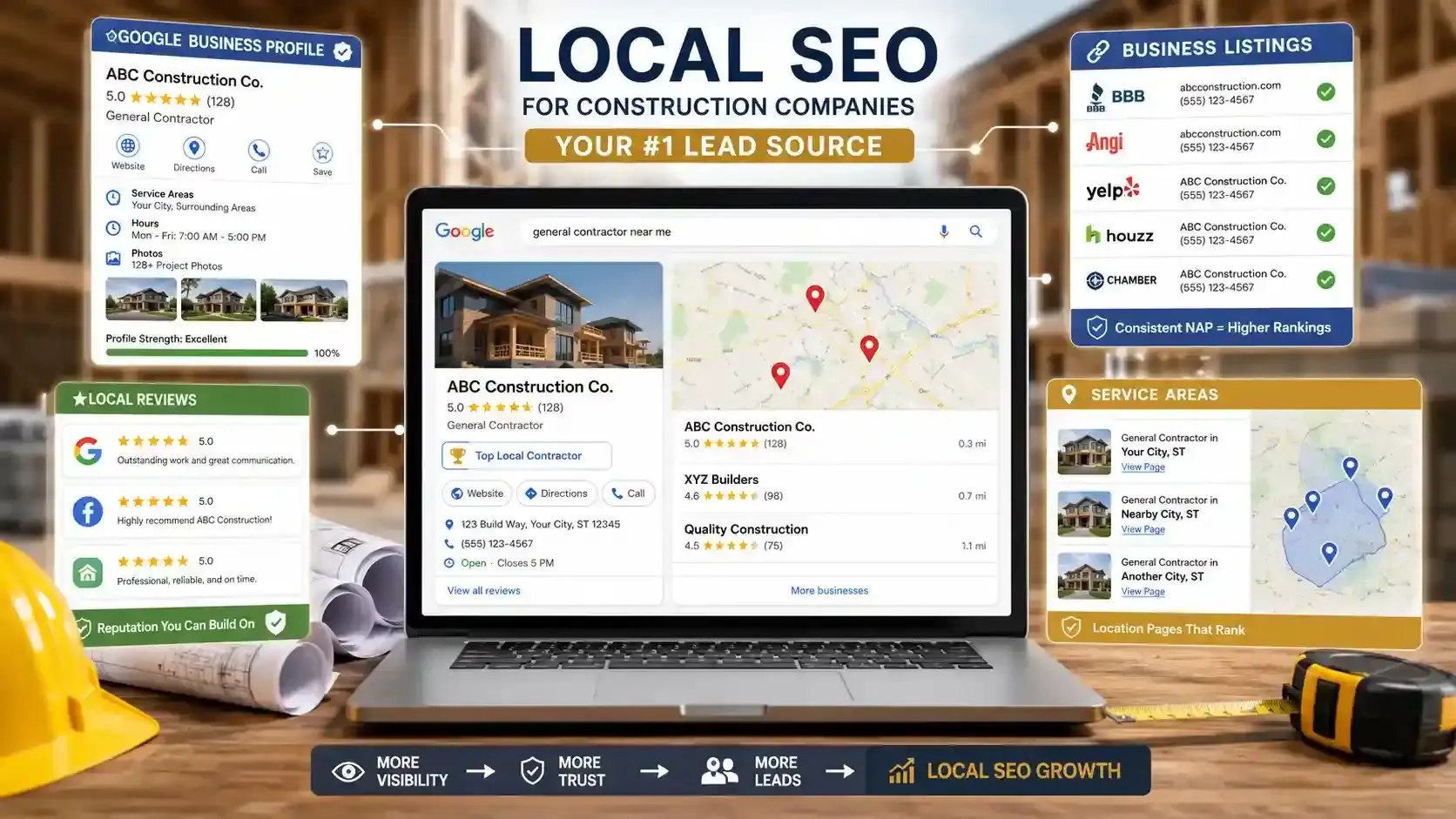
Local SEO for construction companies is the single most important part of your entire search engine optimization strategy. Why? Because construction is a local business. Nobody hires a contractor from three states away.
46% of all Google searches now carry local intent. That means nearly half the people searching on Google are looking for something nearby. If your construction company does not show up in the local pack or Google Maps, you are invisible to those searchers.
And being invisible in local search costs real money. So let me walk you through the four areas that actually move the needle.
How to Set Up and Optimize Google Business Profile for Contractors
Your Google Business Profile is your storefront on Google. Because complete GBP profiles earn 7x more clicks than incomplete ones.
Here is how to optimize yours:
- Pick the right primary category, such as "General Contractor" or "Roofing Contractor," and add secondary categories for other services you offer.
- Keep your NAP (Name, Address, Phone number) identical across your website and every directory listing.
- Upload high-quality project photos every week. Before-and-after shots perform best.
- Post Google updates weekly about recent projects, promotions, or tips.
- Answer every question in the Q&A section before someone else does.
That consistency is what tells Google your business is active and trustworthy. And trust leads directly to the next piece of the puzzle.
What Are Local Citations and Where Should Contractors Get Listed?
Local citations are online mentions of your business name, address, and phone number on directories and industry sites. They confirm to Google that your company is real and operates where you say it does.
Focus on quality over quantity. The best citation sources for contractors include:
- Industry associations like the Associated General Contractors of America
- Your local chamber of commerce
- Supplier and material partner websites
- Regional business directories like BBB and Yelp
Make sure your NAP stays consistent across every listing. Even a small mismatch, like "St." on one site and "Street" on another, can hurt your local search rankings.
How to Get More Google Reviews for a Construction Company
Reviews are the trust currency of contractor SEO. Did you know 97% of consumers read reviews before choosing a local business?
Here is how to build your review count the right way:
- Ask every satisfied client for a review within 48 hours of completing their project, while the experience is still fresh.
- Send a direct Google review link via text or email so they do not have to search for your profile.
- Respond to every review, positive or negative. A professional reply to a bad review shows future clients you care about quality.
Tools like FieldServicely help you automate customer follow-ups after job completion, making the review request feel natural instead of awkward.
How to Create Location Pages That Rank in Local Search
Location pages help Google understand exactly where your construction company operates and match you with nearby searchers. If you serve more than one city or area, each location deserves its own dedicated page. If you are checking rankings for regional branches outside the U.S., use a residential proxy to view accurate local results.
Each location page should include:
- A unique title tag and H1 with the city name, like "General Contractor in Tampa, FL"
- A brief description of the services you offer in that specific area
- Testimonials from clients in that location
- An embedded Google Maps pin showing your service area
- Internal links back to your main service pages
Do not copy and paste the same content across multiple location pages. Google treats duplicate content as low quality, and it will hurt your rankings instead of helping them.
Automate review requests after every completed job
FieldServicely sends follow-ups so you collect Google reviews without chasing clients
On-Page SEO Strategies for Construction Websites
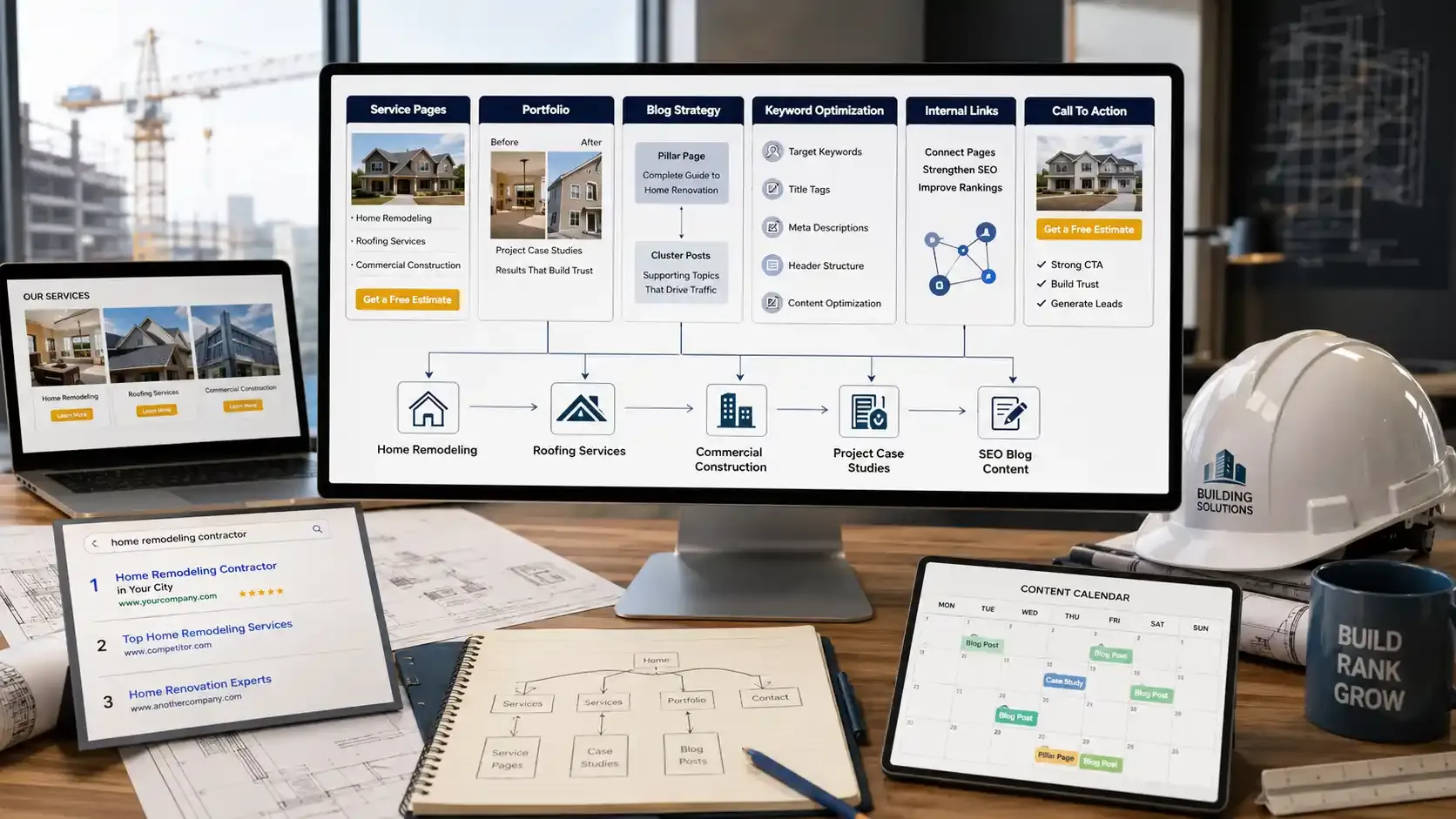
On-page optimization is how you tell Google what each page on your construction website is about. It covers everything from your title tags and meta descriptions to your headings, content structure, and internal links.
Most construction websites treat their site like a digital business card. A homepage, an about page, a contact form, and maybe a list of services. That is not enough to rank.
According to HubSpot, website, blog, and SEO efforts rank as the #1 ROI-driving channel for B2B brands. Construction is no different. If your web pages are not optimized for the right construction keywords, you are losing leads to competitors who did the work.
Here is how to fix that across three key page types.
How to Build Service Pages That Rank and Convert
Every service you offer deserves its own dedicated page. Do not lump roofing, remodeling, and concrete work onto a single "Services" page. Google rewards specific, focused content.
Each service page should include:
- A geo-modified title tag like "Kitchen Remodeling Contractor in Austin, TX"
- A clear H1 heading that matches the search intent behind that service
- Two or three client testimonials specific to that service
- A strong CTA above the fold, such as "Get a Free Estimate" or "Schedule a Site Visit"
- Before-and-after project photos with descriptive alt text
The goal is simple. When someone searches for that exact service in your area, your page should answer their question and give them a reason to call.
Speaking of showing your work, your completed projects can do even more heavy lifting.
Portfolio Pages That Rank and Win Clients
Most contractors upload a few project photos and call it a portfolio. That is a missed opportunity. Each completed project is a chance to rank for long-tail keywords your competitors ignore.
Structure each portfolio page using the Challenge, Solution, Result format:
- Challenge: "The homeowner needed a full second-story addition on a 1960s ranch home in Denver."
- Solution: "We reinforced the existing foundation, built the addition using steel framing, and completed the project in 14 weeks."
- Result: "The project added 1,200 sq ft and increased the home's value by an estimated 35%."
Add location-specific details, project specs, and relevant construction keywords in the headings. This turns a simple photo gallery into a page that ranks and builds trust with potential clients at the same time.
But service pages and portfolios only capture people who already know what they want. To reach buyers earlier in their decision process, you need a blog.
Blog Strategy That Drives Construction Leads
Content marketing for construction works best when you follow a topic cluster model. Pick a core topic, like "home renovation," and build a cluster of blog posts around it.
For example:
- Pillar page: "Complete Guide to Home Renovation"
- Cluster posts: "How Much Does a Kitchen Remodel Cost in 2026," "Do I Need a Permit for a Home Addition," "How to Choose a General Contractor"
Each cluster post links back to the pillar page, and the pillar page links out to each cluster post. This internal linking structure signals to Google that your site has deep expertise on that topic.
A simple content calendar helps you stay consistent. Aim for two to four blog posts per month targeting your low-competition, high-intent keywords from your research. Consistency compounds. After six months, those posts start generating organic traffic without any ad spend.
Your service pages sell the work, and FieldServicely runs it
Manage job creation, photo evidence, and invoicing in one place
Technical SEO Checklist for Construction Websites
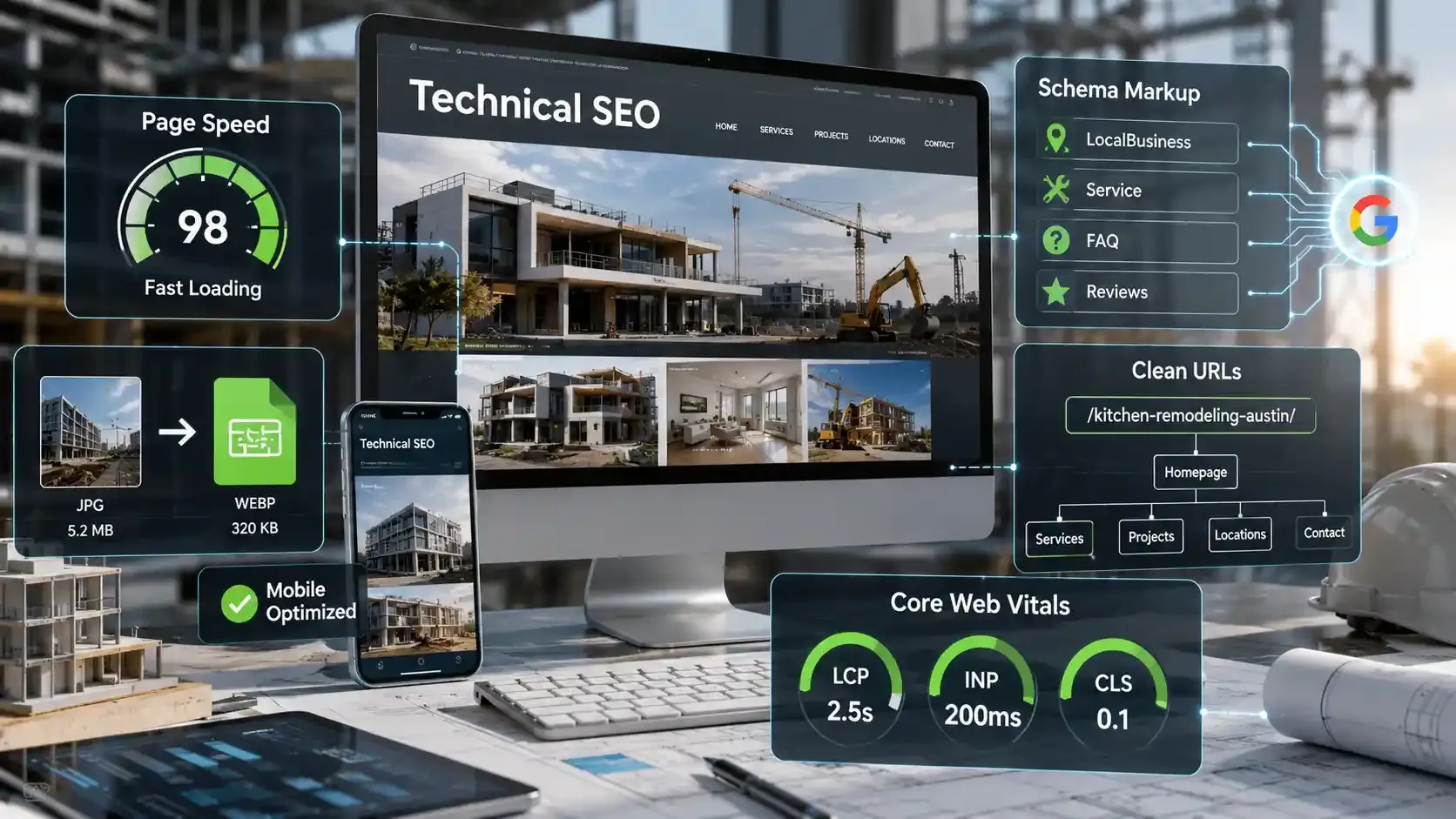
Technical SEO is the foundation your entire construction SEO strategy sits on. Great content and five-star reviews mean nothing if Google cannot crawl, index, or load your website properly.
Most construction websites are image-heavy, built on outdated platforms, and rarely optimized for mobile. But cutting load time from 3 seconds to 1 second boosts conversions by up to 27%!
So if your site feels slow, you are losing leads before anyone sees your work.
Site Speed and Mobile Optimization
Your construction website needs to load in under 2.5 seconds on mobile. Anything slower, and potential clients bounce before they see a single project photo.
Run your site through these two tools to find the problems:
- Google PageSpeed Insights shows your load time and what is slowing you down.
- GTmetrix breaks down which images or scripts are dragging your speed.
Compress project photos to WebP format, enable browser caching, and use a CDN if you serve multiple regions.
Schema Markup
Schema markup tells Google exactly what your business does and where you operate. Without it, search engines guess, and guessing leads to missed rankings.
Four schema types every contractor website needs:
- LocalBusiness schema for your construction company name, address, phone number, and hours
- Service schema for each service like "roof repair" or "kitchen remodeling"
- FAQ schema to make your questions eligible for rich snippets in search engine results pages
- Review schema to display star ratings directly in search results
Test yours for free using Google's Rich Results Test.
Site Architecture and Clean URL Structure
A clean structure helps Google crawl your pages faster and helps visitors find what they need.
- Keep URLs short. Use /kitchen-remodeling-austin/ instead of /page?id=4837.
- Add breadcrumb navigation so users can trace the path back to your homepage in two clicks.
- Submit an XML sitemap through Google Search Console, so Google knows every page on your site.
Every page should be reachable within three clicks from your homepage.
Core Web Vitals Explained
Core Web Vitals are three metrics Google uses to measure how your site feels to real visitors:
- LCP (Largest Contentful Paint) tracks how fast your main content loads. Target: under 2.5 seconds.
- INP (Interaction to Next Paint) measures how quickly your site responds to clicks and taps. Target: under 200 milliseconds.
- CLS (Cumulative Layout Shift) measures how much your layout jumps while loading. Target: below 0.1.
Check your scores in Google Search Console under the Core Web Vitals report. Fix the "Poor" pages first.
A mobile app built for speed in the field
Your crew stays connected with real-time job updates on any device
Off-Page SEO: Building Authority Beyond Your Website
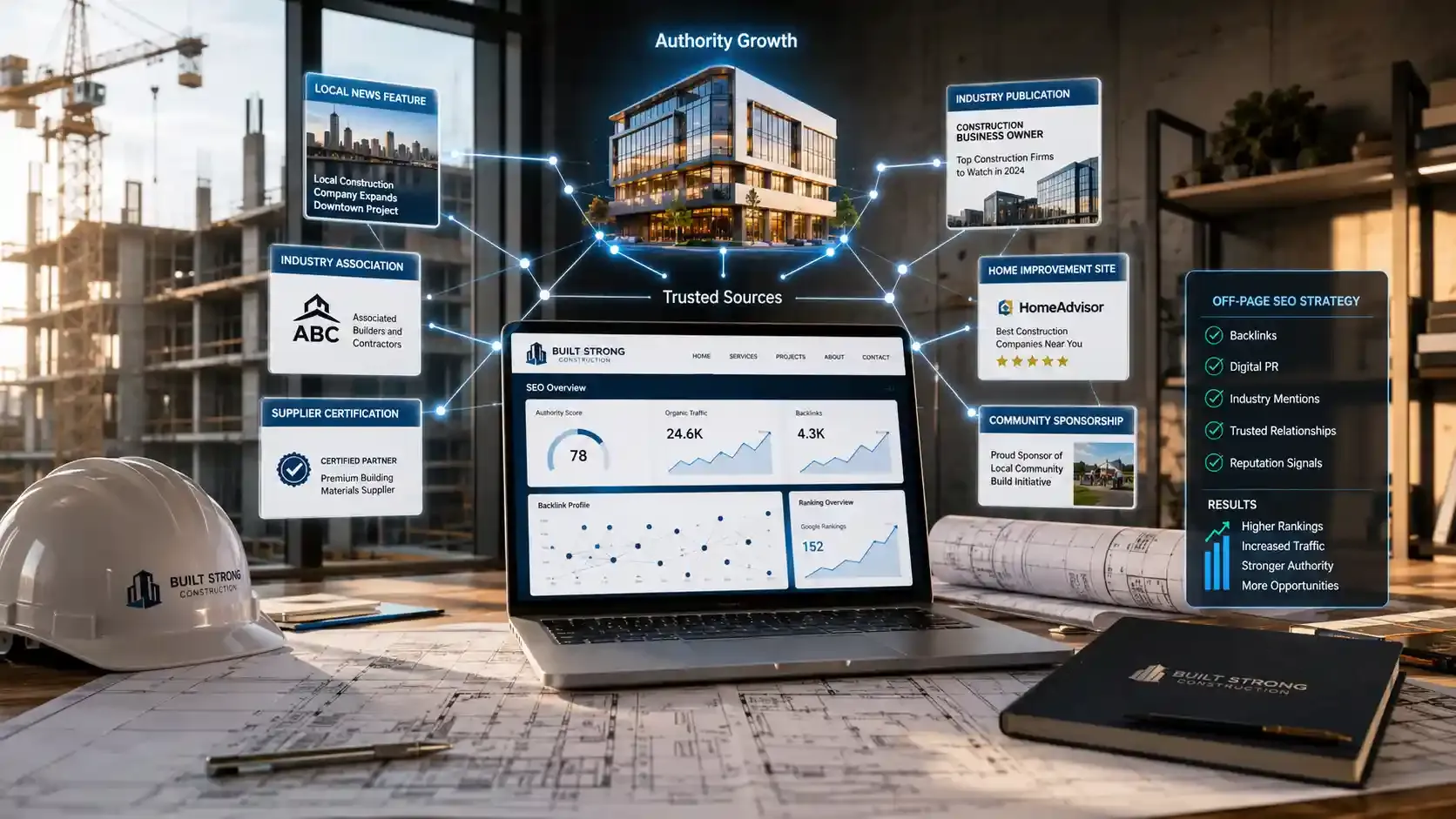
Off-page SEO covers everything you do outside your website to improve search engine rankings. For construction companies, this mostly means earning backlinks from trusted sources and getting your brand mentioned across the web.
Google treats every quality backlink as a vote of confidence. The more you earn from reputable sites, the higher you rank. Link signals make up 15% of local pack rankings, putting them among the top five factors that decide your visibility in map results.
Backlink Sources Worth Targeting
Not all backlinks carry equal weight. A link from your local news station matters far more than one from a random directory.
Focus on these:
- Supplier and manufacturer directories like Owens Corning or James Hardie certified contractor pages
- Trade associations like the Associated General Contractors of America or your state's Home Builders Association
- Local media coverage of your projects or community involvement
- Guest posts on real estate or home improvement sites in your area
Aim for five to ten strong links per quarter instead of chasing hundreds of weak ones. Quality always beats quantity with off-page SEO.
Digital PR for Contractors
Digital PR gets your company into publications and news outlets without ad spend. It builds backlinks, brand mentions, and credibility in one move.
What works:
- Pitch project spotlight stories with before-and-after photos to local journalists
- Sponsor community events or charity builds, since most organizations link to sponsors on their website
- Contribute expert tips to industry publications like Construction Dive, ENR, or Builder Magazine
One solid press mention per quarter keeps your authority growing without eating up your schedule.
Capture jobsite evidence that fuels your portfolio
Document every project with photos and reports ready for your website
How to Optimize for AI Search and Voice Search in 2026 (GEO/AEO)
.webp?2026-06-30T08%3A31%3A41.037Z=&w=3840&q=100)
AI search has changed how people find construction companies. Google AI Overviews, ChatGPT, and Perplexity now answer questions directly on the results page, often without the user clicking a single link.
AI Overviews now appear on roughly 48% of all tracked Google searches. That means nearly half your potential clients may never scroll to your website unless AI cites you in its answer.
Structuring Content for AI Citations
AI engines pull from content that gives clear, direct, fact-rich answers. Vague marketing copy gets ignored. When using AI-assisted content, an AI detector can also help review content for originality and quality
- Open every section with a concise 40 to 60-word answer. AI tools grab these first.
- Use clean heading hierarchies (H1, H2, H3) so crawlers can scan your structure instantly.
- Add comparison tables, bullet points, and short paragraphs throughout.
- Include FAQ schema and structured data on every service page.
Brands cited in AI Overviews earn 35% more organic clicks than uncited competitors. Getting cited is the new ranking.
Voice Search and Conversational Keywords
People talk differently from the way they type. Someone typing searches "roofing contractor Dallas." Someone speaking says, "Who is the best roofing contractor near me in Dallas?"
- Target long-tail, conversational keywords that match natural speech
- Build FAQ sections with natural question-and-answer pairs
- Keep each answer under 50 words, since voice assistants read short responses
E-E-A-T Signals AI Trusts
Google and AI models evaluate your E-E-A-T (Experience, Expertise, Authoritativeness, Trustworthiness) before deciding to cite you. For construction companies, that means:
- Add author bios with industry credentials, licenses, and years of experience
- Showcase certifications from trade organizations on your About page
- Document completed projects with specs, timelines, and measurable results
- Maintain consistent reviews across platforms, since 84% of AI citations come from earned media rather than your own site
Convert every AI-driven lead with smart job management
Handle new inquiries instantly with scheduling, GPS tracking, and real-time updates
Image and Video SEO for Construction Companies
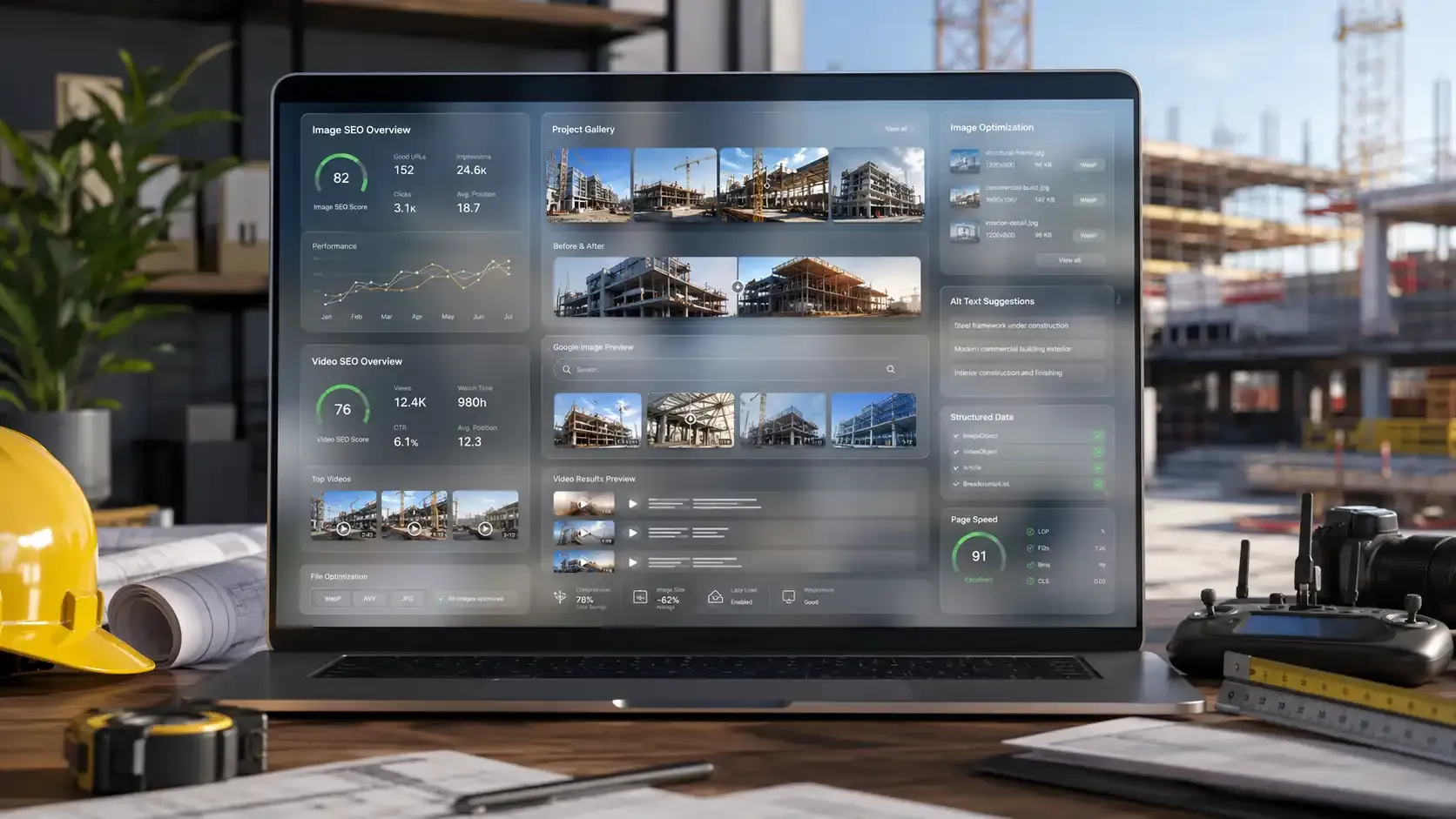
Construction is a visual business. Clients want to see your work before they call. That makes image and video optimization one of the most underused SEO advantages in this industry.
85% of video marketers say video helped them generate leads. For contractors, this means your project photos and walkthroughs are not just portfolio pieces. They are ranking assets.
Here is how to optimize them:
For images:
- Rename files before uploading. Use kitchen-remodel-contractor-austin.webp instead of IMG_4829.jpg.
- Write descriptive alt text like "completed kitchen remodel by [Company Name] in Austin, TX."
- Compress every image to WebP format using TinyPNG to keep page speed fast.
- Upload before-and-after shots to your Google Business Profile weekly.
For videos:
- Post project walkthroughs and drone footage on YouTube with keyword-rich titles and descriptions.
- Add full transcripts to every video, since Google cannot watch your footage, it reads the text.
- Add video schema markup to pages with embedded videos so Google can display rich video snippets in search results.
Construction companies sit on a goldmine of visual content. Most just never optimize it.
Your crew captures project photos right from the field
Use FieldServicely's jobsite photo feature to build SEO-ready visual content
How to Measure Construction SEO Success
You cannot improve what you do not track. Here are the SEO KPIs every construction company should monitor monthly:
- Organic traffic growth shows how many people find your site through Google without paid ads.
- Leads and form submissions tell you if that traffic is actually converting into project inquiries.
- Calls and direction requests from GBP measure how your Google Business Profile drives real-world action.
- Cost per lead from SEO vs paid ads proves whether your organic strategy saves money over time.
- Local pack visibility tracks how often your business appears in the top 3 Google Maps results.
- Keyword rankings reveal which construction keywords are climbing and which need more work.
Use Google Analytics for traffic and conversions, Google Search Console for keyword performance, and a rank tracker like Ahrefs or Semrush for position monitoring.
Set a monthly reporting rhythm. Compare numbers month over month and spot trends before they become problems.
Common SEO Mistakes Construction Companies Make
Most contractors lose rankings not because SEO is too hard, but because they keep repeating the same avoidable errors. Here are the ones I see the most:
- Stuffing keywords into service pages instead of writing naturally. Google penalizes this, and so do your visitors.
- Ignoring mobile optimization, even though most homeowners search for contractors on their phones first.
- Leaving their Google Business Profile incomplete or never claiming one at all, which kills local pack visibility.
- Copying the same content across multiple location pages instead of writing unique descriptions for each city they serve.
- Never asking clients for reviews and then wondering why competitors with 50+ ratings outrank them.
- Skipping AI search optimization entirely while Google AI Overviews already show up on nearly half of all searches.
Conclusion
Honestly, I burned a lot of time figuring out construction SEO. Nobody told me what actually mattered. I chased backlinks when my Google Business Profile was half empty. I wrote content for keywords nobody typed. I paid an agency once that did absolutely nothing for three months.
What finally worked? Fixing the basics first. Then doing one thing well each month instead of ten things badly.
That probably saved me more money than any ad campaign ever did.
FAQs about Construction SEO
How Long Does SEO Take To Show Results for a Construction Company?
Most construction companies start seeing measurable results within 3 to 6 months of consistent effort. Competitive markets may take longer. Local SEO improvements like Google Business Profile optimization often show results faster than organic page rankings.
Can a Small Construction Company Do SEO Without Hiring an Agency?
Yes. A small contractor can handle basic SEO in-house by optimizing their Google Business Profile, publishing blog content around local keywords, collecting reviews, and fixing technical SEO issues using free tools like Google Search Console and PageSpeed Insights.
Does Social Media Activity Help Construction SEO?
Social media does not directly impact search engine rankings. But it drives traffic to your website, increases brand visibility, and helps your content earn backlinks when people share it. That indirect effect supports your overall SEO for the construction business strategy.
How Much Should a Construction Company Budget for SEO?
Most contractors spend between $1,500 and $5,000 per month on professional construction SEO services. DIY efforts cost less but take more time. The right budget depends on your market size, competition level, and how fast you want results.
Is SEO Worth It for a Brand New Construction Company?
Absolutely. New construction companies benefit the most from local SEO because it levels the playing field against established competitors. A well-optimized website with strong reviews and local content can outrank bigger firms that neglect their online presence.
What to read next

Field Service Business
SEO for Healthcare Industry: 8 Proven Strategies for Better Visibility
See Details