Worker Break Laws in 2026: State-by-State Guide
Updated on 10 Jul 2026
Jump to
Summary

Federal law (FLSA) does not require meal or rest breaks at all — it only governs whether breaks that ARE given must be paid (U.S. DOL).
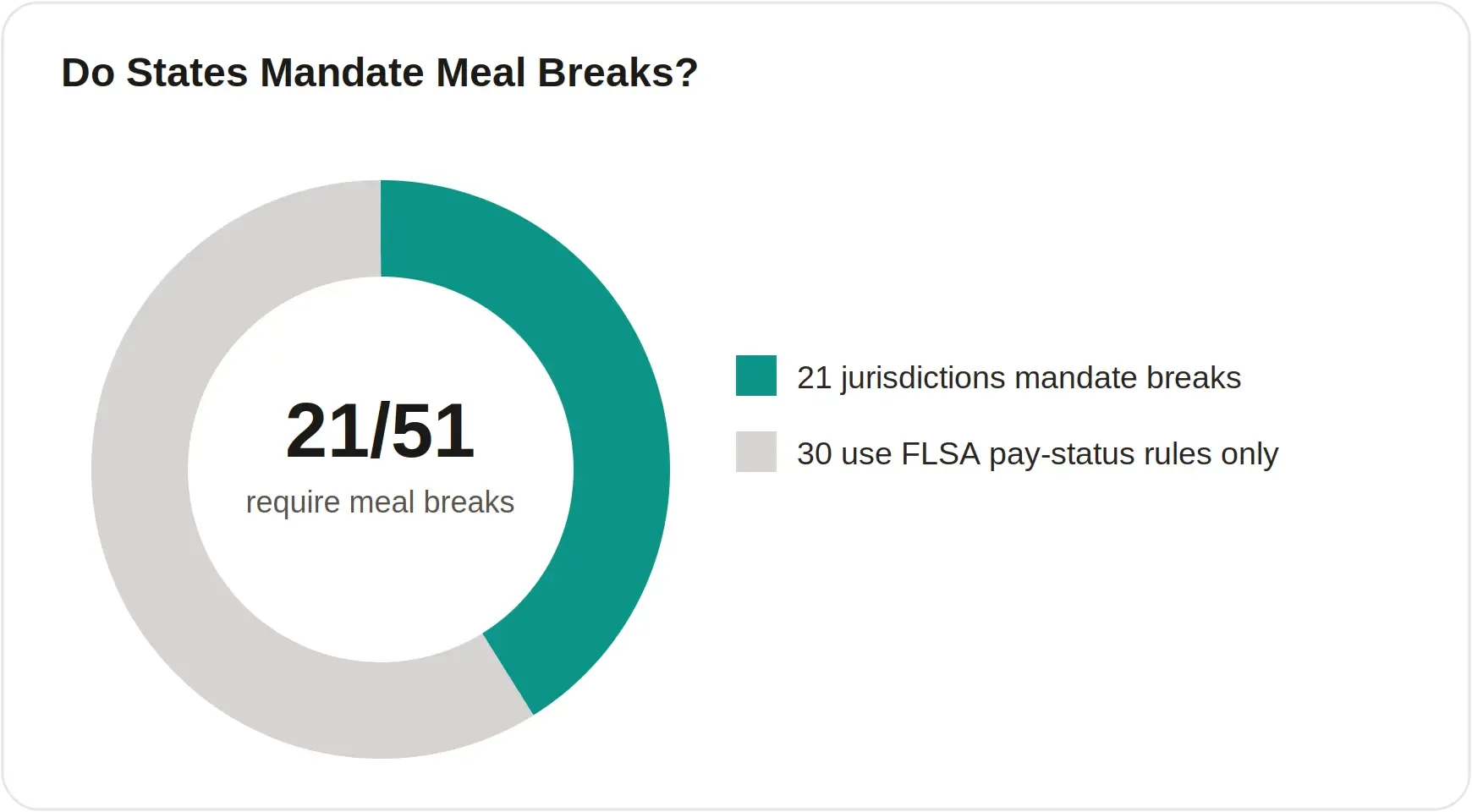
21 states currently mandate meal breaks; 7 of those also require paid rest breaks (California, Colorado, Kentucky, Minnesota, Nevada, Oregon, Washington).
DOL recovered $259M in back wages in FY2025 alone, averaging roughly $1,465 per affected worker.
Minnesota's new break law takes effect January 1, 2026, with automatic liquidated-damages penalties for violations.
Field service employers face a unique compliance gap: verifying breaks for a workforce that's never in one place.
The U.S. Department of Labor recovered $259 million in back wages for nearly 177,000 workers in fiscal year 2025. It's the highest recovery total since 2019 (U.S. DOL WHD, January 2026).
A meaningful share of that traces back to something as basic as "break rules", although federal law doesn't require them. But a growing list of states does, and the penalties for getting it wrong keep climbing.
For field service businesses such as HVAC, plumbing, electrical, cleaning, landscaping, break compliance is harder than it sounds. This is because your crew isn't sitting at one desk. They're driving between five job sites, and"did they actually take a break" isn't something a paper timesheet can answer.
In this guide, I will break down what federal and state law actually require in 2026. Along with it, I will discuss where the risk is highest. And how compliance-minded employers are closing the gap.
What Do Worker Break Laws Actually Require Under Federal Law?
Federal law does not require employers to give workers any breaks at all (U.S. Department of Labor). The Fair Labor Standards Act (FLSA) only kicks in when a break is offered. For example, short breaks of 20 minutes or less are payable.
On the contrary, a genuine meal period of 30 minutes or more can go without paying a single dime. However, it's only applicable when the employee is completely relieved of duty.
Now, the "completely relieved of duty" clause is where most field service employers slip up. If a dispatcher pings a technician mid-lunch to reroute them to an emergency call, that break arguably isn't unpaid anymore. Under federal rules, the employer must pay because the worker was never fully off the clock.
And guess what?
This is a bigger risk for mobile crews than office staff, as a phone that never stops buzzing makes "fully relieved of duty" much harder to prove after the fact.
The FLSA sets the floor, not the standard, even though it's the law most employers default to. State law is where the real obligations live. For a deeper look at what counts as compensable time, see our guide on paying field employees correctly.
Which States Require Meal and Rest Breaks in 2026?
21 U.S. jurisdictions require employers to provide a meal break. And 7 of those also mandate paid rest breaks. They are as follows:
- California
- Colorado
- Kentucky
- Minnesota
- Nevada
- Oregon
- Washington (U.S. DOL WHD, State Meal Break Requirements).
The remaining 30 states rely solely on the FLSA's pay-status rules, meaning employers there have far more discretion — but not zero risk, since local ordinances sometimes fill the gap.
The thresholds vary more than most employers expect. Nevada gives workers a full 8 hours before a meal break kicks in; California, Colorado, Washington, and Kentucky require one after just 5 hours. That's a real scheduling difference for a company operating crews across state lines.
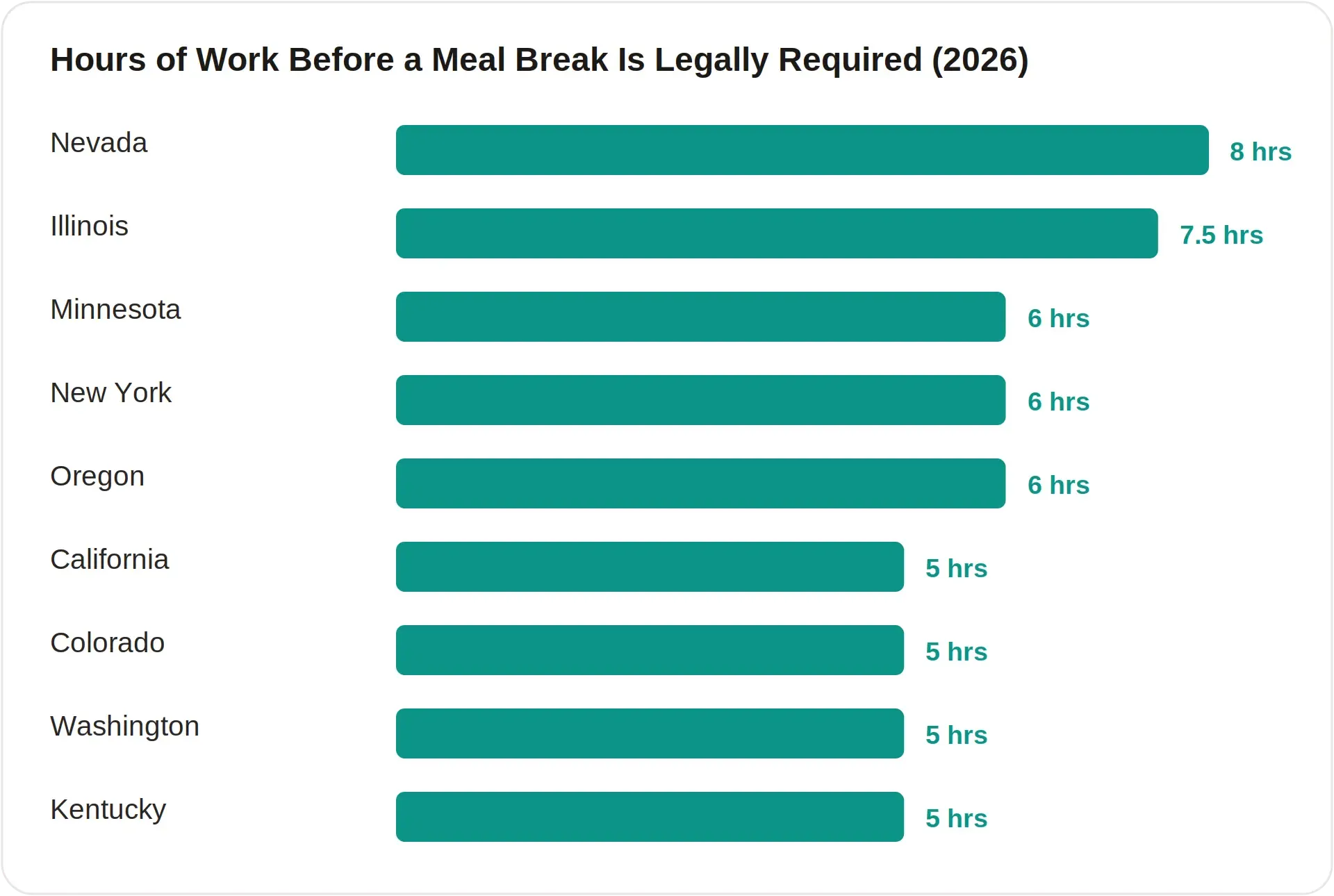
Here's the same data as a reference table, since not every state fits neatly into a bar chart:
| State | Meal Break | Rest Break | Paid? | Trigger |
|---|---|---|---|---|
California | 30 min | 10 min / 4 hrs | Rest paid; meal unpaid | After 5 hrs |
Colorado | 30 min | 10 min / 4 hrs | Rest paid; meal unpaid | After 5 hrs consecutive hrs |
Washington | 30 min | 10 min / 4 hrs | Rest paid; meal unpaid | After 5 hrs |
Oregon | 30 min | 10 min / 4-hr segment | Rest paid; meal unpaid | Roughly mid-shift, 6+ hr shifts |
Nevada | 30 min | 10 min / 4hrs | Rest paid; meal unpaid | 8 hours of continuous work |
Kentucky | ~30 min | 10 min / 4hrs | Rest paid; meal unpaid | After 5 hrs |
Minnesota (new, eff. 1/1/26) | 30 min | 15 min / 4hrs | Both are required by law | 6+ consecutive hrs |
Illinois | 20 min | No general mandate | Short breaks are paid if offered | 7.5+ hr shifts |
New York | 30 min | No general mandate | Meal Unpaid | Every 6 consecutive hrs |
For companies running crews in multiple states, the practical answer is to build your break policy around your strictest operating state, then note exceptions elsewhere.
Trying to remember nine different rule sets on the fly is exactly how violations happen. See how GPS time tracking documents break compliance automatically for how that policy gets enforced in the field.
What Happens When Employers Violate Break Laws?
California's Labor Code section 226.7 requires employers to pay workers extra hours when a meal period is missed. Plus, an extra hour of payment for the missed rest time. Not to mention the payment has to be done as per the employee's regular hourly rate. (Fisher Phillips; CA DIR).
Just so you know, the California Supreme Court has ruled these premiums count as wages. Not in any way can employers count them as penalties. And it stretches the statute of limitations to three years.
Minnesota, on the other hand, takes a different approach starting January 1, 2026. In here, employers who miss a required break must make a compensation payment at the regular rate. Plus an equal amount again as liquidated damages. That's effectively double pay for every missed break. (Ogletree Deakins).
At the federal level, enforcement is trending upward. The DOL's Wage and Hour Division closed roughly 17,000 investigations in FY2025. They also recovered $259 million in total.
And guess what?
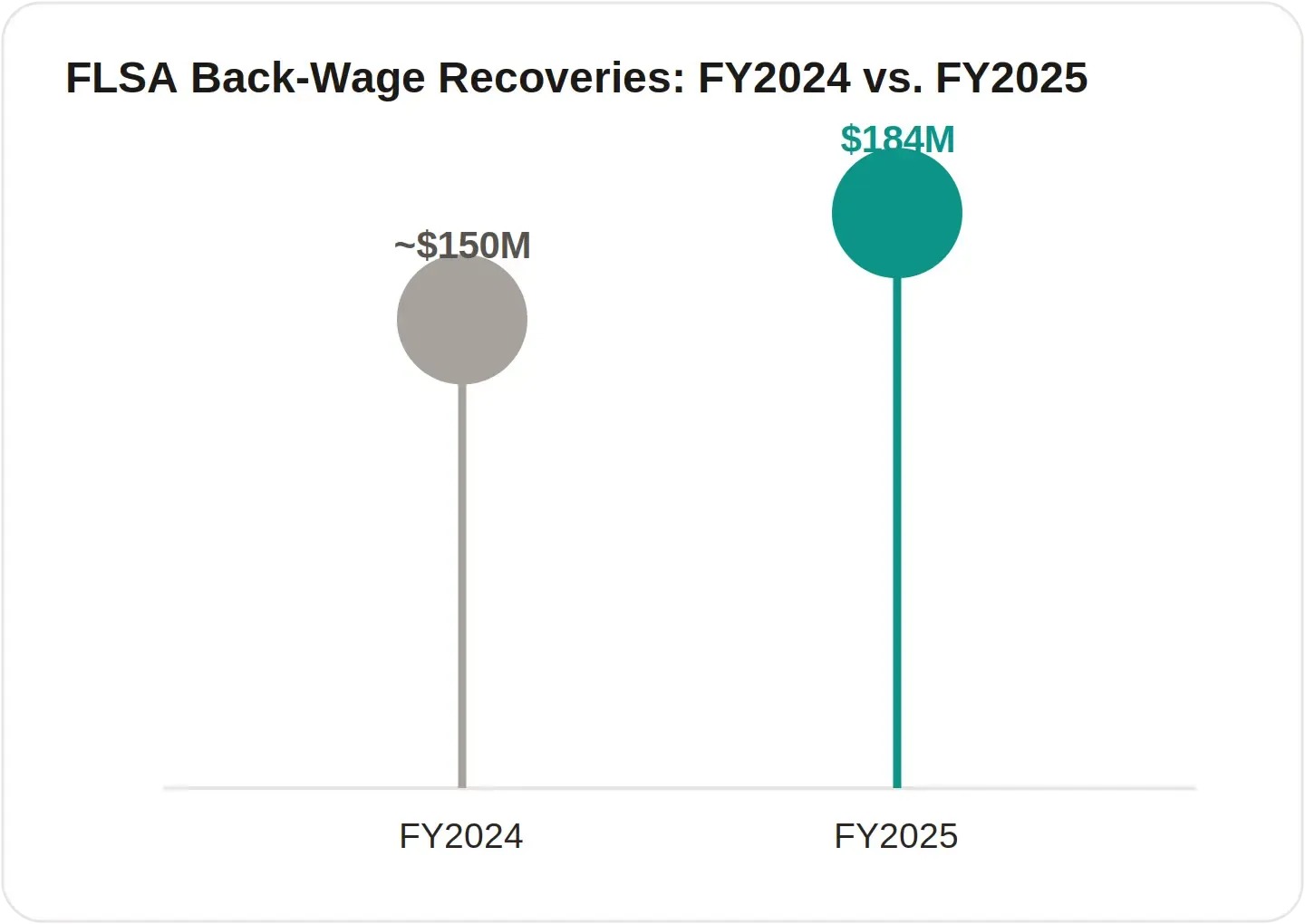
The FLSA-specific violations alone account for over $184 million. That is up from just under $150 million the year before. (HR Dive, January 2026).
For an employer running a 40-person field crew, a small error rate on break compliance grows fast. Our guide on time clock rounding and its legal risk covers a related, equally common wage-and-hour trap.
Why Break Compliance Is Harder for Field Service and Mobile Crews
Field service employers face a compliance problem that office-based businesses simply don't have. That is verifying that a break happened at all.
For example, a technician driving between three job sites doesn't clock in and out of a single building. So the manager can not visually confirm that they stepped away. That is why dispatchers routinely tell us the hardest part isn't writing the break policy, it's actually the lack of proof.
Likewise, drive time adds a second layer of complexity. Time spent traveling between job sites during the workday is generally compensable travel time under the FLSA. It is legally separate from an unpaid meal break, but on a paper timesheet, both can look identical. For instance, a 30-minute gap between two clock punches.
So, without location data, a manager can't tell whether that gap was a genuine break or an under-recorded drive between calls.
That said, the underlying behavior makes the matter even worse. In 2026, over half of employed Americans (55%) reported skipping lunch entirely on hectic days. A third of them skip it at least twice a week (ezCater, The Lunch Report, 2025).
Be that as it may, a lot of "missed break" incidents on paper timesheets are really just missing data. For related coverage on drive-time classification, see how field service businesses calculate compensable time and labor burden.
How Time-Tracking Software Closes the Break-Compliance Gap
The most reliable fix for the field-service break-verification problem is location-anchored time data, not more paperwork. GPS time tracking timestamps and geotags every clock-in, clock-out, and break punch, which turns "did they take a break" from a manager's guess into a data point (ADP SPARK, December 2025).
Automated break reminders close the rest of the gap: rather than relying on a technician to remember state-specific rules mid-shift, the system prompts a break at the legally required interval and logs it the moment it's taken. That shifts compliance from a policy on paper to something enforced at the point of work. See how Fieldservicely's GPS time clock logs break and travel time separately to see this in practice, or explore the full field service scheduling and time-tracking feature set.
For companies that have been burned by a break-related wage claim before, geofenced, timestamped records also do double duty as your defense file. If a technician disputes a missed break, you have a location-stamped log instead of a manager's memory. That record-keeping habit pairs well with our guide on protecting payroll accuracy with GPS-verified time logs.
How GPS Time-Tracking Software Closes the Break-Compliance Gap
The most reliable fix for the field-service break-verification problem is location-anchored time data. GPS time tracking software geotags every clock-in, clock-out, and break punch. It creates a data point for every break an employee takes. (ADP SPARK, December 2025).
With that being said, automated break reminders close the rest of the gap. For example, rather than relying on a technician to remember state-specific rules mid-shift, the system prompts a break at the legally required interval and logs it the moment it's taken. That shifts compliance from a policy on paper to something enforced at the point of work.
For companies that have been burned by a break-related wage claim before, geofenced, timestamped records also do double duty as your defense file — if a technician disputes a missed break, you have a location-stamped log instead of a manager's memory. That record-keeping habit pairs well with our guide on protecting payroll accuracy with GPS-verified time logs.
What's Changing in Break Law Compliance for 2026?
Minnesota's new break law is the clearest sign that this area of employment law is still moving. Effective January 1, 2026, Minnesota requires a 15-minute paid rest break for every 4 hours worked. And a 30-minute unpaid meal break for shifts of 6 or more hours. It comes with automatic liquidated-damages penalties for violations (Ogletree Deakins; SHRM).
Just for the record, Minnesota isn't an isolated case. Multiple states amended wage-and-hour rules effective January 1, 2026. For this reason, employer-side law firms are tracking the pace because it keeps accelerating year over year. (Ogletree Deakins, Employer Compliance Watchlist).
Based on previous history, none of this is likely to slow down. This is because state legislatures amend the law more frequently than most employer handbooks get updated.
The DOL's FY2025 enforcement numbers suggest regulators have more appetite for wage-and-hour cases. If your compliance process depends on someone remembering to check nine different state rule sets, 2026 is a reasonable year to automate it instead.
Conclusion
Federal law sets a low bar on breaks, but 21 states and a growing list of penalties don't. For field service employers, the real risk is the gap between having a break policy and being able to prove it happened for a workforce that's never in one place.
Ready to see it in action? Book a Fieldservicely demo or read next about building a defensible GPS tracking policy your crew will actually follow.
Frequently Asked Questions
Are field technicians paid for drive time between job sites?
Generally, yes. Time spent traveling between job sites during the workday counts as compensable work time under the FLSA. This is distinct from an ordinary home-to-first-job commute, which is typically unpaid (U.S. DOL).
Can an employer require a technician to eat lunch in a company vehicle?
It depends on the state. In states like California and Washington, a meal break only qualifies as unpaid if the employee is fully relieved of duty. But if they must stay reachable by radio or continue driving, the "break" likely must be paid (CA DIR).
Which states require both meal and rest breaks in 2026?
Seven states currently require both: California, Colorado, Kentucky, Minnesota, Nevada, Oregon, and Washington. Minnesota's requirement is new as of January 1, 2026 (U.S. DOL WHD; Ogletree Deakins).
What happens if a worker skips a required break entirely?
The consequences depend on the state. California requires an extra hour of pay per missed meal or rest period (up to two hours per day). Minnesota requires the missed break time to be paid, plus an equal amount in liquidated damages. Federally, DOL enforcement recovered $259 million in back wages in FY2025 alone (U.S. DOL WHD).
Are short breaks under 20 minutes required to be paid?
Yes. Under the FLSA, any break of 20 minutes or less has to be paid by the employer. Because it's considered too short to be effectively used for the employee's own purposes (U.S. DOL).
This guide was compiled and fact-checked by the Fieldservicely editorial team against primary U.S. Department of Labor sources, state labor agency guidance, and employer-side legal analysis (Ogletree Deakins, SHRM, Fisher Phillips). Every statistic below is independently verifiable at its cited source. Last verified 2026-07-03; state break laws change frequently, so confirm current requirements with your state labor agency before setting policy.