Double Time vs Overtime: What's the Difference and When Does Each Apply?
Updated on 10 Jul 2026
Jump to
Summary

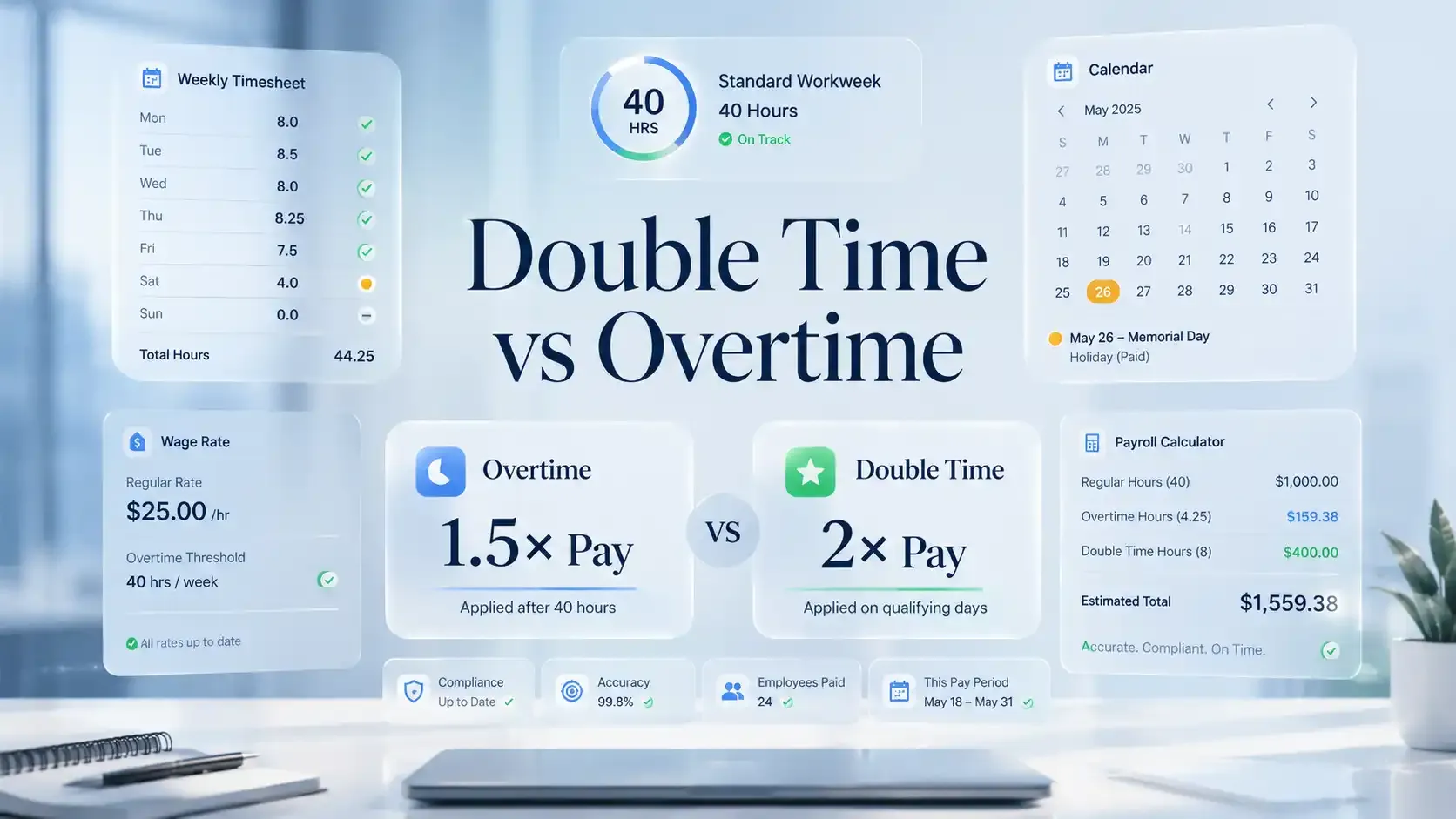
Overtime pays 1.5× your regular rate, whereas double time pays 2×.
Federal law requires overtime for most employees who work over 40 hours a week. It does not require double time.
Double time usually depends on state law, a union agreement, or your employer's policy.
Working on a holiday doesn't automatically mean you get double pay.
Only non-exempt employees usually qualify for overtime or double time.
Paying overtime incorrectly can lead to costly payroll mistakes.
The main difference between overtime and double time is how much you get paid and when the law requires it. Overtime pays 1.5× your regular wage and is required by federal law for most eligible employees who work more than 40 hours in a week. Double time pays 2× your regular wage, but you only receive it if your state, union agreement, or employer provides it.
Whether you receive double time depends on your state, union agreement, or employer's policy.
Why does understanding the difference matter? Every year, many workers miss out on wages because employers calculate overtime incorrectly. In fiscal year 2025, the U.S. Department of Labor recovered more than $259 million in unpaid wages for nearly 177,000 workers, averaging about $1,465 per person.
Whether you're checking your paycheck or managing payroll, here's what you need to know about overtime, double time, when each applies, and how to calculate them.
Double Time vs Overtime: Key Differences at a Glance
Before we get into the details of double time and overtime, here's a side-by-side comparison.
| Feature | Overtime (OT) | Double Time |
|---|---|---|
Pay Rate | 1.5× regular pay (time-and-a-half) | 2× regular pay (double pay) |
Federal Law | Required by the Fair Labor Standards Act (FLSA) for non-exempt employees | Not required under federal law |
When It Applies | Hours worked over 40 in a single workweek | Excessive daily hours (e.g., over 12 in a day) or the 7th consecutive workday; varies by state |
Who Sets the Rule | Federal mandate (nationwide) | State law, union agreement, or company policy |
As you can see, the biggest difference is simple: federal law gives you the right to overtime pay, but double time only applies in certain situations.
What is Overtime Pay?
Overtime pay gives you extra money when you work more than 40 hours in a workweek. If you qualify, you earn 1.5 times your regular hourly rate for every overtime hour. Under the Fair Labor Standards Act (FLSA), most non-exempt employees have this right.
Here are a few important things to know:
- You can't give up your overtime pay. Your employer can't ask you to waive it, even if you agree.
- Each workweek is separate. Your employer can't average your hours over two weeks to avoid paying overtime.
- Your overtime rate may be higher than you think. It can include certain bonuses and commissions, not just your hourly wage.
For more details, see our guide on how to pay field employees properly.
What Is Double Time Pay?
Double time means you earn 2 times your regular hourly rate. For example, if you normally make $20 an hour, you'll earn $40 an hour when you receive double time.
You usually receive double time only if it comes from:
- State law. For example, California requires double time in certain situations.
- A union agreement. Some unions negotiate double-time pay for holidays or long shifts.
- Your employer's policy. Some companies choose to offer double time to reward employees or fill difficult shifts.
That's why your double-time pay depends on where you work. Two people doing the same job can have different pay rules if they work in different states or for different employers.
How to Calculate Overtime and Double Time Pay
Calculating overtime and double time is easy once you know the formulas. The biggest challenge is keeping an accurate record of your hours.
Overtime = Regular hourly rate × 1.5 × Overtime hours
Double time = Regular hourly rate × 2 × Double-time hours
Here's an example. Let's say you earn $20 an hour and work a 14-hour day in California.
- First 8 hours: 8 × $20 = $160
- Hours 9–12 (4 hours): 4 × $30 = $120 (time-and-a-half)
- Hours 13–14 (2 hours): 2 × $40 = $80 (double time)
Total pay for the day: $360
If you earned your regular rate for all 14 hours, you would make only $280. Thanks to overtime and double time, you earn an extra $80 that day.
That's why you should track your hours carefully. Even small mistakes can lead to payroll errors. Using a GPS time clock or reliable timecard calculations can help you record every hour correctly.
Who Qualifies: Exempt vs. Non-Exempt Employees
Not everyone qualifies for overtime or double time. It depends on whether you're non-exempt or exempt.
- Non-exempt employees usually qualify for overtime pay. If your state requires double time, you may qualify for that, too. Most hourly workers fall into this category.
- Exempt employees usually do not qualify for overtime or double time. To be exempt, you typically need to earn a salary above a certain amount and perform executive, administrative, or professional job duties (U.S. Department of Labor, Fact Sheet #17A).
Knowing your classification is important. If you're an employee, it tells you what pay you're entitled to. If you're an employer, classifying workers correctly helps you avoid payroll mistakes and legal problems. Misclassifying employees is one of the most common wage violations.
Challenges You May Face When Calculating Overtime and Double Time
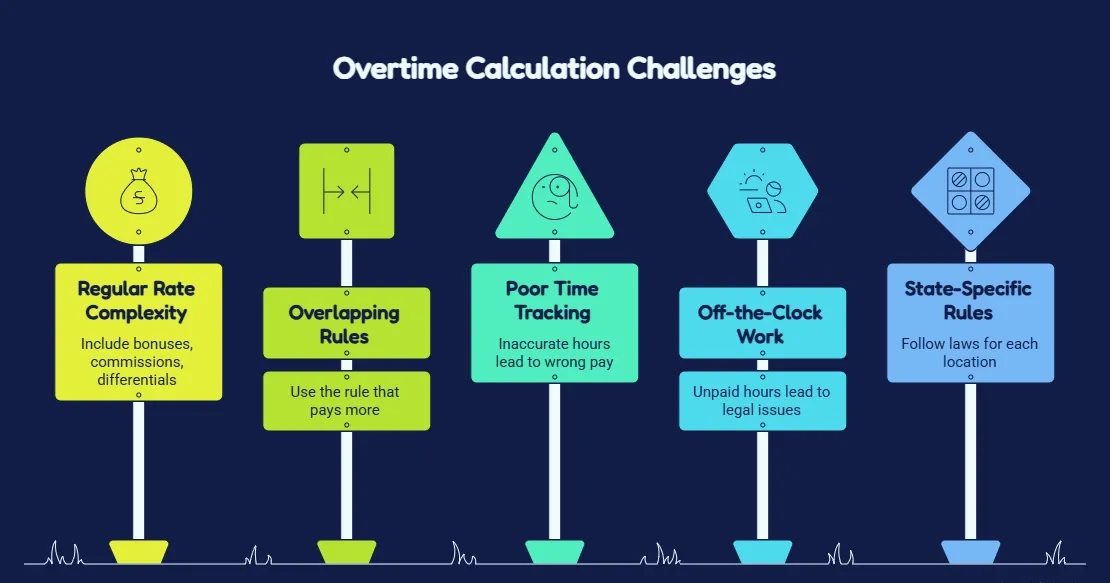
Even if you understand the rules, calculating overtime and double time can still be difficult. Small mistakes can lead to underpaying employees or creating payroll problems.
Here are the most common issues you should watch for:
Your regular rate is more than just your hourly wage
Overtime isn't always based only on your hourly pay. In many cases, you also need to include non-discretionary bonuses, commissions, and shift differentials when calculating your regular rate. If you leave these out, you could pay less overtime than the law requires.
Daily and weekly overtime rules can overlap
In some states, such as California, you may qualify for overtime based on both the number of hours you work in a day and the total hours you work in a week. When both rules apply, you should use the one that gives you the higher pay.
Poor time tracking leads to payroll mistakes
If employees forget to clock in or out, if time gets rounded incorrectly, or if one employee clocks in for another (known as buddy punching), your time records become inaccurate. When your hours are wrong, your pay calculations will be wrong too.
Off-the-clock work still counts
If you work through your lunch break, stay late after your shift, or start working before you clock in, those hours may still need to be paid. Ignoring this time can lead to unpaid wages and legal issues.
Different states have different rules
If your business has employees in more than one state, you need to follow the overtime laws for each location. One state may require only overtime, while another may also require double time or different pay rules.
Most overtime and double-time problems start with inaccurate time records. If you don't track hours correctly, you can't calculate pay correctly. That's why time card fraud and tracking errors are such expensive problems for growing businesses.
Is There a Tool You May Use to Control Labor Costs Smartly?
The best way to manage overtime and double time is to track every hour correctly. When you have accurate time records, you can calculate pay correctly, avoid payroll mistakes, and reduce the risk of paying too much or too little.
FieldServicely makes this easier. You can track employees' work hours with GPS, use geofenced check-ins to make sure they clock in only when they arrive at the job site, and collect accurate timesheets automatically. This helps you see overtime and double-time hours before payroll, so there are no surprises.
If you manage hourly or field employees, good time-tracking software does more than save you time. It helps you pay employees correctly, avoid costly wage disputes, and keep your labor costs under control as your business grows.
To learn more, see our guide on how GPS time tracking helps you manage payroll.
Final Words
Hopefully, you now have a crystal clear idea about the debate on double time vs over time.
Overtime and double time both give you extra pay for working extra hours, but they work differently. Overtime pays 1.5 times your regular hourly rate and usually starts after you work more than 40 hours in a workweek. Federal law requires this for most eligible employees. Double time pays 2 times your regular rate, but federal law doesn't require it.
Whether you're an employee or an employer, you should understand the rules that apply to you and track your work hours carefully. Accurate time records help you avoid payroll mistakes and make sure every hour is paid correctly.
Try Fieldservicely to make time tracking simple with accurate timesheets, GPS tracking, and automatic records. That way, you can pay employees correctly and stay organized as your business grows.
Frequently Asked Questions
Do You Get Double Time For Working Holidays?
No. Federal law doesn't require holiday double pay. You only get it if your state, union agreement, or employer offers it.
Can Your Employer Ask You To Give Up Overtime Pay?
No. You can't give up your legal right to overtime pay. Your employer must pay eligible overtime, even if you agree otherwise.
Do You Pay More Taxes On Double Time?
No. Double time is taxed like your regular wages. Earning more doesn't automatically mean a higher tax rate on all your income.
What States Require Double-Time Pay?
California is the best-known state that requires double time. Other states have daily overtime rules, but not the same double-time requirements.
What Should You Do If Your Employer Doesn't Pay You For Overtime?
You can file a complaint with the U.S. Department of Labor or contact an employment lawyer. You may be able to recover unpaid wages.
Is Overtime Calculated Daily Or Weekly?
Federal law uses a weekly limit of over 40 hours. Some states, like California, also require daily overtime after 8 hours.