Field Service Business
Jump to
Summary

EVV verifies caregiver visits using time, location, and service data to meet Medicaid compliance requirements.
Agencies can use GPS apps, telephony, or FOB devices based on their operational needs and connectivity.
A compliant EVV system reduces claim denials, improves payroll accuracy, and streamlines billing.
Choosing the right EVV solution requires evaluating state compliance, integrations, offline support, and ease of use.
Regular training, monitoring, and exception management help maintain compliance and improve daily operations.
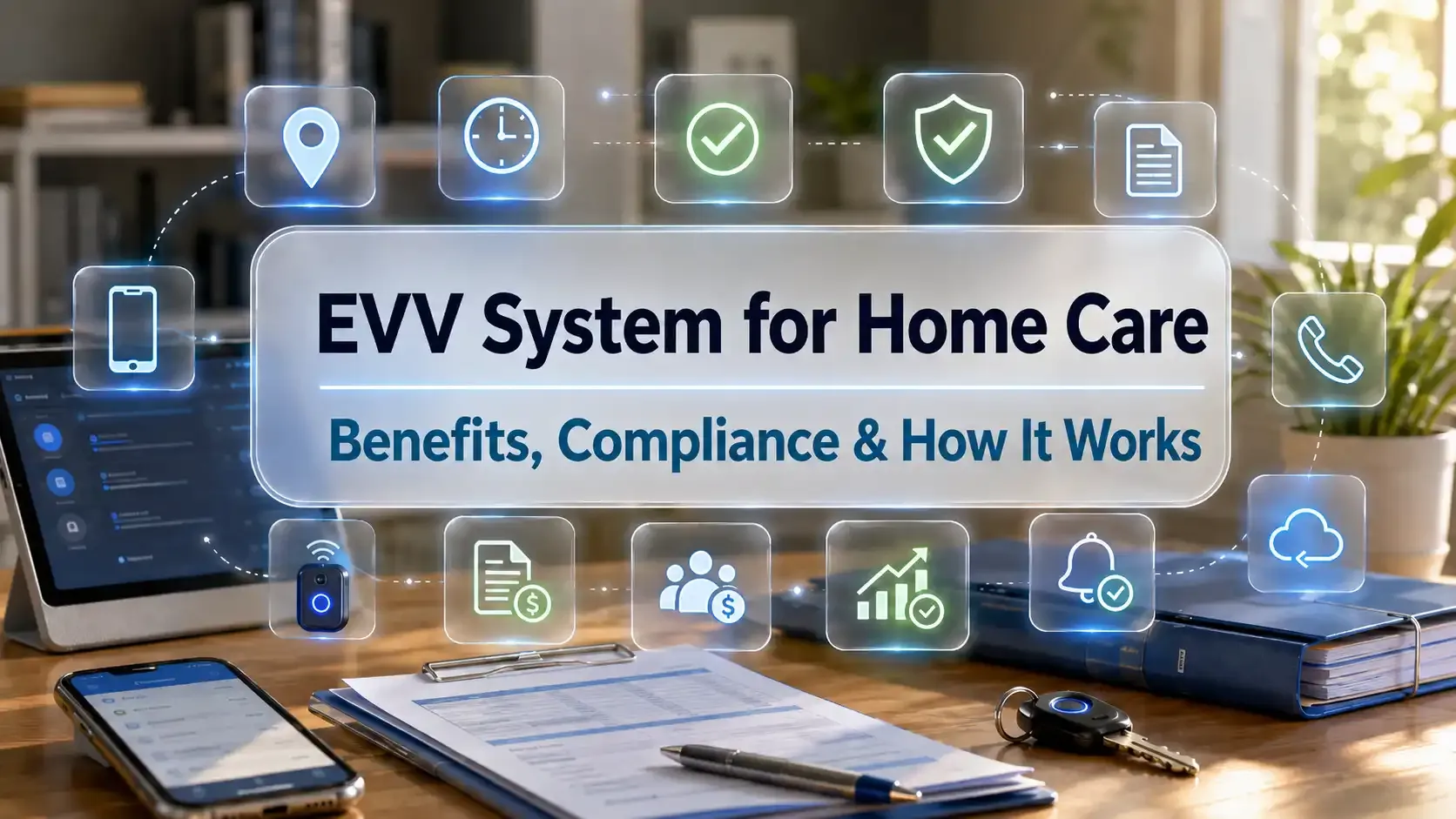
An EVV system for home care verifies every caregiver visit the moment care happens. GPS location, timestamps, patient identity, service type- all captured digitally without paperwork.
If you run a home care agency, you know how quickly revenue disappears due to bad visit records. Caregivers submit hours late, details get lost in paper timesheets, and unverified visits turn into denied Medicaid claims. As a result, your billing team spends weeks chasing.
But picking the right system is not simple. Staying compliant takes work. And getting your team actually to use it is where most agencies struggle.
In this blog, we will cover how EVV works, what the federal mandate requires, and which verification methods fit your agency. We will also discuss how to choose the right software.
An EVV system for home care is a digital platform that records every detail of a caregiver's visit in real time. It captures who delivered the care, who received it, what service took place, when the visit started and ended, and exactly where it happened.
But why does this system even exist?
Because for years, most agencies ran on paper timesheets and handwritten visit logs. Those records were easy to fake, nearly impossible to verify at scale, and a disaster during audits.
And the damage was massive.
A November 2024 audit by the New York State Comptroller revealed that the state paid $14.5 billion in Medicaid personal care claims without a single matching electronic visit verification record. Out of 82 million services reviewed, only 56% had proper EVV documentation.
Now here's where most agency owners get confused. They assume their existing time tracking system already covers EVV. It does not.
Time tracking records how many total hours a caregiver worked for your agency in a given week. EVV verifies the exact times that the caregiver delivered a specific service to a specific patient at a confirmed GPS location.
Put it this way. If your caregiver logs 40 hours on a timesheet but your EVV records show gaps or missing location data, those unverified visits will not get paid. That single misunderstanding costs home care agencies real money every month.
The process starts the moment a caregiver arrives at a patient's home. Here is how the full workflow breaks down:
Read More: How GPS Time Tracking Simplifies Field Team Payroll
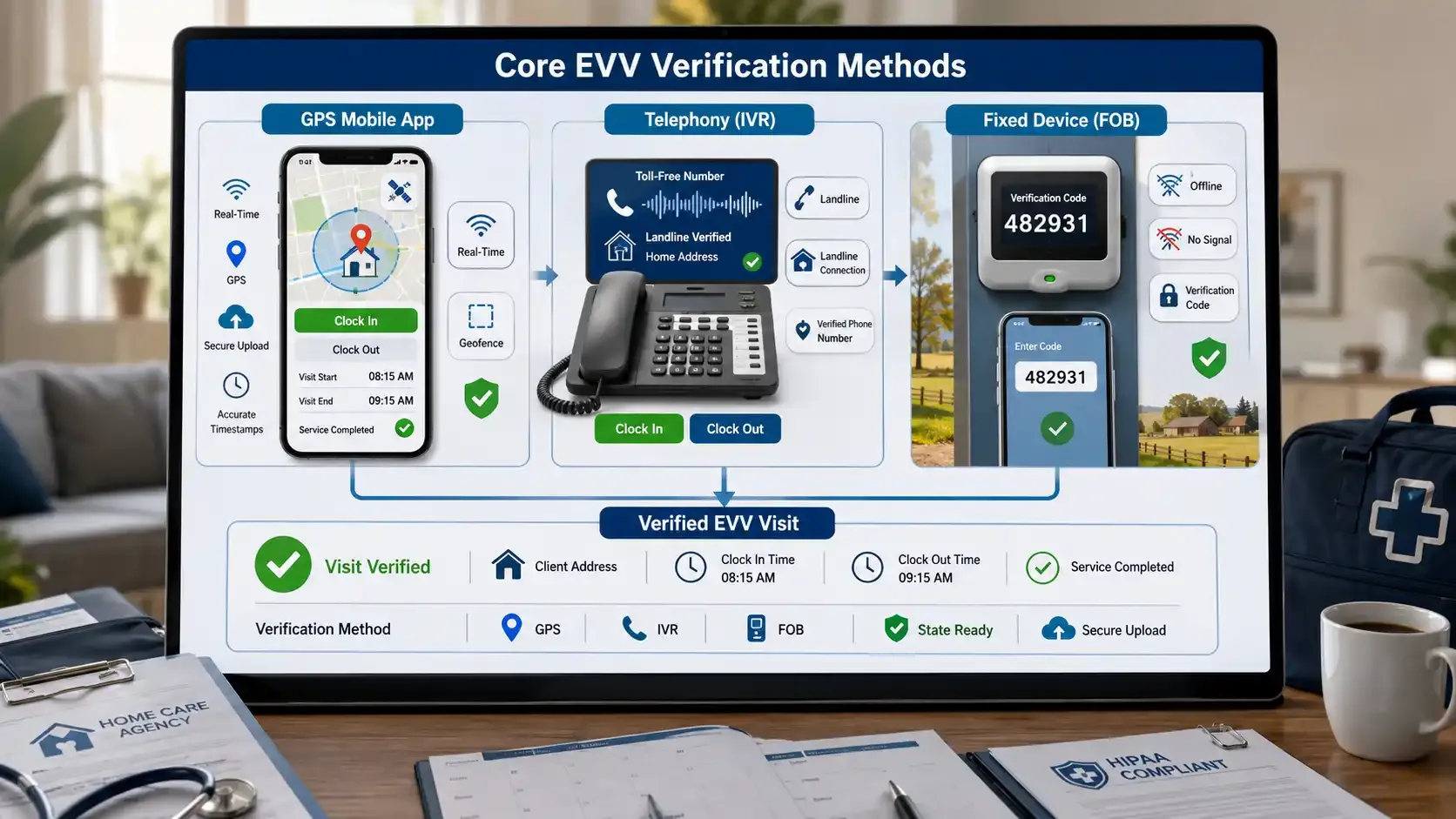
There are three main ways caregivers verify visits through an EVV system for home care. The right method depends on your location, your client's home setup, and connectivity.
Quick Comparison
| Method | Best For | Pros | Cons |
|---|---|---|---|
GPS Mobile App | Urban/suburban agencies | Real-time data, easy, geofencing | Needs cell signal |
Telephony (IVR) | Clients with landlines | No smartphone needed | Tied to one phone line |
Fixed Device (FOB) | Rural/low-connectivity | Works fully offline | Requires physical setup |
GPS mobile apps are the most common EVV verification method today. The caregiver opens an app on their phone and taps the clock in. The device records their exact GPS location and the visit start time.
At clock out, it logs the end time and service type. This gives your agency real-time visit data with zero paperwork. It works best for urban and suburban areas with reliable cell coverage.
Texas now requires at least 80% mobile app usage for EVV. Agencies below that threshold face corrective action.
One thing worth knowing. Most EVV apps only record location at clock-in and clock-out. They do not track caregivers all day. So it is geofencing at the point of service, not constant surveillance.
Not every caregiver has a smartphone. Not every client has a strong cell signal. That is where telephony (IVR) fills the gap.
The caregiver calls a toll-free number from the client's landline to clock in and out. The system matches that phone number to the client's home address. No GPS needed.
Here is the catch, though.
This only works from the client's landline. If a caregiver dials from their personal cell phone, the system has no way to confirm they were actually at the home.
That gap is why states like Pennsylvania and New York push agencies toward GPS apps first.
FOB devices are small physical tokens placed inside the client's home. They generate a unique code every 60 seconds. The caregiver enters that code into their device to prove they were present.
These solve one specific problem. They work when both the internet and landlines are unavailable. That makes them the go-to for rural and remote offline areas where nothing else connects.
Michigan allows agencies to use any method as long as the data reaches the state aggregator. (Source: Michigan MDHHS)
But the downside? Someone has to install a FOB in every client's home. For agencies with hundreds of patients across a wide area, that takes real time and coordination.
Most agencies do not rely on just one method. The strongest setup uses GPS apps as the primary tool with IVR or FOB as backup. That way, no visit goes unverified regardless of where the care happens.
Make field visit verification simple and reliable.
Support your mobile workforce with accurate location and time tracking.
Every agency that provides Medicaid-funded in-home care must use a compliant EVV system. If you fail to comply, your agency faces claim denials, payment recoupments, and potential loss of Managed Care Organization (MCO) contracts.
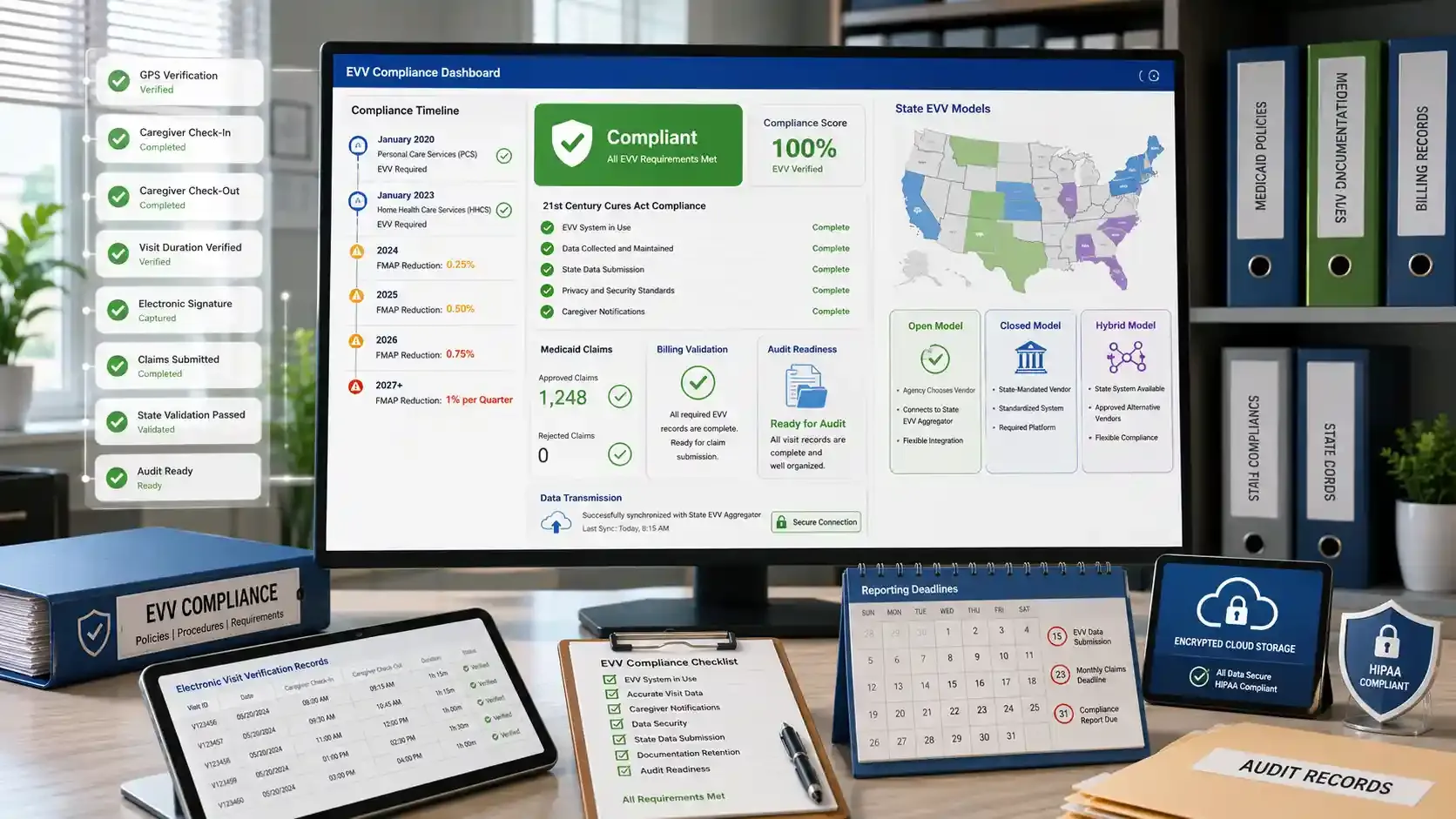
The 21st Century Cures Act set two hard deadlines. All personal care services (PCS) were required to use EVV by January 2020. Home health care services (HHCS) followed in January 2023.
States that missed those dates could apply for a Good Faith Effort (GFE) exemption if they showed real progress but hit unavoidable delays. That window has now closed for nearly every state.
The penalty escalates year by year. For HHCS, the FMAP reduction started at 0.25% in 2024, climbed to 0.50% in 2025, and reached 0.75% in 2026. From 2027 onward, it hits the full 1% per quarter.
For large states, that 1% translates to hundreds of millions in lost federal funding. And that pressure rolls downhill to agencies through stricter billing rules and tighter audits.
Not every state runs EVV the same way. The model your state uses determines your vendor options and how data flows to the state.
Open model states like Washington and New York let your agency pick its own vendor. Your system just needs to integrate with the state EVV aggregator. Closed model states mandate one vendor for all providers. No choice.
Hybrid model states like Colorado offer a free EVV system but allow alternatives that meet state requirements.
Check your state Medicaid agency's EVV page for your specific model and approved vendor list before committing to any platform.
Under the 21st Century Cures Act, every EVV system must capture and verify six specific data elements for Medicaid-funded personal care and home health services:
These six data points confirm that approved visits actually happened as billed. If any single element is missing or mismatched, the visit record fails verification, and the claim tied to it gets flagged, delayed, or denied.
Your EVV platform should capture all six automatically at clock-in and clock-out. If your caregivers are entering any of this data manually regularly, that is a sign your system is not set up correctly.
Stay organized while managing field operations.
Maintain accurate records that support smoother reporting and daily management.
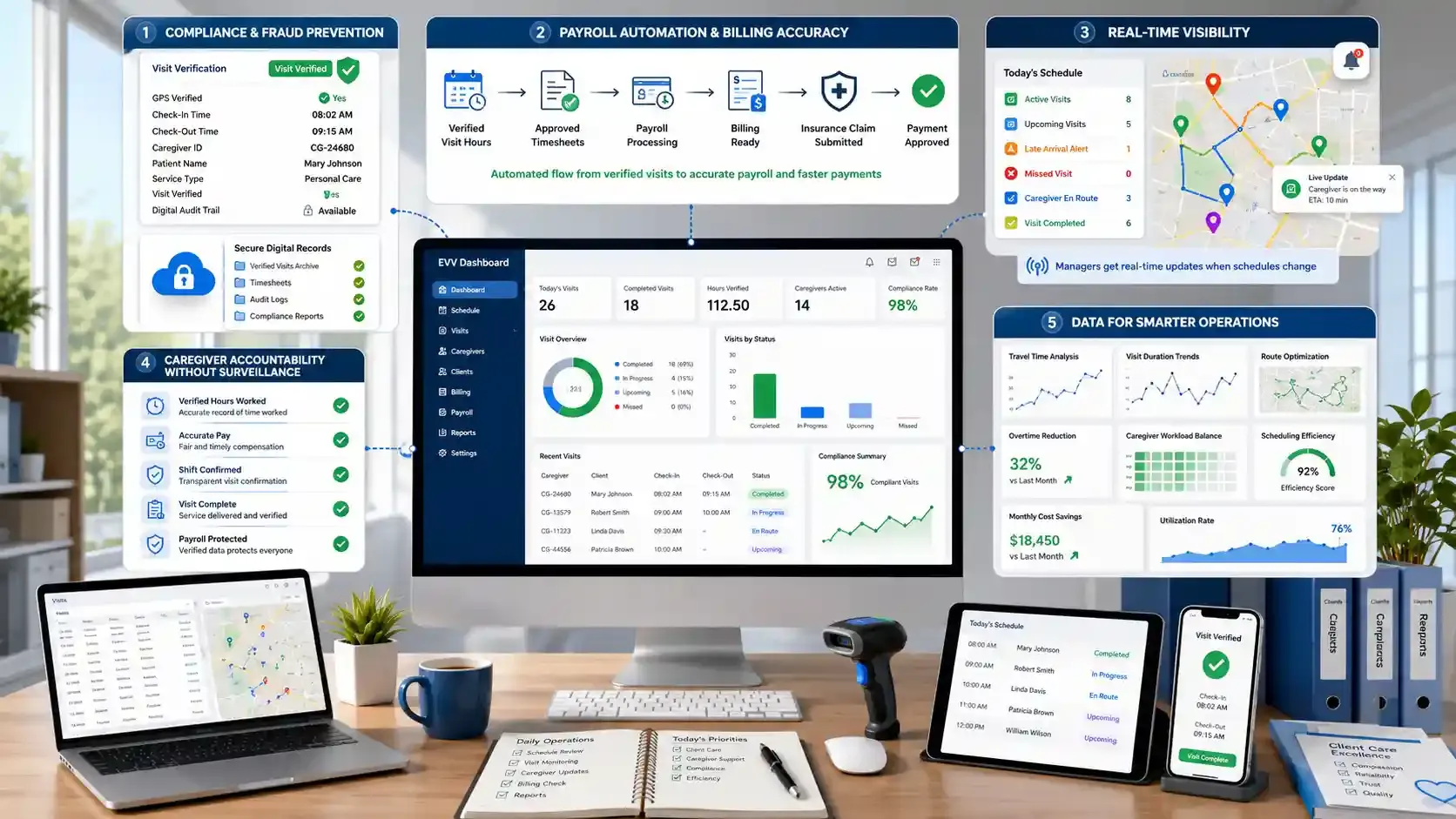
EVV started as a compliance mandate. But agencies that implement it well turn it into a real operational efficiency advantage. Here is what that looks like in practice.
A compliant EVV system replaces paper logs with verified digital records that auditors can actually trust. Every visit gets stamped with GPS, time, caregiver identity, and service type.
That means your agency always has documented proof that care happened exactly as billed.
And the impact is measurable. A 2026 KFF analysis found that personal care fraud convictions dropped to 298 in fiscal year 2024, down from an average of over 400 per year before EVV was fully in place.
Payroll automation is one of the fastest wins agencies notice after going live with EVV. Verified visit hours flow straight into billing and payroll without anyone manually matching paper timesheets to service codes.
That alone cuts down on claim denials caused by data mismatches between what caregivers report and what gets submitted. When clock-in times, service types, and patient records already align before submission, your claims pass on the first try.
Fewer rejections mean faster payments and healthier cash flow.
Read More: Automated Timesheets for Field Service Teams
A live scheduling dashboard changes how managers run daily operations. Late arrivals, missed shifts, and no-shows show up the moment they happen, so you react in minutes instead of discovering problems days later.
That kind of real-time visibility also helps with client satisfaction. When a caregiver runs late, you can reassign or notify the patient before they start calling your office asking where their caregiver is.
EVV protects caregivers just as much as it protects the agency. Accurate hour tracking means accurate paychecks, which eliminates disputes over missed hours or shortened shifts.
Here is what works when rolling it out to your team.
Frame EVV as paycheck protection, not monitoring. That simple shift in language reduces caregiver resistance faster than any formal training session ever will.
Visit data reveals patterns most agencies never see without EVV. Travel time between appointments, average visit duration, and scheduling gaps that quietly waste hours every week all become visible in your reporting.
Agencies use these insights to optimize routes, cut overtime, and balance caregiver workloads more evenly. Over time, that data turns EVV from a compliance cost into a tool that actively saves your agency money every month.
Turn field operations into a smoother daily workflow.
Manage teams, schedules, and job tracking from a single dashboard.
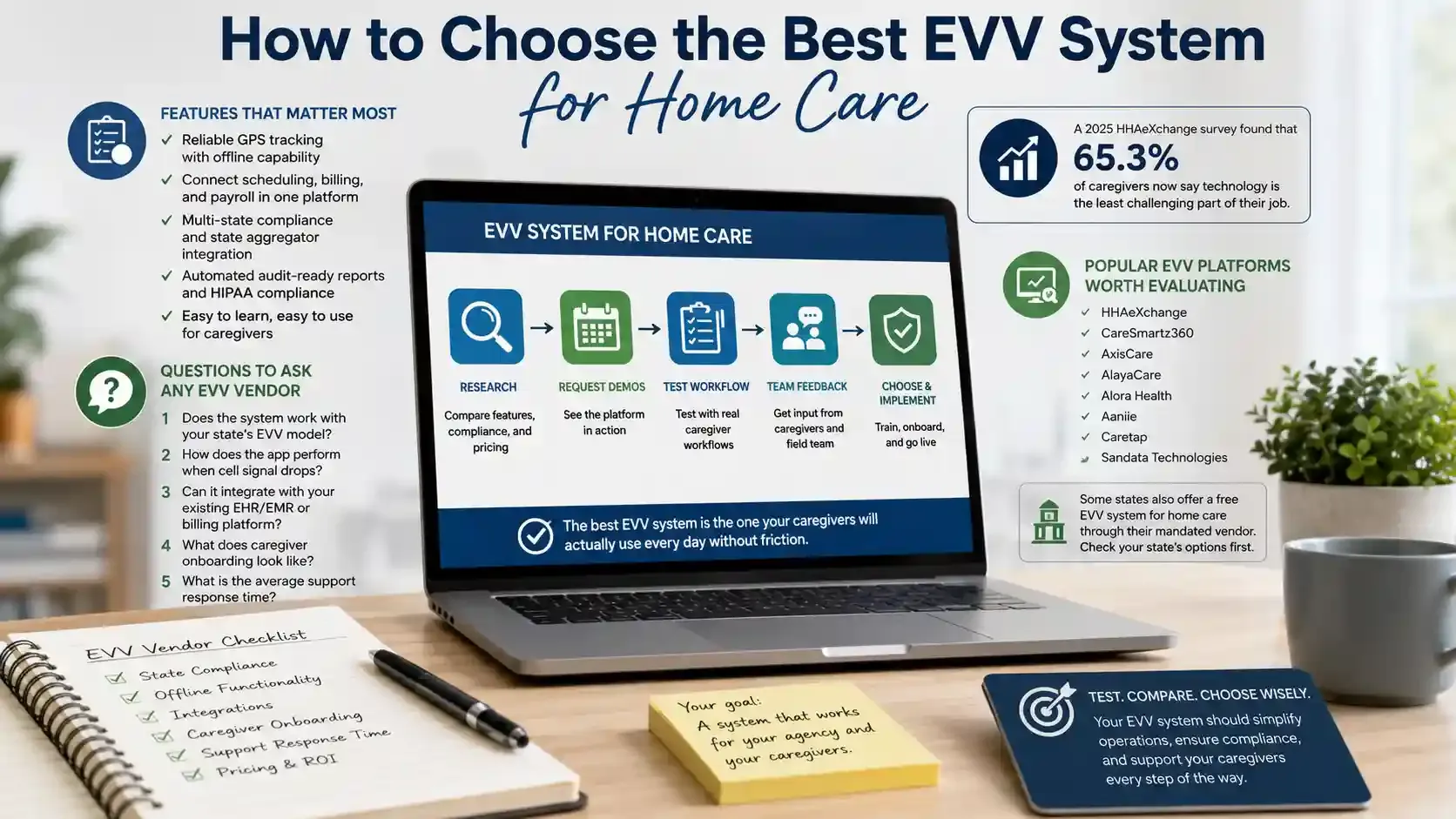
The best EVV system for home care is not the one with the longest feature list. It is the one your caregivers will actually use every day without friction. With national caregiver turnover at 79.2%, a clunky app that frustrates your staff is the last thing your agency needs.
When comparing home care EVV software, focus on what affects daily operations. Your app needs reliable GPS tracking with offline capability for areas with weak signals. It should connect scheduling, billing, and payroll in one platform so data flows without manual steps.
Multi-state compliance support matters if you operate across state lines. So does direct state aggregator integration and automated audit-ready reports. Make sure the system is HIPAA-compliant and that your caregivers can learn the interface in minutes, not days.
A 2025 HHAeXchange survey found that 65.3% of caregivers now say technology is the least challenging part of their job.
So the barrier is not whether your team can handle an app. It is whether you pick one worth using.
Before you sign anything, ask each vendor five things.
If a vendor cannot answer these clearly, move on.
Several platforms serve the EVV system for the home care providers market. This includes HHAeXchange, CareSmartz360, AxisCare, AlayaCare, Alora Health, Aaniie, Caretap, and Sandata Technologies.
Some states also offer a free EVV system for home care through their mandated vendor, so check your state's options first.
Request demos from at least three vendors, test each one with a real caregiver workflow, and let your field team give honest feedback before you commit.
Choose software that supports your growing field team.
Manage scheduling, time tracking, and workforce operations with ease.
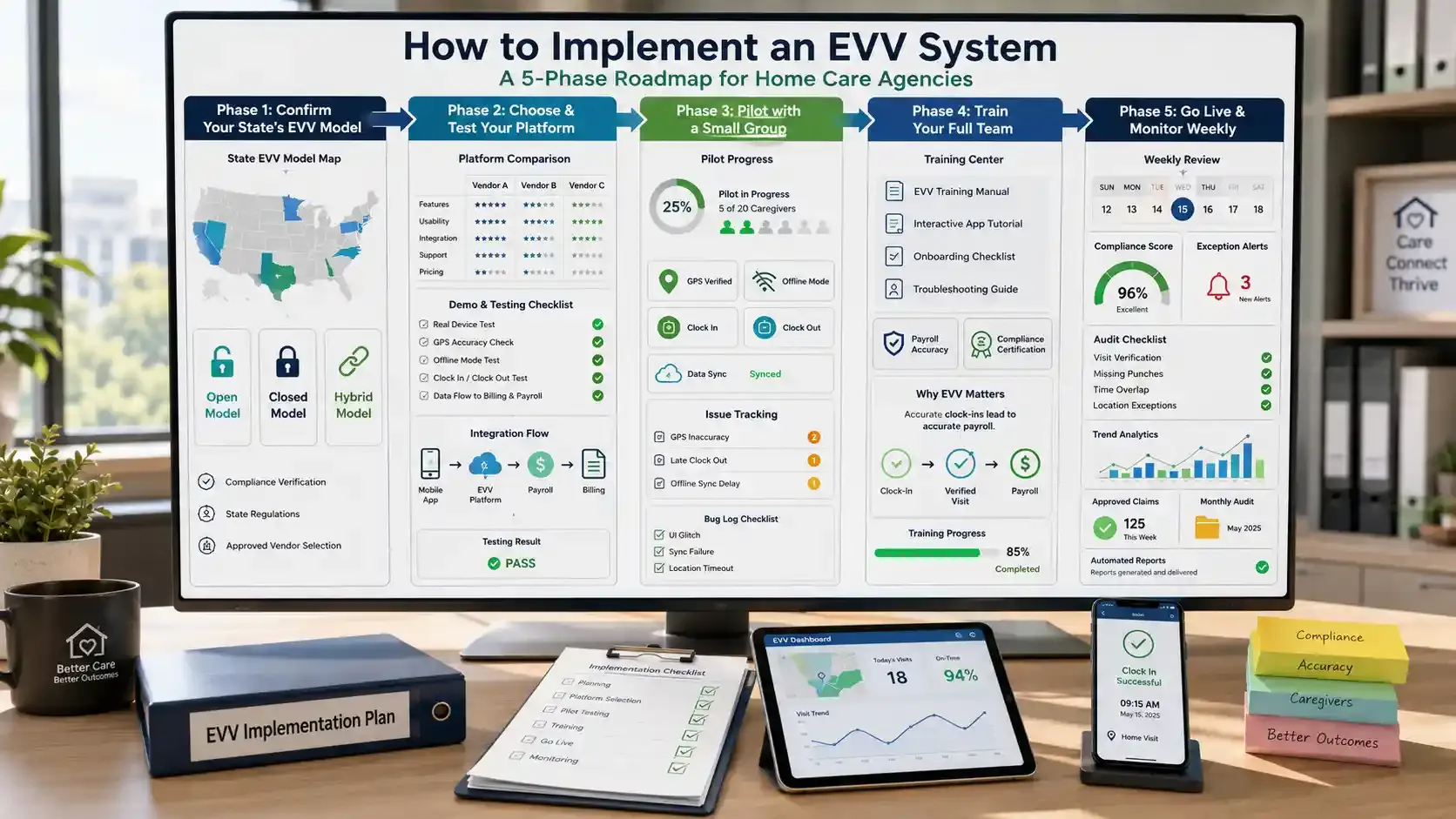
Do not roll out EVV to your entire team on day one. A phased EVV implementation catches problems early and builds caregiver confidence before you go live.
Start by checking your state's model. Is it open, closed, or hybrid? That answer determines your vendor options and whether your state offers a free EVV system for home care through its mandated provider.
Here is a quick breakdown of each:
Keep in mind that some states use different models for different programs. Check your state Medicaid agency's website to confirm which one applies to your specific services before moving forward.
Use the evaluation criteria from the previous section to narrow your shortlist. Request demos from at least three vendors and run test clock-ins with real devices in real locations. Pay close attention to how visit data flows from the app into your billing and payroll system, because that handoff is where most problems hide.
Pick 5 to 10 caregivers for your pilot. Test GPS accuracy, offline mode, clock-in and clock-out flow, and how the data syncs with your back office. Document every issue that comes up during this phase, no matter how small, because those same issues will multiply across your full team if you ignore them.
Caregiver training makes or breaks your rollout. Cover the app, basic troubleshooting, and why EVV matters to them personally. Frame it as paycheck protection, not surveillance.
Caregivers who understand that accurate clock-ins mean accurate pay adopt the system faster. Build EVV into your onboarding process for every new hire going forward.
Roll out to the full team and set up weekly EVV log reviews. Assign someone to track trends, flag recurring exceptions, and follow up directly with staff who show repeated errors. Monthly internal audits catch mismatches and missing records before state auditors do, keeping your compliance score clean and your claims moving.
Roll out new workflows without the usual chaos.
Give your team one simple platform for scheduling and time tracking.
If your visits are not registering as EVV compliant, you are not alone. Here are the most common reasons why visits are not EVV compliant, along with what to do about each one:
EVV is a federal mandate. But it is also an opportunity. Agencies that treat it as a daily habit instead of a compliance checkbox run tighter operations, collect faster payments, and keep their caregivers longer.
Use this guide as your reference. Check your state's EVV model. Evaluate at least three vendors. Train your team with the right framing. And review your EVV logs weekly before small errors become expensive problems. The agencies that act now are the ones that stay ahead.
No. The federal EVV mandate only applies to Medicaid-funded personal care and home health services. However, many private pay agencies still use EVV to improve payroll accuracy, reduce missed visits, simplify billing, and provide families with verified care records.
Yes. Most modern EVV systems support offline mode. Caregivers can clock in and out without a signal, and the app automatically syncs visit data once the device reconnects to the internet. This helps prevent missed records in rural or low-coverage areas.
No. Most EVV systems record location only when caregivers clock in and clock out. They verify that the caregiver arrived at the correct location without continuously tracking movements during the entire shift, helping balance compliance with privacy.
Retention requirements vary by state and payer. Many agencies keep EVV records for at least five to seven years to meet Medicaid, audit, and legal requirements. Always follow your state's Medicaid rules and your organization's document retention policy.
An unverified visit may trigger an exception that requires manual review before billing. If the issue is not corrected, the claim could be delayed or denied. Reviewing exceptions regularly helps agencies fix problems before they affect reimbursement.
Field Service Business