- Field Service Business
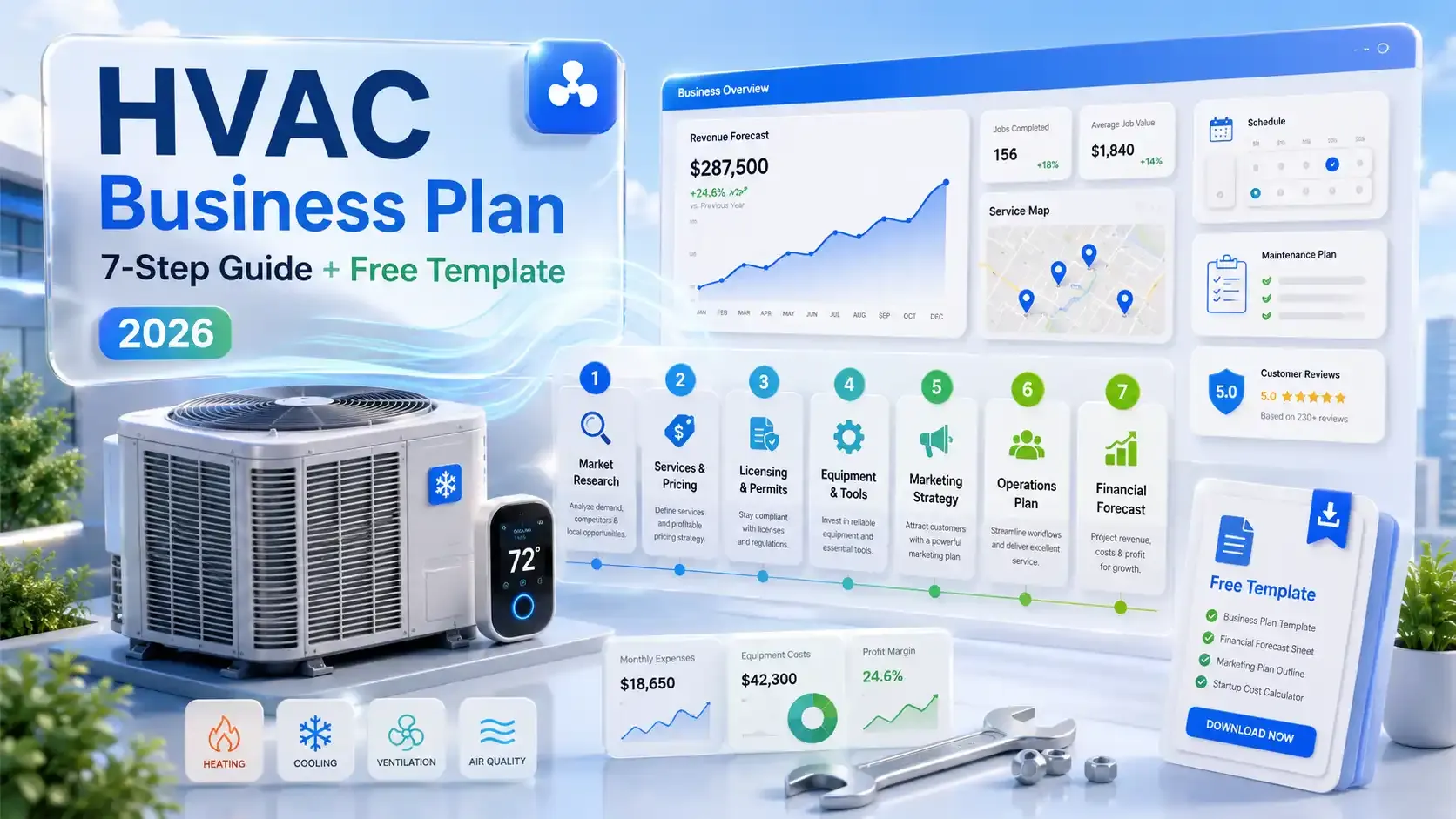
HVAC Business Plan: 7-Step Guide + Free Template (2026)
Updated on 9 Jun 2026
Jump to
Summary

An HVAC business plan maps out your services, target market, pricing, operations, and financial goals in one document.
A strong plan covers seven sections: executive summary, company overview, market analysis, services, marketing, operations, and financials.
A typical HVAC startup costs between $27,000 and $90,000, depending on equipment, vehicle, and licensing.
Maintenance contracts are your strongest revenue tool because they keep cash flowing during slow seasons.
Download the free template, fill in each section using this guide, and revisit it every quarter as your business grows.
The U.S. HVAC market hit $32.95 billion in 2025 and keeps growing at a steady 5.6% each year. That means more homeowners need service, more buildings need systems, and more technicians are jumping in to start their own companies.
But most HVAC technicians are incredible at the trade and terrible at the business side. They can install a system blindfolded. But ask them to write a business plan for their HVAC company? That's where things fall apart.
And it shows. Without a clear plan, most startups burn through cash, underprice their work, and struggle to survive past year two.
In this blog, I'll walk you through how to create an HVAC business plan step by step. I will also show you a real, filled-out example and hand you a free downloadable template you can start using today.
What is an HVAC Business Plan and Why Do You Need One?
An HVAC business plan is a written document that maps out your services, target market, pricing, operations, and financial goals. Think of it as the roadmap for your entire company.
So why does it matter?
Starting an HVAC business without a plan is like driving to a job site without an address. You might get somewhere. But probably not where you need to be.
A solid plan does three things.
- It gives your company clear direction with measurable goals.
- It unlocks funding because banks and SBA lenders won't review your application without one.
- It forces you to study your market, competitors, and finances before spending anything.
That last part saves more HVAC businesses than most owners realize.
How to Write an HVAC Business Plan Step by Step
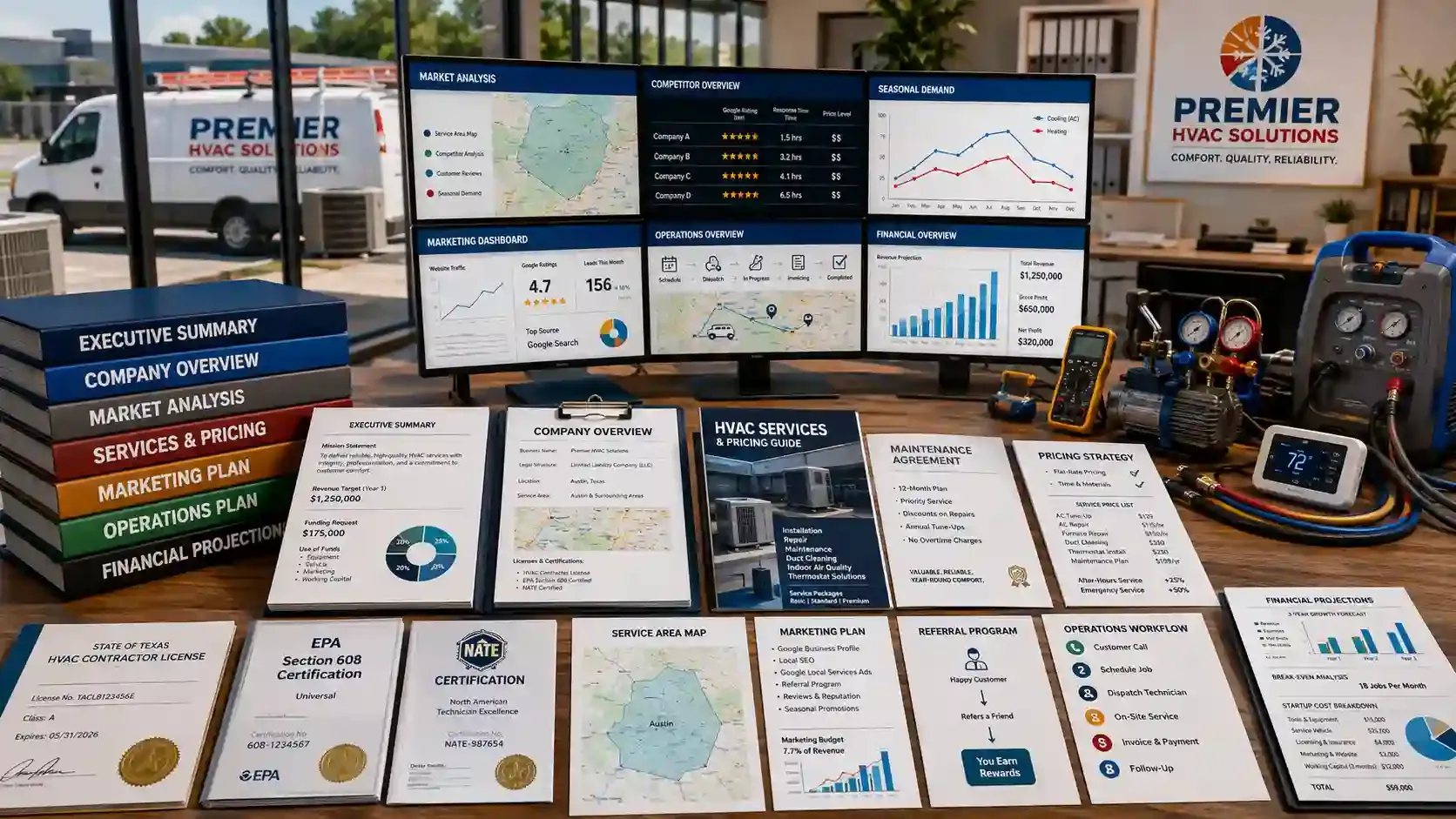
A strong HVAC business plan covers seven sections. Each one answers a question that lenders, partners, or even you will ask before the business spends a dollar.
Let's break them down:
Step 1: Executive Summary
Write this section last, but place it first in the document. It's the one-page snapshot of your entire plan.
Include your business name, mission statement, the services you offer, and who you serve. Then add a quick financial overview with your startup costs and first-year revenue target.
Here's what most people skip. If you're applying for a bank loan or SBA funding, state the exact dollar amount you need and what it covers. Lenders don't want to guess. They want numbers.
Keep it under one page. Every detail here gets expanded in the sections that follow.
Step 2: Company Overview
This section covers who you are and how your HVAC company is structured. Start with your business name, legal structure (LLC, sole proprietorship, or S-corp), location, and service area.
Then add your background. Your years in the trade, certifications, and field experience all build credibility here.
And don't skip licensing. List your EPA Section 608 certification, state contractor license, and any NATE credentials you hold. Most business plan guides leave this out entirely. But lenders and investors look for it because it proves you can legally operate.
Step 3: Market Analysis
This is where you prove real demand exists in your area. Start by defining your target customers. Are you going after residential homeowners, commercial property managers, or new construction projects?
Next, study your local competitors. Pull up Google Maps and Yelp. Search every HVAC company within your service radius. Read their reviews carefully. If three competitors have complaints about slow response times, that's your opening.
Factor in seasonal demand too. HVAC businesses see peaks in summer and winter, with slower months in between. Your plan needs to account for that gap before it hits your cash flow.
Step 4: HVAC Services and Pricing Strategy
List every service your business will offer. AC installation, furnace repair, duct cleaning, thermostat setup, indoor air quality testing, and preventative maintenance. Be specific. Vague terms like "HVAC solutions" don't tell anyone what you actually do.
Then explain your pricing model. Will you use flat-rate pricing or charge by time and materials? How will you mark up parts? What about after-hours and emergency calls?
Here's a tip most plans miss entirely. Add maintenance contracts to this section. They create steady recurring revenue that keeps cash flowing between busy seasons. One 12-month service agreement is often worth more to your bottom line than five one-time repair calls.
Step 5: Marketing and Sales Plan
You could be the best technician in your city. But if nobody knows you exist, it won't matter.
Start with your Google Business Profile. It's free, and 80% of consumers search for local businesses on Google.
Then build from there. Local SEO, Google Local Services Ads, referral programs, and seasonal promotions all belong in your plan. Marketing budgets averaged 7.7% of company revenue in 2025.
So set a real budget and track what brings in leads.
One more thing. For HVAC companies, online reviews and word-of-mouth referrals drive more business than any paid ad. Make earning those a part of your strategy from day one.
Step 6: Operations Plan
This section explains how your business runs on a normal day. Cover the full workflow from the customer call through dispatch and job completion to invoicing.
List the equipment your crew needs to get started: a service van, a refrigerant recovery machine, manifold gauges, a vacuum pump, leak detectors, and a multimeter.
Then cover the software side. Tools like FieldServicely handle scheduling, GPS tracking, and invoicing in one place, which keeps your operations organized from the start.
Don't forget hiring. Outline how many technicians you need in year one versus year three, and how you plan to train and certify them.
Step 7: Financial Projections
This is the section lenders read first. Sometimes even before the executive summary.
Start with a realistic startup cost breakdown. Based on 2025–2026 industry data, here's what a typical HVAC startup looks like:
| Category | Estimated Cost |
|---|---|
Tools & Equipment | $5,000–$25,000 |
Service Vehicle | $8,000–$40,000 |
Licensing & Insurance | $2,000–$5,000 |
Marketing & Website | $2,000–$5,000 |
Working Capital (3 months) | $10,000–$15,000 |
Total | $27,000–$90,000 |
Turn your business plan into daily action
Manage jobs, teams, and finances from a single dashboard
HVAC Business Plan Example
Ever read a guide that explains every section of a business plan but never shows you what a finished one looks like? Let me fix that.
Suppose CoolAir Comfort Solutions provides residential AC installation, furnace repair, and annual maintenance agreements to homeowners within a 30-mile radius of Austin, Texas.
CoolAir requires $65,000 in startup capital for tools, a service van, licensing, and marketing. The year-one revenue target is $300,000, driven by an average of 25 completed jobs per month.
And here's how CoolAir structures its pricing:
| Service | Pricing Model | Avg. Price |
|---|---|---|
AC Installation | Flat rate | $3,500–$7,500 |
Furnace Repair | Time & materials | $150–$600 |
Duct Cleaning | Flat rate | $300–$500 |
Annual Maintenance Plan | Subscription | $199/year |
That $199/year contract is the most valuable line in this table. It brings in recurring revenue that keeps the business alive during slow months.
From plan to action in minutes
Assign jobs, track progress, and invoice customers from one platform
You just read the full guide. Now here's the template to use in real operation.
I put together a free HVAC business plan template that follows the exact structure above. It's a fillable Word document with every section laid out and ready to go.
[Download the Free HVAC Business Plan Template]
Download the file, open it in Word or Google Docs, and fill in each section using the step-by-step guide above. Then revisit it every quarter. Your market shifts, your pricing changes, and your plan should keep up.
Mistakes to Avoid When Writing Your HVAC Business Plan
Most HVAC business plans fail for the same reasons. Here are the ones I see over and over:
- Lowballing startup costs, especially insurance and licensing fees.
- Ignoring seasonal cash flow dips when HVAC demand drops in spring and fall.
- Writing the plan once and never updating it as your business changes.
- Skipping the marketing budget and hoping word-of-mouth alone will carry you.
Setting vague goals like "get more customers" instead of "close 40 jobs/month by Q3."
Conclusion
A solid HVAC business plan keeps you focused, helps you land funding, and forces you to make smart money decisions before you spend a dollar. Most HVAC startups skip this step. You don't have to be one of them. Download the free template above, fill in each section using this guide, and start with a rough draft. The HVAC industry isn't slowing down. The only question is whether your business is ready to grow with it.
Frequently Asked Questions
How Long Should an HVAC Business Plan Be?
Most HVAC business plans run between 15 and 25 pages. Lenders want enough detail to trust your numbers but not so much that they lose interest. Keep it focused. If a section doesn't help you make money or get funded, cut it.
How Long Does It Take for an HVAC Business to Become Profitable?
Most HVAC startups break even within 6 to 12 months if they manage costs well. Profitability depends on your job volume, pricing, and how fast you build a steady customer base. Service agreements speed this up because they bring in recurring revenue from month one.
Can I Start an HVAC Business With No Management Experience?
Yes, but your business plan becomes even more important. The plan forces you to think through pricing, hiring, and cash flow before problems show up. Many successful HVAC owners started as solo technicians and learned the business side as they grew.
Do I Need a Business Plan if I'm a One-person HVAC Operation?
You still need one. Even a solo operation has startup costs, seasonal slowdowns, and pricing decisions that can sink you without a plan. A short, simple plan keeps your finances on track and gives you something to measure progress against.
Should I Hire Someone to Write My HVAC Business Plan?
You can, but nobody knows your market, services, and goals better than you. Write the first draft yourself using a template. Then hire a consultant or accountant to review your financial projections if you need help with the numbers.