- GPS Tracking for Field Service
GPS Time Tracking ROI Guide: Reduce Costs & Boost Returns
Updated on 3 Apr 2026
Jump to
Summary

GPS time tracking connects operational data to real cost savings in fuel, labor, and maintenance
Businesses reduce inefficiencies like idling, time theft, and poor routing to improve productivity
ROI comes from measurable gains compared against the total system cost
Most savings appear early, while full payback typically happens within months to two years
Consistent tracking, optimization, and avoiding common mistakes drive long-term ROI growth
The GPS time tracking ROI guide explains how businesses measure real financial returns from GPS tracking systems. It shows how companies reduce fuel waste, recover lost labor hours, and improve fleet efficiency. More importantly, it connects tracking data directly to cost savings and operational control.
At the same time, GPS time tracking improves payroll accuracy, route planning, and maintenance planning. As a result, teams complete more jobs with fewer resources while reducing unnecessary expenses.
However, many businesses struggle with unclear ROI, poor data tracking, and wrong tool selection. These gaps often delay real results.
In this blog, we will break down GPS time tracking ROI step by step. We will also show how to calculate, improve, and scale it effectively.
What Is GPS Time Tracking ROI?
GPS time tracking ROI means the financial return you get after comparing total savings with the total cost of the system. It measures how much money you recover from better tracking against what you spend on software, hardware, and setup.
In real operations, this is easy to see. Businesses cut fuel costs by up to 10-15% by reducing idling and poor routing. They also recover lost labor hours by eliminating inaccurate timesheets and unverified overtime.
According to research, companies using GPS tracking improve productivity and reduce operating costs within the first year.
Key ROI Drivers for GPS Time Tracking
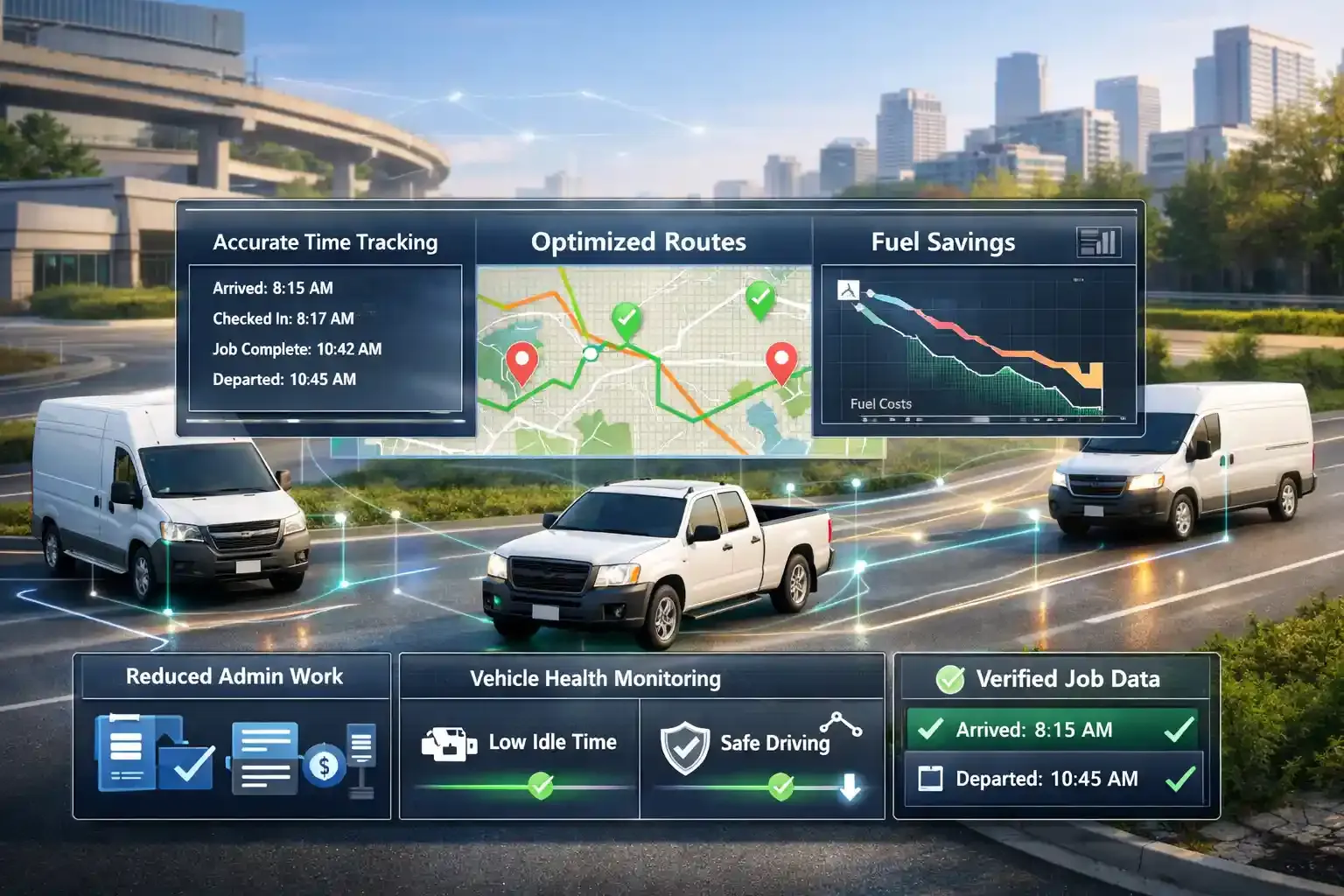
Labor and Time Theft Recovery
Most businesses lose 30 to 60 minutes per employee per day due to untracked breaks, early clock-outs, or slow travel between jobs. Not only that, 24% of workers manipulate the number of hours they work.
Now, when I enabled GPS-based time tracking, I could actually see when employees arrived and left job sites. This removed guesswork and stopped “buddy punching” instantly.
In real numbers, this translates to about $150 to $400 per vehicle per month, depending on team size and workload.
Fuel Savings from Route Optimization
Before tracking, I had no clear view of idling time or unnecessary routes. Once GPS tracking was in place, I could see exactly where fuel was being wasted, and hence it helped with efficient route optimization.
Most of the savings came from three things:
- Reducing idling
- Assigning closer jobs
- Eliminating personal vehicle use
Typical trucks consume 0.8 gallons per hour while idling. When I reduced idle time and optimized routes, fuel costs dropped by 15% to 25%.
And kept improving as routing decisions became smarter over time.
Reduced Administrative Costs
Before automation, payroll and manual timesheet reconciliation took hours every week. Errors were common, and fixing them took even more time.
With GPS time tracking, timesheets became automatic and accurate. The system recorded work hours based on actual movement and job-site presence. This removed manual entry and reduced payroll disputes.
Even companies that automate time tracking reduce payroll processing time by up to 30%. I saw a similar effect. Weekly admin work dropped significantly, and payroll accuracy improved at the same time.
Maintenance Cost Reduction
Before GPS tracking, I had no clear data on how vehicles were being driven. Harsh braking, speeding, and aggressive acceleration went unnoticed.
Once I started monitoring driving patterns, the data told a different story. Some drivers were putting unnecessary stress on vehicles, which increased wear and tear. Fixing these habits reduced maintenance costs almost immediately.
This also reduced unexpected breakdowns. Vehicles stayed in better condition, which improved reliability and reduced downtime.
Insurance Premium Discounts
Insurance savings are often overlooked, but they add steady value. Insurance providers reward businesses that reduce risk, and GPS tracking does exactly that.
When I shared tracking data with insurers, they could see:
- Driving behavior
- Route patterns
- Safety improvements
This reduced perceived risk. As a result, many providers offer discounts for monitored fleets.
Beyond discounts, GPS data also helps during claims. It provides clear evidence of location and behavior, which speeds up dispute resolution.
Customer Dispute Resolution
Before GPS tracking, I had no solid proof of service times. If a customer questioned billing, it often turned into a negotiation.
With GPS logs, this changed completely. The system recorded arrival time, departure time, and time spent on-site
This created a clear record for every job.
According to a report, companies using digital proof-of-service tools reduce billing disputes by up to 30%. When customers see verified data, conversations become easier.
Cut fuel cost by up to 25% with smarter tracking and routing
Reduce idling and unnecessary trips with real-time GPS insights
How to Calculate Your GPS Time Tracking ROI
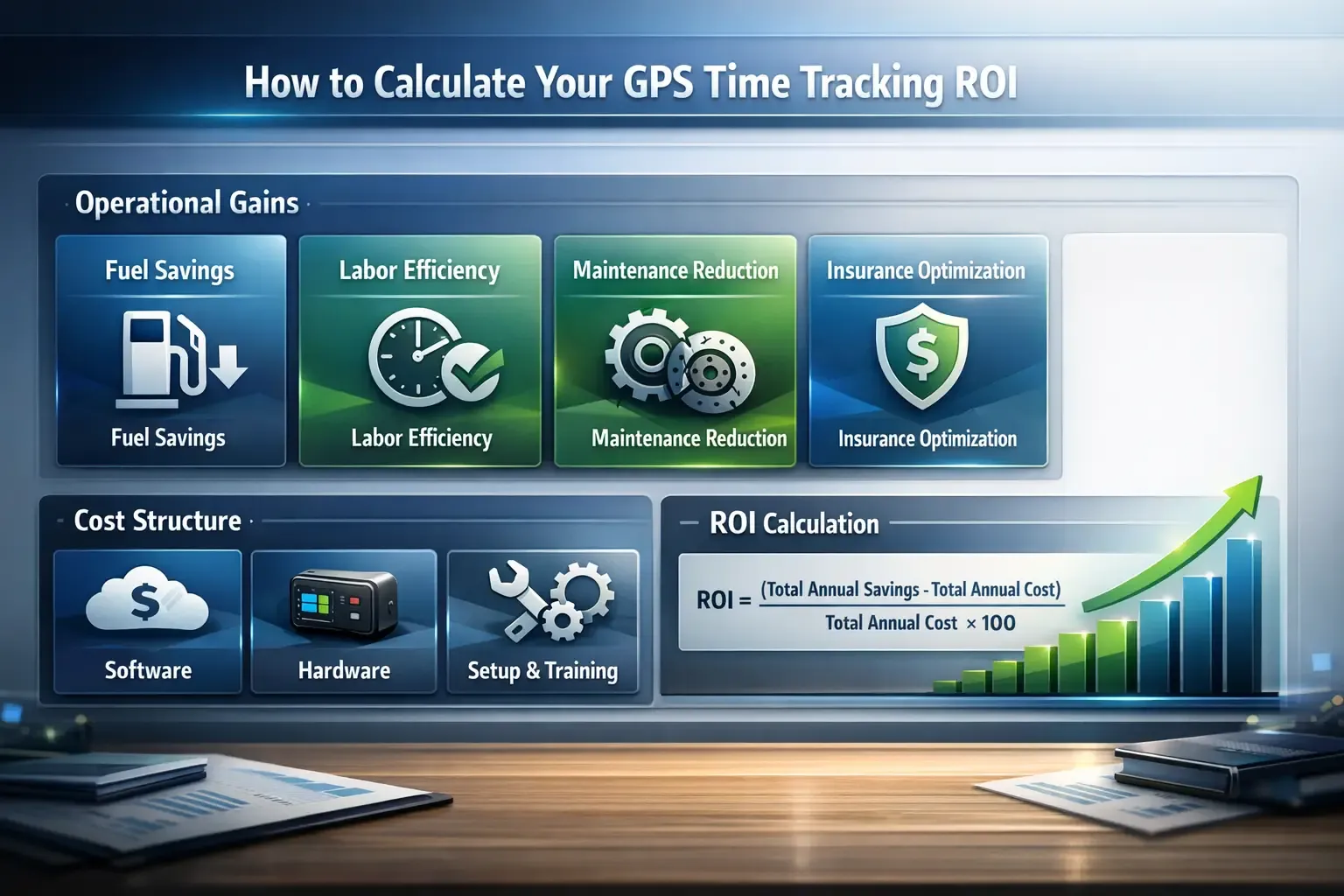
Step 1: Quantify Real Operational Gains
Total annual savings come from fuel, labor, maintenance, and insurance improvements. Each saving must connect to a specific operational inefficiency. So, every figure should reflect an actual change in fleet behavior.
Fuel savings typically appear first. Research showed that one hour of idling burns about 0.8 gallons of fuel per hour. As idle time drops, fuel expenses decrease in direct proportion.
Labor savings follow through accurate time tracking and job verification. As GPS logs replace manual entries, unverified hours are eliminated.
Maintenance savings build gradually through improved driving behavior. Harsh braking alone accelerates brake wear by up to 2–3 times faster than normal driving. As driving stabilizes, wear and tear decline across the fleet.
Step 2: Define the Total Cost Structure
Total investment must include software, hardware, and implementation costs. This ensures the ROI calculation reflects real financial commitment. So, each cost component must align with actual deployment requirements.
Software cost forms the recurring expense layer. Most GPS platforms charge between $5 and $20 per vehicle per month. As fleet size increases, annual cost scales accordingly.
Hardware cost represents the initial capital investment. GPS devices typically cost between $120 to $400 per unit. As more vehicles are equipped, upfront expenses rise proportionally.
Set up and training complete the cost structure. Organizations spend $3,000 to $25,000 on integration and onboarding. As system complexity increases, implementation cost follows.
Step 3: Convert Savings and Costs into ROI
ROI calculation connects total savings with total cost into a single performance metric. This step determines whether the system generates net financial value. So, both sides must be directly comparable.
The formula is:
ROI = (Total Annual Savings-Total Annual Cost/Total Annual Cost) x 100
A positive ROI indicates savings exceed total cost. A higher percentage reflects faster investment recovery.
Replace manual tracking with accurate, automated data
Try for free - No credit card required!
Proven ROI Timeline and Payback Period
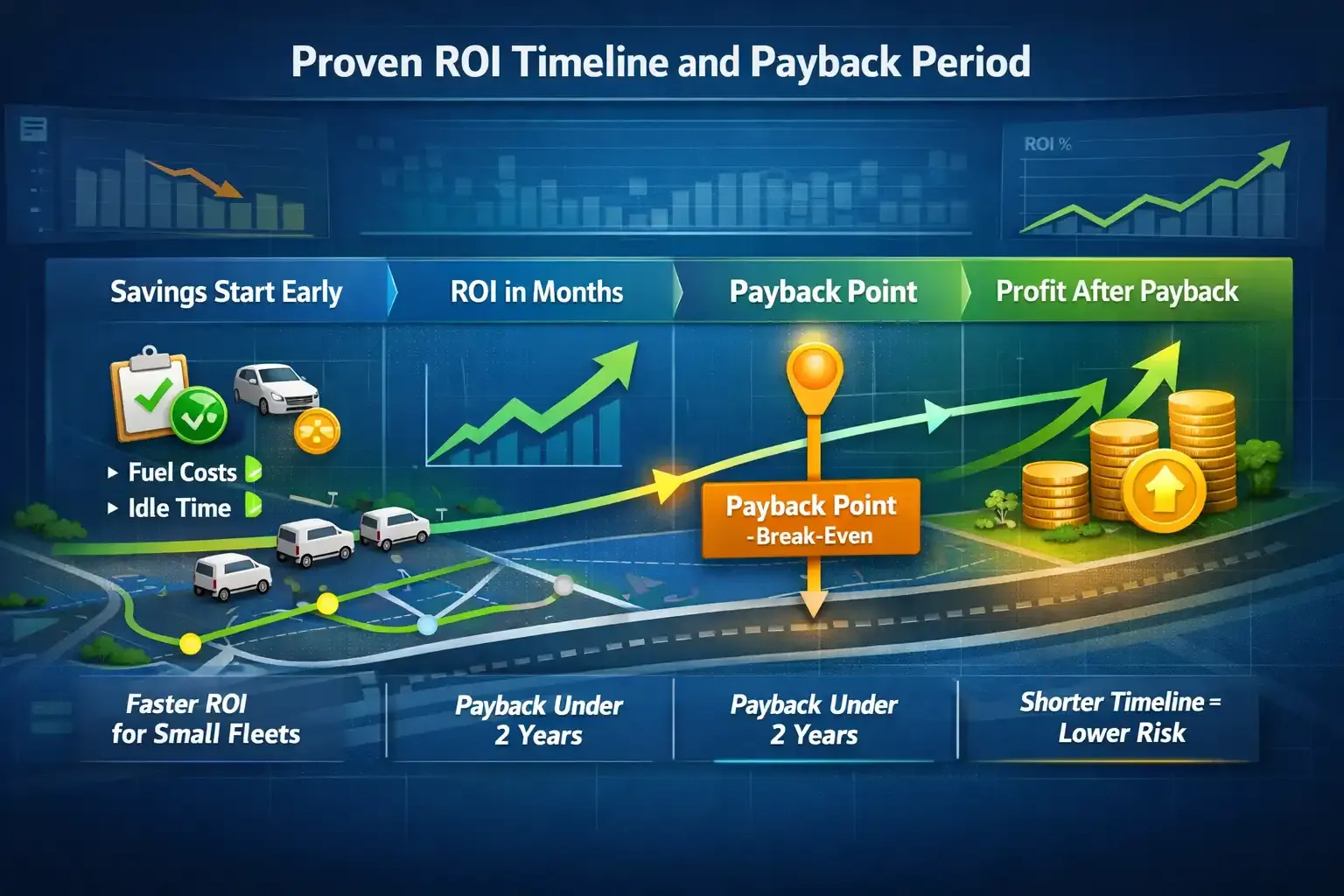
Savings Start Early
Savings begin within the first few weeks of implementation. The biggest early impact comes from visibility into vehicle usage and work hours.
According to research, fleets experience immediate cost reductions once idle tracking and route optimization are enabled. As unnecessary trips and idle time drop, fuel expenses follow quickly.
At the same time, verified job timestamps remove billing gaps. This ensures that work performed is accurately recorded and billed.
ROI Shows Within Months
ROI becomes visible once consistent savings accumulate over time. The same research showed fleet telematics adoption leads to measurable cost reductions within the first operational cycle. These gains come from reduced fuel use, improved dispatching, and better asset utilization.
Payback Takes Under 2 Years
Payback period defines how long it takes to recover the full investment. This depends on both upfront cost and monthly savings.
Even a report showed that a delivery service reduced fuel costs by 12% in the first three months. Systems with strong usage often fall closer to the lower end of this range.
Small Fleets Move Faster
Smaller fleets often reach ROI faster than larger ones. This happens because inefficiencies are easier to identify and correct.
Even minor cost reductions create a noticeable financial impact. As a result, small fleets often experience faster payback and earlier ROI visibility.
Consistent Use Speeds Results
ROI speed depends on how consistently the system is used. Data alone does not reduce cost unless it leads to action.
Fleets that actively monitor idling, driving behavior, and route efficiency reduce costs faster. This shortens the time between implementation and measurable financial return.
Without consistent use, savings slow down, which delays both ROI and payback.
Profit Starts After Payback
Profit begins once the system reaches breakeven. At this point, ongoing savings no longer offset costs but contribute directly to margins.
Operational improvements continue every month, especially in fuel and maintenance. These recurring savings increase total ROI over time without additional investment.
So, long-term value depends on how long the system runs after payback.
Timeline Defines Risk
Timeline matters because it defines financial risk. Shorter payback reduces exposure and improves investment confidence.
According to research, faster-return technologies are preferred in uncertain markets because they recover costs quickly. GPS time tracking fits this model by targeting daily operational waste.
So, a shorter timeline signals both faster returns and lower risk.
Recover your investment faster with smarter tracking
Reduce fuel waste and improve utilization to shorten your payback period
How to Maximize GPS Time Tracking ROI
- Use geofencing to verify exact job-site arrival and departure times and eliminate false clock-ins
- Track driver behavior with scorecards to reduce harsh driving, fuel waste, and vehicle wear
- Field service automation quickly spots overtime, idle time, and unauthorized vehicle usage
- Set real-time alerts to fix inefficiencies before they turn into recurring costs
- Optimize routes using GPS data to reduce mileage, travel time, and fuel consumption
- Dispatch the nearest vehicle to increase jobs completed per day without adding labor hours
- Use weekly performance insights to continuously improve productivity, safety, and cost control
All these strategies work best when the system connects tracking, reporting, and dispatch in one place. FieldServicely brings these features together, so teams don’t need separate systems for each task. As a result, data flows smoothly, and decisions happen faster. This makes it easier to apply these optimizations consistently and improve ROI over time.
Common ROI Mistakes to Avoid
- Avoid overestimating savings because assumptions often ignore real conditions
- Use realistic numbers since inflated projections distort ROI
- Track baseline metrics first, or savings cannot be proven
- Compare before-and-after data to measure real improvement
- Choose tools based on value, not just price
- Monitor ROI after setup to confirm actual gains
- Adjust strategy regularly to keep improving ROI
Conclusion
GPS time tracking ROI becomes clear when data connects directly to cost savings and daily operations. Businesses that track fuel, labor, and maintenance consistently see faster payback and better control. At the same time, avoiding common mistakes ensures results stay accurate and sustainable.
Frequently Asked Questions
How accurate is GPS time tracking for measuring work hours?
GPS time tracking records location-based timestamps, which improves accuracy compared to manual timesheets. It verifies when vehicles arrive and leave job sites, reducing guesswork. However, accuracy depends on signal strength and proper system setup.
Can GPS time tracking work for small businesses?
GPS time tracking works well for small fleets because inefficiencies are easier to detect and fix. Even small savings in fuel or labor create noticeable ROI. As a result, small businesses often see faster returns than large fleets.
Does GPS tracking affect employee trust?
GPS tracking can impact trust if implemented without transparency. Clear communication about safety, payroll accuracy, and efficiency reduces resistance. When used properly, it supports fair work tracking instead of surveillance.
What industries benefit most from GPS time tracking?
Industries like construction, logistics, field services, and delivery benefit the most. These sectors rely on vehicle movement and on-site work verification. So, GPS tracking directly improves their operational control and cost management.
Can GPS time tracking integrate with existing systems?
Most GPS tracking tools integrate with payroll, CRM, and dispatch systems. This allows automatic data flow between operations and reporting. As a result, businesses reduce manual work and improve overall efficiency.